

Marriage and risk of dementia: systematic review and meta-analysis of observational studies
Open accessThe DOI matches its Crossref record; 44 of the 44 references it cites were found in a registry or an index.
Abstract
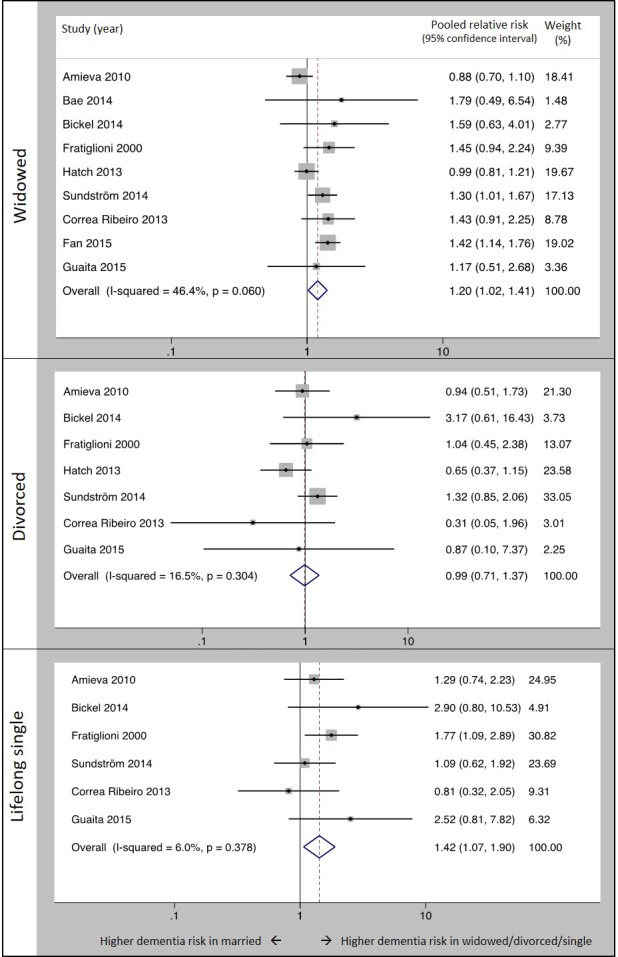
Background: Being married is associated with healthier lifestyle behaviours and lower mortality and may reduce risk for dementia due to life-course factors. We conducted a systematic review and meta-analysis of studies of the association between marital status and the risk of developing dementia. Methods: We searched medical databases and contacted experts in the field for relevant studies reporting the relationship, adjusted for age and sex, between marital status and dementia. We rated methodological quality and conducted random-effects meta-analyses to summarise relative risks of being widowed, divorced or lifelong single, compared with being married. Secondary stratified analyses with meta-regression examined the impact of clinical and social context and study methodology on findings. Results: We included 15 studies with 812 047 participants. Compared with those who are married, lifelong single (relative risk=1.42 (95% CI 1.07 to 1.90)) and widowed (1.20 (1.02 to 1.41)) people have elevated risk of dementia. We did not find an association in divorced people. Further analyses showed that less education partially confounds the risk in widowhood and worse physical health the elevated risk in lifelong single people. Compared with studies that used clinical registers for ascertaining dementia diagnoses, those which clinically examined all participants found higher risk for being unmarried. Conclusions: Being married is associated with reduced risk of dementia than widowed and lifelong single people, who are also underdiagnosed in routine clinical practice. Dementia prevention in unmarried people should focus on education and physical health and should consider the possible effect of social engagement as a modifiable risk factor.
Overview
The claims and statistics of this paper haven’t been checked yet.
Free: it reads the open-access text and checks the first 5 claims that cite a source we can check. Create a free account to check every claim.
Integrity signals
Registry
Cites
Statistics
Figures
Verification
Claims the paper makes
The claims and statistics of this paper haven’t been checked yet.
Free: it reads the open-access text and checks the first 5 claims that cite a source we can check. Create a free account to check every claim.
Claims other papers make about this one
Each is checked against this paper’s own text: does it say what the citing paper says it does?
The source backs part of the claim, not all of it — or backs it for a different population, condition or comparison.
In the citing paper
“A systematic review and meta-analysis including 812 047 people worldwide found dementia risk to be elevated in lifelong single (RR 1·4, 95% CI 1·1–1·9) and widowed people (1·2, 1·0–1·4), compared with married people and the association was consistent in different sociocultural settings.”
From Dementia prevention, intervention, and care: 2020 report of the Lancet Commission (2020) · cites this paper as [120]
Experimental — accuracy not yet measuredThe source backs part of the claim, not all of it — or backs it for a different population, condition or comparison.
In the citing paper
“Despite clear cultural variation in the meaning and perception of social isolation, findings of protective effect of more social contact are largely consistent in different settings and for either sex across the studies and meta-analyses.”
From Dementia prevention, intervention, and care: 2020 report of the Lancet Commission (2020) · cites this paper as [120]
Experimental — accuracy not yet measuredThe cited source says what the claim attributes to it.
In the citing paper
“Differences persisted in studies that adjusted for education and physical health so might be attributable to married people having more social contact, rather than solely because they tend to have better physical health and more education, although residual confounding is possible.”
From Dementia prevention, intervention, and care: 2020 report of the Lancet Commission (2020) · cites this paper as [120]
Self-check
Percentages, sums and reported differences re-computed from the paper’s own numbers.
The self-check needs the paper’s full text.
Citations
Cites
Meta-analysis in clinical trials
DerSimonian, R., & Laird, N. (1986) · Controlled Clinical Trials · doi:10.1016/0197-2456(86)90046-2 · Cited by 39,552 · cited 1×
“23 All included studies provided an estimate of relative risk and CI that we used for the analysis.”
MethodDermyshi, E., Wang, Y., Yan, C., Hong, W., Qiu, G., Gong, X., & Zhang, T. (2017) · Neonatology · doi:10.1159/000454668 · Cited by 24,451
Meta-analysis of Observational Studies in Epidemiology<SUBTITLE>A Proposal for Reporting</SUBTITLE>
Stroup, D. F. (2000) · JAMA · doi:10.1001/jama.283.15.2008 · Cited by 20,623
(2014) · Medical Entomology and Zoology · Cited by 17,633
The social readjustment rating scale
Holmes, T. H., & Rahe, R. H. (1967) · Journal of Psychosomatic Research · doi:10.1016/0022-3999(67)90010-4 · Cited by 11,067
Cognitive reserve in ageing and Alzheimer's disease
Stern, Y. (2012) · The Lancet Neurology · doi:10.1016/s1474-4422(12)70191-6 · Cited by 3,557
How should meta‐regression analyses be undertaken and interpreted?
Thompson, S. G., & Higgins, J. P. T. (2002) · Statistics in Medicine · doi:10.1002/sim.1187 · Cited by 3,026 · cited 1×
“We conducted stratified analyses and used meta-regression 24 to quantify the effect of various study design factors on the association between marital status and all-cause mortality: (1) dementia case ascertainment method: clinical assessment of study participants versus clinical register data; (2)…”
MethodPotential for primary prevention of Alzheimer's disease: an analysis of population-based data
Norton, S., Matthews, F. E., Barnes, D. E., Yaffe, K., & Brayne, C. (2014) · The Lancet Neurology · doi:10.1016/s1474-4422(14)70136-x · Cited by 2,466 · cited 1×
“44 Our findings support the need for further work to develop preventative approaches in these lifestyle domains and indicate this may be particularly important for the high-risk groups of widowed and lifelong single people.”
Background(2015) · HAL · Cited by 2,238
Investigating and dealing with publication and other biases in meta-analysis
Sterne, J. A. C., Egger, M., & Smith, G. D. (2001) · BMJ · doi:10.1136/bmj.323.7304.101 · Cited by 2,225
Research works printed but not linked: 1
- Institute TJB. Joanna briggs institute reviewers' manual: 2016 edition. Australia: The Joanna Briggs Institute, 2016.
Cited by
Items 201–252 of 252
Alexander, D. R. (2020) · Cambridge University Press eBooks · doi:10.1017/9781108566520.002
Alexander, D. R. (2020) · Cambridge University Press eBooks · doi:10.1017/9781108566520.016
Alexander, D. R. (2020) · Cambridge University Press eBooks · doi:10.1017/9781108566520.001
Shen, S., Cheng, J., Li, J., Xie, Y., Wang, L., Zhou, X., Zhou, W., Zhu, L., Wang, T., Tu, J., et al. (2022) · Research Square · doi:10.21203/rs.3.rs-1517787/v1
Yu, Y., Lv, J., Liu, J., Chen, Y., Chen, K., & Yang, Y.-F. (2022) · Research Square · doi:10.21203/rs.3.rs-1567017/v1
Alexander, D. R. (2020) · Cambridge University Press eBooks · doi:10.1017/9781108566520.017
Married people at less risk of developing dementia
(2018) · Nursing Standard · doi:10.7748/ns.32.20.16.s11
Alexander, D. R. (2020) · Cambridge University Press eBooks · doi:10.1017/9781108566520.014
UK Validation of Two Measures of Awareness of Age-Related Change (AARC)Preprint
Sabatini, S., Ukoumunne, O. C., Ballard, C. G., Brothers, A. F., Kaspar, R., Collins, R., Kim, S., Corbett, A., Aarsland, D., Hampshire, A., et al. (2019) · Research Square · doi:10.21203/rs.2.18811/v1
Randolph, J. J., Wishart, H. A., & Rabin, L. A. (2022) · Springer eBooks · doi:10.1007/978-3-031-11389-5_9
Feasibility Study: Machine Learning in Neurodegenerative Disorders, Alzheimer’s Disease
Kong, X. (2023) · Undergraduate Research in Natural and Clinical Science and Technology (URNCST) Journal · doi:10.26685/urncst.426 · Cited by 1
Prävention demenzieller Erkrankungen
Schippinger, W., & Pichler, G. (2024) · Der Nervenarzt · doi:10.1007/s00115-024-01641-5
Mild cognitive impairment in pemphigus
Arani, L. G., Advani, S., Mardani, G., Haghighi, S. M., Abdollahimajd, F., ROBATI, R. M., Mozafari, N., Moravvej, H., Gheisari, M., Nasiri, S., et al. (2024) · International Journal of Dermatology · doi:10.1111/ijd.17229
“27 In contrast, a study revealed paradoxical findings regarding the impact of solitary living on cognitive reserve and MCI.”
Prävention des kognitiven Abbaus im Alter: Ausgewählte primärpräventive Ansätze
Steinmetz, C., Schnieder, M., Heinemann, S., Linke, A., & Arnim, C. A. F. V. (2024) · Zeitschrift für Gerontologie und Geriatrie · doi:10.1007/s00391-024-02337-w
Yoo‐Jeong, M., Weinstein, A. M., Ware, D. P., Brennan‐Ing, M., SHOPTAW, S. J., Teplin, L. A., Haberlen, S., Friedman, M. R., & Plankey, M. W. (2024) · AIDS and Behavior · doi:10.1007/s10461-024-04501-0
Mukhtar, I. G., El-Khashab, M. M., Salim, M. A., Ibrahim, S. A., & Yarube, I. U. (2024) · Current Medicine Research and Practice · doi:10.4103/cmrp.cmrp_87_24 · Cited by 2
Izhar, R., & Hassan, S. M. U. (2025) · Australian Journal on Ageing · doi:10.1111/ajag.70003
“7,16,29 The mediation model indicated that SR partially mediated the association between NG and CF when controlled for age and DOB.”
Loss of a spouse and risk of cognitive decline: insights from six prospective cohort studies
Guo, C., Wang, Y., Sun, X., & Ge, F. (2026) · Epidemiology and Psychiatric Sciences · doi:10.1017/s2045796026101048
Sociodemographic and clinical profile from the Brazilian very old 90+ study (BRAVO-90+)
Ciciliati, A. M. M., Leite, R. E. P., Grinberg, L. T., Pasqualucci, C. A., Paes, V. R., Justo, A. F. O., Ferretti‐Rebustini, R. E. D. L., Ferriolli, E., & Suemoto, C. K. (2025) · Journal of Alzheimer s Disease Reports · doi:10.1177/25424823251336247
“51 Although previous research suggests that marriage may have a more robust protective impact against dementia in men than in women, our strati fi ed analyses revealed no difference.”
Measuring cognitive performance in older adults through completion time and accuracy in brain games
Sufian, L., Arman, L. N., Siriphorn, A., Suriyaamarit, D., & Justine, M. (2025) · International Journal of Health Sciences · doi:10.25259/oa03_8810 · Cited by 1
Zhang, H., Ding, C., Xu, Y., Hao, H., Gong, Y., Wang, J., An, T., Hu, Z., Li, Y., Jiang, S., et al. (2025) · SSRN Electronic Journal · doi:10.2139/ssrn.5346489
Zhou, Y., Feng, Y., & Zhang, M. (2025) · Medicine · doi:10.1097/md.0000000000044162
Alzheimer’s Disease in Illinois: Analyzing Disparities and Projected Trends
Adeleke, T., Knelsen-Dobson, A., McGinity, S., Fontaine, K. M., Albensi, B. C., Roy, B., & Adlimoghaddam, A. (2025) · Geriatrics · doi:10.3390/geriatrics10050132 · Cited by 1
“Marital status is considered a proposed modifiable risk factor for dementia, which can be influenced by social, psychological, and economic resources [60,61].”
InfluentialWang, K., Zhu, Y., Albert, M., Miller, M. I., Davatzikos, C. A., Moghekar, A., Soldan, A., & Wang, M. (2025) · Journal of Alzheimer s Disease · doi:10.1177/13872877251393729
Chen, S. S., Chang, Y.-C., Yu, C., Hsieh, T.-Y., & Sung, W. (2025) · Journal of Clinical Medicine · doi:10.3390/jcm14238302
“In addition, key factors known to influence neurological and psychiatric conditions, such as marital status [20] and substance use disorders [28], were frequently overlooked, further increasing the risk of bias.”
Community awareness of dementia in Vietnam
Nguyen, H., Nguyen, T. T., Esterman, A., Brodaty, H., Kurrle, S. E., Nguyen, B. T., Hinton, L., Tran, K., Crotty, M., Nguyen, T. A., et al. (2025) · Discover Social Science and Health · doi:10.1007/s44155-025-00342-x
Sabatini, S., Ukoumunne, O. C., Ballard, C. G., Brothers, A. F., Kaspar, R., Collins, R., Kim, S., Corbett, A., Aarsland, D., Hampshire, A., et al. (2020) · Figshare · doi:10.6084/m9.figshare.12986245
Basit, S., Wohlfahrt, J., & Boyd, H. A. (2024) · Figshare · doi:10.6084/m9.figshare.26572033
Haghighi, P., & Oremus, M. (2023) · Figshare · doi:10.6084/m9.figshare.22814957
Shen, S., Cheng, J., Li, J., Xie, Y., Wang, L., Zhou, X., Zhou, W., Zhu, L., Wang, T., 涂江龙, et al. (2022) · Figshare · doi:10.6084/m9.figshare.20390778
Potentially modifiable risk factors for dementia in Norway: the HUNT4 70+ Study
Ellingjord‐Dale, M., Strand, B. H., Skirbekk, V. F., Bratsberg, B., Sharma, A., Zotcheva, E., Selbæk, G., Stern, Y., Haberg, A. K., & Engdahl, B. L. (2025) · European Journal of Public Health · doi:10.1093/eurpub/ckaf161.209
Yan, L., Peng, Y., Guo, C., Ren, E., Chen, H., Ou, Y., Han, J., Zhu, Y., Li, W., & Xu, L. (2026) · BMC Geriatrics · doi:10.1186/s12877-025-06924-3 · Cited by 2
“Older adults without a spouse were more likely to develop MCI than were those with a spouse, which is consistent with previous research [57].”
Shin, J., Sim, H., Konlan, K. D., & Park, C. G. (2026) · Healthcare · doi:10.3390/healthcare14020184
“Overall, despite these measurement limitations, the present findings reinforce the importance of social and family support systems in the prevention of MCI and dementia [8,31,32].”
Mid‐life cardiorespiratory fitness and risk of late‐onset dementia incidence
Wiklund, C. A., Wang, R., Lindwall, M., Paulsson, S. Å., Ekblom, Ö. B., & Ekblom‐Bak, E. (2026) · Alzheimer s & Dementia Diagnosis Assessment & Disease Monitoring · doi:10.1002/dad2.70239 · Cited by 1
Apostolou, M. (2026) · V&R unipress eBooks · doi:10.14220/9783737019637.17
Socio-demographic variables among a group of patients with cognitive decline
Riggio, F., Faraci, P., Raffaele, M., Rizzotto, C., & Gangemi, A. (2026) · Frontiers in Psychology · doi:10.3389/fpsyg.2026.1770849
Social determinants of health, behavioral factors, and incident dementia: a prospective cohort study
Zhang, H., Ding, C., Xu, Y., Hao, H., Gong, Y., An, T., An, T., Hu, Z., Li, Y., Jiang, S., et al. (2026) · Alzheimer s Research & Therapy · doi:10.1186/s13195-026-02037-0
“However, a meta-analysis of 15 observational studies with 812,047 participants found that lifelong single and widowed people have elevated risk of dementia than those who are married [33].”
Schrempft, S., Chevalier, C., Antille, D., Dumont, R., Guessous, I., & Nehme, M. (2026) · European Journal of Public Health · doi:10.1093/eurpub/ckag046
“We used marital status (having never been married or lived as a couple) as a marker of low social contact [22].”
Impact des troubles visuels sur la perte d'autonomie et le déclin cognitif du sujet âgé
Naël, V. (2018) · theses.fr (ABES) · doi:10.70675/5418dc53z5ca5z4e7cz875fz131a5ff4268e · Cited by 3
Pair bonding sex-specifically improves object recognition memory in monogamous prairie vole
Iwai, H., Otsuki, C., Kobayashi, Y., Okano, S., Sugimura, N., Kamura, E., Totsuka, A., Noguchi, R., Young, L. J., & Mitsui, S. (2026) · Physiology & Behavior · doi:10.1016/j.physbeh.2026.115333
Cognitive reserve, physical disorders and the trajectory of psychological and cognitive function
Chen, H.-W., Li, Q.-R., Zhong, Q., Wang, S.-A., Xu, Z.-Y., Cao, B., Liu, K., & Wu, X.-B. (2026) · Maturitas · doi:10.1016/j.maturitas.2026.108938
Huang, Y., Li, Q., Chen, A., Li, Y., Chuang, Y.-N., Hu, X., Guo, S. J., He, X., Pang, Y., Zhou, J., et al. (2026) · JAMIA Open · doi:10.1093/jamiaopen/ooag060 · Cited by 2
Jain, M., Begde, A., Brayne, C., Maidment, D., Brooks, R. L., Dening, T., Barnes, L., & Hogervorst, E. (2026) · Springer eBooks · doi:10.1007/978-981-95-2121-0_22
Zhao, Y., Miao, L., Qin, H., Jiang, T., Chen, Z., Zhang, L., & Wang, N. (2026) · Frontiers in Psychology · doi:10.3389/fpsyg.2026.1811924
“…found that race, educational level, marital status, and total household income were statistically associated with cognitive function status, which is broadly consistent with previous findings (Meng and D’Arcy, 2012; Sommerlad et al., 2018; Liao et al., 2022; Wang et al., 2023; Shi et al., 2025).”
Cheng, G. J., Wang, L., Cho, T., Gross, A. L., & Kobayashi, L. C. (2026) · The Journals of Gerontology Series B · doi:10.1093/geronb/gbag110
Marital Life-Course Trajectories and Cognitive Function among Older Adults: Evidence from ChinaPreprint
Yang, X., Li, Y., Liu, H. X., Han, J., & Hu, Z. (2026) · Research Square · doi:10.21203/rs.3.rs-10061692/v1
Gedik, G., & Sütcü, S. T. (2026) · Adıyaman üniversitesi sosyal bilimler enstitüsü dergisi/Adıyaman üniversitesi sosyal bilimler enstitisü dergisi · doi:10.14520/adyusbd.1904435
Mair, C. A., Liu, J., & Anderson, R. (2026) · Health & Place · doi:10.1016/j.healthplace.2026.103723
Kim, H. J., & Oh, M.-K. (2026) · Journal of Evidence-Based Practice · doi:10.63528/jebp.2026.00006
“Furthermore, while cohabitation with a spouse is conventionally reported as a protective factor against dementia across diverse cultural backgrounds [23], our study revealed a notable sex-based divergence: the absence of a spouse elevated dementia risk in males but lowered it in females.”
Xu, H., Li, P., Sun, Q., & Li, X. (2026) · Psychology Health & Medicine · doi:10.1080/13548506.2026.2738083
Zhou, Y.-C., Chou, Y. C., Hung, Y., & Chang, Y.-J. (2026) · PLoS ONE · doi:10.1371/journal.pone.0359778
“The observed protective associations among never-married individuals in the later period contrast with traditional models of successful aging, which often emphasize marriage as a cornerstone of optimal health [13,25,26].”
Meadows, J., Liu, G., Huang, G., Wang, C., & Luo, Y. G. (2026) · Proceedings of the Human Factors and Ergonomics Society Annual Meeting · doi:10.1177/10711813261498753
Metadata
- Authors
- Sommerlad, A., Ruegger, J., Singh-Manoux, A., Lewis, G., & Livingston, G.
- Affiliations
- University College London (GB)
- Camden and Islington NHS Foundation Trust (GB)
- Corresponding author
- Sommerlad, Andrew
- Venue
- Journal of Neurology, Neurosurgery & Psychiatry
- Publisher
- BMJ
- Published
- 2017-11-28
- Volume
- 89
- Issue
- 3
- Pages
- 231-238
- ISSN
- 0022-3050 (ISSN-L)
- 1468-330X
- PMC
- PMC5869449
- OpenAlex
- W2770396411
- Cited by
- 252
- References
- 44
- Citations by year
- 2026: 24 · 2025: 36 · 2024: 34 · 2023: 27 · 2022: 33 · 2021: 33 · 2020: 44 · 2019: 11 · 2018: 9 · 2017: 1
- FWCI
- 2.70
- Type
- journal article
- Language
- en
- Open access
- hybrid
- doi.org
- Licence
- cc-by
- Locations
- Journal of Neurology Neurosurgery & Psychiatry (publishedVersion, cc-by)
- PubMed Central (publishedVersion, cc-by)
- PubMed (publishedVersion)
- UCL Discovery (University College London) (submittedVersion, cc-by)
- HighWire Press Open Archive (submittedVersion)
- Funders
- Wellcome Trust
- Topics
- Health Sciences › Medicine › Psychiatry and Mental health › Dementia and Cognitive Impairment Research
- Social Sciences › Health › Health disparities and outcomes
- Social Sciences › Demography › Family Dynamics and Relationships
- Keywords
- dementia risk, marital status, widowhood, divorce, social engagement, physical health, underdiagnosis of dementia, dementia prevention, social determinants of health
- MeSH terms
- Dementia, Divorce, Educational Status, Humans, Marriage, Risk Factors, Single Person, Confounding Factors, Epidemiologic, Marital Status, Widowhood, Observational Studies as Topic, Protective Factors
About these checks
Registry, retraction, Cites and statistics results are computed, not judged, with one exception: a printed reference that no index lists is read once by a model before it counts as a citation error. Claims are extracted by a model and kept only when their quote appears verbatim in the text; each cited source is then checked, with a model’s help, for whether it says what the claim relies on. Those verdicts can be wrong — read the claim’s quote and the cited source before relying on one.
Statistics and arithmetic are recomputed, not judged.
Confidence bands are shown only for fields calibrated on our annotated test set. None is calibrated yet, so no band is shown.
What counts as a claim ›How we measure confidence ›How we check this ›
Are you an author, or do you see a problem with this page? Request a review
Data sources
Bibliographic data: Semantic Scholar, OpenAlex, Crossref.
Contains information from the Semantic Scholar Academic Graph Datasets, made available under the ODC Attribution License (ODC-BY 1.0).
Semantic Scholar’s data is described in: Kinney, R., et al. (2023). The Semantic Scholar Open Data Platform. arXiv:2301.10140.
