

Marriage and risk of dementia: systematic review and meta-analysis of observational studies
Open accessThe DOI matches its Crossref record; 44 of the 44 references it cites were found in a registry or an index.
Abstract
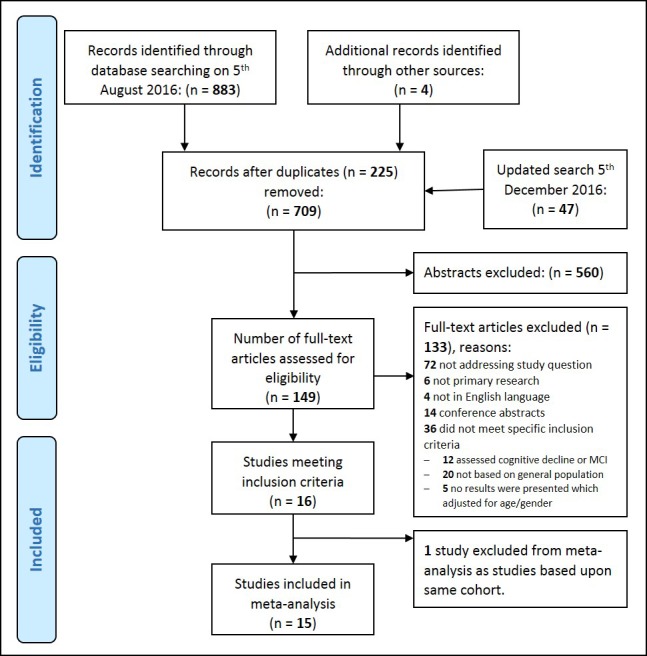
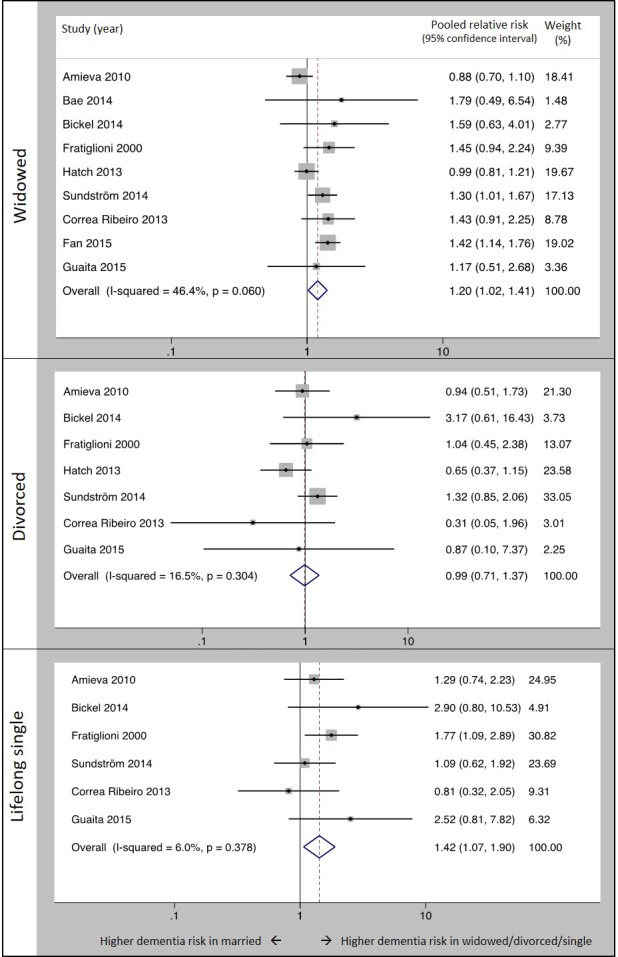
Background: Being married is associated with healthier lifestyle behaviours and lower mortality and may reduce risk for dementia due to life-course factors. We conducted a systematic review and meta-analysis of studies of the association between marital status and the risk of developing dementia. Methods: We searched medical databases and contacted experts in the field for relevant studies reporting the relationship, adjusted for age and sex, between marital status and dementia. We rated methodological quality and conducted random-effects meta-analyses to summarise relative risks of being widowed, divorced or lifelong single, compared with being married. Secondary stratified analyses with meta-regression examined the impact of clinical and social context and study methodology on findings. Results: We included 15 studies with 812 047 participants. Compared with those who are married, lifelong single (relative risk=1.42 (95% CI 1.07 to 1.90)) and widowed (1.20 (1.02 to 1.41)) people have elevated risk of dementia. We did not find an association in divorced people. Further analyses showed that less education partially confounds the risk in widowhood and worse physical health the elevated risk in lifelong single people. Compared with studies that used clinical registers for ascertaining dementia diagnoses, those which clinically examined all participants found higher risk for being unmarried. Conclusions: Being married is associated with reduced risk of dementia than widowed and lifelong single people, who are also underdiagnosed in routine clinical practice. Dementia prevention in unmarried people should focus on education and physical health and should consider the possible effect of social engagement as a modifiable risk factor.
Overview
The claims and statistics of this paper haven’t been checked yet.
Free: it reads the open-access text and checks the first 5 claims that cite a source we can check. Create a free account to check every claim.
Integrity signals
Registry
Cites
Statistics
Figures
Verification
Claims the paper makes
The claims and statistics of this paper haven’t been checked yet.
Free: it reads the open-access text and checks the first 5 claims that cite a source we can check. Create a free account to check every claim.
Claims other papers make about this one
Each is checked against this paper’s own text: does it say what the citing paper says it does?
The source backs part of the claim, not all of it — or backs it for a different population, condition or comparison.
In the citing paper
“A systematic review and meta-analysis including 812 047 people worldwide found dementia risk to be elevated in lifelong single (RR 1·4, 95% CI 1·1–1·9) and widowed people (1·2, 1·0–1·4), compared with married people and the association was consistent in different sociocultural settings.”
From Dementia prevention, intervention, and care: 2020 report of the Lancet Commission (2020) · cites this paper as [120]
Experimental — accuracy not yet measuredThe source backs part of the claim, not all of it — or backs it for a different population, condition or comparison.
In the citing paper
“Despite clear cultural variation in the meaning and perception of social isolation, findings of protective effect of more social contact are largely consistent in different settings and for either sex across the studies and meta-analyses.”
From Dementia prevention, intervention, and care: 2020 report of the Lancet Commission (2020) · cites this paper as [120]
Experimental — accuracy not yet measuredThe cited source says what the claim attributes to it.
In the citing paper
“Differences persisted in studies that adjusted for education and physical health so might be attributable to married people having more social contact, rather than solely because they tend to have better physical health and more education, although residual confounding is possible.”
From Dementia prevention, intervention, and care: 2020 report of the Lancet Commission (2020) · cites this paper as [120]
Self-check
Percentages, sums and reported differences re-computed from the paper’s own numbers.
The self-check needs the paper’s full text.
Citations
Cites
Meta-analysis in clinical trials
DerSimonian, R., & Laird, N. (1986) · Controlled Clinical Trials · doi:10.1016/0197-2456(86)90046-2 · Cited by 39,552 · cited 1×
“23 All included studies provided an estimate of relative risk and CI that we used for the analysis.”
MethodDermyshi, E., Wang, Y., Yan, C., Hong, W., Qiu, G., Gong, X., & Zhang, T. (2017) · Neonatology · doi:10.1159/000454668 · Cited by 24,451
Meta-analysis of Observational Studies in Epidemiology<SUBTITLE>A Proposal for Reporting</SUBTITLE>
Stroup, D. F. (2000) · JAMA · doi:10.1001/jama.283.15.2008 · Cited by 20,623
(2014) · Medical Entomology and Zoology · Cited by 17,633
The social readjustment rating scale
Holmes, T. H., & Rahe, R. H. (1967) · Journal of Psychosomatic Research · doi:10.1016/0022-3999(67)90010-4 · Cited by 11,067
Cognitive reserve in ageing and Alzheimer's disease
Stern, Y. (2012) · The Lancet Neurology · doi:10.1016/s1474-4422(12)70191-6 · Cited by 3,557
How should meta‐regression analyses be undertaken and interpreted?
Thompson, S. G., & Higgins, J. P. T. (2002) · Statistics in Medicine · doi:10.1002/sim.1187 · Cited by 3,026 · cited 1×
“We conducted stratified analyses and used meta-regression 24 to quantify the effect of various study design factors on the association between marital status and all-cause mortality: (1) dementia case ascertainment method: clinical assessment of study participants versus clinical register data; (2)…”
MethodPotential for primary prevention of Alzheimer's disease: an analysis of population-based data
Norton, S., Matthews, F. E., Barnes, D. E., Yaffe, K., & Brayne, C. (2014) · The Lancet Neurology · doi:10.1016/s1474-4422(14)70136-x · Cited by 2,466 · cited 1×
“44 Our findings support the need for further work to develop preventative approaches in these lifestyle domains and indicate this may be particularly important for the high-risk groups of widowed and lifelong single people.”
Background(2015) · HAL · Cited by 2,238
Investigating and dealing with publication and other biases in meta-analysis
Sterne, J. A. C., Egger, M., & Smith, G. D. (2001) · BMJ · doi:10.1136/bmj.323.7304.101 · Cited by 2,225
Research works printed but not linked: 1
- Institute TJB. Joanna briggs institute reviewers' manual: 2016 edition. Australia: The Joanna Briggs Institute, 2016.
Cited by
Dementia prevention, intervention, and care: 2020 report of the Lancet Commission
Livingston, G., Huntley, J., Sommerlad, A., Ames, D., Ballard, C., Banerjee, S., Brayne, C., Burns, A., Cohen-Mansfield, J., Cooper, C., et al. (2020) · The Lancet · doi:10.1016/s0140-6736(20)30367-6 · Cited by 10,430
“118,120,121”
Self-citationRetractedDementia prevention, intervention, and care: 2024 report of the Lancet standing Commission
Livingston, G., Huntley, J., Liu, K. Y., Costafreda, S. G., Selbæk, G., Alladi, S., Ames, D., Banerjee, S., Burns, A., Brayne, C., et al. (2024) · The Lancet · doi:10.1016/s0140-6736(24)01296-0 · Cited by 3,860
Self-citationAlzheimer’s disease: risk factors and potentially protective measures
Silva, M. V. F., Loures, C. D. M. G., Alves, L. C. V., de Souza, L. C., Borges, K. B. G., & Carvalho, M. D. G. (2019) · Journal of Biomedical Science · doi:10.1186/s12929-019-0524-y · Cited by 937
Social participation and risk of developing dementia
Sommerlad, A., Kivimäki, M., Larson, E. B., Röhr, S., Shirai, K., Singh-Manoux, A., & Livingston, G. (2023) · Nature Aging · doi:10.1038/s43587-023-00387-0 · Cited by 207
Self-citationLiu, H., Zhang, Y., Burgard, S. A., & Needham, B. L. (2019) · Annals of Epidemiology · doi:10.1016/j.annepidem.2019.08.007 · Cited by 159
“, degree of participation in a community or society) and a larger network size may reduce the risk of dementia by improving cognitive reserves, which strengthen the ability to cope with neuropathological damage [38,58].”
BackgroundMethodMarital Status and Dementia: Evidence from the Health and Retirement Study
Liu, H., Zhang, Z., Choi, S.-W., & Langa, K. M. (2020) · The Journals of Gerontology: Series B · doi:10.1093/geronb/gbz087 · Cited by 155
“A meta-analysis of 15 studies (n = 812,047)—all from outside the United States—found that never-married and widowed people have 42% and 20% higher risks of dementia, respectively, than married people (Sommerlad et al., 2018).”
BackgroundResultIs Alzheimer’s Disease Risk Modifiable?
Serrano-Pozo, A., & Growdon, J. H. (2019) · Journal of Alzheimer's Disease · doi:10.3233/jad181028 · Cited by 154
“Conversely, loneliness and single or widow/ widower marital status have been associated with a higher risk of developing dementia [236,237].”
Hu, M., Shu, X., Yu, G., Wu, X., Välimäki, M., & Feng, H. (2021) · Journal of Medical Internet Research · doi:10.2196/20298 · Cited by 139
“smaller cognitive reserves across life may be less likely to marry [33].”
BackgroundResultJones, A., Ali, M. U., Kenny, M., Mayhew, A., Mokashi, V., He, H. T., Lin, S. H., Yavari, E., Paik, K., Subramanian, D., et al. (2024) · Dementia and Geriatric Cognitive Disorders · doi:10.1159/000536643 · Cited by 132
Ma'u, E., Cullum, S., Cheung, G., Livingston, G., & Mukadam, N. (2021) · The Lancet Regional Health - Western Pacific · doi:10.1016/j.lanwpc.2021.100191 · Cited by 82
Self-citationFreak-Poli, R., Wagemaker, N., Wang, R., Lysen, T. S., Ikram, M. A., Vernooij, M. W., Dintica, C. S., Vernooij-Dassen, M., Melis, R. J. F., Laukka, E. J., et al. (2022) · Journal of Alzheimer's Disease · doi:10.3233/jad-210330 · Cited by 79
“Additionally, structural aspects of social support play a role, as illustrated by a meta-analysis of 15 studies which concluded that marriage is protective against dementia [16].”
BackgroundWu, X., Yang, H., He, S., Xia, T., Chen, D., Zhou, Y., Liu, J., Liu, M., & Sun, Z. (2022) · Frontiers in Immunology · doi:10.3389/fimmu.2022.872542 · Cited by 73
Yin, S., Yang, Q. X., Xiong, J., Tian, L., & Zhu, X. (2020) · Frontiers in Psychiatry · doi:10.3389/fpsyt.2020.00254 · Cited by 76
Demeyere, N., Haupt, M., Webb, S. S., Strobel, L., Milosevich, E. T., Moore, M. J., Wright, H., Finke, K., & Duta, M. D. (2021) · Scientific Reports · doi:10.1038/s41598-021-87287-8 · Cited by 79
Poststroke Cognitive Outcomes: Sex Differences and Contributing Factors
Dong, L., Briceño, E. M., Morgenstern, L. B., & Lisabeth, L. D. (2020) · Journal of the American Heart Association · doi:10.1161/jaha.120.016683 · Cited by 61
Dura-Perez, E., Goodman‐Casanova, J. M., Vega-Núñez, A., Guerrero-Pertiñez, G., Moreno, E. V., Garolera, M., Quintana, M., Vargas, A. I. C., Barnestein‐Fonseca, P., Sánchez-Lafuente, C. G., et al. (2022) · Journal of Medical Internet Research · doi:10.2196/30598 · Cited by 65
“COVID-19 confinement has resulted in an increase in known risk factors for dementia, such as inactivity [9], limited access to basic services [10], isolation [11], and decreased family and social support [12].”
Does widowhood affect cognitive function among Chinese older adults?
Zhang, Z., Li, L., Xu, H., & Liu, J. (2018) · SSM - Population Health · doi:10.1016/j.ssmph.2018.100329 · Cited by 64
“Recent research on widowhood and cognitive health in later life suggests that widowhood may be a risk factor for cognitive decline, cognitive impairment, and dementia (Sommerlad et al., 2018).”
BackgroundResultBiddle, K. D., Jacobs, H. I. L., Uquillas, F. D., Zide, B. S., Kirn, D. R., Properzi, M. J., Rentz, D. M., Johnson, K. A., Sperling, R. A., & Donovan, N. J. (2020) · JAMA Network Open · doi:10.1001/jamanetworkopen.2020.0121 · Cited by 56
Potential neurobiological links between social isolation and Alzheimer's disease risk
Drinkwater, E., Davies, C., & Spires‐Jones, T. L. (2021) · European Journal of Neuroscience · doi:10.1111/ejn.15373 · Cited by 60
Naheed, A., Hakim, M., Islam, M. S., Islam, M. B., Tang, E. Y. H., Prodhan, A. A., Amin, M. R., Stephan, B. C. M., & Mohammad, Q. D. (2023) · The Lancet Regional Health - Southeast Asia · doi:10.1016/j.lansea.2023.100257 · Cited by 67
“44,45 High educational attainment has consistently been associated with a lower risk of cognitive impairment and dementia via increased cognitive reserve in both high and LMIC settings.”
BackgroundXu, P., Wei, R., Cheng, B.-J., Wang, A.-J., Li, X., Li, H.-B., Sun, L., de Haan-Du, J., Sheng, J., Liu, K., et al. (2020) · Aging Clinical and Experimental Research · doi:10.1007/s40520-020-01743-5 · Cited by 52
International relevance of two measures of awareness of age-related change (AARC)
Sabatini, S., Ukoumunne, O. C., Ballard, C. G., Brothers, A. F., Kaspar, R., Collins, R., Kim, S., Corbett, A., Aarsland, D., Hampshire, A., et al. (2020) · BMC Geriatrics · doi:10.1186/s12877-020-01767-6 · Cited by 56
Almeida‐Meza, P., Steptoe, A., & Cadar, D. (2021) · Journal of Alzheimer s Disease · doi:10.3233/jad-200952 · Cited by 54
“A systematic review highlighted that being married is associated with healthier lifestyle behaviors, and consequently, to a reduced risk of dementia [19].”
BackgroundA national longitudinal study of marital quality and cognitive decline among older men and women
Liu, H., Zhang, Z., & Zhang, Y. (2021) · Social Science & Medicine · doi:10.1016/j.socscimed.2021.114151 · Cited by 54
Welberry, H., Brodaty, H., Hsu, B., Barbieri, S., & Jorm, L. R. (2020) · Scientific Reports · doi:10.1038/s41598-020-65273-w · Cited by 50
Prevalence of dementia and quality of life of caregivers of people living with dementia in Malaysia
Ganapathy, S. S., Sooryanarayana, R., Ahmad, N. A., Jamaluddin, R., Abd Razak, M. A., Tan, M. P., Mohd Sidik, S., Mohamad Zahir, S., Sandanasamy, K. S., & Ibrahim, N. (2020) · Geriatrics & Gerontology International · doi:10.1111/ggi.14031 · Cited by 45
Bougea, A. M., Anagnostouli, M. C., Angelopoulou, E., Spanou, I., & Chrousos, G. P. (2020) · Journal of Geriatric Psychiatry and Neurology · doi:10.1177/0891988720973759 · Cited by 51
Widowhood and cognitive decline in adults aged 50 and over: A systematic review and meta-analysis
Singham, T., Bell, G., Saunders, R., & Stott, J. C. H. (2021) · Ageing Research Reviews · doi:10.1016/j.arr.2021.101461 · Cited by 57
The Association between Marital Status and Obesity: A Systematic Review and Meta-Analysis
Turnić, T. N., Jakovljevic, V. L., Strizhkova, Z. A., Polukhin, N., Ryaboy, D., Kartashova, M., Korenkova, M., Kolchina, V., & Reshetnikov, V. A. (2024) · Diseases · doi:10.3390/diseases12070146 · Cited by 65
Midlife Marital Dissolution and the Onset of Cognitive Impairment
Brown, S. L., Lin, I., Vielee, A., & Mellencamp, K. A. (2020) · The Gerontologist · doi:10.1093/geront/gnaa193 · Cited by 47
“First, social interactions provide mental stimulation and social support that can help individuals to maintain cognitive health (Kelly et al., 2017; Sommerlad et al., 2018).”
BackgroundResultHu, F., Cheng, G., Liu, D., Liu, Q., Gan, X.-G., Li, L., Wang, X., Zhang, B., An, L., Chen, C., et al. (2021) · Journal of Neurology · doi:10.1007/s00415-021-10886-y · Cited by 48
“We estimated the PAFs of eight risk factors, including two new potential risk factors (being unmarried [13, 14] and”
BackgroundYu, Y., Lv, J., Liu, J., Chen, Y., Chen, K., & Yang, Y. (2022) · BMC Geriatrics · doi:10.1186/s12877-022-03473-x · Cited by 42
“Social engagement and a larger social network size could increase cognitive reserve and prevent cognitive decline [50, 51].”
BackgroundHow the evidence stacks up for preventing Alzheimer’s disease
Sohn, E. (2018) · Nature · doi:10.1038/d41586-018-05724-7 · Cited by 35
Senff, J. R., Tack, R. W. P., Mallick, A., Gutiérrez-Martínez, L., Duskin, J. A., Kimball, T. N., Tan, B. Y., Chemali, Z. N., Newhouse, A. L., Kourkoulis, C. E., et al. (2025) · Journal of Neurology Neurosurgery & Psychiatry · doi:10.1136/jnnp-2024-334925 · Cited by 43
Durrani, R., Friedrich, M. G., Schulze, K. M., Awadalla, P., Balasubramanian, K., Black, S. E., Broët, P., Busseuil, D., Desai, D., Dummer, T., et al. (2021) · Neurology · doi:10.1212/wnl.0000000000012765 · Cited by 36
“Being in a marital partnership has been associated with better cognition and lower risk of dementia; in a recent systematic review, being single throughout life was associated with 40% increased risk.(31) High psychological stress, including stress in midlife, has been associated with 60% increased risk for later-life…”
BackgroundPublic perceptions of brain health: an international, online cross-sectional survey
Budin‐Ljøsne, I., Mowinckel, A. M., Friedman, B. B., Ebmeier, K. P., Drevon, C. A., Carver, R. B., Zsoldos, E., Fredheim, N. A. G., Sørensen, Ø., Baaré, W. F. C., et al. (2022) · BMJ Open · doi:10.1136/bmjopen-2021-057999 · Cited by 39
Collaborative Facilitation in Older Couples: Successful Joint Remembering Across Memory Tasks
Barnier, A. J., Harris, C. B., Morris, T., & Savage, G. R. (2018) · Frontiers in Psychology · doi:10.3389/fpsyg.2018.02385 · Cited by 37
Lenart‐Bugla, M., Łuc, M., Pawłowski, M., Szcześniak, D. M., Seifert, I., Wiegelmann, H., Gerhardus, A., Wolf‐Ostermann, K., Rouwette, E. A. J. A., Ikram, M. A., et al. (2022) · Brain Sciences · doi:10.3390/brainsci12091214 · Cited by 41
“The majority of findings indicated an association between a higher risk of MCI, dementia, or AD and being lifelong single, divorced, or widowed; married participants were less likely to develop dementia [14,34,37,39].”
BackgroundMarital loss and risk of dementia: Do race and gender matter?
Zhang, Z., Liu, H., & Choi, S. (2021) · Social Science & Medicine · doi:10.1016/j.socscimed.2021.113808 · Cited by 35
“, divorce or widowhood) may put adults at higher risk of dementia in later life (Liu et al., 2020; Sommerlad et al., 2018; Sundstrom et al., 2016).”
BackgroundHill‐Jarrett, T. G., & Jones, M. K. (2021) · The Clinical Neuropsychologist · doi:10.1080/13854046.2021.1923804 · Cited by 39
A Scoping Review of Interventions for Spousal Bereavement in Older Adults
Davidow, J. B., Zide, B. S., Levin, L., Biddle, K. D., Urizar, J. C., & Donovan, N. J. (2021) · American Journal of Geriatric Psychiatry · doi:10.1016/j.jagp.2021.08.002 · Cited by 35
He, C. Y. Y., Zhou, Z., Kan, M. M. P., Chan, D. H. Y., Wong, A. C. T., Mok, K. H. Y., Lam, F. M. H., Chan, S. C. C., Cheung, C. K. C., Yeung, M. K. C., et al. (2024) · Ageing Research Reviews · doi:10.1016/j.arr.2024.102350 · Cited by 48
Hui, E. K., Mukadam, N., Kohl, G., & Livingston, G. (2025) · Journal of Alzheimer s Disease · doi:10.1177/13872877251319054 · Cited by 40
“23”
Self-citationSkirbekk, V., Bowen, C. E., Haberg, A. K., Jugessur, A., Engdahl, B., Bratsberg, B., Zotcheva, E., Selbæk, G., Kohler, H., Weiss, J., et al. (2022) · Journal of Aging and Health · doi:10.1177/08982643221131926 · Cited by 36
“A meta-analysis of 15 studies comprising N = 812,047 individuals (including one Swedish study of N = 750,129) found that people who were single their entire life or widowed had a higher risk of dementia than those who were married (Sommerlad et al., 2018).”
BackgroundResultInfluentialHofbauer, L. M., & Rodriguez, F. S. (2023) · Epidemiology and Psychiatric Sciences · doi:10.1017/s2045796023000033 · Cited by 31
“Being married or partnered has beneficial effects on cognition (Sommerlad et al., 2018) and mitigates negative effects of deprivation on mental health (Bierman, 2009).”
Chen, Z., Wu, H., Wang, X., Zeng, Y., Huang, G., Lv, Y., Niu, J., Meng, X., Cai, P., Shen, L., et al. (2021) · International Journal of Geriatric Psychiatry · doi:10.1002/gps.5649 · Cited by 32
“Some research has shown that unmarried people have a higher risk of developing dementia than those who are married.(4) Some studies have found an association only for those who are single,(5) others have reported an association for single and divorced people, while still others have found increased risk of dementia on…”
BackgroundStatus and Factors of Cognitive Function Among Older Adults in Urban China
Shen, L., Tang, X., Li, C., Qian, Z., Wang, J., & Liu, W. (2021) · Frontiers in Psychology · doi:10.3389/fpsyg.2021.728165 · Cited by 36
Souza, J. G., Farias‐Itao, D. S., Aliberti, M. J. R., Bertola, L., de Andrade, F. B., Lima‐Costa, M. F., Ferri, C. P., & Suemoto, C. K. (2023) · American Journal of Geriatric Psychiatry · doi:10.1016/j.jagp.2023.03.013 · Cited by 27
Apostolou, M., Christoforou, C., & Lajunen, T. J. (2023) · Evolutionary Psychology · doi:10.1177/14747049231210245 · Cited by 37
“Another meta-analysis of 15 studies and more than 800,000 participants, found that being married was associated with a reduced risk of dementia than being widowed or lifelong single (Sommerlad et al., 2017).”
BackgroundCheng, Y., Ahmed, A., Zamrini, E., Tsuang, D. W., Sheriff, H. M., & Zeng-Treitler, Q. (2020) · Journal of Alzheimer's Disease · doi:10.3233/jad-191188 · Cited by 20
Karaköse, S., Luchetti, M., Stéphan, Y., Sutin, A. R., & Terracciano, A. (2025) · Alzheimer s & Dementia · doi:10.1002/alz.70072 · Cited by 28
Hofbauer, L. M., & Rodriguez, F. S. (2021) · International Psychogeriatrics · doi:10.1017/s1041610221000995 · Cited by 26
“It has been established that beingmarried or partnered has beneficial effects on cognition (Sommerlad et al., 2018).”
Exploring the relationship between marital quality and cognitive function: A systematic review
Haghighi, P., Littler, E. A. L., Mauer-Vakil, D., Miller, M., & Oremus, M. (2024) · Social Science & Medicine · doi:10.1016/j.socscimed.2024.117120 · Cited by 30
“A previous systematic review investigated the impact of marital status on cognitive functioning, finding that single and widowed individuals have an elevated risk of developing dementia compared to married individuals (Sommerlad et al., 2018).”
Widowhood and cognition among older women in India: New insights on widowhood duration and mediators
Jain, U., Liu, H., Langa, K., Farron, M. R., Kabeto, M. U., & Lee, J. (2022) · SSM: Population Health · doi:10.1016/j.ssmph.2022.101242 · Cited by 19
Association of social support with cognition among older adults in China: A cross-sectional study
Li, B., Guo, Y., Deng, Y., Zhao, S., Li, C., Yang, J., Li, Q., Yan, Y., Li, F., Li, X., et al. (2022) · Frontiers in Public Health · doi:10.3389/fpubh.2022.947225 · Cited by 24
Marriage and risk of dementia: systematic review and meta-analysis of observational studies
Chen, C., & Mok, V. (2017) · Journal of Neurology Neurosurgery & Psychiatry · doi:10.1136/jnnp-2017-317178 · Cited by 26
Adverse events in older adults and the risk of dementia and cognitive decline
Nilaweera, D., Gurvich, C., Freak-Poli, R., Woods, R., Owen, A., Murray, A., Orchard, S. G., Britt, C., Wu, Z., McNeil, J., et al. (2023) · Journal of Affective Disorders Reports · doi:10.1016/j.jadr.2023.100592 · Cited by 21
“41), in comparison to married individuals (Sommerlad et al., 2018).”
McMichael, A., Zafeiridi, E., Passmore, P., Cunningham, E. L., & McGuinness, B. (2020) · Journal of Alzheimer s Disease · doi:10.3233/jad-190751 · Cited by 22
“Our analysis aligns the findings of past research which have indicated that marriage may lower mortality rates after diagnosis [7, 29], as people who are divorced, separated, or widowed had significantly higher mortality rates in comparison to those who are married.”
ResultRamos, H., Alacreu, M., Guerrero, M. D., Sánchez, R. M., & Moreno, L. (2021) · Journal of Personalized Medicine · doi:10.3390/jpm11121366 · Cited by 19
Vital Exhaustion and Incidence of Dementia: Results from the Copenhagen City Heart Study
Islamoska, S., Ishtiak‐Ahmed, K., Hansen, Å. M., Grynderup, M. B., Mortensen, E. L., Garde, A. H., Gyntelberg, F., Prescott, E., Török, E., Waldemar, G., et al. (2018) · Journal of Alzheimer s Disease · doi:10.3233/jad-180478 · Cited by 25
“From CCHS data in 1991–1994, we obtained information on marital status [36] categorized as being married (married/cohabiting)/unmarried (not married; divorced/separated; widow/widower), and the highest attained educational level [2] defined as low educational level (primary school), medium educational level (upper sec…”
MethodTomata, Y., Li, X., Karlsson, I., Mosing, M. A., Pedersen, N. L., & Hägg, S. (2020) · Journal of Internal Medicine · doi:10.1111/joim.13071 · Cited by 21
Qin, Y., Tian, Y., Han, H., Liu, L., Ge, X., Xue, H., Wang, T., Zhou, L., Liang, R., & Yu, H. (2019) · Psychiatry Research · doi:10.1016/j.psychres.2019.05.027 · Cited by 19
Xiang, N., Liu, E., Li, H., Qin, X., Liang, H., & Yue, Z. (2021) · Healthcare · doi:10.3390/healthcare9080991 · Cited by 20
Haghighi, P., & Oremus, M. (2023) · BMC Geriatrics · doi:10.1186/s12877-023-03982-3 · Cited by 19
O’Donovan, G., Hamer, M., Sarmiento, O. L., & Hessel, P. (2020) · Scientific Reports · doi:10.1038/s41598-020-74822-2 · Cited by 21
Luck, T., Pabst, A., Röhr, S., Wiese, B., Eisele, M., Heser, K., Weeg, D., Fuchs, Â., Brettschneider, C., Werle, J., et al. (2019) · International Psychogeriatrics · doi:10.1017/s1041610219001935 · Cited by 17
“Regarding the literature, there is rather evidence that being married reduces the risk of dementia (e.g. probably due to increased social interaction/ cognitive reserve and healthier lifestyle; Sommerlad et al., 2018).”
BackgroundAssociation between adverse childhood experiences and marital status among Japanese older adults
Matsukura, H., Yamaoka, Y., Matsuyama, Y., Kondo, K., & Fujiwara, T. (2023) · Child Abuse & Neglect · doi:10.1016/j.chiabu.2023.106340 · Cited by 22
Cognitive Decline After Divorce and Widowhood: Is Marital Loss Always a Loss?
Hanes, D. W., & Clouston, S. (2024) · Innovation in Aging · doi:10.1093/geroni/igae033 · Cited by 18
“However, while a recent meta-analysis found widowed persons at increased risk of dementia, it found no association between dementia risk and divorce (Andrew et al., 2018).”
BackgroundMartin, J., Reid, N., Ward, D. D., King, S. J., Hubbard, R. E., & Gordon, E. H. (2023) · Journal of Alzheimer s Disease · doi:10.3233/jad-230700 · Cited by 16
Hu, M., Gao, Y., Kwok, T. C. Y., Shao, Z., Xiao, L. D., & Feng, H. (2022) · Frontiers in Aging Neuroscience · doi:10.3389/fnagi.2022.755005 · Cited by 15
“Future detailed information on the type, duration, intensity, and timing of that activity might improve the accuracy of the model (Stern and Munn, 2010; Sajeev et al., 2016).”
BackgroundMethodShen, S., Cheng, J., Li, J., Xie, Y., Wang, L., Zhou, X., Zhou, W., Zhu, L., Wang, T., Tu, J., et al. (2022) · BMC Psychiatry · doi:10.1186/s12888-022-04159-9 · Cited by 18
“In addition, young people are more social, which is considered to have a protective effect on cognitive function [29, 30].”
Ren, H., Zheng, Y., Li, C., Jing, F., Wang, Q., Luo, Z., Li, D., Liang, D., Tang, W., Liu, L., et al. (2025) · JMIR Aging · doi:10.2196/67437 · Cited by 20
Posis, A. I. B., Shadyab, A. H., Parada, H., Alcaraz, J. E., Kremen, W. S., & McEvoy, L. K. (2024) · Journal of Alzheimer s Disease · doi:10.3233/jad-230809 · Cited by 15
Wändell, P. E., Carlsson, A. C., Li, X., Gašević, D., Sundquist, J., & Sundquist, K. (2020) · Aging Clinical and Experimental Research · doi:10.1007/s40520-019-01449-3 · Cited by 15
Functional hybrid factor regression model for handling heterogeneity in imaging studies
Huang, C., & Zhu, H. (2022) · Biometrika · doi:10.1093/biomet/asac007 · Cited by 16
Mulhauser, K. R. W., Hampstead, B. M., Coughlin, L. N., & Ilgen, M. A. (2023) · Journal of the International Neuropsychological Society · doi:10.1017/s1355617723000061 · Cited by 14
“…alcohol in the past year were associated with small to moderate reductions in risk for SMC, consistent the clinical literature identifying marriage (Sommerlad et al., 2018), education (Stern, 2009; Tucker, 2012), and light to moderate alcohol consumption (Mukamal et al., 2003; Ruitenberg et al.,…”
Associations between parenthood and dementia in men and women: biology or confounding?
Basit, S., Wohlfahrt, J., & Boyd, H. A. (2023) · BMC Neurology · doi:10.1186/s12883-023-03108-7 · Cited by 15
Potential modifiable factors associated with late-life cognitive trajectories
Wu, Z., Woods, R. L., Chong, T. T. ‐., Orchard, S. G., McNeil, J. J., Shah, R. C., Wolfe, R. S., Murray, A. M., Storey, E., & Ryan, J. L. (2022) · Frontiers in Neurology · doi:10.3389/fneur.2022.950644 · Cited by 11
“These potentially modifiable factors, however, might further affect cognitive function via comorbidities that are themselves associated with cognitive impairment, such as cardiometabolic disorders, depression, frailty and renal impairment (2, 11, 13, 14), and therefore could have both direct and indirect effects on co…”
BackgroundGarcía-García, C., Moreno, L., Alacreu, M., Muñoz–Almaraz, F. J., & Martínez, L. A. (2022) · International Journal of Environmental Research and Public Health · doi:10.3390/ijerph191912911 · Cited by 13
“Thus, compared to married individuals, widowers and singles had a 20% and 42% higher risk, respectively, of suffering from cognitive alterations [89].”
BackgroundAge and Marital Status Predict Mild Cognitive Impairment During Acute Coronary Syndrome Admission
Weddell, J., Naismith, S. L., Bauman, A. E., Tofler, G. H., Zhao, E., Redfern, J., Buckley, T., & Gallagher, R. D. (2022) · The Journal of Cardiovascular Nursing · doi:10.1097/jcn.0000000000000964 · Cited by 11
Monserud, M. A. (2019) · Journal of Cross-Cultural Gerontology · doi:10.1007/s10823-019-09380-w · Cited by 13
Vaquero-Puyuelo, D., De‐la‐Cámara, C., Olaya, B., Gracia‐García, P., Lobo, A., López‐Antón, R., & Santabárbara, J. (2021) · International Journal of Environmental Research and Public Health · doi:10.3390/ijerph18041370 · Cited by 12
Association between zinc deficiency and cognitive decline in community-dwelling older adults
Marchetti, M. F., da Silva, G. M., Freiria, C. N., Borim, F. S. A., de Brito, T. R. P., Milanski, M., & Corona, L. P. (2022) · Ciência & Saúde Coletiva · doi:10.1590/1413-81232022277.19932021 · Cited by 19
Merrick, R., & Brayne, C. (2024) · Journal of Alzheimer's Disease · doi:10.3233/jad-240358 · Cited by 18
“43 In those with a study diagnosis of dementia, although only crude (not adjusted) analysis showed men were less likely to have a clinical diagnosis than women, 44 this sub-study did show that those living alone or in care were less likely to be diagnosed than those living with a partner.”
Social isolation from childhood to mid-adulthood: is there an association with older brain age?
Lay‐Yee, R., Hariri, A. R., Knodt, A. R., Barrett-Young, A., Matthews, T., & Milne, B. J. (2023) · Psychological Medicine · doi:10.1017/s0033291723001964 · Cited by 11
Time-Varying Effects of Marital Status on Gastric Cancer: A Population-Based Study
Li, B., & Hu, X. (2020) · Cancer Management and Research · doi:10.2147/cmar.s234738 · Cited by 11
“Physiologically, unmarried patients have been demonstrated to be at higher risk of cardiovascular diseases(34) and dementia.(35) Comorbidities have included chronic conditions that affect long-term survival in multiple cancers,(36) although the cancer type and severity may be determinants of the magnitude and presence…”
BackgroundPredictors of Life Expectancy in Autopsy-Confirmed Alzheimer’s Disease1
Schaffert, J., LoBue, C., Hynan, L. S., Hart, J., Rossetti, H., Carlew, A. R., Lacritz, L., White, C. L., & Cullum, C. M. (2022) · Journal of Alzheimer s Disease · doi:10.3233/jad-215200 · Cited by 15
Lan, T., Lu, Y., Luo, H., He, J., He, J., Hu, Z., & Haibin, X. (2020) · Medical Science Monitor · doi:10.12659/msm.923630 · Cited by 12
Noguchi, T., Kondo, F., Nishiyama, T., Otani, T., Nakagawa-Senda, H., Watanabe, M., Imaeda, N., Goto, C., Hosono, A., Shibata, K., et al. (2020) · Journal of Epidemiology · doi:10.2188/jea.je20200343 · Cited by 9
The Impact of Marital Quality as Older Couples Adjust to Dementia Onset
Huo, M. L., Kim, K., & Han, S. H. (2021) · The Journals of Gerontology Series B · doi:10.1093/geronb/gbab235 · Cited by 10
“A plethora of research documents that compared to nonmarried older adults, married older adults experience slower cognitive declines and are less likely to develop dementia (Fingerman et al., 2020; Sommerlad et al., 2018).”
BackgroundGrasset, L., Bis, J. C., Frenzel, S., Kojis, D. J., Simino, J. M., Yaqub, A., Beiser, A., Berr, C., Bressler, J., Bülow, R., et al. (2025) · Alzheimer s & Dementia · doi:10.1002/alz.70148 · Cited by 8
Calatayud, E., Salavera, C., & Gómez‐Soria, I. (2021) · International Journal of Environmental Research and Public Health · doi:10.3390/ijerph18063106 · Cited by 12
“This model explains that being married is associated with unique social, psychological, and economic resources that promote health and longevity in the elderly by using compensatory cognitive approaches that increase neuronal plasticity and improve the cognitive reserve [51].”
BackgroundWang, Z., & Zeng, Z. (2023) · Frontiers in Public Health · doi:10.3389/fpubh.2023.1188248 · Cited by 11
Social tourism & older people: the IMSERSO initiative
Sedgley, D., Haven-Tang, C. L., & Espeso-Molinero, P. (2018) · Journal of Policy Research in Tourism Leisure and Events · doi:10.1080/19407963.2018.1465064 · Cited by 19
Partner Bereavement and Detection of Dementia: A UK-Based Cohort Study Using Routine Health Data
Forbes, H. J., Wong, A. Y. S., Morton, C. E., Bhaskaran, K., Smeeth, L. L., Richards, M., Schmidt, S. A. J., Langan, S., & Warren‐Gash, C. (2019) · Journal of Alzheimer s Disease · doi:10.3233/jad-190571 · Cited by 8
“Previous research indicates that widowed individuals are at greater risk of dementia compared to their married counterparts [5], with evidence coming from seven longitudinal studies where dementia was systematically ascertained at baseline and during follow-up (ranging from a mean of 3 to 20 years) by clinicians [20].”
BackgroundKim, Y. (2021) · The International Journal of Aging and Human Development · doi:10.1177/00914150211024181 · Cited by 11
“Finally, the selection argument suggests that those who have never married are the most likely to suffer from cognitive impairment because people suffering from health problems are less likely to get married compared with those who are healthy (Fu & Goldman, 1996; Sommerlad et al., 2018).”
BackgroundGilsanz, P., Mayeda, E. R., Eng, C. W., Meyer, O. L., Glymour, M. M., Quesenberry, C. P., & Whitmer, R. A. (2021) · BMJ Open · doi:10.1136/bmjopen-2020-040233 · Cited by 9
Kim, Y. J., Kim, Y., Kim, J., Kim, Y. H., Yoon, D. Y., & Bae, J. S. (2020) · BioMed Research International · doi:10.1155/2020/1836471 · Cited by 8
Spouse bereavement and brain pathologies: A propensity score matching study
Kim, J. W., Byun, M. S., Lee, J. H., Yi, D., Kim, M. J., Jung, G., Lee, J., Lee, Y., Kim, Y. K., Kang, K. M., et al. (2022) · Psychiatry and Clinical Neurosciences · doi:10.1111/pcn.13439 · Cited by 6
“A meta-analysis of 15 studies also showed that those who had experienced spouse bereavement had a 20% greater risk of developing dementia during 3 to 15 years of follow-up.(7) Nevertheless, little information is available on the neuropathological changes underlying the association between the experience of spouse bere…”
MethodDeterminants of exercise adherence in sedentary middle‐aged and older adults
Cabral, D. F., Fried, P. J., Bigliassi, M., Cahalin, L. P., & Gomes‐Osman, J. (2024) · Psychophysiology · doi:10.1111/psyp.14591 · Cited by 11
Metadata
- Authors
- Sommerlad, A., Ruegger, J., Singh-Manoux, A., Lewis, G., & Livingston, G.
- Affiliations
- University College London (GB)
- Camden and Islington NHS Foundation Trust (GB)
- Corresponding author
- Sommerlad, Andrew
- Venue
- Journal of Neurology, Neurosurgery & Psychiatry
- Publisher
- BMJ
- Published
- 2017-11-28
- Volume
- 89
- Issue
- 3
- Pages
- 231-238
- ISSN
- 0022-3050 (ISSN-L)
- 1468-330X
- PMC
- PMC5869449
- OpenAlex
- W2770396411
- Cited by
- 252
- References
- 44
- Citations by year
- 2026: 24 · 2025: 36 · 2024: 34 · 2023: 27 · 2022: 33 · 2021: 33 · 2020: 44 · 2019: 11 · 2018: 9 · 2017: 1
- FWCI
- 2.70
- Type
- journal article
- Language
- en
- Open access
- hybrid
- doi.org
- Licence
- cc-by
- Locations
- Journal of Neurology Neurosurgery & Psychiatry (publishedVersion, cc-by)
- PubMed Central (publishedVersion, cc-by)
- PubMed (publishedVersion)
- UCL Discovery (University College London) (submittedVersion, cc-by)
- HighWire Press Open Archive (submittedVersion)
- Funders
- Wellcome Trust
- Topics
- Health Sciences › Medicine › Psychiatry and Mental health › Dementia and Cognitive Impairment Research
- Social Sciences › Health › Health disparities and outcomes
- Social Sciences › Demography › Family Dynamics and Relationships
- Keywords
- dementia risk, marital status, widowhood, divorce, social engagement, physical health, underdiagnosis of dementia, dementia prevention, social determinants of health
- MeSH terms
- Dementia, Divorce, Educational Status, Humans, Marriage, Risk Factors, Single Person, Confounding Factors, Epidemiologic, Marital Status, Widowhood, Observational Studies as Topic, Protective Factors
About these checks
Registry, retraction, Cites and statistics results are computed, not judged, with one exception: a printed reference that no index lists is read once by a model before it counts as a citation error. Claims are extracted by a model and kept only when their quote appears verbatim in the text; each cited source is then checked, with a model’s help, for whether it says what the claim relies on. Those verdicts can be wrong — read the claim’s quote and the cited source before relying on one.
Statistics and arithmetic are recomputed, not judged.
Confidence bands are shown only for fields calibrated on our annotated test set. None is calibrated yet, so no band is shown.
What counts as a claim ›How we measure confidence ›How we check this ›
Are you an author, or do you see a problem with this page? Request a review
Data sources
Bibliographic data: Semantic Scholar, OpenAlex, Crossref.
Contains information from the Semantic Scholar Academic Graph Datasets, made available under the ODC Attribution License (ODC-BY 1.0).
Semantic Scholar’s data is described in: Kinney, R., et al. (2023). The Semantic Scholar Open Data Platform. arXiv:2301.10140.
