

Neuronal pentraxin 2: a synapse-derived CSF biomarker in genetic frontotemporal dementia
Open accessThe DOI matches its Crossref record; 45 of the 45 references it cites were found in a registry or an index.
Abstract
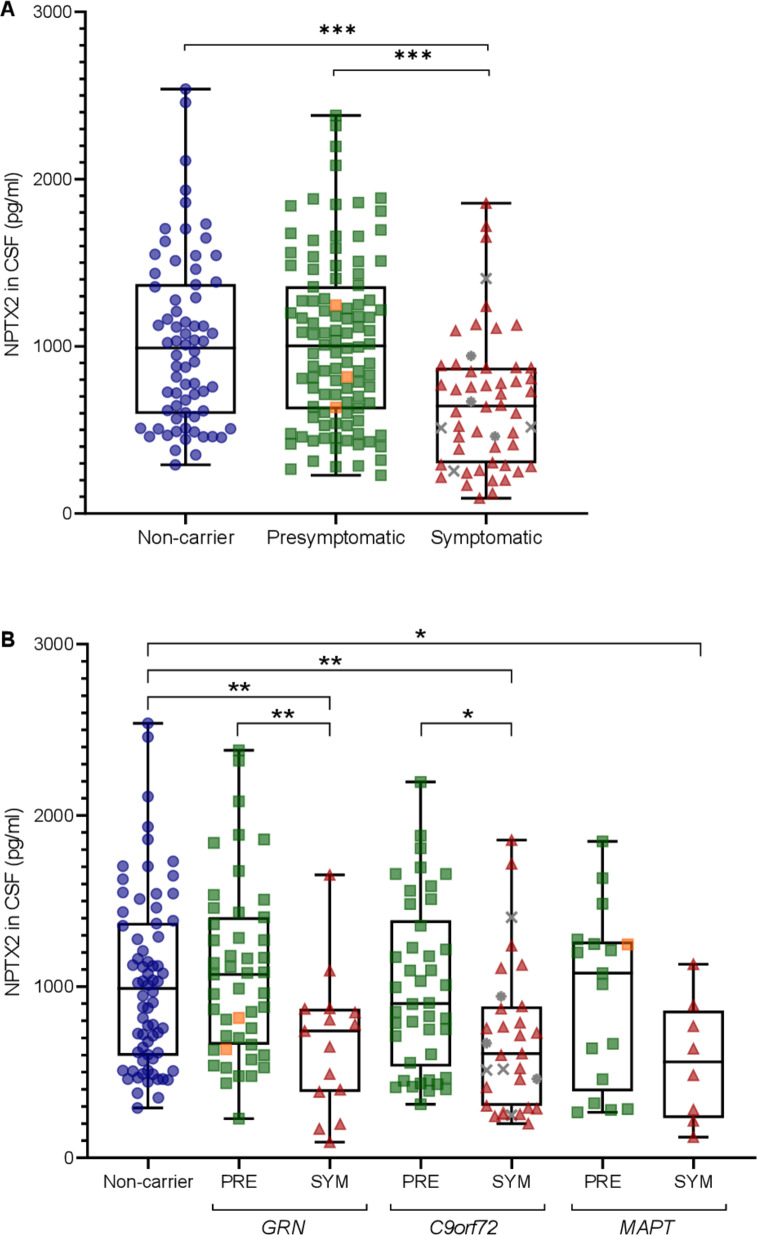
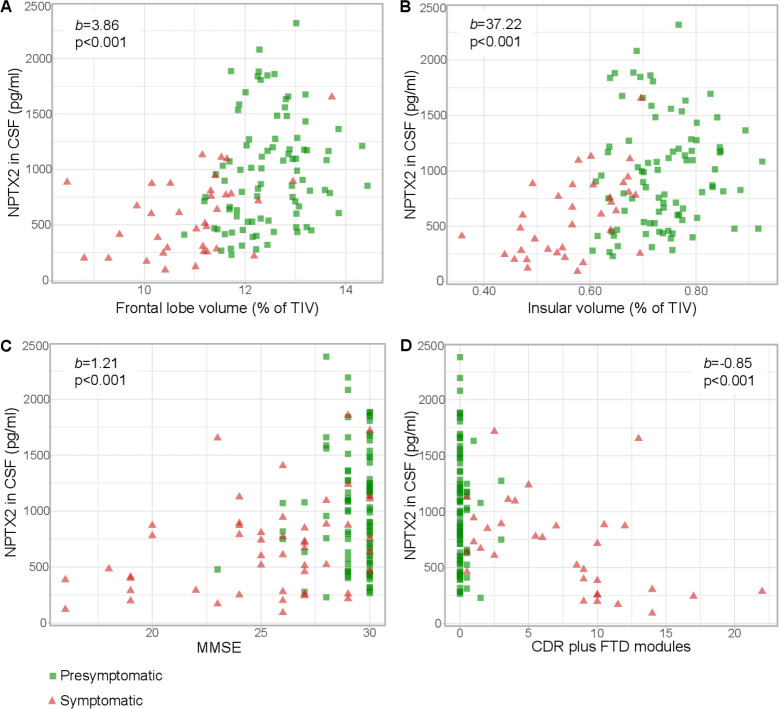
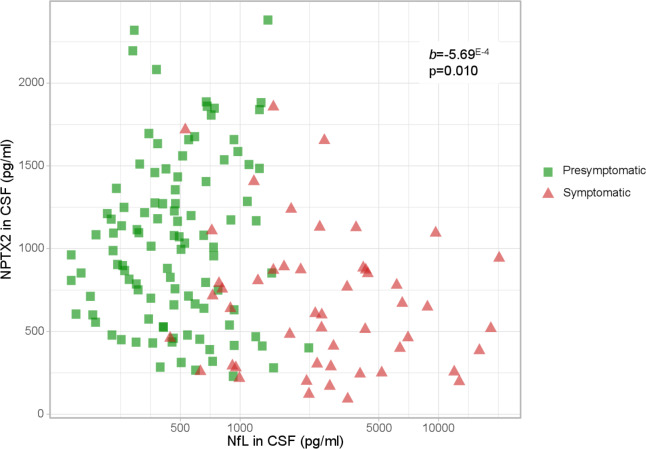
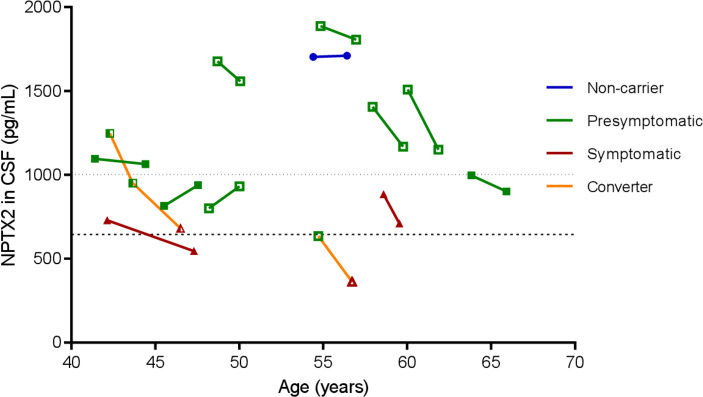
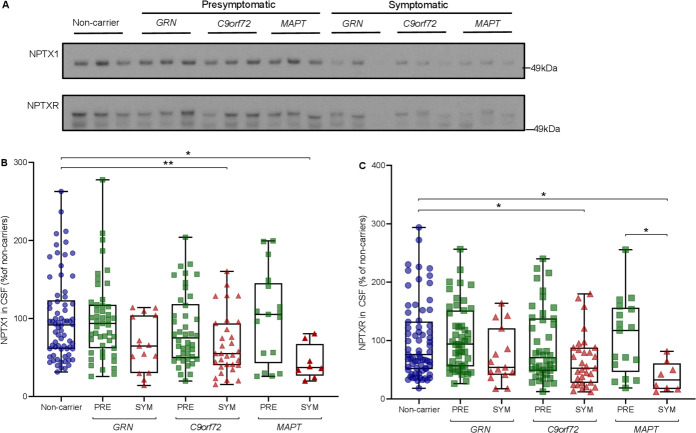
Introduction: Synapse dysfunction is emerging as an early pathological event in frontotemporal dementia (FTD), however biomarkers are lacking. We aimed to investigate the value of cerebrospinal fluid (CSF) neuronal pentraxins (NPTXs), a family of proteins involved in homeostatic synapse plasticity, as novel biomarkers in genetic FTD. Methods: We included 106 presymptomatic and 54 symptomatic carriers of a pathogenic mutation in GRN,C9orf72 or MAPT, and 70 healthy non-carriers participating in the Genetic Frontotemporal dementia Initiative (GENFI), all of whom had at least one CSF sample. We measured CSF concentrations of NPTX2 using an in-house ELISA, and NPTX1 and NPTX receptor (NPTXR) by Western blot. We correlated NPTX2 with corresponding clinical and neuroimaging datasets as well as with CSF neurofilament light chain (NfL) using linear regression analyses. Results: Symptomatic mutation carriers had lower NPTX2 concentrations (median 643 pg/mL, IQR (301–872)) than presymptomatic carriers (1003 pg/mL (624–1358), p<0.001) and non-carriers (990 pg/mL (597–1373), p<0.001) (corrected for age). Similar results were found for NPTX1 and NPTXR. Among mutation carriers, NPTX2 concentration correlated with several clinical disease severity measures, NfL and grey matter volume of the frontal, temporal and parietal lobes, insula and whole brain. NPTX2 predicted subsequent decline in phonemic verbal fluency and Clinical Dementia Rating scale plus FTD modules. In longitudinal CSF samples, available in 13 subjects, NPTX2 decreased around symptom onset and in the symptomatic stage. Discussion: We conclude that NPTX2 is a promising synapse-derived disease progression biomarker in genetic FTD.
Overview
The claims and statistics of this paper haven’t been checked yet.
Free: it reads the open-access text and checks the first 5 claims that cite a source we can check. Create a free account to check every claim.
Integrity signals
Registry
Cites
Statistics
Figures
Verification
Claims the paper makes
The claims and statistics of this paper haven’t been checked yet.
Free: it reads the open-access text and checks the first 5 claims that cite a source we can check. Create a free account to check every claim.
Claims other papers make about this one
Each is checked against this paper’s own text: does it say what the citing paper says it does?
The source backs part of the claim, not all of it — or backs it for a different population, condition or comparison.
In the citing paper
“Synaptic dysfunction and loss of synaptic plasticity are fundamental processes that underlie several neurodegenerative disorders from early stages.”
From Synaptic biomarkers in the cerebrospinal fluid associate differentially with classical neuronal biomarkers in patients with Alzheimer’s disease and frontotemporal dementia (2023) · cites this paper as [7]
Experimental — accuracy not yet measuredThe source backs part of the claim, not all of it — or backs it for a different population, condition or comparison.
In the citing paper
“In fact, synaptic pathology has been identified in pre-clinical stages of AD, FTD, dementia with Lewy bodies, and Parkinson’s disease, as well as certain psychiatric disorders [5–7].”
From Synaptic biomarkers in the cerebrospinal fluid associate differentially with classical neuronal biomarkers in patients with Alzheimer’s disease and frontotemporal dementia (2023) · cites this paper as [7]
Experimental — accuracy not yet measuredThe source backs part of the claim, not all of it — or backs it for a different population, condition or comparison.
In the citing paper
“A synaptic protein progressively decreasing with the disease state in genetic FTD is neuronal pentraxin-2 (NPTX2), mainly present as an extracellular protein in the synaptic cleft [7]”
From Synaptic biomarkers in the cerebrospinal fluid associate differentially with classical neuronal biomarkers in patients with Alzheimer’s disease and frontotemporal dementia (2023) · cites this paper as [7]
Experimental — accuracy not yet measuredThe cited source says what the claim attributes to it.
In the citing paper
“This is in line with previous findings in FTD mutation carriers for which a negative association between NPTX2 and NfL in CSF was also observed [43].”
The cited source says what the claim attributes to it.
In the citing paper
“In particular, NPTX2 decreases paralleling disease progression and may reflect an association between synaptic disruption and cognitive impairment.”
From Neuronal pentraxins as biomarkers of synaptic activity: from physiological functions to pathological changes in neurodegeneration (2022) · cites this paper as van der Ende et al. 2020
12 more claims about this paper
Create a free account to see every claim other papers make about this one.
Self-check
Percentages, sums and reported differences re-computed from the paper’s own numbers.
The self-check needs the paper’s full text.
Citations
Cites
A compendium of neuropsychological tests: administration, norms, and commentary
(1991) · Choice Reviews Online · doi:10.5860/choice.29-2400 · Cited by 6,120
El Escorial revisited: revised criteria for the diagnosis of amyotrophic lateral sclerosis
Brooks, B. R., Miller, R. G., Swash, M., & Munsat, T. L. (2000) · Amyotrophic Lateral Sclerosis and Other Motor Neuron Disorders · doi:10.1080/146608200300079536 · Cited by 5,433
Sensitivity of revised diagnostic criteria for the behavioural variant of frontotemporal dementia
Rascovsky, K., Hodges, J. R., Knopman, D., Mendez, M. F., Kramer, J. H., Neuhaus, J., van Swieten, J. C., Seelaar, H., Dopper, E. G. P., Onyike, C. U., et al. (2011) · Brain · doi:10.1093/brain/awr179 · Cited by 5,221
Self-citationClassification of primary progressive aphasia and its variants
Gorno-Tempini, M. L., Hillis, A. E., Weintraub, S., Kertesz, A., Mendez, M., Cappa, S. F., Ogar, J. M., Rohrer, J. D., Black, S., Boeve, B. F., et al. (2011) · Neurology · doi:10.1212/wnl.0b013e31821103e6 · Cited by 5,141
Self-citationTerry, R. D., Masliah, E., Salmon, D. P., Butters, N., DeTeresa, R., Hill, R., Hansen, L. A., & Katzman, R. (1991) · Annals of Neurology · doi:10.1002/ana.410300410 · Cited by 4,397
Appelhof, B., Bakker, C., Van Duinen-van den Ijssel, J. C. L., Zwijsen, S. A., Smalbrugge, M., Verhey, F. R. J., de Vugt, M. E., Zuidema, S. U., & Koopmans, R. T. C. M. (2017) · Dementia and Geriatric Cognitive Disorders · doi:10.1159/000477087 · Cited by 2,760
Qualitative Assessment of Verbal Fluency Performance in Frontotemporal Dementia
van den Berg, E., Jiskoot, L. C., Grosveld, M. J. H., van Swieten, J. C., & Papma, J. M. (2017) · Dementia and Geriatric Cognitive Disorders · doi:10.1159/000477538 · Cited by 2,046
Self-citationNeurofilaments as biomarkers in neurological disorders
Khalil, M., Teunissen, C. E., Otto, M., Piehl, F., Sormani, M. P., Gattringer, T., Barro, C., Kappos, L., Comabella, M., Fazekas, F., et al. (2018) · Nature Reviews Neurology · doi:10.1038/s41582-018-0058-z · Cited by 1,988
Self-citationChurchill, A. J., Gutiérrez, G. D., Singer, R. A., Lorberbaum, D. S., Fischer, K. A., & Sussel, L. (2017) · eLife · doi:10.7554/elife.20010 · Cited by 1,236
Network abnormalities and interneuron dysfunction in Alzheimer disease
Palop, J. J., & Mucke, L. (2016) · Nature reviews. Neuroscience · doi:10.1038/nrn.2016.141 · Cited by 1,022
Cited by
Root, J., Merino, P., Nuckols, A., Johnson, M., & Kukar, T. (2021) · Neurobiology of Disease · doi:10.1016/j.nbd.2021.105360 · Cited by 238
Targeting synapse function and loss for treatment of neurodegenerative diseases
Dejanovic, B., Sheng, M., & Hanson, J. E. (2023) · Nature Reviews Drug Discovery · doi:10.1038/s41573-023-00823-1 · Cited by 193
Zhou, J., Wade, S. D., Graykowski, D., Xiao, M.-F., Zhao, B., Giannini, L. A. A., Hanson, J. E., van Swieten, J. C., Sheng, M., Worley, P. F., et al. (2023) · Science Translational Medicine · doi:10.1126/scitranslmed.adf0141 · Cited by 152
Self-citationFluid biomarkers in frontotemporal dementia: past, present and future
Swift, I. J., Sogorb-Esteve, A., Heller, C., Synofzik, M., Otto, M., Graff, C., Galimberti, D., Todd, E., Heslegrave, A. J., van der Ende, E. L., et al. (2021) · Journal of Neurology, Neurosurgery & Psychiatry · doi:10.1136/jnnp-2020-323520 · Cited by 122
Self-citationGómez de San José, N., Massa, F., Halbgebauer, S., Oeckl, P., Steinacker, P., & Otto, M. (2022) · Journal of Neural Transmission · doi:10.1007/s00702-021-02411-2 · Cited by 112
Self-citationLongitudinal CSF proteomics identifies NPTX2 as a prognostic biomarker of Alzheimer's disease
Libiger, O., Shaw, L. M., Watson, M. H., Nairn, A. C., Umaña, K. L., Biarnes, M. C., Canet‐Avilés, R. M., Jack, C. R., Breton, Y., Cortes, L., et al. (2021) · Alzheimer's & Dementia · doi:10.1002/alz.12353 · Cited by 108
Biomarker-guided decision making in clinical drug development for neurodegenerative disorders
Cummings, J. L., Teunissen, C. E., Fiske, B. K., Ber, I. L., Wildsmith, K. R., Schöll, M., Dunn, B., & Scheltens, P. (2025) · Nature Reviews Drug Discovery · doi:10.1038/s41573-025-01165-w · Cited by 89
“CSF levels of GFAP and NPTX2 have shown correlations with clinical measures, brain atrophy and disease severity in genetic FTD and might become suitable markers to monitor therapeutic trials 136,137,212 .”
Self-citationA model of human neural networks reveals NPTX2 pathology in ALS and FTLD
Hruska-Plochan, M., Wiersma, V. I., Betz, K. M., Mallona, I., Ronchi, S., Maniecka, Z., Hock, E.-M., Tantardini, E., Laferriere, F., Sahadevan, S., et al. (2024) · Nature · doi:10.1038/s41586-024-07042-7 · Cited by 69
Aryal, S., Bonanno, K., Song, B. J., Mani, D. R., Keshishian, H., Carr, S. A., Sheng, M., & Dejanovic, B. (2023) · Cell Reports · doi:10.1016/j.celrep.2023.112497 · Cited by 82
Ali, M., Erabadda, B., Chen, Y., Xu, Y., Gong, K., Liu, M., Binette, A. P., Timsina, J., Western, D., Yang, C., et al. (2025) · Nature Medicine · doi:10.1038/s41591-025-03833-1 · Cited by 76
“Additionally, proteins such as ENO1 ( β = 0.47, P = 2.6 × 10 −25 ) and NPTXR ( β = −0.72, P = 5.8 × 10 −25 ), involved in glycolysis and synaptic functions, respectively, were also associated with FTD, highlighting metabolic dysregulation and synaptic dysfunction 22 .”
InfluentialCross-disorder and disease-specific pathways in dementia revealed by single-cell genomics
Rexach, J. E., Cheng, Y., Chen, L., Polioudakis, D., Lin, L.-C., Mitri, V., Elkins, A., Han, X., Yamakawa, M., Yin, A., et al. (2024) · Cell · doi:10.1016/j.cell.2024.08.019 · Cited by 48
A data-driven disease progression model of fluid biomarkers in genetic frontotemporal dementia
van der Ende, E. L., Bron, E. E., Poos, J. M., Jiskoot, L. C., Panman, J. L., Papma, J. M., Meeter, L. H., Dopper, E. G. P., Wilke, C., Synofzik, M., et al. (2022) · Brain · doi:10.1093/brain/awab382 · Cited by 58
“An in-house ELISA was used to measure CSF NPTX2.(10,11) Plasma GFAP was measured using the multiplex Neurology 4-plex A kit from Quanterix on a Simoa HD-1 Analyzer.”
InfluentialSelf-citationGracias, J., Orhan, F., Hörbeck, E., Holmén‐Larsson, J., Khanlarkani, N., Malwade, S., Goparaju, S. K., Schwieler, L., Demirel, I. S., Fu, T., et al. (2022) · Nature Communications · doi:10.1038/s41467-022-33797-6 · Cited by 63
Blood Biomarkers for Alzheimer’s Disease in Down Syndrome
Montoliu‐Gaya, L., Strydom, A., Blennow, K., Zetterberg, H., & Ashton, N. J. (2021) · Journal of Clinical Medicine · doi:10.3390/jcm10163639 · Cited by 60
TDP-43 Proteinopathy Specific Biomarker Development
Cordts, I., Wachinger, A., Scialò, C., Lingor, P., Polymenidou, M., Buratti, E., & Feneberg, E. (2023) · Cells · doi:10.3390/cells12040597 · Cited by 55
Synaptic Loss in Frontotemporal Dementia Revealed by [ 11 C ] UCB‐J Positron Emission Tomography
Malpetti, M., Jones, P. S., Cope, T. E., Holland, N., Naessens, M., Rouse, M. A., Rittman, T., Savulich, G., Whiteside, D. J., Street, D., et al. (2023) · Annals of Neurology · doi:10.1002/ana.26543 · Cited by 53
“In frontotemporal dementia, fewer markers for synaptic health have been identified as useful, including pentraxins.(17,44) In particular, neuronal pentraxin 2 is described as the earliest biomarker to become detectably abnormal, as compared to other CSF markers, in presymptomatic carriers of gene mutations related to…”
BackgroundSelf-citationdel Campo, M., Zetterberg, H., Gandy, S., Onyike, C. U., Oliveira, F., Udeh‐Momoh, C., Lleó, A., Teunissen, C. E., & Pijnenburg, Y. (2022) · Alzheimer's & Dementia · doi:10.1002/alz.12643 · Cited by 52
Self-citationSoldan, A., Oh, S., Ryu, T., Pettigrew, C. A., Zhu, Y., Moghekar, A., Xiao, M., Pontone, G. M., Albert, M., Na, C. H., et al. (2023) · Annals of Neurology · doi:10.1002/ana.26725 · Cited by 51
“11 Given that NPTX2 does not appear to be an AD-speci fi c marker, but a marker of synaptic degeneration across neurodegenerative diseases, 11,38,41 therapeutics targeting NPTX2 may have broad applicability.”
Self-citationDas, S., Goossens, J., Jacobs, D., Dewit, N., Pijnenburg, Y. A. L., In ‘t Veld, S. G. J. G., Teunissen, C. E., & Vanmechelen, E. (2023) · Alzheimer's Research & Therapy · doi:10.1186/s13195-023-01212-x · Cited by 50
“GluR4 was recently identified as a biomarker that demonstrates preclinical changes in AD patients before neurodegeneration and Tau pathology, although the diagnostic and prognostic value of this AMPA receptor complex protein remains to be evaluated in depth [5, 7].”
BackgroundSelf-citationSynaptic density in carriers of C9orf72 mutations: a [11C]UCB‐J PET study
Malpetti, M., Holland, N., Jones, P. S., Ye, R., Cope, T. E., Fryer, T. D., Hong, Y. T., Savulich, G., Rittman, T., Passamonti, L., et al. (2021) · Annals of Clinical and Translational Neurology · doi:10.1002/acn3.51407 · Cited by 44
“For example, pentraxin-2, which is implicated in synaptic plasticity, is decreased in symptomatic C9orf72 mutation carriers, but not pre-symptomatic carriers.(7) However, such fluidic markers for synaptic loss do not elucidate in vivo spatial distributions of pathology, and the restricted spatial extent of pre-symptom…”
BackgroundSelf-citationTemporal proteomics of human cerebrospinal fluid after severe traumatic brain injury
Shultz, S. R., Shah, A. D., Huang, C., Dill, L. K., Schittenhelm, R. B., Morganti-Kossmann, M. C., & Semple, B. D. (2022) · Journal of Neuroinflammation · doi:10.1186/s12974-022-02654-0 · Cited by 41
Sogorb-Esteve, A., Nilsson, J., Swift, I. J., Heller, C., Bocchetta, M., Russell, L. L., Peakman, G., Convery, R. S., van Swieten, J. C., Seelaar, H., et al. (2022) · Alzheimer's Research & Therapy · doi:10.1186/s13195-022-01042-3 · Cited by 39
“Two further studies additionally showed that NPTX2 was decreased in symptomatic mutation carriers in all three groups compared with controls using antibody-based approaches [47, 48], and one of these studies showed that NPTX1 was decreased in C9orf72 and MAPT mutation carriers [48].”
BackgroundResultSelf-citationBelbin, O., Xiao, M.-F., Xu, D., Carmona-Iragui, M., Pegueroles, J., Benejam, B., Videla, L., Fernández, S., Barroeta, I., Nuñez-Llaves, R., et al. (2020) · Molecular Neurodegeneration · doi:10.1186/s13024-020-00398-0 · Cited by 39
Self-citationBergström, S., Öijerstedt, L., Remnestål, J., Olofsson, J., Ullgren, A., Seelaar, H., van Swieten, J. C., Synofzik, M., Sanchez-Valle, R., Moreno, F., et al. (2021) · Molecular Neurodegeneration · doi:10.1186/s13024-021-00499-4 · Cited by 36
“CSF levels of NPTX2 have been shown to negatively correlate with disease severity and grey matter volume in genetic FTD [8].”
BackgroundSelf-citationBolsewig, K., Hok-A-Hin, Y. S., Sepe, F. N., Boonkamp, L., Jacobs, D., Bellomo, G., Paoletti, F. P., Vanmechelen, E., Teunissen, C. E., Parnetti, L., et al. (2022) · Journal of Alzheimer's Disease · doi:10.3233/jad-220318 · Cited by 36
Self-citationProdromal frontotemporal dementia: clinical features and predictors of progression
Benussi, A., Ashton, N. J., Karikari, T. K., Alberici, A., Saraceno, C., Ghidoni, R., Benussi, L., Zetterberg, H., Blennow, K., & Borroni, B. (2021) · Alzheimer's Research & Therapy · doi:10.1186/s13195-021-00932-2 · Cited by 26
Self-citationBiomarkers in frontotemporal dementia: Current landscape and future directions
Gifford, A., Praschan, N. C., Newhouse, A. L., & Chemali, Z. N. (2023) · Biomarkers in Neuropsychiatry · doi:10.1016/j.bionps.2023.100065 · Cited by 33
Synaptic Effects of Palmitoylethanolamide in Neurodegenerative Disorders
Assogna, M., Lorenzo, F. D., Martorana, A., & Koch, G. (2022) · Biomolecules · doi:10.3390/biom12081161 · Cited by 28
“Indeed, FTLD abnormal brain connectivity (connectopathy) or synaptopathy has been described [31,32].”
BackgroundAssociation between serum NPTX2 and cognitive function in patients with vascular dementia
Shao, K., Shan, S., Ru, W., & Ma, C. (2020) · Brain and Behavior · doi:10.1002/brb3.1779 · Cited by 25
“A newly published study points out that NPTX2 is significantly lower in genetic frontotemporal dementia (FTD) and is a novel synaptic marker to predict the progression of FTD disease (van der Ende et al., 2020).”
BackgroundFrontotemporal dementia. How to deal with its diagnostic complexity?
Antonioni, A., Raho, E. M., Granieri, E., & Koch, G. (2025) · Expert Review of Neurotherapeutics · doi:10.1080/14737175.2025.2461758 · Cited by 25
“Specifically, the neuronal pentraxin receptor is reduced in the CSF of symptomatic genetic FTD patients, along with neuronal pentraxin-2 (NPTX2) [60].”
CSF Protein Level of Neurotransmitter Secretion, Synaptic Plasticity, and Autophagy in PD and DLB
Lerche, S., Sjödin, S., Brinkmalm, A., Blennow, K., Wurster, I., Röeben, B., Zimmermann, M., Hauser, A., Liepelt‐Scarfone, I., Waniek, K., et al. (2021) · Movement Disorders · doi:10.1002/mds.28704 · Cited by 25
“Decreased CSF levels of NPTX1 and NPTX2 have also been shown in patients with frontotemporal dementia and even in presymptomatic mutation carriers (GRN, C9orf72, or MAPT).(24) With the identification of variants in the GBA gene as major genetic risk factor for PD and DLB, it became clear that impairment in lysosomal-m…”
BackgroundMol, M. O., Miedema, S. S. M., Swieten, J. C. V., van Rooij, J., & Dopper, E. G. P. (2021) · International Journal of Molecular Sciences · doi:10.3390/ijms221910298 · Cited by 25
Self-citationSaloner, R., Staffaroni, A. M., Dammer, E. B., Johnson, E. C. B., Paolillo, E. W., Wise, A. B., Heuer, H. W., Forsberg, L. K., Lario‐Lago, A., Webb, J. D., et al. (2025) · Nature Aging · doi:10.1038/s43587-025-00878-2 · Cited by 24
“CSF NPTX2, previously shown to decrease in symptomatic FTLD and other neurodegenerative diseases 45–47 , exhibited the strongest association with cognitive decline out of any individual protein.”
Self-citationSogorb‐Esteve, A., Weiner, S., Simrén, J., Swift, I. J., Bocchetta, M., Todd, E. G., Cash, D. M., Bouzigues, A., Russell, L. L., Foster, P. H., et al. (2025) · Science Translational Medicine · doi:10.1126/scitranslmed.adm9654 · Cited by 23
Self-citationIn vivo exploration of synaptic projections in frontotemporal dementia
Salmon, E., Bahri, M. A., Plenevaux, A., Becker, G., Seret, A., Delhaye, E., Degueldre, C., Balteau, E., Lemaire, C., Luxen, A., et al. (2021) · Scientific Reports · doi:10.1038/s41598-021-95499-1 · Cited by 21
Hok‐A‐Hin, Y. S., Vermunt, L., Peeters, C. F. W., van der Ende, E. L., de Boer, S. C. M., Meeter, L. H. H., Houwer, J. F. H. D., Seelaar, H., Swieten, J. C. V., Hu, W. T., et al. (2025) · Molecular Neurodegeneration · doi:10.1186/s13024-025-00882-5 · Cited by 20
Self-citationDuggan, M. R., Yang, Z., Cui, Y., Dark, H. E., Wen, J., Erus, G., Hohman, T. J., Chen, J., Lewis, A., Moghekar, A., et al. (2024) · Alzheimer s & Dementia · doi:10.1002/alz.14142 · Cited by 21
Extracellular vesicles in TDP-43 proteinopathies: pathogenesis and biomarker potential
Dellar, E. R., Nikel, L., Fowler, S. L., Vahsen, B. F., Dafinca, R., Feneberg, E., Talbot, K., Turner, M. R., & Thompson, A. G. (2025) · Molecular Neurodegeneration · doi:10.1186/s13024-025-00859-4 · Cited by 19
Mavrina, E., Kimble, L. E., Waury, K., Gogishvili, D., José, N. G. D. S., Das, S., Coppens, S., Gomes, B. F., Mravinacová, S., Wojdała, A. L., et al. (2022) · Frontiers in Neurology · doi:10.3389/fneur.2022.890638 · Cited by 19
Self-citationLleó, A., Carmona‐Iragui, M., Videla, L., Fernández, S., Benejam, B., Pegueroles, J., Barroeta, I., Altuna, M., Valldeneu, S., Xiao, M.-F., et al. (2021) · Alzheimer s Research & Therapy · doi:10.1186/s13195-021-00861-0 · Cited by 18
Self-citationData‐driven staging of genetic frontotemporal dementia using multi‐modal MRI
McCarthy, J., Borroni, B., Sánchez‐Valle, R., Moreno, F., Laforce, R. J., Graff, C., Synofzik, M., Galimberti, D., Rowe, J. B., Masellis, M., et al. (2022) · Human Brain Mapping · doi:10.1002/hbm.25727 · Cited by 16
Self-citationBenussi, A., Libri, I., Premi, E., Alberici, A., Cantoni, V., Gadola, Y., Rivolta, J., Pengo, M., Gazzina, S., Calhoun, V. D., et al. (2022) · Alzheimer's & Dementia: Translational Research & Clinical Interventions · doi:10.1002/trc2.12326 · Cited by 14
Self-citationAltered plasma protein profiles in genetic FTD – a GENFI study
Ullgren, A., Öijerstedt, L., Olofsson, J., Bergström, S., Remnestål, J., Swieten, J. C. V., Jiskoot, L. C., Seelaar, H., Borroni, B., Sánchez‐Valle, R., et al. (2023) · Molecular Neurodegeneration · doi:10.1186/s13024-023-00677-6 · Cited by 14
“Most efforts have focused on finding biomarkers in cerebrospinal fluid (CSF) and a few promising candidates have been found, such as neurofilament light chain (NEFL) and neuronal pentraxin 2 (NPTX2) [2, 3].”
BackgroundSelf-citationEmerging perspectives of synaptic biomarkers in ALS and FTD
Krishnamurthy, K., & Pradhan, R. K. (2024) · Frontiers in Molecular Neuroscience · doi:10.3389/fnmol.2023.1279999 · Cited by 14
“Lower levels of NPTX2 have been reported in the CSF of patients with FTD, suggesting a potential role as a synaptic biomarker (van der Ende et al., 2020).”
BackgroundSaunders, T. S., Gadd, D. A., Spires‐Jones, T. L., King, D., Ritchie, C. W., & Terrera, G. M. (2022) · European Journal of Neuroscience · doi:10.1111/ejn.15656 · Cited by 13
microRNA‐based predictor for diagnosis of frontotemporal dementia
Magen, I., Yacovzada, N., Warren, J. D., Heller, C., Swift, I., Bobeva, Y., Malaspina, A., Rohrer, J. D., Fratta, P., & Hornstein, E. (2023) · Neuropathology and Applied Neurobiology · doi:10.1111/nan.12916 · Cited by 12
Self-citationDas, S., van Engelen, M.-P. E., Goossens, J., Jacobs, D., Bongers, B., Fieldhouse, J. L. P., Pijnenburg, Y. A. L., Teunissen, C. E., Vanmechelen, E., & Verberk, I. M. W. (2024) · Alzheimer's Research & Therapy · doi:10.1186/s13195-024-01409-8 · Cited by 12
“…of lower NPTX2 concentrations in sporadic FTD compared with PPD and controls are in line with our previous pilot study and with a recent study among patients with genetic forms of FTD, in which symptomatic mutation carriers showed lower concentrations of CSF NPTX2 compared with controls [13].”
BackgroundResultSelf-citationKhrouf, W., Saracino, D., Rucheton, B., Houot, M., Clot, F., Rinaldi, D., Vítor, J., Huynh, M., Heng, E., Schlemmer, D., et al. (2023) · Neurobiology of Disease · doi:10.1016/j.nbd.2023.106108 · Cited by 12
Piel, J. H. A., Bargemann, L., Leypoldt, F., Wandinger, K., & Dargvainiene, J. (2024) · Frontiers in Neurology · doi:10.3389/fneur.2024.1356575 · Cited by 12
Hsiao‐Nakamoto, J., Chiu, C., VandeVrede, L. A., Ravi, R., Vandenberg, B., Groot, J. D., Tsogtbaatar, B., Fang, M., Auger, P., Gould, N. S., et al. (2024) · bioRxiv (Cold Spring Harbor Laboratory) · doi:10.1101/2024.02.09.579529 · Cited by 13
Arias, C. C. W. P., Silbern, I., Gomes, L. C., Wartmann, H., Dambeck, V., Fanz, J., Neuenroth, L., Bähr, M., Outeiro, T. F., Bonn, S., et al. (2023) · Journal of Neurochemistry · doi:10.1111/jnc.15924 · Cited by 11
Lim, B., Fowler, C., Li, Q.-X., Rowe, C., Dhiman, K., Gupta, V. B., Masters, C. L., Doecke, J. D., Martins, R. N., Collins, S., et al. (2020) · Neuroscience Letters · doi:10.1016/j.neulet.2020.135078 · Cited by 10
Proteomic signature of dementia risk in type 2 diabetes
Wang, Z., Ning, Y., Gao, P., Xu, L., Cao, S., Li, Y., & Jia, J. (2025) · Journal of Advanced Research · doi:10.1016/j.jare.2025.08.012 · Cited by 10
Sheikh, W. G. E., Sleem, B., Kobeissy, F. H., & Bizri, M. (2023) · Biomarkers in Neuropsychiatry · doi:10.1016/j.bionps.2023.100064 · Cited by 10
Anderson, C. L., Gross, A. L., Pettigrew, C. A., Vazquez, J. P., Moghekar, A., Oh, S., Na, C. H., Albert, M., Worley, P. F., & Soldan, A. (2025) · Neurobiology of Aging · doi:10.1016/j.neurobiolaging.2025.09.002 · Cited by 9
Self-citationvan den Berg, E., Nilsson, J., Kersten, I., Brinkmalm, G., de Kort, A. M., Klijn, C. J. M., Schreuder, F. H. B. M., Jäkel, L., Gobom, J., Portelius, E., et al. (2023) · Journal of Alzheimer s Disease · doi:10.3233/jad-220977 · Cited by 9
“Decreased NPTX2 CSF levels were previously reported in AD, however differentially expressed pentraxins have also been associated with other neurodegenerative diseases, including multiple sclerosis, frontotemporal dementia, and Parkinson’s disease [27, 29].”
BackgroundPatel, M., Zhang, Y., Xiao, M.-F., Worley, P. F., & Moghekar, A. (2024) · Neurologia i Neurochirurgia Polska · doi:10.5603/pjnns.98212 · Cited by 9
“In cerebrospinal fluid (CSF), reduced levels of NPTX2 have been observed in AD [3], genetic frontotemporal dementia [4], and dementia with Lewy bodies [5], leading to its promising potential use as a biomarker in these disorders.”
BackgroundSelf-citationSavonenko, A. V., Wong, P. C., & Li, T. (2022) · Elsevier eBooks · doi:10.1016/b978-0-323-85654-6.00022-8 · Cited by 9
Vazquez, J. P., Pettigrew, C. A., Zhu, Y., Anderson, C. L., Erus, G., Davatzikos, C. A., Miller, M. I., Moghekar, A., Oh, S., Na, C. H., et al. (2025) · Annals of Clinical and Translational Neurology · doi:10.1002/acn3.70216 · Cited by 9
“Similar cross-sectional associations between lower CSF NPTX2 levels and lower cortical thickness or brain volumes have been reported among adults with Down syndrome [18], who have a form of genetically determined early onset AD, as well as among patients with fronto-temporal dementia [19, 20].”
Self-citationGuo, Z., Hong, X., Wang, X., Chen, W., & Guo, Z. (2024) · Aging Clinical and Experimental Research · doi:10.1007/s40520-023-02670-x · Cited by 7
Dellar, E. R., Vendrell, I., Amein, B., Lester, D., Edmond, E., Yoganathan, K. T., Dharmadasa, T., Sogorb‐Esteve, A., Fischer, R., Talbot, K., et al. (2024) · Annals of Neurology · doi:10.1002/ana.27133 · Cited by 7
Self-citationZhang, Z.-H., Chen, X., Sheng, Z.-H., Jiang, N., & Zou, W. (2025) · Journal of Neuroinflammation · doi:10.1186/s12974-025-03545-w · Cited by 7
“NPTX2, an immediate early gene product secreted by excitatory neurons, is critical for maintaining excitatory synaptic connectivity, especially between pyramidal neurons and parvalbumin (PV) -positive interneurons [5, 6].”
Göverti, D., Büyüklüoğlu, N., Kaya, H., Yüksel, R. N., Yücel, Ç., & Göka, E. (2022) · Psychopharmacology · doi:10.1007/s00213-022-06147-z · Cited by 7
Graafland, C. H., Kaat, L. D., Richard, E., Swieten, J. C. V., Seelaar, H., & Bunnik, E. M. (2025) · Alzheimer s & Dementia Diagnosis Assessment & Disease Monitoring · doi:10.1002/dad2.70133 · Cited by 6
“Promising examples include fluid biomarkers such as cryptic exons 10 or neu-ronalpentraxin-2, 11 neuropsychologicaltests,andmagneticresonance imaging biomarkers.”
Self-citationSogorb‐Esteve, A., Nilsson, J., Swift, I. J., Heller, C., Russell, L. L., Peakman, G., Convery, R. S., Swieten, J. C. V., Seelaar, H., Borroni, B., et al. (2022) · Research Square · doi:10.21203/rs.3.rs-1188941/v1 · Cited by 6
Self-citationLoupy, K. M., Dawud, L. M., Zambrano, C. A., Lee, T., Heinze, J. D., Elsayed, A. I., Hassell, J. E., D'Angelo, H. M., Frank, M. G., Maier, S. F., et al. (2025) · NeuroImmunoModulation · doi:10.1159/000544842 · Cited by 5
“…for cognition and memory by mediating excitatory (glutamatergic) synaptic transmission of neurons in the hippocampus and cortex; decreases in the abundance or function of NPTXR [76 – 78], reelin [79], or Sez6 proteins [80], are linked to various forms of cognitive impairments and dementia.”
Genetic Mechanisms of Experience-Dependent Neuronal Plasticity
West, A. E. (2025) · Annual Review of Genetics · doi:10.1146/annurev-genet-020325-103824 · Cited by 5
“…is detectable in cerebral spinal fluid, and reduced levels of NPTX2 have been reported to serve as a sensitive biomarker for impaired cognitive function in a variety of neurodegenerative pathologies, including in Alzheimer’s disease, frontotemporal dementia, and Parkinson’s disease (105, 157, 170).”
Distinct proteomic CSF profiles in genetic frontotemporal lobar degeneration
Houwer, J. F. H. D., Dopper, E. G. P., van Buuren, R., Stokkel, M. E., de Boer, L., Swartenbroekx, T., Boesjes, P., Rajicic, A., Sogorb‐Esteve, A., Bouzigues, A., et al. (2025) · Brain · doi:10.1093/brain/awaf457 · Cited by 5
“This allowed us to uncover a strong connection between immune pathways and MAPT , adding an important dimension to the current proteomic landscape in FTLD.”
InfluentialSelf-citationDai, L., Kirsebom, B., Wang, C., Zhang, M., Wang, Q., Ni, M., González‐Ortiz, F., Blennow, K., Shi, J., Fladby, T., et al. (2026) · Nature Communications · doi:10.1038/s41467-026-70472-6 · Cited by 6
“While reduced CSF NPTX2 levels have been consistently reported in AD 17 – 20 and other neurodegenerative disorders 21,22 , data on NPTX1 and NPTXR in AD remain sparse and inconsistent.”
Research trends and hotspots for frontotemporal dementia from 2000 to 2022: a bibliometric analysis
Chen, X., Chen, Y., Ni, B., & Huang, C. (2024) · Frontiers in Neurology · doi:10.3389/fneur.2024.1399600 · Cited by 4
Chu, M., Yue, A., Nan, H., Ye, H., Qu, M., & Wu, L. (2025) · Neurobiology of Disease · doi:10.1016/j.nbd.2025.107135 · Cited by 4
Fluid biomarkers in familial frontotemporal dementia: progress and prospects
Guo, M., Qin, L., Cai, H., Wang, R., Luo, C., Yang, F., Feng, S., Gao, H., & Chen, Q. (2025) · Frontiers in Neurology · doi:10.3389/fneur.2025.1663609 · Cited by 4
Zhou, J., Li, X., Wang, X., Yang, Y., Nai, A., Shi, H., Zhao, J., Zhang, J., Ding, S., Han, Y. K., et al. (2024) · Psychopharmacology · doi:10.1007/s00213-023-06515-3 · Cited by 4
“Previous research into neurodegenerative diseases and NPTX2 has shown that patients with low levels of NPTX2 perform poorly on cognitive tests (van der Ende et al. 2020; Xiao et al. 2017).”
Ansari, U., Wen, J., Syed, B., Nadora, D., Sedighi, R., Nadora, D., Chen, V., & Lui, F. (2024) · AIMS neuroscience · doi:10.3934/neuroscience.2024031 · Cited by 4
Li, J., Ma, W., & Gu, S. (2025) · Brain and Behavior · doi:10.1002/brb3.70305 · Cited by 4
Shinozuka, T., Kanda, M., Sato, Y., Shimizu, D., Umeda, S., Takami, H., Hattori, N., Hayashi, M., Tanaka, C., & Kodera, Y. (2024) · Annals of Surgical Oncology · doi:10.1245/s10434-024-15353-2 · Cited by 3
Zupo, L., Adinolfi, A., Pieraccioli, M., Guerra, M., Corvino, V., Ria, F., Ceci, V., Chiurchiù, V., Gaetani, L., Sperandei, S., et al. (2026) · Cell Death Discovery · doi:10.1038/s41420-026-03051-9 · Cited by 2
Proteomic analysis in Alzheimer’s disease and other dementias: a focus on sex-specific differences
Comas‐Albertí, A., Lladó, A., Esteller, D., Borrego‐Écija, S., Falgàs, N., Dakterzada, F., Pérez‐Millan, A., Puey, R., Collet-Romà, T., Guillén, N., et al. (2026) · Alzheimer s Research & Therapy · doi:10.1186/s13195-026-02068-7 · Cited by 2
“…with NPTX1, NPTX2, and NPTXR distinguishing FTD from AD and LBD. Previous studies have reported reduced levels of NPTX1, NPTX2, and NPTXR in the CSF of individuals with different FTD subtypes [39, 40], in line with our findings, and decreases in NPTX1 and NPTX2 have also been described in AD [41].”
Self-citationGomes, B. F., Sauer, M., Montoliu‐Gaya, L., Franquesa‐Mullerat, M., Bejanin, A., Alcolea, D. A., Lleó, A., Illán‐Gala, I., Fortea, J., Blennow, K., et al. (2026) · Alzheimer s & Dementia Diagnosis Assessment & Disease Monitoring · doi:10.1002/dad2.70391 · Cited by 2
Aguzzoli, C. S., Battista, P., Hadad, R., Borges, Y. F. F., Schilling, L. P., & Miller, B. L. (2022) · Neurocase · doi:10.1080/13554794.2022.2135448 · Cited by 2
Oh, S., Jang, Y., VandeVrede, L. A., Boxer, A. L., Sockanathan, S., & Na, C. H. (2021) · Research Square · doi:10.21203/rs.3.rs-148356/v1 · Cited by 2
“Confirming earlier studies, we also detect reductions in NPTX1, another 19 neuronal pentraxin that is involved in synaptic homeostasis, in the CSF of patients with FTLD [31, 50]; 20 however, changes in NPTX1 in CSF of patients with ALS did not reach significance.”
BackgroundResultUllgren, A., Rydell, M. T., Bergström, S., Öijerstedt, L., Olofsson, J., Bouzigues, A., Russell, L. L., Foster, P. H., Ferry‐Bolder, E., Swieten, J. C. V., et al. (2026) · Journal of Neural Transmission · doi:10.1007/s00702-026-03118-y · Cited by 1
“Neuronal pentraxin 2 (NPTX2) is reduced in cerebrospinal fluid (CSF) from patients with FTD, corre - lates with disease severity and with brain volume already at the presymptomatic stage in individuals with mutations in C9orf72 or GRN [7, 8 ].”
Self-citationMuhammad, J. S., Siddiqui, R., & Khan, N. A. (2022) · Hospital Practice · doi:10.1080/21548331.2022.2088183 · Cited by 1
“Moreover, cerebrospinal fluid proteomics and serum analysis have shown that NPTX2 levels have been reported as a novel biomarker and cognitive function predictor for Alzheimer’s disease, vascular dementia, and frontotemporal dementia [39,40].”
BackgroundFluid and Imaging Markers of Frontotemporal Lobar Degeneration
Prinse, F., Houwer, J. F. H. D., Dopper, E. G. P., & Seelaar, H. (2025) · Springer eBooks · doi:10.1007/978-3-031-80849-4_9 · Cited by 1
Self-citationLeskelä, S. (2020) · UEF eRepo (University of Eastern Finland)
Sogorb‐Esteve, A., Nilsson, J., Swift, I. J., Heller, C., Russell, L. L., Peakman, G., Convery, R. S., Swieten, J. C. V., Seelaar, H., Borroni, B., et al. (2022) · Research Square · doi:10.21203/rs.3.rs-1188941/v2
Self-citationArgelazi, R. L., Graça, S. C., Thomazoni, P. V., Moura, C. B., Gomes, A. C. G., Kormanski, M. K., de Almeida, S. S. C., Ferreira, Y. D., & Santos, D. H. (2025) · Dementia & Neuropsychologia · doi:10.1590/1980-5764-dn-2024-0227
“It also brings to light a complex reality within the Brazilian context, where multidisciplinary teams and genetic testing are not routinely available within the public health system 16 .”
Additional file 1 of Altered plasma protein profiles in genetic FTD – a GENFI study
Ullgren, A., Öijerstedt, L., Olofsson, J., Bergström, S., Remnestål, J., Swieten, J. C. V., Jiskoot, L. C., Seelaar, H., Borroni, B., Sánchez‐Valle, R., et al. (2024) · Figshare · doi:10.6084/m9.figshare.26640538
Self-citationDas, S., van Engelen, M.-P. E., Goossens, J., Jacobs, D., Bongers, B., Fieldhouse, J. L. P., Pijnenburg, Y. A. L., Teunissen, C. E., Vanmechelen, E., & Verberk, I. M. W. (2024) · Figshare · doi:10.6084/m9.figshare.25223556
Self-citationDas, S., van Engelen, M.-P. E., Goossens, J., Jacobs, D., Bongers, B., Fieldhouse, J. L. P., Pijnenburg, Y. A. L., Teunissen, C. E., Vanmechelen, E., & Verberk, I. M. W. (2024) · Figshare · doi:10.6084/m9.figshare.25223869
Self-citationBenussi, A., Ashton, N. J., Karikari, T. K., Alberici, A., Saraceno, C., Ghidoni, R., Benussi, L., Zetterberg, H., Blennow, K., & Borroni, B. (2021) · Figshare · doi:10.6084/m9.figshare.17020881
Self-citationDas, S., Goossens, J., Jacobs, D., Dewit, N., Pijnenburg, Y. A. L., In ‘t Veld, S. G. J. G., Teunissen, C. E., & Vanmechelen, E. (2023) · Figshare · doi:10.6084/m9.figshare.22619722
Self-citationVidela, L. (2023) · Dipòsit Digital de Documents de la UAB (Universitat Autònoma de Barcelona)
Pedrero-Prieto, C. M. (2020) · RUIdeRA - Institutional University Repository (University of Castilla-La Mancha)
Complement mediated synapse elimination in schizophrenia
Lekander, J. G. (2023) · Open Archive (Karolinska Institutet)
Investigation of the [18F]MK-6240 Tau-PET Tracer in Genetic Frontotemporal Dementia
Levy, J. P. (2021) · eScholarship@McGill (McGill) · doi:10.82308/45649
Protein and MRI profiling of genetic frontotemporal dementia
Ullgren, A. (2024) · Open Archive (Karolinska Institutet)
Exploring the Genetic and Proteomic Landscape of Frontotemporal Dementia and Related Disorders
Mol, M. O. (2022) · EUR Research Repository (Erasmus University Rotterdam)
CSF NPTX2 reflects α-synuclein pathology and predicts disease progression in Parkinson’s diseasePreprint
Chen, Z., Song, D., Ai, Y., Mingzhu, Y., Li, Y., Zhou, X., Long, D., Zuo, H., & Cheng, O. (2025) · Research Square · doi:10.21203/rs.3.rs-8386534/v1
Metadata
- Authors
- van der Ende, E. L., Xiao, M., Xu, D., Poos, J. M., Panman, J. L., Jiskoot, L. C., Meeter, L. H., Dopper, E. G., Papma, J. M., Heller, C., Convery, R., Moore, K., Bocchetta, M., Neason, M., Peakman, G., Cash, D. M., Teunissen, C. E., Graff, C., Synofzik, M., Moreno, F., Finger, E., Sánchez-Valle, R., Vandenberghe, R., Laforce Jr, R., Masellis, M., Tartaglia, M. C., Rowe, J. B., Butler, C. R., Ducharme, S., Gerhard, A., Danek, A., Levin, J., Pijnenburg, Y. A., Otto, M., Borroni, B., Tagliavini, F., de Mendonca, A., Santana, I., Galimberti, D., Seelaar, H., Rohrer, J. D., Worley, P. F., & van Swieten, J. C.
- Affiliations
- Johns Hopkins University (US)
- Erasmus MC (NL)
- Leiden University Medical Center (NL)
- University College London (GB)
- UCL Queen Square Institute of Neurology (GB)
- Amsterdam Neuroscience (NL)
- Karolinska University Hospital (SE)
- German Center for Neurodegenerative Diseases (DE)
- Western University (CA)
- KU Leuven (BE)
- Sunnybrook Health Science Centre (CA)
- University of Toronto (CA)
- University of Cambridge (GB)
- University of Oxford (GB)
- Montreal Neurological Institute and Hospital (CA)
- Klinik und Poliklinik für Neurologie (DE)
- Universität Ulm (DE)
- University of Brescia (IT)
- Istituti di Ricovero e Cura a Carattere Scientifico (IT)
- Centro de Neurociências e Biologia Celular (PT)
- University of Milan (IT)
- ORCID
- van der Ende, Emma L
- Xu, Desheng
- Poos, Jackie M
- Panman, Jessica L
- Jiskoot, Lize C
- Meeter, Lieke H
- Dopper, Elise GP
- Papma, Janne M
- Heller, Carolin
- Convery, Rhian
- Moore, Katrina
- Bocchetta, Martina
- Neason, Mollie
- Peakman, Georgia
- Cash, David M
- Teunissen, Charlotte E
- Graff, Caroline
- Synofzik, Matthis
- Finger, Elizabeth
- Vandenberghe, Rik
- Masellis, Mario
- Tartaglia, Maria Carmela
- Rowe, James B
- Butler, Christopher R
- Ducharme, Simon
- Danek, Adrian
- Levin, Johannes
- Pijnenburg, Yolande AL
- Otto, Markus
- Borroni, Barbara
- Tagliavini, Fabrizio
- Santana, Isabel
- Galimberti, Daniela
- Seelaar, Harro
- Rohrer, Jonathan D
- Worley, Paul F
- van Swieten, John C
- Venue
- Journal of Neurology, Neurosurgery & Psychiatry
- Publisher
- BMJ
- Published
- 2020-04-09
- Volume
- 91
- Issue
- 6
- Pages
- 612-621
- ISSN
- 0022-3050 (ISSN-L)
- 1468-330X
- PMC
- PMC7279197
- OpenAlex
- W3015522591
- Semantic Scholar
- 095274530f496d48213024f2b76d26e9068c5dcd
- Cited by
- 94
- References
- 45
- Citations by year
- 2026: 7 · 2025: 20 · 2024: 17 · 2023: 15 · 2022: 16 · 2021: 15 · 2020: 4
- FWCI
- 9.12
- Type
- journal article
- Language
- en
- Open access
- hybrid
- doi.org
- Locations
- Journal of Neurology Neurosurgery & Psychiatry (publishedVersion, cc-by)
- PubMed Central (publishedVersion, cc-by)
- PubMed (publishedVersion)
- Amsterdam UMC (VU Amsterdam) - Institutional Repository (publishedVersion, other-oa)
- Institutional Research Information System (Università degli Studi di Trento) (submittedVersion, cc-by)
- Lirias (KU Leuven) (submittedVersion, other-oa)
- EUR Research Repository (Erasmus University Rotterdam) (submittedVersion, other-oa)
- Data Archiving and Networked Services (DANS) (submittedVersion, cc-by)
- Archivio Istituzionale della Ricerca (Universita Degli Studi Di Milano) (submittedVersion, other-oa)
- Leiden Repository (Leiden University) (submittedVersion, cc-by)
- UCL Discovery (University College London) (submittedVersion)
- Open access LMU (Ludwid Maxmilian's Universitat Munchen) (submittedVersion, cc-by)
- Institutional Research Information System (Università degli Studi di Brescia) (submittedVersion)
- HighWire Press Open Archive (submittedVersion)
- DZNE Pub (submittedVersion)
- Apollo (University of Cambridge) (submittedVersion)
- Data Archiving and Networked Services (DANS) (submittedVersion, other-oa)
- Apollo
- Funders
- Deutsche Forschungsgemeinschaft
- Horizon 2020 Framework Programme (779357)
- Schorling foundation
- NIHR Rare Disease Translational Research Collaboration (BRC149/NS/MH)
- Stockholms Läns Landsting
- Munich Cluster for Systems Neurology (EXC 2145 SyNergy 390857198)
- Swedish Demensfonden
- Swedish FTD Initiative
- The Bluefield Project to Cure Frontotemporal Dementia
- Stichting Dioraphte (1402 1300)
- Swedish Alzheimer Foundation
- Stiftelsen för Gamla Tjänarinnor
- Vetenskapsrådet (2015-02926, 2018-02754, 529-2014-7504)
- Hjärnfonden
- MRC UK (MR/M023664/1)
- Nederlandse Organisatie voor Wetenschappelijk Onderzoek (733050103, 733050813)
- Alzheimer Nederland (733050103, 733050813)
- StratNeuro
- European Joint Programme - Neurodegenerative Disease Research (733051024, 733051042)
- Mady Browaeys Fonds voor Onderzoek naar Frontotemporale Degeneratie
- Karolinska Institutet Doctoral funding
- Fundacio Marato de TV3 (20143810)
- MRC Clinician Scientist Fellowship (MR/M008525/1)
- Wellcome Trust (103838)
- Alzheimer's Society (As-PhD-2015-005)
- Topics
- Health Sciences › Medicine › Psychiatry and Mental health › Dementia and Cognitive Impairment Research
- Life Sciences › Neuroscience › Cellular and Molecular Neuroscience › Alzheimer's disease research and treatments
- Health Sciences › Medicine › Clinical Neurology › Amyotrophic Lateral Sclerosis Research
- Keywords
- NPTX2, NPTX1, cerebrospinal fluid biomarkers, genetic frontotemporal dementia, presymptomatic mutation carriers, synaptic dysfunction, neurofilament light chain, gray matter volume, disease progression, phonemic fluency, Clinical Dementia Rating
- MeSH terms
- Pentraxins, Adult, Aged, C-Reactive Protein, Female, Heterozygote, Humans, Male, Middle Aged, Nerve Tissue Proteins, Biomarkers, Neurofilament Proteins, Disease Progression, Frontotemporal Dementia
About these checks
Registry, retraction, Cites and statistics results are computed, not judged, with one exception: a printed reference that no index lists is read once by a model before it counts as a citation error. Claims are extracted by a model and kept only when their quote appears verbatim in the text; each cited source is then checked, with a model’s help, for whether it says what the claim relies on. Those verdicts can be wrong — read the claim’s quote and the cited source before relying on one.
Statistics and arithmetic are recomputed, not judged.
Confidence bands are shown only for fields calibrated on our annotated test set. None is calibrated yet, so no band is shown.
What counts as a claim ›How we measure confidence ›How we check this ›
Are you an author, or do you see a problem with this page? Request a review
Data sources
Bibliographic data: Semantic Scholar, OpenAlex, Crossref.
Contains information from the Semantic Scholar Academic Graph Datasets, made available under the ODC Attribution License (ODC-BY 1.0).
Semantic Scholar’s data is described in: Kinney, R., et al. (2023). The Semantic Scholar Open Data Platform. arXiv:2301.10140.
