

Which politicians receive abuse? Four factors illuminated in the UK general election 2019
Open accessThe DOI matches its Crossref record; 28 of the 28 references it cites were found in a registry or an index.
Abstract
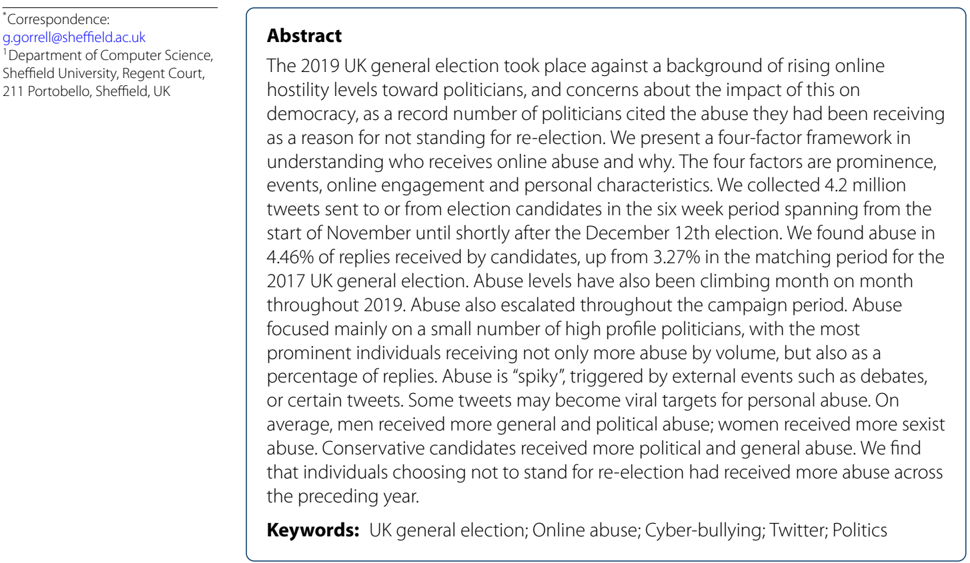
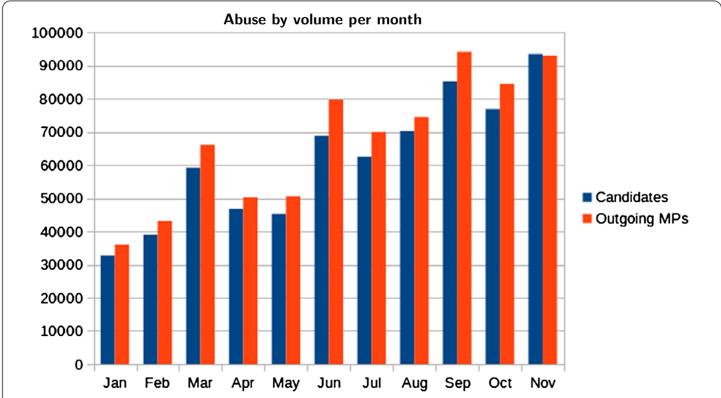
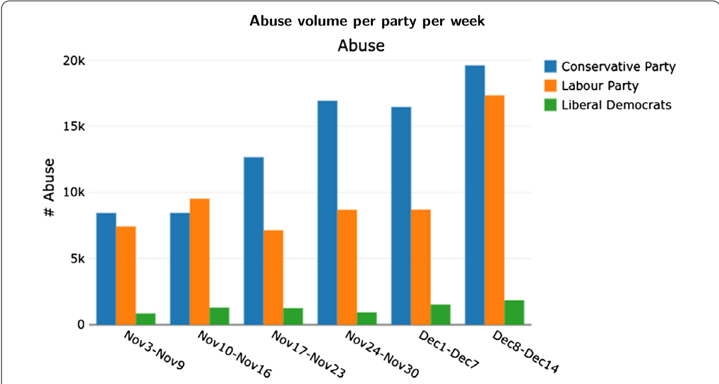
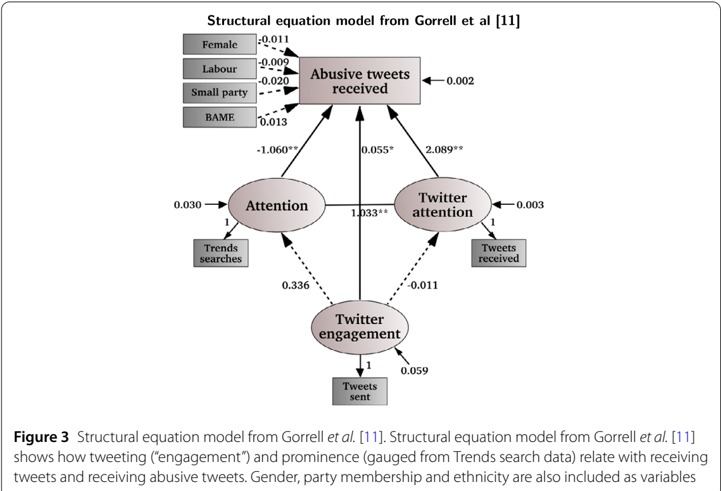
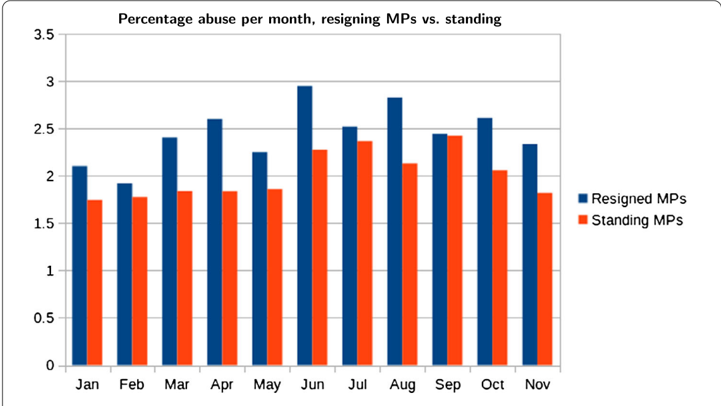
The 2019 UK general election took place against a background of rising online hostility levels toward politicians, and concerns about the impact of this on democracy, as a record number of politicians cited the abuse they had been receiving as a reason for not standing for re-election. We present a four-factor framework in understanding who receives online abuse and why. The four factors are prominence, events, online engagement and personal characteristics. We collected 4.2 million tweets sent to or from election candidates in the six week period spanning from the start of November until shortly after the December 12th election. We found abuse in 4.46% of replies received by candidates, up from 3.27% in the matching period for the 2017 UK general election. Abuse levels have also been climbing month on month throughout 2019. Abuse also escalated throughout the campaign period. Abuse focused mainly on a small number of high profile politicians, with the most prominent individuals receiving not only more abuse by volume, but also as a percentage of replies. Abuse is “spiky”, triggered by external events such as debates, or certain tweets. Some tweets may become viral targets for personal abuse. On average, men received more general and political abuse; women received more sexist abuse. Conservative candidates received more political and general abuse. We find that individuals choosing not to stand for re-election had received more abuse across the preceding year.
Overview
The claims and statistics of this paper haven’t been checked yet.
Free: it reads the open-access text and checks the first 5 claims that cite a source we can check. Create a free account to check every claim.
Integrity signals
Registry
Cites
Statistics
Figures
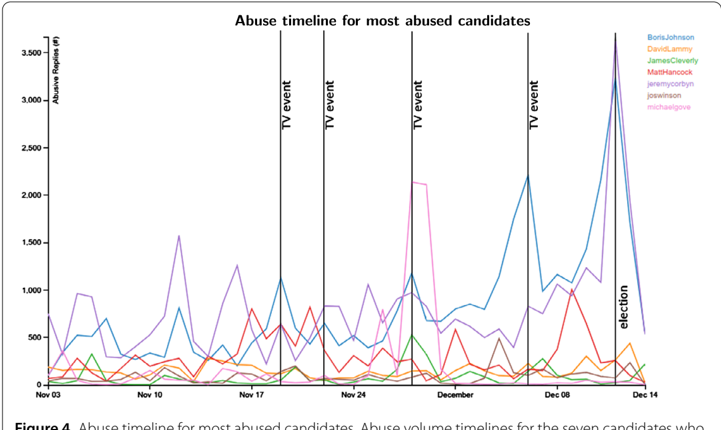
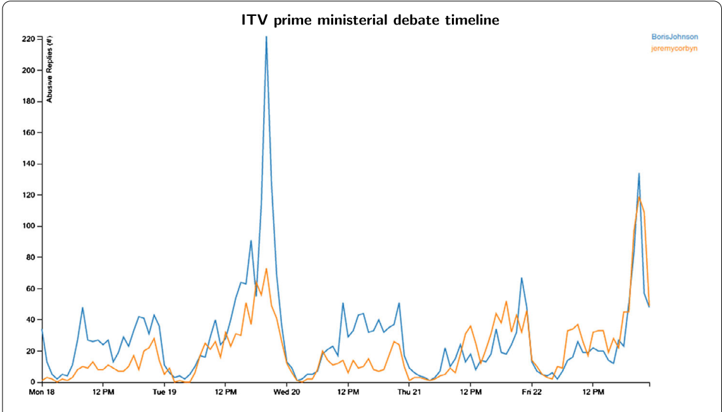
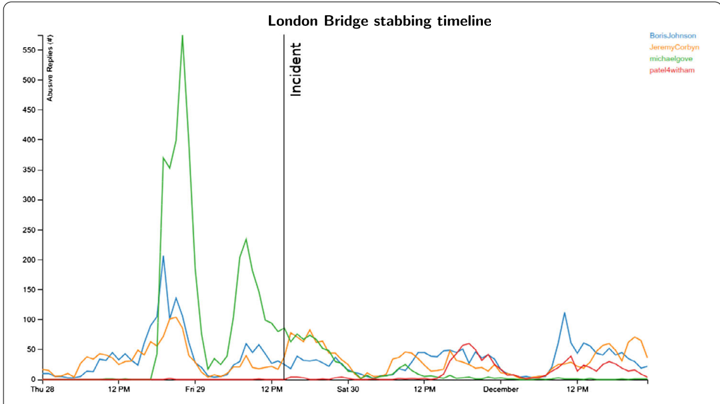
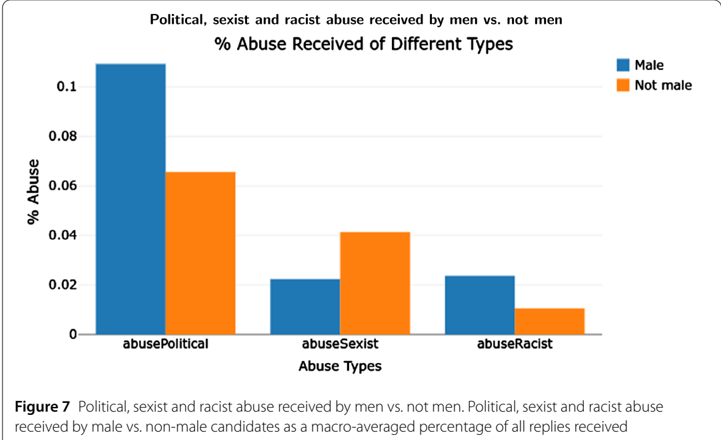
Verification
Claims the paper makes
The claims and statistics of this paper haven’t been checked yet.
Free: it reads the open-access text and checks the first 5 claims that cite a source we can check. Create a free account to check every claim.
Claims other papers make about this one
Each is checked against this paper’s own text: does it say what the citing paper says it does?
The source backs part of the claim, not all of it — or backs it for a different population, condition or comparison.
In the citing paper
“However, most of what people experience on a daily basis is more complex(Saleem etal. 2017; Gorrell etal. 2020).”
From Misogynoir: challenges in detecting intersectional hate (2022) · cites this paper as Gorrell et al. 2020
Experimental — accuracy not yet measured
Self-check
Percentages, sums and reported differences re-computed from the paper’s own numbers.
The self-check needs the paper’s full text.
Citations
Cites
Semantics derived automatically from language corpora contain human-like biases
Caliskan, A., Bryson, J. J., & Narayanan, A. (2017) · Science · doi:10.1126/science.aal4230 · Cited by 2,887
Equality of Opportunity in Supervised Learning
Hardt, M., Price, E., & Srebro, N. (2016) · arXiv · doi:10.48550/arxiv.1610.02413 · Cited by 2,536
A Survey on Hate Speech Detection using Natural Language Processing
Schmidt, A., & Wiegand, M. (2017) · Proceedings of the Fifth International Workshop on Natural Language Processing for Social Media · doi:10.18653/v1/w17-1101 · Cited by 1,395
A Survey on Automatic Detection of Hate Speech in Text
Fortuna, P., & Nunes, S. (2019) · ACM Computing Surveys · doi:10.1145/3232676 · Cited by 1,241
Detection of Abusive Language: the Problem of Biased Datasets
Wiegand, M., Ruppenhofer, J., & Kleinbauer, T. (2019) · Conference of the North American Chapter of the Association for Computational Linguistics: Human Language Technologies (NAACL-HLT) · doi:10.18653/v1/n19-1060 · Cited by 332
Reducing Gender Bias in Abusive Language Detection
Park, J. H., Shin, J., & Fung, P. (2018) · Proceedings of the 2018 Conference on Empirical Methods in Natural Language Processing · doi:10.18653/v1/d18-1302 · Cited by 323
Exploring Misogyny across the Manosphere in Reddit
Farrell, T., Fernandez, M., Novotny, J., & Alani, H. (2019) · Proceedings of the 10th ACM Conference on Web Science · doi:10.1145/3292522.3326045 · Cited by 265
Theocharis, Y., Barberá, P., Fazekas, Z., Popa, S. A., & Parnet, O. (2016) · Journal of Communication · doi:10.1111/jcom.12259 · Cited by 237
Politicians in the line of fire: Incivility and the treatment of women on social media
Rheault, L., Rayment, E., & Musulan, A. (2019) · Research & Politics · doi:10.1177/2053168018816228 · Cited by 233
Wimpy and undeserving of respect: Penalties for men’s gender-inconsistent success
Heilman, M. E., & Wallen, A. S. (2010) · Journal of Experimental Social Psychology · doi:10.1016/j.jesp.2010.01.008 · Cited by 231
Research works printed but not linked: 3
- Chaturvedi S (2016) I am a troll: inside the secret world of the BJP's digital army. Juggernaut Books, New Delhi
- Rijsbergen CJ (1979) Information retrieval, 2nd edn
- Bolukbasi T, Chang K-W, Zou JY, Saligrama V, Kalai AT (2016) Man is to computer programmer as woman is to homemaker? Debiasing word embeddings. In: Advances in neural information processing systems, pp 4349-4357
Cited by
Collignon, S., & Rüdig, W. (2021) · Journal of Elections Public Opinion and Parties · doi:10.1080/17457289.2021.1968413 · Cited by 78
Opinion dynamics of online social network users: a micro-level analysis
Kozitsin, I. (2021) · Journal of Mathematical Sociology · doi:10.1080/0022250x.2021.1956917 · Cited by 85
Gender and politics in a digitalised world: Investigating online hostility against UK female MPs
Esposito, E., & Breeze, R. (2022) · Discourse & Society · doi:10.1177/09579265221076608 · Cited by 71
“…of all kinds seems to have increased in step with a general polarisation of the political atmosphere since before the Brexit referendum, a significant proportion of the abuse received by politicians in this period was related to gender, ethnicity and other identity factors (Gorrell et al., 2019).”
BackgroundNölleke, D., Leonhardt, B., & Hanusch, F. (2023) · Public Understanding of Science · doi:10.1177/09636625221146749 · Cited by 62
On the dynamics of political discussions on Instagram: A network perspective
Ferreira, C. H. G., Murai, F., Silva, A. P. C., Almeida, J. M., Trevisan, M., Vassio, L., Mellia, M., & Drago, I. (2021) · Online Social Networks and Media · doi:10.1016/j.osnem.2021.100155 · Cited by 63
Detecting inorganic financial campaigns on Twitter
Tardelli, S., Avvenuti, M., Tesconi, M., & Cresci, S. (2021) · Information Systems · doi:10.1016/j.is.2021.101769 · Cited by 39
Misogynoir: challenges in detecting intersectional hate
Kwarteng, J., Perfumi, S. C., Farrell, T., Third, A., & Fernandez, M. (2022) · Social Network Analysis and Mining · doi:10.1007/s13278-022-00993-7 · Cited by 30
Håkansson, S. (2023) · Politics & Gender · doi:10.1017/s1743923x23000144 · Cited by 35
Celuch, M., Oksa, R., Ellonen, N., & Oksanen, A. (2023) · Information Communication & Society · doi:10.1080/1369118x.2023.2289978 · Cited by 32
“Discussing highly debated, controversial topics is also connected to more online abuse among academics, politicians, and media professionals alike (Gorrell et al., 2020; Gosse et al., 2021; Waisbord, 2020).”
InfluentialThe Cost of Debating Harassment Against Politicians: Are Women and Men Affected Equally?
Håkansson, S., & Grahn, M. (2025) · Political Behavior · doi:10.1007/s11109-025-10039-1 · Cited by 27
“…about 60 to 90% of MPs, mayors and candidates experience political violence in democratic contexts such as the US (Herrick et al. 2021; Herrick and Thomas 2022 ), UK (Collignon and Rüdig 2020, 2021; Gorrell et al. 2020), Sweden (Håkansson and Lajevardi 2024), and Denmark (Kosiara-Pedersen 2023 ).”
Carson, A., Mikołajczak, G., Ruppanner, L., & Foley, E. (2023) · Local Government Studies · doi:10.1080/03003930.2023.2228237 · Cited by 41
“Gorrell et al. (2020) found that on average, men experienced more incivility (i.e., receiving more general and political abuse) but women received more sexist abuse.”
BackgroundResultIndividual factors predicting reactions to online harassment among Finnish professionals
Celuch, M., Savela, N., Oksa, R., Latikka, R., & Oksanen, A. (2021) · Computers in Human Behavior · doi:10.1016/j.chb.2021.107022 · Cited by 29
Damage Control: How Campaign Teams Interpret and Respond to Online Incivility
Tenove, C., Tworek, H., Lore, G., Buffie, J., & Deley, T. (2022) · Political Communication · doi:10.1080/10584609.2022.2137743 · Cited by 23
“Candidates and elected officials also face considerable abuse and incivility on social media (Collignon & Rüdig, 2020; Gorrell et al., 2020; Theocharis et al., 2020).”
BackgroundHate Speech in Political Discourse: A Case Study of UK MPs on Twitter
Agarwal, P., Hawkins, O., Amaxopoulou, M., Dempsey, N., Sastry, N. R., & Wood, E. (2021) · ACM Conference on Hypertext and Social Media (HT) · doi:10.1145/3465336.3475113 · Cited by 38
Håkansson, S., & Lajevardi, N. (2024) · American Political Science Review · doi:10.1017/s000305542400100x · Cited by 22
“Gorrell et al. (2020) find that Muslim MPs in the United Kingdom are particularly targeted with racist rhetoric on Twitter, but the authors note that their sample of ethnic minority politicians is too small to draw general conclusions.”
Farrell, T., Gorrell, G., & Bontcheva, K. (2020) · Journal of Computational Social Science · doi:10.1007/s42001-020-00090-9 · Cited by 26
“We explore the four factors that contribute to how these dimensions are perceived, such as prominence, specific events, engagement habits and features of identity [25].”
BackgroundMethodInfluentialSelf-citationOnline Abuse of Politicians: Experimental Evidence on Politicians’ Own Perceptions
Pedersen, R. T., Petersen, N. B. G., & Thau, M. (2024) · Political Behavior · doi:10.1007/s11109-024-09944-8 · Cited by 24
“Sexism may sometimes be in the form of insults, for example the use of gendered slurs, but sexism may also be in the form of messages containing gender-stereotypes, objectifications or unsolicited sexual propositions (Gorrell et al., 2020; Raver & Nishii, 2010).”
InfluentialBauschke, R., & Jäckle, S. (2023) · Policy & Internet · doi:10.1002/poi3.335 · Cited by 23
Gender differences in online abuse: the case of Dutch politicians
van der Vegt, I. (2024) · Crime Science · doi:10.1186/s40163-024-00203-z · Cited by 17
“Finally, Gorrell et al. (2020) found that certain personal characteristics, such as political stance and gender, led to differences in the level and forms of abuse received.”
BackgroundResultInfluentialPolarizing publics in Twitter through organic targeting tactics of political incivility
Kountouri, F., & Kollias, A. (2023) · Frontiers in Political Science · doi:10.3389/fpos.2023.1110953 · Cited by 17
Vrielink, J., & van der Pas, D. (2024) · Political Studies Review · doi:10.1177/14789299241258099 · Cited by 14
“To cite Gorrell et al. (2020: 13–14) ‘when [women] do receive abuse the likelihood is much greater than for a man that this will focus on [their] body, and not [their] politics’.”
Pierri, F. (2024) · EPJ Data Science · doi:10.1140/epjds/s13688-024-00501-1 · Cited by 14
Unkel, J., & Kümpel, A. S. (2022) · Frontiers in Political Science · doi:10.3389/fpos.2022.809805 · Cited by 12
“…(Oz et al., 2018; Jaidka et al., 2019), post (Stroud et al., 2015; Theocharis et al., 2020), and person characteristics (Rheault et al., 2019; Gorrell et al., 2020) that lead users to leave incivil comments on political social media posts, we are lacking a comprehensive understanding of the…”
BackgroundInfluentialMisogynoir: public online response towards self-reported misogynoir
Kwarteng, J., Perfumi, S. C., Farrell, T., & Fernandez, M. (2021) · Proceedings of the 2021 IEEE/ACM International Conference on Advances in Social Networks Analysis and Mining · doi:10.1145/3487351.3488342 · Cited by 11
Gender, Religion, and Political Violence: Lessons from Muslim Women’s Experiences in UK Elections
Akhtar, P., Jenichen, A., & Intezar, H. (2024) · Politics & Gender · doi:10.1017/s1743923x24000175 · Cited by 11
“Gorrell et al. (2020), for example, found that politicians who had received more online abuse than their peers were more likely to decide against re-election.”
InfluentialStoll, A., Yu, J., Andrich, A., & Domahidi, E. (2025) · Communication Methods and Measures · doi:10.1080/19312458.2025.2551693 · Cited by 11
“…studies have shown that politicians are disproportionately subjected to online incivility that includes trolling, hate speech, negative sentiment, and extreme and emotionally charged language (e.g., Esposito & Breeze, 2022; Gorrell et al., 2020; Rheault et al., 2019; Southern & Harmer, 2021).”
Assessing the Politics of Debasement: From Impoliteness to Demonization in Political Communication
Feldman, O. (2023) · Springer eBooks · doi:10.1007/978-981-99-0467-9_1 · Cited by 12
The Role of Gender in Hate Speech Targeting Politicians: Evidence from Finnish Twitter
Meriläinen, J. (2024) · International Journal of Politics Culture and Society · doi:10.1007/s10767-024-09476-3 · Cited by 11
“For example, Lingiardi et al. (2020) used a lexicon-based approach, and Gorrell et al. (2020) used a rule-based approach for detecting hateful content.”
Hibbs, L. (2025) · Journal of Women Politics & Policy · doi:10.1080/1554477x.2025.2572265 · Cited by 7
“This can include gendered slurs and misogynistic hate speech as well as more serious forms of gendered violence like rape threats (Esposito and Breeze 2022; Fuchs and Schäfer 2021; Gorrell et al. 2020; Harmer and Southern 2021; Wagner 2022; Ward and McLoughlin 2020).”
Protecting public figures online: how do platforms and regulators define public figures?
Cover, R., Henry, N., Gleave, J., Greenfield, S., Grechyn, V., & Huynh, T. B. (2024) · Media International Australia · doi:10.1177/1329878x231225745 · Cited by 8
“Online abuse has resulted in a substantial number of women and minority public of fi cials leaving of fi ce (Erikson et al., 2021; Gorrell et al., 2020; Harmer and Southern, 2021).”
Watson, R., Hammans, L., Hansby, O., Barry‐Walsh, J., & Every‐Palmer, S. (2025) · Kōtuitui New Zealand Journal of Social Sciences Online · doi:10.1080/1177083x.2025.2473949 · Cited by 9
“Gorrell et al. (2020) identified several factors as increasing a politician’s likelihood of receiving abusive messages, including public pro-minence (Håkansson 2021), the politician being linked to specific events (Agarwal et al. 2019), how they engage online (e.g. engagement in opinionated…”
Harmer, E., & Southern, R. (2025) · Political Communication · doi:10.1080/10584609.2025.2585498 · Cited by 7
“The vast majority focus on Twitter (Esposito & Breeze, 2022; Gorrell et al., 2020; Southern & Harmer, 2019; Ward & McLoughlin, 2020), with some notable exceptions (Akhtar & Morrison, 2019; Esposito & Zollo, 2021; Phillips et al., 2023).”
Holm, M., Bjarnegård, E., & Zetterberg, P. (2024) · Politics & Gender · doi:10.1017/s1743923x24000163 · Cited by 5
“…receive more personal attacks including sexist and gendered slurs, objectifying comments about their appearance, and stereotypical claims about their characteristics, while men receive more general, political, and racist abuse (Fuchs and Schäfer 2021; Gorrell et al. 2020; Southern and Harmer 2021).”
InfluentialExposure to Online Abuse of Politicians Does Not Scare Citizens Away From Politics
Pedersen, R. T., Thau, M., & Petersen, N. B. G. (2025) · Journal of Experimental Political Science · doi:10.1017/xps.2024.20 · Cited by 6
van Dijk, R. E., & Kosiara‐Pedersen, K. (2025) · European Journal of Politics and Gender · doi:10.1332/25151088y2025d000000117 · Cited by 4
Intergroup Relations: The Level, Content, and Dynamics of Cooperation and Conflict Between Groups
Ellemers, N., & Scheepers, D. T. (2025) · doi:10.70400/mvrg3326 · Cited by 5
Burke-Moore, L., Williams, A. R., & Bright, J. (2025) · EPJ Data Science · doi:10.1140/epjds/s13688-025-00556-8 · Cited by 5
“However, there is no other platform that is widely used by all the groups in our study.”
Political Polarization, Political Hate Speech and Social Media: The Experience of Spanish Teenagers
Paz-Rebollo, M. A., Feijoo, B., & Rivera-Guerrero, A. (2026) · Young · doi:10.1177/11033088251414549 · Cited by 5
The security of politicians: towards a research agenda
Matthews, N., & Haughey, S. (2024) · Parliamentary Affairs · doi:10.1093/pa/gsae015 · Cited by 4
“Studies have examined the prevalence and form of political violence (James et al., 2016a; Gorrell et al. , 2020; Ward and McLoughlin 2020; Southern and Harmer 2021), its potential drivers (Stoker 2017; Clarke et al., 2018; Weinberg 2021a), its perpetrators (James et al., 2016a), and its impact on 4…”
BackgroundDecoding Dehumanization: Leveraging NLP to Identify Dehumanizing Language and Its Targets
Joshi, D. (2024) · International Conference on Natural Language Processing and Information Retrieval (NLPIR) · doi:10.1145/3711542.3711598 · Cited by 7
Bavel, A. V., Erzeel, S., & Celis, K. (2026) · Acta Politica · doi:10.1057/s41269-026-00421-0 · Cited by 3
‘Risky visibility’: the online harassment of queer politicians
Stephenson, E., Williams, B., Mikołajczak, G., & Hayes, J. (2025) · European Journal of Politics and Gender · doi:10.1332/25151088y2025d000000075 · Cited by 3
Marinin hallituksen ministereihin Twitterissä suunnattu vihapuhe
Meriläinen, J. (2022) · Prologi · doi:10.33352/prlg.122025 · Cited by 5
Target-Oriented Investigation of Online Abusive Attacks: A Dataset and Analysis
Alharthi, R., Alharthi, R., Shekhar, R., & Zubiaga, A. (2023) · IEEE Access · doi:10.1109/access.2023.3289148 · Cited by 6
When Does Fame Not Matter? Examining Gender Differences in Politicians’ Social Media Experiences
Lühiste, M., Praet, S., Popa, S. A., Theocharis, Y., Barberá, P., Fazekas, Z., & Tucker, J. A. (2025) · Politics & Gender · doi:10.1017/s1743923x25100111 · Cited by 4
“Abuse, threats and the normalization of a culture of intimidation, especially on social media, were explicitly mentioned by mostly female MPs (Gorrell et al., 2020).”
InfluentialManagerial approaches to mitigate police professionals’ online harms in the United Kingdom
Wong, Y. N., Horgan, S., & Aston, E. (2025) · Police Practice and Research · doi:10.1080/15614263.2025.2522835 · Cited by 3
“…al., 2020; Miller & Lewis, 2022; Sampaio-Dias et al., 2023; Waisbord, 2024), academics (O’Meara et al., 2024) and politicians (Erikson et al., 2023; Gorrell et al., 2020; Harmer & Southern, 2023; Ward & McLoughlin, 2020) have however highlighted increased risks of online victimisation due to the…”
The harassment of parliamentarians and judicial officers: a South Australian perspective
Anne, S., Gronthos, C., & Crouch, C. (2023) · Psychiatry Psychology and Law · doi:10.1080/13218719.2023.2222379 · Cited by 2
“Harassment experienced by public officials over social media is a growing concern linked with significant psychological harm and has been implicated in victims leaving positions of public office (Gorrell et al., 2020).”
Misogynistic targeting of women in power predicts broader online harassment patterns
Golbeck, J. (2024) · Computational and Mathematical Organization Theory · doi:10.1007/s10588-024-09387-w · Cited by 2
“To measure the frequency of slurs use among users in each group, we used the list of slurs provided at by the University of Sheffield at https:// gate-socme dia. sites. sheffi eld. ac. uk/ topics/ elect ions- hate-speech/ ge2019-suppl ement ary-mater ials (Gorrell et al. 2020).”
Intersectionality and the gendered discussion around Muslim Canadian politicians on Twitter
Al‐Rawi, A., Einifar, M., & Chun, W. H. K. (2023) · Journal of Language Aggression and Conflict · doi:10.1075/jlac.00086.alr · Cited by 2
MP Twitter Engagement and Abuse Post-first COVID-19 Lockdown in the UK: White PaperPreprint
Farrell, T., Bakir, M., & Bontcheva, K. (2021) · arXiv.org · doi:10.48550/arxiv.2103.02917 · Cited by 1
“May 2020 [2], Table 3 shows a comparative table for periods studied before and during the 2017 and 2019 General Elections.”
BackgroundMethodResultInfluentialSelf-citationBetween meme and reality: youth perceptions of politics and politicians in the digital age
Paz-Rebollo, M. A., Feijoo, B., & Nevado, J. I. (2026) · Journal of Youth Studies · doi:10.1080/13676261.2026.2614483 · Cited by 1
Silenced Voices: How Violence Marginalizes Women and Immigrant Politicians in Policy Debates
Håkansson, S., & Josefsson, C. (2026) · British Journal of Political Science · doi:10.1017/s0007123426101380 · Cited by 1
“…and how attacks differ when targeting women and men or ethnic minority and majority politicians (Bjarnegård 2018a; Bjarnegård et al. 2022; Gorrell et al. 2020; Håkansson 2021; Håkansson and Lajevardi 2025; Herrick et al. 2021; Herrick and Thomas 2023b; Kosiara-Pedersen 2023; Kuperberg…”
Citizen–Elite Toxicity and Political Equality Online
Belschner, J., & Sandberg, L. (2026) · Perspectives on Politics · doi:10.1017/s1537592726104976 · Cited by 1
De-democratising political representation: the impact of violence against politicians
Bavel, A. V., Celis, K., & Erzeel, S. (2026) · European Journal of Politics and Gender · doi:10.1332/25151088y2026d000000154 · Cited by 1
Holm, M., & Hunklinger, M. (2026) · Media and Communication · doi:10.17645/mac.12798 · Cited by 1
“Research has consistently shown that female politicians to a larger extent are exposed to personal attacks, including sexual slurs and degrading talk, while heterosexual ethnic majority men rather receive abuse that targets their politics (see e.g., Fuchs & Schäfer, 2021; Gorrell et al., 2020).”
Online Violence Against Women in Politics: Canada in a Comparative PerspectivePreprint
Bardall, G., & Tenove, C. (2024) · SocArXiv (OSF Preprints) · doi:10.31235/osf.io/cjqm2 · Cited by 1
Näthat och demokratiskt deltagande – en kunskapsöversikt
Svensson, M., Björkenfeldt, O., Åström, F., & Dahlstrand, K. (2021) · Lund University Publications (Lund University) · Cited by 3
Users Hate Blondes: Detecting Sexism in User Comments on Online Romanian News
Moldovan, A., Csürös, K., Bucur, A.-M., & Bercuci, L. (2022) · Workshop on Online Abuse and Harms (WOAH) · doi:10.18653/v1/2022.woah-1.21 · Cited by 1
“There are other similar approaches analysing how sexism manifests in different environments: at the workplace (Grosz and Céspedes, 2020), in the gaming communities (Ghosh, 2021), in politics (Gorrell et al., 2020; Fuchs and Schäfer, 2020).”
BackgroundMisogyny, Women in Power, and Patterns of Social Media Harassment
Golbeck, J. (2023) · Lecture notes in computer science · doi:10.1007/978-3-031-43129-6_1 · Cited by 1
Abuse in the time of COVID-19: the effects of Brexit, gender and partisanship
Bakir, M., Farrell, T., & Bontcheva, K. (2024) · Online information review (Print) · doi:10.1108/oir-07-2022-0392 · Cited by 1
Self-citationIn Safe Elections, Democracy Wins
Isotalo, V., & Wass, H. (2024) · Routledge eBooks · doi:10.4324/9781003452287-5
(2024) · Bristol University Press eBooks · doi:10.51952/9781529227024.bm001
Prevalence and Impact of Hate Speech among Politicians in Switzerland
Albrecht, J. N., Endrass, J., Dreifuss, M. S., Schnyder, N., & Rossegger, A. (2024) · Societies · doi:10.3390/soc14070098
“Similarly, Gorrell and colleagues [4] found that the number of abusive tweets that UK politicians received was associated with their decision to stand for re-election (or not).”
BackgroundSala, A., Vinagre, J., Esposito, E., Fortuna, P., Consonni, C., Porcaro, L., Bostelmann, G., & Gómez, E. (2025) · SocArXiv (OSF Preprints) · doi:10.31235/osf.io/8xmh9_v1
Sala, A., Vinagre, J., Esposito, E., Fortuna, P., Consonni, C., Porcaro, L., Bostelmann, G., & Gómez, E. (2025) · SocArXiv (OSF Preprints) · doi:10.31235/osf.io/8xmh9_v2
Skubic, J. (2025) · Contributions to Contemporary History · doi:10.51663/pnz.65.2.10
Williams, B., Stephenson, E., Mikołajczak, G., & Hayes, J. (2025) · Australian Journal of Political Science · doi:10.1080/10361146.2025.2574028
Celuch, M. (2025) · Kriminologia · doi:10.54332/krim.164314
Larsson, J. (2023) · Lund University Publications Student Papers (Lund University)
Aftermath of Abuse on the Internet : Reactions of targets and bystanders to online harassment
Celuch, M. (2024) · Tampere University Institutional Repository (Tampere University) · Cited by 2
Watson, S. (2025) · Emerald Group Publishing Limited eBooks · doi:10.1108/978-1-83549-724-120251013
Ehdokkaiden kokemukset vaalihäirinnästä
Isotalo, V., & Wass, H. (2026) · Tampere University Press eBooks · doi:10.61201/vzrggp05
Chen, L. (2026) · SZTE Repository of Dissertations (University of Szeged) · doi:10.14232/phd.12970
Victimological perspectives on police reporting among elected representatives in Sweden
Holm, F. (2026) · International Review of Victimology · doi:10.1177/02697580261458816
“Research indicates that various personal characteristics of politicians can increase vulnerability to violence with some suggesting that women may be more vulnerable than men (e.g. Håkansson, 2021; Krook, 2020), while others show the opposite (Gorrell et al., 2020; van der vegt, 2024).”
The impact of artificial intelligence on close protection and surveillance
van der Vegt, I. (2026) · Legal and Criminological Psychology · doi:10.1111/lcrp.70054
Deswert, C., Devroe, R., Storme, E., & Haute, É. V. (2026) · Political Studies · doi:10.1177/00323217261470570
A Non-Gendered Approach to a Gendered Problem: Violence Mitigation Policy in the Swedish Parliament
Erikson, J., & Håkansson, S. (2026) · Journal of Women Politics & Policy · doi:10.1080/1554477x.2026.2742127
Gajewska, E. (2026) · Corpus Pragmatics · doi:10.1007/s41701-026-00267-z
“We deploy a dedicated emotion classification model (Hutto & Gilbert, 2014) alongside established psychological lexicons (Gorrell et al., 2020 ; Wiegand et al., 2018) to score each utterance for both discrete emotional categories (e.g., anger, fear, joy) and overall emotional arousal.”
Metadata
- Authors
- Gorrell, G., Bakir, M. E., Roberts, I., Greenwood, M. A., & Bontcheva, K.
- Affiliations
- University of Sheffield (GB)
- Corresponding author
- Gorrell, Genevieve
- Venue
- EPJ Data Science
- Published
- 2020-07-02
- Volume
- 9
- Issue
- 1
- ISSN
- 2193-1127 (ISSN-L)
- OpenAlex
- W3039327525
- Semantic Scholar
- acadcbfe94294ca2747a05cb596897e0f41473d2
- Cited by
- 63
- References
- 28
- Citations by year
- 2026: 9 · 2025: 13 · 2024: 16 · 2023: 11 · 2022: 6 · 2021: 6 · 2020: 2
- FWCI
- 2.46
- Type
- journal article
- Language
- en
- Open access
- gold
- doi.org
- Licence
- cc-by
- creativecommons.org/licenses/by/4.0 (tdm)
- creativecommons.org/licenses/by/4.0 (vor)
- Locations
- EPJ Data Science (publishedVersion, cc-by)
- White Rose Research Online (University of Leeds, The University of Sheffield, University of York) (acceptedVersion)
- DOAJ (DOAJ: Directory of Open Access Journals) (submittedVersion, cc-by-sa)
- Funders
- Economic and Social Research Council (ES/T012714/1)
- Topics
- Physical Sciences › Computer Science › Artificial Intelligence › Hate Speech and Cyberbullying Detection
- Social Sciences › Communication › Social Media and Politics
- Social Sciences › Sociology and Political Science › Misinformation and Its Impacts
- Keywords
- 2019 UK general election, political campaigns, Twitter, political abuse, online engagement, gender differences in abuse, Conservative Party
About these checks
Registry, retraction, Cites and statistics results are computed, not judged, with one exception: a printed reference that no index lists is read once by a model before it counts as a citation error. Claims are extracted by a model and kept only when their quote appears verbatim in the text; each cited source is then checked, with a model’s help, for whether it says what the claim relies on. Those verdicts can be wrong — read the claim’s quote and the cited source before relying on one.
Statistics and arithmetic are recomputed, not judged.
Confidence bands are shown only for fields calibrated on our annotated test set. None is calibrated yet, so no band is shown.
What counts as a claim ›How we measure confidence ›How we check this ›
Are you an author, or do you see a problem with this page? Request a review
Data sources
Bibliographic data: Semantic Scholar, OpenAlex, Crossref.
Contains information from the Semantic Scholar Academic Graph Datasets, made available under the ODC Attribution License (ODC-BY 1.0).
Semantic Scholar’s data is described in: Kinney, R., et al. (2023). The Semantic Scholar Open Data Platform. arXiv:2301.10140.
