

The DOI matches its Crossref record; 7 of the 7 references it cites were found in a registry or an index.
Do holographic CFT states have unique semiclassical bulk duals?
Abstract
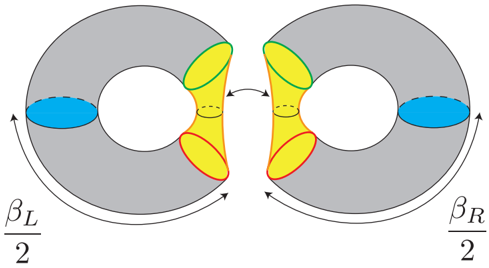
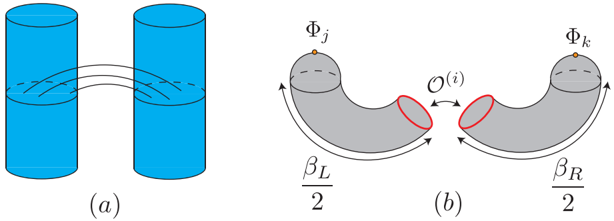
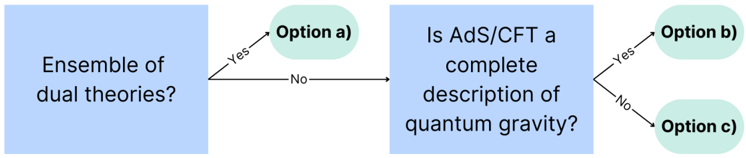
We discuss a situation where a holographic CFT state has multiple semiclassical bulk duals. In our example, a given holographic state has two simple, semiclassical descriptions, one with a closed universe, constructed using the gravitational path integral, and one without a closed universe, constructed using the extrapolate dictionary. This highlights an ambiguity in the AdS/CFT dictionary. We propose various options for resolving this tension although none is perfectly satisfactory. We also discuss what this implies for the black hole interior and the gravitational path integral.
Overview
The claims and statistics of this paper haven’t been checked yet.
Run the check — free, no account needed. It reads the open-access text and checks the sources it cites.
Integrity signals
Registry
Cites
Statistics
Figures

Verification
Claims the paper makes
The claims and statistics of this paper haven’t been checked yet.
Run the check — free, no account needed. It reads the open-access text and checks the sources it cites.
Claims other papers make about this one
Each is checked against this paper’s own text: does it say what the citing paper says it does?
In the citing paper
“In [61] a subset of us pointed out that there exists an alternative semiclassical description of the CFT state of interest.The idea is to absorb the universe into the state of the matter fields in the two AdS spaces, which according to (2.7) is”
From The baby universe is fine and the CFT knows it: on holography for closed universes (2025) · cites this paper as [61]
Self-check
Percentages, sums and reported differences re-computed from the paper’s own numbers.
The self-check needs the paper’s full text.
Citations
Cites
Black Holes: Complementarity or Firewalls?
Almheiri, A., Marolf, D., Polchinski, J., & Sully, J. (2012) · arXiv · doi:10.48550/arxiv.1207.3123 · Cited by 1,471
Entanglement wedge reconstruction and the information paradox
Penington, G. (2020) · Journal of High Energy Physics · doi:10.1007/jhep09(2020)002 · Cited by 968 · cited 1×
“Recent progress has led to the derivation of the Page curve, demonstrating unitarity of black hole evaporation, by using the gravitational Euclidean path integral [5–8].”
MethodReplica wormholes and the entropy of Hawking radiation
Almheiri, A., Hartman, T., Maldacena, J., Shaghoulian, E., & Tajdini, A. (2020) · Journal of High Energy Physics · doi:10.1007/jhep05(2020)013 · Cited by 910 · cited 1×
“Recent progress has led to the derivation of the Page curve, demonstrating unitarity of black hole evaporation, by using the gravitational Euclidean path integral [5–8].”
MethodThe Page curve of Hawking radiation from semiclassical geometry
Almheiri, A., Mahajan, R., Maldacena, J., & Zhao, Y. (2020) · Journal of High Energy Physics · doi:10.1007/jhep03(2020)149 · Cited by 898
Replica wormholes and the black hole interior
Penington, G., Shenker, S. H., Stanford, D., & Yang, Z. (2019) · arXiv · doi:10.48550/arxiv.1911.11977 · Cited by 809
Marolf, D., & Maxfield, H. (2020) · Journal of High Energy Physics · doi:10.1007/jhep08(2020)044 · Cited by 300 · cited 6×
“[17], Description 1 captures physics in the Hartle-Hawking state, whereas Description 2 represents a specific α -state in the baby universe Hilbert space.”
BackgroundInfluentialMeasurements without probabilities in the final state proposal
Bousso, R., & Stanford, D. (2014) · Physical Review D · doi:10.1103/physrevd.89.044038 · Cited by 25
Research works printed but not linked: 42
- 10.4310/ATMP.1998.v2.n2.a1 · DOI · Paper page
- 10.1088/0264-9381/26/22/224001 · DOI · Paper page
- 10.1007/JHEP02(2013)062 · DOI · Paper page
- 10.1007/JHEP09(2013)018 · DOI · Paper page
- 10.1007/JHEP12(2019)063 · DOI · Paper page
- 10.1007/JHEP03(2022)205 · DOI · Paper page
- 10.21468/SciPostPhys.12.1.029 · DOI
- 10.1007/JHEP04(2023)122 · DOI
- 10.1088/1361-6382/ac1082 · DOI · Paper page
- 10.1007/JHEP12(2022)069 · DOI
- 10.1007/JHEP03(2023)158 · DOI · Paper page
- 10.1007/JHEP02(2024)003 · DOI
- 10.1007/JHEP06(2024)155 · DOI · Paper page
- Chao R., 8th Innovations in Theoretical Computer Science Conf., 67, 1
- 10.1088/1126-6708/2004/02/053 · DOI · Paper page
- 10.1007/JHEP12(2021)156 · DOI
- 10.1007/JHEP03(2022)039 · DOI
- 10.1088/1361-6382/ad1d46 · DOI
- 10.1103/PhysRevLett.130.221601 · DOI
- 10.1007/JHEP02(2021)009 · DOI
- 10.1007/JHEP11(2020)111 · DOI
- 10.1103/PhysRevD.105.086012 · DOI
- 10.1103/PhysRevD.102.086009 · DOI
- 10.1007/JHEP06(2022)089 · DOI
- 10.1007/JHEP11(2023)188 · DOI · Paper page
- 10.1007/JHEP02(2019)156 · DOI
- Balasubramanian V., 2024, Phys. Rev. X, 14, 011024
- 10.1103/PhysRevD.102.066005 · DOI · Paper page
- 10.1007/JHEP09(2018)114 · DOI
- 10.4310/ATMP.1998.v2.n2.a2 · DOI · Paper page
- 10.1103/PhysRevD.86.105043 · DOI
- 10.1088/0264-9381/30/2/025001 · DOI · Paper page
- 10.1103/PhysRevD.102.106019 · DOI · Paper page
- 10.1038/s41550-019-0906-9 · DOI · Paper page
- 10.1103/PhysRevD.103.063529 · DOI · Paper page
- 10.1103/PhysRevLett.117.021601 · DOI · Paper page
- 10.1103/PhysRevD.100.126006 · DOI
- 10.1088/1126-6708/2004/02/008 · DOI · Paper page
- 10.21468/SciPostPhys.12.5.157 · DOI · Paper page
- 10.1007/JHEP02(2025)150 · DOI · Paper page
- 10.1016/0550-3213(78)90161-X · DOI · Paper page
- 10.1007/JHEP07(2022)108 · DOI
Cited by
Sorted by citations
The baby universe is fine and the CFT knows it: on holography for closed universes
Antonini, S., Rath, P., Sasieta, M., Swingle, B., & Vilar López, A. (2025) · Journal of High Energy Physics · doi:10.1007/jhep12(2025)159 · Cited by 35
Self-citationFurther Evidence Against a Semiclassical Baby Universe in AdS/CFT
Engelhardt, N., & Gesteau, E. (2025) · arXiv · doi:10.48550/arxiv.2504.14586 · Cited by 28
Metadata
- Authors
- Antonini, S., & Rath, P.
- Venue
- International Journal of Modern Physics D
- Publisher
- World Scientific Pub Co Pte Ltd
- Published
- 2025-09-29
- Volume
- 34
- Issue
- 16
- ISSN
- 0218-2718
- 1793-6594
- Cited by
- 18
- References
- 7
- Language
- en
- Funders
- the Department of Energy, Office of Science, Office of High Energy Physics (DE-SC0019380)
- the U.S. Department of Energy (DE-FOA-0002563)
About these checks
Registry, retraction, Cites and statistics results are computed, not judged, with one exception: a printed reference that no index lists is read once by a model before it counts as a citation error. Claims are extracted by a model and kept only when their quote appears verbatim in the text; each cited source is then checked, with a model’s help, for whether it says what the claim relies on. Those verdicts can be wrong — read the claim’s quote and the cited source before relying on one.
Statistics and arithmetic are recomputed, not judged.
Confidence bands are shown only for fields calibrated on our annotated test set. None is calibrated yet, so no band is shown.
What counts as a claim ›How we measure confidence ›How we check this ›
Are you an author, or do you see a problem with this page? Request a review
