

Examining Joy of Use and Usability During Mobile Phone Interactions within a Multimodal Methods Approach
Open accessThe DOI matches its Crossref record; 34 of the 34 references it cites were found in a registry or an index.
Abstract
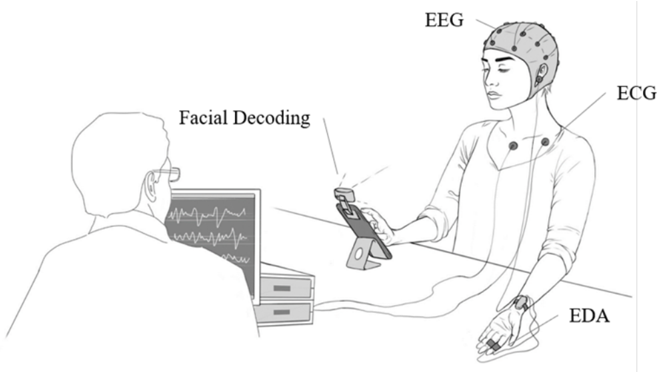
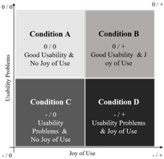
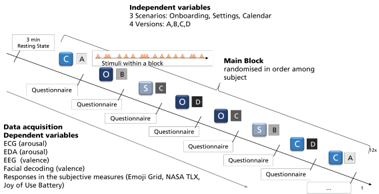
Objective: We investigate experienced joy of use (JoU) and usability using a multimodal methods approach by systematically varying mobile phone interactions. Methods: We combined subjective and objective measures to investigate whether positive emotional experiences and moments of joy during the interaction can be distinguished from neutral and negative emotional experiences. In a study with 30 participants, electroencephalography (EEG), electrocardiography (ECG), electrodermal activity (EDA), facial emotion recognition, and questionnaires were used. Results: There were greater positive experiences in interactions designed to elicit JoU, even under bad usability. We did not observe a difference between the conditions in the EEG indices. However, a higher heart rate and components in the EDA phasic response as well as facial muscle activity associated with anger were linked to good usability combined with no JoU. Conclusion: The multimodal methods approach reveals great potential to investigate JoU and usability in naturalistic scenarios. Application: The developed framework provides a groundwork to evaluate and improve interactions with technology. Thereby, users and their emotional experiences are placed at the centre when designing user interfaces. By detecting moments of joy, this approach can support a better understanding of how technology can be purposefully designed for joyful experiences.
Overview
The claims and statistics of this paper haven’t been checked yet.
Free: it reads the open-access text and checks the first 5 claims that cite a source we can check. Create a free account to check every claim.
Integrity signals
Registry
Cites
Statistics
Figures
Verification
Claims the paper makes
The claims and statistics of this paper haven’t been checked yet.
Free: it reads the open-access text and checks the first 5 claims that cite a source we can check. Create a free account to check every claim.
Claims other papers make about this one
Each is checked against this paper’s own text: does it say what the citing paper says it does?
The source backs part of the claim, not all of it — or backs it for a different population, condition or comparison.
In the citing paper
“Likewise, in immersive or emotional scenarios such as those addressed in [13,16,29], visual ergonomics is reflected through interfaces that balance stimulation and simplicity: coherent visual narratives, controlled visual focus, non-intrusive colors, and navigation paths guided by the user's attention.”
From The Impact of User Interface and Experience (UI/UX) Design on Visual Ergonomics: A Technical Approach for Reducing Human Error in Industrial Settings (2026) · cites this paper as [29]
Experimental — accuracy not yet measuredThe source backs part of the claim, not all of it — or backs it for a different population, condition or comparison.
In the citing paper
“Sectors such as healthcare and technical education require simplicity and easy navigation to lower cognitive load [13,16,18,26,29].”
From The Impact of User Interface and Experience (UI/UX) Design on Visual Ergonomics: A Technical Approach for Reducing Human Error in Industrial Settings (2026) · cites this paper as [29]
Experimental — accuracy not yet measuredThe source backs part of the claim, not all of it — or backs it for a different population, condition or comparison.
In the citing paper
“Third, while studies report immediate improvements in accuracy or efficiency, few assess the sustainability of these benefits over the medium or long term or consider demographic factors like age or specific visual conditions [3,29].”
From The Impact of User Interface and Experience (UI/UX) Design on Visual Ergonomics: A Technical Approach for Reducing Human Error in Industrial Settings (2026) · cites this paper as [29]
Experimental — accuracy not yet measuredThe cited source says what the claim attributes to it.
In the citing paper
“In contrast, studies [6,8,16,28,29] address intermediate or non-specialized users, whether university students, mobile users or digital collaborators.”
From The Impact of User Interface and Experience (UI/UX) Design on Visual Ergonomics: A Technical Approach for Reducing Human Error in Industrial Settings (2026) · cites this paper as [29]
The check wasn’t confident either way, so it gives no verdict — never disputed.
In the citing paper
“Articles such as [6,8,16,26,29] reveal that the absence of a clear visual structure, feedback, or functional coding leads to misunderstandings, omissions, and navigation errors.”
From The Impact of User Interface and Experience (UI/UX) Design on Visual Ergonomics: A Technical Approach for Reducing Human Error in Industrial Settings (2026) · cites this paper as [29]
Experimental — accuracy not yet measured
1 more claim about this paper
Create a free account to see every claim other papers make about this one.
Self-check
Percentages, sums and reported differences re-computed from the paper’s own numbers.
The self-check needs the paper’s full text.
Citations
Cites
Statistical Power Analysis for the Behavioral Sciences
Muller, K. (1989) · Technometrics · doi:10.1080/00401706.1989.10488618 · Cited by 99,167
Russell, J. A. (1980) · Journal of Personality and Social Psychology · doi:10.1037/h0077714 · Cited by 16,334 · cited 1×
“The circumplex model of affect [63] suggests that affective states are composed by two diametric neurophysiological systems, namely (a) valence (i.e., continuous evaluation of pleasant vs. un-pleasant states) and, (b) arousal (i.e., continuous measure of physical activation; see [59], for a review).”
BackgroundA Real-Time QRS Detection Algorithm
Pan, J., & Tompkins, W. J. (1985) · IEEE Transactions on Biomedical Engineering · doi:10.1109/tbme.1985.325532 · Cited by 7,855 · cited 1×
“Peaks were detected following Pan and Tompkins [53].”
Autonomic nervous system activity in emotion: a review
Kreibig, S. D. (2010) · Biological Psychology · doi:10.1016/j.biopsycho.2010.03.010 · Cited by 3,188 · cited 1×
“Previous research has revealed that experiencing negative emotions is associated with increased HR, whereas positive emotions display rather ambivalent HR responses [17, 39].”
BackgroundMNE software for processing MEG and EEG data
Gramfort, A., Luessi, M., Larson, E., Engemann, D. A., Strohmeier, D., Brodbeck, C., Parkkonen, L., & Hämäläinen, M. S. (2014) · NeuroImage · doi:10.1016/j.neuroimage.2013.10.027 · Cited by 1,951
What is satisfying about satisfying events? Testing 10 candidate psychological needs.
Sheldon, K. M., Elliot, A. J., Kim, Y., & Kasser, T. (2001) · Journal of Personality and Social Psychology · doi:10.1037/0022-3514.80.2.325 · Cited by 1,694 · cited 2×
“Psychological needs were measured on a 5-point Likert scale using the meCUE luxury subscale [48], and an adapted version of the need-based questionnaire for the items examining competence, relatedness, and autonomy [67].”
BackgroundMethodAttrakDiff: Ein Fragebogen zur Messung wahrgenommener hedonischer und pragmatischer Qualität
Hassenzahl, M., Burmester, M., & Koller, F. (2003) · Berichte des German Chapter of the ACM · doi:10.1007/978-3-322-80058-9_19 · Cited by 955
Needs, affect, and interactive products – Facets of user experience
Hassenzahl, M., Diefenbach, S., & Göritz, A. (2010) · Interacting with Computers · doi:10.1016/j.intcom.2010.04.002 · Cited by 867
Chaumon, M., Bishop, D. V. M., & Busch, N. A. (2015) · Journal of Neuroscience Methods · doi:10.1016/j.jneumeth.2015.02.025 · Cited by 833 · cited 1×
“Artefact-contaminated components were manually selected after visual inspection of the topography, times course, and power spectral intensity [10, 31].”
MethodDesigning Pleasurable Products
Jordan, P. W. (2000) · CRC Press eBooks · doi:10.4324/9780203305683 · Cited by 645
Neural Correlates of Positive and Negative Emotion Regulation
Kim, S. H., & Hamann, S. (2007) · Journal of Cognitive Neuroscience · doi:10.1162/jocn.2007.19.5.776 · Cited by 615 · cited 1×
“The frontal alpha asymmetry (FAA) measured in EEG is well-suited as an index distinguishing positive and negative emotions [2, 36, 37, 73].”
BackgroundResting frontal brain asymmetry predicts affective responses to films.
Tomarken, A. J., Davidson, R. J., & Henriques, J. B. (1990) · Journal of Personality and Social Psychology · doi:10.1037//0022-3514.59.4.791 · Cited by 444 · cited 1×
“The frontal alpha asymmetry (FAA) measured in EEG is well-suited as an index distinguishing positive and negative emotions [2, 36, 37, 73].”
BackgroundAhern, G. L., & Schwartz, G. E. (1985) · Neuropsychologia · doi:10.1016/0028-3932(85)90081-8 · Cited by 437 · cited 2×
“The frontal alpha asymmetry (FAA) measured in EEG is well-suited as an index distinguishing positive and negative emotions [2, 36, 37, 73].”
BackgroundSzajnberg, N. M. (2022) · Journal of the American Psychoanalytic Association · doi:10.1177/00030651221107681 · Cited by 425
Estimating workload using EEG spectral power and ERPs in the n-back task
Brouwer, A.-M., Hogervorst, M. A., van Erp, J. B. F., Heffelaar, T., Zimmerman, P. H., & Oostenveld, R. (2012) · Journal of Neural Engineering · doi:10.1088/1741-2560/9/4/045008 · Cited by 407 · cited 1×
“We calculated the WL-index [7, 20, 35, 54] by dividing the average theta band power in Fz by the average power in the alpha band of Pz: WL = Frontal Theta Band Parietal Alpha Band (1) The EI-index associated with visuo-motoric information processing and coordination was calculated according to Pope…”
MethodMeasuring workload of ICU nurses with a questionnaire survey: the NASA Task Load Index (TLX)
Hoonakker, P., Carayon, P., Gurses, A. P., Brown, R., Khunlertkit, A., McGuire, K., & Walker, J. M. (2011) · IIE Transactions on Healthcare Systems Engineering · doi:10.1080/19488300.2011.609524 · Cited by 384 · cited 1×
“(2) The Nasa Task Load Index (TLX; [32]) examines usability factors on an adapted sliding scale ranging from 0 to 100.”
BackgroundLipponen, J. A., & Tarvainen, M. P. (2019) · Journal of Medical Engineering & Technology · doi:10.1080/03091902.2019.1640306 · Cited by 364 · cited 1×
“The ECG signal was band-pass filtered between 5 and 15 Hz using a third order Butterworth filter and artefact-corrected according to Lipponen and Tarvainen [41].”
MethodFacial expression analysis with AFFDEX and FACET: A validation study
Stöckli, S., Schulte-Mecklenbeck, M., Borer, S., & Samson, A. C. (2018) · Behavior Research Methods · doi:10.3758/s13428-017-0996-1 · Cited by 294 · cited 1×
“For the facial expression recognition, we explored the AFFDEX algorithm classifying seven basic emotions [70].”
MethodAFFDEX SDK: A Cross-Platform Real-Time Multi-Face Expression Recognition Toolkit
McDuff, D., Mahmoud, A., Mavadati, M., Amr, M., Turcot, J., & Kaliouby, R. E. (2016) · Proceedings of the 2016 CHI Conference Extended Abstracts on Human Factors in Computing Systems · doi:10.1145/2851581.2890247 · Cited by 280 · cited 1×
“Recent studies revealed the potential of facial expressions to predict consumer liking, preference, and intent to purchase a product [47, 64].”
BackgroundVisual product evaluation: exploring users’ emotional relationships with products
McDonagh, D., Bruseberg, A., & Haslam, C. (2002) · Applied Ergonomics · doi:10.1016/s0003-6870(02)00008-x · Cited by 227 · cited 1×
“When we interact with technology, it is the experienced emotions, such as joy or frustration that determine how we evaluate the interaction and the product itself [42, 46].”
BackgroundBrain oscillatory 4–30 Hz responses during a visual n-back memory task with varying memory load
Pesonen, M., Hämäläinen, H., & Krause, C. M. (2007) · Brain Research · doi:10.1016/j.brainres.2006.12.076 · Cited by 215 · cited 2×
“We calculated the WL-index [7, 20, 35, 54] by dividing the average theta band power in Fz by the average power in the alpha band of”
MethodHassenzahl, M., Wiklund-Engblom, A., Bengs, A., Hägglund, S., & Diefenbach, S. (2015) · International Journal of Human-Computer Interaction · doi:10.1080/10447318.2015.1064664 · Cited by 167 · cited 1×
“It is determined by (i) aesthetic properties [5, 11, 79], (ii) moments of »Wow« (i.e., positively perceived surprise, [74]), and (iii) fulfilment of individual needs [28, 56, 68].”
BackgroundHedonic and pragmatic halo effects at early stages of User Experience
Minge, M., & Thüring, M. (2017) · International Journal of Human-Computer Studies · doi:10.1016/j.ijhcs.2017.07.007 · Cited by 161 · cited 1×
“They are associated with both a hedonic, beautiful is useful, as well as a pragmatic halo effect, useful is beautiful [49].”
BackgroundFacets of simplicity for the smartphone interface: A structural model
Choi, J. H., & Lee, H.-J. (2012) · International Journal of Human-Computer Studies · doi:10.1016/j.ijhcs.2011.09.002 · Cited by 159 · cited 1×
“It is determined by (i) aesthetic properties [5, 11, 79], (ii) moments of »Wow« (i.e., positively perceived surprise, [74]), and (iii) fulfilment of individual needs [28, 56, 68].”
BackgroundBriesemeister, B. B., Tamm, S., Heine, A., & Jacobs, A. M. (2013) · Psychology · doi:10.4236/psych.2013.43a039 · Cited by 139 · cited 1×
“Stimuli rated as positive are associated with greater relative left-hemispheric alpha activation in frontal electrodes, while stimuli rated as negative reveal greater relative right-hemispheric frontal activation [2, 6, 9].”
BackgroundOcklenburg, S., Friedrich, P., Schmitz, J., Schlüter, C., Genç, E., Güntürkün, O., Peterburs, J., & Grimshaw, G. M. (2018) · Laterality Asymmetries of Body Brain and Cognition · doi:10.1080/1357650x.2018.1543314 · Cited by 60 · cited 1×
“All participants had normal or corrected-to-normal vision and were screened for their suitability to participate in an EEG study, to be right-handed (since influences of handedness on hemispheric asymmetry cannot be excluded; [52]), and to show adequate language skills.”
BackgroundThe EmojiGrid as a Tool to Assess Experienced and Perceived Emotions
Toet, A., & van Erp, J. B. F. (2019) · Psych · doi:10.3390/psych1010036 · Cited by 55 · cited 1×
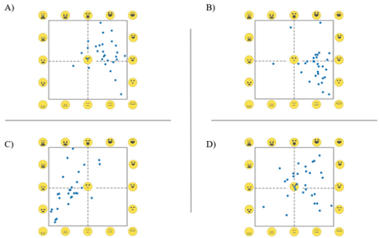
“Subscales comprised the following constructs: (1) Arousal and valence were examined on a continuous visual scale ranging from 0 to 9 via the Emoji Grid [72].”
MethodMensch und Computer 2015 - Usability Professionals
Endmann, A., Fischer, H., & Krökel, M. (2015) · De Gruyter eBooks · doi:10.1515/9783110443882 · Cited by 54
From doing to being: getting closer to the user experience
Wilson, G. M., & Sasse, M. A. (2004) · Interacting with Computers · doi:10.1016/j.intcom.2004.06.001 · Cited by 39 · cited 1×
“While physiological measures such as heart rate variability or electrodermal activity are well-suited to capture arousal [19, 43, 77], neurophysiological methods measuring brain activity (e.g., captured via EEG recordings) allow identifying differences in valence (e.g., [9]).”
BackgroundUser perceptions of Wow experiences and design implications for Cloud services
Väänänen, K., Palviainen, J., Pakarinen, S., Lagerstam, E., & Kangas, E. (2011) · Conference on Designing Pleasurable Products and Interfaces (DPPI) · doi:10.1145/2347504.2347573 · Cited by 20 · cited 2×
“It is determined by (i) aesthetic properties [5, 11, 79], (ii) moments of »Wow« (i.e., positively perceived surprise, [74]), and (iii) fulfilment of individual needs [28, 56, 68].”
BackgroundElectrophysiological Measures Applied in User Experience Studies
Yan, G. E., Chen, Y., Yanfang, L. I. U., Wen, L. I., & Xianghong, S. U. N. (2014) · Advances in Psychological Science · doi:10.3724/sp.j.1042.2014.00959 · Cited by 17 · cited 1×
“While physiological measures such as heart rate variability or electrodermal activity are well-suited to capture arousal [19, 43, 77], neurophysiological methods measuring brain activity (e.g., captured via EEG recordings) allow identifying differences in valence (e.g., [9]).”
BackgroundEine modulare Erweiterung des User Experience Questionnaire
Schrepp, M., & Thomaschewski, J. (2019) · Hochschulschriftenserver der Hochschule Emden/Leer · doi:10.18420/muc2019-up-0108 · Cited by 12 · cited 1×
“(3) The Extended User Experience Questionnaire (UEQ+; [65]) was used to assess visual aesthetics, as well as Wow, the latter via the subscale originality and stimulation, on a 7-point Likert scale.”
MethodMinge, M., Riedel, L., & Thüring, M. (2013) · Cited by 10
Oscillatory EEG Signatures of Affective Processes during Interaction with Adaptive Computer Systems
Vukelić, M., Lingelbach, K., Pollmann, K., & Peißner, M. (2020) · Brain Sciences · doi:10.3390/brainsci11010035 · Cited by 7 · cited 1×
“…time-frequency and spatially resolved oscillatory EEG measures, such as event-related spectral perturbation and functional connectivity analysis, might reveal higher sensitivity and distinctiveness for detecting affective experiences during the interaction with more naturalistic stimuli [66, 76].”
BackgroundSelf-citation
Research works printed but not linked: 44
- ISO 9241-11: 2018. 2018. Ergonomics of Human-System Interaction-Part 11: Usability: Definitions and Concepts.
- David Bethge, Thomas Kosch, Tobias Grosse-Puppendahl, Lewis L Chuang, Mo- hamed Kari, Alexander Jagaciak, and Albrecht Schmidt. 2021. VEmotion: Using Driving Context for Indirect Emotion Prediction in Real-Time. In The 34th An- nual ACM Symposium on User Interface Software and Technology. Association for Computing Machinery, New York, NY, United States, 638-651.
- Upasna Bhandari, Klarissa Chang, and Tillmann Neben. 2019. Understanding the impact of perceived visual aesthetics on user evaluations: An emotional perspective. Information & management 56, 1 (2019), 85-93.
- Jing Chai, Yan Ge, Yanfang Liu, Wen Li, Lei Zhou, Lin Yao, and Xianghong Sun. 2014. Application of frontal EEG asymmetry to user experience research. In International conference on engineering psychology and cognitive ergonomics. Springer, Springer, Berlin/Heidelberg, Germany, 234-243.
- Frédéric Dehais, Raphaëlle N Roy, Gautier Durantin, Thibault Gateau, and Daniel Callan. 2017. EEG-engagement index and auditory alarm misperception: an inattentional deafness study in actual flight condition. In International Conference on Applied Human Factors and Ergonomics. Springer, Springer, Berlin/Heidelberg, Germany, 227-234.
- Pieter Desmet and Steven Fokkinga. 2020. Beyond Maslow's pyramid: introducing a typology of thirteen fundamental needs for human-centered design. Multimodal technologies and interaction 4, 3 (2020), 38.
- PMA Desmet, Rick Porcelijn, and MB Van Dijk. 2005. HOW to design WOW? Introducing a layered-emotional approach. In Proceedings of The International Conference on Designing Pleasurable Products and Interfaces. Association for Com- puting Machinery, New York, NY, United States, 24-27.
- Paul Ekman. 1992. An argument for basic emotions. Cognition & emotion 6, 3-4 (1992), 169-200.
- Paul Ekman, Robert W Levenson, and Wallace V Friesen. 1983. Autonomic nervous system activity distinguishes among emotions. science 221, 4616 (1983), 1208-1210.
- Nora Fronemann and Matthias Peissner. 2014. User experience concept explo- ration: user needs as a source for innovation. In Proceedings of the 8th nordic conference on human-computer interaction: Fun, fast, foundational. Association for Computing Machinery, New York, NY, United States, 727-736.
- Alan Gevins, Michael E Smith, Linda McEvoy, and Daphne Yu. 1997. High- resolution EEG mapping of cortical activation related to working memory: effects of task difficulty, type of processing, and practice. Cerebral cortex (New York, NY: 1991) 7, 4 (1997), 374-385.
- Alice Gross and Johanna Silvennoinen. 2014. Surprise as a design strategy in goal-oriented mobile applications. In Advances in Human Factors and Ergonomics 2014. The Applied Human Factors and Ergonomics Conference, CRC Press, Boca Raton, Florida, FL, 4716-4726.
- Alice Gross and Manfred Thüring. 2013. Encountering the Unexpected: In- fluencing User Experience through Surprise.. In UMAP Workshops. Springer, Berlin/Heidelberg, Germany, 1-7.
- Marc Hassenzahl. 2007. The hedonic/pragmatic model of user experience. Towards a UX manifesto 10 (2007), 10-14.
- Marc Hassenzahl. 2018. A personal journey through user experience. Journal of Usability Studies 13, 4 (2018), 168-176.
- Marc Hassenzahl, Michael Burmester, and Franz Koller. 2003. AttrakDiff: A questionnaire to measure perceived hedonic and pragmatic quality. In Mensch & Computer, Vol. 57. Springer, Springer, Berlin/Heidelberg, Germany, 187-196.
- Douglas Heaven. 2020. Why faces don't always tell the truth about feelings. Nature 578, 7796 (2020), 502-505.
- Frederick Herzberg, Bernard Mausner, and Barbara B Snyderman. 1959. The Motivation to Work. Vol. 195. John Wiley & Sons Inc., New York, NY, United States.
- Joerg F Hipp and Markus Siegel. 2013. Dissociating neuronal gamma-band activity from cranial and ocular muscle activity in EEG. Frontiers in human neuroscience -, -(2013), 338.
- Altyngul T Kamzanova, Almira M Kustubayeva, and Gerald Matthews. 2014. Use of EEG workload indices for diagnostic monitoring of vigilance decrement. Human factors 56, 6 (2014), 1136-1149.
- Min-Ki Kim, Miyoung Kim, Eunmi Oh, and Sung-Phil Kim. 2013. A review on the computational methods for emotional state estimation from the human EEG. Computational and mathematical methods in medicine 2013 (2013), 1-13.
- Thomas Kosch, Mariam Hassib, Robin Reutter, and Florian Alt. 2020. Emotions on the go: Mobile emotion assessment in real-time using facial expressions. In Pro- ceedings of the International Conference on Advanced Visual Interfaces. Association for Computing Machinery, New York, NY, United States, 1-9.
- Te-Won Lee, Mark Girolami, and Terrence J Sejnowski. 1999. Independent com- ponent analysis using an extended infomax algorithm for mixed subgaussian and supergaussian sources. Neural computation 11, 2 (1999), 417-441.
- Sascha Mahlke and Gitte Lindgaard. 2007. Emotional experiences and quality per- ceptions of interactive products. In International Conference on Human-Computer Interaction. Springer, Springer, Berlin/Heidelberg, Germany, 164-173.
- Marco Maier, Daniel Elsner, Chadly Marouane, Meike Zehnle, and Christoph Fuchs. 2019. DeepFlow: Detecting Optimal User Experience From Physiological Data Using Deep Neural Networks. In AAMAS. International Joint Conferences on Artificial Intelligence, California, CA, United States, 2108-2110.
- Dominique Makowski, Tam Pham, Zen J Lau, Jan C Brammer, François Lespinasse, Hung Pham, Christopher Schölzel, and SH Chen. 2021. NeuroKit2: A Python toolbox for neurophysiological signal processing. Behavior research methods 53, 4 (2021), 1689-1696.
- Slobodan Marković. 2012. Components of aesthetic experience: aesthetic fas- cination, aesthetic appraisal, and aesthetic emotion. i-Perception 3, 1 (2012), 1-17.
- John Mingers. 2001. Combining IS research methods: towards a pluralist method- ology. Information systems research 12, 3 (2001), 240-259.
- Richard E Nisbett and Timothy D Wilson. 1977. Telling more than we can know: Verbal reports on mental processes. Psychological review 84, 3 (1977), 231.
- Rosalind W Picard. 2011. Measuring affect in the wild. In International con- ference on affective computing and intelligent interaction. Springer, Springer, Berlin/Heidelberg, Germany, 3-3.
- Anna E Pohlmeyer, Martin Hecht, and Lucienne Blessing. 2009. User experi- ence lifecycle model ContinUE [continuous user experience]. Der Mensch im Mittepunkt technischer Systeme. Fortschritt-Berichte VDI Reihe 22 (2009), 314-317.
- Kathrin Pollmann, Oilver Stefani, Amelie Bengsch, Matthias Peissner, and Math- ias Vukelić. 2019. How to work in the car of the future? A neuroergonomical study assessing concentration, performance and workload based on subjective, behavioral and neurophysiological insights. In Proceedings of the 2019 CHI Con- ference on Human Factors in Computing Systems. Association for Computing Machinery, New York, NY, United States, 1-14.
- Alan T Pope, Edward H Bogart, and Debbie S Bartolome. 1995. Biocybernetic system evaluates indices of operator engagement in automated task. Biological psychology 40, 1-2 (1995), 187-195.
- Jonathan Posner, James A Russell, and Bradley S Peterson. 2005. The circumplex model of affect: An integrative approach to affective neuroscience, cognitive development, and psychopathology. Development and psychopathology 17, 3 (2005), 715-734.
- Steven Reiss. 2004. Multifaceted nature of intrinsic motivation: The theory of 16 basic desires. Review of general psychology 8, 3 (2004), 179-193.
- John TE Richardson. 2011. Eta squared and partial eta squared as measures of effect size in educational research. Educational research review 6, 2 (2011), 135-147.
- Shilpa S Samant, Matthew J Chapko, and Han-Seok Seo. 2017. Predicting con- sumer liking and preference based on emotional responses and sensory percep- tion: A study with basic taste solutions. Food research international 100 (2017), 325-334.
- Dennis JLG Schutter and Gennady G Knyazev. 2012. Cross-frequency coupling of brain oscillations in studying motivation and emotion. Motivation and emotion 36, 1 (2012), 46-54.
- Andreas Sonnleitner, Marvin Pawlowski, Timm Kässer, and Matthias Peissner. 2013. Experimentally manipulating positive user experience based on the fulfil- ment of user needs. In IFIP Conference on Human-Computer Interaction. Springer, Springer, Berlin/Heidelberg, Germany, 555-562.
- Sabrina Stöckli, Michael Schulte-Mecklenbeck, Stefan Borer, and Andrea C Sam- son. 2018. Facial expression analysis with AFFDEX and FACET: A validation study. Behavior research methods 50, 4 (2018), 1446-1460.
- LimeSurvey Project Team and Carsten Schmitz. 2012. LimeSurvey: An open source survey tool. LimeSurvey Project Hamburg, Germany 1, 1 (2012), 1. http: //www.limesurvey.org
- Arnold POS Vermeeren, Effie Lai-Chong Law, Virpi Roto, Marianna Obrist, Jettie Hoonhout, and Kaisa Väänänen-Vainio-Mattila. 2010. User experience evaluation methods: current state and development needs. In Proceedings of the 6th Nordic conference on human-computer interaction: Extending boundaries. Association for Computing Machinery, New York, NY, United States, 521-530.
- Yan Wu, Ruolei Gu, Qiwei Yang, and Yue-jia Luo. 2019. How do amusement, anger and fear influence heart rate and heart rate variability? Frontiers in neuroscience 1, 1 (2019), 1131.
- Haotian Zhou and Xiaolan Fu. 2007. Understanding, measuring, and designing user experience: The causal relationship between the aesthetic quality of prod- ucts and user affect. In International Conference on Human-Computer Interaction. Springer, Springer, Berlin/Heidelberg, Germany, 340-349.
Cited by
Smartphone app aesthetics influence users' experience and performance
Perrig, S. A. C., Ueffing, D., Opwis, K., & Brühlmann, F. (2023) · Frontiers in Psychology · doi:10.3389/fpsyg.2023.1113842 · Cited by 65
“, 2000; Lavie and Tractinsky, 2004; Tseng and Lee, 2019), or joy of use (Lingelbach et al., 2022) has already been demonstrated and widely researched.”
BackgroundVizcarra, A., Quiroz, G., & Cornejo, J. (2026) · Designs · doi:10.3390/designs10010008 · Cited by 3
Metadata
- Authors
- Lingelbach, K., Tagalidou, N., Markey, P. S., Föll, B., Peissner, M., & Vukelić, M.
- Affiliations
- Carl von Ossietzky Universität Oldenburg (DE)
- University of Stuttgart (DE)
- Huawei Technologies (Germany) (DE)
- Fraunhofer Institute for Industrial Engineering (DE)
- Venue
- Mensch und Computer 2022
- Publisher
- ACM
- Published
- 2022-09-04
- Pages
- 276-285
- OpenAlex
- W4296130277
- Cited by
- 2
- References
- 33
- Citations by year
- 2026: 1 · 2023: 1
- FWCI
- 0.20
- Type
- conference paper
- Language
- en
- Open access
- hybrid
- doi.org
- Licence
- Locations
- Mensch und Computer (MuC) (publishedVersion, cc-by)
- Fraunhofer-Publica (Fraunhofer-Gesellschaft) (submittedVersion, cc-by)
- Topics
- Physical Sciences › Computer Science › Human-Computer Interaction › Innovative Human-Technology Interaction
- Physical Sciences › Computer Science › Human-Computer Interaction › Usability and User Interface Design
- Physical Sciences › Computer Science › Artificial Intelligence › Emotion and Mood Recognition
- Keywords
- usability, mobile phone interaction, emotional experience, multimodal methods, electrodermal activity, heart rate, facial emotion recognition, anger, EEG, user interface design, positive emotions
About these checks
Registry, retraction, Cites and statistics results are computed, not judged, with one exception: a printed reference that no index lists is read once by a model before it counts as a citation error. Claims are extracted by a model and kept only when their quote appears verbatim in the text; each cited source is then checked, with a model’s help, for whether it says what the claim relies on. Those verdicts can be wrong — read the claim’s quote and the cited source before relying on one.
Statistics and arithmetic are recomputed, not judged.
Confidence bands are shown only for fields calibrated on our annotated test set. None is calibrated yet, so no band is shown.
What counts as a claim ›How we measure confidence ›How we check this ›
Are you an author, or do you see a problem with this page? Request a review
Data sources
Bibliographic data: Semantic Scholar, OpenAlex, Crossref.
Contains information from the Semantic Scholar Academic Graph Datasets, made available under the ODC Attribution License (ODC-BY 1.0).
Semantic Scholar’s data is described in: Kinney, R., et al. (2023). The Semantic Scholar Open Data Platform. arXiv:2301.10140.
