

CodeGeeX: A Pre-Trained Model for Code Generation with Multilingual Benchmarking on HumanEval-X
Open accessThe DOI matches its Crossref record; 57 of the 57 references it cites were found in a registry or an index; 13 of the 15 sources its claims cite were checked for support.
Abstract
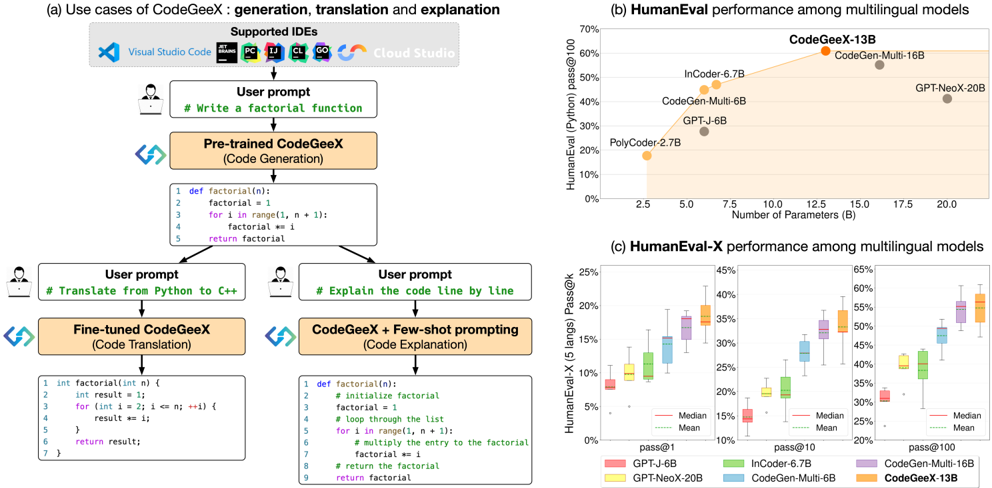
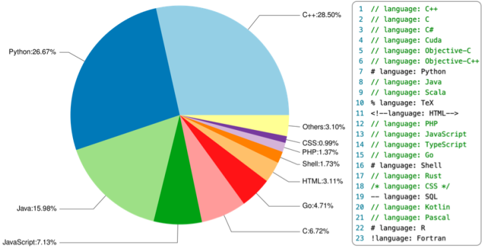
Large pre-trained code generation models, such as OpenAI Codex, can generate syntax-and function-correct code, making the coding of programmers more productive. In this paper, we introduce CodeGeeX, a multilingual model with 13 billion parameters for code generation. CodeGeeX is pre-trained on 850 billion tokens of 23 programming languages as of June 2022. Our extensive experiments suggest that CodeGeeX outperforms multilingual code models of similar scale for both the tasks of code generation and translation on HumanEval-X. Building upon HumanEval (Python only), we develop the HumanEval-X benchmark for evaluating multilingual models by hand-writing the solutions in C++, Java, JavaScript, and Go. In addition, we build CodeGeeX-based extensions on Visual Studio Code, JetBrains, and Cloud Studio, generating 8 billion tokens for tens of thousands of active users per week. Our user study demonstrates that CodeGeeX can help to increase coding efficiency for 83.4% of its users. Finally, CodeGeeX is publicly accessible since Sep. 2022, we open-sourced its code, model weights, API, extensions, and HumanEval-X at https://github.com/THUDM/CodeGeeX.
Overview
CoChat Summary
TL;DR
CodeGeeX is a 13B-parameter multilingual code generation model pre-trained on 850B tokens across 23 programming languages, released with the HumanEval-X benchmark for evaluating code generation and translation in Python, C++, Java, JavaScript, and Go. It reports competitive or best average performance among same-scale multilingual baselines on HumanEval-X and positive user-reported coding-efficiency gains.
Key findings
- CodeGeeX achieves the best average performance on HumanEval-X code generation among compared models, with average pass@1 18.40%, pass@10 33.29%, and pass@100 54.76%, slightly better than CodeGen-Multi-16B in all three metrics (0.37%–1.67% improvements).
- On Python HumanEval, CodeGeeX reaches pass@1 22.89%, pass@10 39.57%, and pass@100 60.92%; the paper notes it is second-highest among multilingual code generation models on HumanEval, surpassed by PaLMCoder-540B.
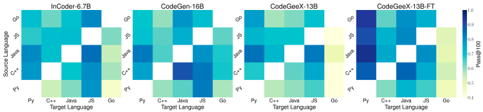
- For cross-lingual code translation, fine-tuned CodeGeeX-13B-FT performs best on pass@100 in 11 of 20 language pairs, while CodeGen-Multi-16B is best on 7.
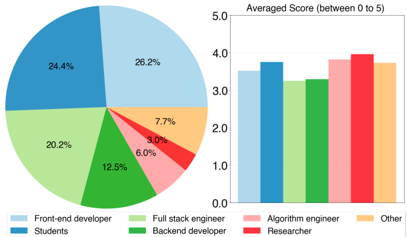
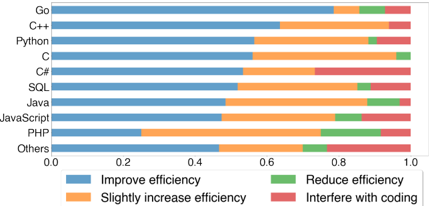
- In a user survey of 168 users, over 83.4% report that CodeGeeX improves or slightly increases coding efficiency; the deployed extensions generate 8 billion tokens per week for tens of thousands of daily active users, averaging 200+ API calls per active user per weekday.
Methods
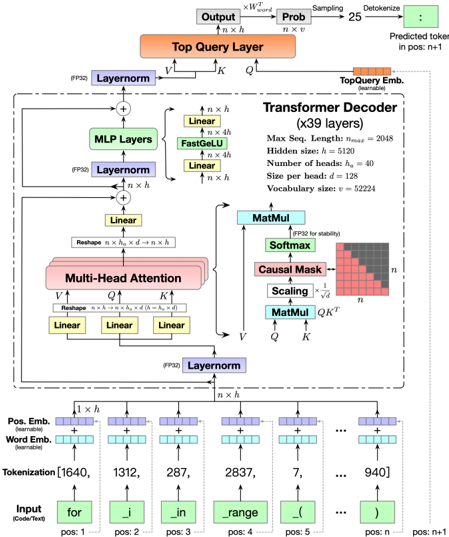
- CodeGeeX is a 39-layer decoder-only transformer with 13B parameters, hidden size 5120, vocabulary size 52,224, maximum sequence length 2048, and a top query layer; it was trained on 850B tokens over 213,000 steps using 1,536 Ascend 910 AI processors, Mindspore v1.7.0, 8-way model parallelism, 192-way data parallelism, and global batch size 3,072.
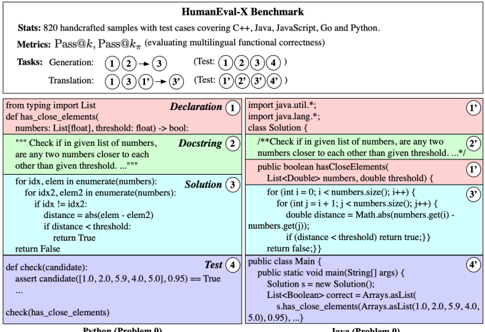
- HumanEval-X was built by manually rewriting the 164 Python HumanEval problems into C++, Java, JavaScript, and Go, yielding 820 problem-solution pairs; it supports code generation and translation across 20 source-target language pairs, evaluated with pass@k using n=200 generations and k ∈ {1, 10, 100}.
- Baselines include GPT-J-6B, GPT-NeoX-20B, InCoder-6.7B, and CodeGen-Multi-6B/16B; additional evaluations cover MBPP, CodeXGLUE code summarization, and XLCoST code translation.
Limitations
- The paper states that it is computationally unaffordable to test different architectural designs for large pre-trained models, and that multilingual models may require larger model capacity to master different languages; it also observes asymmetry in translation performance, suggesting models lack high-level understanding between languages.
- The paper notes language-specific weaknesses: Go is harder to translate into due to strict syntax constraints such as forbidding unused variables/imports, and Ruby is absent from CodeGeeX’s pre-training corpus.
- Evident from the text: the main multilingual evaluation is limited to HumanEval-X and selected benchmarks, and the user-efficiency result comes from a self-reported survey of 168 users rather than a controlled productivity study.
Model-written summary. Check it against the paper before relying on it.
Integrity signals
Registry
Cites
Statistics
Figures
Verification
Claims the paper makes
6 Valid · 3 Not valid · 0 Not checked · 65 Own results and interpretations
The cited sources support only part of this claim — read each source’s verdict below.
In the paper
“existing multilingual datasets [18,28,45] use string similarity metrics like BLEU [21] for evaluation rather than really verify the functional correctness of generated code.”
§ CodeGeeX: A Pre-Trained Model for Code Generation with Multilingual Benchmarking on HumanEval-X > 1 INTRODUCTION
What the sources say
- Supportedcites [18] matched to “CodeXGLUE: A Machine Learning Benchmark Dataset for Code Understanding and Generation” (2021) source
Section 3.5 (p. 4) describes a Java–C# code-translation dataset. Section 5.7 (p. 9) lists exact match, BLEU, and CodeBLEU as its evaluation measures, with CodeBLEU as the overall metric, rather than a functional-correctness test. The claim is supported for this dataset; it should not be read as saying BLEU alone is the overall metric. (LLM, conf=0.87)
- Supportedcites [28] matched to “CodeBLEU: a Method for Automatic Evaluation of Code Synthesis” (2020) source
The citation to this paper is attached to BLEU as an evaluation metric, not to the identification of the multilingual datasets. The Introduction (p. 1) calls BLEU a popular code-synthesis evaluation method based on token overlap, and Related Work (p. 7) says it ignores logical correctness. That supports the attributed distinction between string similarity and verification of functional correctness. (LLM, conf=0.88)
- Supportedcites [45] matched to “XLCoST: A Benchmark Dataset for Cross-lingual Code Intelligence” (2022) source
XLCoST evaluates code generation with BLEU and CodeBLEU (Evaluation Metrics and Baselines, p. 6). Its Limitations and Future Work section (p. 7) says evaluation could be improved by using test cases and treats automated test-case generation as future work. CodeBLEU also checks syntax and data flow, but the paper does not report verifying generated code’s functional correctness with tests. (LLM, conf=0.91)
- Not matchedcites [21]
The reference list we hold has no entry [21].
plain- Asserted: passes — The authors put it forward as true.
- Checkable: passes — It can be checked against evidence.
- Load-bearing: passes — The paper’s conclusions depend on it.
- Based: passes — The paper gives a reason why it holds.
- Supported
The cited sources support only part of this claim — read each source’s verdict below.
In the paper
“HumanEval [7]-developed by OpenAI for evaluating Codex-and other benchmarks [2,13,20] only consist of programming problems in a single language”
- Also stated in: § 3.1 HumanEval-X: A Multilingual Benchmark · plain
“However, similar to MBPP [2] and APPS [13], it only consists of handcrafted programming problems in Python, thus cannot be directly applied to systematically evaluate the performance of multilingual code generation.”
§ CodeGeeX: A Pre-Trained Model for Code Generation with Multilingual Benchmarking on HumanEval-X > 1 INTRODUCTION
What the sources say
- Supportedcites [7] matched to “Evaluating Large Language Models Trained on Code” (2021) source
The Codex and Codex-S Performance section (p. 2) says the authors created a 164-problem dataset to evaluate their model on generating standalone Python functions. Section 2.2 (p. 4) names that dataset HumanEval. The separate citations attached to “other benchmarks” are not judged here. (LLM, conf=0.93)
- Partly supportedcites [2] matched to “Program Synthesis with Large Language Models” (2021) sourceExperimental — accuracy not yet measured
The Introduction (p. 2) says this paper introduces two Python code-synthesis datasets, and §2.1 (p. 4) describes MBPP as containing Python programs. That supports the single-language claim for this paper’s benchmarks. The Introduction (p. 3) mentions HumanEval but does not establish that it, or every other benchmark in the citing sentence, contains problems in only one language. (LLM, conf=0.84)
- Supportedcites [13] matched to “Measuring Coding Challenge Competence With APPS” (2021) source
The Abstract (p. 1) says APPS evaluates generation of Python code, and the Conclusion (p. 9) calls it a benchmark of 10,000 Python programming problems. This supports the single-language point for APPS, the benchmark identified by this citation; it does not need to establish the language coverage of HumanEval. (LLM, conf=0.92)
- Supportedcites [20] matched to “CodeGen: An Open Large Language Model for Code with Multi-Turn Program Synthesis” (2022) source
Section 3 (p. 4) identifies HumanEval as 164 Python programming problems. Sections 4.1 (p. 6) and 4.2 (p. 7) describe this paper’s own benchmark, MTPB, using Python prompts and execution. The paper therefore supports the single-language characterization for the benchmarks it discusses; it does not establish that every programming benchmark is single-language. (LLM, conf=0.87)
plain- Asserted: passes — The authors put it forward as true.
- Checkable: passes — It can be checked against evidence.
- Load-bearing: passes — The paper’s conclusions depend on it.
- Based: passes — The paper gives a reason why it holds.
- Also stated in: § 3.1 HumanEval-X: A Multilingual Benchmark · plain
A result the paper reports from its own data — it cites no other source for it, so there is none to check. The quote shows it is in the paper.
In the paper
“The inference time per token is within 13ms (1.61 seconds / 128 tokens).”
§ CodeGeeX: A Pre-Trained Model for Code Generation with Multilingual Benchmarking on HumanEval-X > 2.4 Fast Inference
plain- Asserted: passes — The authors put it forward as true.
- Checkable: passes — It can be checked against evidence.
- Load-bearing: passes — The paper’s conclusions depend on it.
- Based: passes — The paper gives a reason why it holds.
- Rests on an assumption not shown here.
A result the paper reports from its own data — it cites no other source for it, so there is none to check. The quote shows it is in the paper.
In the paper
“Our user survey suggests that 83.4% of users feel the CodeGeeX extensions improve their programming efficiency.”
- Also stated in: § Budget Allocation Strategies. · plain
“There are on average over 83.4% of users think CodeGeeX can improve or slightly increase their coding efficiency, especially for mainstream programming languages like Go, C++, Python, C, C#, etc.”
- Also stated in: § 6 CONCLUSION · plain
“Over 83.4% of users have positive answers.”
§ CodeGeeX: A Pre-Trained Model for Code Generation with Multilingual Benchmarking on HumanEval-X > 1 INTRODUCTION
plain- Asserted: passes — The authors put it forward as true.
- Checkable: passes — It can be checked against evidence.
- Load-bearing: unclear — It is unclear whether the paper’s conclusions depend on it.
- Based: passes — The paper gives a reason why it holds.
- Rests on an assumption not shown here.
- Also stated in: § Budget Allocation Strategies. · plain
A result the paper reports from its own data — it cites no other source for it, so there is none to check. The quote shows it is in the paper.
In the paper
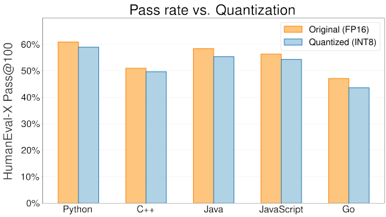
“Importantly, Figure 4 shows that the quantization only slightly affects the performance on the code generation task”
§ CodeGeeX: A Pre-Trained Model for Code Generation with Multilingual Benchmarking on HumanEval-X > 2.4 Fast Inference
plain- Asserted: passes — The authors put it forward as true.
- Checkable: passes — It can be checked against evidence.
- Load-bearing: passes — The paper’s conclusions depend on it.
- Based: passes — The paper gives a reason why it holds.
- Rests on an assumption not shown here.
24 more claims
Create a free account to see all 74 claims and every source verdict.
- Probably not a substantial claim. 20
- It may state two separate claims as one. 29
- The quote only partly states this claim. 2
Self-check
Percentages, sums and reported differences re-computed from the paper’s own numbers.
Each contradiction between two passages listed here was confirmed by an independent check.
Rated major: it would touch a result — a value a result rests on, reported and recomputed p-values on opposite sides of the significance level, two passages that conflict with no sign which is right, or a cited work retracted before this paper was published.
In the paper
“The entire pre-training process takes two months on 192 nodes with 1,536 AI processors, during which the model consumes 850B tokens, equivalent to 5+ epochs (213,000 steps).”
§ CodeGeeX: A Pre-Trained Model for Code Generation with Multilingual Benchmarking on HumanEval-X > 2.3 CodeGeeX Training
Reported 850000000000 · recomputed 1340080128000
Rated minor: it would not touch a result — a value no result rests on, a p-value that stays on the same side of the significance level, or a conflict that is clerical, resolved elsewhere in the paper, or outside its own findings.
In the paper
§ CodeGeeX: A Pre-Trained Model for Code Generation with Multilingual Benchmarking on HumanEval-X > Additional information
“| pass@𝑘𝜋 (𝑘 = 100) | Best Single 33.77% Uniform 36.40% Weighted 36.76% | 42.67% 44.75% 44.97% | 43.95% 43.89% 45.60% | 53.19% 53.47% 53.94%”
§ CodeGeeX: A Pre-Trained Model for Code Generation with Multilingual Benchmarking on HumanEval-X > Additional information
“| | pass@100 32.96% | 42.23% | 40.70% | 53.91% | 60.62% | 58.42% | |”
Rated minor: it would not touch a result — a value no result rests on, a p-value that stays on the same side of the significance level, or a conflict that is clerical, resolved elsewhere in the paper, or outside its own findings.
In the paper
§ CodeGeeX: A Pre-Trained Model for Code Generation with Multilingual Benchmarking on HumanEval-X > Budget Allocation Strategies.
“Both Uniform and Weighted outperform Best Single by promoting a more diverse generation, which gives a higher chance of solving problems.”
§ CodeGeeX: A Pre-Trained Model for Code Generation with Multilingual Benchmarking on HumanEval-X > Additional information
“| 43.95% 43.89% 45.60% |”
Citations
Cites
Deep Residual Learning for Image Recognition
He, K., Zhang, X., Ren, S., & Sun, J. (2016) · 2016 IEEE Conference on Computer Vision and Pattern Recognition (CVPR) · doi:10.1109/cvpr.2016.90 · Cited by 235,474 · cited 1×
“We use an approximation of GELU (Gaussian Linear Units) operation [14], namely FastGELU, which is more efficient under Ascend 910: Generative Pre-Training Objective.”
MethodVaswani, A., Shazeer, N., Parmar, N., Uszkoreit, J., Jones, L., Gomez, A. N., Kaiser, L., & Polosukhin, I. (2017) · arXiv · doi:10.48550/arxiv.1706.03762 · Cited by 120,404
Adam: A Method for Stochastic Optimization
Kingma, D. P., & Ba, J. (2014) · arXiv · doi:10.48550/arxiv.1412.6980 · Cited by 98,946
Language Models are Few-Shot Learners
Brown, T. B., Mann, B., Ryder, N., Subbiah, M., Kaplan, J., Dhariwal, P., Neelakantan, A., Shyam, P., Sastry, G., Askell, A., et al. (2020) · arXiv · doi:10.48550/arxiv.2005.14165 · Cited by 23,372
BLEU: a method for automatic evaluation of machine translation
Papineni, K., Roukos, S., Ward, T., & Zhu, W.-J. (2001) · Proceedings of the 40th Annual Meeting on Association for Computational Linguistics - ACL '02 · doi:10.3115/1073083.1073135 · Cited by 21,344
Advances in Neural Information Processing Systems 29
Teymur, O., Zygalakis, K., & Calderhead, B. (2016) · Cited by 13,887
Transformers: State-of-the-Art Natural Language Processing
Wolf, T., Debut, L., Sanh, V., Chaumond, J., Delangue, C., Moi, A., Cistac, P., Rault, T., Louf, R., Funtowicz, M., et al. (2020) · Proceedings of the 2020 Conference on Empirical Methods in Natural Language Processing: System Demonstrations · doi:10.18653/v1/2020.emnlp-demos.6 · Cited by 8,741
Chain-Of-Thought Prompting Elicits Reasoning in Large Language Models
Wei, J., Wang, X., Schuurmans, D., Bosma, M., Ichter, B., Xia, F., Chi, E., Le, Q. V., & Zhou, D. (2022) · Advances in Neural Information Processing Systems 35 · doi:10.52202/068431-1800 · Cited by 4,505
Gaussian Error Linear Units (GELUs)
Hendrycks, D., & Gimpel, K. (2016) · arXiv · doi:10.48550/arxiv.1606.08415 · Cited by 3,537
HuggingFace's Transformers: State-of-the-art Natural Language Processing
Wolf, T., Debut, L., Sanh, V., Chaumond, J., Delangue, C., Moi, A., Cistac, P., Rault, T., Louf, R., Funtowicz, M., et al. (2019) · arXiv · doi:10.48550/arxiv.1910.03771 · Cited by 3,347
Research works printed but not linked: 3
- Alec Radford Jeffrey Wu Rewon Child David Luan Dario Amodei Ilya Sutskever etal 2019. Language models are unsupervised multitask learners. OpenAI blog Vol. 1 8 (2019) 9. Alec Radford Jeffrey Wu Rewon Child David Luan Dario Amodei Ilya Sutskever et al. 2019. Language models are unsupervised multitask learners. OpenAI blog Vol. 1 8 (2019) 9.
- Lewis Tunstall , Leandro von Werra , and Thomas Wolf . 2022. Natural language processing with transformers. "O'Reilly Media , Inc .". Lewis Tunstall, Leandro von Werra, and Thomas Wolf. 2022. Natural language processing with transformers. "O'Reilly Media, Inc.".
- Richard J Waldinger and Richard CT Lee . 1969 . PROW: A step toward automatic program writing . In Proceedings of the 1st international joint conference on Artificial intelligence. 241--252 . Richard J Waldinger and Richard CT Lee. 1969. PROW: A step toward automatic program writing. In Proceedings of the 1st international joint conference on Artificial intelligence. 241--252.
Cited by
Large Language Models for Software Engineering: A Systematic Literature Review
Hou, X., Zhao, Y., Liu, Y., Yang, Z., Wang, K., Li, L., Luo, X., Lo, D., Grundy, J., & Wang, H. (2024) · ACM Transactions on Software Engineering and Methodology · doi:10.1145/3695988 · Cited by 1,029
Self-citationLongBench: A Bilingual, Multitask Benchmark for Long Context Understanding
Bai, Y., Lv, X., Zhang, J., Lyu, H., Tang, J., Huang, Z., Du, Z., Liu, X., Zeng, A., Hou, L., et al. (2024) · Proceedings of the 62nd Annual Meeting of the Association for Computational Linguistics (Volume 1: Long Papers) · doi:10.18653/v1/2024.acl-long.172 · Cited by 400
Self-citationLost in Translation: A Study of Bugs Introduced by Large Language Models while Translating Code
Pan, R., Ibrahimzada, A. R., Krishna, R., Sankar, D., Wassi, L. P., Merler, M., Sobolev, B., Pavuluri, R., Sinha, S., & Jabbarvand, R. (2024) · Proceedings of the IEEE/ACM 46th International Conference on Software Engineering · doi:10.1145/3597503.3639226 · Cited by 349
A Review of Current Trends, Techniques, and Challenges in Large Language Models (LLMs)
Patil, R., & Gudivada, A. V. (2024) · doi:10.20944/preprints202402.0357.v1 · Cited by 296
A Review of Current Trends, Techniques, and Challenges in Large Language Models (LLMs)
Patil, R., & Gudivada, V. (2024) · Applied Sciences · doi:10.3390/app14052074 · Cited by 290
Self-collaboration code generation via ChatGPT
Dong, Y., Jiang, X., Jin, Z., & Li, G. (2024) · ACM Transactions on Software Engineering and Methodology · doi:10.1145/3672459 · Cited by 256
Self-citationSelf-collaboration Code Generation via ChatGPT
Dong, Y., Jiang, X., Jin, Z., & Li, G. (2023) · arXiv · doi:10.48550/arxiv.2304.07590 · Cited by 256
Self-citationA Survey on Large Language Models for Code Generation
Jiang, J., Wang, F., Shen, J., Kim, S., & Kim, S. (2026) · ACM Transactions on Software Engineering and Methodology · doi:10.1145/3747588 · Cited by 251
“2 Overview: LLMs for Code Generations”
InfluentialOctoPack: Instruction Tuning Code Large Language Models
Muennighoff, N., Liu, Q., Zebaze, A., Zheng, Q., Hui, B., Zhuo, T. Y., Singh, S., Tang, X., von Werra, L., & Longpre, S. (2023) · arXiv · doi:10.48550/arxiv.2308.07124 · Cited by 245
Self-citationMetaGPT: Meta Programming for A Multi-Agent Collaborative Framework
Hong, S., Zhuge, M., Chen, J., Zheng, X., Cheng, Y., Zhang, C., Wang, J., Wang, Z., Yau, S. K. S., Lin, Z., et al. (2023) · arXiv · doi:10.48550/arxiv.2308.00352 · Cited by 2,825
“We conduct a comparative evaluation by comparing recent domain-specific LLMs in the code generation field, including AlphaCode [28], Incoder [43], CodeGeeX [44], and CodeX [24] and CodeT [45], with general domain LLMs such as PaLM [46], GPT-4 [47], and MetaGPT.”
MethodSelf-citationSelf-Planning Code Generation with Large Language Models
Jiang, X., Dong, Y., Wang, L., Fang, Z., Shang, Q., Li, G., Jin, Z., & Jiao, W. (2024) · ACM Transactions on Software Engineering and Methodology · doi:10.1145/3672456 · Cited by 158
Self-citationLarge Language Models as Zero-Shot Conversational Recommenders
He, Z., Xie, Z., Jha, R., Steck, H., Liang, D., Feng, Y., Majumder, B. P., Kallus, N., & Mcauley, J. (2023) · Proceedings of the 32nd ACM International Conference on Information and Knowledge Management · doi:10.1145/3583780.3614949 · Cited by 140
Zhang, K., Li, J., Li, G., Shi, X., & Jin, Z. (2024) · Proceedings of the 62nd Annual Meeting of the Association for Computational Linguistics (Volume 1: Long Papers) · doi:10.18653/v1/2024.acl-long.737 · Cited by 138
Gunasekar, S., Zhang, Y., Aneja, J., Mendes, C. C. T., Del Giorno, A., Gopi, S., Javaheripi, M., Kauffmann, P., de Rosa, G., Saarikivi, O., et al. (2023) · arXiv · doi:10.48550/arxiv.2306.11644 · Cited by 138
Self-citationWhat Makes Good In-Context Demonstrations for Code Intelligence Tasks with LLMs?
Gao, S., Wen, X.-C., Gao, C., Wang, W., Zhang, H., & Lyu, M. R. (2023) · 2023 38th IEEE/ACM International Conference on Automated Software Engineering (ASE) · doi:10.1109/ase56229.2023.00109 · Cited by 106
History, development, and principles of large language models: an introductory survey
Wang, Z., Chu, Z., Doan, T. V., Ni, S., Yang, M., & Zhang, W. (2025) · AI and Ethics · doi:10.1007/s43681-024-00583-7 · Cited by 109
LLM for SoC Security: A Paradigm Shift
Saha, D., Tarek, S., Yahyaei, K., Saha, S. K., Zhou, J., Tehranipoor, M., & Farahmandi, F. (2024) · IEEE Access · doi:10.1109/access.2024.3427369 · Cited by 93
Finetuning Large Language Models for Vulnerability Detection
Shestov, A., Levichev, R., Mussabayev, R., Maslov, E., Cheshkov, A., & Zadorozhny, P. (2024) · arXiv · doi:10.48550/arxiv.2401.17010 · Cited by 93
Finetuning Large Language Models for Vulnerability Detection
Shestov, A., Levichev, R., Mussabayev, R., Maslov, E., Zadorozhny, P., Cheshkov, A., Mussabayev, R., Toleu, A., Tolegen, G., & Krassovitskiy, A. (2025) · IEEE Access · doi:10.1109/access.2025.3546700 · Cited by 162
“First, we attempted to use the CodeGeeX model [16].”
BackgroundMethodFedBiOT: LLM Local Fine-tuning in Federated Learning without Full Model
Wu, F., Li, Z., Li, Y., Ding, B., & Gao, J. (2024) · ACM SIGKDD Conference on Knowledge Discovery and Data Mining (KDD) · doi:10.1145/3637528.3671897 · Cited by 196
Self-citationTeaching Large Language Models to Self-Debug
Chen, X., Lin, M., Schärli, N., & Zhou, D. (2023) · arXiv · doi:10.48550/arxiv.2304.05128 · Cited by 812
“In particular, recent large language models have demonstrated a significant leap in improvement over prior deep neural networks (Chen et al., 2021a; Nijkamp et al., 2023; Zheng et al., 2023; Xu et al., 2022).”
BackgroundMultitask-Based Evaluation of Open-Source LLM on Software Vulnerability
Yin, X., Ni, C., & Wang, S. (2024) · IEEE Transactions on Software Engineering · doi:10.1109/tse.2024.3470333 · Cited by 135
Self-citationWandelt, S., Zheng, C., Wang, S., Liu, Y., & Sun, X. (2024) · Applied Sciences · doi:10.3390/app14177455 · Cited by 105
Self-citationA Survey on LLM-Based Code Generation for Low-Resource and Domain-Specific Programming Languages
Joel, S., Wu, J. J., & Fard, F. H. (2026) · ACM Transactions on Software Engineering and Methodology · doi:10.1145/3770084 · Cited by 207
Understanding LLMs: A comprehensive overview from training to inference
Liu, Y., He, H., Han, T., Zhang, X., Liu, M., Tian, J., Zhang, Y., Wang, J., Gao, X., Zhong, T., et al. (2024) · Neurocomputing · doi:10.1016/j.neucom.2024.129190 · Cited by 106
On the Effectiveness of Large Language Models in Domain-Specific Code Generation
Gu, X., Chen, M., Lin, Y., Hu, Y., Zhang, H., Wan, C., Wei, Z., Xu, Y., & Wang, J. (2024) · ACM Transactions on Software Engineering and Methodology · doi:10.1145/3697012 · Cited by 171
“Our work differentiates itself from existing studies by exploring deeper integration of domain (API) knowledge into the code-generation process.”
CodeScore: Evaluating Code Generation by Learning Code Execution
Dong, Y., Ding, J., Jiang, X., Li, G., Li, Z., & Jin, Z. (2025) · ACM Transactions on Software Engineering and Methodology · doi:10.1145/3695991 · Cited by 64
Self-citationChain-of-Thought in Neural Code Generation: From and for Lightweight Language Models
Yang, G., Zhou, Y., Chen, X., Zhang, X., Zhuo, T. Y., & Chen, T. (2024) · IEEE Transactions on Software Engineering · doi:10.1109/tse.2024.3440503 · Cited by 112
“To provide a comprehensive evaluation, we compare nine commonly used baselines, including CodeBERT [54], GraphCodeBERT [55], CodeGPT [56], CodeGPT-adapter [56], PLBART [57], CodeT5 [58], NatGen [59], Llama2 [28], and CodeGeeX2 [60].”
MethodThe Current Challenges of Software Engineering in the Era of Large Language Models
Gao, C., Hu, X., Gao, S., Xia, X., & Jin, Z. (2025) · ACM Transactions on Software Engineering and Methodology · doi:10.1145/3712005 · Cited by 54
Self-citationLarge language models: an overview of foundational architectures, recent trends, and a new taxonomy
Mienye, I. D., Jere, N., Obaido, G., Ogunruku, O. O., Esenogho, E., & Modisane, C. (2025) · Discover Applied Sciences · doi:10.1007/s42452-025-07668-w · Cited by 46
“Zheng et al. [102] 2023 Demonstrated Codex’s high accuracy in functional code generation for common programming tasks.”
DeepSeek: Paradigm Shifts and Technical Evolution in Large AI Models
Xiong, L., Wang, H., Chen, X., Sheng, L., Xiong, Y., Liu, J., Xiao, Y., Chen, H., Han, Q., & Tang, Y. S. (2025) · IEEE/CAA Journal of Automatica Sinica · doi:10.1109/jas.2025.125495 · Cited by 60
“…[55] Avg. level of 10 0 B, Up to 65B Avg. level of 10 1 GB/ 10 0 B tokens, Up to 160GB/4B tokens BERT-like models GPT-2 [56], Codex [57], CodeGeeX [58], LLaMA [59], Pythia [60], Gemini 1.5 [61] GPT-like models Scaling-UpofLLMs 2019 T5 [2], GPT-3 [62], Gopher [63], BLOOM [64], Chinchilla [65],…”
InfluentialRobot learning in the era of foundation models: a survey
Xiao, X., Liu, J., Wang, Z., Zhou, Y., Qi, Y., Jiang, S., He, B., & Cheng, Q. (2025) · Neurocomputing · doi:10.1016/j.neucom.2025.129963 · Cited by 90
Self-citationKnowledge Transfer from High-Resource to Low-Resource Programming Languages for Code LLMs
Cassano, F., Gouwar, J., Lucchetti, F., Schlesinger, C., Freeman, A., Anderson, C. J., Feldman, M. Q., Greenberg, M., Jangda, A., & Guha, A. (2024) · Proceedings of the ACM on Programming Languages · doi:10.1145/3689735 · Cited by 149
“Models are most impressive at producing code in high-resource programming languages such as Python, JavaScript, and Java, but struggle in low-resource languages, such as Racket and OCaml [Athiwaratkun et al. 2022; Cassano et al. 2023; Zheng et al. 2023].”
Framework for evaluating code generation ability of large language models
Yeo, S., Ma, Y., Kim, S. C., Jun, H., & Kim, T. (2024) · ETRI Journal · doi:10.4218/etrij.2023-0357 · Cited by 54
AceCoder : An Effective Prompting Technique Specialized in Code Generation
Li, J., Zhao, Y., Li, Y., Li, G., & Jin, Z. G. (2024) · ACM Transactions on Software Engineering and Methodology · doi:10.1145/3675395 · Cited by 149
“We pick three representative LLMs as base models [12, 13, 30, 51], which scale from 6B to 13B.”
BackgroundMethodInfluentialSelf-citationAutoVCoder: A Systematic Framework for Automated Verilog Code Generation using LLMs
Mingzhe, G., Zhao, J., Lin, Z., Ding, W., Hou, X., Feng, Y., Li, C., & Guo, M. (2024) · IEEE International Conference on Computer Design: VLSI in Computers and Processors (ICCD) · doi:10.1109/iccd63220.2024.00033 · Cited by 82
“The effectiveness of these models in generating syntactically correct and logically coherent code snippets has been demonstrated in previous studies [1, 2, 3, 4, 5, 6, 7, 8], showcasing their potential to automate software development and reduce workload of developers.”
BackgroundMethodLLM Compiler: Foundation Language Models for Compiler Optimization
Cummins, C., Seeker, V., Grubisic, D., Rozière, B., Gehring, J., Synnaeve, G., & Leather, H. (2025) · ACM SIGPLAN International Conference on Compiler Construction (CC) · doi:10.1145/3708493.3712691 · Cited by 163
CodeA11y: Making AI Coding Assistants Useful for Accessible Web Development
Mowar, P., Peng, Y.-H., Wu, J., Steinfeld, A., & Bigham, J. P. (2025) · Proceedings of the 2025 CHI Conference on Human Factors in Computing Systems · doi:10.1145/3706598.3713335 · Cited by 31
SALLM: Security Assessment of Generated Code
Siddiq, M. L., Santos, J. C. S., Devareddy, S., & Muller, A. (2024) · IEEE/ACM International Conference on Automated Software Engineering Workshops (ASEW) · doi:10.1145/3691621.3694934 · Cited by 124
Fight Fire with Fire: How Much Can We Trust ChatGPT on Source Code-Related Tasks?
Yu, X., Liu, L., Hu, X., Keung, J. W., Liu, J., & Xia, X. (2024) · arXiv · doi:10.48550/arxiv.2405.12641 · Cited by 29
Self-citationLearning-based Widget Matching for Migrating GUI Test Cases
Zhang, Y., Zhang, W., Ran, D., Zhu, Q., Dou, C., Hao, D., Xie, T., & Zhang, L. (2024) · ACM/IEEE International Conference on Software Engineering: Companion Proceedings (ICSE-Companion) · doi:10.1145/3597503.3623322 · Cited by 61
“TEMdroid also outperforms baseline approaches in both two tasks.”
MethodMaltracker: A Fine-Grained NPM Malware Tracker Copiloted by LLM-Enhanced Dataset
Yu, Z., Wen, M., Guo, X., & Jin, H. (2024) · ACM SIGSOFT International Symposium on Software Testing and Analysis (ISSTA) · doi:10.1145/3650212.3680397 · Cited by 42
Comprehensive Fine-Tuning Large Language Models of Code for Automated Program Repair
Huang, K., Zhang, J., Bao, X., Wang, X., & Liu, Y. (2025) · IEEE Transactions on Software Engineering · doi:10.1109/tse.2025.3532759 · Cited by 56
“In addition, we also add the FPFT strategy to compare it with PEFT techniques.”
Codepori: Large-Scale System for Autonomous Software Development Using Multi-Agent Technology
Rasheed, Z., Malik, S., Kemell, K.-K., Muhammad, W., Saari, M., Systä, K., & Abrahamsson, P. (2024) · doi:10.2139/ssrn.4979510 · Cited by 27
How Important Are Good Method Names in Neural Code Generation? A Model Robustness Perspective
Yang, G., Zhou, Y., Yang, W., Yue, T., Chen, X., & Chen, T. (2024) · ACM Transactions on Software Engineering and Methodology · doi:10.1145/3630010 · Cited by 45
On the Effectiveness of LLM-as-a-Judge for Code Generation and Summarization
Crupi, G., Tufano, R., Velasco, A., Mastropaolo, A., Poshyvanyk, D., & Bavota, G. (2025) · IEEE Transactions on Software Engineering · doi:10.1109/tse.2025.3586082 · Cited by 88
Fight Fire With Fire: How Much Can We Trust ChatGPT on Source Code-Related Tasks?
Yu, X., Liu, L., Hu, X., Keung, J., Liu, J., & Xia, X. (2024) · IEEE Transactions on Software Engineering · doi:10.1109/tse.2024.3492204 · Cited by 61
Self-citationLLM based autonomous agent of human-robot collaboration for aerospace wire harnessing assembly
Wang, Y., Guo, Q., Zheng, L., Wang, B., Zheng, P., & Qi, Z. (2025) · Robotics and Computer-Integrated Manufacturing · doi:10.1016/j.rcim.2025.103120 · Cited by 34
Harnessing the Power of General-Purpose LLMs in Hardware Trojan Design
Kokolakis, G., Moschos, A., & Keromytis, A. D. (2024) · Lecture notes in computer science · doi:10.1007/978-3-031-61486-6_11 · Cited by 39
“In software engineering, LLMs are mainly employed as tools that assist in the generation of code [1, 18, 26, 31, 35–37, 39, 41, 42, 50, 53, 61, 65], the identification of vulnerabilities and bugs [19, 20, 29, 32, 60] and recently bug correction [25, 47, 62].”
MethodMFTCoder: Boosting Code LLMs with Multitask Fine-Tuning
Liu, B., Chen, C., Gong, Z., Liao, C., Wang, H., Lei, Z., Liang, M., Chen, D., Shen, M., Zhou, H., et al. (2024) · Proceedings of the 30th ACM SIGKDD Conference on Knowledge Discovery and Data Mining · doi:10.1145/3637528.3671609 · Cited by 23
CodeFuse-13B: A Pretrained Multi-lingual Code Large Language Model
Di, P., Li, J., Yu, H., Jiang, W., Cai, W., Cao, Y., Chen, C., Chen, D., Chen, H., Chen, L., et al. (2024) · IEEE/ACM International Conference on Software Engineering: Software Engineering in Practice (ICSE-SEIP) · doi:10.1145/3639477.3639719 · Cited by 59
Self-citationRouterdc: Query-based router by dual contrastive learning for assembling large language models
Chen, S., Jiang, W., Lin, B., Kwok, J., & Zhang, Y. (2024) · Advances in Neural Information Processing Systems 37 · doi:10.52202/079017-2120 · Cited by 22
AgileCoder: Dynamic Collaborative Agents for Software Development based on Agile Methodology
Nguyen, M. H., Chau, T. P., Nguyen, P. X., & Bui, N. D. Q. (2024) · arXiv · doi:10.48550/arxiv.2406.11912 · Cited by 21
Towards Understanding the Effectiveness of Large Language Models on Directed Test Input Generation
Jiang, Z., Wen, M., Cao, J., Shi, X., & Jin, H. (2024) · IEEE/ACM International Conference on Automated Software Engineering (ASE) · doi:10.1145/3691620.3695513 · Cited by 55
Empowering Agile-Based Generative Software Development through Human-AI Teamwork
Zhang, S., Xing, Z., Guo, R., Xu, F., Chen, L., Zhang, Z., Zhang, X., Feng, Z., & Zhuang, Z. (2025) · ACM Transactions on Software Engineering and Methodology · doi:10.1145/3702987 · Cited by 56
Transformers in source code generation: A comprehensive survey
Ghaemi, H., Alizadehsani, Z., Shahraki, A., & Corchado, J. M. (2024) · Journal of Systems Architecture · doi:10.1016/j.sysarc.2024.103193 · Cited by 31
A survey on robustness attacks for deep code models
Qu, Y., Huang, S., & Yao, Y. (2024) · Automated Software Engineering · doi:10.1007/s10515-024-00464-7 · Cited by 32
Federated Transfer Learning for On-Device LLMs Efficient Fine Tuning Optimization
Li, C., Gu, B., Zhao, Z., Qu, Y., Xin, G., Huo, J., & Gao, L. (2025) · Big Data Mining and Analytics · doi:10.26599/bdma.2024.9020068 · Cited by 20
AgileCoder: Dynamic Collaborative Agents for Software Development based on Agile Methodology
Nguyen, M. H., Chau, T. P., Nguyen, P. X., & Bui, N. D. Q. (2025) · IEEE/ACM International Conference on AI Foundation Models and Software Engineering (FORGE) · doi:10.1109/forge66646.2025.00026 · Cited by 96
Who is using AI to code? Global diffusion and impact of generative AI
Daniotti, S., Wachs, J., Feng, X., & Neffke, F. M. H. (2026) · Science · doi:10.1126/science.adz9311 · Cited by 95
Between Lines of Code: Unraveling the Distinct Patterns of Machine and Human Programmers
Shi, Y., Zhang, H., Wan, C., & Gu, X. (2025) · ACM/IEEE International Conference on Software Engineering: Companion Proceedings (ICSE-Companion) · doi:10.1109/icse55347.2025.00005 · Cited by 67
Qu, Y., Huang, S., Li, Y., Bai, T., Chen, X., Wang, X., Li, L., & Yao, Y. (2025) · Automated Software Engineering · doi:10.1007/s10515-024-00485-2 · Cited by 24
“Within the realm of intelligent software engineering, LLMs have further attained groundbreaking results in code generation (Li et al. 2022; Chen et al. 2021b; Zheng et al. 2023).”
Self-citationSurvey of Natural Language Processing for Education: Taxonomy, Systematic Review, and Future Trends
Lan, Y., Li, X., Du, H., Lu, X., Gao, M. Z., Qian, W., & Zhou, A. (2025) · IEEE Transactions on Knowledge and Data Engineering · doi:10.1109/tkde.2025.3621181 · Cited by 61
FALCON: Feedback-driven Adaptive Long/short-term memory reinforced Coding OptimizatioN
Li, Z., He, Y., He, L., Wang, J., Shi, T., Lei, B., Li, Y., & Chen, Q. (2025) · IEEE International Conference on Multimedia and Expo (ICME) · doi:10.1109/icme59968.2025.11208959 · Cited by 27
“Several models, such as CodeGeeX [11] and DeepSeek-Coder [3], use Causal Language Modelling (CLM) pretraining, while others like CodeT5 [12] utilize an encoder-decoder architecture.”
Self-citationLarge language models meet NLP: a survey
Qin, L., Chen, Q., Feng, X., Wu, Y., Zhang, Y., Li, Y., Li, M., Che, W., & Yu, P. S. (2026) · Frontiers of Computer Science · doi:10.1007/s11704-025-50472-3 · Cited by 241
Self-citationOn Extracting Specialized Code Abilities from Large Language Models: A Feasibility Study
Li, Z., Wang, C., Ma, P., Liu, C., Wang, S., Wu, D., Gao, C., & Liu, Y. (2024) · ACM/IEEE International Conference on Software Engineering: Companion Proceedings (ICSE-Companion) · doi:10.1145/3597503.3639091 · Cited by 67
Self-citationLLMEffiChecker : Understanding and Testing Efficiency Degradation of Large Language Models
Feng, X., Han, X., Chen, S. H., & Yang, W. M. (2024) · ACM Transactions on Software Engineering and Methodology · doi:10.1145/3664812 · Cited by 39
“However, in most cases with normal inputs, such a threshold will not yield any real impact, as the EOS token often appears much earlier (e.g., in code generation applications, setting the max_length of LLMs to 512 is a widely adopted practice [8, 48, 94]).”
CoSec: On-the-Fly Security Hardening of Code LLMs via Supervised Co-decoding
Li, D., Yan, M. L., Zhang, Y. X., Liu, Z., Liu, C. C., Zhang, X., Chen, T., & Lo, D. (2024) · ACM SIGSOFT International Symposium on Software Testing and Analysis (ISSTA) · doi:10.1145/3650212.3680371 · Cited by 39
JavaBench: A Benchmark of Object-Oriented Code Generation for Evaluating Large Language Models
Cao, J., Chen, Z., Wu, J., Cheung, S.-C., & Xu, C. (2024) · IEEE/ACM International Conference on Automated Software Engineering (ASE) · doi:10.1145/3691620.3695470 · Cited by 62
“Emerging code generation/completion benchmarks [16, 23, 27, 38, 40, 58, 62, 63] like HumanEval [23] have been introduced to evaluate LLMs’ capabilities, providing insights into their strengths and weaknesses in various real-world scenarios, thereby guiding LLM researchers to address related issues…”
InfluentialLarge Language Models for Security Operations Centers: A Comprehensive Survey
Habibzadeh, A., Feyzi, F., & Atani, R. E. (2026) · Journal of Electrical and Computer Engineering · doi:10.1155/jece/3383674 · Cited by 13
RGD: Multi-LLM Based Agent Debugger via Refinement and Generation Guidance
Jin, H., Sun, Z., & Chen, H. (2024) · IEEE International Conference on Agents (ICA) · doi:10.1109/ica63002.2024.00037 · Cited by 31
“…Models (LLMs) have made significant advancements in the domain of automated code generation, showcasing their capability to translate natural language into functional code, generate code explanations [1], and even perform code-to-code translations across different programming languages [2] [3].”
What is wrong with your code generated by large language models? An extensive study
Dou, S., Jia, H., Wu, S., Zheng, H., Wu, M., Tao, Y., Zhang, M., Chai, M., Fan, J., Xu, N., et al. (2026) · Science China Information Sciences · doi:10.1007/s11432-025-4632-8 · Cited by 117
Gandhi, S., Patwardhan, M. S., Khatri, J., Vig, L., & Medicherla, R. K. (2024) · International Workshop on Large Language Models for Code (LLM4Code) · doi:10.1145/3643795.3648388 · Cited by 28
CoderUJB: An Executable and Unified Java Benchmark for Practical Programming Scenarios
Zeng, Z., Wang, Y., Xie, R., Ye, W., & Zhang, S. (2024) · ACM SIGSOFT International Symposium on Software Testing and Analysis (ISSTA) · doi:10.1145/3650212.3652115 · Cited by 32
“However, this can raise concerns for researchers about how these models would perform with tasks in other programming languages [9, 65].”
MORepair : Teaching LLMs to Repair Code via Multi-Objective Fine-Tuning
Yang, B., Tian, H., Ren, J., Zhang, H., Klein, J., Bissyandé, T. F., Goues, C. L., & Jin, S. (2026) · ACM Transactions on Software Engineering and Methodology · doi:10.1145/3735129 · Cited by 67
RepoTransBench: A Real-World Multilingual Benchmark for Repository-Level Code Translation
Wang, Y., Wang, Y., Wang, S., Guo, D., Chen, J., Grundy, J., Liu, X., Ma, Y., Mao, M., Zhang, H., et al. (2026) · IEEE Transactions on Software Engineering · doi:10.1109/tse.2025.3645056 · Cited by 70
“Automatic code translation can significantly reduce manual effort and has thus garnered widespread attention in recent years [20], [21], [22], [23], [24], [25], [26], [27], [28].”
Self-citationLLM-as-a-Judge for Software Engineering: Literature Review, Vision, and the Road Ahead
He, J., Shi, J., Zhuo, T. Y., Treude, C., Sun, J., Du, X., Xing, Z., & Lo, D. (2026) · ACM Transactions on Software Engineering and Methodology · doi:10.1145/3797276 · Cited by 12
“They find that the LLM not only identifies most quality flaws but also provides reliable explanations for them.”
Alibaba LingmaAgent: Improving Automated Issue Resolution via Comprehensive Repository Exploration
Ma, Y., Yang, Q., Cao, R., Li, B., Huang, F., & Li, Y. (2025) · ACM Joint European Software Engineering Conference and Symposium on the Foundations of Software Engineering (ESEC/FSE) · doi:10.1145/3696630.3728549 · Cited by 163
“Precisely, the code generation test set [5, 8, 28, 31, 54] consists of the short problem description, the solution, and the corresponding unit test data.”
Self-citationZheng, D., Wang, Y., Shi, E., Zhang, R., Ma, Y., Zhang, H., & Zheng, Z. (2025) · 2025 IEEE/ACM 47th International Conference on Software Engineering (ICSE) · doi:10.1109/icse55347.2025.00228 · Cited by 11
“Many code LLMs [8]–[10], [17], [18], [29]–[33], [39], [40], [51] are being employed to empower programming assistants, which are playing a vital role in practical * Yanlin Wang is the corresponding author. software development [70]–[73].”
Unraveling the Potential of Large Language Models in Code Translation: How Far are We?
Tao, Q., Yu, T., Gu, X., & Shen, B. (2024) · Asia-Pacific Software Engineering Conference (APSEC) · doi:10.1109/apsec65559.2024.00046 · Cited by 53
“Due to the extraordinary efficacy of LLMs [7, 9, 10, 30], researchers have started to empirically study LLMs’ code translation capability.”
Lessons from Building StackSpot AI: A Contextualized AI Coding Assistant
Pinto, G., De Souza, C., Neto, J. B., Souza, A., Gotto, T., & Monteiro, E. (2024) · Proceedings of the 46th International Conference on Software Engineering: Software Engineering in Practice · doi:10.1145/3639477.3639751 · Cited by 12
Reindex-Then-Adapt: Improving Large Language Models for Conversational Recommendation
He, Z., Xie, Z., Steck, H., Liang, D., Jha, R., Kallus, N., & McAuley, J. (2025) · ACM International Conference on Web Search and Data Mining (WSDM) · doi:10.1145/3701551.3703573 · Cited by 36
LLM4TDG: test-driven generation of large language models based on enhanced constraint reasoning
Liu, J., Liang, R., Zhu, X., Zhang, Y., Liu, Y., & Liu, Q. (2025) · Cybersecurity · doi:10.1186/s42400-024-00335-4 · Cited by 20
“Additionally, there are other benchmarks for other languages, such as Spider (Yu et al. 2018) (SQL), HUMANEVAL-X (Zheng et al. 2023) (C ++ , Javascript, and Go), CodeContests (Li et al. 2022) (C ++ and Java), and MultiPL-E (Cassano et al. 2023), which extend HUMANEVAL and MBPP to 18 programming languages.”
Correctness assessment of code generated by Large Language Models using internal representations
Bui, T.-D., Vu, T. T., Nguyen, T.-T., Nguyen, S., & Vo, H. D. (2025) · Journal of Systems and Software · doi:10.1016/j.jss.2025.112570 · Cited by 48
LLMLOOP: Improving LLM-Generated Code and Tests Through Automated Iterative Feedback Loops
Ravi, R., Bradshaw, D., Ruberto, S., Jahangirova, G., & Terragni, V. (2025) · IEEE International Conference on Software Maintenance (ICSM) · doi:10.1109/icsme64153.2025.00109 · Cited by 44
A Language Model of Java Methods with Train/Test Deduplication
Su, C., Bansal, A., Jain, V., Ghanavati, S., & McMillan, C. (2023) · ACM Joint European Software Engineering Conference and Symposium on the Foundations of Software Engineering (ESEC/FSE) · doi:10.1145/3611643.3613090 · Cited by 21
“Many even target source code, such as CodePar-rot [37], StarCoder [39], and CodeGeeX [41].”
BackgroundHDLEval Benchmarking LLMs for multiple HDLs
Kashanaki, F. R., Zakharov, M., & Renau, J. (2024) · 2024 IEEE LLM Aided Design Workshop (LAD) · doi:10.1109/lad62341.2024.10691770 · Cited by 16
An Empirical Study on Automatically Detecting AI-Generated Source Code: How Far are We?
Suh, H., Tafreshipour, M., Li, J., Bhattiprolu, A., & Ahmed, I. (2025) · ACM/IEEE International Conference on Software Engineering: Companion Proceedings (ICSE-Companion) · doi:10.1109/icse55347.2025.00064 · Cited by 26
Program Repair with Minimal Edits Using CodeT5
Shirafuji, A., Rahman, M. M., Amin, M. F. I., & Watanobe, Y. (2023) · International Conference on Awareness Science and Technology (iCAST) · doi:10.1109/icast57874.2023.10359288 · Cited by 14
Integrating Generative AI in Software Engineering Education: Practical Strategies
Li, Y., Keung, J., & Ma, X. (2024) · 2024 International Symposium on Educational Technology (ISET) · doi:10.1109/iset61814.2024.00019 · Cited by 8
“Through the utilization of generative AI tools, code generation, and auto-completion processes can be automated, resulting in improved productivity and efficiency for students [3, 4].”
BackgroundSelf-citationDiehl, P., Nader, N., Moraru, M., & Brandt, S. R. (2025) · Journal of Machine Learning for Modeling and Computing · doi:10.1615/jmachlearnmodelcomput.2025058957 · Cited by 9
Benchmarking Large Language Models for Ethereum Smart Contract Development
Daspe, E., Durand, M., Hatin, J., & Bradai, S. (2024) · Conference on Blockchain Research & Applications for Innovative Networks and Services · doi:10.1109/brains63024.2024.10732686 · Cited by 15
“…benchmarks have started to tackle the problem of multi-language evaluation (MBXP, Multilingual HumanEval, MathQA-X [9], xCodeEval [10], HumanEval-X [11], Hu-manEvalPack [12]), thus extending the evaluation spectrum to other languages (Java, JS, TypeScript, Go, C#, PHP, Ruby, Kotlin, C, C++, Perl,…”
BackgroundA Catalog of Data Smells for Coding Tasks
Vitale, A., Oliveto, R., & Scalabrino, S. (2025) · ACM Transactions on Software Engineering and Methodology · doi:10.1145/3707457 · Cited by 11
Intelligent Q&A System for Power Dispatching Based on Retrieval Augmented Generation
Zhang, K., Li, L., Xu, X. Y., Xin, R., Xu, X., & Zhang, P. (2024) · International Conference on Energy, Power and Grid (ICEPG) · doi:10.1109/icepg63230.2024.10775438 · Cited by 8
“Researchers are constantly exploring the application of Artificial General Intelligence (AGI), represented by LLM technology, in multiple professional fields such as healthcare [11] , programming [12] , and law [13] .”
Top Pass: improve code generation by pass@k-maximized code ranking
Lyu, Z., Li, X., Xie, Z., & Li, M. (2025) · Frontiers of Computer Science · doi:10.1007/s11704-024-40415-9 · Cited by 30
Zhang, Y., Lu, Q., Liu, K., Dou, W., Zhu, J., Li, Q., Zhang, C., Lin, Z., & Wei, J. (2025) · ACM Transactions on Software Engineering and Methodology · doi:10.1145/3763791 · Cited by 29
“First, we select two representative open source code LLMs: CodeGeeX4 [56] and DeepSeek-V3 [10], both of which have demonstrated competitive performance on recent public benchmarks related to coding tasks, such as BigCodeBench [57] and NaturalCodeBench [52].”
Desolda, G., Esposito, A., Greco, F., Tucci, C., Buono, P., & Piccinno, A. (2025) · International Journal of Human-Computer Studies · doi:10.1016/j.ijhcs.2025.103648 · Cited by 7
Yao, K., Wang, H., Qin, C., Zhu, H., Wu, Y., & Zhang, L. (2024) · ACM Transactions on Software Engineering and Methodology · doi:10.1145/3688839 · Cited by 12
AnnCoder: A Mti-Agent-Based Code Generation and Optimization Model
Zhang, Z., Wang, J., Li, Z., Wang, Y., & Zheng, J. (2025) · Symmetry · doi:10.3390/sym17071087 · Cited by 23
Enhancing Project-Specific Code Completion by Inferring Internal API Information
Deng, L., Ren, X., Ni, C., Liang, M., Lo, D., & Liu, Z. (2025) · IEEE Transactions on Software Engineering · doi:10.1109/tse.2025.3592823 · Cited by 15
Metadata
- Authors
- Zheng, Q., Xia, X., Zou, X., Dong, Y., Wang, S., Xue, Y., Shen, L., Wang, Z., Wang, A., Li, Y., Su, T., Yang, Z., & Tang, J.
- Affiliations
- Tsinghua University (CN)
- Zhipu AI (China) (CN)
- Huawei Technologies (China) (CN)
- ORCID
- Venue
- Proceedings of the 29th ACM SIGKDD Conference on Knowledge Discovery and Data Mining
- Publisher
- ACM
- Published
- 2023-08-04
- Pages
- 5673-5684
- OpenAlex
- W4385562549
- Semantic Scholar
- bafe023fb072045dc0cd50316382a61c8dcb9fae
- Cited by
- 563
- References
- 15
- Citations by year
- 2026: 148 · 2025: 205 · 2024: 157 · 2023: 53
- FWCI
- 108.31
- Type
- conference paper
- Language
- en
- Open access
- hybrid
- doi.org
- Licence
- Locations
- ACM SIGKDD Conference on Knowledge Discovery and Data Mining (KDD) (publishedVersion, cc-by)
- arXiv (Cornell University) (submittedVersion, cc-by)
- arXiv (Cornell University) (cc-by)
- Funders
- Natural Science Foundation of China (No. 62276148, No. 61836013, No. 61825602)
- Topics
- Physical Sciences › Computer Science › Information Systems › Software Engineering Research
- Physical Sciences › Computer Science › Artificial Intelligence › Topic Modeling
- Physical Sciences › Computer Science › Computer Science Applications › Teaching and Learning Programming
- Keywords
- multilingual code generation, pre-trained code models, program translation, programming language support, Visual Studio Code extension, coding efficiency
About these checks
Registry, retraction, Cites and statistics results are computed, not judged, with one exception: a printed reference that no index lists is read once by a model before it counts as a citation error. Claims are extracted by a model and kept only when their quote appears verbatim in the text; each cited source is then checked, with a model’s help, for whether it says what the claim relies on. Those verdicts can be wrong — read the claim’s quote and the cited source before relying on one.
The claim verdicts this report counts are experimental: their accuracy is not yet measured.
A language model drew the claims from the paper on 2026-10-05, under version 3 of the claim definition (model deepseek-v4.1-flash, prompt extract-v3).
A second model labelled each claim on 2026-10-05 (model jev-1.13-20260917, definition revision gold-guideline-v0.2).
Cited sources are checked with a language model’s help (gpt-6-sol).
Statistics and arithmetic are recomputed, not judged.
Confidence bands are shown only for fields calibrated on our annotated test set. None is calibrated yet, so no band is shown.
What counts as a claim ›How we measure confidence ›How we check this ›
Are you an author, or do you see a problem with this page? Request a review
Data sources
Bibliographic data: Semantic Scholar, OpenAlex, Crossref.
Contains information from the Semantic Scholar Academic Graph Datasets, made available under the ODC Attribution License (ODC-BY 1.0).
Semantic Scholar’s data is described in: Kinney, R., et al. (2023). The Semantic Scholar Open Data Platform. arXiv:2301.10140.
