

Quantum Combinatorial Optimization in the NISQ Era: A Systematic Mapping Study
Open accessThe DOI matches its Crossref record; 269 of the 305 references it cites were found in a registry or an index; 180 of the 283 sources its claims cite were checked for support.
Abstract
The application of quantum computing to combinatorial optimization problems is attracting increasing research interest, resulting in diverse approaches and research streams. This study aims at identifying, classifying, and understanding existing solution approaches as well as typical use cases in the field. The obtained classification schemes are based on a full-text analysis of 156 included papers. Our results can be used by researchers and practitioners to (i) better understand adaptations to and utilizations of existing gate-based and quantum annealing approaches and (ii) identify typical use cases for quantum computing in areas such as graph optimization, routing, and scheduling.
Overview
CoChat Summary
TL;DR
This systematic mapping study reviews 156 papers on quantum combinatorial optimization for NISQ devices, classifying solution approaches, adaptations, classical integration, and use cases. It finds gate-model approaches dominate, VQAs are the most studied, and Max-Cut is the most common validation problem.
Key findings
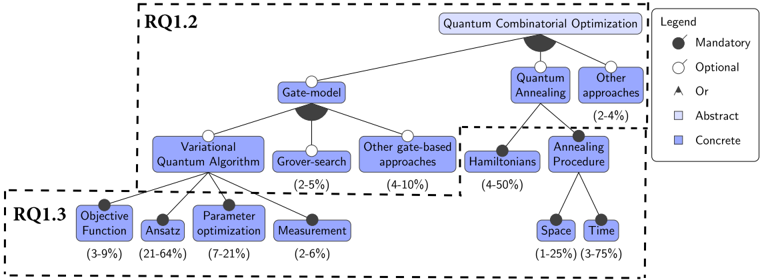
- Among identified quantum CO approaches, 80% are gate-model, 16% quantum annealing, and 4% other; within gate-model approaches, VQAs account for 85%. For adaptations, the ansatz is the most prominent VQA adaptation (64%), while changes to the Hamiltonian are the most studied QA adaptation (50%).
- Machine learning is the most generally applicable and popular classical means for enhancing quantum algorithms, appearing in 67% of identified studies. When quantum solvers are used as subroutines in classical frameworks, 42% use architecture-independent QUBO solvers, 17% use decomposition methods, and 25% use QAOA/VQE.
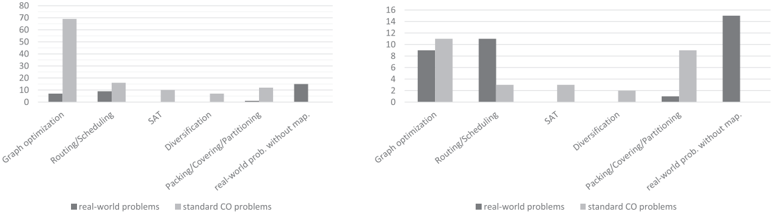
- Typical use cases are graph optimization, routing, and scheduling; Max-Cut is the most popular validation problem, especially for gate-based approaches. Most solved problems are real-world instances with no given mapping to a standard CO problem in the original literature.
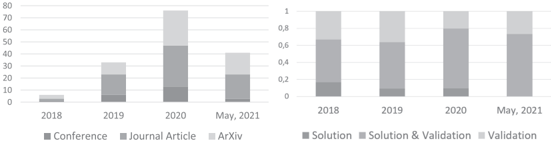
- Bibliometric results: 38% of studies are ArXiv publications and 47% are journal articles from peer-reviewed repositories. Pure solution papers decreased from 17% to 0%, solution-plus-validation papers increased from 50% to 73%, and no evaluation papers were identified. Topic areas are gate-based approaches (53%), QA (35%), other approaches (4%), and problem formulation (8%).
Methods
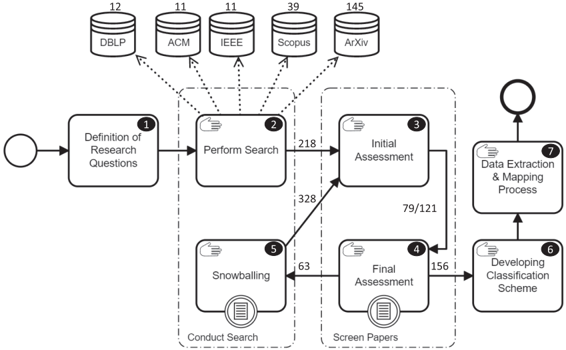
- Systematic mapping study following established guidelines, using the search string `('quantum AND computing' AND 'combinatorial AND optimization')` across DBLP, ACM, IEEE Xplore, Scopus, and ArXiv, limited to English papers published between January 2018 and May 2021.
- Two-phase selection: database search retrieved 218 papers, initial assessment selected 79, full-text assessment selected 63; snowballing selected 328 papers, fully read 121, and included 93, yielding 156 total included studies. A pre-defined validation set of 15 relevant papers was used, with 11 found by the initial search and 4 by snowballing.
- Classification scheme was iteratively developed from the full text of the 156 studies; bibliometric data extraction covered publication time, type, channel, and research facet, with results documented in a replication package.
Limitations
- Stated: external validity may be threatened by a nonrepresentative sample, mitigated by including non-peer-reviewed e-print literature and two-phase snowballing; English-language limitation is considered minimal; the 2018 start date is discussed. Internal validity was mitigated by researcher agreement on inclusion/exclusion. Construct validity was addressed via multiple databases, search string derived from RQs, snowballing, and inter-researcher agreement. Conclusion validity notes other researchers may derive different concepts, with countermeasures including emergent concepts and multi-researcher extraction.
- Evident from the text: the review is restricted to January 2018–May 2021 and English publications, and it excludes compilation/embedding techniques, error mitigation, classical numerical solvers for parameter optimization, classical post-processing, quantum Monte Carlo, quantum walk, quantum machine learning, and quantum-inspired approaches. The authors also report that no evaluation papers were identified.
Model-written summary. Check it against the paper before relying on it.
Integrity signals
Registry
Cites
Statistics
Figures
Verification
Claims the paper makes
124 Valid · 10 Not valid · 37 Not checked · 74 Own results and interpretations
At least one cited source doesn’t support this claim or points to a different paper, and none confirmed it — see the verdicts below.
In the paper
“so-called Noisy Intermediate-Scale Quantum (NISQ) computers already exist today”
What the sources say
- Disputedcites [209] John Preskill. 2018. Quantum computing in the NISQ era and beyond. Quantum 2 (2018), 79. sourceExperimental — accuracy not yet measured
Preskill says on p. 1 that NISQ technology “will be available in the near future.” Section 4.1 (p. 4) likewise describes intermediate-scale quantum computers as becoming available “in the next few years,” rather than saying they already exist. (LLM, conf=0.86)
Checked by a reasoning model — may be wrong.
plain- Asserted: passes — The authors put it forward as true.
- Checkable: passes — It can be checked against evidence.
- Load-bearing: passes — The paper’s conclusions depend on it.
- Based: passes — The paper gives a reason why it holds.
- Disputed
Every source the paper cites for this claim was checked and supports it.
In the paper
“However, the parameterized quantum circuits often utilize multi-controlled operations to encode constraints into the ansatz, e.g., the Quantum Alternating Operator Ansatz [58].”
What the sources say
- Supportedcites [58] source
The paper’s “Mixing operators” section describes mixers that restrict evolution to the feasible subspace and says a partitioned mixer uses multiqubit-controlled-NOT operators. Section 4.3.1 likewise describes operations controlled by neighboring vertices to preserve feasibility. These support the cited ansatz as an example of using multi-controlled operations to encode constraints. (LLM, conf=0.90)
plainstates an association- Asserted: passes — The authors put it forward as true.
- Checkable: passes — It can be checked against evidence.
- Load-bearing: unclear — It is unclear whether the paper’s conclusions depend on it.
- Based: passes — The paper gives a reason why it holds.
- Supported
Every source the paper cites for this claim was checked and supports it.
In the paper
“However, with the mappings of CO problems to Hamiltonians stated in the previous section, besides quantum chemical problems, the same approach can be used to solve CO problems [10].”
What the sources say
- Supportedcites [10] source
Section 2 explicitly says the VQE approach can be used to attempt to solve combinatorial optimization problems. It describes mapping a QUBO problem to a Hamiltonian and applying VQE to seek its ground state. (LLM, conf=0.95)
plainstates a cause- Asserted: passes — The authors put it forward as true.
- Checkable: passes — It can be checked against evidence.
- Load-bearing: passes — The paper’s conclusions depend on it.
- Based: passes — The paper gives a reason why it holds.
- Supported
The cited sources support only part of this claim — read each source’s verdict below.
In the paper
“Besides the mentioned ansatz search, as the driving force behind ansatz adaptation, there is also the possibility of having these adaptations as a byproduct, like it happens, e.g., within the Quantum Alternating Operator Ansatz where the primary goal is to find a mixing Hamiltonian that ensures to stay in the feasible subspace [11, 58, 95, 112, 116, 117, 120, 127].”
What the sources say
- Supportedcites [11] source
The comparison with standard QAOA (p. 3) describes the Quantum Alternating Operator Ansatz as focused on mixer design and says its mixing unitaries must preserve the feasible subspace. The description of adaptations as a byproduct is the citing authors’ framing; the source supports the attributed example and its mixer-design goal. (LLM, conf=0.88)
- Partly supportedcites [58] sourceExperimental — accuracy not yet measured
The Introduction and Conclusions describe designing mixing operators that keep evolution within the feasible subspace, supporting that part of the claim. But the paper presents its extension of the ansatz as an explicit aim, not a byproduct, and says its mixers need not arise from a fixed mixing Hamiltonian. The indexed passages provide section labels but no page numbers. (LLM, conf=0.86)
- Supportedcites [95] source
Section II (pp. 6–7) describes modifying the mixing operator to separate feasible from infeasible states, so the quantum walk remains in the feasible subspace. This supports the cited paper as an example of adapting an alternating-operator approach to preserve feasibility. (LLM, conf=0.88)
- Partly supportedcites [112] sourceExperimental — accuracy not yet measured
The Conclusion (p. 9) says the paper’s tailored variational forms explore only feasible solutions, supporting the general idea of adapting an ansatz to stay within a feasible search space. But the paper does not describe the Quantum Alternating Operator Ansatz or a mixing Hamiltonian as the means of doing so; its Applications section (p. 6) instead treats QAOA as a comparison method that uses constraint penalties. (LLM, conf=0.84)
- Supportedcites [116] source
The paper’s “XY mixer: Enforcing evolution in the feasible subspace” section (p. 4) says it selects a mixing term that preserves the feasible subspace. The Introduction (p. 1) identifies this as its approach to implementing the Quantum Alternating Operator Ansatz for constrained problems. The characterization of ansatz adaptation as a byproduct is the citing authors’ framing. (LLM, conf=0.91)
- Supportedcites [117] source
The Introduction (p. 1) identifies B as the mixing Hamiltonian, and Scheme 1 (p. 4) says encoding constraints in B connects feasible solutions while excluding infeasible ones. This supports the cited paper as an example of adapting the mixer to keep the evolution in the feasible subspace; calling that adaptation a “byproduct” is the citing authors’ framing. (LLM, conf=0.87)
- Not matchedcites [120]
Couldn’t be matched to a paper in Crossref, so it can’t be checked.
- Supportedcites [127] source
The paper’s C. MIXING OPERATORS section describes designing mixing operators that preserve the feasible subspace, and its Abstract identifies these as quantum alternating operator ansatz constructions. The citing authors’ description of ansatz adaptation as a “byproduct” is their framing of that design work. (LLM, conf=0.88)
hedgedstates a cause- Asserted: passes — The authors put it forward as true.
- Checkable: passes — It can be checked against evidence.
- Load-bearing: unclear — It is unclear whether the paper’s conclusions depend on it.
- Based: passes — The paper gives a reason why it holds.
- Supported
Every source the paper cites for this claim was checked and supports it.
In the paper
“In this sense, CVar [10], ascending CVar [78], and the Gibbs objective function [86] can be regarded as adaptations of standard QAOA or VQE that affect their underlying objective function.”
What the sources say
- Supportedcites [10] source
The Introduction states that the paper replaces minimization of expected energy with minimization of CVaR and applies this modification to VQE and QAOA. That supports the part of the citing sentence attached to this source, CVaR as an objective-function adaptation; the other two methods have separate citations. (LLM, conf=0.94)
- Supportedcites [78] source
The citation to this paper is attached to ascending CVaR, not to the other two objective functions in the sentence. Section III describes Ascending-CVaR as a dynamically evolving cost function, and “Our contributions” states that it is tested with both VQE and QAOA. (LLM, conf=0.93)
- Supportedcites [86] source
The Theory section describes the Gibbs objective function as an alternative to the standard energy-expectation objective for choosing variational parameters. The Numerical experiments section compares QAOA using Gibbs with the original QAOA prescription using energy, confirming the attributed change to QAOA’s objective function. This citation is attached to the Gibbs objective function, not to either CVaR variant. (LLM, conf=0.94)
plainstates a cause- Asserted: passes — The authors put it forward as true.
- Checkable: passes — It can be checked against evidence.
- Load-bearing: unclear — It is unclear whether the paper’s conclusions depend on it.
- Based: passes — The paper gives a reason why it holds.
- Supported
77 more claims · 30 with their cited sources checked
Create a free account to see all 245 claims and to verify the 4 references still open.
- Probably not a substantial claim. 119
- It may state two separate claims as one. 72
Self-check
Percentages, sums and reported differences re-computed from the paper’s own numbers.
Each contradiction between two passages listed here was confirmed by an independent check.
Rated major: it would touch a result — a value a result rests on, reported and recomputed p-values on opposite sides of the significance level, two passages that conflict with no sign which is right, or a cited work retracted before this paper was published.
In the paper
§ 4.1 Solution Approaches to Quantum Combinatorial Optimization · p. 19
“A comparison with SA, spin-vector-monte-carlo [215], and simulated QA suggests that QA possesses the best scaling properties [7].”
§ 4.1 Solution Approaches to Quantum Combinatorial Optimization · p. 20
“QA shows superior scaling properties compared to SA, where both are significantly inferior to simulated QA [7].”
Rated minor: it would not touch a result — a value no result rests on, a p-value that stays on the same side of the significance level, or a conflict that is clerical, resolved elsewhere in the paper, or outside its own findings.
In the paper
§ 4.1 Solution Approaches to Quantum Combinatorial Optimization · p. 12
“The use of problem-specific parameterized quantum circuits of the VQE algorithm where the information on constraints is used for the circuit design has been suggested by DÃŋez-Valle et al. [96] to reduce the search space and accelerate convergence.”
§ PRIMARY LITERATURE · p. 31
“[96] Atsushi Matsuo, Yudai Suzuki, and Shigeru Yamashita. 2020. Problem-specific parameterized quantum circuits of the VQE algorithm for optimization problems.”
Citations
Cites
Optimization by Simulated Annealing
Kirkpatrick, S., Gelatt, C. D., & Vecchi, M. P. (1983) · Science · doi:10.1126/science.220.4598.671 · Cited by 45,134 · cited 1×
“QA [178] is a heuristic related to adiabatic quantum computation [178] that is inspired by simulated annealing [195].”
BackgroundQuantum Computation and Quantum Information
Nielsen, M. A., Chuang, I., & Grover, L. K. (2002) · American Journal of Physics · doi:10.1119/1.1463744 · Cited by 21,895
Fast unfolding of communities in large networks
Blondel, V. D., Guillaume, J.-L., Lambiotte, R., & Lefebvre, E. (2008) · Journal of Statistical Mechanics: Theory and Experiment · doi:10.1088/1742-5468/2008/10/p10008 · Cited by 21,424 · cited 1×
“Kalehbasti et al.[74] proposed the generalizable idea of replacing the greedy heuristic within the Louvain algorithm [165], a classical heuristic for the k-community detection problem, by a QUBO solver to consider a larger search space in each iteration [74].”
MethodQuantum computation and quantum information
Law, J. (2001) · ACM SIGSOFT Software Engineering Notes · doi:10.1145/505482.505499 · Cited by 18,842
Boyd, S., Parikh, N., Chu, E., Peleato, B., & Eckstein, J. (2011) · Foundations and Trends® in Machine Learning · doi:10.1561/2200000016 · Cited by 17,075
Boyd, S. (2010) · now publishers, Inc. eBooks · doi:10.1561/9781601984616 · Cited by 12,677
Quantum Computing in the NISQ era and beyond
Preskill, J. (2018) · Quantum · doi:10.22331/q-2018-08-06-79 · Cited by 8,830 · cited 2×
“Furthermore, the concept of NISQ quantum computing has been introduced in 2018 [209].”
BackgroundA fast quantum mechanical algorithm for database search
Grover, L. K. (1996) · Proceedings of the twenty-eighth annual ACM symposium on Theory of computing - STOC '96 · doi:10.1145/237814.237866 · Cited by 8,830
Exploring Network Structure, Dynamics, and Function Using NetworkX
Hagberg, A. A., Schult, D. A., & Swart, P. J. (2008) · Proceedings of the Python in Science Conference · doi:10.25080/tcwv9851 · Cited by 7,477 · cited 1×
“A comparison between various decomposition techniques, i.e., principal component decomposition [185], free-and-anneal [163], qbSolv, and iterative centrality halo [172] has demonstrated the superiority of qbsolv in terms of solution quality [12].”
BackgroundCase-Based Reasoning: Foundational Issues, Methodological Variations, and System Approaches
Aamodt, A., & Plaza, E. (1994) · AI Communications · doi:10.3233/aic-1994-7104 · Cited by 5,624 · cited 1×
“A further specific application of variational algorithms within a classical framework is a proposed quantum version of case-based reasoning [158].”
Background
Research works printed but not linked: 8
- Tim Bittner and Sven Groppe. 2020. Avoiding blocking by scheduling transactions using quantum annealing. In 24th Symposium on International Database Engineering & Applications. 1–10.
- Atsushi Matsuo, Yudai Suzuki, and Shigeru Yamashita. 2020. Problem-specific parameterized quantum circuits of the VQE algorithm for optimization problems. arXiv preprint arXiv:2006.05643 (2020). · arXiv
- Jiahao Yao, Marin Bukov, and Lin Lin. 2020. Policy gradient based quantum approximate optimization algorithm. In Mathematical and Scientific Machine Learning. PMLR, 605–634.
- Elsevier. 2023. Quantum computing research trends report. https://beta.elsevier.com/insights/quantum-computing-report?trial=true
- 10.5555/3226649.3226818 · doi:10.5555/3226649.3226818
- Staffs Keele. 2007. Guidelines for Performing Systematic Literature Reviews in Software Engineering. Technical Report.
- 10.1103/PhysRevE.99.013304 · DOI · Paper page
- L. S. Pontryagin, V. G. Boltyanskii, R. V. Gamkrelidze, and E. F. Mishchenko. 1986. The Mathematical Theory of Optimal Processes’Selected Works of LS Pontryagin, Vol. 4, Gordon and Breach Science Pub. S.A. Montreux, Switzerland.
Cited by
Quantum annealing for combinatorial optimization: a benchmarking study
Kim, S., Ahn, S.-W., Suh, I.-S., Dowling, A. W., Lee, E., & Luo, T. (2025) · npj Quantum Information · doi:10.1038/s41534-025-01020-1 · Cited by 46
“38,39 : Here, t is the elapsed annealing time, and t a is the total annealing time.”
SoK: quantum computing methods for machine learning optimization
Baniata, H. (2024) · Quantum Machine Intelligence · doi:10.1007/s42484-024-00180-1 · Cited by 17
“Specifically, the Ising problem without an external field can be equivalently formulated as a graph maximum cut (Max-Cut) problem that can be solved via combinatorial optimization, which had been well studied in the literature to be solved using QC (Gemeinhardt et al. 2023; Zhou et al. 2023).”
Quantum Computing Through the Lens of Control: A Tutorial Introduction
Berberich, J., & Fink, D. (2024) · IEEE Control Systems · doi:10.1109/mcs.2024.3466448 · Cited by 28
“Various quantum algorithms were developed to solve combinatorial optimization problems [S8], [S9].”
MethodContemporary approaches in matheuristics an updated survey
Boschetti, M. A., & Maniezzo, V. (2024) · Annals of Operations Research · doi:10.1007/s10479-024-06302-z · Cited by 10
“The real turning point was the demonstration of the equivalence between the QUBO model and the Ising model, which plays a prominent role in quantum mechanics (see, Glover et al. (2019, 2022); Gemeinhardt et al. (2023)).”
Gnatowski, A., & Niżyński, T. (2026) · Lecture notes in networks and systems · doi:10.1007/978-3-032-14163-7_19 · Cited by 8
Imaginary Hamiltonian variational Ansatz for combinatorial optimization problems
Wang, X., Chai, Y., Feng, X., Guo, Y., Jansen, K., & Tüysüz, C. (2025) · Physical Review A · doi:10.1103/physreva.111.032612 · Cited by 16
“Many applications of quantum computers involve the preparation of the ground state of a Hamiltonian sys-tem in fields such as chemistry [1], drug design [2, 3], particle physics [4, 5], combinatorial optimization [6, 7] and quantum machine learning [8].”
Hardware-level Interfaces for Hybrid Quantum-Classical Computing Systems
Rallis, K., Liliopoulos, I., Tsipas, E., Varsamis, G. D., Melissourgos, N., Karafyllidis, I. G., Sirakoulis, G. C., & Dimitrakis, P. (2025) · International Conference in Electronic Engineering & Information Technology (EEITE) · doi:10.1109/eeite65381.2025.11166221 · Cited by 10
“Representative types of problems that can benefit from the use of quantum computing are several combinatorial optimization problems [12], machine learning and AI-related tasks [13], cryptography and security tasks [14], computational biology tasks [15], and computational chemistry tasks [16] just…”
Robustness of optimal quantum annealing protocols
Funcke, N., & Berberich, J. (2024) · New Journal of Physics · doi:10.1088/1367-2630/ad7b6b · Cited by 3
“Both quantum annealing (QA, [9, 10]) and the quantum approximate optimization algorithm (QAOA, [11]) tackle this problem by interpolating or iterating between two Hamiltonians.”
Modeling of Assignment Problem in Quantum Approximate Optimization Algorithm
Roy, A., Singh, N. B., & Saha, A. K. (2025) · Advanced Quantum Technologies · doi:10.1002/qute.202400364 · Cited by 2
Inference of Maximum Parsimony Phylogenetic Trees with Model‐Based Classical and Quantum Methods
Zhang, J., Chen, Y., Zhou, Y., & Huang, J.-H. (2026) · Advanced Quantum Technologies · doi:10.1002/qute.202500695 · Cited by 4
Characterizing the Effects of Zero-Noise Extrapolation on a QAOA Workflow
Vénere, M., Lusso, A., Onofre, V., et al. (2024) · IEEE International Conference on Quantum Computing and Engineering (QCE) · doi:10.1109/qce60285.2024.10338 · Cited by 1
Comparison of Quantum Programming Frameworks for IQM Spark 5
Biskup, A., Berniker, K., Owczarek, M., Sikora, E., & Gnatowski, A. (2026) · Lecture notes in networks and systems · doi:10.1007/978-3-032-14163-7_27 · Cited by 1
Reale, S., & Nitto, E. D. (2024) · IEEE International Conference on Quantum Software (QSW) · doi:10.1109/qsw62656.2024.00017
“In this context, despite its focus on the standard gate model, the work by Gemeinhardt et al. [20] represents a good starting point for describing the state of the art in our specific topic of interest, which is quantum combinatorial optimization.”
MethodDillo, T. (2025) · International Journal of Theoretical and Applied Mathematics · doi:10.11648/j.ijtam.20251104.12
Quantum-Optimized Control of the Inverted-Pendulum System
Stamatiou, G. T., & Magoutis, K. (2026) · IEEE International Conference on Quantum Software (QSW) · doi:10.1109/qsw72780.2026.00032
Exploring Beamforming Solutions Using Recursive Quantum Approximate Optimization Algorithm
Dhara, B., Agrawal, M., & Roy, S. D. (2025) · IEEE International Conference on Quantum Computing and Engineering (QCE) · doi:10.1109/qce65121.2025.00014
“The application of quantum computing to combinatorial optimization problems is attracting increasing research interest, especially concerning the near-term possibilities of Quantum Computing [12].”
QUBO-Based Scheduling of Heterogeneous Quantum Computing Resources in Scale-Free Industrial Networks
Wang, Y., Wang, X., Pan, Y., & Gao, Q. (2026) · Youth Academic Annual Conference of Chinese Association of Automation (YAC) · doi:10.1109/yac71005.2026.11616218
Quantum Dominating Set Problem: An Unbalanced Penalization Analysis
Chaurra-Gutierrez, F. A., Feregrino-Uribe, C., & Sun, G. (2026) · International Conference on Quantum Communications, Networking, and Computing (QCNC) · doi:10.1109/qcnc69040.2026.00033
“…Quantum (NISQ) era, hybrid quantum-classical algorithms such as the Variational Quantum Eigensolver (VQE) and the Quantum Approximate Optimization Algorithm (QAOA) have emerged as leading solutions to these challenges, leveraging shallow quantum circuits paired with classical optimizers [1], [2].”
He, C., Li, Q., & Zhang, J. (2026) · Processes · doi:10.3390/pr14132095 · Cited by 1
Studies of quantum combinatorial optimization algorithms: <?A3B2 pi6?>a review
Li, Z., Wu, Y., Zhang, R., Wen, J., Wang, T., & Wang, C. (2025) · Chinese Science Bulletin (Chinese Version) · doi:10.1360/csb-2025-5565
Workflow-as-a-Service brokers in cloud environments: A systematic mapping study
Abrishami, S., Zandi, F. M., & Nourbakhsh, A. (2026) · Journal of Network and Computer Applications · doi:10.1016/j.jnca.2026.104592
Metadata
- Authors
- Gemeinhardt, F., Garmendia, A., Wimmer, M., Weder, B., & Leymann, F.
- Affiliations
- Johannes Kepler University of Linz (AT)
- Universidad Autónoma de Madrid, Modelling & Software Engineering Research Group, Spain
- University of Stuttgart (DE)
- Venue
- ACM Computing Surveys
- Published
- 2023-10-05
- Volume
- 56
- Issue
- 3
- Pages
- 1-36
- ISSN
- 0360-0300 (ISSN-L)
- 1557-7341
- OpenAlex
- W4386443168
- Cited by
- 22
- References
- 305
- Citations by year
- 2026: 9 · 2025: 7 · 2024: 6
- FWCI
- 1.95
- Type
- journal article
- Language
- en
- Open access
- hybrid
- doi.org
- Licence
- Locations
- ACM Computing Surveys (publishedVersion, cc-by)
- Biblos-e Archivo (Universidad Autónoma de Madrid) (submittedVersion, cc-by)
- BURJC Digital (King Juan Carlos University) (submittedVersion, cc-by)
- University Library Linz repository (Johannes Kepler Universitat Linz) (submittedVersion, cc-by)
- Hispana (submittedVersion)
- Hispana (submittedVersion, cc-by)
- Funders
- Austrian Federal Ministry for Digital and Economic Affairs and the National Foundation for Research, Technology and Development and by the Austrian Science Fund (P 30525-N31)
- Federal Ministry for Economic Affairs and Climate Action (PlanQK (01MK20005N) and EniQmA (01MQ22007B))
- Spanish MICINN (PID2021-122270OB-I00 and TED2021-129381B-C21)
- Topics
- Physical Sciences › Computer Science › Artificial Intelligence › Quantum Computing Algorithms and Architecture
- Physical Sciences › Computer Science › Computational Theory and Mathematics › Complexity and Algorithms in Graphs
- Physical Sciences › Computer Science › Artificial Intelligence › Metaheuristic Optimization Algorithms Research
- Keywords
- NISQ devices, quantum annealing, gate-based quantum computing, graph optimization, routing, scheduling
About these checks
Registry, retraction, Cites and statistics results are computed, not judged, with one exception: a printed reference that no index lists is read once by a model before it counts as a citation error. Claims are extracted by a model and kept only when their quote appears verbatim in the text; each cited source is then checked, with a model’s help, for whether it says what the claim relies on. Those verdicts can be wrong — read the claim’s quote and the cited source before relying on one.
The claim verdicts this report counts are experimental: their accuracy is not yet measured.
A language model drew the claims from the paper on 2026-10-12, under version 3 of the claim definition (model deepseek-v4.1-flash, prompt extract-v3).
A second model labelled each claim on 2026-10-12 (model jev-1.13-20260917, definition revision gold-guideline-v0.2).
Cited sources are checked with a language model’s help (gpt-6-sol).
Statistics and arithmetic are recomputed, not judged.
Confidence bands are shown only for fields calibrated on our annotated test set. None is calibrated yet, so no band is shown.
What counts as a claim ›How we measure confidence ›How we check this ›
Are you an author, or do you see a problem with this page? Request a review
Data sources
Bibliographic data: Semantic Scholar, OpenAlex, Crossref.
Contains information from the Semantic Scholar Academic Graph Datasets, made available under the ODC Attribution License (ODC-BY 1.0).
Semantic Scholar’s data is described in: Kinney, R., et al. (2023). The Semantic Scholar Open Data Platform. arXiv:2301.10140.
