

Impact of Voice Fidelity on Decision Making: A Potential Dark Pattern?
Open accessThe DOI matches its Crossref record; 61 of the 61 references it cites were found in a registry or an index.
Abstract
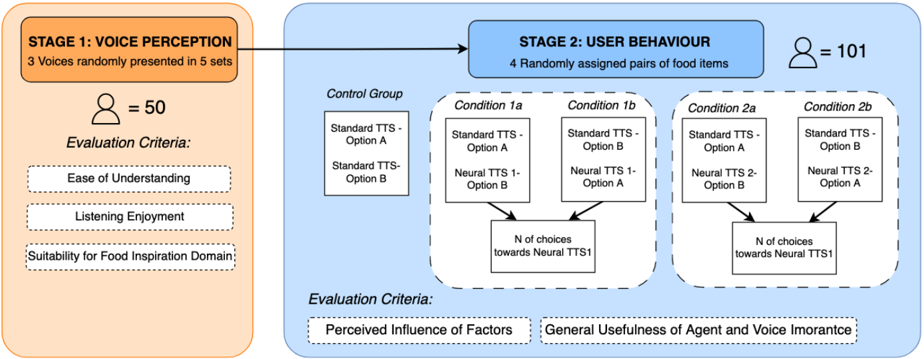
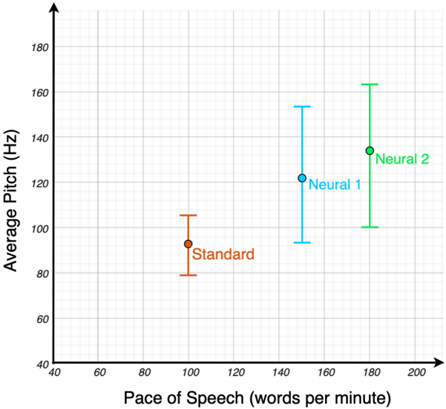
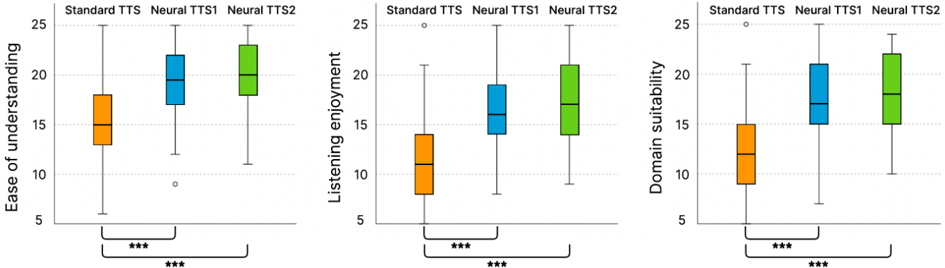
Manipulative design in user interfaces (conceptualized as dark patterns) has emerged as a significant impediment to the ethical design of technology and a threat to user agency and freedom of choice. While previous research focused on exploring these patterns in the context of graphical user interfaces, the impact of speech has largely been overlooked. We conducted a listening test (N = 50) to elicit participants’ preferences regarding different synthetic voices that varied in terms of synthesis method (concatenative vs. neural) and prosodic qualities (speech pace and pitch variance), and then evaluated their impact in an online decision-making study (N = 101). Our results indicate a significant effect of voice qualities on the participant’s choices, independently from the content of the available options. Our results also indicate that the voice’s perceived engagement, ease of understanding, and domain fit directly translate to its impact on participants’ behavior in decision-making tasks.
Overview
The claims and statistics of this paper haven’t been checked yet.
Free: it reads the open-access text and checks the first 5 claims that cite a source we can check. Create a free account to check every claim.
Integrity signals
Registry
Cites
Statistics
Figures
Verification
Claims the paper makes
The claims and statistics of this paper haven’t been checked yet.
Free: it reads the open-access text and checks the first 5 claims that cite a source we can check. Create a free account to check every claim.
Claims other papers make about this one
Each is checked against this paper’s own text: does it say what the citing paper says it does?
In the citing paper
“Given that prior research, such as Dubiel et al. [26, 27], has indicated that even minor variations in voice characteristics can significantly influence user perceptions, we decided to adopt a synthetic voice for the user role as well.”
From Examining Humanness as a Metaphor to Design Voice User Interfaces (2024) · cites this paper as [27]
Self-check
Percentages, sums and reported differences re-computed from the paper’s own numbers.
The self-check needs the paper’s full text.
Citations
Cites
Nudge: improving decisions about health, wealth, and happiness
(2008) · Choice Reviews Online · doi:10.5860/choice.46-0977 · Cited by 11,572
Baddeley, A. (1992) · Science · doi:10.1126/science.1736359 · Cited by 5,258
Principles of Voice Production
Titze, I. R., & Martin, D. W. (1998) · The Journal of the Acoustical Society of America · doi:10.1121/1.424266 · Cited by 1,643
Slovic, P., Finucane, M. L., Peters, E., & MacGregor, D. G. (2007) · European Journal of Operational Research · doi:10.1016/j.ejor.2005.04.006 · Cited by 1,537 · cited 2×
“Specifically, he postulated a link between affect and cognition and forming options and attitudes, where ‘people consult or refer to “affect pool” containing all the positive and negative tags consciously or unconsciously associated with the representations’ [64].”
Food Choice: A Conceptual Model of the Process
FURST, T., CONNORS, M., BISOGNI, C. A., SOBAL, J., & FALK, L. W. (1996) · Appetite · doi:10.1006/appe.1996.0019 · Cited by 1,230
Consumer experiences, attitude and behavioral intention toward online food delivery (OFD) services
Yeo, V. C. S., Goh, S.-K., & Rezaei, S. (2017) · Journal of Retailing and Consumer Services · doi:10.1016/j.jretconser.2016.12.013 · Cited by 956 · cited 1×
“Research indicates that people rarely engage in an extensive decision-making process or in-depth evaluation of product features when buying food [68, 80].”
BackgroundThe Dark (Patterns) Side of UX Design
Gray, C. M., Kou, Y., Battles, B., Hoggatt, J., & Toombs, A. L. (2018) · Proceedings of the 2018 CHI Conference on Human Factors in Computing Systems · doi:10.1145/3173574.3174108 · Cited by 848 · cited 4×
“In this light, the voice influence mechanism we analysed could be likened to the “Interface Interference” dark pattern [30] prevalent in visual interfaces, including cookie consent banners.”
BackgroundMethodInfluentialDark Patterns at Scale: Findings from a Crawl of 11K Shopping Websites
Mathur, A., Acar, G., Friedman, M. J., Lucherini, E., Mayer, J., Chetty, M., & Narayanan, A. (2019) · Proceedings of the ACM on Human-Computer Interaction · doi:10.1145/3359183 · Cited by 816
Hansen, P. G., & Jespersen, A. M. (2013) · European Journal of Risk Regulation · doi:10.1017/s1867299x00002762 · Cited by 773 · cited 1×
“…test ( 𝑁 = 50) to elicit participants’ preferences regarding different synthetic voices that varied in terms of synthesis method (concatenative vs. neural) and prosodic qualities (speech pace and pitch variance), and then evaluated their impact in an online decision-making study ( 𝑁 = 101).”
Harmon-Jones, E., & Mills, J. (2019) · Cognitive dissonance: Reexamining a pivotal theory in psychology (2nd ed.). · doi:10.1037/0000135-001 · Cited by 760
Research works printed but not linked: 17
- Shlomo Benartzi, John Beshears, Katherine L Milkman, Cass R Sunstein, Richard H Thaler, Maya Shankar, Will Tucker-Ray, William J Congdon, and Steven Galing. 2017. Should governments invest more in nudging? Psychological science 28, 8 (2017), 1041-1055.
- Kerstin Bongard-Blanchy, Arianna Rossi, Salvador Rivas, Sophie Doublet, Vincent Koenig, and Gabriele Lenzini. 2021. " I am Definitely Manipulated, Even When I am Aware of it. It's Ridiculous!"-Dark Patterns from the End-User Perspective. In Designing Interactive Systems Conference 2021. 763-776.
- Akash Chaudhary, Jaivrat Saroha, Kyzyl Monteiro, Angus G Forbes, and Aman Parnami. 2022. "Are You Still Watching?": Exploring Unintended User Behaviors and Dark Patterns on Video Streaming Platforms. In Designing Interactive Systems Conference. 776-791.
- Elizabeth Dula, Andres Rosero, and Elizabeth Phillips. 2023. Identifying Dark Patterns in Social Robot Behavior. In 2023 Systems and Information Engineering Design Symposium (SIEDS). IEEE, 7-12.
- Bureau européen des unions de consommateurs. 2022. "Dark patterns" and the EU consumer law acquisition. https://www.beuc.eu/sites/default/files/publications/ beuc-x-2022-013_dark_patters_paper.pdf Last accessed 9 January 2023.
- Colin M Gray, Lorena Sanchez Chamorro, Ike Obi, and Ja-Nae Duane. 2023. Mapping the Landscape of Dark Patterns Scholarship: A Systematic Literature Review. In Designing Interactive Systems Conference. 188-193.
- Tianzhi He and Farrokh Jazizadeh. 2022. Nudging Occupants for Energy-Saving through Voice-Based Proactive Virtual Assistants. In Construction Research Con- gress 2022. 402-411.
- Lars Hornuf and Sonja Mangold. 2022. Digital dark nudges. In Diginomics Research Perspectives: The Role of Digitalization in Business and Society. Springer, 89-104.
- Luiza Jarovsky. 2022. Dark Patterns in Personal Data Collection: Definition, Taxonomy and Lawfulness. Taxonomy and Lawfulness (March 1, 2022) (2022).
- Mandy B Korpusik. 2019. Deep learning for spoken dialogue systems: application to nutrition. Ph. D. Dissertation. Massachusetts Institute of Technology.
- Cherie Lacey and Catherine Caudwell. 2019. Cuteness as a 'dark pattern'in home robots. In 2019 14th ACM/IEEE International Conference on Human-Robot Interaction (HRI). IEEE, 374-381.
- Oksana Mont, Matthias Lehner, and Eva Heiskanen. 2014. Nudging: A tool for sustainable behaviour? Naturvårdsverket.
- Anna Oleszkiewicz, Katarzyna Pisanski, Kinga Lachowicz-Tabaczek, and Ag- nieszka Sorokowska. 2017. Voice-based assessments of trustworthiness, compe- tence, and warmth in blind and sighted adults. Psychonomic bulletin & review 24 (2017), 856-862.
- Anssi Tarkiainen and Sanna Sundqvist. 2009. Product involvement in organic food consumption: does ideology meet practice? Psychology & Marketing 26, 9 (2009), 844-863.
- Paul Taylor. 2009. Text-to-speech synthesis. Cambridge university press.
- Reha Tuncer, Anastasia Sergeeva, Kerstin Bongard-Blanchy, Verena Distler, So- phie Doublet, and Vincent Koenig. 2023. Running out of time (rs): effects of scarcity cues on perceived task load, perceived benevolence and user experience on e-commerce sites. Behaviour & Information Technology (2023), 1-19.
- Aarron Walter and Jared M Spool. 2011. Designing for emotion. Vol. 9. A book apart New York.
Cited by
Examining Humanness as a Metaphor to Design Voice User Interfaces
Desai, S., Dubiel, M., & Leiva, L. A. (2024) · ACM Conversational User Interfaces 2024 · doi:10.1145/3640794.3665535 · Cited by 21
“Given that prior research, such as Dubiel et al. [26, 27], has indicated that even minor variations in voice characteristics can significantly influence user perceptions, we decided to adopt a synthetic voice for the user role as well.”
ResultSelf-citationIsola, C., & Esposito, F. (2025) · Computer law & security review · doi:10.1016/j.clsr.2025.106169 · Cited by 31
Dubiel, M., Leiva, L. A., Bongard-Blanchy, K., & Sergeeva, A. (2024) · ACM Transactions on Computer-Human Interaction · doi:10.1145/3685274 · Cited by 17
“Research shows that CAs that sound like humans are generally perceived as significantly more trustworthy [40, 109], more pleasant to listen to [34] and likeable [76] than CAs with more ‘robot like’ voices.”
Self-citationToward Metaphor-Fluid Conversation Design for Voice User Interfaces
Desai, S., Chin, J., Wang, D., Cowan, B. R., & Twidale, M. B. (2026) · ACM Conference on Conversational User Interfaces (CUI) · doi:10.1145/3816046.3816223 · Cited by 16
A Comprehensive Study on Dark PatternsPreprint
Li, M., Wang, X., Nie, L., Li, C., Liu, Y., Zhao, Y., Xue, L., & Said, K. S. (2024) · arXiv (Cornell University) · doi:10.48550/arxiv.2412.09147 · Cited by 16
Voicecraft: Designing Task-specific Voice Assistant Personas
Dubiel, M., Desai, S., Zargham, N., & Schmitt, A. (2024) · ACM Conference on Conversational User Interfaces (CUI) · doi:10.1145/3640794.3670000 · Cited by 11
“Since auditory cues such as pitch variance or speaking rate and their modifications can affect user perception and behaviour (e.g., [1, 11, 12, 14, 17]), exploring such cues will be the focus of our workshop.”
BackgroundSelf-citationUnboxing Manipulation Checks for Voice UX
Seaborn, K., Rogers, K., Altmeyer, M., Watanabe, M., Sawa, Y., Nam, S., Itagaki, T., & Li, G. (2025) · Interacting with Computers · doi:10.1093/iwc/iwae062 · Cited by 13
The Voice: Lessons on Trustworthy Conversational Agents from 'Dune'
Feldman, P. (2024) · ACM Conference on Conversational User Interfaces (CUI) · doi:10.1145/3640794.3665890 · Cited by 9
“Advances in AI and speech synthesis technologies have made it possible to manipulate vocal cues with great precision allowing state-of-the art speech systems to convey even subtle emotions and attitudes [5, 21].”
BackgroundKim, J., & Fussell, S. R. (2025) · Proceedings of the 2025 CHI Conference on Human Factors in Computing Systems · doi:10.1145/3706598.3714203 · Cited by 6
“Whether we are aware of it or not, prosodic voice features affect our perceptions and behaviors [20].”
Zhang, S., Chen, H., Wang, Y. M., Xu, Y., Bai, J., Wu, Y., Li, S., Yi, X., Wang, C., & Li, H. (2025) · Proceedings of the ACM on Interactive Mobile Wearable and Ubiquitous Technologies · doi:10.1145/3749510 · Cited by 7
Towards a Framework for Exploring Synthetic Voices in VUI Design
Fritsch, J., Karaturhan, P., Jørgensen, S. M. H., Ada, A. A., & Knudsen, S. L. (2025) · Designing Interactive Systems Conference · doi:10.1145/3715336.3735729 · Cited by 4
“To tackle this, [18] conducted a listening test that compared voice synthesis meth-ods and prosodic qualities to explore the effect of voice fidelity on decision-making tendencies without the user’s awareness, pointing towards potential use of dark patterns in the VUIs.”
Leschanowsky, A., Sergeeva, A., Bauer, J., Vijapurapu, S., & Dubiel, M. (2025) · International Journal of Human-Computer Studies · doi:10.1016/j.ijhcs.2025.103590 · Cited by 4
Self-citationA Systematic Review of User Experiments on the Effects of Dark Patterns
Schaffner, B., Heysen, L., & Chetty, M. (2026) · CHI Conference on Human Factors in Computing Systems · doi:10.1145/3772318.3790383 · Cited by 3
Fostering people's autonomy by foregrounding and questioning daily choices
Clasen, D., & Hassenzahl, M. (2024) · Nordic Conference on Human-Computer Interaction · doi:10.1145/3677045.3685442 · Cited by 3
Disclosure By Design: Identity Transparency as a Behavioural Property of Conversational AI ModelsPreprint
Gausen, A., Wallbridge, S., Kirk, H. R., Williams, J. D., & Summerfield, C. (2026) · arXiv (Cornell University) · doi:10.48550/arxiv.2603.16874 · Cited by 6
“Secondly, human-AI interactions increasingly take place in the voice modality, where richer anthropomorphic cues alter social perceptions of interlocutor identity (Fang et al., 2025; Dubiel et al., 2024).”
Predicting Biased Human Decision-Making with Large Language Models in Conversational Settings
Pilli, S., & Nallur, V. (2026) · ACM International Conference on Intelligent User Interfaces (IUI) · doi:10.1145/3742413.3789127 · Cited by 5
Koçyiğit, E., Liga, D., & Lenzini, G. (2025) · Communications in computer and information science · doi:10.1007/978-3-031-89103-8_5 · Cited by 2
Fake Reviews as Dark Patterns: A Nudge Theory Perspective Using the SOR Framework
Thukral, A., Aggarwal, N., Saini, C. P., & Kapoor, P. (2025) · Interdisciplinary Journal of Information Knowledge and Management · doi:10.28945/5653 · Cited by 1
“According to recent research by Dubiel et al. (2024) , choice architecture can be u sed to unethically manipulate people, particularly in our example, through the use of fake reviews.”
Dark Patterns in Digital Design: A Review and Assessment via Risk, Trust and Diversity Scores
Marwaha, P., Mahajan, S., Joshi, K. M. I., Srivastava, A., Sharma, P., & Chaukiyal, A. (2026) · ITEGAM- Journal of Engineering and Technology for Industrial Applications (ITEGAM-JETIA) · doi:10.5935/jetia.v12i57.2715 · Cited by 2
Emulating Aggregate Human Choice Behavior and Biases with GPT Conversational Agents
Pilli, S., & Nallur, V. (2026) · CHI Conference on Human Factors in Computing Systems · doi:10.1145/3772318.3791835 · Cited by 2
Moving Beyond Clicks: Rethinking Consent and User Control in the Age of AI
Seymour, W., Alt, F., Benenson, Z., Grimme, S. A., Karegar, F., Poikela, M. E., Rossi, A., & Warner, M. (2026) · CHI Conference Extended Abstracts on Human Factors in Computing Systems (CHI EA) · doi:10.1145/3772363.3778697 · Cited by 2
“Emerging interface such as voice have been shown to lack workable consent mechanisms [23], and along with mixed and alternate reality interfaces are vulnerable to their own manipulative design patterns [9, 13, 17, 24].”
Synthetic speech and affective experience in virtual reality: A scoping review
Dubiel, M., & Botev, J. (2025) · Empathic Computing · doi:10.70401/ec.2025.0011
Self-citationThe Influence of Prior Discourse on Conversational Agent-Driven Decision-MakingPreprint
Pilli, S., & Nallur, V. (2025) · arXiv (Cornell University) · doi:10.48550/arxiv.2503.04692
“Dubiel et al. [9] explored the impact of voice fidelity in synthetic speech on decision-making, focusing on how auditory cues could exploit cognitive biases and heuristics.”
Co-creating Vocal Imaginaries with Conversational AIs
Karaturhan, P., Glanois, C., & Fritsch, J. (2025) · Australian Conference on Human-Computer Interaction (OzCHI) · doi:10.1145/3764687.3764716
The Voice: Lessons on Trustworthy Conversational Agents from 'Dune'
Feldman, P. (2024) · Maryland Shared Open Access Repository (USMAI Consortium) · doi:10.13016/m2y4cr-v6dd
Schilling, T., & Sergeeva, A. (2026) · International Journal of Human-Computer Interaction · doi:10.1080/10447318.2026.2662520 · Cited by 1
Self-citationA Model of Multi-turn Human Persuadability Using Probabilistic Belief TracingPreprint
Moore, J., Goodman, N. D., Haber, N., & Kleiman-Weiner, M. (2026) · arXiv (Cornell University) · doi:10.48550/arxiv.2606.05330
Tebourbi, H., Stassart, A., Rastegar, S., Vijapurapu, S., Sergeeva, A., & Leschanowsky, A. (2026) · ACM Conference on Conversational User Interfaces (CUI) · doi:10.1145/3816046.3816298
“Moreover, despite the higher activation of users’ persuasion knowledge in voice agents’ presentations [14], listeners can miss the manipulations of prosodic features [5, 23].”
Self-citationShadowGuard: An Agentic Edge Framework for On-Device Detection of Mobile Dark Patterns
Song, Y., 嵇浩翔, Liu, X., Wei, F., Gao, H., & Cai, Z. (2026) · IEEE Transactions on Network Science and Engineering · doi:10.1109/tnse.2026.3715836
“The second is tight coupling to surface-level UI conventions inherited from early catalogs of deceptive de-sign [1], [3]: definitions tied to specific widgets or modal styles age poorly as interaction paradigms evolve and new modalities such as voice interfaces enter the picture [60], [61].”
Kinoshita, Y., & Nakamura, S. (2026) · Nordic Conference on Human-Computer Interaction · doi:10.1145/3829807.3829876
Metadata
- Authors
- Dubiel, M., Sergeeva, A., & Leiva, L. A.
- Affiliations
- University of Luxembourg (LU)
- Venue
- Proceedings of the 29th International Conference on Intelligent User Interfaces
- Publisher
- ACM
- Published
- 2024-03-18
- Pages
- 181-194
- OpenAlex
- W4393970546
- Cited by
- 16
- References
- 57
- Citations by year
- 2026: 4 · 2025: 7 · 2024: 5
- FWCI
- 5.16
- Type
- conference paper
- Language
- en
- Open access
- hybrid
- doi.org
- Licence
- Locations
- ACM International Conference on Intelligent User Interfaces (IUI) (publishedVersion, cc-by-nc-nd)
- arXiv (Cornell University) (submittedVersion, cc-by-nc-nd)
- Open Repository and Bibliography (University of Luxembourg) (submittedVersion, cc-by-nc-nd)
- arXiv (Cornell University)
- Funders
- Horizon 2020 Framework Programme (BANANA, grant CHIST-ERA-20-BCI-001)
- HORIZON EUROPE European Innovation Council (SYMBIOTIK, grant 101071147)
- Luxembourg National Research Fund (FNR) (Decepticon (grant no.IS/14717072))
- Topics
- Physical Sciences › Computer Science › Human-Computer Interaction › Innovative Human-Technology Interaction
- Physical Sciences › Computer Science › Human-Computer Interaction › Usability and User Interface Design
- Social Sciences › Business, Management and Accounting › Marketing › AI in Service Interactions
- Keywords
- dark patterns, synthetic speech, manipulative design, decision-making, user agency, ethical design, speech synthesis, prosody, neural text-to-speech, concatenative synthesis, user preferences, listening tests
About these checks
Registry, retraction, Cites and statistics results are computed, not judged, with one exception: a printed reference that no index lists is read once by a model before it counts as a citation error. Claims are extracted by a model and kept only when their quote appears verbatim in the text; each cited source is then checked, with a model’s help, for whether it says what the claim relies on. Those verdicts can be wrong — read the claim’s quote and the cited source before relying on one.
Statistics and arithmetic are recomputed, not judged.
Confidence bands are shown only for fields calibrated on our annotated test set. None is calibrated yet, so no band is shown.
What counts as a claim ›How we measure confidence ›How we check this ›
Are you an author, or do you see a problem with this page? Request a review
Data sources
Bibliographic data: Semantic Scholar, OpenAlex, Crossref.
Contains information from the Semantic Scholar Academic Graph Datasets, made available under the ODC Attribution License (ODC-BY 1.0).
Semantic Scholar’s data is described in: Kinney, R., et al. (2023). The Semantic Scholar Open Data Platform. arXiv:2301.10140.
