

The Impact of Response Latency and Task Type on Human-LLM Interaction and Perception
Open accessThe DOI matches its Crossref record; 58 of the 58 references it cites were found in a registry or an index; none of the 67 sources its claims cite is checked for support yet.
Abstract
Responsiveness in large language model (LLM) applications is widely assumed to be critical, yet the impact of latency on user behavior and perception of output quality has not been systematically explored. We report a controlled experiment varying time-to-first-token latency (2, 9, 20 seconds) across two taxonomy-driven knowledge task types (Creation and Advice). Log analyses reveal that user interaction behaviors were robust to latency, yet varied by task type: Creation tasks elicited more frequent prompting than Advice tasks. In contrast, participants who experienced 2-second latencies rated the LLM’s outputs less thoughtful and useful than those who experienced 9- or 20-second latencies. Participants attributed delays to AI deliberation, though long waits occasionally shifted this interpretation toward frustration or concerns about reliability. Overall, this work demonstrates that latency is not simply a cost to reduce but a tunable design variable with ethical implications. We offer design strategies for enhancing human-LLM interaction.
Overview
CoChat Summary
TL;DR
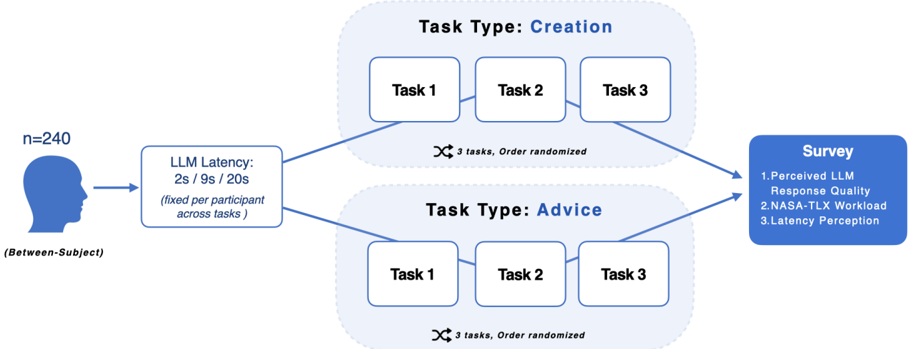
In a 2×3 between-subjects experiment with 240 participants, LLM response latency (2, 9, 20 s time-to-first-token) did not significantly change interaction behaviors, but task type did: Creation tasks elicited more prompts than Advice. Perceptions varied: 2 s responses were rated less thoughtful and useful than 9–20 s responses, while Creation outputs were rated more favorably than Advice outputs.
Key findings
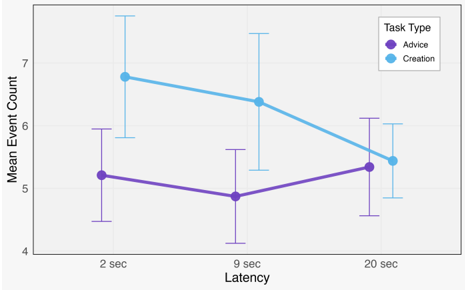
- Interaction behavior was robust to latency: no significant latency or interaction effects on new prompts, copy/paste, or new-chat actions. Task type mattered: Creation participants submitted more new prompts (M = 6.20, SD = 2.94) than Advice participants (M = 5.14, SD = 2.33), F(1, 236) = 8.57, p = .004, η²p = .035, d = −0.40.
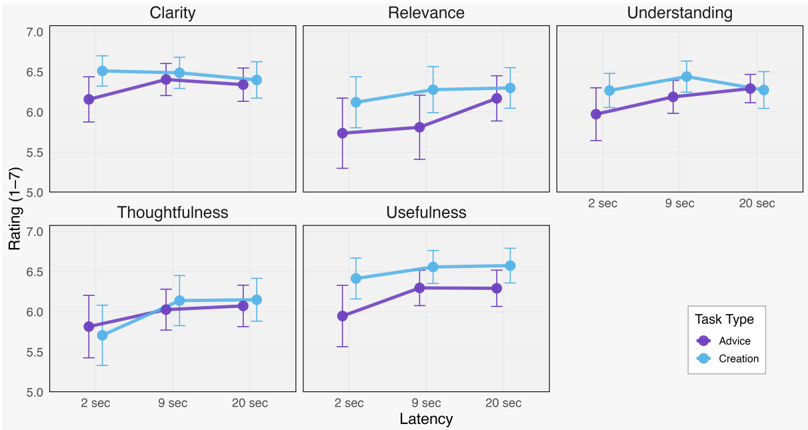
- Perceived quality varied by latency and task type. Responses at 2 s were rated less thoughtful (M = 5.76, SD = 1.18) than at 9 s (M = 6.09, SD = 0.90; p = .008) and 20 s (M = 6.11, SD = 0.82; p = .040). Usefulness was higher at 9 s (M = 6.44, SD = 0.67) than at 2 s (M = 6.19, SD = 1.01; p = .021), and Creation responses were rated more useful than Advice responses (M = 6.52 vs. 6.18; F(1, 234) = 34.9, p < .001, η²p = .13).
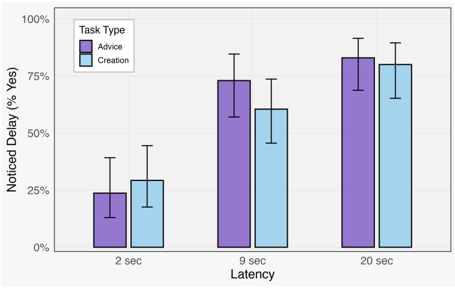
- Latency noticeability increased with delay: in Creation, 29.3% noticed at 2 s, 60.5% at 9 s, and 80.0% at 20 s; in Advice, 23.7%, 73.0%, and 82.9%, respectively; χ²(5, N = 240) = 54.29, p < .001, Cramér’s V = .48.
- Qualitative themes among the 140 participants who noticed delay included No/Minimal Impact (45.0%), Inferred AI Deliberation (30.7%), System Reliability Concern (14.3%), Quality-Contingent Value (13.6%), Interaction Strategy Adaptation (8.6%), Negative Affective Cost (7.1%), and Self-Regulatory Use (3.6%).
Methods
- A 2 × 3 between-subjects experiment manipulated Task-Type (Creation vs. Advice) and Latency-Level (2, 9, or 20 s TTFT). The final analytic sample was 240 participants; the paper reports exclusions from 309 valid logs (withdrawn consent n = 3, failed attention check n = 1, speeding n = 2, latency-fidelity rule n = 63). Participants were U.S.-based Prolific adults (18+) who used AI assistants at least monthly.
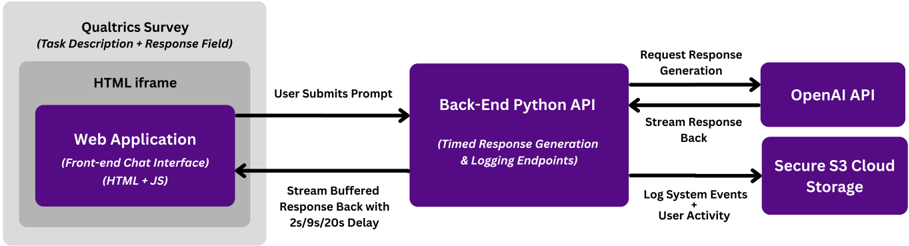
- Each participant completed three tasks of their assigned type in randomized order under a fixed latency. The system used GPT-4o, buffered output to enforce assigned TTFT, then streamed at 25 tokens/s (40 ms inter-token interval).
- Measures included system logs of LLM query events and user action events, post-task perceived-quality ratings (7 items, 7-point Likert), NASA-TLX workload, and latency perception with open-ended reflections. Quantitative analyses used aligned rank transform ANOVA with post hoc Tukey-adjusted comparisons and chi-square for latency perception; open-ended responses were thematically coded (inter-rater reliability κ = .46–.80).
Limitations
- Stated: the study manipulated only TTFT, held streaming throughput constant, and tested three discrete latency levels, so it cannot establish whether perceptions follow a continuous curve or hinge on discrete thresholds. It was conducted in a controlled environment without real consequences, with tasks confined to a single interface, and with U.S.-based Prolific adults who reported regular AI use. The interface was deliberately cue-free, omitting progress indicators or “thinking” labels.
- Stated: future work should test finer-grained timing manipulations, streaming pace, total response duration, cue-based transparency, ecologically richer settings, and more diverse cultural/demographic contexts.
- Evident: qualitative themes came only from the 140 participants who reported noticing delay, so those proportions do not represent all participants. The latency-fidelity rule excluded 63 participants, and the paper’s participant-count reporting is somewhat inconsistent (240 randomized vs. 309 valid logs before exclusions), which may affect reproducibility.
Model-written summary. Check it against the paper before relying on it.
Integrity signals
Registry
Cites
Statistics
Figures
Verification
Claims the paper makes
0 Valid · 3 Not valid · 48 Not checked · 148 Own results and interpretations
A result the paper reports from its own data — it cites no other source for it, so there is none to check. The quote shows it is in the paper.
In the paper
“In contrast, participants who experienced 2-second latencies rated the LLM's outputs less thoughtful and useful than those who experienced 9-or 20-second latencies.”
§ The Impact of Response Latency and Task Type on Human-LLM Interaction and Perception > Abstract
plainstates a cause- Asserted: passes — The authors put it forward as true.
- Checkable: passes — It can be checked against evidence.
- Load-bearing: passes — The paper’s conclusions depend on it.
- Based: passes — The paper gives a reason why it holds.
A result the paper reports from its own data — it cites no other source for it, so there is none to check. The quote shows it is in the paper.
In the paper
“Understanding: A significant main effect of Task-Type was found, 𝐹 (1, 234) = 7.12, 𝑝 = .008,𝜂 2 𝑝 = .031.”
§ The Impact of Response Latency and Task Type on Human-LLM Interaction and Perception > 4.2 Perceived Quality of LLM Responses
plainstates an association- Asserted: passes — The authors put it forward as true.
- Checkable: passes — It can be checked against evidence.
- Load-bearing: passes — The paper’s conclusions depend on it.
- Based: passes — The paper gives a reason why it holds.
A result the paper reports from its own data — it cites no other source for it, so there is none to check. The quote shows it is in the paper.
In the paper
“Clarity: A significant main effect of Task-Type was found, 𝐹 (1, 234) = 7.68, 𝑝 = .006,𝜂 2 𝑝 = .033.”
§ The Impact of Response Latency and Task Type on Human-LLM Interaction and Perception > 4.2 Perceived Quality of LLM Responses
plainstates an association- Asserted: passes — The authors put it forward as true.
- Checkable: passes — It can be checked against evidence.
- Load-bearing: passes — The paper’s conclusions depend on it.
- Based: passes — The paper gives a reason why it holds.
A result the paper reports from its own data — it cites no other source for it, so there is none to check. The quote shows it is in the paper.
In the paper
“Regardless of whether onset delays were 2 s, 9 s, or 20 s, participants submitted new prompts, copied outputs, and pasted or refreshed the chat at similar rates.”
§ The Impact of Response Latency and Task Type on Human-LLM Interaction and Perception > 5.1 Interaction Behavior: Robustness to Latency (RQ1)
plain- Asserted: passes — The authors put it forward as true.
- Checkable: passes — It can be checked against evidence.
- Load-bearing: passes — The paper’s conclusions depend on it.
- Based: passes — The paper gives a reason why it holds.
A result the paper reports from its own data — it cites no other source for it, so there is none to check. The quote shows it is in the paper.
In the paper
“Thoughtfulness: A significant main effect of Latency-Level emerged, 𝐹 (2, 234) = 5.12, 𝑝 = .007,𝜂 2 𝑝 = .037.”
§ The Impact of Response Latency and Task Type on Human-LLM Interaction and Perception > 4.2 Perceived Quality of LLM Responses
plainstates a cause- Asserted: passes — The authors put it forward as true.
- Checkable: passes — It can be checked against evidence.
- Load-bearing: passes — The paper’s conclusions depend on it.
- Based: passes — The paper gives a reason why it holds.
77 more claims
Create a free account to see all 199 claims and every source verdict.
- It may state two separate claims as one. 66
- Probably not a substantial claim. 76
- The quote only partly states this claim. 3
Statistics that don’t add up
Each reported p-value recomputed from its test statistic and degrees of freedom, each partial η² from its F, and each ratio, mean difference or B printed with a p checked against its own confidence interval.
Rated minor: it would not touch a result — a value no result rests on, a p-value that stays on the same side of the significance level, or a conflict that is clerical, resolved elsewhere in the paper, or outside its own findings.
In the paper
“𝐹 (1, 234) = 7.12, 𝑝 = .008,𝜂 2 𝑝 = .031”
§ The Impact of Response Latency and Task Type on Human-LLM Interaction and Perception > 4.2 Perceived Quality of LLM Responses
Reported ηp² = .031 · recomputed ηp² .02951–.02954
Rated minor: it would not touch a result — a value no result rests on, a p-value that stays on the same side of the significance level, or a conflict that is clerical, resolved elsewhere in the paper, or outside its own findings.
In the paper
“𝐹 (1, 234) = 4.14, 𝑝 = .043,𝜂 2 𝑝 = .018”
§ The Impact of Response Latency and Task Type on Human-LLM Interaction and Perception > 4.2 Perceived Quality of LLM Responses
Reported ηp² = .018 · recomputed ηp² = .0174
Rated minor: it would not touch a result — a value no result rests on, a p-value that stays on the same side of the significance level, or a conflict that is clerical, resolved elsewhere in the paper, or outside its own findings.
In the paper
“𝐹 (2, 234) = 5.12, 𝑝 = .007,𝜂 2 𝑝 = .037”
§ The Impact of Response Latency and Task Type on Human-LLM Interaction and Perception > 4.2 Perceived Quality of LLM Responses
Reported ηp² = .037 · recomputed ηp² = .0419
Rated minor: it would not touch a result — a value no result rests on, a p-value that stays on the same side of the significance level, or a conflict that is clerical, resolved elsewhere in the paper, or outside its own findings.
In the paper
“𝐹 (1, 234) = 7.68, 𝑝 = .006,𝜂 2 𝑝 = .033”
§ The Impact of Response Latency and Task Type on Human-LLM Interaction and Perception > 4.2 Perceived Quality of LLM Responses
Reported ηp² = .033 · recomputed ηp² .03176–.03179
Rated minor: it would not touch a result — a value no result rests on, a p-value that stays on the same side of the significance level, or a conflict that is clerical, resolved elsewhere in the paper, or outside its own findings.
In the paper
“𝐹 (2, 234) = 3.61, 𝑝 = .028,𝜂 2 𝑝 = .032”
§ The Impact of Response Latency and Task Type on Human-LLM Interaction and Perception > 4.2 Perceived Quality of LLM Responses
Reported ηp² = .032 · recomputed ηp² = .0299
Statistics recomputed
Every reported test result, recomputed from its test statistic and degrees of freedom. A result shows as not adding up only once an independent check has confirmed it.
- ConsistentF(1, 236) = 8.57reported p = .004 · recomputed p = .004
“F (1, 236) = 8.57, p = .004”
- Consistentt(236) = -2.93reported p = .004 · recomputed p = .004
“t (236) = -2.93,p = .004”
- ConsistentF(1, 234) = 7.68reported p = .006 · recomputed p = .006
“F (1, 234) = 7.68, p = .006”
- ConsistentF(1, 234) = 4.14reported p = .043 · recomputed p = .043
“F (1, 234) = 4.14, p = .043”
- ConsistentF(1, 234) = 7.12reported p = .008 · recomputed p = .008
“F (1, 234) = 7.12, p = .008”
4 more recomputed tests
Create a free account to see every test the Stats check recomputed.
Self-check
Percentages, sums and reported differences re-computed from the paper’s own numbers.
Each contradiction between two passages listed here was confirmed by an independent check.
Rated minor: it would not touch a result — a value no result rests on, a p-value that stays on the same side of the significance level, or a conflict that is clerical, resolved elsewhere in the paper, or outside its own findings.
In the paper
§ The Impact of Response Latency and Task Type on Human-LLM Interaction and Perception > Generation Cues and Transparency Interventions.
“We deliberately adopted a cue-free interface, omitting progress indicators such as "thinking" labels during the study's wait period.”
§ The Impact of Response Latency and Task Type on Human-LLM Interaction and Perception > 3.2.2 Front-End Interface.
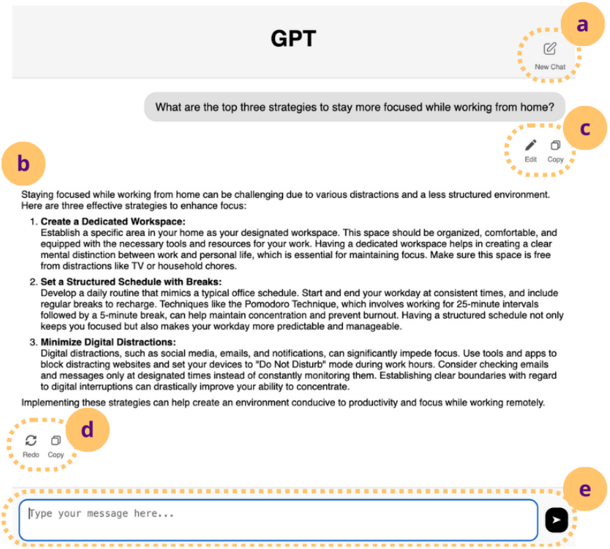
“A pulsing cursor signaled pending output until the assigned TTFT elapsed.”
Rated minor: it would not touch a result — a value no result rests on, a p-value that stays on the same side of the significance level, or a conflict that is clerical, resolved elsewhere in the paper, or outside its own findings.
In the paper
“| Education | High school | 62 (26.7%) |”
§ The Impact of Response Latency and Task Type on Human-LLM Interaction and Perception > B Participant demographics
Reported 26.7 · recomputed 25.833333
Rated minor: it would not touch a result — a value no result rests on, a p-value that stays on the same side of the significance level, or a conflict that is clerical, resolved elsewhere in the paper, or outside its own findings.
In the paper
§ The Impact of Response Latency and Task Type on Human-LLM Interaction and Perception > 3.4 Participants
“A total of 240 participants were randomized into six experimental conditions, with group sizes as follows:”
§ The Impact of Response Latency and Task Type on Human-LLM Interaction and Perception > 3.4 Participants
“We analyzed data from 309 participants with valid interaction logs 5 .From these, we excluded participants who withdrew consent (n=3), failed the attention check (n=1), or exhibited speeding (n=2).We then applied a latency-fidelity rule excluding participants whose median observed latency exceeded 120% of their assigned latency (𝑛 = 63; see Section 3.5.1 on rationale and preprocessing method).”
Rated minor: it would not touch a result — a value no result rests on, a p-value that stays on the same side of the significance level, or a conflict that is clerical, resolved elsewhere in the paper, or outside its own findings.
In the paper
§ The Impact of Response Latency and Task Type on Human-LLM Interaction and Perception > 4.4 LLM Latency Perception
“In the Creation task, 29.3% noticed latency at 2 s, rising to 60.5% at 9 s, and 80.0% at 20 s.A similar trend was observed in the Advice task, with 23.7% noticing latency at 2 s, 73.0% at 9 s, and 82.9% at 20 s.”
§ The Impact of Response Latency and Task Type on Human-LLM Interaction and Perception > B Participant demographics
“Figure: Creation: 2 s (𝑛 = 41), 9 s (𝑛 = 42), 20 s (𝑛 = 41) • Advice: 2 s (𝑛 = 38), 9 s (𝑛 = 38), 20 s (𝑛 = 40)”
Citations
Cites
Development of NASA-TLX (Task Load Index): Results of Empirical and Theoretical Research
(1988) · Advances in Psychology · doi:10.1016/s0166-4115(08)62386-9 · Cited by 20,029
A simplest systematics for the organization of turn-taking for conversation
Sacks, H., Schegloff, E. A., & Jefferson, G. (1974) · Language · doi:10.2307/412243 · Cited by 11,350
Machines and Mindlessness: Social Responses to Computers
Nass, C., & Moon, Y. (2000) · Journal of Social Issues · doi:10.1111/0022-4537.00153 · Cited by 4,022
The aligned rank transform for nonparametric factorial analyses using only anova procedures
Wobbrock, J. O., Findlater, L., Gergle, D., & Higgins, J. J. (2011) · Proceedings of the SIGCHI Conference on Human Factors in Computing Systems · doi:10.1145/1978942.1978963 · Cited by 2,854
Individual differences in reasoning: Implications for the rationality debate?
Stanovich, K. E., & West, R. F. (2000) · Behavioral and Brain Sciences · doi:10.1017/s0140525x00003435 · Cited by 2,762
Hollan, J., Hutchins, E., & Kirsh, D. (2000) · ACM Transactions on Computer-Human Interaction · doi:10.1145/353485.353487 · Cited by 2,300
Algorithm appreciation: People prefer algorithmic to human judgment
Logg, J. M., Minson, J. A., & Moore, D. A. (2019) · Organizational Behavior and Human Decision Processes · doi:10.1016/j.obhdp.2018.12.005 · Cited by 2,061 · cited 1×
“In this setting, time is a communicative signal of effort, or malfunction that shapes how people trust, strategize, and collaborate with intelligent systems [21, 24, 35, 46].”
Some observations on mental models
Norman, D. A. (1983) · Medical Entomology and Zoology · Cited by 1,549
Araujo, T. (2018) · Computers in Human Behavior · doi:10.1016/j.chb.2018.03.051 · Cited by 1,156
Buçinca, Z., Malaya, M. B., & Gajos, K. Z. (2021) · arXiv · doi:10.48550/arxiv.2102.09692 · Cited by 1,124
Brynjolfsson, E., Li, D., & Raymond, L. (2025) · The Quarterly Journal of Economics · doi:10.1093/qje/qjae044 · Cited by 1,083
Response time in man-computer conversational transactions
Miller, R. B. (1968) · Proceedings of the December 9-11, 1968, fall joint computer conference, part I on - AFIPS '68 (Fall, part I) · doi:10.1145/1476589.1476628 · Cited by 942 · cited 3×
“In this setting, time is a communicative signal of effort, or malfunction that shapes how people trust, strategize, and collaborate with intelligent systems [21, 24, 35, 46].”
InfluentialQuestioning the AI: Informing Design Practices for Explainable AI User Experiences
Liao, Q. V., Gruen, D., & Miller, S. (2020) · Proceedings of the 2020 CHI Conference on Human Factors in Computing Systems · doi:10.1145/3313831.3376590 · Cited by 925
Stop Overthinking: A Survey on Efficient Reasoning for Large Language Models
Sui, Y., Chuang, Y.-N., Wang, G., Zhang, J., Zhang, T., Yuan, J., Liu, H., Wen, A., Zhong, S., Zou, N., et al. (2025) · arXiv · Cited by 517
Lee, H.-P. (., Sarkar, A., Tankelevitch, L., Drosos, I., Rintel, S., Banks, R., & Wilson, N. (2025) · Proceedings of the 2025 CHI Conference on Human Factors in Computing Systems · doi:10.1145/3706598.3713778 · Cited by 490
Kruger, J., Wirtz, D., Van Boven, L., & Altermatt, T. W. (2004) · Journal of Experimental Social Psychology · doi:10.1016/s0022-1031(03)00065-9 · Cited by 425
Tam, T. Y. C., Sivarajkumar, S., Kapoor, S., Stolyar, A. V., Polanska, K., McCarthy, K. R., Osterhoudt, H., Wu, X., Visweswaran, S., Fu, S., et al. (2024) · npj Digital Medicine · doi:10.1038/s41746-024-01258-7 · Cited by 424 · cited 2×
“No other pairwise differences were significant.”
The Effects of Interactive Latency on Exploratory Visual Analysis
Liu, Z., & Heer, J. (2014) · IEEE Transactions on Visualization and Computer Graphics · doi:10.1109/tvcg.2014.2346452 · Cited by 326
Designing for Responsible Trust in AI Systems: A Communication Perspective
Liao, Q. V., & Sundar, S. S. (2022) · 2022 ACM Conference on Fairness Accountability and Transparency · doi:10.1145/3531146.3533182 · Cited by 165
Impact of response latency on user behavior in web search
Arapakis, I., Bai, X., & Cambazoglu, B. B. (2014) · International ACM SIGIR Conference on Research and Development in Information Retrieval (SIGIR) · doi:10.1145/2600428.2609627 · Cited by 164
Bridging the Gulf of Envisioning: Cognitive Challenges in Prompt Based Interactions with LLMs
Subramonyam, H., Pea, R., Pondoc, C., Agrawala, M., & Seifert, C. (2024) · Proceedings of the CHI Conference on Human Factors in Computing Systems · doi:10.1145/3613904.3642754 · Cited by 162
40years of searching for the best computer system response time
Dabrowski, J., & Munson, E. V. (2011) · Interacting with Computers · doi:10.1016/j.intcom.2011.05.008 · Cited by 107
Pu, K., Feng, K. J. K., Grossman, T., Hope, T., Mishra, B. D., Latzke, M., Bragg, J., Chang, J., & Siangliulue, P. (2024) · International Conference on Human Factors in Computing Systems · doi:10.1145/3706598.3714057 · Cited by 96
Benevolent deception in human computer interaction
Adar, E., Tan, D. S., & Teevan, J. (2013) · Proceedings of the SIGCHI Conference on Human Factors in Computing Systems · doi:10.1145/2470654.2466246 · Cited by 93
Kuang, E., Li, M., Fan, M., & Shinohara, K. (2024) · CHI Conference on Human Factors in Computing Systems · doi:10.1145/3613904.3642168 · Cited by 87
Dang, H., Goller, S., Lehmann, F., & Buschek, D. (2023) · Proceedings of the 2023 CHI Conference on Human Factors in Computing Systems · doi:10.1145/3544548.3580969 · Cited by 83
Exploring a Behavioral Model of “Positive Friction” in Human-AI Interaction
Chen, Z., & Schmidt, R. (2024) · Lecture notes in computer science · doi:10.1007/978-3-031-61353-1_1 · Cited by 70
Task Supportive and Personalized Human-Large Language Model Interaction: A User Study
Wang, B., Liu, J., Karimnazarov, J., & Thompson, N. (2024) · Conference on Human Information Interaction and Retrieval · doi:10.1145/3627508.3638344 · Cited by 67
A Slow Algorithm Improves Users' Assessments of the Algorithm's Accuracy
Park, J. S., Barber, R., Kirlik, A., & Karahalios, K. (2019) · Proceedings of the ACM on Human-Computer Interaction · doi:10.1145/3359204 · Cited by 65
Mendel, T., Singh, N., Mann, D. M., Wiesenfeld, B., & Nov, O. (2025) · Journal of Medical Internet Research · doi:10.2196/64290 · Cited by 64
Self-citationLiu, Y., Chen, S., Cheng, H., Yu, M., Ran, X., Mo, A., Tang, Y., & Huang, Y. (2024) · Proceedings of the CHI Conference on Human Factors in Computing Systems · doi:10.1145/3613904.3642698 · Cited by 61
Evaluating Human-Language Model Interaction
Lee, M., Srivastava, M., Hardy, A., Thickstun, J., Durmus, E., Paranjape, A., Gerard-Ursin, I., Li, X. L., Ladhak, F., Rong, F., et al. (2022) · arXiv · doi:10.48550/arxiv.2212.09746 · Cited by 61
A Taxonomy for Human-LLM Interaction Modes: An Initial Exploration
Gao, J., Gebreegziabher, S. A., Choo, K. T. W., Li, T. J.-J., Perrault, S. T., & Malone, T. W. (2024) · Extended Abstracts of the CHI Conference on Human Factors in Computing Systems · doi:10.1145/3613905.3650786 · Cited by 57
Current and Future Use of Large Language Models for Knowledge Work
Brachman, M., El-Ashry, A., Dugan, C., & Geyer, W. (2025) · Proceedings of the ACM on Human-Computer Interaction · doi:10.1145/3757403 · Cited by 53
Friction: Deciphering Writing Feedback into Writing Revisions through LLM-Assisted Reflection
Zhang, C., Ju, K., Bidoshi, P., Yen, Y.-C. G., & Rzeszotarski, J. M. (2025) · CHI Conference on Human Factors in Computing Systems · doi:10.1145/3706598.3714316 · Cited by 49
Standardized task strain and system response times in human-computer interaction
Thum, M., Boucsein, W., Kuhmann, W., & Ray, W. J. (1995) · Ergonomics · doi:10.1080/00140139508925192 · Cited by 49
AI language model rivals expert ethicist in perceived moral expertise
Dillion, D., Mondal, D., Tandon, N., & Gray, K. (2025) · Scientific Reports · doi:10.1038/s41598-025-86510-0 · Cited by 47
Predictivity of system delays shortens human response time
Thomaschke, R., & Haering, C. (2013) · International Journal of Human-Computer Studies · doi:10.1016/j.ijhcs.2013.12.004 · Cited by 44
Utilization of Generative AI-drafted Responses for Managing Patient-Provider Communication
Mandal, S., Wiesenfeld, B. M., Szerencsy, A. C., Small, W. R., Major, V. J., Richardson, S. I., Schoenthaler, A., Mann, D., & Nov, O. (2025) · npj Digital Medicine · doi:10.1038/s41746-025-01972-w · Cited by 40
Self-citationHow Knowledge Workers Use and Want to Use LLMs in an Enterprise Context
Brachman, M., El-Ashry, A., Dugan, C., & Geyer, W. (2024) · Extended Abstracts of the CHI Conference on Human Factors in Computing Systems · doi:10.1145/3613905.3650841 · Cited by 37
Explaining the Wait: How Justifying Chatbot Response Delays Impact User Trust
Zhang, Z., Tsiakas, K., & Schneegass, C. (2024) · ACM Conference on Conversational User Interfaces (CUI) · doi:10.1145/3640794.3665550 · Cited by 36
Yeh, S.-F., Wu, M.-H., Chen, T.-Y., Lin, Y.-C., Chang, X., Chiang, Y.-H., & Chang, Y.-J. (2022) · CHI Conference on Human Factors in Computing Systems · doi:10.1145/3491102.3501941 · Cited by 35
The role of Weber’s law in human time perception
Haigh, A., Apthorp, D., & Bizo, L. A. (2020) · Attention Perception & Psychophysics · doi:10.3758/s13414-020-02128-6 · Cited by 34
Using Large Language Models to Generate, Validate, and Apply User Intent Taxonomies
Shah, C., White, R. W., Andersen, R., Buscher, G., Counts, S., Das, S. S. S., Montazer, A., Manivannan, S., Neville, J., Ni, X., et al. (2023) · arXiv · doi:10.48550/arxiv.2309.13063 · Cited by 33
Using Large Language Models to Generate, Validate, and Apply User Intent Taxonomies
Shah, C., White, R., Andersen, R., Buscher, G., Counts, S., Das, S., Montazer, A., Manivannan, S., Neville, J., Rangan, N., et al. (2025) · ACM Transactions on the Web · doi:10.1145/3732294 · Cited by 33
System response time and readiness for task execution the optimum duration of inter-task delays
Kohlisch, O., & Kuhmann, W. (1997) · Ergonomics · doi:10.1080/001401397188143 · Cited by 29
Better Slow than Sorry: Introducing Positive Friction for Reliable Dialogue SystemsPreprint
İnan, M., Sicilia, A., Dey, S., Dongre, V., Srinivasan, T., Thomason, J., Tür, G., Hakkani-Tur, D. Z., & Alikhani, M. (2025) · arXiv (Cornell University) · doi:10.48550/arxiv.2501.17348 · Cited by 27
Ghafurian, M., Reitter, D., & Ritter, F. E. (2020) · ACM Transactions on Computer-Human Interaction · doi:10.1145/3380961 · Cited by 24
When Delayed in a Hurry: Interpretations of Response Delays in Time-Sensitive Instant Messaging
Hwang, S. Y., Khojasteh, N., & Fussell, S. R. (2019) · Proceedings of the ACM on Human-Computer Interaction · doi:10.1145/3361115 · Cited by 22
System Response Time as a Stressor in a Digital World: Literature Review and Theoretical Model
Riedl, R., & Fischer, T. (2018) · Lecture notes in computer science · doi:10.1007/978-3-319-91716-0_14 · Cited by 22
While We Wait... How Users Perceive Waiting Times and Generation Cues during AI Image Generation
Lee, H. M., Yadav, D., Lee, S., Govindarazan, K., Chen, C., & Sundar, S. S. (2025) · CHI Conference Extended Abstracts on Human Factors in Computing Systems (CHI EA) · doi:10.1145/3706599.3719725 · Cited by 17
“The Chatbot is typing …” – The Role of Typing Indicators in Human-Chatbot Interaction
Gnewuch, U., Morana, S., Adam, M. T. P., & Maedche, A. (2018) · Journal of the Association for Information Systems · Cited by 15
Towards time design: pacing of hypertext navigation by system response times
Myer, H. A., & Hildebrandt, M. (2002) · CHI Conference Extended Abstracts on Human Factors in Computing Systems (CHI EA) · doi:10.1145/506443.506616 · Cited by 11
The Siren Song of LLMs: How Users Perceive and Respond to Dark Patterns in Large Language Models
Shi, Y., Xiao, Q., Hu, Q., Shen, H., & Shen, H. (2025) · arXiv · doi:10.48550/arxiv.2509.10830 · Cited by 7
The Siren Song of LLMs: How Users Perceive and Respond to Dark Patterns in Large Language Models
Shi, Y., Xiao, Q., Hu, Q., Shen, H., & Shen, H. (2026) · Proceedings of the 2026 CHI Conference on Human Factors in Computing Systems · doi:10.1145/3772318.3791149 · Cited by 7
Time and Timing in Human-Computer Interaction
Riemer, M., Bogon, J., Rußwinkel, N., Henze, N., Wiese, E., Halbhuber, D., & Thomaschke, R. (2023) · Gesellschaft für Informatik (GI) · doi:10.18420/muc2023-mci-ws05-106 · Cited by 1
Sleep-time Compute: Beyond Inference Scaling at Test-time
Lin, K., Snell, C., Wang, Y., Packer, C., Wooders, S., Stoica, I., & Gonzalez, J. E. (2025) · arXiv · doi:10.48550/arxiv.2504.13171
Current and Future Use of Large Language Models for Knowledge Work
Brachman, M., El-Ashry, A., Dugan, C., & Geyer, W. (2025) · arXiv · doi:10.48550/arxiv.2503.16774
Research works printed but not linked: 5
- Stuart K. Card, Allen Newell, and Thomas P. Moran. 1983. The Psychology of Human-Computer Interaction. L. Erlbaum Associates Inc., USA. · doi:10.5555/578027
- Thomas H. Davenport. 2005. Thinking for a living : how to get better performance and results from knowledge workers. Harvard Business School Press.
- D. Kahneman. 2011. Thinking, Fast and Slow. Farrar, Straus and Giroux.
- David H. Maister. 1985. The Psychology of Waiting Lines. In The Service Encounter, John A. Czepiel, Michael R. Solomon, and Carol Surprenant (Eds.). Lexington Books, Lexington, MA, 113-123.
- Jakob Nielsen. 1994. Usability Engineering. Morgan Kaufmann Publishers Inc., San Francisco, CA, USA. · doi:10.5555/2821575
Cited by
CRAFT: Exploring Wearable Creative AI on Smart Glasses for Fiction Writing in Real-World Contexts
Cai, R., Huang, Y., Yuan, L.-P., Xiang, K., Hsu, D., Nogues, C., Holopainen, J. P., & Zhao, S. (2026) · Proceedings of the ACM on Interactive Mobile Wearable and Ubiquitous Technologies · doi:10.1145/3831952 · Cited by 2
Prompt Engineering State-of-the-Art: Prompting as Behavioral Engineering for Google Gemini
Leal, D. C., Capetillo, A., & Castorena, D. G. (2026) · International Journal of Human-Computer Interaction · doi:10.1080/10447318.2026.2705755
FaultSense: Fault Localization in Large-Scale Mixture-of-Experts Model Serving Infrastructure
Harish, S. A., Vignesh, S., Kumar, A., Gandhi, R., & Tammana, P. (2026) · ACM SIGOPS Asia-Pacific Workshop on Systems (APSys) · doi:10.1145/3838177.3841737
Zhu, Z., & Xu, J. (2026) · Frontiers in Psychology · doi:10.3389/fpsyg.2026.1924155
Yin, M., Chiang, A., Cox, S. R., & Xiao, R. (2026) · arXiv · doi:10.48550/arxiv.2605.24729
Metadata
- Authors
- Tan, F. F.-Y., Messerschmidt, M. A., Yin, W., & Nov, O.
- Affiliations
- New York University (US)
- National University of Singapore (SG)
- Venue
- Proceedings of the 2026 CHI Conference on Human Factors in Computing Systems
- Publisher
- ACM
- Published
- 2026-04-13
- Pages
- 1-17
- OpenAlex
- W7153665608
- Semantic Scholar
- 099ca134a2cb69276e7e4c173e97f19664c071f5
- Cited by
- 10
- References
- 55
- Citations by year
- 2026: 10
- FWCI
- 25.19
- Type
- conference paper
- Language
- en
- Open access
- hybrid
- doi.org
- Locations
- CHI Conference on Human Factors in Computing Systems (publishedVersion, cc-by)
- arXiv (Cornell University) (submittedVersion, cc-by)
- OSF Preprints (OSF Preprints) (submittedVersion, cc-by)
- Funders
- NSF (National Science Foundation) (1928614, 2129076)
- Topics
- Physical Sciences › Computer Science › Human-Computer Interaction › Usability and User Interface Design
- Social Sciences › Business, Management and Accounting › Marketing › AI in Service Interactions
- Physical Sciences › Computer Science › Human-Computer Interaction › Innovative Human-Technology Interaction
- Keywords
- large language models, response latency, human-LLM interaction, task type, user frustration
About these checks
Registry, retraction, Cites and statistics results are computed, not judged, with one exception: a printed reference that no index lists is read once by a model before it counts as a citation error. Claims are extracted by a model and kept only when their quote appears verbatim in the text; each cited source is then checked, with a model’s help, for whether it says what the claim relies on. Those verdicts can be wrong — read the claim’s quote and the cited source before relying on one.
A language model drew the claims from the paper on 2026-11-24, under version 3 of the claim definition (model deepseek-v4.1-flash, prompt extract-v3).
A second model labelled each claim on 2026-11-24 (model jev-1.13-20260917, definition revision gold-guideline-v0.2).
Statistics and arithmetic are recomputed, not judged.
Confidence bands are shown only for fields calibrated on our annotated test set. None is calibrated yet, so no band is shown.
What counts as a claim ›How we measure confidence ›How we check this ›
Are you an author, or do you see a problem with this page? Request a review
Data sources
Bibliographic data: Semantic Scholar, OpenAlex, Crossref.
Contains information from the Semantic Scholar Academic Graph Datasets, made available under the ODC Attribution License (ODC-BY 1.0).
Semantic Scholar’s data is described in: Kinney, R., et al. (2023). The Semantic Scholar Open Data Platform. arXiv:2301.10140.
