

The DOI matches its Crossref record; 153 of the 153 references it cites were found in a registry or an index.
Regulatory T Cells in Cancer
Open accessAbstract
The immune system has evolved complex effector mechanisms to protect the host against a diversity of pathogenic organisms and regulatory adaptations that can curtail pathological sequelae of inflammatory events, prevent autoimmunity, and assist in tissue repair. Cancers, by virtue of their local manifestations of tissue dysfunction and destruction, inflammation, and genomic instability, can evoke these protective mechanisms, which support the progression of tumors and prevent their immune eradication. Central to these processes is a subset of CD4+T cells, known as regulatory T (Treg) cells, that express the X chromosome–linked transcription factor FOXP3. In addition to their critical role in controlling autoimmunity and suppressing inflammatory responses in diverse biological settings, Treg cells are ubiquitously present in the tumor microenvironment where they promote tumor development and progression by dampening antitumor immune responses. Furthermore, Treg cells can directly support the survival of transformed cells through the elaboration of growth factors and interacting with accessory cells in tumors such as fibroblasts and endothelial cells. Current insights into the biology of tumor-associated Treg cells have opened up opportunities for their selective targeting in cancer, with the goal of alleviating their suppression of antitumor immune responses while maintaining overall immune homeostasis.
Overview
The claims and statistics of this paper haven’t been checked yet.
Run the check — free, no account needed. It reads the open-access text and checks the sources it cites.
Integrity signals
Registry
Cites
Statistics
Figures
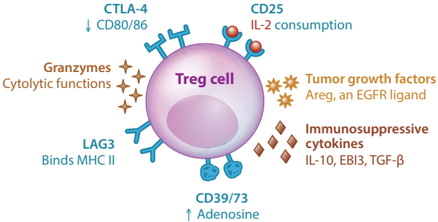
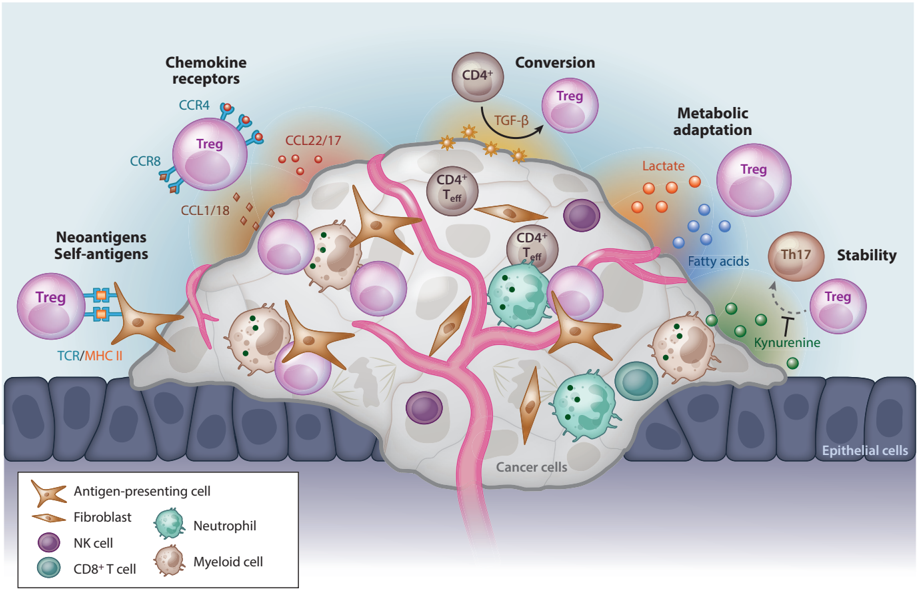
Verification
Claims the paper makes
The claims and statistics of this paper haven’t been checked yet.
Run the check — free, no account needed. It reads the open-access text and checks the sources it cites.
Claims other papers make about this one
Each is checked against this paper’s own text: does it say what the citing paper says it does?
The cited source says what the claim attributes to it.
In the citing paper
“Regulatory T (Treg) cells maintain immune homeostasis and prevent autoimmunity.”
From Contrasting cytotoxic and regulatory T cell responses underlying distinct clinical outcomes to anti-PD-1 plus lenvatinib therapy in cancer (2025) · cites this paper as [41]
Self-check
Percentages, sums and reported differences re-computed from the paper’s own numbers.
The self-check needs the paper’s full text.
Citations
Cites
Hallmarks of Cancer: The Next Generation
Hanahan, D., & Weinberg, R. A. (2011) · Cell · doi:10.1016/j.cell.2011.02.013 · Cited by 66,590
Control of Regulatory T Cell Development by the Transcription Factor Foxp3
Hori, S., Nomura, T., & Sakaguchi, S. (2003) · Science · doi:10.1126/science.1079490 · Cited by 8,187
Foxp3 programs the development and function of CD4+CD25+ regulatory T cells
Fontenot, J. D., Gavin, M. A., & Rudensky, A. Y. (2003) · Nature Immunology · doi:10.1038/ni904 · Cited by 7,745
Self-citationSakaguchi, S., Sakaguchi, N., Asano, M., Itoh, M., & Toda, M. (1995) · The Journal of Immunology · doi:10.4049/jimmunol.155.3.1151 · Cited by 5,608
Curiel, T. J., Coukos, G., Zou, L., Alvarez, X., Cheng, P., Mottram, P., Evdemon-Hogan, M., Conejo-Garcia, J. R., Zhang, L., Burow, M., et al. (2004) · Nature Medicine · doi:10.1038/nm1093 · Cited by 5,151
Tumor-associated B7-H1 promotes T-cell apoptosis: A potential mechanism of immune evasion
Dong, H., Strome, S. E., Salomao, D. R., Tamura, H., Hirano, F., Flies, D. B., Roche, P. C., Lu, J., Zhu, G., Tamada, K., et al. (2002) · Nature Medicine · doi:10.1038/nm730 · Cited by 5,025
Ipilimumab plus Dacarbazine for Previously Untreated Metastatic Melanoma
Robert, C., Thomas, L., Bondarenko, I., O'Day, S., Weber, J., Garbe, C., Lebbe, C., Baurain, J.-F., Testori, A., Grob, J.-J., et al. (2011) · New England Journal of Medicine · doi:10.1056/nejmoa1104621 · Cited by 4,496
Vignali, D. A. A., Collison, L. W., & Workman, C. J. (2008) · Nature Reviews Immunology · doi:10.1038/nri2343 · Cited by 3,463
Sakaguchi, S. (2003) · Annual Review of Immunology · doi:10.1146/annurev.immunol.21.120601.141122 · Cited by 3,315
Iwai, Y., Ishida, M., Tanaka, Y., Okazaki, T., Honjo, T., & Minato, N. (2002) · Proceedings of the National Academy of Sciences · doi:10.1073/pnas.192461099 · Cited by 3,261
Research works printed but not linked: 4
- Bennett CL, 2001, Genet, 27, 20
- Bonertz A, 2009, J. Clin. Investig., 119, 3311
- Chen W, 2003, Med, 198, 1875
- Ehrlich P., 1906, The Collected Papers of Paul Ehrlich, Vol. 2, Immunology and Cancer Research
Cited by
Sorted by citations
Items 101–148 of 148
The Impact of Induction Regimes on Immune Responses in Patients with Multiple Myeloma
Firer, M. A., Shapira, M. Y., & Luboshits, G. (2021) · Cancers · doi:10.3390/cancers13164090 · Cited by 5
Identification of ANKRD13D as a potential target in renal cell carcinomas
Zhou, W., Huang, Y., Liu, J., Liu, Y., Liu, Y., & Yu, C. (2024) · The International Journal of Biological Markers · doi:10.1177/03936155241236498 · Cited by 5
Tregs tango with killer cells in acute infection
Sun, X., & Chi, H. (2022) · Proceedings of the National Academy of Sciences · doi:10.1073/pnas.2202400119 · Cited by 4
Wang, Z., Ma, K., Fujino, M., Kusano, K., Yi, S., Iwai, A., & Li, X. (2021) · Heliyon · doi:10.1016/j.heliyon.2021.e07277 · Cited by 4
Chen, J.-S., Enwolo-Chibueze, C. G., Chinyama, H. A., Lai, C.-T., Ezeala, I. C., Huang, P.-Y., Wu, A. T. H., & Huang, Y.-J. (2025) · International Journal of Molecular Sciences · doi:10.3390/ijms26188780 · Cited by 4
Dawoud, A., Abaza, T., Youssef, Y., Seada, D. A., Mohamed, A. H., Ragab, M. F., Fahmy, J. M., Masry, H. E. H. E., Sabry, M. G., Fawzy, M. P., et al. (2025) · Critical Reviews in Biochemistry and Molecular Biology · doi:10.1080/10409238.2025.2567334 · Cited by 3
Ahmad, S., Aftab, M. N., & Aslam, M. (2026) · Human Immunology · doi:10.1016/j.humimm.2026.111747 · Cited by 3
Gadwa, J., Yu, J., Piper, M., Knitz, M. W., Darragh, L. B., Olimpo, N. A., Corbo, S., Beynor, J. I., Neupert, B., Nguyen, A. T., et al. (2025) · Journal for ImmunoTherapy of Cancer · doi:10.1136/jitc-2024-010405 · Cited by 3
Kaur, S. D., Abubakar, M., Bedi, N., Puppala, E. R., Kapoor, D. N., Kumar, N., Ahemad, N., & Anwar, S. (2025) · Current Problems in Cancer · doi:10.1016/j.currproblcancer.2025.101252 · Cited by 2
Emerging roles of ferroptosis in modulating the immune landscape of glial tumours
Argenziano, M., Neelakantan, T. V., Sperring, C. P., Adeuyan, O. O., Higgins, D. M. O., Bruce, J. N., Kim, B. Y. S., Dovas, A., Canoll, P., Lim, M. K., et al. (2026) · Nature Cell Biology · doi:10.1038/s41556-026-01972-2 · Cited by 3
Zhang, S., Bacon, W., Peppelenbosch, M. P., van Kemenade, F. J., & Stubbs, A. (2022) · Cancers · doi:10.3390/cancers15010153 · Cited by 2
Clinical Implementation of MicroRNAs in Cancer Immunology
Schwarzenbach, H. (2024) · International Journal of Translational Medicine · doi:10.3390/ijtm4010003 · Cited by 3
Oncogenes Feed Treg Cells without Calling CD8s to the Table
Khatwani, N., & Turk, M. J. (2020) · Immunity · doi:10.1016/j.immuni.2020.06.020 · Cited by 2
Murphy, J. D., Shiomitsu, K., Milner, R. J., Lejeune, A. T., Ossiboff, R. J., Castellanos-Gell, J., & Axiak‐Bechtel, S. M. (2023) · Veterinary Immunology and Immunopathology · doi:10.1016/j.vetimm.2023.110560 · Cited by 2
Metchnikoff’s legacy: the dysplastic nature of innate immunity in myelodysplastic syndromes
Greenberg, P. L. (2021) · Haematologica · doi:10.3324/haematol.2021.279419 · Cited by 1
Regulatory T cells in the primary tumor growth lesion in colorectal cancer
Kryukova, V. V., Л., Ц. В., & П., Т. П. (2025) · Advances in molecular oncology · doi:10.17650/2313-805x-2025-12-4-100-108 · Cited by 1
β2-integrins in Immunity: New Roles for Old Players
Uotila, L. M., Harjunpää, H., & Fagerholm, S. C. (2023) · Biology of extracellular matrix · doi:10.1007/978-3-031-23781-2_10 · Cited by 1
The essential elements of adaptive immunity and their relevance to cancer immunology
Bullock, T. N. J. (2023) · Elsevier eBooks · doi:10.1016/b978-0-323-87763-3.00016-2 · Cited by 1
Investigating nano-sized tumor-derived extracellular vesicles in enhancing anti-PD-1 immunotherapy
Abouali, H., Przedborski, M., Kohandel, M., & Poudineh, M. (2024) · Nanoscale · doi:10.1039/d4nr00729h · Cited by 1
Immunotherapy with Dendritic Cells and Newcastle Disease Virus in Glioblastoma Multiforme
Neelhut, T., Marx, D., Neelhut, J., & Fändrich, F. (2011) · InTech eBooks · doi:10.5772/22074 · Cited by 1
Haines, R., Panduro, M., Lake, A. C., Palombella, V. J., Hill, J., & Mohan, J. F. (2022) · Regular and Young Investigator Award Abstracts · doi:10.1136/jitc-2022-sitc2022.1338 · Cited by 1
Editorial: Non-lymphoid functions of regulatory T cells in health and disease
Bos, P. D., Yoshimura, A., & Rudra, D. (2023) · Frontiers in Immunology · doi:10.3389/fimmu.2023.1109245 · Cited by 1
Zawawi, W. F. A. W. M., Hibma, M. H., Salim, M. I. M., & Jemon, K. B. (2021) · Research Square · doi:10.21203/rs.3.rs-125646/v1
Deconstructing T Cell Clonal Dynamics in Response to Immune-Checkpoint BlockadePreprint
Rao, S., Obradović, A., Gharib, K., Kornberg, A. E., Botella, T., Moon, C., Ghasemzadeh, A., Lin, S., Krupska, I., Bush, E. C., et al. (2022) · SSRN Electronic Journal · doi:10.2139/ssrn.4144960
Shofiyah, A., Djati, M. S., & Rifa’i, M. (2022) · Journal of Tropical Life Science · doi:10.11594/jtls.12.02.11
Thibodeaux, S. R., Barnett, B. B., Pandeswara, S., Wall, S. R., Hurez, V. J., Dao, V. A., Sun, L., Daniel, B. J., Brumlik, M. J., Drerup, J. M., et al. (2023) · doi:10.1158/1078-0432.c.6530445
Mujal, A. M., Combes, A. J., Rao, A. A., Binnewies, M., Samad, B., Tsui, J. L., Boissonnas, A., Pollack, J. L., Argüello, R. J., Meng, M. V., et al. (2023) · doi:10.1158/2326-6066.c.6550550
Macchia, I., Iacobone, F., & Urbani, F. (2024) · Methods in cell biology · doi:10.1016/bs.mcb.2024.06.005
Tumor Microenvironment Role in Cancer Immunotherapy Response
Silva, J. C., Xavier, F. C. D. A., & Carrera, M. (2024) · Interdisciplinary cancer research · doi:10.1007/16833_2024_391
Natural killer cell function is regulated by TGF-β signaling in pregnancy and tumor progressionPreprint
Yalin, A., Wang, S.-Y., Landsberger, T., Gamliel, M., Elefant, N., Kotzur, R., Goldman‐Wohl, D., David, E., Molgora, M., Bhattarai, B., et al. (2024) · bioRxiv (Cold Spring Harbor Laboratory) · doi:10.1101/2024.09.18.613652
Evaluation of GARP immunohistochemical expression in papillary thyroid carcinoma
Atia, E. A. M. M., Sammour, S. A. E., Ibrahim, E. A.-S., Gabal, H. H. A., & Elgohary, S. A. (2024) · The Egyptian Journal of Otolaryngology · doi:10.1186/s43163-024-00658-6
Lei, X., Wang, F., Zhang, X., Huang, J., & Huang, Y. (2025) · Computational Biology and Chemistry · doi:10.1016/j.compbiolchem.2025.108412
Regulatory T cells in the tumor microenvironment
Park, S., & Ha, S. (2025) · KOBRA Reports · doi:10.64066/kobrareports.25.0008
Not aIL Treg-mediated suppress10n is equal
Klawon, D. E. J., & Jacks, T. (2026) · Immunity · doi:10.1016/j.immuni.2025.12.015
Adepwar, R. V., Patil‐Takbhate, B., & Khopkar-Kale, P. (2026) · Indian Journal of Gynecologic Oncology · doi:10.1007/s40944-026-01104-6
High-Throughput Phenotypic Screen to Identify FoxP3 Regulators in Primary T Cells
Wei, Q., Hajjar, E., Cornillot-Clément, S., Solli, E., García‐Díaz, N., Landskron, J., Gade, A., Ahmad, R., & Taskén, K. (2026) · ACS Chemical Biology · doi:10.1021/acschembio.5c01019
Regulatory T lymphocytes in regional lymph nodes of patients with colorectal cancer
Kryukova, V. V., Львович, Ц. В., & Терешков, П. П. (2025) · Saratov Journal of Medical Scientific Research · doi:10.15275/ssmj2104479
Hadjigol, S., Shah, B. A., Yazdani, N., & O’brien-simpson, N. M. (2026) · Cells · doi:10.3390/cells15100855
Alvarez, J. S., Villacampa, E. G., Labuz, D., Guryleva, M. V., Urgard, E., Kågedal, Å., Solmell, O., Nasman, A., Morlanes, J. E., Ma, J., et al. (2026) · bioRxiv (Cold Spring Harbor Laboratory) · doi:10.64898/2026.06.04.730068
Fayyad‐Kazan, M. (2026) · Molecular Biology Reports · doi:10.1007/s11033-026-12209-8
Regulatory T Cells: The Immune System’s Control and Repair Team
Bluestone, J. A., & Ramsdell, F. (2026) · Frontiers for Young Minds · doi:10.3389/frym.2026.1827200
Breast-specific regulatory T cell mediators
Modanwal, S., Mishra, A., Mishra, N., & Sethi, G. (2026) · Elsevier eBooks · doi:10.1016/b978-0-443-43846-2.00003-9
Lymph node–specific regulatory T cell mediators
Sharma, P., Sengar, A., & Gabrani, R. (2026) · Elsevier eBooks · doi:10.1016/b978-0-443-43846-2.00015-5
Adrenal gland-specific regulatory T cell mediators
Perusomula, R. S., Alluri, R., & Paturi, G. (2026) · Elsevier eBooks · doi:10.1016/b978-0-443-43846-2.00014-3
Biomaterial-mediated immunomodulation of regulatory T cells in cancer
Hengen, A. C., Kolon, H. H., & Ackun‐Farmmer, M. A. (2026) · Biomaterials Science · doi:10.1039/d6bm00653a
CD3-engaging bispecific antibodies convert human regulatory T cells into cytotoxic effectorsPreprint
Michel, J. J., Frenking, J. H., Metzler, A., Schach, A., Meermeier, E. W., Thiel, V., Kehl, N., Wagner, T. R., Zoller, J., Cuntz, S., et al. (2026) · medRxiv · doi:10.64898/2026.09.23.26363285
Suhail, N. (2026) · Current Epidemiology Reports · doi:10.1007/s40471-026-00407-8
Rosenstein, B. S., & Karp, J. M. (2026) · Elsevier eBooks · doi:10.1016/b978-0-443-13468-5.00012-6
Metadata
- Authors
- Plitas, G., & Rudensky, A. Y.
- Affiliations
- Memorial Sloan Kettering Cancer Center (US)
- Venue
- Annual Review of Cancer Biology
- Publisher
- Annual Reviews
- Published
- 2020-03-09
- Volume
- 4
- Issue
- 1
- Pages
- 459-477
- ISSN
- 2472-3428 (ISSN-L)
- OpenAlex
- W3011819632
- Cited by
- 148
- References
- 153
- Citations by year
- 2026: 19 · 2025: 21 · 2024: 29 · 2023: 21 · 2022: 27 · 2021: 23 · 2020: 7
- FWCI
- 1.91
- Type
- journal article
- Language
- en
- Open access
- hybrid
- doi.org
- Locations
- Annual Review of Cancer Biology (publishedVersion, cc-by)
- Funders
- Memorial Sloan-Kettering Cancer Center (CA008748, P30 CA008748, Support Grant P30 CA008748)
- National Institutes of Health (CA008748, AI034206)
- Ludwig Center at Harvard (P30 CA008748, AI034206)
- National Cancer Institute (P30CA008748)
- National Institute of Allergy and Infectious Diseases (R37AI034206)
- Topics
- Life Sciences › Immunology and Microbiology › Immunology › T-cell and B-cell Immunology
- Health Sciences › Medicine › Oncology › Cancer Immunotherapy and Biomarkers
- Life Sciences › Immunology and Microbiology › Immunology › Immunotherapy and Immune Responses
- Keywords
- regulatory T cells, Foxp3, tumor microenvironment, tumor immunosuppression, CD4+ T cells, tumor progression, tumor-associated Treg cells, tumor-infiltrating lymphocytes, cancer-associated fibroblasts, tumor angiogenesis, immune homeostasis
About these checks
Registry, retraction, Cites and statistics results are computed, not judged, with one exception: a printed reference that no index lists is read once by a model before it counts as a citation error. Claims are extracted by a model and kept only when their quote appears verbatim in the text; each cited source is then checked, with a model’s help, for whether it says what the claim relies on. Those verdicts can be wrong — read the claim’s quote and the cited source before relying on one.
Statistics and arithmetic are recomputed, not judged.
Confidence bands are shown only for fields calibrated on our annotated test set. None is calibrated yet, so no band is shown.
What counts as a claim ›How we measure confidence ›How we check this ›
Are you an author, or do you see a problem with this page? Request a review
