

The DOI matches its Crossref record; 153 of the 153 references it cites were found in a registry or an index.
Regulatory T Cells in Cancer
Open accessAbstract
The immune system has evolved complex effector mechanisms to protect the host against a diversity of pathogenic organisms and regulatory adaptations that can curtail pathological sequelae of inflammatory events, prevent autoimmunity, and assist in tissue repair. Cancers, by virtue of their local manifestations of tissue dysfunction and destruction, inflammation, and genomic instability, can evoke these protective mechanisms, which support the progression of tumors and prevent their immune eradication. Central to these processes is a subset of CD4+T cells, known as regulatory T (Treg) cells, that express the X chromosome–linked transcription factor FOXP3. In addition to their critical role in controlling autoimmunity and suppressing inflammatory responses in diverse biological settings, Treg cells are ubiquitously present in the tumor microenvironment where they promote tumor development and progression by dampening antitumor immune responses. Furthermore, Treg cells can directly support the survival of transformed cells through the elaboration of growth factors and interacting with accessory cells in tumors such as fibroblasts and endothelial cells. Current insights into the biology of tumor-associated Treg cells have opened up opportunities for their selective targeting in cancer, with the goal of alleviating their suppression of antitumor immune responses while maintaining overall immune homeostasis.
Overview
The claims and statistics of this paper haven’t been checked yet.
Run the check — free, no account needed. It reads the open-access text and checks the sources it cites.
Integrity signals
Registry
Cites
Statistics
Figures
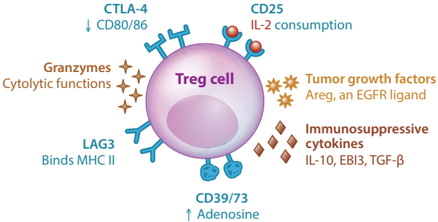
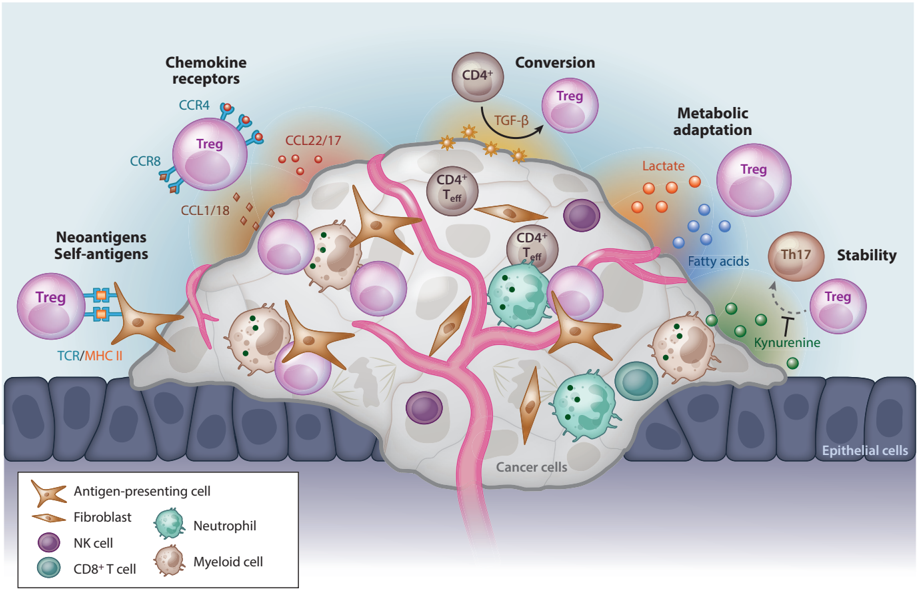
Verification
Claims the paper makes
The claims and statistics of this paper haven’t been checked yet.
Run the check — free, no account needed. It reads the open-access text and checks the sources it cites.
Claims other papers make about this one
Each is checked against this paper’s own text: does it say what the citing paper says it does?
The cited source says what the claim attributes to it.
In the citing paper
“Regulatory T (Treg) cells maintain immune homeostasis and prevent autoimmunity.”
From Contrasting cytotoxic and regulatory T cell responses underlying distinct clinical outcomes to anti-PD-1 plus lenvatinib therapy in cancer (2025) · cites this paper as [41]
Self-check
Percentages, sums and reported differences re-computed from the paper’s own numbers.
The self-check needs the paper’s full text.
Citations
Cites
Hallmarks of Cancer: The Next Generation
Hanahan, D., & Weinberg, R. A. (2011) · Cell · doi:10.1016/j.cell.2011.02.013 · Cited by 66,590
Control of Regulatory T Cell Development by the Transcription Factor Foxp3
Hori, S., Nomura, T., & Sakaguchi, S. (2003) · Science · doi:10.1126/science.1079490 · Cited by 8,187
Foxp3 programs the development and function of CD4+CD25+ regulatory T cells
Fontenot, J. D., Gavin, M. A., & Rudensky, A. Y. (2003) · Nature Immunology · doi:10.1038/ni904 · Cited by 7,745
Self-citationSakaguchi, S., Sakaguchi, N., Asano, M., Itoh, M., & Toda, M. (1995) · The Journal of Immunology · doi:10.4049/jimmunol.155.3.1151 · Cited by 5,608
Curiel, T. J., Coukos, G., Zou, L., Alvarez, X., Cheng, P., Mottram, P., Evdemon-Hogan, M., Conejo-Garcia, J. R., Zhang, L., Burow, M., et al. (2004) · Nature Medicine · doi:10.1038/nm1093 · Cited by 5,151
Tumor-associated B7-H1 promotes T-cell apoptosis: A potential mechanism of immune evasion
Dong, H., Strome, S. E., Salomao, D. R., Tamura, H., Hirano, F., Flies, D. B., Roche, P. C., Lu, J., Zhu, G., Tamada, K., et al. (2002) · Nature Medicine · doi:10.1038/nm730 · Cited by 5,025
Ipilimumab plus Dacarbazine for Previously Untreated Metastatic Melanoma
Robert, C., Thomas, L., Bondarenko, I., O'Day, S., Weber, J., Garbe, C., Lebbe, C., Baurain, J.-F., Testori, A., Grob, J.-J., et al. (2011) · New England Journal of Medicine · doi:10.1056/nejmoa1104621 · Cited by 4,496
Vignali, D. A. A., Collison, L. W., & Workman, C. J. (2008) · Nature Reviews Immunology · doi:10.1038/nri2343 · Cited by 3,463
Sakaguchi, S. (2003) · Annual Review of Immunology · doi:10.1146/annurev.immunol.21.120601.141122 · Cited by 3,315
Iwai, Y., Ishida, M., Tanaka, Y., Okazaki, T., Honjo, T., & Minato, N. (2002) · Proceedings of the National Academy of Sciences · doi:10.1073/pnas.192461099 · Cited by 3,261
Research works printed but not linked: 4
- Bennett CL, 2001, Genet, 27, 20
- Bonertz A, 2009, J. Clin. Investig., 119, 3311
- Chen W, 2003, Med, 198, 1875
- Ehrlich P., 1906, The Collected Papers of Paul Ehrlich, Vol. 2, Immunology and Cancer Research
Cited by
Sorted by citations
Anderson, N. M., & Simon, M. C. (2020) · Current Biology · doi:10.1016/j.cub.2020.06.081 · Cited by 2,718
Advances in the development of personalized neoantigen-based therapeutic cancer vaccines
Blass, E., & Ott, P. A. (2021) · Nature Reviews Clinical Oncology · doi:10.1038/s41571-020-00460-2 · Cited by 1,042
CD8+ T cells in the cancer-immunity cycle
Giles, J. R., Globig, A.-M., Kaech, S. M., & Wherry, E. J. (2023) · Immunity · doi:10.1016/j.immuni.2023.09.005 · Cited by 507
Lymph node colonization induces tumor-immune tolerance to promote distant metastasis
Reticker-Flynn, N. E., Zhang, W., Belk, J. A., Basto, P. A., Escalante, N. K., Pilarowski, G. O. W., Bejnood, A., Martins, M. M., Kenkel, J. A., Linde, I. L., et al. (2022) · Cell · doi:10.1016/j.cell.2022.04.019 · Cited by 399
Becker, W. R., Nevins, S. A., Chen, D. C., Chiu, R., Horning, A. M., Guha, T. K., Laquindanum, R., Mills, M. A., Chaı̈b, H., Ladabaum, U., et al. (2022) · Nature Genetics · doi:10.1038/s41588-022-01088-x · Cited by 333
Metadata
- Authors
- Plitas, G., & Rudensky, A. Y.
- Affiliations
- Memorial Sloan Kettering Cancer Center (US)
- Venue
- Annual Review of Cancer Biology
- Publisher
- Annual Reviews
- Published
- 2020-03-09
- Volume
- 4
- Issue
- 1
- Pages
- 459-477
- ISSN
- 2472-3428 (ISSN-L)
- OpenAlex
- W3011819632
- Cited by
- 148
- References
- 153
- Citations by year
- 2026: 19 · 2025: 21 · 2024: 29 · 2023: 21 · 2022: 27 · 2021: 23 · 2020: 7
- FWCI
- 1.91
- Type
- journal article
- Language
- en
- Open access
- hybrid
- doi.org
- Locations
- Annual Review of Cancer Biology (publishedVersion, cc-by)
- Funders
- Memorial Sloan-Kettering Cancer Center (CA008748, P30 CA008748, Support Grant P30 CA008748)
- National Institutes of Health (CA008748, AI034206)
- Ludwig Center at Harvard (P30 CA008748, AI034206)
- National Cancer Institute (P30CA008748)
- National Institute of Allergy and Infectious Diseases (R37AI034206)
- Topics
- Life Sciences › Immunology and Microbiology › Immunology › T-cell and B-cell Immunology
- Health Sciences › Medicine › Oncology › Cancer Immunotherapy and Biomarkers
- Life Sciences › Immunology and Microbiology › Immunology › Immunotherapy and Immune Responses
- Keywords
- regulatory T cells, Foxp3, tumor microenvironment, tumor immunosuppression, CD4+ T cells, tumor progression, tumor-associated Treg cells, tumor-infiltrating lymphocytes, cancer-associated fibroblasts, tumor angiogenesis, immune homeostasis
About these checks
Registry, retraction, Cites and statistics results are computed, not judged, with one exception: a printed reference that no index lists is read once by a model before it counts as a citation error. Claims are extracted by a model and kept only when their quote appears verbatim in the text; each cited source is then checked, with a model’s help, for whether it says what the claim relies on. Those verdicts can be wrong — read the claim’s quote and the cited source before relying on one.
Statistics and arithmetic are recomputed, not judged.
Confidence bands are shown only for fields calibrated on our annotated test set. None is calibrated yet, so no band is shown.
What counts as a claim ›How we measure confidence ›How we check this ›
Are you an author, or do you see a problem with this page? Request a review
