

The General Factor of Psychopathology
Open accessPublished version of a preprint
The DOI matches its Crossref record; 120 of the 120 references it cites were found in a registry or an index.
Abstract
An important advance in understanding and defining mental disorders has been the development of empirical approaches to mapping dimensions of dysfunction and their interrelatedness. Such empirical approaches have consistently observed intercorrelations among the many forms of psychopathology, leading to the identification of a general factor of psychopathology (the p factor). In this article, we review empirical support for p, including evidence for the stability and criterion validity of p. Further, we discuss the strong relationship between p and both the general factor of personality and the general factor of personality disorder, substantive interpretations of p, and the potential clinical utility of p. We posit that proposed substantive interpretations of p do not explain the full range of symptomatology typically included in p. The most plausible explanation is that p represents an index of impairment that has the potential to inform the duration and intensity of a client's mental health treatment.
Overview
The claims and statistics of this paper haven’t been checked yet.
Free: it reads the open-access text and checks the first 5 claims that cite a source we can check. Create a free account to check every claim.
Integrity signals
Registry
Cites
Statistics
Figures
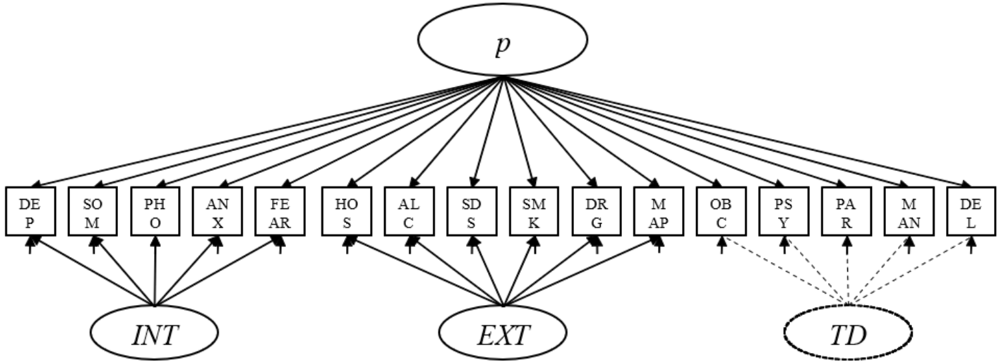
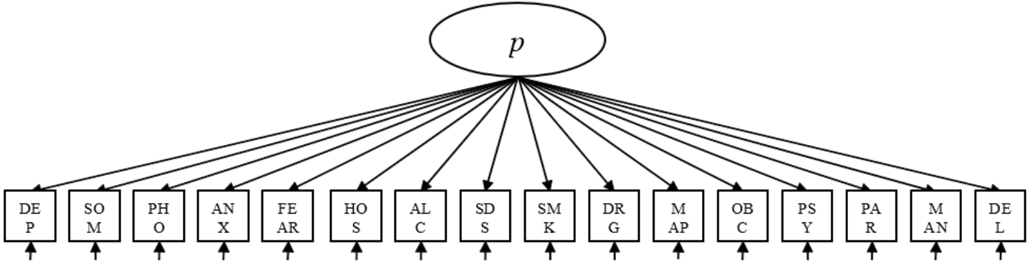
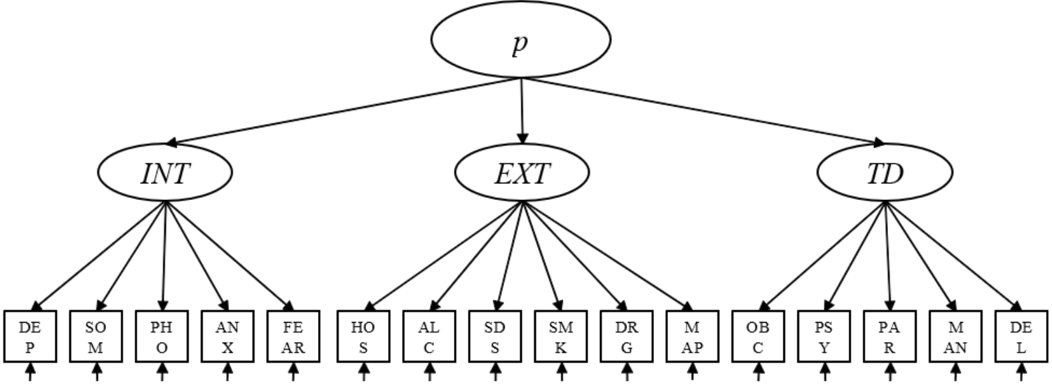
Verification
Claims the paper makes
The claims and statistics of this paper haven’t been checked yet.
Free: it reads the open-access text and checks the first 5 claims that cite a source we can check. Create a free account to check every claim.
Claims other papers make about this one
Each is checked against this paper’s own text: does it say what the citing paper says it does?
The source backs part of the claim, not all of it — or backs it for a different population, condition or comparison.
In the citing paper
“The dominant approach in contemporary medical science views depression through the lens of a biological model, focusing on physiological factors such as neurochemical imbalances, genetic predispositions, and brain-structure anomalies; common interventions include medication (6, 7), positive-thinking activities (8), and social support (6, 8, 9).”
From Anti-stigmatizing: a collaborative autoethnography on recovery from depression (2024) · cites this paper as [7]
Experimental — accuracy not yet measured
Self-check
Percentages, sums and reported differences re-computed from the paper’s own numbers.
The self-check needs the paper’s full text.
Citations
Cites
Kessler, R. C., Chiu, W. T., Demler, O., & Walters, E. E. (2005) · Archives of General Psychiatry · doi:10.1001/archpsyc.62.6.617 · Cited by 12,052
Handbook of Personality: Theory and Research
Krueger, R. F., & Johnson, W. (2008) · Cited by 7,884
Negative affectivity: the disposition to experience aversive emotional states
Watson, D., & Clark, L. A. (1984) · Psychological Bulletin · doi:10.1037/0033-2909.96.3.465 · Cited by 4,636 · cited 1×
“The tendency to experience negative affect and distress is a stable and robust personality disposition (Watson & Clark 1984), and dispositional negative emotionality is implicated in a large portion of psychiatric disorders (Lahey 2009, Meijer et al. 2011).”
BackgroundKotov, R., Krueger, R. F., Watson, D., Achenbach, T. M., Althoff, R. R., Bagby, R. M., Brown, T. A., Carpenter, W. T., Caspi, A., Clark, L. A., et al. (2017) · Journal of Abnormal Psychology · doi:10.1037/abn0000258 · Cited by 3,335 · cited 2×
“…factors of psychopathology were then examined across 10 mental disorders and adapted to fit their manifestation in adults, with internalizing largely similar to how the dimension is defined for adolescents and externalizing including antisocial behavior and substance use problems (Krueger 1999).”
BackgroundMethodInfluentialArcelus, J., Mitchell, A. J., Wales, J., & Nielsen, S. (2011) · Archives of General Psychiatry · doi:10.1001/archgenpsychiatry.2011.74 · Cited by 2,864 · cited 1×
“Her eating disorder is more complex given her history of being underweight and meeting criteria for AN, which has the highest mortality rate of any mental illness (Arcelus et al. 2011).”
BackgroundThe p Factor: One General Psychopathology Factor in the Structure of Psychiatric Disorders?
Caspi, A., Houts, R. M., Belsky, D. W., Goldman-Mellor, S. J., Harrington, H., Israel, S., Meier, M. H., Ramrakha, S., Shalev, I., Poulton, R., et al. (2014) · Clinical Psychological Science · doi:10.1177/2167702613497473 · Cited by 2,449
Roberts, B. W., Kuncel, N. R., Shiner, R., Caspi, A., & Goldberg, L. R. (2007) · Perspectives on Psychological Science · doi:10.1111/j.1745-6916.2007.00047.x · Cited by 2,361 · cited 1×
“…of functioning, including physical health, psychological health, mortality, marital outcomes, interpersonal functioning, educational and occupational attainment, life happiness, engagement in substance abuse, and psychopathology (Costa &McCrae 1996, Ozer & Benet-Martínez 2006, Roberts et al. 2007).”
BackgroundPersonality and the Prediction of Consequential Outcomes
Ozer, D. J., & Benet-Martínez, V. (2006) · Annual Review of Psychology · doi:10.1146/annurev.psych.57.102904.190127 · Cited by 2,170
Empirically supported psychological interventions: Controversies and evidence
Chambless, D. L., & Ollendick, T. H. (2001) · Annual Review of Psychology · doi:10.1146/annurev.psych.52.1.685 · Cited by 2,097
Public health significance of neuroticism
Lahey, B. B. (2009) · American Psychologist · doi:10.1037/a0015309 · Cited by 1,901 · cited 2×
“Research has also shown that, across samples and cultures, negative emotionality is one of the primary factors extracted from individual difference measures of personality ( John et al. 2008, Lahey 2009, Markon et al. 2005).”
Background
Research works printed but not linked: 4
- Krueger RF, Markon KE. 2011. A dimensional-spectrum model of psychopathology: Progress and opportunities. Arch. Gen. Psychiat. 68(1):10-11.
- Kupfer DJ, First MB, Regier DA. 2002. A research agenda for DSM-V. Arlington VA: American Psychiatric Association The General Factor of Psychopathology 43
- Riley EN, Atkinson EA, Smith GT. June 2019. Alcohol consumption as part of the p factor of general psychopathology. Poster presented at the 42 nd annual meeting of the Research Society on Alcoholism. Minneapolis MN.
- Widiger TA, 2008, Handbook of Personality: Theory and Research, 743
Cited by
Lynch, S. J., Sunderland, M., Newton, N. C., & Chapman, C. (2021) · Clinical Psychology Review · doi:10.1016/j.cpr.2021.102036 · Cited by 194
Parental sensitivity and child behavioral problems: A meta-analytic review
Cooke, J. E., Deneault, A.-A., Devereux, C., Eirich, R., Fearon, R. M. P., & Madigan, S. (2022) · Child Development · doi:10.1111/cdev.13764 · Cited by 173
A review of approaches and models in psychopathology conceptualization research
Eaton, N. R., Bringmann, L. F., Elmer, T., Fried, E. I., Forbes, M. K., Greene, A. L., Krueger, R. F., Kotov, R., McGorry, P. D., Mei, C., et al. (2023) · Nature Reviews Psychology · doi:10.1038/s44159-023-00218-4 · Cited by 198
“For instance, there are many interpretations of the p -factor, including as a representation of general liability for psychopathology or of overall psychopathology severity 27,51,53 .”
BackgroundForbes, M. K., Sunderland, M., Rapee, R. M., Batterham, P. J., Calear, A. L., Carragher, N., Ruggero, C. J., Zimmerman, M. A., Baillie, A., Lynch, S. J., et al. (2021) · Clinical Psychological Science · doi:10.1177/2167702620954799 · Cited by 121
Culture and psychopathology: An attempt at reconsidering the role of social learning
Fonagy, P., Campbell, C., Constantinou, M., Higgitt, A., Allison, E., & Luyten, P. (2021) · Development and Psychopathology · doi:10.1017/s0954579421000092 · Cited by 140
Metadata
- Authors
- Smith, G. T., Atkinson, E. A., Davis, H. A., Riley, E. N., & Oltmanns, J. R.
- Affiliations
- University of Kentucky (US)
- Venue
- Annual Review of Clinical Psychology
- Publisher
- Annual Reviews
- Published
- 2020-05-07
- Volume
- 16
- Issue
- 1
- Pages
- 75-98
- ISSN
- 1548-5943 (ISSN-L)
- 1548-5951
- OpenAlex
- W3005443371
- Cited by
- 195
- References
- 120
- Citations by year
- 2026: 18 · 2025: 32 · 2024: 37 · 2023: 32 · 2022: 29 · 2021: 36 · 2020: 10
- FWCI
- 3.89
- Type
- journal article
- Language
- en
- Open access
- green
- doi.org
- Licence
- cc-by
- Locations
- Annual Review of Clinical Psychology (publishedVersion)
- PubMed (publishedVersion)
- PsyArXiv (OSF Preprints) (submittedVersion)
- PsyArXiv (OSF Preprints) (submittedVersion, cc-by)
- Topics
- Social Sciences › Psychology › Experimental and Cognitive Psychology › Mental Health Research Topics
- Social Sciences › Psychology › Clinical Psychology › Personality Disorders and Psychopathology
- Social Sciences › Psychology › Experimental and Cognitive Psychology › Anxiety, Depression, Psychometrics, Treatment, Cognitive Processes
- Keywords
- general psychopathology factor, p-factor, psychopathology dimensions, general factor of personality, criterion validity
- MeSH terms
- Mental Disorders, Humans, Personality, Personality Disorders
About these checks
Registry, retraction, Cites and statistics results are computed, not judged, with one exception: a printed reference that no index lists is read once by a model before it counts as a citation error. Claims are extracted by a model and kept only when their quote appears verbatim in the text; each cited source is then checked, with a model’s help, for whether it says what the claim relies on. Those verdicts can be wrong — read the claim’s quote and the cited source before relying on one.
Statistics and arithmetic are recomputed, not judged.
Confidence bands are shown only for fields calibrated on our annotated test set. None is calibrated yet, so no band is shown.
What counts as a claim ›How we measure confidence ›How we check this ›
Are you an author, or do you see a problem with this page? Request a review
How to cite
Cite CoChat for the checks on this page, and the paper for its own findings.
- This page
- CoChat. (2026). Citation check: The General Factor of Psychopathology. https://app.cochat.ai/papers/10.1146/annurev-clinpsy-071119-115848
- The paper
- Smith, G. T., Atkinson, E. A., Davis, H. A., Riley, E. N., & Oltmanns, J. R. (2020). The General Factor of Psychopathology. Annual Review of Clinical Psychology. https://doi.org/10.1146/annurev-clinpsy-071119-115848
Data sources
Bibliographic data: Semantic Scholar, OpenAlex, Crossref.
Contains information from the Semantic Scholar Academic Graph Datasets, made available under the ODC Attribution License (ODC-BY 1.0).
Semantic Scholar’s data is described in: Kinney, R., et al. (2023). The Semantic Scholar Open Data Platform. arXiv:2301.10140.
