

Cholesterol Metabolism in Aging and Age-Related Disorders
Open accessThe DOI matches its Crossref record; 142 of the 142 references it cites were found in a registry or an index; none of the 69 sources its claims cite is checked for support yet.
Abstract
All mammalian cell membranes contain cholesterol to maintain membrane integrity. The transport of this hydrophobic lipid is mediated by lipoproteins. Cholesterol is especially enriched in the brain, particularly in synaptic and myelin membranes. Aging involves changes in sterol metabolism in peripheral organs and also in the brain. Some of those alterations have the potential to promote or to counteract the development of neurodegenerative diseases during aging. Here, we summarize the current knowledge of general principles of sterol metabolism in humans and mice, the most widely used model organism in biomedical research. We discuss changes in sterol metabolism that occur in the aged brain and highlight recent developments in cell type–specific cholesterol metabolism in the fast-growing research field of aging and age-related diseases, focusing on Alzheimer's disease. We propose that cell type–specific cholesterol handling and the interplay between cell types critically influence age-related disease processes.
Overview
CoChat Summary
TL;DR
This review synthesizes human and mouse evidence on cholesterol metabolism in aging and age-related disorders, focusing on the brain and Alzheimer's disease. It argues that cell type-specific cholesterol handling and intercellular cholesterol flux critically influence age-related disease processes.
Key findings
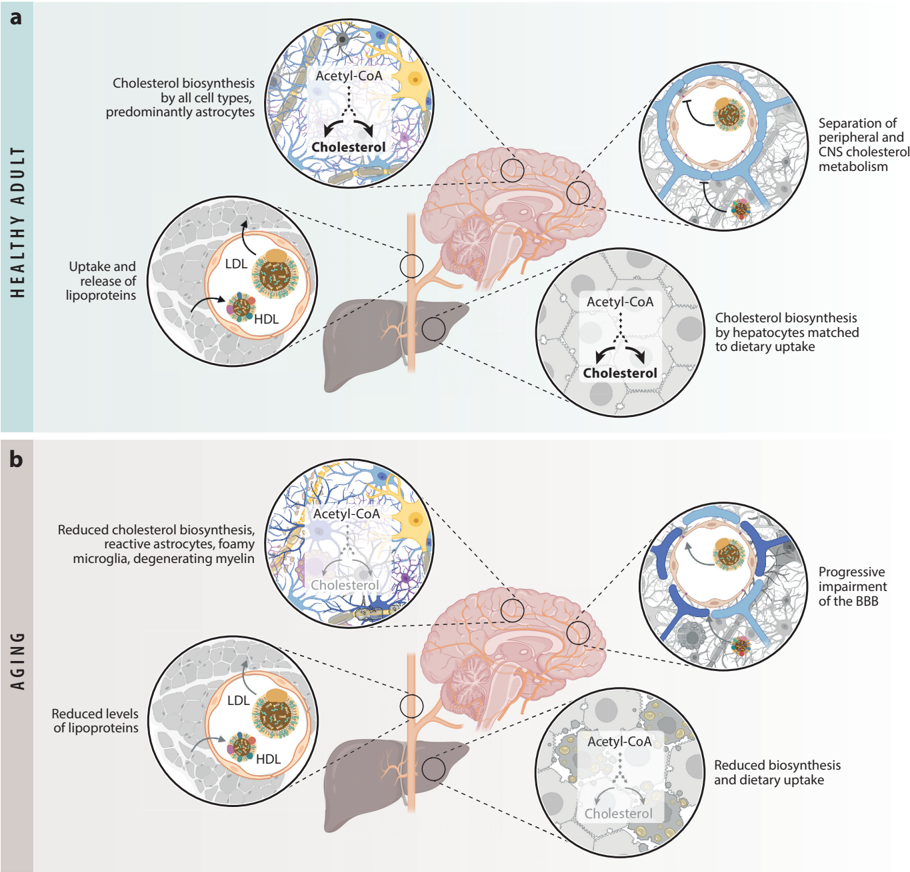
- CNS cholesterol is largely separated from peripheral cholesterol by the blood-brain barrier; brain cholesterol is almost entirely locally synthesized, with astrocytes as major producers in the adult CNS and ApoE as the major CNS apolipoprotein. Adult rodent brain has approximately 70–80% of cholesterol in myelin; brain cholesterol half-life is approximately 1 year in mice and 5 years in humans.
- Aging is accompanied by reduced dietary absorption and hepatic synthesis, lower circulating cholesterol/LDL, and decreased brain cholesterol synthesis. Low plasma cholesterol, low synthesis/uptake, and low LDL in aged individuals have been associated with poor health and mortality, while survival beyond 90 years was linked to rising plasma cholesterol during old age.
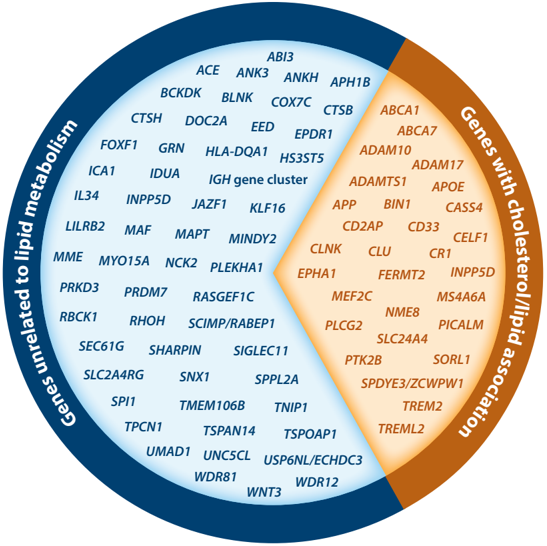
- AD is strongly linked to cholesterol/lipid metabolism: APOE4 is the strongest risk factor for late-onset sporadic AD, with homozygous carriers having a 4- to 14-fold increased risk; approximately one third of known AD risk genes relate to sterol/lipid metabolism; cholesterol affects APP processing, tau pathology, and microglial function.
- Cell type-specific changes in the aging brain include declining myelin/synaptic cholesterol, impaired myelin repair linked to inefficient lipid/cholesterol recycling by phagocytes, and aging microglia accumulating cholesterol/lipid droplets and losing process motility.
Methods
- Design: narrative review; no primary experiments or systematic review protocol.
- Data/sample: synthesizes published human and mouse studies on sterol metabolism, CNS versus peripheral cholesterol, aging, and AD; includes a GWAS/expression-based AD risk gene figure.
- Analysis: conceptual synthesis; proposes that cell type-specific cholesterol handling and intercellular cholesterol flux are critical for age-related disease.
Limitations
- Stated: the author notes the discussion was restricted by word count and reference limits and apologizes for not discussing all relevant work.
- Evident: as a narrative review, it does not use systematic search/selection or quantitative meta-analysis; the text also notes conflicting findings on sterol levels in plasma, brain, and CSF and mixed statin results.
- Evident: many mechanisms remain unresolved, including how individual fasting blood cholesterol is regulated, CNS lipoprotein transport complexity, and causal relationships between cholesterol dysfunction, inflammation, and aging.
Model-written summary. Check it against the paper before relying on it.
Integrity signals
Registry
Cites
Statistics
Figures
Verification
Claims the paper makes
0 Valid · 10 Not valid · 47 Not checked · 26 Own results and interpretations
In the paper
“Hypercholesteremia and obesity in middleaged individuals are known to associate with the development of dementia (Dai et al. 2021), which is likely also promoted by vascular defects.”
§ Cholesterol Metabolism in Aging and Age-Related Disorders > Cholesterol Metabolism During Aging
What the sources say
- Not checked yetcites Dai et al. 2021 matched to “Cholesterol Metabolism in Neurodegenerative Diseases: Molecular Mechanisms and Therapeutic Targets” (2021) source
boostedstates an association- Asserted: passes — The authors put it forward as true.
- Checkable: passes — It can be checked against evidence.
- Load-bearing: unclear — It is unclear whether the paper’s conclusions depend on it.
- Based: passes — The paper gives a reason why it holds.
The paper states this without a source or data behind it here, so there is nothing to check it against. The quote shows it is in the paper.
In the paper
“Aging involves changes in sterol metabolism in peripheral organs and also in the brain.”
§ Cholesterol Metabolism in Aging and Age-Related Disorders > Abstract
plainstates a cause- Asserted: passes — The authors put it forward as true.
- Checkable: passes — It can be checked against evidence.
- Load-bearing: passes — The paper’s conclusions depend on it.
- Based: unclear — It is unclear why the paper says it holds.
A conclusion the paper draws from its own results — it cites no other source for it, so there is none to check. The quote shows it is in the paper.
In the paper
“We propose that cell type-specific cholesterol handling and the interplay between cell types critically influence age-related disease processes.”
§ Cholesterol Metabolism in Aging and Age-Related Disorders > Abstract
plainstates a cause- Asserted: passes — The authors put it forward as true.
- Checkable: passes — It can be checked against evidence.
- Load-bearing: passes — The paper’s conclusions depend on it.
- Based: unclear — It is unclear why the paper says it holds.
- Rests on an assumption not shown here.
A conclusion the paper draws from its own results — it cites no other source for it, so there is none to check. The quote shows it is in the paper.
In the paper
“Thus, astrocytes likely provide cholesterol to other brain cells via lipoprotein-mediated transport.”
§ Cholesterol Metabolism in Aging and Age-Related Disorders > Central Nervous System Versus Peripheral Cholesterol Metabolism
hedgedstates a possible cause- Asserted: passes — The authors put it forward as true.
- Checkable: passes — It can be checked against evidence.
- Load-bearing: unclear — It is unclear whether the paper’s conclusions depend on it.
- Based: passes — The paper gives a reason why it holds.
A statement the paper makes itself — it cites no source for it, so there is none to check. The quote shows it is in the paper.
In the paper
“This age-related decline of cholesterol levels is accompanied by both reduced dietary absorption and hepatic synthesis (Figure 1b).”
§ Cholesterol Metabolism in Aging and Age-Related Disorders > Cholesterol Metabolism During Aging
plainstates an association- Asserted: passes — The authors put it forward as true.
- Checkable: passes — It can be checked against evidence.
- Load-bearing: unclear — It is unclear whether the paper’s conclusions depend on it.
- Based: passes — The paper gives a reason why it holds.
51 more claims
Create a free account to see all 83 claims and to verify the 67 references still open.
- It may state two separate claims as one. 20
- Probably not a substantial claim. 8
Citations
Cites
Feigin, V. L., Nichols, E., Alam, T., Bannick, M. S., Beghi, E., Blake, N., Culpepper, W. J., Dorsey, E. R., Elbaz, A., Ellenbogen, R. G., et al. (2019) · The Lancet Neurology · doi:10.1016/s1474-4422(18)30499-x · Cited by 5,644
NLRP3 inflammasomes are required for atherogenesis and activated by cholesterol crystals
Duewell, P., Kono, H., Rayner, K. J., Sirois, C. M., Vladimer, G., Bauernfeind, F. G., Abela, G. S., Franchi, L., Nuñez, G., Schnurr, M., et al. (2010) · Nature · doi:10.1038/nature08938 · Cited by 4,026
The neuropathological diagnosis of Alzheimer's disease
DeTure, M. A., & Dickson, D. W. (2019) · Molecular Neurodegeneration · doi:10.1186/s13024-019-0333-5 · Cited by 3,329 · cited 1×
“The duration of AD stages shortens with age, and aging is the strongest risk factor for AD (DeTure & Dickson 2019, Vermunt et al. 2019).”
BackgroundmTOR at the nexus of nutrition, growth, ageing and disease
Liu, G. Y., & Sabatini, D. M. (2020) · Nature Reviews Molecular Cell Biology · doi:10.1038/s41580-019-0199-y · Cited by 2,737 · cited 2×
“As a major driver of aging and neurodegeneration, mammalian target of rapamycin (mTOR) signaling integrates cellular energy metabolism with stress and autophagy-mediated degradation (Liu & Sabatini 2020).”
BackgroundNew insights into the genetic etiology of Alzheimer’s disease and related dementias
Bellenguez, C., Küçükali, F., Jansen, I. E., Kleineidam, L., Moreno-Grau, S., Amin, N., Naj, A. C., Campos-Martin, R., Grenier-Boley, B., Andrade, V., et al. (2022) · Nature Genetics · doi:10.1038/s41588-022-01024-z · Cited by 2,498 · cited 2×
“…of AD has developed from a pure neuronal pathology to a multifactorial disorder with many risk loci that involves all cell types in the brain and the immune system, although the number of risk loci is debated (Bellenguez et al. 2022; Johnson et al. 2020, 2022; Yang et al. 2022; Zhang et al. 2020a).”
BackgroundMarschallinger, J., Iram, T., Zardeneta, M., Lee, S. E., Lehallier, B., Haney, M. S., Pluvinage, J. V., Mathur, V., Hahn, O., Morgens, D. W., et al. (2020) · Nature Neuroscience · doi:10.1038/s41593-019-0566-1 · Cited by 1,586 · cited 1×
“Losing the ability to handle intracellular lipids is a key feature of aging microglia, leading to intra-cellular accumulation of cholesterol (Cantuti-Castelvetri et al. 2018, Marschallinger et al. 2020).”
BackgroundMarschallinger, J., Iram, T., Zardeneta, M., Lee, S. E., Lehallier, B., Haney, M. S., Pluvinage, J. V., Mathur, V., Hahn, O., Morgens, D. W., et al. (2019) · doi:10.1101/722827 · Cited by 1,414
Neural mechanisms of ageing and cognitive decline
Bishop, N. A., Lu, T., & Yankner, B. A. (2010) · Nature · doi:10.1038/nature08983 · Cited by 1,323 · cited 3×
“However, the initial mild cognitive decline of the aging brain is caused rather by loss of connectivity and plasticity (Bishop et al. 2010).”
BackgroundClearance of senescent glial cells prevents tau-dependent pathology and cognitive decline
Bussian, T. J., Aziz, A., Meyer, C. F., Swenson, B. L., van Deursen, J. M., & Baker, D. J. (2018) · Nature · doi:10.1038/s41586-018-0543-y · Cited by 1,289 · cited 1×
“Moreover, genetic or pharmacological reinforcement of apoptosis of senescent glial cells in a tauopathy model prevented neurodegeneration and cognitive decline (Bussian et al. 2018).”
BackgroundBrain Cholesterol: Long Secret Life Behind a Barrier
Björkhem, I., & Meaney, S. (2004) · Arteriosclerosis, Thrombosis, and Vascular Biology · doi:10.1161/01.atv.0000120374.59826.1b · Cited by 1,044 · cited 1×
“In adult brains of rodents, approximately 70– 80% of the cholesterol is found in myelin (Björkhem & Meaney 2004).”
Background
Research works printed but not linked: 5
- Dodge HH, Buracchio TJ, Fisher GG, Kiyohara Y, Meguro K, et al. 2012. Trends in the prevalence of dementia in Japan. Int. J. Alzheimer's Dis. 2012:956354
- Gu Q, Paulose-Ram R, Burt VL, Kit BK. 2014. Prescription cholesterol-lowering medication use in adults aged 40 and over: United States, 2003-2012. NCHS Data Brief 177:1-8
- Herink M, Ito MK. 2000. Medication induced changes in lipid and lipoproteins. In Endotext, ed. KR Feingold, B Anawalt, A Boyce, G Chrousos, WW de Herder, et al. South Dartmouth, MA: Endotext Höglinger D, Burgoyne T, Sanchez-Heras E, Hartwig P, Colaco A, et al. 2019. NPC1 regulates ER contacts with endocytic organelles to mediate cholesterol egress. Nat. Commun. 10:4276
- Roser M, Ortiz-Ospina E, Ritchie H. 2013. Life expectancy. Our World in Data. https://ourworldindata.org/ life-expectancy
- Roser M, Ritchie H, Spooner F. 2021. Burden of disease. Our World in Data. https://ourworldindata. org/burden-of-disease
Cited by
Neuroinflammation in Alzheimer disease
Heneka, M. T., van der Flier, W. M., Jessen, F., Hoozemanns, J., Thal, D. R., Boche, D., Brosseron, F., Teunissen, C., Zetterberg, H., Jacobs, A. H., et al. (2025) · Nature Reviews Immunology · doi:10.1038/s41577-024-01104-7 · Cited by 638
Cui, D., Yu, X., Guan, Q., Shen, Y., Liao, J., Liu, Y., & Su, Z. (2025) · Molecular Biomedicine · doi:10.1186/s43556-025-00321-3 · Cited by 146
Regulation of synaptic function and lipid metabolism
Zhang, T., Yin, Y., Xia, X., Que, X., Liu, X. Y., Zhao, G., Chen, J., Chen, Q., Xu, Q., Tang, Y., et al. (2025) · Neural Regeneration Research · doi:10.4103/nrr.nrr-d-24-01412 · Cited by 57
“Cholesterol in the brain is closely related to learning and memory (Saher, 2023).”
Rudajev, V., & Novotný, J. (2023) · Cell & Bioscience · doi:10.1186/s13578-023-01127-y · Cited by 55
“However, cholesterol turnover is not the same throughout brain tissue [75–77].”
BackgroundThe translational potential of cholesterol-based therapies for neurological disease
Valenza, M., Birolini, G., & Cattaneo, E. F. (2023) · Nature Reviews Neurology · doi:10.1038/s41582-023-00864-5 · Cited by 52
Cerasuolo, M., Di Meo, I., Auriemma, M. C., Paolisso, G., Papa, M., & Rizzo, M. R. (2024) · Biomolecules · doi:10.3390/biom14111362 · Cited by 47
Lipid and lipoprotein metabolism in microglia: Alzheimer’s disease mechanisms and interventions
Sprenger, K. G., Lietzke, E. E., Melchior, J. T., & Bruce, K. D. (2025) · Journal of Lipid Research · doi:10.1016/j.jlr.2025.100872 · Cited by 42
Kim, Y. S., Choi, S., Kim, K.-Y., Pelaez, J. M. N., Perkins, G. A., Choi, S., Kim, J., Nazarenkov, N., Rissman, R. A., Ju, W., et al. (2024) · Journal of Neuroinflammation · doi:10.1186/s12974-024-03214-4 · Cited by 27
Chemical Inhibition of Sterol Biosynthesis
Peeples, E. S., Mirnics, K., & Korade, Ž. (2024) · Biomolecules · doi:10.3390/biom14040410 · Cited by 26
Gao, P., Fu, Y. H. H., He, X., Zhang, D., Chi, H., Huang, Y., Wang, Z.-B., Zhang, W., Ou, Y., Ge, Y., et al. (2025) · Journal of Advanced Research · doi:10.1016/j.jare.2025.06.046 · Cited by 25
“Cholesterol plays an important role in neurodegenerative diseases due to its neuroprotective functions that help maintain nervous system integrity [81].”
Microbial metabolites as modulators of host physiology
Joyce, S. A., & Clarke, D. J. (2024) · Advances in microbial physiology/Advances in Microbial Physiology · doi:10.1016/bs.ampbs.2023.12.001 · Cited by 24
Singhaarachchi, P. H., Antal, P., Calon, F., Culmsee, C., Delpech, J.-C., Feldotto, M., Geertsema, J., Hoeksema, E. E., Kőrösi, A., Layé, S., et al. (2024) · Neuroscience & Biobehavioral Reviews · doi:10.1016/j.neubiorev.2024.105724 · Cited by 21
“…lipidomic studies have unveiled alterations in various lipid species in the brains of AD patients, a considerable portion of research has been dedicated to understanding the impact of changes in cholesterol, PUFAs, and phospholipids on neurodegenerative processes (Saher, 2023; Husain et al., 2021).”
BackgroundChandramouli, A., & Kamat, S. S. (2024) · Biochemistry · doi:10.1021/acs.biochem.4c00160 · Cited by 17
Targeting lipid metabolism in neurodegenerative diseases: From experimental to clinical
Long, J., Liu, S., Shi, Y., Zhang, C., Li, Q., & Ai, Q. (2025) · Metabolism · doi:10.1016/j.metabol.2025.156436 · Cited by 15
He, Z., Zhang, L., Gong, S., Yang, X., & Xu, G. (2025) · International Journal of Molecular Medicine · doi:10.3892/ijmm.2025.5667 · Cited by 15
“The dysregulation of cholesterol metabolic enzymes is implicated in various pathologies, including familial hypercholesterolemia (49), atherosclerosis (35) and Alzheimer's disease (50).”
Sun, Y., Zhong, M., Wang, J., Feng, M., Shen, C., Han, Z., Cao, X., & Zhang, Q. (2025) · European Journal of Pharmacology · doi:10.1016/j.ejphar.2025.177388 · Cited by 14
Cholesterol and oxysterols in retinal neuron-glia interactions: relevance for glaucoma
Masson, E., Serrano, J., Léger-Charnay, E., & Acar, N. (2024) · Frontiers in Ophthalmology · doi:10.3389/fopht.2023.1303649 · Cited by 11
“This is likely the result of both decreased cholesterol biosynthesis, especially in astrocytes, and increased neuronal Cyp46a1 expression in response to oxidative stress (76 – 78).”
BackgroundYTHDF1 differentiates the contributing roles of mTORC1 in aging
Xu, C., Yu, C., Zhang, J., Zhang, Z., Zhang, J., Meng, Y., Wang, M., Wen, M., Chen, J., Ning, Y., et al. (2025) · Molecular Cell · doi:10.1016/j.molcel.2025.05.003 · Cited by 11
White matter lipid alterations during aging in the rhesus monkey brain
Dimovasili, C., Vitantonio, A. T., Conner, B., Vaughan, K. L., Mattison, J. A., & Rosene, D. L. (2024) · GeroScience · doi:10.1007/s11357-024-01353-3 · Cited by 10
“Studies have shown that induced loss of cholesterol synthesis in one CNS cell type results in compensatory enhanced transport from other cells [74], and the same might be true even among different brain regions.”
Effect of cholesterol metabolism on hepatolithiasis
Lin, Z., Ye, Z., & Ma, J. (2025) · World Journal of Gastroenterology · doi:10.3748/wjg.v31.i1.99960 · Cited by 10
Pandia, S., & Chakraborty, H. (2024) · The Journal of Physical Chemistry B · doi:10.1021/acs.jpcb.4c03853 · Cited by 10
Lucassen, P. J., Kőrösi, A., de Rooij, S. R., Smit, A. B., van Dam, A., Daskalakis, N. P., van Kesteren, R. E., Verheijen, M. H. G., Lesuis, S. L., Kessels, H. W. H. G., et al. (2024) · Biological Psychiatry · doi:10.1016/j.biopsych.2024.11.007 · Cited by 9
Mendoza-Núñez, V. M., Aguilar-Curiel, J. V., Castillo‐Martínez, L., Rodríguez-García, W. D., Vaquero‐Barbosa, N., Rosado-Pérez, J., & Arista-Ugalde, T. L. (2024) · Irish Journal of Medical Science (1971 -) · doi:10.1007/s11845-024-03727-0 · Cited by 8
“…LDL increase until adulthood and decrease with aging, some factors, such as environmental (diet and physical exercise), hormonal, sleep disorders, psychological (distress), socioeconomic level and chronic consumption of some medications, can influence the lipid profile levels of older adults [24].”
BackgroundLiu, Y., Cheng, G., Hu, Y., Han, H., Tian, T., Luo, Y., Yang, X., Xie, W., Wu, Q., Wang, S., et al. (2025) · Pest Management Science · doi:10.1002/ps.8638 · Cited by 8
“46 Sterols are critical for a wide range of physiological processes, particularly reproduction.”
Spinedi, M., Clark, C., Zullo, L., Kerksiek, A., Pistis, G., Castelao, E., von Gunten, A., Preisig, M., Lütjohann, D., & Popp, J. (2024) · iScience · doi:10.1016/j.isci.2024.109013 · Cited by 8
“46,47 Our results suggest that lower or decreasing cholesterol circulating levels in older people may indicate a higher risk of cognitive decline, possibly reflecting ongoing cerebral pathological changes.”
BackgroundGriffiths, L., Hawkins, K., Yutuc, E., Angelini, R., Fosuah, R., Pacciarini, M., Dickson, A. L., Robertson, N., Childs, L., Loveless, S., et al. (2025) · Brain Pathology · doi:10.1111/bpa.70001 · Cited by 8
“Disrupted cholesterol homeostasis is associated with neurodegenerative and age-related neuropathology [40], while age and ageing play a determining role in the MS course [41].”
The interplay between metabolic health factors and stroke incidence in aging populations
Zhang, C., Xiong, T., Ren, K., Wu, H., Cai, S., & Wang, L. (2025) · Frontiers in Endocrinology · doi:10.3389/fendo.2025.1646643 · Cited by 7
“First, cholesterol plays a crucial role in maintaining neuronal membrane integrity and myelin formation (52 – 54), and moderately elevated cholesterol levels may confer neuroprotective effects by supporting membrane stability and neurotransmitter receptor function (55).”
Reduced triacylglycerols and lipid droplets are associated with resilience to Alzheimer's disease
van der Vliet, D., de Vries, L. E., Di, X., Wever, D. D., de Jong, B., van der Meij, M. T. C., van der Peet, M., Harms, A. C., Hankemeier, T., Swaab, D. F., et al. (2026) · Alzheimer s & Dementia · doi:10.1002/alz.71083 · Cited by 7
“14 More recently, lipid droplet (LD)– accumulating microglia surrounding plaques have been described in animal models of AD and in AD patients, 16–18 which were associated with increased levels of neuroinflammation.”
The roles of enhancer, especially super-enhancer-driven genes in tumor metabolism and immunity
Guo, S., Zhang, L., Ren, J., Lü, Z., Ma, X., Liu, X., Jin, H., & Li, J. (2025) · International Journal of Biological Macromolecules · doi:10.1016/j.ijbiomac.2025.142414 · Cited by 7
Wang, Y., Wu, Q., You, Y., Jiang, W., Fu, P., Dai, K., & Sun, Y. (2025) · Advanced Science · doi:10.1002/advs.202410414 · Cited by 7
Plasma proteomic profiles of Alzheimer’s disease and neurodegeneration in African cohorts
Pola, I., Akinyemi, T. O., Tan, K., Olalusi, O., Traichel, W., Giacomucci, G., Yaria, J. O., Rahmouni, N., Ogunde, G. O., Oguntiloye, O., et al. (2026) · Nature Communications · doi:10.1038/s41467-026-74971-4 · Cited by 6
Fu, Y., Zhang, X., Li, L., Jiang, H., Ren, Q., Yi, T., Zhang, Y., & Lu, Y. (2025) · Antioxidants · doi:10.3390/antiox14111321 · Cited by 6
“In recent years, many academic studies have discovered that lipid metabolism abnormalities are closely associated with Alzheimer’s disease (AD) [51].”
Chiu, P., Chou, H., Lin, C., Li, H., Chen, T., Chen, H., & Chang, H.-T. (2025) · Alzheimer s Research & Therapy · doi:10.1186/s13195-025-01910-8 · Cited by 6
Shao, W., Wang, K., Liu, Y., Zhang, H., Sun, Z., & Zhou, R. (2026) · International Journal of Molecular Sciences · doi:10.3390/ijms27125580 · Cited by 6
“This senescent derangement leads to an aberrant accumulation of unesterified sterols within cell membranes and lipid rafts, profoundly altering glial membrane biophysical dynamics and homeostatic clearance capacity independent of overt neurodegenerative cascades [41].”
Calycosin-7-O-β-D-Glucoside Ameliorates Palmitate-Induced Lipid Accumulation in HT22 Cells
Xu, Y., Li, D., Xue, A., Gu, J., Ren, Y., Zhu, S., Lei, X., Liu, J., Zhao, J., Geng, F., et al. (2024) · Actas Españolas de Psiquiatría · doi:10.62641/aep.v52i5.1723 · Cited by 6
“A key pathological feature of AD is the hyper-phosphorylation of Tau protein, leading to its detachment from microtubules, abnormal folding, aggregation, and formation of neurofibrillary tangles (NFTs), which contribute to neuronal injury and synaptic dysfunction [23].”
BackgroundHuang, H., Zhou, C., Chen, C., Tang, H., Dong, W., Wan, J., Kang, W., Sun, A., Liu, Y., Jin, C., et al. (2026) · Advanced Science · doi:10.1002/advs.202519874 · Cited by 5
“Cholesterol plays critical roles in plasma membrane fluidity, synaptic vesicle formation, and synaptic plasticity [ 6–8 ], and reductions in cholesterol level and synthesis rate are strongly associated with the aging brain and neurodegenerative diseases [ 9, 10 ].”
Inhibition of liver cholesterol synthesis by a diet-induced gut hormone
Huang, X., & Ye, J. (2024) · Acta Pharmaceutica Sinica B · doi:10.1016/j.apsb.2024.07.026 · Cited by 5
Basak, I., Harfoot, R., Palmer, J. E., Kumar, A., Quiñones‐Mateu, M. E., Schweitzer, L., & Hughes, S. M. (2023) · Biomolecules · doi:10.3390/biom13111597 · Cited by 4
The Effect of Statin Treatment on Synaptogenesis in the Hippocampus
Taylor, S., & Adhikari, R. (2024) · Biological Research For Nursing · doi:10.1177/10998004241270079 · Cited by 4
“High cholesterol levels are implicated in neurodegenerative disorders that manifest with cognitive decline, including Alzheimer ’ s and age-related dementia (Loera et al., 2019; Saher, 2023; Song et al., 2021).”
Mishra, S. S., Mahapatra, P., & Chakraborty, H. (2026) · Chemical Communications · doi:10.1039/d5cc05466d · Cited by 4
Luo, S., Xiang, Q., Hussain, M. M., & Liu, Y. (2025) · Neurosurgical Review · doi:10.1007/s10143-025-03975-3 · Cited by 3
“Meanwhile, GNRI incorporates body weight, pro - viding an estimate of chronic energy deficit [ 35], while the CONUT score includes serum cholesterol, which reflects cellular membrane integrity and caloric sufficiency [ 36].”
Wu, J., Lu, X., Zhang, J., Shuaihan, W., Lu, Z., Han, Y., Yang, R., Su, Y., Tan, C., Huo, D., et al. (2026) · Cell Reports · doi:10.1016/j.celrep.2026.117193 · Cited by 3
Cholesterol-modifying strategies for Alzheimer disease: promise or fallacy?
Azarfar, K., Decourt, B., Camacho, B. S., Lawrence, J. J., Omondi, T. R., & Sabbagh, M. N. (2025) · Expert Review of Neurotherapeutics · doi:10.1080/14737175.2025.2483928 · Cited by 3
“Very importantly, older age is associated with dysregulation of cholesterol biosynthesis in the brain [40] that could occur for various reasons, such as chronic low-grade inflammation, microbe infection, protein aggregation (e.g. Aβ), and mitochondrial dysfunction [41].”
Anti-aging mechanism of deer antler velvet: A network pharmacology and molecular docking analysis
Zhao, X., Pei, H., Dai, X., Muhammad, A., He, Z., & Du, R. (2025) · Aging advances. · doi:10.4103/agingadv.agingadv-d-25-00023 · Cited by 3
Pleiotropic Cholesterol Signaling in Drosophila and Mammalian Systems
Kang, Y., Atif, M., & Lee, Y. (2026) · Metabolites · doi:10.3390/metabo16040220 · Cited by 3
“It serves a multifaceted role in metabolic and homeostatic regulation [6–11], development [12–14], physiology [15–17], aging [18–21], immunity [22–24], and cancer [25–27].”
The causal relationship between blood cell traits and aging: a Mendelian randomization study
Chen, P., Zhou, Y.-H., Wei, X. C., Wei, H.-G., Li, B., & Ouyang, L. (2025) · BMC Geriatrics · doi:10.1186/s12877-025-06051-z · Cited by 2
“Moreover, cholesterol homeostasis and metabolism are found to be closely related to aging [67].”
Orlistat Confers Neuroprotection in Traumatic Brain Injury by Modulating Microglial Lipid Metabolism
Yu, C., Ni, Y., Xiong, Y., Kang, H., Jiang, Z., Liu, Y., Zhang, X., Liu, Y., Zhao, K., Wang, S., et al. (2025) · Cells · doi:10.3390/cells14181469 · Cited by 2
“In terms of pathways, ORL treatment activated pathways such as the PPAR pathway and MAPK pathway in microglia [31,32] while inhibiting pathways such as the IL-17 pathway and cholesterol metabolism (Figure 6E) [33–36].”
Regulation of CNS Lipids by Protease Activated Receptor 1
Yoon, H., Triplet, E. M., Wurtz, L. I., Simon, W. L., Choi, C., & Scarisbrick, I. A. (2025) · Journal of Neurochemistry · doi:10.1111/jnc.70047 · Cited by 2
“Perturbations in lipid and cholesterol homeostasis are also associated with pathogenesis in neurological diseases arising from other causes, such as Alzheimer's (AD), Parkinson's, and Huntington's diseases (Saher 2023).”
Wang, L., Liu, X., Li, S., Li, R., Li, R., Yan, F., & Xi, J. (2025) · Molecular Genetics and Genomics · doi:10.1007/s00438-025-02299-7 · Cited by 2
A Machine‐Learning Approach Identifies Rejuvenating Interventions in the Human Brain
Santamaria, G., Iglesias, C., Jung, S., Hodar, J. A., Nogueiras, R., & del Sol, A. (2025) · Advanced Science · doi:10.1002/advs.202503344 · Cited by 2
Feng, Y., Tang, Q., Li, S. B., Yang, L., Yang, M., Yang, J., & Zeng, Y. H. (2025) · Journal of Clinical Medicine · doi:10.3390/jcm14197029 · Cited by 2
“Previous studies have shown that TC, TG, and LDL-C levels tend to decrease with advancing age, while HDL-C increases, consistent with our correlation findings [26,27].”
Glucose and Lipid Metabolic Mechanisms in Vascular Aging and Related Therapeutic Strategies
Han, F., Wen, Z., Li, C., & Chen, T. (2026) · Reviews in Cardiovascular Medicine · doi:10.31083/rcm45053 · Cited by 2
Su, Y.-X., Sun, D., Cao, C., & Wang, Y. (2024) · Biochemistry and Biophysics Reports · doi:10.1016/j.bbrep.2024.101679 · Cited by 2
“For example, inadequate cholesterol levels due to various genetic mutations in cholesterol biosynthesis genes preferentially lead to cataracts in the eye lens [22].”
BackgroundSong, H., Yang, M., Wu, S., Dai, Q., Qin, W., Xie, W., Chen, Y., Jiang, X., Zhang, X., Deng, X., et al. (2026) · iScience · doi:10.1016/j.isci.2026.116033 · Cited by 1
“58 Evidence from genetics, epidemiology, and biochemistry suggests that cholesterol homeostasis is disrupted in AD and that AD susceptibility might stem from changes in cholesterol metabolism.”
Plasminogen Activator Inhibitor 1, Cell Senescence, and Aging-Related Diseases
Liu, R.-M., & Nakamya, M. F. (2026) · Cells · doi:10.3390/cells15060551 · Cited by 1
Nie, L., Wu, W., Hu, C., Zhang, Z., He, K., Yang, X., & Xie, H. (2026) · Mechanisms of Ageing and Development · doi:10.1016/j.mad.2026.112209 · Cited by 1
Pathophysiologic abnormalities in transgenic mice carrying the Alzheimer disease PSEN1 Δ440 mutation
Fuller, P. E., Collis, V. L., Sharma, P., Burkett, A. M., Wang, S., Brown, K. A., Weir, N., Goulbourne, C. N., Nixon, R. A., Longden, T. A., et al. (2024) · Human Molecular Genetics · doi:10.1093/hmg/ddae139 · Cited by 1
Deng, Z., Chen, J., Li, J., Luo, X., Luo, Z., Ren, M., & Li, X. (2026) · Biology · doi:10.3390/biology15120938 · Cited by 1
“…convergent driver of diverse neurodegenerative pathways, including altered proteopathic stress and synaptic injury in disease models [11–13], and emerging evidence suggests that Srebf2 -centered cholesterol programs may interface with aging and neurodegenerative disease processes more broadly [14].”
Dominicus, C. S., Peretti, D., Rodschinka, G., Ogden, S., Steer, J., Leija‐Salazar, M., Feriz, A. M., Feng, C., Kataria, S., Su, J., et al. (2026) · bioRxiv (Cold Spring Harbor Laboratory) · doi:10.64898/2026.10.13.758778 · Cited by 1
“Together, this analysis identifies a set of cellular gene expression programs that are perturbed upon knockout of AD candidate genes, many of which have been previously implicated in neurodegeneration such as sterol metabolism 38 , stress response 40 and inflammatory signalling 48 .”
Peñalva, D. A., Munafó, J. P., & Antollini, S. S. (2025) · Chemistry and Physics of Lipids · doi:10.1016/j.chemphyslip.2025.105484 · Cited by 1
Xiao, W., Hu, Y., Shao, L., Liu, J., Wang, D., & Li, H. (2025) · Microchimica Acta · doi:10.1007/s00604-025-07639-3 · Cited by 1
“It can serve as a crucial physiological marker for the diagnosis of various diseases [3, 4].”
Cholesterol-dependent modulation of β-amyloid 1–40 peptide aggregation by membrane organization
Munafó, J. P., Makowski, M., Fabiani, C., Maniscalchi, A., Salvador, G. A., López‐Montero, I., Peñalva, D. A., & Antollini, S. S. (2026) · Journal of Colloid and Interface Science · doi:10.1016/j.jcis.2026.140739 · Cited by 1
Han, H. (2024) · ORBi (University of Liège) · Cited by 1
Targeting the liver for longevity
Yu, J., Fan, B., Gao, X., Fan, Y., Wang, S., Huang, C., & Fan, S. (2026) · Ageing Research Reviews · doi:10.1016/j.arr.2026.103142
Carvalho, L. D. O., Farias, H. R., da Silva, S. W., Ramos, J. M. O., Griesang, C. T., Koetz, M., de Oliveira, J., & Konrath, E. L. (2025) · Revista Brasileira de Farmacognosia · doi:10.1007/s43450-025-00622-2
“…that a hypercholesterolemic diet may disrupt the BBB and lead to the accumulation of LDL in central nervous system (CNS) cells (Chang et al. 2017), reinforcing the hypothesis that the loss of brain lipid metabolism homeostasis is likely related to the onset of age-related disorders (Saher 2023).”
Cheng, M., Xi, K., Ni, Z., Wang, L., Tang, J., Wang, W., Li, Z., Zhou, L., Jiang, X., Wu, J., et al. (2026) · Bioactive Materials · doi:10.1016/j.bioactmat.2026.08.017
“Preliminary research has indicated that cholesterol metabolism is involved in cellular aging [8,10,26].”
Du, K., Zhao, Y., & Liu, Z. (2026) · Neurological Sciences · doi:10.1007/s10072-026-08864-1
Kaur, A., Murthy, S., Bharath Kumar, D. R., Gokulakrishnan, S., Philantharopa, U. P. B., & Narajji, C. (2026) · Elsevier eBooks · doi:10.1016/b978-0-443-40563-1.00010-7
Fat on Fire: Disrupted Microglial Lipid Metabolism as a Driver of Anesthetic Neurotoxicity
Mou, Y., Tu, H., Yi-chan, W., Song, S.-Y., Liu, H., Wang, D., Wu, J., Meng, X., Qin, Z.-H., & Ji, F.-H. (2026) · Neuroscience Bulletin · doi:10.1007/s12264-026-01623-4
“Cholesterol depletion, therefore, disrupts lipid raft integrity, mislocalizes synaptic receptors and scaffolding proteins, and impairs synaptic plasticity [129].”
Wu, R., Yu, X., Song, X., He, Q. Q., Walker, M. N., Sisbarro, D., Horbinski, C., Tiek, D. M., Hu, B., Zhang, N., et al. (2026) · Neuro-Oncology · doi:10.1093/neuonc/noag030
Kim, Y. S., Choi, S.-H., Kim, K.-Y., Pelaez, J. M. N., Perkins, G. A., Choi, S., Kim, J., Nazarenkov, N., Rissman, R. A., Ju, W.-K., et al. (2024) · Figshare · doi:10.6084/m9.figshare.27129329
Multiple target strategies in Alzheimer's disease therapy
Ma, X., Sun, H., & Ye, J. (2026) · Acta Pharmaceutica Sinica B · doi:10.1016/j.apsb.2026.10.018
Gauvrit, T., Minquilan, P., Marchand, V., Motorin, Y., & Martin, J. (2026) · bioRxiv (Cold Spring Harbor Laboratory) · doi:10.64898/2026.04.17.719250
Zuo, N., Liu, S. J., Pan, S., Ou-Yang, X.-P., Yao, J., Zhou, Y., Zhou, Y., Ling-dong, K., & Pan, Y. (2026) · Molecular Psychiatry · doi:10.1038/s41380-026-03682-5
Carotid plaque formation prediction model and validation: a case-control study
Wu, J., Yang, X., Maimaitimin, A., Aikemujiang, A., & 张俊仕 (2026) · Frontiers in Cardiovascular Medicine · doi:10.3389/fcvm.2026.1798393
“Firstly, studies have confirmed that aging is accompanied by a 30%–40% decrease in hepatic LDL receptor expression and a 1.6-fold prolongation of plasma LDL-C retention time, leading to prolonged vascular exposure despite normal lipid concentrations (27).”
InfluentialIssa, S. A., Gauvrit, T., Daira, P., Bernoud‐Hubac, N., & Martin, J. (2026) · Aging Cell · doi:10.1111/acel.70464
“In addition, other metabolic parameters, such as sterol (including cholesterol) homeostasis have also been implicated in aging and neurodegeneration, both in Drosophila (Jing and Behmer 2020; Tschäpe et al. 2002) and in mammals (Saher 2023).”
Ma, X., Yang, H., Qu, J., & Tang, M. (2025) · SSRN Electronic Journal · doi:10.2139/ssrn.5164050
Auswirkungen von Lasp1 auf Atherosklerose und Cholesterinmetabolismus in \(Ldlr.Lasp1\)-/- Mäusen
Kowalski, I. (2025) · Online Publication Service of Würzburg University (Würzburg University) · doi:10.25972/opus-39944
Hayne, M. R., Lipka, J., Lucas, T. A., Soung, A., Adrian, M., Ghosh, S., Lin, H., Chu, S., Stark, K. L., Ngu, H., et al. (2026) · Journal of Neuroinflammation · doi:10.1186/s12974-026-03910-3
“Spatacsin has been previously implicated in lipid processing in neurons, and emerging evidence suggests that lipid metabolism in myeloid cells plays a key role in regulating immune responses [20, 41, 42].”
Huang, J., Zhang, L., Jiang, Q., Wang, S., Xiao, Y., Che, N.-N., Lin, J., Zhao, B., Cheng, Y., Li, C., et al. (2025) · Frontiers in Nutrition · doi:10.3389/fnut.2025.1663881
Wang, L., Li, L., Tao, Y., Jia, Y., Yue, J., Zhang, Y., Wang, Y., Zhang, Y., Xin, M., Liu, J., et al. (2026) · medRxiv · doi:10.64898/2026.04.22.26351474
Orthogonal Chemical Proteomic Strategies Reveal the Cholesteryl Ester Interactome in Mammalian CellsPreprint
Chandramouli, A., Sharma, K., Kallattu, A., Katkar, C., Deshmukh, M., Thakral, P., Chakrapani, H., & Kamat, S. S. (2026) · bioRxiv (Cold Spring Harbor Laboratory) · doi:10.64898/2026.09.21.753363
“In light of accumulating evidence linking CE dysregulation to neurodegenerative disorders 60-68 , oncogenesis 13,19,20,69-71 , and cardiovascular disease 12,68,71-74 , this interaction atlas provides a foundational resource for connecting CE metabolism to disease-relevant protein networks and for…”
A fluorescent cholesterol analog, R-Chol, mimics the dynamics of free cholesterol in live cells
Mogi, H., Yamashita, Y., Sano, M., Kadowaki, R., Honda, T., Kohama, T., & Nakamura, H. (2025) · Archives of Biochemistry and Biophysics · doi:10.1016/j.abb.2025.110600
Wang, X., Lv, A., Tian, Y., Li, D., Fan, X., Wang, Y., Zhuang, P., & Zhang, Y. (2026) · Aging and Disease · doi:10.14336/ad.2026.1294
The Role of Statins in the Prevention and Management of Alzheimer’s Disease: A Focused Review
Copelin, T. A., Kobzeff, M. L., Franco, R. A., & Gafurova, S. M. (2025) · Scholarly Research In Progress · doi:10.64057/001c.150262
“As the brain ages, the density of the synapse declines while the possibility of chronic neuroinflammation becomes more apparent (49).”
GENÇ, T. T., & Sargın, M. (2024) · Authorea · doi:10.22541/au.172114484.46821760/v1
Bansal, K., Eshwari, O., Yusof, S. R., & Komal, P. (2026) · ACS Pharmacology & Translational Science · doi:10.1021/acsptsci.6c00491
Ezh2 variant orchestrates cholesterol biosynthesis via epigenetic regulation in mouse cerebellumPreprint
Guan, F., Jiang, Z., Tian, Y., Jiang, B., Fan, Y., Liang, H., Jin, J., Yin, Y., & He, X. (2026) · doi:10.65215/ltspreprints.2026.09.24.000353
Aging remodels the neuronal activity-dependent transcriptomePreprint
Um, J., Lei, H. C., Nakamura, K., Tycksen, E., Adelman, J. W., & Pollina, E. A. (2026) · bioRxiv (Cold Spring Harbor Laboratory) · doi:10.64898/2026.11.17.767442
“9b,c,d ) and included targets of the known longevity-associated factor FOXO1 56 , the cholesterol synthesis regulator SREBF2 57 , and the anti-inflammatory hormone receptor PGR 58 as well as classical ARG transcription factors ( Extended Data Fig.”
The Association Between High Cholesterol Levels and Severity of Periodontitis
Javaid, R., Mukhtar, S., Nawaz, A., Errum, A., Arslan, B., & Fatima, A. (2024) · Pakistan Journal of Health Sciences · doi:10.54393/pjhs.v5i11.2201
Carvalho, J. P. R., da Rocha, R. W. G., Monteiro-Júnior, R. S., Monteiro, E. P., Diniz, C. W. P., & Bento-Torres, N. V. O. (2025) · Revista CPAQV - Centro de Pesquisas Avançadas em Qualidade de Vida · doi:10.36692/v17n2-105r
Lipid Metabolism and Its Profound Influence on Biological Aging and Age-Related Pathologies
Hartmann, E. M., Nguyen, D. T., & Álvarez, S. M. (2025) · Frontiers in Medical and Clinical Sciences · doi:10.64917/fmcs-006
Singh, T. I., Karki, B., & Tanna, A. R. (2026) · Modern Physics Letters B · doi:10.1142/s0217984926502210
Zhang, X., Liu, P., Tan, Y., Liang, X., & Sun, N. (2026) · The Journal of Steroid Biochemistry and Molecular Biology · doi:10.1016/j.jsbmb.2026.107118
Metadata
- Authors
- Saher, G.
- Affiliations
- Max Planck Institute for Multidisciplinary Sciences (DE)
- Corresponding author
- Saher, Gesine
- ORCID
- Saher, Gesine
- Venue
- Annual Review of Neuroscience
- Publisher
- Annual Reviews
- Published
- 2023-07-10
- Volume
- 46
- Issue
- 1
- Pages
- 59-78
- ISSN
- 0147-006X (ISSN-L)
- 1545-4126
- OpenAlex
- W4383823281
- Cited by
- 96
- References
- 136
- Citations by year
- 2026: 34 · 2025: 36 · 2024: 23 · 2023: 3
- FWCI
- 2.23
- Type
- journal article
- Language
- en
- Open access
- hybrid
- doi.org
- Locations
- Annual Review of Neuroscience (publishedVersion, cc-by)
- PubMed (publishedVersion)
- GoeScholar The Publication Server of the Georg-August-Universität Göttingen (Georg-August-Universität Göttingen) (submittedVersion)
- Funders
- Wilhelm Sander-Stiftung (2019.138.1)
- Alzheimer Forschung Initiative (19070)
- Deutsche Forschungsgemeinschaft (SA2114/2)
- Topics
- Life Sciences › Biochemistry, Genetics and Molecular Biology › Biochemistry › Cholesterol and Lipid Metabolism
- Life Sciences › Neuroscience › Cellular and Molecular Neuroscience › Alzheimer's disease research and treatments
- Health Sciences › Medicine › Genetics (clinical) › Lysosomal Storage Disorders Research
- Keywords
- cholesterol metabolism, aging, age-related diseases, neurodegenerative diseases, Alzheimer's disease, brain cholesterol, lipoproteins, synaptic membranes, myelin membrane, sterol metabolism, mice
- MeSH terms
- Aged, Aging, Alzheimer Disease, Animals, Brain, Cholesterol, Humans, Mammals, Mice
About these checks
Registry, retraction, Cites and statistics results are computed, not judged, with one exception: a printed reference that no index lists is read once by a model before it counts as a citation error. Claims are extracted by a model and kept only when their quote appears verbatim in the text; each cited source is then checked, with a model’s help, for whether it says what the claim relies on. Those verdicts can be wrong — read the claim’s quote and the cited source before relying on one.
A language model drew the claims from the paper on 2026-11-26, under version 3 of the claim definition (model deepseek-v4.1-flash, prompt extract-v3).
A second model labelled each claim on 2026-11-26 (model jev-1.13-20260917, definition revision gold-guideline-v0.2).
Statistics and arithmetic are recomputed, not judged.
Confidence bands are shown only for fields calibrated on our annotated test set. None is calibrated yet, so no band is shown.
What counts as a claim ›How we measure confidence ›How we check this ›
Are you an author, or do you see a problem with this page? Request a review
Data sources
Bibliographic data: Semantic Scholar, OpenAlex, Crossref.
Contains information from the Semantic Scholar Academic Graph Datasets, made available under the ODC Attribution License (ODC-BY 1.0).
Semantic Scholar’s data is described in: Kinney, R., et al. (2023). The Semantic Scholar Open Data Platform. arXiv:2301.10140.
