

Cholesterol Metabolism in Aging and Age-Related Disorders
Open accessThe DOI matches its Crossref record; 142 of the 142 references it cites were found in a registry or an index; none of the 69 sources its claims cite is checked for support yet.
Abstract
All mammalian cell membranes contain cholesterol to maintain membrane integrity. The transport of this hydrophobic lipid is mediated by lipoproteins. Cholesterol is especially enriched in the brain, particularly in synaptic and myelin membranes. Aging involves changes in sterol metabolism in peripheral organs and also in the brain. Some of those alterations have the potential to promote or to counteract the development of neurodegenerative diseases during aging. Here, we summarize the current knowledge of general principles of sterol metabolism in humans and mice, the most widely used model organism in biomedical research. We discuss changes in sterol metabolism that occur in the aged brain and highlight recent developments in cell type–specific cholesterol metabolism in the fast-growing research field of aging and age-related diseases, focusing on Alzheimer's disease. We propose that cell type–specific cholesterol handling and the interplay between cell types critically influence age-related disease processes.
Overview
CoChat Summary
TL;DR
This review synthesizes human and mouse evidence on cholesterol metabolism in aging and age-related disorders, focusing on the brain and Alzheimer's disease. It argues that cell type-specific cholesterol handling and intercellular cholesterol flux critically influence age-related disease processes.
Key findings
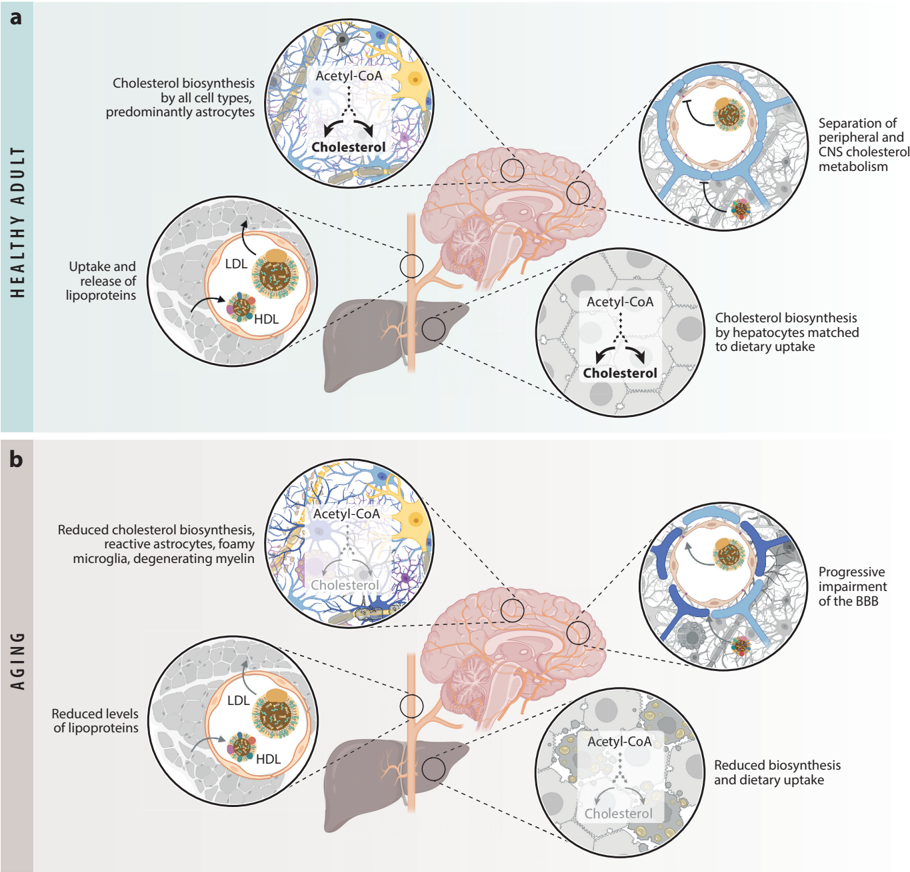
- CNS cholesterol is largely separated from peripheral cholesterol by the blood-brain barrier; brain cholesterol is almost entirely locally synthesized, with astrocytes as major producers in the adult CNS and ApoE as the major CNS apolipoprotein. Adult rodent brain has approximately 70–80% of cholesterol in myelin; brain cholesterol half-life is approximately 1 year in mice and 5 years in humans.
- Aging is accompanied by reduced dietary absorption and hepatic synthesis, lower circulating cholesterol/LDL, and decreased brain cholesterol synthesis. Low plasma cholesterol, low synthesis/uptake, and low LDL in aged individuals have been associated with poor health and mortality, while survival beyond 90 years was linked to rising plasma cholesterol during old age.
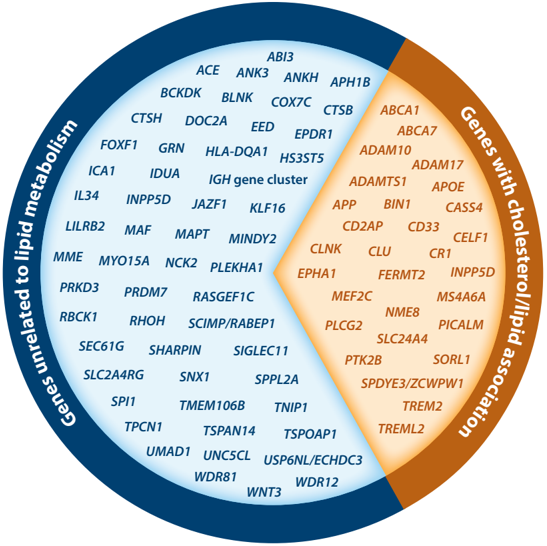
- AD is strongly linked to cholesterol/lipid metabolism: APOE4 is the strongest risk factor for late-onset sporadic AD, with homozygous carriers having a 4- to 14-fold increased risk; approximately one third of known AD risk genes relate to sterol/lipid metabolism; cholesterol affects APP processing, tau pathology, and microglial function.
- Cell type-specific changes in the aging brain include declining myelin/synaptic cholesterol, impaired myelin repair linked to inefficient lipid/cholesterol recycling by phagocytes, and aging microglia accumulating cholesterol/lipid droplets and losing process motility.
Methods
- Design: narrative review; no primary experiments or systematic review protocol.
- Data/sample: synthesizes published human and mouse studies on sterol metabolism, CNS versus peripheral cholesterol, aging, and AD; includes a GWAS/expression-based AD risk gene figure.
- Analysis: conceptual synthesis; proposes that cell type-specific cholesterol handling and intercellular cholesterol flux are critical for age-related disease.
Limitations
- Stated: the author notes the discussion was restricted by word count and reference limits and apologizes for not discussing all relevant work.
- Evident: as a narrative review, it does not use systematic search/selection or quantitative meta-analysis; the text also notes conflicting findings on sterol levels in plasma, brain, and CSF and mixed statin results.
- Evident: many mechanisms remain unresolved, including how individual fasting blood cholesterol is regulated, CNS lipoprotein transport complexity, and causal relationships between cholesterol dysfunction, inflammation, and aging.
Model-written summary. Check it against the paper before relying on it.
Integrity signals
Registry
Cites
Statistics
Figures
Verification
Claims the paper makes
0 Valid · 10 Not valid · 47 Not checked · 26 Own results and interpretations
In the paper
“Hypercholesteremia and obesity in middleaged individuals are known to associate with the development of dementia (Dai et al. 2021), which is likely also promoted by vascular defects.”
§ Cholesterol Metabolism in Aging and Age-Related Disorders > Cholesterol Metabolism During Aging
What the sources say
- Not checked yetcites Dai et al. 2021 matched to “Cholesterol Metabolism in Neurodegenerative Diseases: Molecular Mechanisms and Therapeutic Targets” (2021) source
boostedstates an association- Asserted: passes — The authors put it forward as true.
- Checkable: passes — It can be checked against evidence.
- Load-bearing: unclear — It is unclear whether the paper’s conclusions depend on it.
- Based: passes — The paper gives a reason why it holds.
The paper states this without a source or data behind it here, so there is nothing to check it against. The quote shows it is in the paper.
In the paper
“Aging involves changes in sterol metabolism in peripheral organs and also in the brain.”
§ Cholesterol Metabolism in Aging and Age-Related Disorders > Abstract
plainstates a cause- Asserted: passes — The authors put it forward as true.
- Checkable: passes — It can be checked against evidence.
- Load-bearing: passes — The paper’s conclusions depend on it.
- Based: unclear — It is unclear why the paper says it holds.
A conclusion the paper draws from its own results — it cites no other source for it, so there is none to check. The quote shows it is in the paper.
In the paper
“We propose that cell type-specific cholesterol handling and the interplay between cell types critically influence age-related disease processes.”
§ Cholesterol Metabolism in Aging and Age-Related Disorders > Abstract
plainstates a cause- Asserted: passes — The authors put it forward as true.
- Checkable: passes — It can be checked against evidence.
- Load-bearing: passes — The paper’s conclusions depend on it.
- Based: unclear — It is unclear why the paper says it holds.
- Rests on an assumption not shown here.
A conclusion the paper draws from its own results — it cites no other source for it, so there is none to check. The quote shows it is in the paper.
In the paper
“Thus, astrocytes likely provide cholesterol to other brain cells via lipoprotein-mediated transport.”
§ Cholesterol Metabolism in Aging and Age-Related Disorders > Central Nervous System Versus Peripheral Cholesterol Metabolism
hedgedstates a possible cause- Asserted: passes — The authors put it forward as true.
- Checkable: passes — It can be checked against evidence.
- Load-bearing: unclear — It is unclear whether the paper’s conclusions depend on it.
- Based: passes — The paper gives a reason why it holds.
A statement the paper makes itself — it cites no source for it, so there is none to check. The quote shows it is in the paper.
In the paper
“This age-related decline of cholesterol levels is accompanied by both reduced dietary absorption and hepatic synthesis (Figure 1b).”
§ Cholesterol Metabolism in Aging and Age-Related Disorders > Cholesterol Metabolism During Aging
plainstates an association- Asserted: passes — The authors put it forward as true.
- Checkable: passes — It can be checked against evidence.
- Load-bearing: unclear — It is unclear whether the paper’s conclusions depend on it.
- Based: passes — The paper gives a reason why it holds.
51 more claims
Create a free account to see all 83 claims and to verify the 64 references still open.
- It may state two separate claims as one. 20
- Probably not a substantial claim. 8
Citations
Cites
Feigin, V. L., Nichols, E., Alam, T., Bannick, M. S., Beghi, E., Blake, N., Culpepper, W. J., Dorsey, E. R., Elbaz, A., Ellenbogen, R. G., et al. (2019) · The Lancet Neurology · doi:10.1016/s1474-4422(18)30499-x · Cited by 5,644
NLRP3 inflammasomes are required for atherogenesis and activated by cholesterol crystals
Duewell, P., Kono, H., Rayner, K. J., Sirois, C. M., Vladimer, G., Bauernfeind, F. G., Abela, G. S., Franchi, L., Nuñez, G., Schnurr, M., et al. (2010) · Nature · doi:10.1038/nature08938 · Cited by 4,026
The neuropathological diagnosis of Alzheimer's disease
DeTure, M. A., & Dickson, D. W. (2019) · Molecular Neurodegeneration · doi:10.1186/s13024-019-0333-5 · Cited by 3,329 · cited 1×
“The duration of AD stages shortens with age, and aging is the strongest risk factor for AD (DeTure & Dickson 2019, Vermunt et al. 2019).”
BackgroundmTOR at the nexus of nutrition, growth, ageing and disease
Liu, G. Y., & Sabatini, D. M. (2020) · Nature Reviews Molecular Cell Biology · doi:10.1038/s41580-019-0199-y · Cited by 2,737 · cited 2×
“As a major driver of aging and neurodegeneration, mammalian target of rapamycin (mTOR) signaling integrates cellular energy metabolism with stress and autophagy-mediated degradation (Liu & Sabatini 2020).”
BackgroundNew insights into the genetic etiology of Alzheimer’s disease and related dementias
Bellenguez, C., Küçükali, F., Jansen, I. E., Kleineidam, L., Moreno-Grau, S., Amin, N., Naj, A. C., Campos-Martin, R., Grenier-Boley, B., Andrade, V., et al. (2022) · Nature Genetics · doi:10.1038/s41588-022-01024-z · Cited by 2,498 · cited 2×
“…of AD has developed from a pure neuronal pathology to a multifactorial disorder with many risk loci that involves all cell types in the brain and the immune system, although the number of risk loci is debated (Bellenguez et al. 2022; Johnson et al. 2020, 2022; Yang et al. 2022; Zhang et al. 2020a).”
BackgroundMarschallinger, J., Iram, T., Zardeneta, M., Lee, S. E., Lehallier, B., Haney, M. S., Pluvinage, J. V., Mathur, V., Hahn, O., Morgens, D. W., et al. (2020) · Nature Neuroscience · doi:10.1038/s41593-019-0566-1 · Cited by 1,586 · cited 1×
“Losing the ability to handle intracellular lipids is a key feature of aging microglia, leading to intra-cellular accumulation of cholesterol (Cantuti-Castelvetri et al. 2018, Marschallinger et al. 2020).”
BackgroundMarschallinger, J., Iram, T., Zardeneta, M., Lee, S. E., Lehallier, B., Haney, M. S., Pluvinage, J. V., Mathur, V., Hahn, O., Morgens, D. W., et al. (2019) · doi:10.1101/722827 · Cited by 1,414
Neural mechanisms of ageing and cognitive decline
Bishop, N. A., Lu, T., & Yankner, B. A. (2010) · Nature · doi:10.1038/nature08983 · Cited by 1,323 · cited 3×
“However, the initial mild cognitive decline of the aging brain is caused rather by loss of connectivity and plasticity (Bishop et al. 2010).”
BackgroundClearance of senescent glial cells prevents tau-dependent pathology and cognitive decline
Bussian, T. J., Aziz, A., Meyer, C. F., Swenson, B. L., van Deursen, J. M., & Baker, D. J. (2018) · Nature · doi:10.1038/s41586-018-0543-y · Cited by 1,289 · cited 1×
“Moreover, genetic or pharmacological reinforcement of apoptosis of senescent glial cells in a tauopathy model prevented neurodegeneration and cognitive decline (Bussian et al. 2018).”
BackgroundBrain Cholesterol: Long Secret Life Behind a Barrier
Björkhem, I., & Meaney, S. (2004) · Arteriosclerosis, Thrombosis, and Vascular Biology · doi:10.1161/01.atv.0000120374.59826.1b · Cited by 1,044 · cited 1×
“In adult brains of rodents, approximately 70– 80% of the cholesterol is found in myelin (Björkhem & Meaney 2004).”
Background
Research works printed but not linked: 5
- Dodge HH, Buracchio TJ, Fisher GG, Kiyohara Y, Meguro K, et al. 2012. Trends in the prevalence of dementia in Japan. Int. J. Alzheimer's Dis. 2012:956354
- Gu Q, Paulose-Ram R, Burt VL, Kit BK. 2014. Prescription cholesterol-lowering medication use in adults aged 40 and over: United States, 2003-2012. NCHS Data Brief 177:1-8
- Herink M, Ito MK. 2000. Medication induced changes in lipid and lipoproteins. In Endotext, ed. KR Feingold, B Anawalt, A Boyce, G Chrousos, WW de Herder, et al. South Dartmouth, MA: Endotext Höglinger D, Burgoyne T, Sanchez-Heras E, Hartwig P, Colaco A, et al. 2019. NPC1 regulates ER contacts with endocytic organelles to mediate cholesterol egress. Nat. Commun. 10:4276
- Roser M, Ortiz-Ospina E, Ritchie H. 2013. Life expectancy. Our World in Data. https://ourworldindata.org/ life-expectancy
- Roser M, Ritchie H, Spooner F. 2021. Burden of disease. Our World in Data. https://ourworldindata. org/burden-of-disease
Cited by
Neuroinflammation in Alzheimer disease
Heneka, M. T., van der Flier, W. M., Jessen, F., Hoozemanns, J., Thal, D. R., Boche, D., Brosseron, F., Teunissen, C., Zetterberg, H., Jacobs, A. H., et al. (2025) · Nature Reviews Immunology · doi:10.1038/s41577-024-01104-7 · Cited by 638
Cui, D., Yu, X., Guan, Q., Shen, Y., Liao, J., Liu, Y., & Su, Z. (2025) · Molecular Biomedicine · doi:10.1186/s43556-025-00321-3 · Cited by 146
Regulation of synaptic function and lipid metabolism
Zhang, T., Yin, Y., Xia, X., Que, X., Liu, X. Y., Zhao, G., Chen, J., Chen, Q., Xu, Q., Tang, Y., et al. (2025) · Neural Regeneration Research · doi:10.4103/nrr.nrr-d-24-01412 · Cited by 57
Rudajev, V., & Novotný, J. (2023) · Cell & Bioscience · doi:10.1186/s13578-023-01127-y · Cited by 55
The translational potential of cholesterol-based therapies for neurological disease
Valenza, M., Birolini, G., & Cattaneo, E. F. (2023) · Nature Reviews Neurology · doi:10.1038/s41582-023-00864-5 · Cited by 52
Metadata
- Authors
- Saher, G.
- Affiliations
- Max Planck Institute for Multidisciplinary Sciences (DE)
- Corresponding author
- Saher, Gesine
- ORCID
- Saher, Gesine
- Venue
- Annual Review of Neuroscience
- Publisher
- Annual Reviews
- Published
- 2023-07-10
- Volume
- 46
- Issue
- 1
- Pages
- 59-78
- ISSN
- 0147-006X (ISSN-L)
- 1545-4126
- OpenAlex
- W4383823281
- Cited by
- 96
- References
- 136
- Citations by year
- 2026: 34 · 2025: 36 · 2024: 23 · 2023: 3
- FWCI
- 2.23
- Type
- journal article
- Language
- en
- Open access
- hybrid
- doi.org
- Locations
- Annual Review of Neuroscience (publishedVersion, cc-by)
- PubMed (publishedVersion)
- GoeScholar The Publication Server of the Georg-August-Universität Göttingen (Georg-August-Universität Göttingen) (submittedVersion)
- Funders
- Wilhelm Sander-Stiftung (2019.138.1)
- Alzheimer Forschung Initiative (19070)
- Deutsche Forschungsgemeinschaft (SA2114/2)
- Topics
- Life Sciences › Biochemistry, Genetics and Molecular Biology › Biochemistry › Cholesterol and Lipid Metabolism
- Life Sciences › Neuroscience › Cellular and Molecular Neuroscience › Alzheimer's disease research and treatments
- Health Sciences › Medicine › Genetics (clinical) › Lysosomal Storage Disorders Research
- Keywords
- cholesterol metabolism, aging, age-related diseases, neurodegenerative diseases, Alzheimer's disease, brain cholesterol, lipoproteins, synaptic membranes, myelin membrane, sterol metabolism, mice
- MeSH terms
- Aged, Aging, Alzheimer Disease, Animals, Brain, Cholesterol, Humans, Mammals, Mice
About these checks
Registry, retraction, Cites and statistics results are computed, not judged, with one exception: a printed reference that no index lists is read once by a model before it counts as a citation error. Claims are extracted by a model and kept only when their quote appears verbatim in the text; each cited source is then checked, with a model’s help, for whether it says what the claim relies on. Those verdicts can be wrong — read the claim’s quote and the cited source before relying on one.
A language model drew the claims from the paper on 2026-11-26, under version 3 of the claim definition (model deepseek-v4.1-flash, prompt extract-v3).
A second model labelled each claim on 2026-11-26 (model jev-1.13-20260917, definition revision gold-guideline-v0.2).
Statistics and arithmetic are recomputed, not judged.
Confidence bands are shown only for fields calibrated on our annotated test set. None is calibrated yet, so no band is shown.
What counts as a claim ›How we measure confidence ›How we check this ›
Are you an author, or do you see a problem with this page? Request a review
Data sources
Bibliographic data: Semantic Scholar, OpenAlex, Crossref.
Contains information from the Semantic Scholar Academic Graph Datasets, made available under the ODC Attribution License (ODC-BY 1.0).
Semantic Scholar’s data is described in: Kinney, R., et al. (2023). The Semantic Scholar Open Data Platform. arXiv:2301.10140.
