

The DOI matches its Crossref record; 148 of the 150 references it cites were found in a registry or an index.
MicroRNAs: New Regulators of Toll-Like Receptor Signalling Pathways
Open accessAbstract
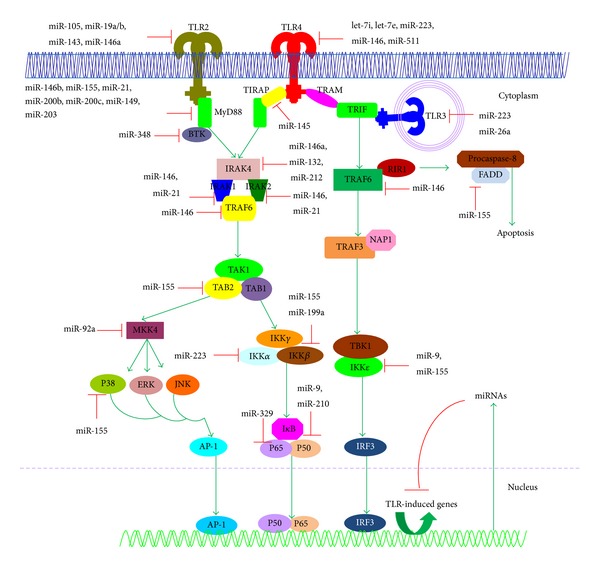
Toll-like receptors (TLRs), a critical family of pattern recognition receptors (PRRs), are responsible for the innate immune responses via signalling pathways to provide effective host defence against pathogen infections. However, TLR-signalling pathways are also likely to stringently regulate tissue maintenance and homeostasis by elaborate modulatory mechanisms. MicroRNAs (miRNAs) have emerged as key regulators and as an essential part of the networks involved in regulating TLR-signalling pathways. In this review, we highlight our understanding of the regulation of miRNA expression profiles by TLR-signalling pathways and the regulation of TLR-signalling pathways by miRNAs. We focus on the roles of miRNAs in regulating TLR-signalling pathways by targeting multiple molecules, including TLRs themselves, their associated signalling proteins and regulatory molecules, and transcription factors and functional cytokines induced by them, at multiple levels.
Overview
The claims and statistics of this paper haven’t been checked yet.
Run the check — free, no account needed. It reads the open-access text and checks the sources it cites.
Integrity signals
Registry
Cites
Statistics
Figures
Verification
Claims the paper makes
The claims and statistics of this paper haven’t been checked yet.
Run the check — free, no account needed. It reads the open-access text and checks the sources it cites.
Claims other papers make about this one
Each is checked against this paper’s own text: does it say what the citing paper says it does?
The cited source says what the claim attributes to it.
In the citing paper
“TLR signalling has also been shown to be regulated by microRNAs at multiple levels, such as by targeting TLRs, downstream signalling proteins, related regulatory molecules, transcription factors as well as genes induced by TLR signalling (e.g., cytokines), which was reviewed elsewhere [128].”
From Transition from inflammation to proliferation: a critical step during wound healing (2016) · cites this paper as [128]
Self-check
Percentages, sums and reported differences re-computed from the paper’s own numbers.
The self-check needs the paper’s full text.
Citations
Cites
MicroRNAs: Target Recognition and Regulatory Functions
Bartel, D. P. (2009) · Cell · doi:10.1016/j.cell.2009.01.002 · Cited by 20,068
(2008) · doi:10.1038/nrg2290 · Cited by 5,199
Taganov, K. D., Boldin, M. P., Chang, K.-J., & Baltimore, D. (2006) · Proceedings of the National Academy of Sciences · doi:10.1073/pnas.0605298103 · Cited by 4,317
Cellular and Molecular Immunology
Abbas, A. K., Lichtman, A. H., & Pillai, S. S. (1994) · Cited by 3,571
Regulation of mRNA Translation and Stability by microRNAs
Fabian, M. R., Sonenberg, N., & Filipowicz, W. (2010) · Annual Review of Biochemistry · doi:10.1146/annurev-biochem-060308-103103 · Cited by 3,214
MicroRNA-155 is induced during the macrophage inflammatory response
O'Connell, R. M., Taganov, K. D., Boldin, M. P., Cheng, G., & Baltimore, D. (2007) · Proceedings of the National Academy of Sciences · doi:10.1073/pnas.0610731104 · Cited by 1,866
Self-citationIdentification of Virus-Encoded MicroRNAs
Pfeffer, S., Zavolan, M., Grässer, F., Chien, M.-C., Russo, J., Ju, J.-Y., John, B., Enright, A., Marks, D., Sander, C., et al. (2004) · Science · doi:10.1126/science.1096781 · Cited by 1,708
Signaling in innate immunity and inflammation
Newton, K., & Dixit, V. M. (2012) · Cold Spring Harbor Perspectives in Biology · doi:10.1101/cshperspect.a006049 · Cited by 1,513
Regulation of the Germinal Center Response by MicroRNA-155
Thai, T., Calado, D. P., Casola, S. S., Ansel, K. M., Xiao, C., Xue, Y., Murphy, A. J., Frendewey, D. A., Valenzuela, D. M., Kutok, J. L., et al. (2007) · Science · doi:10.1126/science.1141229 · Cited by 1,477
MicroRNAs bind to Toll-like receptors to induce prometastatic inflammatory response
Fabbri, M., Paone, A., Calore, F., Galli, R., Gaudio, E., Santhanam, R., Lovat, F., Fadda, P., Mao, C., Nuovo, G. J., et al. (2012) · Proceedings of the National Academy of Sciences · doi:10.1073/pnas.1209414109 · Cited by 1,434
Research works printed but not linked: 15
- 2013, Acta Biochimica et Biophysica Sinica, 45, 240
- Cold Spring Harbor in Perspectives Biology, 4
- 2013, Cell, 53, 516
- 2013, PLoS One, 8
- 2013, PLoS Pathogens, 9
- 2012, PLoS One, 7
- 2013, Proceedings of the National Academy of Sciences of the United States of America, 110, 11449
- 2013, PLoS One, 8
- 2013, PLoS One, 8
- 2012, Cellular & Molecular Immunology, 9, 495
- 2013, Molecular Vision, 19, 737
- 10.4255/mcpharmacol.11.19 · DOI
- 2011, Zhejiang Da Xue Xue Bao Yi Xue Ban, 40, 588
- 2012, PLoS Pathogens, 8
- 2013, RNA Biology, 10, 1
Cited by
Sorted by citations
Transition from inflammation to proliferation: a critical step during wound healing
Landén, N. X., Li, D., & Ståhle, M. (2016) · Cellular and Molecular Life Sciences · doi:10.1007/s00018-016-2268-0 · Cited by 1,980
“, cytokines), which was reviewed elsewhere [128].”
Ti, D., Hao, H., Tong, C., Liu, J., Dong, L., Zheng, J., Zhao, Y., Liu, H., Fu, X., & Han, W. (2015) · Journal of Translational Medicine · doi:10.1186/s12967-015-0642-6 · Cited by 664
Toll-like receptors activation, signaling, and targeting: an overview
El-Zayat, S. R., Sibaii, H., & Mannaa, F. A. E. (2019) · Bulletin of the National Research Centre/Bulletin of the National Research Center · doi:10.1186/s42269-019-0227-2 · Cited by 603
Regulating IRFs in IFN Driven Disease
Jefferies, C. A. (2019) · Frontiers in Immunology · doi:10.3389/fimmu.2019.00325 · Cited by 364
Gao, W., Xiong, Y., Li, Q., & Yang, H. Y. (2017) · Frontiers in Physiology · doi:10.3389/fphys.2017.00508 · Cited by 372
Metadata
- Authors
- He, X., Jing, Z., & Cheng, G.
- Affiliations
- Lanzhou Veterinary Research Institute (CN)
- Shanghai Veterinary Research Institute (CN)
- Corresponding author
- Jing, Zhizhong
- Cheng, Guofeng
- Venue
- BioMed Research International
- Publisher
- Wiley
- Published
- 2014
- Volume
- 2014
- Pages
- 1-14
- ISSN
- 1110-7243 (ISSN-L)
- 2314-6133
- 2314-6141
- PMC
- PMC3977468
- OpenAlex
- W2066588601
- Cited by
- 238
- References
- 150
- Citations by year
- 2026: 5 · 2025: 7 · 2024: 17 · 2023: 12 · 2022: 14 · 2021: 43 · 2020: 28 · 2019: 21 · 2018: 19 · 2017: 28 · 2016: 21 · 2015: 15 · 2014: 8
- FWCI
- 2.34
- Type
- journal article
- Language
- en
- Open access
- hybrid
- doi.org
- Locations
- BioMed Research International (publishedVersion, cc-by)
- Europe PMC (PubMed Central) (publishedVersion, cc-by)
- PubMed Central (publishedVersion, cc-by)
- PubMed (publishedVersion)
- Funders
- National Natural Science Foundation of China (31302072, 31372423, 30871884)
- Topics
- Life Sciences › Immunology and Microbiology › Immunology › Immune Response and Inflammation
- Life Sciences › Biochemistry, Genetics and Molecular Biology › Cancer Research › MicroRNA in disease regulation
- Life Sciences › Biochemistry, Genetics and Molecular Biology › Molecular Biology › Inflammasome and immune disorders
- Keywords
- microRNA, Toll-like receptors, innate immunity, pattern recognition receptors, miRNA expression regulation, microRNA target regulation, transcription factors, cytokines, tissue homeostasis
- MeSH terms
- Animals, Humans, Signal Transduction, MicroRNAs, Toll-Like Receptors
About these checks
Registry, retraction, Cites and statistics results are computed, not judged, with one exception: a printed reference that no index lists is read once by a model before it counts as a citation error. Claims are extracted by a model and kept only when their quote appears verbatim in the text; each cited source is then checked, with a model’s help, for whether it says what the claim relies on. Those verdicts can be wrong — read the claim’s quote and the cited source before relying on one.
Statistics and arithmetic are recomputed, not judged.
Confidence bands are shown only for fields calibrated on our annotated test set. None is calibrated yet, so no band is shown.
What counts as a claim ›How we measure confidence ›How we check this ›
Are you an author, or do you see a problem with this page? Request a review
