

The DOI matches its Crossref record; 102 of the 102 references it cites were found in a registry or an index.
Relevance of Sympathetic Nervous System Activation in Obesity and Metabolic Syndrome
Open accessAbstract
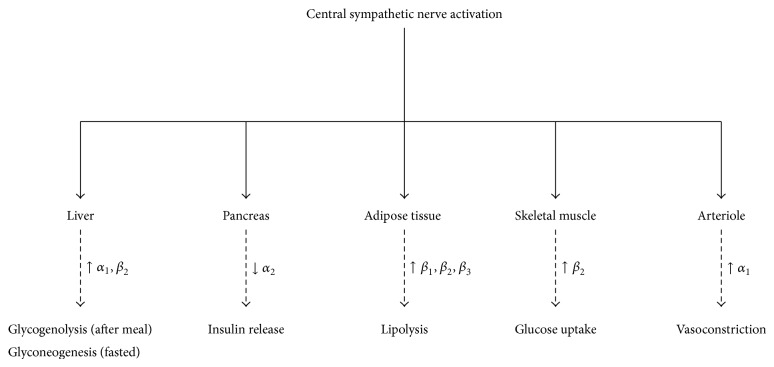
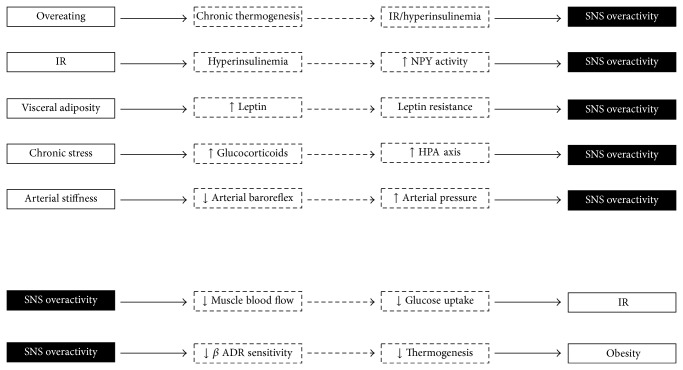
Sympathetic tone is well recognised as being implicit in cardiovascular control. It is less readily acknowledged that activation of the sympathetic nervous system is integral in energy homeostasis and can exert profound metabolic effects. Accumulating data from animal and human studies suggest that central sympathetic overactivity plays a pivotal role in the aetiology and complications of several metabolic conditions that can cluster to form the Metabolic Syndrome (MetS). Given the known augmented risk for type 2 diabetes, cardiovascular disease, and premature mortality associated with the MetS understanding the complex pathways underlying the metabolic derangements involved has become a priority. Many factors have been proposed to contribute to increased sympathetic nerve activity in metabolic abnormalities including obesity, impaired baroreflex sensitivity, hyperinsulinemia, and elevated adipokine levels. Furthermore there is mounting evidence to suggest that chronic sympathetic overactivity can potentiate two of the key metabolic alterations of the MetS, central obesity and insulin resistance. This review will discuss the regulatory role of the sympathetic nervous system in metabolic control and the proposed pathophysiology linking sympathetic overactivity to metabolic abnormalities. Pharmacological and device-based approaches that target central sympathetic drive will also be discussed as possible therapeutic options to improve metabolic control in at-risk patient cohorts.
Overview
The claims and statistics of this paper haven’t been checked yet.
Run the check — free, no account needed. It reads the open-access text and checks the sources it cites.
Integrity signals
Registry
Cites
Statistics
Figures
Verification
Claims the paper makes
The claims and statistics of this paper haven’t been checked yet.
Run the check — free, no account needed. It reads the open-access text and checks the sources it cites.
Claims other papers make about this one
Each is checked against this paper’s own text: does it say what the citing paper says it does?
In the citing paper
“The SNS increases in response to caloric surplus, with norepinephrine activating β-adrenergic receptors, particularly in BAT. This stimulates UCP1 in BAT mitochondria, generating heat through uncoupled respiration.”
From Beyond Calories: Individual Metabolic and Hormonal Adaptations Driving Variability in Weight Management—A State-of-the-Art Narrative Review (2024) · cites this paper as [39]
Self-check
Percentages, sums and reported differences re-computed from the paper’s own numbers.
The self-check needs the paper’s full text.
Citations
Cites
Toprak, Ö., Kurt, H., Sarı, Y., Şarkış, C., Us, H., & Kırık, A. (2017) · Kidney & Blood Pressure Research · doi:10.1159/000468530 · Cited by 29,772
Alberti, K. G. M. M., Eckel, R. H., Grundy, S. M., Zimmet, P. Z., Cleeman, J. I., Donato, K. A., Fruchart, J.-C., James, W. P. T., Loria, C. M., & Smith, S. C. (2009) · Circulation · doi:10.1161/circulationaha.109.192644 · Cited by 14,860
Diagnosis and Classification of Diabetes Mellitus
American Diabetes Association (2010) · Diabetes Care · doi:10.2337/dc11-s062 · Cited by 14,094
The metabolic syndrome—a new worldwide definition
Alberti, K. G. M., Zimmet, P., & Shaw, J. (2005) · The Lancet · doi:10.1016/s0140-6736(05)67402-8 · Cited by 9,352
Diagnosis and classification of diabetes mellitus
American Diabetes Association (2010) · Diabetes Care · doi:10.2337/dc10-s062 · Cited by 5,491
Maffei, M., Halaas, J., Ravussin, E., Pratley, R. E., Lee, G. H., Zhang, Y., Fei, H., Kim, S., Lallone, R., Ranganathan, S., et al. (1995) · Nature Medicine · doi:10.1038/nm1195-1155 · Cited by 3,725
Krum, H., Schlaich, M., Whitbourn, R., Sobotka, P. A., Sadowski, J., Bartus, K., Kapelak, B., Walton, A., Sievert, H., Thambar, S., et al. (2009) · The Lancet · doi:10.1016/s0140-6736(09)60566-3 · Cited by 2,108
Self-citationMalik, S., Wong, N. D., Franklin, S. S., Kamath, T. V., L'Italien, G. J., Pio, J. R., & Williams, G. R. (2004) · Circulation · doi:10.1161/01.cir.0000140677.20606.0e · Cited by 1,837
Ford, E. S. (2005) · Diabetes Care · doi:10.2337/diacare.28.7.1769 · Cited by 1,718
Turning off the signal: desensitization of β‐adrenergic receptor function
Hausdorff, W. P., Caron, M. G., & Lefkowitz, R. J. (1990) · The FASEB Journal · doi:10.1096/fasebj.4.11.2165947 · Cited by 1,259
Research works printed but not linked: 7
- 1986, Quarterly Journal of Medicine, 61, 1081
- 1995, The American Journal of Physiology, 269, R222
- 10.1210/en.133.4.1753 · DOI
- 1992, The Journal of Clinical Investigation, 90, 27
- 2008, Jounral of Hypertension, 26, S347
- 1998, Blood Pressure, Supplement, 7, 5
- 2010, Arterial Hypertension (Greek), 19, 32
Cited by
Sorted by citations
Heart rate variability in type 2 diabetes mellitus: A systematic review and meta–analysis
Benichou, T., Pereira, B., Mermillod, M., Tauveron, I., Pfabigan, D., Maqdasy, S., & Dutheil, F. (2018) · PLOS ONE · doi:10.1371/journal.pone.0195166 · Cited by 419
Leggio, M., Lombardi, M., Caldarone, E., Severi, P., D’Emidio, S., Armeni, M., Bravi, V., Bendini, M. G., & Mazza, A. (2017) · Hypertension Research · doi:10.1038/hr.2017.75 · Cited by 319
Heart Failure With Preserved Ejection Fraction and Diabetes
McHugh, K., DeVore, A. D., Wu, J., Matsouaka, R. A., Fonarow, G. C., Heidenreich, P. A., Yancy, C. W., Green, J. B., Altman, N., & Hernandez, A. F. (2019) · Journal of the American College of Cardiology · doi:10.1016/j.jacc.2018.11.033 · Cited by 313
SGLT2 Inhibitor–Induced Sympathoinhibition
Herat, L. Y., Magno, A. L., Rudnicka, C., Hricova, J., Carnagarin, R., Ward, N. C., Arcambal, A., Kiuchi, M. G., Head, G. A., Schlaich, M. P., et al. (2020) · JACC: Basic to Translational Science · doi:10.1016/j.jacbts.2019.11.007 · Cited by 233
“There is clear evidence to indicate that obesity, metabolic syndrome, and type 2 diabetes are associated with chronic activation of sympathetic nervous tone (7,8).”
BackgroundSelf-citationRole of the sympathetic nervous system in regulation of the sodium glucose cotransporter 2
Matthews, V. B., Elliot, R. H., Rudnicka, C., Hricova, J., Herat, L., & Schlaich, M. P. (2017) · Journal of Hypertension · doi:10.1097/hjh.0000000000001434 · Cited by 222
“Sympathetic activity is upregulated in obesity and type 2 diabetes and associated with perturbed glucose homeostasis, as recently reviewed in detail [5,6].”
BackgroundInfluentialSelf-citation
Metadata
- Authors
- Thorp, A. A., & Schlaich, M. P.
- Affiliations
- Baker Heart and Diabetes Institute (AU)
- Corresponding author
- Schlaich, Markus P.
- ORCID
- Schlaich, Markus P.
- Venue
- Journal of Diabetes Research
- Publisher
- Wiley
- Published
- 2015
- Volume
- 2015
- Pages
- 1-11
- ISSN
- 2314-6745 (ISSN-L)
- 2314-6753
- PMC
- PMC4430650
- OpenAlex
- W2066041574
- Cited by
- 425
- References
- 101
- Citations by year
- 2026: 28 · 2025: 42 · 2024: 36 · 2023: 44 · 2022: 40 · 2021: 45 · 2020: 48 · 2019: 40 · 2018: 33 · 2017: 31 · 2016: 32 · 2015: 5
- FWCI
- 4.38
- Type
- journal article
- Language
- en
- Open access
- gold
- doi.org
- Locations
- Journal of Diabetes Research (publishedVersion, cc-by)
- Europe PMC (PubMed Central) (publishedVersion, cc-by)
- PubMed Central (publishedVersion, cc-by)
- UWA Profiles and Research Repository (UWA) (publishedVersion, cc-by)
- PubMed (publishedVersion)
- DOAJ (DOAJ: Directory of Open Access Journals) (submittedVersion, cc-by-sa)
- Funders
- National Health and Medical Research Council
- Victorian Government’s Operational Infrastructure Support Program
- Topics
- Health Sciences › Medicine › Endocrinology, Diabetes and Metabolism › Adipokines, Inflammation, and Metabolic Diseases
- Health Sciences › Medicine › Endocrinology, Diabetes and Metabolism › Diabetes, Cardiovascular Risks, and Lipoproteins
- Health Sciences › Medicine › Cardiology and Cardiovascular Medicine › Cardiovascular Disease and Adiposity
- Keywords
- sympathetic nervous system, sympathetic hyperactivity, obesity, metabolic syndrome, energy homeostasis, abdominal obesity, insulin resistance, baroreflex sensitivity, hyperinsulinemia, adipokines, type 2 diabetes, cardiovascular disease, sympathetic activity, device therapy
- MeSH terms
- Animals, Humans, Obesity, Sympathetic Nervous System, Metabolic Syndrome
About these checks
Registry, retraction, Cites and statistics results are computed, not judged, with one exception: a printed reference that no index lists is read once by a model before it counts as a citation error. Claims are extracted by a model and kept only when their quote appears verbatim in the text; each cited source is then checked, with a model’s help, for whether it says what the claim relies on. Those verdicts can be wrong — read the claim’s quote and the cited source before relying on one.
Statistics and arithmetic are recomputed, not judged.
Confidence bands are shown only for fields calibrated on our annotated test set. None is calibrated yet, so no band is shown.
What counts as a claim ›How we measure confidence ›How we check this ›
Are you an author, or do you see a problem with this page? Request a review
