

Spindle Activity Orchestrates Plasticity during Development and Sleep
Open accessThe DOI matches its Crossref record; 189 of the 190 references it cites were found in a registry or an index.
Abstract
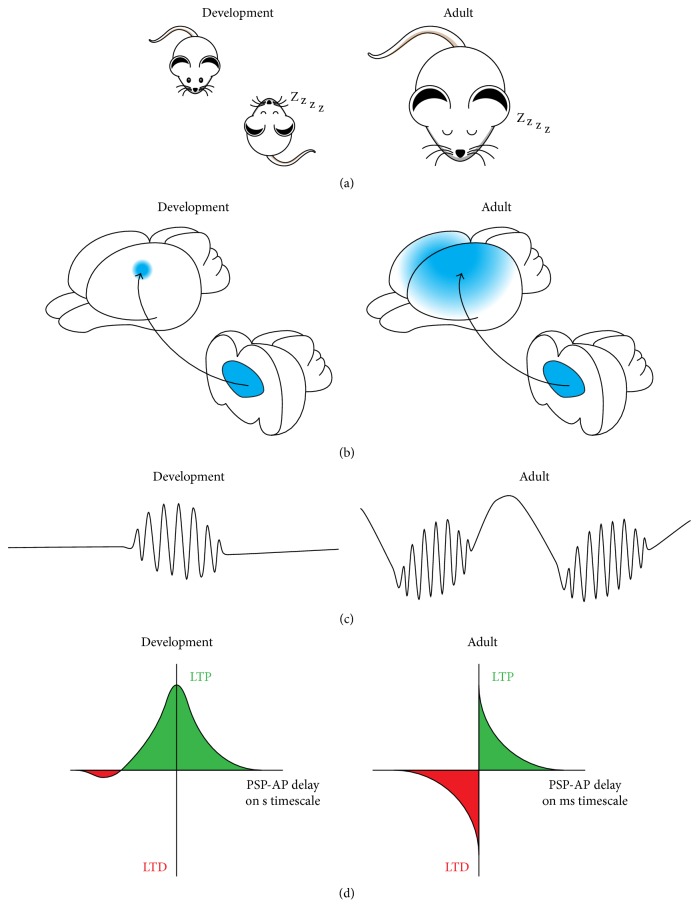
Spindle oscillations have been described during early brain development and in the adult brain. Besides similarities in temporal patterns and involved brain areas, neonatal spindle bursts (NSBs) and adult sleep spindles (ASSs) show differences in their occurrence, spatial distribution, and underlying mechanisms. While NSBs have been proposed to coordinate the refinement of the maturating neuronal network, ASSs are associated with the implementation of acquired information within existing networks. Along with these functional differences, separate synaptic plasticity mechanisms seem to be recruited. Here, we review the generation of spindle oscillations in the developing and adult brain and discuss possible implications of their differences for synaptic plasticity. The first part of the review is dedicated to the generation and function of ASSs with a particular focus on their role in healthy and impaired neuronal networks. The second part overviews the present knowledge of spindle activity during development and the ability of NSBs to organize immature circuits. Studies linking abnormal maturation of brain wiring with neurological and neuropsychiatric disorders highlight the importance to better elucidate neonatal plasticity rules in future research.
Overview
The claims and statistics of this paper haven’t been checked yet.
Free: it reads the open-access text and checks the first 5 claims that cite a source we can check. Create a free account to check every claim.
Integrity signals
Registry
Cites
Statistics
Figures
Verification
Claims the paper makes
The claims and statistics of this paper haven’t been checked yet.
Free: it reads the open-access text and checks the first 5 claims that cite a source we can check. Create a free account to check every claim.
Claims other papers make about this one
Each is checked against this paper’s own text: does it say what the citing paper says it does?
The source backs part of the claim, not all of it — or backs it for a different population, condition or comparison.
In the citing paper
“NREM sleep spindles, primarily stage 2 (N2) sleep spindles, reflect memory plasticity mechanisms [reviews in Ref. (157, 158)], especially the consolidation of new learning [reviews in Ref. (159, 160)].”
From The Stress Acceleration Hypothesis of Nightmares (2017) · cites this paper as [158]
Experimental — accuracy not yet measured
Self-check
Percentages, sums and reported differences re-computed from the paper’s own numbers.
The self-check needs the paper’s full text.
Citations
Cites
Shrestha, S., & Offer, S. M. (2016) · Medical Epigenetics · doi:10.1159/000444713 · Cited by 8,914
Neuronal Oscillations in Cortical Networks
Buzsáki, G., & Draguhn, A. (2004) · Science · doi:10.1126/science.1099745 · Cited by 6,576 · cited 2×
“Such rhythmic network activity is supposed to coordinate neuronal activity and to facilitate the integration of information based on the synchrony of convergent inputs, aswell as the selection of inputs depending on their timing [1, 2].”
BackgroundRegulation of Synaptic Efficacy by Coincidence of Postsynaptic APs and EPSPs
Markram, H., Lübke, J., Frotscher, M., & Sakmann, B. (1997) · Science · doi:10.1126/science.275.5297.213 · Cited by 3,832 · cited 1×
“This nucleus is also recognized as the main pacemaker for the generation of fast ASSs in humans as detailed below.”
BackgroundDiekelmann, S., & Born, J. (2010) · Nature Reviews Neuroscience · doi:10.1038/nrn2762 · Cited by 3,760 · cited 1×
“On the other hand, cortical slow oscillations, thalamocortical spindle activity, and hippocampal sharp-wave ripples are prominent during NREM sleep [32, 74].”
BackgroundThalamocortical oscillations in the sleeping and aroused brain
Steriade, M., McCormick, D. A., & Sejnowski, T. J. (1993) · Science · doi:10.1126/science.8235588 · Cited by 3,564 · cited 1×
“In reaction to synchronized inhibition by TRN cells, TC cells show paradoxical activation and fire postinhibitory rebound bursts [41, 42].”
BackgroundRasch, B., & Born, J. (2013) · Physiological Reviews · doi:10.1152/physrev.00032.2012 · Cited by 2,783 · cited 1×
“While the underlying mechanisms of ASSs have been extensively investigated in the past, aiming to identify their role for consolidation of memories [4, 5, 11], NSB-related mechanisms are still largely unresolved and their function remains rather blurry.”
BackgroundRhythms for cognition: communication through coherence
Fries, P. (2015) · Neuron · doi:10.1016/j.neuron.2015.09.034 · Cited by 2,725 · cited 3×
“Such rhythmic network activity is supposed to coordinate neuronal activity and to facilitate the integration of information based on the synchrony of convergent inputs, aswell as the selection of inputs depending on their timing [1, 2].”
BackgroundTononi, G., & Cirelli, C. (2014) · Neuron · doi:10.1016/j.neuron.2013.12.025 · Cited by 2,356 · cited 3×
“However, the exact functions of different sleep stages in relationship with corresponding rhythmic neuronal activity are still poorly understood [3, 5].”
BackgroundThe K+/Cl− co-transporter KCC2 renders GABA hyperpolarizing during neuronal maturation
Rivera, C., Voipio, J., Payne, J. A., Ruusuvuori, E., Lahtinen, H., Lamsa, K., Pirvola, U., Saarma, M., & Kaila, K. (1999) · Nature · doi:10.1038/16697 · Cited by 2,152 · cited 1×
“Synchronization and coupling of neuronal networks in oscillatory rhythms early during development organize the communication of spatially distributed neuronal subsets.”
BackgroundThe organization of recent and remote memories
Frankland, P. W., & Bontempi, B. (2005) · Nature Reviews Neuroscience · doi:10.1038/nrn1607 · Cited by 2,138 · cited 1×
“This nucleus is also recognized as the main pacemaker for the generation of fast ASSs in humans as detailed below.”
Background
Research works printed but not linked: 1
- Gibbs F. A. Gibbs E. L. Atlas of Electroencephalography 1950 1 Reading, Mass, USA Addison-Wesley
Cited by
Sleep spindles: mechanisms and functions
Fernandez, L. M. J., & Lüthi, A. (2020) · Physiological Reviews · doi:10.1152/physrev.00042.2018 · Cited by 716
Carmassi, C., Palagini, L., Caruso, D., Masci, I., Nobili, L., Vita, A., & Dell’Osso, L. (2019) · Frontiers in Psychiatry · doi:10.3389/fpsyt.2019.00366 · Cited by 220
Cortical dendritic activity correlates with spindle-rich oscillations during sleep in rodents
Seibt, J., Richard, C. J., Sigl-Glöckner, J., Takahashi, N., Kaplan, D. I., Doron, G., de Limoges, D., Bocklisch, C., & Larkum, M. E. (2017) · Nature Communications · doi:10.1038/s41467-017-00735-w · Cited by 165
Abnormal sleep spindles, memory consolidation, and schizophrenia
Manoach, D. S., & Stickgold, R. (2019) · Annual Review of Clinical Psychology · doi:10.1146/annurev-clinpsy-050718-095754 · Cited by 157
“As early as the first postnatal week, spindle bursts— precursors of adult sleep spindles that are similar in shape, frequency, and origin (Lindemann et al. 2016)—appear and refine reciprocal thalamocortical glutamatergic connections to somatosensory and motor cortex (Cirelli & Tononi 2015).”
BackgroundBitzenhofer, S. H., Pöpplau, J. A., Chini, M., Marquardt, A., & Hanganu-Opatz, I. L. (2021) · Neuron · doi:10.1016/j.neuron.2021.02.011 · Cited by 93
“Transcranial ramp light stimulation was titrated in power andduration to reliably induceoscillatory bursts that resemble those occurring spontaneously in the neonatal mPFC (Figures 1E and S1; Brockmann et al., 2011; Lindemann et al., 2016).”
Self-citationA mechanism for learning with sleep spindles
Peyrache, A., & Seibt, J. (2020) · Philosophical Transactions of the Royal Society B: Biological Sciences · doi:10.1098/rstb.2019.0230 · Cited by 89
“Evidence points to a role for spindles in the early establishment of sensorimotor cortical maps [67 – 69].”
BackgroundBaran, B., Karahanoğlu, F. I., Mylonas, D., Demanuele, C., Vangel, M., Stickgold, R., Anticevic, A., & Manoach, D. S. (2019) · Biological Psychiatry: Cognitive Neuroscience and Neuroimaging · doi:10.1016/j.bpsc.2019.04.012 · Cited by 78
“As early as the first postnatal week in rodents, spindle bursts, a precursor to adult sleep spindles that are similar in shape, frequency, and origin (72), refine these reciprocal thalamocortical glutamatergic connections, particularly in somatosensory and motor cortex (73–76).”
BackgroundThalamocortical function in developing sensory circuits
Colonnese, M. T., & Phillips, M. A. (2018) · Current Opinion in Neurobiology · doi:10.1016/j.conb.2018.04.019 · Cited by 76
Gorgoni, M., D'Atri, A., Scarpelli, S., Reda, F., & De Gennaro, L. (2020) · Sleep Medicine · doi:10.1016/j.sleep.2019.06.025 · Cited by 66
Early patterns of activity in the developing cortex: Focus on the sensorimotor system
Khazipov, R., & Milh, M. (2017) · Seminars in Cell and Developmental Biology · doi:10.1016/j.semcdb.2017.09.014 · Cited by 68
“There are several reviews describing the features of the early cortical activity patterns and their developmental roles in the activity-dependent wiring of cortical neuronal networks including circuit development [1, 2], network mechanisms and synaptic plasticity [3-15], methodological aspects of recording early brain…”
BackgroundThe Stress Acceleration Hypothesis of Nightmares
Nielsen, T. (2017) · Frontiers in Neurology · doi:10.3389/fneur.2017.00201 · Cited by 63
The developing brain revealed during sleep
BLUMBERG, M. S., Dooley, J. C., & Sokoloff, G. (2019) · Current Opinion in Physiology · doi:10.1016/j.cophys.2019.11.002 · Cited by 68
“Finally, despite these and other differences, spindle bursts and sleep spindles are both strongly implicated in neural plasticity across the lifespan [62,63].”
BackgroundDyscoordination of non-rapid eye movement sleep oscillations in autism spectrum disorder
Mylonas, D., Machado, S., Larson, O., Patel, R., Cox, R., Vangel, M. G., Maski, K. P., Stickgold, R., & Manoach, D. S. (2022) · SLEEP · doi:10.1093/sleep/zsac010 · Cited by 61
“As early as the first postnatal week, spindle bursts, generated by the TRN, appear [83] and refine reciprocal thalamocortical connections [84–86].”
BackgroundDevelopmental pathways towards mood disorders in adult life: Is there a role for sleep disturbances?
Palagini, L., Domschke, K., Benedetti, F., Foster, R. G., Wulff, K., & Riemann, D. (2019) · Journal of Affective Disorders · doi:10.1016/j.jad.2018.09.011 · Cited by 48
Thalamic inhibitory circuits and network activity development
Murata, Y., & Colonnese, M. T. (2018) · Brain Research · doi:10.1016/j.brainres.2018.10.024 · Cited by 54
“…to enter the just forming cortical layers, bursts of thalamic firing, generated in response to input from the sense organ (for thalamic relay nuclei) or hippocampus (for midline thalamic nuclei), drive topographically restricted activity in cortex (Khazipov et al., 2013b; Lindemann et al., 2016).”
Sleep EEG oscillations in neurodevelopmental disorders without intellectual disabilities
Gorgoni, M., Scarpelli, S., Reda, F., & Gennaro, L. D. (2019) · Sleep Medicine Reviews · doi:10.1016/j.smrv.2019.101224 · Cited by 48
Ang, G., McKillop, L. E., Purple, R. J., Blanco‐Duque, C., Peirson, S. N., Foster, F., Harrison, P. J., Sprengel, R., Davies, K. E., Oliver, P. L., et al. (2018) · Translational Psychiatry · doi:10.1038/s41398-018-0199-2 · Cited by 52
Ahlbeck, J., Song, L., Chini, M., Candela, A., Bitzenhofer, S. H., & Hanganu‐Opatz, I. L. (2018) · eLife · doi:10.7554/elife.33158 · Cited by 43
“These frequency-tuned brain states are present already during early development, long before the emergence of cognitive abilities, and have been extensively characterized and categorized according to their spatial and temporal structure (Lindemann et al., 2016).”
BackgroundSelf-citationTargeting sleep oscillations to improve memory in schizophrenia
Manoach, D. S., Mylonas, D., & Baxter, B. (2020) · Schizophrenia Research · doi:10.1016/j.schres.2020.01.010 · Cited by 36
“As early as the first postnatal week in rodents, spindle bursts, a precursor to adult sleep spindles that are similar in shape, frequency and origin (Lindemann et al., 2016), refine these reciprocal thalamocortical connections (Cirelli and Tononi, 2015; Evrard and Ropert, 2009; Pinault, 2011).”
BackgroundGerstenberg, M., Furrer, M., Tesler, N., Franscini, M., Walitza, S., & Huber, R. (2020) · Schizophrenia Research · doi:10.1016/j.schres.2019.11.060 · Cited by 34
Merikanto, I., Kuula, L., Makkonen, T., Halonen, R., Lahti, J. M. T., Heinonen, K., Räikkönen, K., & Pesonen, A. (2018) · Neurobiology of Learning and Memory · doi:10.1016/j.nlm.2018.12.004 · Cited by 33
Sleep’s contribution to memory formation
Lutz, N. D., Harkotte, M., & Born, J. (2025) · Physiological Reviews · doi:10.1152/physrev.00054.2024 · Cited by 59
Dera, H. S. A. (2022) · Biomedicine & Pharmacotherapy · doi:10.1016/j.biopha.2022.112688 · Cited by 32
Genetic risk factors for schizophrenia associate with sleep spindle activity in healthy adolescents
Merikanto, I., Utge, S., Lahti, J. M. T., Kuula, L., Makkonen, T., Lahti‐Pulkkinen, M., Heinonen, K., Räikkönen, K., Andersson, S., Strandberg, T. E., et al. (2018) · Journal of Sleep Research · doi:10.1111/jsr.12762 · Cited by 21
Tripathi, S., Taneja, P., & Jha, S. K. (2018) · Frontiers in Behavioral Neuroscience · doi:10.3389/fnbeh.2018.00260 · Cited by 21
“The sharp wave-ripples, SWA, and spindles during sleep help promote the hippocampal-cortical dialog, which seems to play a causal role in the consolidation of the hippocampaldependent memory (Maingret et al., 2016; Latchoumane et al., 2017).”
BackgroundWhitehead, K., Laudiano‐Dray, M. P., Meek, J. H., & Fabrizi, L. (2018) · SLEEP · doi:10.1093/sleep/zsy096 · Cited by 22
“For example, wakefulness is characterized by α activity which is thought to be associated with cognitive capacity [27], whereas non-REM sleep is associated with spindle activity which plays a role in memory consolidation [28].”
BackgroundAlbertini, M. L., Spoto, G., Ceraolo, G., Fichera, M. F., Consoli, C., Nicotera, A. G., & Rosa, G. D. (2025) · Brain Sciences · doi:10.3390/brainsci15090983 · Cited by 25
“These events, known as delta brushes or spindle bursts, represent a hallmark of immature cortical activity [71].”
Schizotypal traits are associated with sleep spindles and rapid eye movement in adolescence
Kuula, L., Merikanto, I., Makkonen, T., Halonen, R., Lahti‐Pulkkinen, M., Lahti, J. M. T., Heinonen, K., Räikkönen, K., & Pesonen, A. (2018) · Journal of Sleep Research · doi:10.1111/jsr.12692 · Cited by 15
Grieve, P. G., Fifer, W. P., Cousy, N. P., Monk, C. E., Stark, R. I., Gingrich, J. A., & Myers, M. M. (2019) · Clinical Neurophysiology · doi:10.1016/j.clinph.2019.08.021 · Cited by 14
“Spindles first appear at 44 weeks and are longer (2–4 s) in duration than delta brushes (Ellingson, 1982, Metcalf, 1970, Lindemann et al., 2016).”
BackgroundChildhood absence epilepsy patients with cognitive impairment have decreased sleep spindle density
Zhang, W., Xin, M., Song, G., & Liang, J. (2023) · Sleep Medicine · doi:10.1016/j.sleep.2023.01.012 · Cited by 14
Halász, P., & Szűcs, A. (2023) · Frontiers in Neurology · doi:10.3389/fneur.2023.1092244 · Cited by 14
Halonen, R., Kuula, L., Lahti, J. M. T., Räikkönen, K., & Pesonen, A. (2022) · Behavioural Brain Research · doi:10.1016/j.bbr.2022.113889 · Cited by 14
“NMDA receptors are involved in triggering the calcium influx during spindles, which consequently leads to signaling cascades underlying long-term potentiation [50].”
BackgroundAutistic Traits Are Associated With Decreased Activity of Fast Sleep Spindles During Adolescence
Merikanto, I., Kuula, L., Makkonen, T., Salmela, L., Räikkönen, K., & Pesonen, A. (2019) · Journal of Clinical Sleep Medicine · doi:10.5664/jcsm.7662 · Cited by 16
García-Pérez, M. A., Irani, M., Tiznado, V., Bustamante, T., Inostroza, M., Maldonado, P. E., & Valdés, J. L. (2022) · Frontiers in Neuroscience · doi:10.3389/fnins.2022.891523 · Cited by 10
Ng, T.-P., Noh, E., & Spencer, R. M. C. (2025) · eLife · doi:10.7554/elife.101992 · Cited by 26
Contreras, M. P., Fechner, J., Born, J., & Inostroza, M. (2023) · The Journal of Neuroscience · doi:10.1523/jneurosci.1967-22.2023 · Cited by 9
Reid, C. A., Rollo, B., Petrou, S., & Berkovic, S. F. (2018) · Epilepsia · doi:10.1111/epi.14077 · Cited by 8
“Discontinuous structure of EEG activity, alternating between periods of oscillatory discharges and network silence, in premature infants is thought to reflect such activity.(37) Rodents at birth provide ideal models for investigating these early events given that they correspond to the second gestational trimester in…”
BackgroundHalonen, R., Kuula, L., Lahti, J. M. T., Makkonen, T., Räikkönen, K., & Pesonen, A. (2019) · Behavioural Brain Research · doi:10.1016/j.bbr.2019.112157 · Cited by 9
“Sleep spindles are involved in memory replay during sleep [21, 38-42] and considered a mechanism of LTP [43].”
InfluentialSpindle-slow wave coupling and problem-solving skills: impact of age
Baena, D., Toor, B., van den Berg, N., Ray, L. B., & Fogel, S. M. (2024) · SLEEP · doi:10.1093/sleep/zsae072 · Cited by 9
“The repeated and coherent firing pattern associated with spindles is thought to promote plastic changes underlying sleep-related memory consolidation [26–28].”
BackgroundWitte, M. A., Lloyd, R. M., McGree, M. E., & Kawai, Y. (2023) · Journal of Clinical Sleep Medicine · doi:10.5664/jcsm.10750 · Cited by 10
Hong, X., Farmer, C., Kozhemiako, N., Holmes, G. L., Thompson, L., Manwaring, S. S., Thurm, A. E., & Buckley, A. W. (2025) · Journal of Neurodevelopmental Disorders · doi:10.1186/s11689-024-09586-1 · Cited by 5
“Sleep spindles are believed to have functional roles in information processing, memory consolidation, and neuroplasticity during development [18–20].”
Ng, T.-P., Noh, E., & Spencer, R. M. C. (2025) · eLife · doi:10.7554/elife.101992.2 · Cited by 12
Ng, T.-P., Noh, E., & Spencer, R. M. C. (2025) · eLife · doi:10.1101/2024.08.28.610060 · Cited by 8
“This precise association enhances synaptic plasticity, leading to long-term changes in synaptic connections be-tween cortical neurons, a mechanism for memory consolidation 29–32 .”
Sleep: Neural Optimization as an Ultimate Function for Memory Consolidation
Jha, V. M., & Jha, S. K. (2020) · Springer eBooks · doi:10.1007/978-981-15-7175-6_5 · Cited by 6
Ng, T.-P., Noh, E., & Spencer, R. M. C. (2024) · eLife · doi:10.7554/elife.101992.1 · Cited by 10
Temporal Interference Stimulation Enhances Neural Regeneration
Peressotti, S., Garrido, M. G., Dzialecka, P., Law, R. M. H., Lara, R. P., Geary, B., Faillace, E., Aslie, S. M.-N., Wojewska, M. J., Otero‐Jimenez, M., et al. (2026) · Advanced Science · doi:10.1002/advs.202524341 · Cited by 6
“Theta band oscillation is a hallmark of early brain activity, emerging spontaneously as ‘spindle bursts’ [ 103–106 ] and shaping development through sensory-driven processes [ 104, 106, 50, 107, 108 ].”
Tarokh, L. (2021) · Current Biology · doi:10.1016/j.cub.2021.06.065 · Cited by 2
Sousouri, G., & Huber, R. (2019) · Handbook of behavioral neuroscience · doi:10.1016/b978-0-12-813743-7.00028-1 · Cited by 7
Acute Sleep Deprivation Suppresses Sleep Spindles in Mice
Xu, Y., Tan, M., Li, D., & Zhang, C. (2025) · Nature and Science of Sleep · doi:10.2147/nss.s549263 · Cited by 1
“20 Interhemispheric EEG coherence quantifies large-scale neural synchrony: high coherence at low frequencies (delta/theta/spindles) indicates widespread cortical coupling.”
Hu, Y., Zhang, B., Hu, Z., Liu, X., Li, X., & Dai, J. (2025) · Sensors · doi:10.3390/s25247552 · Cited by 1
Михайловна, М. И., Berdina, O. N., Андреевна, П. А., & Shirokov, A. A. (2026) · The European Physical Journal Special Topics · doi:10.1140/epjs/s11734-025-02116-7 · Cited by 2
“SSs have been associated with some brain functions, including neuroplasticity and cognitive abilities, such as memory consolidation and learning efficiency [4–6].”
Peters, S. E. (2017) · doi:10.7282/t35142bt · Cited by 1
“processing and cortical network development (Lindemann et al., 2016).”
Polygenic impact of morningness on the overnight dynamics of sleep spindle amplitude
Pesonen, A., Merikanto, I., Halonen, R., Ujma, P. P., Makkonen, T., Räikkönen, K., Lahti, J. M. T., & Kuula, L. (2020) · Genes Brain & Behavior · doi:10.1111/gbb.12641 · Cited by 2
Does sleep contribute to the consolidation of motor memory? A literature review
Maltry, L., Ohlendorf, D., Bendels, M. H. K., Groneberg, D. A., & Mickel, C. (2020) · Manuelle Medizin · doi:10.1007/s00337-020-00674-6 · Cited by 2
Electroencephalographic and neurophysiological changes
Gorgoni, M., Salfi, F., Gennaro, L. D., & Ferrara, M. (2021) · Elsevier eBooks · doi:10.1016/b978-0-12-822963-7.00038-4 · Cited by 1
Wang, J., Lin, Y., Xiao, Y., Zhu, Y., Gao, J., & Zheng, H. (2026) · Sleep Medicine · doi:10.1016/j.sleep.2025.108685
Schizophrenia, other neuropsychiatric disorders and sleep
Manoach, D. S., Larson, O., & Stickgold, R. (2021) · Elsevier eBooks · doi:10.1016/b978-0-12-822963-7.00059-1
Differential expression of spatiotemporal sleep spindle clusters in ageingPreprint
Raud, L., Smits, M. J. B., Sneve, M. H., Ness, H. T., Folvik, L., Rasch, B., & Fjell, A. M. (2025) · bioRxiv (Cold Spring Harbor Laboratory) · doi:10.1101/2025.05.19.654222
Twitching in sleeping premature infants provides a sensitive behavioral assay of early motor control
Sokoloff, G., Christiansen, T., Long, H., Karr, L. K., Kopp, O., Kriz, D. N., Sanderson, A. C., Liu, W., Johnson, I. K., Coulter, B. J., et al. (2026) · iScience · doi:10.1016/j.isci.2026.115878 · Cited by 1
Metadata
- Authors
- Lindemann, C., Ahlbeck, J., Bitzenhofer, S. H., & Hanganu-Opatz, I. L.
- Affiliations
- University Medical Center Hamburg-Eppendorf (DE)
- Developmental Neurophysiology, Institute of Neuroanatomy, University Medical Center Hamburg-Eppendorf, 20251 Hamburg, Germany
- Corresponding author
- Lindemann, Christoph
- Venue
- Neural Plasticity
- Publisher
- Hindawi Limited
- Published
- 2016
- Volume
- 2016
- Pages
- 1-14
- ISSN
- 1687-5443 (ISSN-L)
- 2090-5904
- PMC
- PMC4884844
- OpenAlex
- W2369453128
- Cited by
- 59
- References
- 190
- Citations by year
- 2026: 3 · 2025: 9 · 2024: 3 · 2023: 4 · 2022: 4 · 2021: 4 · 2020: 6 · 2019: 11 · 2018: 11 · 2017: 4
- FWCI
- 0.91
- Type
- journal article
- Language
- en
- Open access
- gold
- doi.org
- Locations
- Neural Plasticity (publishedVersion, cc-by)
- Europe PMC (PubMed Central) (publishedVersion, cc-by)
- PubMed Central (publishedVersion, cc-by)
- PubMed (publishedVersion)
- DOAJ (DOAJ: Directory of Open Access Journals) (submittedVersion, cc-by-sa)
- Topics
- Life Sciences › Neuroscience › Cognitive Neuroscience › Neural dynamics and brain function
- Life Sciences › Neuroscience › Cognitive Neuroscience › Sleep and Wakefulness Research
- Life Sciences › Neuroscience › Cellular and Molecular Neuroscience › Neuroscience and Neuropharmacology Research
- Keywords
- sleep spindles, spindle oscillations, synaptic plasticity, brain development, neuronal network maturation, sleep-dependent memory consolidation, neurological disorders, neuropsychiatric disorders
- MeSH terms
- Adult, Brain, Humans, Neuronal Plasticity, Sleep, Sleep Stages, Brain Waves
About these checks
Registry, retraction, Cites and statistics results are computed, not judged, with one exception: a printed reference that no index lists is read once by a model before it counts as a citation error. Claims are extracted by a model and kept only when their quote appears verbatim in the text; each cited source is then checked, with a model’s help, for whether it says what the claim relies on. Those verdicts can be wrong — read the claim’s quote and the cited source before relying on one.
Statistics and arithmetic are recomputed, not judged.
Confidence bands are shown only for fields calibrated on our annotated test set. None is calibrated yet, so no band is shown.
What counts as a claim ›How we measure confidence ›How we check this ›
Are you an author, or do you see a problem with this page? Request a review
Data sources
Bibliographic data: Semantic Scholar, OpenAlex, Crossref.
Contains information from the Semantic Scholar Academic Graph Datasets, made available under the ODC Attribution License (ODC-BY 1.0).
Semantic Scholar’s data is described in: Kinney, R., et al. (2023). The Semantic Scholar Open Data Platform. arXiv:2301.10140.
