

Spindle Activity Orchestrates Plasticity during Development and Sleep
Open accessThe DOI matches its Crossref record; 189 of the 190 references it cites were found in a registry or an index.
Abstract
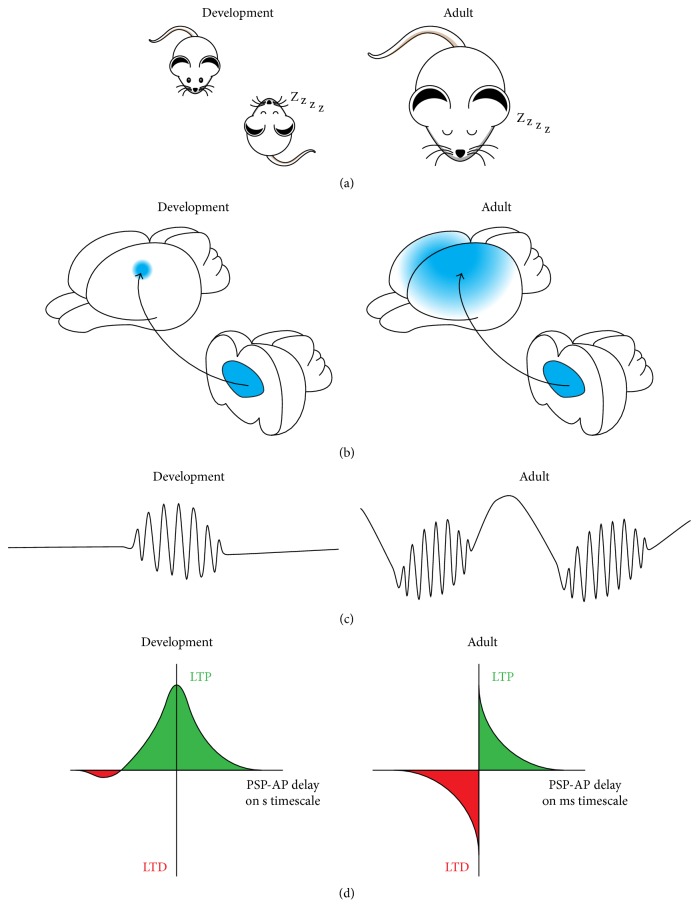
Spindle oscillations have been described during early brain development and in the adult brain. Besides similarities in temporal patterns and involved brain areas, neonatal spindle bursts (NSBs) and adult sleep spindles (ASSs) show differences in their occurrence, spatial distribution, and underlying mechanisms. While NSBs have been proposed to coordinate the refinement of the maturating neuronal network, ASSs are associated with the implementation of acquired information within existing networks. Along with these functional differences, separate synaptic plasticity mechanisms seem to be recruited. Here, we review the generation of spindle oscillations in the developing and adult brain and discuss possible implications of their differences for synaptic plasticity. The first part of the review is dedicated to the generation and function of ASSs with a particular focus on their role in healthy and impaired neuronal networks. The second part overviews the present knowledge of spindle activity during development and the ability of NSBs to organize immature circuits. Studies linking abnormal maturation of brain wiring with neurological and neuropsychiatric disorders highlight the importance to better elucidate neonatal plasticity rules in future research.
Overview
The claims and statistics of this paper haven’t been checked yet.
Free: it reads the open-access text and checks the first 5 claims that cite a source we can check. Create a free account to check every claim.
Integrity signals
Registry
Cites
Statistics
Figures
Verification
Claims the paper makes
The claims and statistics of this paper haven’t been checked yet.
Free: it reads the open-access text and checks the first 5 claims that cite a source we can check. Create a free account to check every claim.
Claims other papers make about this one
Each is checked against this paper’s own text: does it say what the citing paper says it does?
The source backs part of the claim, not all of it — or backs it for a different population, condition or comparison.
In the citing paper
“NREM sleep spindles, primarily stage 2 (N2) sleep spindles, reflect memory plasticity mechanisms [reviews in Ref. (157, 158)], especially the consolidation of new learning [reviews in Ref. (159, 160)].”
From The Stress Acceleration Hypothesis of Nightmares (2017) · cites this paper as [158]
Experimental — accuracy not yet measured
Self-check
Percentages, sums and reported differences re-computed from the paper’s own numbers.
The self-check needs the paper’s full text.
Citations
Cites
Shrestha, S., & Offer, S. M. (2016) · Medical Epigenetics · doi:10.1159/000444713 · Cited by 8,914
Neuronal Oscillations in Cortical Networks
Buzsáki, G., & Draguhn, A. (2004) · Science · doi:10.1126/science.1099745 · Cited by 6,576 · cited 2×
“Such rhythmic network activity is supposed to coordinate neuronal activity and to facilitate the integration of information based on the synchrony of convergent inputs, aswell as the selection of inputs depending on their timing [1, 2].”
BackgroundRegulation of Synaptic Efficacy by Coincidence of Postsynaptic APs and EPSPs
Markram, H., Lübke, J., Frotscher, M., & Sakmann, B. (1997) · Science · doi:10.1126/science.275.5297.213 · Cited by 3,832 · cited 1×
“This nucleus is also recognized as the main pacemaker for the generation of fast ASSs in humans as detailed below.”
BackgroundDiekelmann, S., & Born, J. (2010) · Nature Reviews Neuroscience · doi:10.1038/nrn2762 · Cited by 3,760 · cited 1×
“On the other hand, cortical slow oscillations, thalamocortical spindle activity, and hippocampal sharp-wave ripples are prominent during NREM sleep [32, 74].”
BackgroundThalamocortical oscillations in the sleeping and aroused brain
Steriade, M., McCormick, D. A., & Sejnowski, T. J. (1993) · Science · doi:10.1126/science.8235588 · Cited by 3,564 · cited 1×
“In reaction to synchronized inhibition by TRN cells, TC cells show paradoxical activation and fire postinhibitory rebound bursts [41, 42].”
BackgroundRasch, B., & Born, J. (2013) · Physiological Reviews · doi:10.1152/physrev.00032.2012 · Cited by 2,783 · cited 1×
“While the underlying mechanisms of ASSs have been extensively investigated in the past, aiming to identify their role for consolidation of memories [4, 5, 11], NSB-related mechanisms are still largely unresolved and their function remains rather blurry.”
BackgroundRhythms for cognition: communication through coherence
Fries, P. (2015) · Neuron · doi:10.1016/j.neuron.2015.09.034 · Cited by 2,725 · cited 3×
“Such rhythmic network activity is supposed to coordinate neuronal activity and to facilitate the integration of information based on the synchrony of convergent inputs, aswell as the selection of inputs depending on their timing [1, 2].”
BackgroundTononi, G., & Cirelli, C. (2014) · Neuron · doi:10.1016/j.neuron.2013.12.025 · Cited by 2,356 · cited 3×
“However, the exact functions of different sleep stages in relationship with corresponding rhythmic neuronal activity are still poorly understood [3, 5].”
BackgroundThe K+/Cl− co-transporter KCC2 renders GABA hyperpolarizing during neuronal maturation
Rivera, C., Voipio, J., Payne, J. A., Ruusuvuori, E., Lahtinen, H., Lamsa, K., Pirvola, U., Saarma, M., & Kaila, K. (1999) · Nature · doi:10.1038/16697 · Cited by 2,152 · cited 1×
“Synchronization and coupling of neuronal networks in oscillatory rhythms early during development organize the communication of spatially distributed neuronal subsets.”
BackgroundThe organization of recent and remote memories
Frankland, P. W., & Bontempi, B. (2005) · Nature Reviews Neuroscience · doi:10.1038/nrn1607 · Cited by 2,138 · cited 1×
“This nucleus is also recognized as the main pacemaker for the generation of fast ASSs in humans as detailed below.”
BackgroundControl of memory formation through regulated expression of a CaMKII transgene
Mayford, M., Bach, M. E., Huang, Y.-Y., Wang, L., Hawkins, R. D., & Kandel, E. R. (1996) · Science · doi:10.1126/science.274.5293.1678 · Cited by 1,550 · cited 1×
“This nucleus is also recognized as the main pacemaker for the generation of fast ASSs in humans as detailed below.”
BackgroundTop-down modulation: bridging selective attention and working memory
Gazzaley, A., & Nobre, A. C. (2012) · Trends in Cognitive Sciences · doi:10.1016/j.tics.2011.11.014 · Cited by 1,404 · cited 1×
“This nucleus is also recognized as the main pacemaker for the generation of fast ASSs in humans as detailed below.”
BackgroundK+ channel regulation of signal propagation in dendrites of hippocampal pyramidal neurons
Hoffman, D. A., Magee, J. C., Colbert, C. M., & Johnston, D. (1997) · Nature · doi:10.1038/43119 · Cited by 1,389 · cited 1×
“This nucleus is also recognized as the main pacemaker for the generation of fast ASSs in humans as detailed below.”
BackgroundA Synaptically Controlled, Associative Signal for Hebbian Plasticity in Hippocampal Neurons
Magee, J. C., & Johnston, D. (1997) · Science · doi:10.1126/science.275.5297.209 · Cited by 1,315 · cited 4×
“Furthermore, Ca2+-signaling is important for spike-timing dependent plasticity (STDP) [62].”
BackgroundInfluentialTranslating developmental time across mammalian species
Clancy, B., Darlington, R. B., & Finlay, B. L. (2001) · Neuroscience · doi:10.1016/s0306-4522(01)00171-3 · Cited by 1,221 · cited 1×
“Since rodents are altricial and the stage of their brain development at birth corresponds to the second gestational trimester in humans, they represent an ideal animal model for the investigation of early patterns of activity [120, 121], which are highly reminiscent to those recorded in human preterm babies [13, 122,…”
BackgroundMcCormick, D. A., & Pape, H. C. (1990) · The Journal of Physiology · doi:10.1113/jphysiol.1990.sp018331 · Cited by 1,139
Mechanisms of CaMKII action in long-term potentiation
Lisman, J., Yasuda, R., & Raghavachari, S. (2012) · Nature Reviews Neuroscience · doi:10.1038/nrn3192 · Cited by 1,134 · cited 1×
“CaMKII facilitates synaptic potentiation by phosphorylation of AMPA receptors and augmentation of GluR1-containing AMPA receptors at the postsynaptic density [59].”
BackgroundConcurrent overproduction of synapses in diverse regions of the primate cerebral cortex
Rakic, P., Bourgeois, J.-P., Eckenhoff, M. F., Zecevic, N., & Goldman-Rakic, P. S. (1986) · Science · doi:10.1126/science.3952506 · Cited by 1,133 · cited 1×
“In other words, a rough connectivity scheme at early development is established long before the emergence of precise topographic maps.”
BackgroundCoordinated interactions between hippocampal Ripples and Cortical Spindles during Slow-Wave Sleep
Siapas, A. G., & Wilson, M. A. (1998) · Neuron · doi:10.1016/s0896-6273(00)80629-7 · Cited by 1,052 · cited 1×
“To enable this transfer, fast ASSs generated by the thalamus build a unitary complex with cortical slow oscillations and hippocampal sharp-wave ripples (80–200Hz) [79, 80].”
BackgroundCommunication between neocortex and hippocampus during sleep in rodents
Sirota, A., Csicsvari, J., Buhl, D., & Buzsáki, G. (2003) · Proceedings of the National Academy of Sciences · doi:10.1073/pnas.0437938100 · Cited by 930 · cited 1×
“This nucleus is also recognized as the main pacemaker for the generation of fast ASSs in humans as detailed below.”
BackgroundPKA phosphorylation of AMPA receptor subunits controls synaptic trafficking underlying plasticity
Esteban, J. A., Shi, S.-H., Wilson, C., Nuriya, M., Huganir, R. L., & Malinow, R. (2003) · Nature Neuroscience · doi:10.1038/nn997 · Cited by 894 · cited 1×
“Before P10 the induction of LTP in the rodent hippocampus was shown to be PKA and GluR4-dependent [178–180] and could be induced by random neuronal activity [181].”
BackgroundLearning-dependent increases in sleep spindle density
Gais, S., Mölle, M., Helms, K., & Born, J. (2002) · The Journal of Neuroscience · doi:10.1523/jneurosci.22-15-06830.2002 · Cited by 859 · cited 1×
“This nucleus is also recognized as the main pacemaker for the generation of fast ASSs in humans as detailed below.”
BackgroundModeling transformations of neurodevelopmental sequences across mammalian species
Workman, A. D., Charvet, C. J., Clancy, B., Darlington, R. B., & Finlay, B. L. (2013) · The Journal of Neuroscience · doi:10.1523/jneurosci.5746-12.2013 · Cited by 833 · cited 1×
“Since rodents are altricial and the stage of their brain development at birth corresponds to the second gestational trimester in humans, they represent an ideal animal model for the investigation of early patterns of activity [120, 121], which are highly reminiscent to those recorded in human preterm babies [13, 122,…”
BackgroundStaresina, B. P., Bergmann, T. O., Bonnefond, M., van der Meij, R., Jensen, O., Deuker, L., Elger, C. E., Axmacher, N., & Fell, J. (2015) · Nature Neuroscience · doi:10.1038/nn.4119 · Cited by 831 · cited 1×
“This nucleus is also recognized as the main pacemaker for the generation of fast ASSs in humans as detailed below.”
BackgroundSomatosensory Cortex: Structural Alterations following Early Injury to Sense Organs
Van der Loos, H., & Woolsey, T. A. (1973) · Science · doi:10.1126/science.179.4071.395 · Cited by 820 · cited 1×
“This nucleus is also recognized as the main pacemaker for the generation of fast ASSs in humans as detailed below.”
BackgroundReplay of rule-learning related neural patterns in the prefrontal cortex during sleep
Peyrache, A., Khamassi, M., Benchenane, K., Wiener, S. I., & Battaglia, F. P. (2009) · Nature Neuroscience · doi:10.1038/nn.2337 · Cited by 767 · cited 1×
“This nucleus is also recognized as the main pacemaker for the generation of fast ASSs in humans as detailed below.”
BackgroundLow-Threshold Calcium Currents in Central Nervous System Neurons
Huguenard, J. R. (1996) · Annual Review of Physiology · doi:10.1146/annurev.ph.58.030196.001553 · Cited by 763
Functional organization of thalamocortical relays
Sherman, S. M., & Guillery, R. W. (1996) · Journal of Neurophysiology · doi:10.1152/jn.1996.76.3.1367 · Cited by 760 · cited 1×
“This nucleus is also recognized as the main pacemaker for the generation of fast ASSs in humans as detailed below.”
BackgroundCation-chloride cotransporters in neuronal development, plasticity and disease
Kaila, K., Price, T. J., Payne, J. A., Puskarjov, M., & Voipio, J. (2014) · Nature Reviews Neuroscience · doi:10.1038/nrn3819 · Cited by 749 · cited 1×
“During the embryonic stage and the first postnatal week an increased chloride accumulation/extrusion ratio due to high NKCC1 activity and low KCC2 expression causes a depolarizing action of GABA in immature neurons [163, 164].”
BackgroundThe Consolidation and Transformation of Memory
Dudai, Y., Karni, A., & Born, J. (2015) · Neuron · doi:10.1016/j.neuron.2015.09.004 · Cited by 741 · cited 1×
“However, the exact functions of different sleep stages in relationship with corresponding rhythmic neuronal activity are still poorly understood [3, 5].”
BackgroundCortical firing and sleep homeostasis
Vyazovskiy, V. V., Olcese, U., Lazimy, Y. M., Faraguna, U., Esser, S. K., Williams, J. C., Cirelli, C., & Tononi, G. (2009) · Neuron · doi:10.1016/j.neuron.2009.08.024 · Cited by 740 · cited 1×
“The concomitant synaptic potentiation and increase in firing during wakefulness puts the brain under a higher energy demand than continuously sustainable [84, 85].”
BackgroundActivation of CaMKII in single dendritic spines during long-term potentiation
Lee, S.-J. R., Escobedo-Lozoya, Y., Szatmari, E. M., & Yasuda, R. (2009) · Nature · doi:10.1038/nature07842 · Cited by 685 · cited 1×
“This nucleus is also recognized as the main pacemaker for the generation of fast ASSs in humans as detailed below.”
BackgroundThe deafferented reticular thalamic nucleus generates spindle rhythmicity
Steriade, M., Domich, L., Oakson, G., & Deschenes, M. (1987) · Journal of Neurophysiology · doi:10.1152/jn.1987.57.1.260 · Cited by 640 · cited 1×
“(i) In line with their ability to initiate rhythmic discharges, neurons in the TRNare themain pacemakers of ASS activity [31].”
BackgroundEarly motor activity drives spindle bursts in the developing somatosensory cortex
Khazipov, R., Sirota, A., Leinekugel, X., Holmes, G. L., Ben-Ari, Y., & Buzsáki, G. (2004) · Nature · doi:10.1038/nature03132 · Cited by 632 · cited 8×
“Stimulation of the optical nerve, mechanical touch of the limbs, or whisker stimulation reliably triggered NSBs in primary sensory cortices [14, 15, 124].”
BackgroundInfluentialMechanisms underlying development of visual maps and receptive fields
Huberman, A. D., Feller, M. B., & Chapman, B. (2008) · Annual Review of Neuroscience · doi:10.1146/annurev.neuro.31.060407.125533 · Cited by 628 · cited 2×
“[145] A.”
BackgroundSleep promotes branch-specific formation of dendritic spines after learning
Yang, G., Lai, C. S. W., Cichon, J., Ma, L., Li, W., & Gan, W.-B. (2014) · Science · doi:10.1126/science.1249098 · Cited by 616 · cited 2×
“of somatic Ca levels during subsequent NREM sleep, but not REM sleep [77].”
BackgroundThe origin of spontaneous activity in the developing auditory system
Tritsch, N. X., Yi, E., Gale, J. E., Glowatzki, E., & Bergles, D. E. (2007) · Nature · doi:10.1038/nature06233 · Cited by 567 · cited 1×
“In the auditory system, inner hair cells in the cochlea of neonatal rats (P7) generate discrete bursts of action potentials that propagate along central auditory pathways already before hearing onset [149, 150].”
BackgroundSleep Spindles and Their Significance for Declarative Memory Consolidation
Schabus, M., Gruber, G., Parapatics, S., Sauter, C., Klösch, G., Anderer, P., Klimesch, W., Saletu, B., & Zeitlhofer, J. (2004) · Sleep · doi:10.1093/sleep/27.7.1479 · Cited by 560 · cited 1×
“ASSs present during specific sleep phases have been proposed to be beneficial for several forms of memory including declarative [68, 69], procedural [70], and emotional memory [71].”
BackgroundMölle, M., Bergmann, T. O., Marshall, L., & Born, J. (2011) · Sleep · doi:10.5665/sleep.1290 · Cited by 557 · cited 1×
“This suggests the presence of a feedback loop that would enable a precisely timed bidirectional information transfer between cortex and hippocampus promoting synaptic plasticity and consolidation of memory [22].”
BackgroundPhysiological Basis of the Alpha Rhythm
Andersen, P. N., & Andersson, S. A. (1968) · Medical Entomology and Zoology · Cited by 540
Control of Spatiotemporal Coherence of a Thalamic Oscillation by Corticothalamic Feedback
Contreras, D., Destexhe, A., Sejnowski, T. J., & Steriade, M. (1996) · Science · doi:10.1126/science.274.5288.771 · Cited by 515 · cited 1×
“The importance of the cortex and the corticothalamic feedback for ASS synchronization and amplification is reflected by reduced ASS synchrony and phase locking after cortical depression and locally restricted synchronization after decortication [49, 50].”
BackgroundExuberance in the development of cortical networks
Innocenti, G. M., & Price, D. J. (2005) · Nature Reviews Neuroscience · doi:10.1038/nrn1790 · Cited by 512
Silent synapses during development of thalamocortical inputs
Isaac, J. T. R., Crair, M. C., Nicoll, R. A., & Malenka, R. C. (1997) · Neuron · doi:10.1016/s0896-6273(00)80267-6 · Cited by 507 · cited 1×
“These data indicate that an early gap junction syncytium acts as template for later cortical topography [160] and represents an efficient mechanism of communication at a developmental time point of synaptic immaturity [161, 162].”
BackgroundLarge-scale oscillatory calcium waves in the immature cortex
Garaschuk, O., Linn, J., Eilers, J., & Konnerth, A. (2000) · Nature Neuroscience · doi:10.1038/74823 · Cited by 493 · cited 1×
“Ca imaging revealed similar activity patterns spreading along the posterior-anterior cortical axis [129, 130].”
MethodWamsley, E. J., Tucker, M. A., Shinn, A. K., Ono, K. E., McKinley, S. K., Ely, A. V., Goff, D. C., Stickgold, R., & Manoach, D. S. (2012) · Biological Psychiatry · doi:10.1016/j.biopsych.2011.08.008 · Cited by 492 · cited 2×
“[112] E.”
BackgroundEarly patterns of electrical activity in the developing cerebral cortex of humans and rodents
Khazipov, R., & Luhmann, H. J. (2006) · Trends in Neurosciences · doi:10.1016/j.tins.2006.05.007 · Cited by 482 · cited 1×
“Since rodents are altricial and the stage of their brain development at birth corresponds to the second gestational trimester in humans, they represent an ideal animal model for the investigation of early patterns of activity [120, 121], which are highly reminiscent to those recorded in human preterm babies [13, 122,…”
BackgroundNeural activity and the dynamics of central nervous system development
Hua, J. Y., & Smith, S. J. (2004) · Nature Neuroscience · doi:10.1038/nn1218 · Cited by 450
Electrical Synapses in the Thalamic Reticular Nucleus
Landisman, C. E., Long, M. A., Beierlein, M., Deans, M. R., Paul, D. L., & Connors, B. W. (2002) · The Journal of Neuroscience · doi:10.1523/jneurosci.22-03-01002.2002 · Cited by 445 · cited 1×
“While anterior ASSs seem to depend mostly on generators within the ventrobasal thalamic nucleus, posterior ASSs appear to be largely initiated by the TRN [20].”
BackgroundSleep, epilepsy and thalamic reticular inhibitory neurons
Steriade, M. (2005) · Trends in Neurosciences · doi:10.1016/j.tins.2005.03.007 · Cited by 442 · cited 1×
“This nucleus is also recognized as the main pacemaker for the generation of fast ASSs in humans as detailed below.”
BackgroundPostnatal synaptic potentiation: delivery of GluR4-containing AMPA receptors by spontaneous activity
Zhu, J. J., Esteban, J. A., Hayashi, Y., & Malinow, R. (2000) · Nature Neuroscience · doi:10.1038/80614 · Cited by 437 · cited 1×
“Before P10 the induction of LTP in the rodent hippocampus was shown to be PKA and GluR4-dependent [178–180] and could be induced by random neuronal activity [181].”
BackgroundPattern-Specific Associative Long-Term Potentiation Induced by a Sleep Spindle-Related Spike Train
Rosanova, M., & Ulrich, D. (2005) · The Journal of Neuroscience · doi:10.1523/jneurosci.2149-05.2005 · Cited by 413 · cited 6×
“From P12 on LTP was driven by activation of CaMKII and GluR1 and plasticity started to follow precise STDP rules, including LTD [182, 183].”
BackgroundInfluentialThe organization of the nucleus reticularis thalami: A golgi study
Scheibel, M. E., & Scheibel, A. B. (1966) · Brain Research · doi:10.1016/0006-8993(66)90104-1 · Cited by 377 · cited 1×
“TRN cells form dense inhibitory connections with thalamocortical (TC) cells in the dorsal thalamus [40].”
BackgroundDendritic Low-Threshold Calcium Currents in Thalamic Relay Cells
Destexhe, A., Neubig, M., Ulrich, D., & Huguenard, J. (1998) · The Journal of Neuroscience · doi:10.1523/jneurosci.18-10-03574.1998 · Cited by 363 · cited 1×
“Excitatory back-projections from TC to TRN cells establish a self-maintaining excitation-inhibition cycle that enables stronger network synchronization and progressive recruitment of further thalamic cells [37].”
BackgroundCorrelated Bursts of Activity in the Neonatal Hippocampus in Vivo
Leinekugel, X., Khazipov, R., Cannon, R., Hirase, H., Ben-Ari, Y., & Buzsáki, G. (2002) · Science · doi:10.1126/science.1071111 · Cited by 362 · cited 1×
“Brief periods of early gamma oscillations also occur independent of spindles in cortical [125], thalamic [131], and hippocampal networks [132].”
BackgroundAre corticothalamic ‘up’ states fragments of wakefulness?
Destexhe, A., Hughes, S. W., Rudolph, M., & Crunelli, V. (2007) · Trends in Neurosciences · doi:10.1016/j.tins.2007.04.006 · Cited by 355 · cited 1×
“This nucleus is also recognized as the main pacemaker for the generation of fast ASSs in humans as detailed below.”
BackgroundKoester, H. J., & Sakmann, B. (1998) · Proceedings of the National Academy of Sciences · doi:10.1073/pnas.95.16.9596 · Cited by 339 · cited 1×
“This nucleus is also recognized as the main pacemaker for the generation of fast ASSs in humans as detailed below.”
BackgroundContreras, D., & Steriade, M. (1996) · The Journal of Physiology · doi:10.1113/jphysiol.1996.sp021133 · Cited by 329 · cited 1×
“This nucleus is also recognized as the main pacemaker for the generation of fast ASSs in humans as detailed below.”
BackgroundA developmental switch in the signaling cascades for LTP induction
Yasuda, H., Barth, A. L., Stellwagen, D., & Malenka, R. C. (2003) · Nature Neuroscience · doi:10.1038/nn985 · Cited by 325 · cited 1×
“Before P10 the induction of LTP in the rodent hippocampus was shown to be PKA and GluR4-dependent [178–180] and could be induced by random neuronal activity [181].”
BackgroundRapid developmental switch in the mechanisms driving early cortical columnar networks
Dupont, E., Hanganu, I. L., Kilb, W., Hirsch, S., & Luhmann, H. J. (2006) · Nature · doi:10.1038/nature04264 · Cited by 324 · cited 1×
“Inhibition of gap junctions was followed by reduction or abolishment of spindle oscillations both in vitro [159] and in vivo [125].”
BackgroundMölle, M., Eschenko, O., Gais, S., Sara, S. J., & Born, J. (2009) · European Journal of Neuroscience · doi:10.1111/j.1460-9568.2009.06654.x · Cited by 322 · cited 1×
“The density of ASSs, especially, has been correlated with the performance in memory retrieval after sleep [72, 73].”
BackgroundMicrocircuits and their interactions in epilepsy: is the focus out of focus?
Paz, J. T., & Huguenard, J. R. (2015) · Nature Neuroscience · doi:10.1038/nn.3950 · Cited by 321 · cited 1×
“This nucleus is also recognized as the main pacemaker for the generation of fast ASSs in humans as detailed below.”
BackgroundDevelopment of neonatal EEG activity: From phenomenology to physiology
Vanhatalo, S., & Kaila, K. (2006) · Seminars in Fetal and Neonatal Medicine · doi:10.1016/j.siny.2006.07.008 · Cited by 314 · cited 2×
“Spindle oscillations are typical representatives of rhythmic network activity that have been monitored in electroencephalographic (EEG) recordings both during early development and at adulthood [6–10].”
BackgroundExperience Strengthening Transmission by Driving AMPA Receptors into Synapses
Takahashi, T., Svoboda, K., & Malinow, R. (2003) · Science · doi:10.1126/science.1079886 · Cited by 310 · cited 6×
“From P12 on LTP was driven by activation of CaMKII and GluR1 and plasticity started to follow precise STDP rules, including LTD [182, 183].”
InfluentialDevelopment of precise maps in visual cortex requires patterned spontaneous activity in the retina
Cang, J., Rentería, R. C., Kaneko, M., Liu, X., Copenhagen, D. R., & Stryker, M. P. (2005) · Neuron · doi:10.1016/j.neuron.2005.09.015 · Cited by 306 · cited 1×
“NSBs, which play an important role in this synchronization, emerge within the thalamocortical networks at neonatal age [124, 147].”
BackgroundSleep Oscillations in the Thalamocortical System Induce Long-Term Neuronal Plasticity
Chauvette, S., Seigneur, J., & Timofeev, I. (2012) · Neuron · doi:10.1016/j.neuron.2012.08.034 · Cited by 304 · cited 1×
“As common input to neuronal ensembles is relevant for induction of synaptic plasticity, the alternation of UP and DOWN states and, accordingly, long-range network synchronization is thought to provide temporal windows for memory consolidation processes [56, 76].”
BackgroundThalamic dysfunction in schizophrenia suggested by whole-night deficits in slow and fast spindles
Ferrarelli, F., Peterson, M. J., Sarasso, S., Riedner, B. A., Murphy, M. J., Benca, R. M., Bria, P., Kalin, N. H., & Tononi, G. (2010) · American Journal of Psychiatry · doi:10.1176/appi.ajp.2010.09121731 · Cited by 301 · cited 1×
“affected [101], yet lower ASS occurrence correlates with abnormal memory consolidation and the severity of positive”
BackgroundGABA Regulates Excitatory Synapse Formation in the Neocortex via NMDA Receptor Activation
Wang, D. D., & Kriegstein, A. R. (2008) · The Journal of Neuroscience · doi:10.1523/jneurosci.5599-07.2008 · Cited by 299 · cited 1×
“Furthermore, the tight interaction of GABAA and NMDA receptors controls the activation of silent synapses [166].”
BackgroundRetinal Waves Trigger Spindle Bursts in the Neonatal Rat Visual Cortex
Hanganu, I. L., Ben-Ari, Y., & Khazipov, R. (2006) · Journal of Neuroscience · doi:10.1523/jneurosci.0752-06.2006 · Cited by 296 · cited 7×
“In line with the developmental delay of the prefrontal cortex (PFC) compared to the sensory areas, NSBs are absent at birth and firstly detected in the PFC at P3 [14, 126].”
BackgroundInfluentialCortical calcium waves in resting newborn mice
Adelsberger, H., Garaschuk, O., & Konnerth, A. (2005) · Nature Neuroscience · doi:10.1038/nn1502 · Cited by 279 · cited 1×
“Ca imaging revealed similar activity patterns spreading along the posterior-anterior cortical axis [129, 130].”
MethodDash, M. B., Douglas, C. L., Vyazovskiy, V. V., Cirelli, C., & Tononi, G. (2009) · The Journal of Neuroscience · doi:10.1523/jneurosci.5486-08.2009 · Cited by 278 · cited 1×
“The resulting progressive increase of glutamate in the extrasynaptic space would lead on the long run to cell intoxication and death [86].”
BackgroundYang, J.-W., Hanganu-Opatz, I. L., Sun, J.-J., & Luhmann, H. J. (2009) · Journal of Neuroscience · doi:10.1523/jneurosci.5646-08.2009 · Cited by 276 · cited 5×
“5Hz, also known as delta waves, seem to coordinate NSBs [128], whereas long-oscillations (20–110 s duration) have been characterized in the primary somatosensory cortex [125].”
BackgroundInfluentialSelf-citationA conserved switch in sensory processing prepares developing neocortex for vision
Colonnese, M. T., Kaminska, A., Minlebaev, M., Milh, M., Bloem, B., Lescure, S., Moriette, G., Chiron, C., Ben-Ari, Y., & Khazipov, R. (2010) · Neuron · doi:10.1016/j.neuron.2010.07.015 · Cited by 273 · cited 1×
“The mechanisms generating early network oscillations vary during the course of development [156].”
BackgroundDevelopment, evolution and pathology of neocortical subplate neurons
Hoerder-Suabedissen, A., & Molnár, Z. (2015) · Nature Reviews Neuroscience · doi:10.1038/nrn3915 · Cited by 271 · cited 1×
“At early developmental stage, they show adult neuronal characteristics with a heterogeneous morphology and neurotransmitter profile as well as dense connectivity [137, 138].”
BackgroundInteraction between neocortical and hippocampal networks via slow oscillations
Sirota, A., & Buzsáki, G. (2005) · Thalamus and Related Systems · doi:10.1017/s1472928807000258 · Cited by 270 · cited 1×
“As common input to neuronal ensembles is relevant for induction of synaptic plasticity, the alternation of UP and DOWN states and, accordingly, long-range network synchronization is thought to provide temporal windows for memory consolidation processes [56, 76].”
BackgroundAnalysis of calcium channels in single spines using optical fluctuation analysis
Sabatini, B. L., & Svoboda, K. (2000) · Nature · doi:10.1038/35046076 · Cited by 269 · cited 1×
“This nucleus is also recognized as the main pacemaker for the generation of fast ASSs in humans as detailed below.”
BackgroundSpindle frequency activity in the sleep EEG: individual differences and topographical distribution
Werth, E., Achermann, P., Dijk, D.-J., & Borbély, A. A. (1997) · Electroencephalography and Clinical Neurophysiology · doi:10.1016/s0013-4694(97)00070-9 · Cited by 260 · cited 3×
“This distribution depends on different factors, such as spindle peak frequency (slow or fast), sleep stage period (early or late), and age of the investigated person [20–23].”
BackgroundDestexhe, A., Contreras, D., Steriade, M., Sejnowski, T., & Huguenard, Jr. (1996) · The Journal of Neuroscience · doi:10.1523/jneurosci.16-01-00169.1996 · Cited by 260 · cited 1×
“On the one hand, prominent slow ASSs (9–13Hz) emerge as product of spindle generators located in frontal brain regions.”
BackgroundEarly Gamma Oscillations Synchronize Developing Thalamus and Cortex
Minlebaev, M., Colonnese, M., Tsintsadze, T., Sirota, A., & Khazipov, R. (2011) · Science · doi:10.1126/science.1210574 · Cited by 257 · cited 1×
“Brief periods of early gamma oscillations also occur independent of spindles in cortical [125], thalamic [131], and hippocampal networks [132].”
BackgroundActivity-Dependent Clustering of Functional Synaptic Inputs on Developing Hippocampal Dendrites
Kleindienst, T., Winnubst, J., Roth-Alpermann, C., Bonhoeffer, T., & Lohmann, C. (2011) · Neuron · doi:10.1016/j.neuron.2011.10.015 · Cited by 249
Topography of age-related changes in sleep spindles
Martin, N., Lafortune, M., Godbout, J., Barakat, M., Robillard, R., Poirier, G., Bastien, C., & Carrier, J. (2013) · Neurobiology of Aging · doi:10.1016/j.neurobiolaging.2012.05.020 · Cited by 245
The Thalamic Reticular Nucleus and Schizophrenia
Ferrarelli, F., & Tononi, G. (2011) · Schizophrenia Bulletin · doi:10.1093/schbul/sbq142 · Cited by 244 · cited 1×
“This nucleus is also recognized as the main pacemaker for the generation of fast ASSs in humans as detailed below.”
BackgroundMechanisms of sleep-dependent consolidation of cortical plasticity
Aton, S. J., Seibt, J., Dumoulin, M., Jha, S. K., Steinmetz, N., Coleman, T., Naidoo, N., & Frank, M. G. (2009) · Neuron · doi:10.1016/j.neuron.2009.01.007 · Cited by 244 · cited 1×
“This nucleus is also recognized as the main pacemaker for the generation of fast ASSs in humans as detailed below.”
BackgroundUhlhaas, P. J., & Singer, W. (2015) · Biological Psychiatry · doi:10.1016/j.biopsych.2014.11.019 · Cited by 243
Sleep Spindles: Where They Come From, What They Do
Lüthi, A. (2014) · The Neuroscientist · doi:10.1177/1073858413500854 · Cited by 233
Clause, A., Kim, G., Sonntag, M., Weisz, C. J. C., Vetter, D. E., Rűbsamen, R., & Kandler, K. (2014) · Neuron · doi:10.1016/j.neuron.2014.04.001 · Cited by 226 · cited 1×
“This activity was shown to be crucial for the establishment of precise tonotopy in auditory nuclei, for example, lateral superior olive [151].”
BackgroundGABA depolarizes immature neurons and inhibits network activity in the neonatal neocortex in vivo
Kirmse, K., Kummer, M., Kovalchuk, Y., Witte, O. W., Garaschuk, O., & Holthoff, K. (2015) · Nature Communications · doi:10.1038/ncomms8750 · Cited by 224 · cited 1×
“However, GABAA receptor-mediated depolarization has been recently shown to exert an inhibitory control on network activity in vivo [167].”
BackgroundEarly somatostatin interneuron connectivity mediates the maturation of deep layer cortical circuits
Tuncdemir, S. N., Wamsley, B., Stam, F. J., Osakada, F., Goulding, M., Callaway, E. M., Rudy, B., & Fishell, G. (2016) · Neuron · doi:10.1016/j.neuron.2015.11.020 · Cited by 224 · cited 1×
“This innervation supports the development of parvalbumin interneuron driven perisomatic inhibition of pyramidal neurons, which is crucial for the generation of fast rhythmic activity in the adult cortex [173].”
BackgroundCalcium action potentials in hair cells pattern auditory neuron activity before hearing onset
Tritsch, N. X., Rodríguez-Contreras, A., Crins, T. T. H., Wang, H. C., Borst, J. G. G., & Bergles, D. E. (2010) · Nature Neuroscience · doi:10.1038/nn.2604 · Cited by 219 · cited 1×
“In the auditory system, inner hair cells in the cochlea of neonatal rats (P7) generate discrete bursts of action potentials that propagate along central auditory pathways already before hearing onset [149, 150].”
BackgroundThalamic Relay of Spontaneous Retinal Activity Prior to Vision
Mooney, R., Penn, A. A., Gallego, R., & Shatz, C. J. (1996) · Neuron · doi:10.1016/s0896-6273(00)80218-4 · Cited by 216 · cited 1×
“Burst activity in the LGN was suppressed after pharmacological blockade or cut of the optic nerve [148].”
BackgroundFine‐tuned coupling between human parahippocampal ripples and sleep spindles
Clemens, Z., Mölle, M., Erőss, L., Jakus, R., Rásonyi, G., Halász, P., & Born, J. (2011) · European Journal of Neuroscience · doi:10.1111/j.1460-9568.2010.07505.x · Cited by 214 · cited 1×
“This nucleus is also recognized as the main pacemaker for the generation of fast ASSs in humans as detailed below.”
BackgroundMotor Sequence Learning Increases Sleep Spindles and Fast Frequencies in Post-Training Sleep
(2008) · Sleep · doi:10.5665/sleep/31.8.1149 · Cited by 213 · cited 1×
“ASSs present during specific sleep phases have been proposed to be beneficial for several forms of memory including declarative [68, 69], procedural [70], and emotional memory [71].”
BackgroundByne, W., Buchsbaum, M. S., Kemether, E., Hazlett, E. A., Shinwari, A., Mitropoulou, V., & Siever, L. J. (2001) · Archives of General Psychiatry · doi:10.1001/archpsyc.58.2.133 · Cited by 210 · cited 1×
“This nucleus is also recognized as the main pacemaker for the generation of fast ASSs in humans as detailed below.”
BackgroundLack of regional specificity for connections formed between thalamus and cortex in coculture
Molnár, Z., & Blakemore, C. (1991) · Nature · doi:10.1038/351475a0 · Cited by 209 · cited 1×
“This nucleus is also recognized as the main pacemaker for the generation of fast ASSs in humans as detailed below.”
BackgroundButts, D. A., Kanold, P. O., & Shatz, C. J. (2007) · PLoS Biology · doi:10.1371/journal.pbio.0050061 · Cited by 208 · cited 2×
“A bias towards potentiation based on the timing of bursts over a second-long time window was also described in the immature thalamus [186].”
BackgroundTHE ELECTRICAL ACTIVITY OF A THALAMOCORTICAL RELAY SYSTEM
Dempsey, E. W., & Morison, R. S. (1943) · American Journal of Physiology-Legacy Content · doi:10.1152/ajplegacy.1943.138.2.283 · Cited by 204
Network Mechanisms of Spindle-Burst Oscillations in the Neonatal Rat Barrel Cortex In Vivo
Minlebaev, M., Ben-Ari, Y., & Khazipov, R. (2007) · Journal of Neurophysiology · doi:10.1152/jn.00759.2006 · Cited by 198 · cited 6×
“Stimulation of the optical nerve, mechanical touch of the limbs, or whisker stimulation reliably triggered NSBs in primary sensory cortices [14, 15, 124].”
BackgroundInfluentialNeural Connections Between the Lateral Geniculate Nucleus and Visual Cortex in Vitro
Yamamoto, N., Kurotani, T., & Toyama, K. (1989) · Science · doi:10.1126/science.2749258 · Cited by 194
Cortically-induced coherence of a thalamic-generated oscillation
Destexhe, A., Contreras, D., & Steriade, M. (1999) · Neuroscience · doi:10.1016/s0306-4522(99)00024-x · Cited by 194 · cited 1×
“The importance of the cortex and the corticothalamic feedback for ASS synchronization and amplification is reflected by reduced ASS synchrony and phase locking after cortical depression and locally restricted synchronization after decortication [49, 50].”
BackgroundÉlectroencéphalographie du nouveau-né prématuré et à terme. Aspects maturatifs et glossaire
Lamblin, M. D., André, M., Challamel, M. J., Curzi-Dascalova, L., d'Allest, A. M., De Giovanni, E., Moussalli-Salefranque, F., Navelet, Y., Plouin, P., Radvanyi-Bouvet, M. F., et al. (1999) · Neurophysiologie Clinique/Clinical Neurophysiology · doi:10.1016/s0987-7053(99)80051-3 · Cited by 186
Corticothalamic Feedback Controls Sleep Spindle Duration In Vivo
Bonjean, M., Baker, T., Lemieux, M., Timofeev, I., Sejnowski, T., & Bazhenov, M. (2011) · Journal of Neuroscience · doi:10.1523/jneurosci.0077-11.2011 · Cited by 186 · cited 1×
“Finally, reduced synchronization and phase locking of the thalamus and cortex diminishes rebound bursts in TC cells and stops further recurrent entrainment of the network [54].”
BackgroundBrockmann, M. D., Pöschel, B., Cichon, N., & Hanganu-Opatz, I. L. (2011) · Neuron · doi:10.1016/j.neuron.2011.05.041 · Cited by 186 · cited 8×
“Neurotoxic lesion of cholinergic nuclei in the basal forebrain profoundly affected the activity within prefrontal-hippocampal networks by increasing the occurrence of hippocampal theta oscillations and the NSB amplitude in the PFC [174].”
BackgroundInfluentialSelf-citationRumpel, S., Hatt, H., & Gottmann, K. (1998) · The Journal of Neuroscience · doi:10.1523/jneurosci.18-21-08863.1998 · Cited by 184 · cited 1×
“These data indicate that an early gap junction syncytium acts as template for later cortical topography [160] and represents an efficient mechanism of communication at a developmental time point of synaptic immaturity [161, 162].”
BackgroundSpontaneous Activity Drives Local Synaptic Plasticity In Vivo
Winnubst, J., Cheyne, J. E., Niculescu, D., & Lohmann, C. (2015) · Neuron · doi:10.1016/j.neuron.2015.06.029 · Cited by 180 · cited 1×
“Repetitive coactivation of specific networks during NSBs would create optimal conditions to strengthen and refine synaptic connections [134, 185, 186].”
BackgroundManipulating sleep spindles – expanding views on sleep, memory, and disease
Astori, S., Wimmer, R. D., & Lüthi, A. (2013) · Trends in Neurosciences · doi:10.1016/j.tins.2013.10.001 · Cited by 179 · cited 3×
“They have a waxing and waning waveform with the main frequency ranging from 9 to 15Hz [6, 11].”
BackgroundTolner, E. A., Sheikh, A., Yukin, A. Y., Kaila, K., & Kanold, P. O. (2012) · The Journal of Neuroscience · doi:10.1523/jneurosci.1538-11.2012 · Cited by 179 · cited 2×
“Removal of subplate neurons in rats at postnatal days (P) 0-1 prevents the emergence of spontaneous and evoked NSBs in the somatosensory cortex at P7–10 together with a weakening of thalamocortical connectivity [16].”
BackgroundA new mode of corticothalamic transmission revealed in the Gria4−/− model of absence epilepsy
Paz, J. T., Bryant, A. S., Peng, K., Fenno, L., Yizhar, O., Frankel, W. N., Deisseroth, K., & Huguenard, J. R. (2011) · Nature Neuroscience · doi:10.1038/nn.2896 · Cited by 176 · cited 1×
“This nucleus is also recognized as the main pacemaker for the generation of fast ASSs in humans as detailed below.”
BackgroundSleep spindles in Parkinson's disease may predict the development of dementia
Latreille, V., Carrier, J., Lafortune, M., Postuma, R. B., Bertrand, J.-A., Panisset, M., Chouinard, S., & Gagnon, J.-F. (2015) · Neurobiology of Aging · doi:10.1016/j.neurobiolaging.2014.09.009 · Cited by 176 · cited 1×
“This nucleus is also recognized as the main pacemaker for the generation of fast ASSs in humans as detailed below.”
BackgroundVolumes of association thalamic nuclei in schizophrenia: a postmortem study
Dános, P., Baumann, B., Krämer, A., Bernstein, H.-G., Stauch, R., Krell, D., Falkai, P., & Bogerts, B. (2003) · Schizophrenia Research · doi:10.1016/s0920-9964(02)00307-9 · Cited by 174 · cited 1×
“This nucleus is also recognized as the main pacemaker for the generation of fast ASSs in humans as detailed below.”
BackgroundThalamic Network Oscillations Synchronize Ontogenetic Columns in the Newborn Rat Barrel Cortex
Yang, J.-W., An, S., Sun, J.-J., Reyes-Puerta, V., Kindler, J., Berger, T., Kilb, W., & Luhmann, H. J. (2013) · Cerebral Cortex · doi:10.1093/cercor/bhs103 · Cited by 170 · cited 3×
“They equally demonstrate that NSBs partially depend on the activity of intrinsic pacemakers [136].”
BackgroundInfluentialJankel, W. R., & Niedermeyer, E. (1985) · Journal of Clinical Neurophysiology · doi:10.1097/00004691-198501000-00001 · Cited by 166
Functional Synaptic Projections onto Subplate Neurons in Neonatal Rat Somatosensory Cortex
Hanganu, I. L., Kilb, W., & Luhmann, H. J. (2002) · The Journal of Neuroscience · doi:10.1523/jneurosci.22-16-07165.2002 · Cited by 159
Cormier, R. J., Greenwood, A. C., & Connor, J. A. (2001) · Journal of Neurophysiology · doi:10.1152/jn.2001.85.1.399 · Cited by 152 · cited 2×
“[61] R.”
Activity-Dependent Long-Term Depression of Electrical Synapses
Haas, J. S., Zavala, B., & Landisman, C. E. (2011) · Science · doi:10.1126/science.1207502 · Cited by 151 · cited 1×
“In addition, coupling of TRN cells by gap junctions facilitates synchronization of the reticular network activity [43, 44].”
BackgroundModulation of a pacemaker current through Ca2+-induced stimulation of cAMP production
Lüthi, A., & McCormick, D. A. (1999) · Nature Neuroscience · doi:10.1038/10189 · Cited by 145 · cited 1×
“This nucleus is also recognized as the main pacemaker for the generation of fast ASSs in humans as detailed below.”
BackgroundHanganu‐Opatz, I. L. (2010) · Brain Research Reviews · doi:10.1016/j.brainresrev.2010.03.005 · Cited by 141
Self-citationHuberman, A. D., Speer, C. M., & Chapman, B. (2006) · Neuron · doi:10.1016/j.neuron.2006.07.028 · Cited by 137 · cited 2×
“, barrels in the somatosensory cortex, ocular dominance columns in the visual cortex of higher mammals) is established [136, 144–146].”
BackgroundTargeted Memory Reactivation During Slow Wave Sleep Facilitates Emotional Memory Consolidation
Cairney, S. A., Durrant, S. J., Hulleman, J., & Lewis, P. A. (2014) · Sleep · doi:10.5665/sleep.3572 · Cited by 125 · cited 1×
“ASSs present during specific sleep phases have been proposed to be beneficial for several forms of memory including declarative [68, 69], procedural [70], and emotional memory [71].”
BackgroundSlow Sleep Spindle Activity, Declarative Memory, and General Cognitive Abilities in Children
Hoedlmoser, K., Heib, D. P. J., Roell, J., Peigneux, P., Sadeh, A., Gruber, G., & Schabus, M. (2014) · Sleep · doi:10.5665/sleep.4000 · Cited by 121 · cited 1×
“ASSs present during specific sleep phases have been proposed to be beneficial for several forms of memory including declarative [68, 69], procedural [70], and emotional memory [71].”
BackgroundEarly depolarizing GABA controls critical-period plasticity in the rat visual cortex
Deidda, G., Allegra, M., Cerri, C., Naskar, S., Bony, G., Zunino, G., Bozzi, Y., Caleo, M., & Cancedda, L. (2015) · Nature Neuroscience · doi:10.1038/nn.3890 · Cited by 120 · cited 1×
“Synchronization and coupling of neuronal networks in oscillatory rhythms early during development organize the communication of spatially distributed neuronal subsets.”
BackgroundImpairment of sleep-related memory consolidation in schizophrenia: relevance of sleep spindles?
Göder, R., Graf, A., Ballhausen, F., Weinhold, S. L., Baier, P. C., Junghanns, K., & Prehn‐Kristensen, A. (2015) · Sleep Medicine · doi:10.1016/j.sleep.2014.12.022 · Cited by 120 · cited 1×
“This nucleus is also recognized as the main pacemaker for the generation of fast ASSs in humans as detailed below.”
BackgroundImpaired Hippocampal Ripple-Associated Replay in a Mouse Model of Schizophrenia
Suh, J., Foster, D. J., Davoudi, H., Wilson, M. A., & Tonegawa, S. (2013) · Neuron · doi:10.1016/j.neuron.2013.09.014 · Cited by 119 · cited 4×
“Similarly, in a Disrupted-In-Schizophrenia 1 (DISC1) mouse model of mental illness 14C2-DG imaging revealed pronounced hypometabolism in frontal and hippocampal regions as well as in the TRN.”
BackgroundInfluentialCortical development, electroencephalogram rhythms, and the sleep/wake cycle
Cirelli, C., & Tononi, G. (2015) · Biological Psychiatry · doi:10.1016/j.biopsych.2014.12.017 · Cited by 117 · cited 1×
“In the barrel cortex themechanisms mediating LTP are similar, yet the switch from PKA and GluR4 dependence to CaMKII and GluR1 dependence occurs at P13 [184, 185].”
BackgroundThe electroencephalogram of the premature infant.
Dreyfus-Brisac, C. (1962) · PubMed · Cited by 112
Spontaneous activity in developing sensory circuits: Implications for resting state fMRI
Colonnese, M. T., & Khazipov, R. (2012) · NeuroImage · doi:10.1016/j.neuroimage.2012.02.046 · Cited by 108 · cited 1×
“Since rodents are altricial and the stage of their brain development at birth corresponds to the second gestational trimester in humans, they represent an ideal animal model for the investigation of early patterns of activity [120, 121], which are highly reminiscent to those recorded in human preterm babies [13, 122,…”
BackgroundColonnese, M. T., & Khazipov, R. (2010) · The Journal of Neuroscience · doi:10.1523/jneurosci.4995-09.2010 · Cited by 107 · cited 1×
“Excitatory back-projections from TC to TRN cells establish a self-maintaining excitation-inhibition cycle that enables stronger network synchronization and progressive recruitment of further thalamic cells [37].”
BackgroundLow-Threshold Ca2+Current Amplifies Distal Dendritic Signaling in Thalamic Reticular Neurons
Crandall, S. R., Govindaiah, G., & Cox, C. L. (2010) · The Journal of Neuroscience · doi:10.1523/jneurosci.3636-10.2010 · Cited by 103
Functional Excitatory Microcircuits in Neonatal Cortex Connect Thalamus and Layer 4
Zhao, C., Kao, J. P. Y., & Kanold, P. O. (2009) · The Journal of Neuroscience · doi:10.1523/jneurosci.4471-09.2009 · Cited by 101 · cited 1×
“These subplate cells provide excitatory input to layer IV neurons in the auditory cortex [152].”
BackgroundSubplate cells: amplifiers of neuronal activity in the developing cerebral cortex
Luhmann, H. (2009) · Frontiers in Neuroanatomy · doi:10.3389/neuro.05.019.2009 · Cited by 96 · cited 1×
“These data indicate that an early gap junction syncytium acts as template for later cortical topography [160] and represents an efficient mechanism of communication at a developmental time point of synaptic immaturity [161, 162].”
BackgroundSensory-Evoked and Spontaneous Gamma and Spindle Bursts in Neonatal Rat Motor Cortex
An, S., Kilb, W., & Luhmann, H. J. (2014) · Journal of Neuroscience · doi:10.1523/jneurosci.4539-13.2014 · Cited by 94 · cited 2×
“Third, NSBs occur spontaneously at irregular intervals [12, 14, 124], whereas ASSs are generated more regularly.”
BackgroundHanganu, I. L., Okabe, A., Lessmann, V., & Luhmann, H. J. (2009) · Cerebral Cortex · doi:10.1093/cercor/bhn061 · Cited by 92 · cited 2×
“The slow oscillations seen in SWS synchronize over large cortical areas and produce alternating depolarized UP and hyperpolarized DOWN states [75].”
BackgroundAyoub, A., Aumann, D., Hörschelmann, A., Kouchekmanesch, A., Paul, P., Born, J., & Marshall, L. (2013) · Sleep · doi:10.5665/sleep.2722 · Cited by 91
Mechawar, N., & Descarries, L. (2001) · Neuroscience · doi:10.1016/s0306-4522(01)00389-x · Cited by 91 · cited 1×
“Subplate cells form a transiently expressed layer located between the intermediate zone and the cortical plate [139, 140].”
BackgroundThe sleep relay—the role of the thalamus in central and decentral sleep regulation
Coulon, P., Budde, T., & Pape, H. (2011) · Pflügers Archiv - European Journal of Physiology · doi:10.1007/s00424-011-1014-6 · Cited by 91 · cited 1×
“Second, the strong accumulation of Ca in dendrites of TRN cells activates the sarco- (endo-) plasmatic reticulum Ca ATPase (SERCA) that pumps Ca back into the cellular stores and interrupts the T-SK2 channel interaction [34, 51].”
BackgroundNMDA Receptors Pattern Early Activity in the Developing Barrel Cortex In Vivo
Minlebaev, M., Ben-Ari, Y., & Khazipov, R. (2009) · Cerebral Cortex · doi:10.1093/cercor/bhn115 · Cited by 90 · cited 1×
“The slow delta components of NSBs are reliant on both NMDA and AMPA receptors whereas the faster spindle component mainly depends on AMPA receptors [158].”
BackgroundReduced Sleep Spindle Activity in Early-Onset and Elevated Risk for Depression
Lopez, J., Hoffmann, R., & Armitage, R. (2010) · Journal of the American Academy of Child & Adolescent Psychiatry · doi:10.1016/j.jaac.2010.05.014 · Cited by 89 · cited 2×
“This decrease was more pronounced in females [108].”
BackgroundReduced mediodorsal thalamic volume and prefrontal cortical spindle activity in schizophrenia
Buchmann, A., Dentico, D., Peterson, M. J., Riedner, B. A., Sarasso, S., Massimini, M., Tononi, G., & Ferrarelli, F. (2014) · NeuroImage · doi:10.1016/j.neuroimage.2014.08.017 · Cited by 84 · cited 1×
“This nucleus is also recognized as the main pacemaker for the generation of fast ASSs in humans as detailed below.”
BackgroundBidirectional GABAergic control of action potential firing in newborn hippocampal granule cells
Heigele, S., Sultan, S., Toni, N., & Bischofberger, J. (2016) · Nature Neuroscience · doi:10.1038/nn.4218 · Cited by 84 · cited 1×
“Recently, it was shown in vitro for adult born neurons in the hippocampus that weak GABAergic input is beneficial for neuronal excitation and strong GABAergic input leads to shunting inhibition [170].”
BackgroundPlante, D. T., Goldstein, M. R., Landsness, E. C., Peterson, M. J., Riedner, B. A., Ferrarelli, F., Wanger, T., Guokas, J. J., Tononi, G., & Benca, R. M. (2013) · Journal of Affective Disorders · doi:10.1016/j.jad.2012.06.016 · Cited by 83 · cited 2×
“With increasing age, the shortage of spindle activity is overcompensated, the ASSs being more frequent in adult female patients when compared to healthy controls [107, 108].”
BackgroundFogel, S. M., Smith, C. T., & Beninger, R. J. (2009) · Brain Research Bulletin · doi:10.1016/j.brainresbull.2009.03.002 · Cited by 80 · cited 1×
“In support of this, correlation of theta activity and subsequent increase in ASSs during SWS was also shown for theta oscillations occurring in REM sleep [92].”
Espinosa, F., Torres-Vega, M. A., Marks, G. A., & Joho, R. H. (2008) · The Journal of Neuroscience · doi:10.1523/jneurosci.0747-08.2008 · Cited by 80 · cited 1×
“On the one hand, prominent slow ASSs (9–13Hz) emerge as product of spindle generators located in frontal brain regions.”
BackgroundGABAA-Receptor-Mediated Rebound Burst Firing and Burst Shunting in Thalamus
Ulrich, D., & Huguenard, J. R. (1997) · Journal of Neurophysiology · doi:10.1152/jn.1997.78.3.1748 · Cited by 78 · cited 2×
“This nucleus is also recognized as the main pacemaker for the generation of fast ASSs in humans as detailed below.”
BackgroundAdult cortical plasticity depends on an early postnatal critical period
Greenhill, S. D., Juczewski, K., de Haan, A. M., Seaton, G., Fox, K., & Hardingham, N. R. (2015) · Science · doi:10.1126/science.aaa8481 · Cited by 76 · cited 7×
“From P12 on LTP was driven by activation of CaMKII and GluR1 and plasticity started to follow precise STDP rules, including LTD [182, 183].”
BackgroundInfluentialVecchierini, M., D’Allest, A.-M., & Verpillat, P. (2003) · Brain and Development · doi:10.1016/s0387-7604(03)00007-x · Cited by 73
Cholinergic Modulation of Spindle Bursts in the Neonatal Rat Visual Cortex In Vivo
Hanganu, I. L., Staiger, J. F., Ben-Ari, Y., & Khazipov, R. (2007) · The Journal of Neuroscience · doi:10.1523/jneurosci.5233-06.2007 · Cited by 67 · cited 1×
“logical blockade of cortical muscarinic acetylcholine receptors lead to substantial reduction of NSB occurrence [153].”
BackgroundMagnetoencephalography Demonstrates Multiple Asynchronous Generators During Human Sleep Spindles
Dehghani, N., Cash, S. S., Rossetti, A. O., Chen, C. C., & Halgren, E. (2010) · Journal of Neurophysiology · doi:10.1152/jn.00198.2010 · Cited by 66
Vukadinovic, Z. (2011) · European Journal of Neuroscience · doi:10.1111/j.1460-9568.2011.07822.x · Cited by 63
Spindle Bursts in Neonatal Rat Cerebral Cortex
Yang, J., Reyes‐Puerta, V., Kilb, W., & Luhmann, H. J. (2016) · Neural Plasticity · doi:10.1155/2016/3467832 · Cited by 63 · cited 1×
“Even within the same area, the hyperpolarizing action of GABA starts in more mature deeper cortical layers before it reaches the upper cortical layers [172].”
BackgroundNeocortical Layer 6B as a Remnant of the Subplate - A Morphological Comparison
Marx, M., Qi, G., Hanganu-Opatz, I. L., Kilb, W., Luhmann, H. J., & Feldmeyer, D. (2015) · Cerebral Cortex · doi:10.1093/cercor/bhv279 · Cited by 63 · cited 1×
“At early developmental stage, they show adult neuronal characteristics with a heterogeneous morphology and neurotransmitter profile as well as dense connectivity [137, 138].”
BackgroundSelf-citationGleich, T., Deserno, L., Lorenz, R. C., Boehme, R., Pankow, A., Buchert, R., Kuhn, S., Heinz, A., Schlagenhauf, F., & Gallinat, J. (2015) · Journal of Neuroscience · doi:10.1523/jneurosci.0329-15.2015 · Cited by 62
Krüger, H., Brockmann, M. D., Salamon, J., Ittrich, H., & Hanganu‐Opatz, I. L. (2012) · Neurobiology of Learning and Memory · doi:10.1016/j.nlm.2012.04.001 · Cited by 62 · cited 1×
“First correlative evidence suggests that the coherent activity within neonatal prefrontal-hippocampal networks is critical for juvenile cognitive abilities, such as recognition memory [177].”
BackgroundSelf-citationSynaptic Homeostasis and Restructuring across the Sleep-Wake Cycle
Blanco, W., Pereira, C. M., Cota, V. R., Souza, A. C., Rennó-Costa, C., Santos, S., Dias, G., Guerreiro, A. M. G., Tort, A. B. L., Neto, A. D., et al. (2015) · PLOS Computational Biology · doi:10.1371/journal.pcbi.1004241 · Cited by 62 · cited 1×
“Modelling of plasticity processes in the hippocampus supports a correlation of activated CaMKII with the occurrence of cortical ASSs at the transition between sleep stages [60].”
BackgroundCharacterization of Topographically Specific Sleep Spindles in Mice
Kim, D., Hwang, E., Lee, M., Sung, H., & Choi, J. H. (2015) · Sleep · doi:10.5665/sleep.4330 · Cited by 61
Marcano‐Reik, A. J., & Blumberg, M. S. (2008) · European Journal of Neuroscience · doi:10.1111/j.1460-9568.2008.06461.x · Cited by 61 · cited 1×
“sum inhibit developmental activity patterns during the first postnatal week [154].”
BackgroundThe Spindles: Are They Still Thalamic?
Timofeev, I., & Chauvette, S. (2013) · Sleep · doi:10.5665/sleep.2702 · Cited by 61 · cited 3×
“[27] I.”
BackgroundSugiura, H., & Yamauchi, T. (1992) · Brain Research · doi:10.1016/0006-8993(92)91269-k · Cited by 58 · cited 1×
“In the barrel cortex themechanisms mediating LTP are similar, yet the switch from PKA and GluR4 dependence to CaMKII and GluR1 dependence occurs at P13 [184, 185].”
BackgroundSynaptic clustering during development and learning: the why, when, and how
Winnubst, J., & Lohmann, C. (2012) · Frontiers in Molecular Neuroscience · doi:10.3389/fnmol.2012.00070 · Cited by 57 · cited 1×
“(iii) To prevent unrestrained excitation and concomitant development of epileptic seizures, several mechanisms control and terminate ASS activity.”
BackgroundTopographical frequency dynamics within EEG and MEG sleep spindles
Dehghani, N., Cash, S. S., & Halgren, E. (2011) · Clinical Neurophysiology · doi:10.1016/j.clinph.2010.06.018 · Cited by 56 · cited 2×
“On the other hand, low amplitude fast ASSs (13–15Hz) originate from the thalamic reticular nucleus (TRN) and spread over the whole cortex with strongest occurrence in central and parietal areas [23–27].”
BackgroundCoulon, P., Herr, D., Kanyshkova, T. G., Meuth, P., Budde, T., & Pape, H. (2009) · Cell Calcium · doi:10.1016/j.ceca.2009.09.005 · Cited by 56 · cited 1×
“Second, the strong accumulation of Ca in dendrites of TRN cells activates the sarco- (endo-) plasmatic reticulum Ca ATPase (SERCA) that pumps Ca back into the cellular stores and interrupts the T-SK2 channel interaction [34, 51].”
BackgroundBitzenhofer, S. H., Sieben, K., Siebert, K. D., Spehr, M., & Hanganu‐Opatz, I. L. (2015) · Cell Reports · doi:10.1016/j.celrep.2015.03.031 · Cited by 53 · cited 1×
“These are relayed to pyramidal neurons of layer V in the PFC via glutamatergic projections, which in turn trigger local beta/gamma activity in cortical networks [126, 175, 176].”
BackgroundSelf-citationChiu, C., & Weliky, M. (2002) · Neuron · doi:10.1016/s0896-6273(02)00867-x · Cited by 51
Urakami, Y. (2008) · Journal of Clinical Neurophysiology · doi:10.1097/wnp.0b013e318162a8a4 · Cited by 50
Plasticity in oscillatory coupling between hippocampus and cortex
Igarashi, K. M. (2015) · Current Opinion in Neurobiology · doi:10.1016/j.conb.2015.09.005 · Cited by 50 · cited 1×
“This nucleus is also recognized as the main pacemaker for the generation of fast ASSs in humans as detailed below.”
BackgroundZerouali, Y., Lina, J., Sekerovic, Z., Godbout, J., Dubé, J., Jolicœur, P., & Carrier, J. (2014) · Frontiers in Neuroscience · doi:10.3389/fnins.2014.00310 · Cited by 49 · cited 2×
“Spontaneous ASSs synchronize large cortical areas, following defined patterns of spatial distribution that have been monitored in humans both by EEG and magnetoencephalogram (MEG) [17–19].”
MethodCholinergic Control in Developing Prefrontal–Hippocampal Networks
Janiesch, P. C., Krüger, H.-S., Pöschel, B., & Hanganu-Opatz, I. L. (2011) · The Journal of Neuroscience · doi:10.1523/jneurosci.2644-11.2011 · Cited by 49 · cited 2×
“NSBs are not restricted to sensory cortical areas but also synchronize limbic structures [126, 174].”
BackgroundSelf-citationShimizu, M., Fujiwara, H., Hirao, K., Namiki, C., Fukuyama, H., Hayashi, T., & Murai, T. (2008) · Schizophrenia Research · doi:10.1016/j.schres.2007.12.486 · Cited by 48
Candy, J., Perry, E. K., Perry, R. H., Bloxham, C. A., Thompson, J., Johnson, M. H., Oakley, A. E., & Edwardson, J. A. (1985) · Neuroscience Letters · doi:10.1016/0304-3940(85)90406-9 · Cited by 46 · cited 1×
“Subplate cells form a transiently expressed layer located between the intermediate zone and the cortical plate [139, 140].”
BackgroundCross-sectional Study of Glutamate in the Anterior Cingulate and Hippocampus in Schizophrenia
Gallinat, J., McMahon, K., Kühn, S., Schubert, F., & Schaefer, M. (2015) · Schizophrenia Bulletin · doi:10.1093/schbul/sbv124 · Cited by 46 · cited 1×
“[109] J.”
Arakawa, H., Suzuki, A., Zhao, S., Tsytsarev, V., Lo, F.-S., Hayashi, Y., Itohara, S., Iwasato, T., & Erzurumlu, R. S. (2014) · The Journal of Neuroscience · doi:10.1523/jneurosci.1663-14.2014 · Cited by 45 · cited 1×
“Knockout of the NR1 NMDA receptor subunit in the ventrobasal thalamic nucleus resulted in miswiring of the barrel cortex and behavioral deficits supporting a contribution of NMDA receptors to STDP already during early development [157].”
BackgroundConhaim, J., Easton, C. R., Becker, M. I., Barahimi, M., Cedarbaum, E. R., Moore, J. G., Mather, L. F., Dabagh, S., Minter, D. J., Moen, S. P., et al. (2011) · The Journal of Physiology · doi:10.1113/jphysiol.2010.202382 · Cited by 43 · cited 1×
“Around P12 an increase in KCC2 expression and reduction in NKCC1 activity in cortical neurons shifts the GABAergic transmission to the “classical” hyperpolarizing function [171].”
BackgroundItami, C., & Kimura, F. (2012) · Journal of Neuroscience · doi:10.1523/jneurosci.2506-12.2012 · Cited by 43 · cited 2×
“In the barrel cortex themechanisms mediating LTP are similar, yet the switch from PKA and GluR4 dependence to CaMKII and GluR1 dependence occurs at P13 [184, 185].”
BackgroundDawson, N., Kurihara, M., Thomson, D. M., Winchester, C. L., McVie, A., Hedde, J. R., Randall, A. D., Shen, S., Seymour, P. A., Hughes, Z. A., et al. (2015) · Translational Psychiatry · doi:10.1038/tp.2015.60 · Cited by 38 · cited 1×
“The observed abnormal functional communication between brain areas was accompanied by reduced glutamate release probability [113].”
BackgroundReduced sleep spindle density in early onset schizophrenia: A preliminary finding
Tesler, N., Gerstenberg, M., Franscini, M., Jenni, O. G., Walitza, S., & Huber, R. (2015) · Schizophrenia Research · doi:10.1016/j.schres.2015.04.042 · Cited by 36 · cited 1×
“This nucleus is also recognized as the main pacemaker for the generation of fast ASSs in humans as detailed below.”
BackgroundMarcano-Reik, A. J., Prasad, T., Weiner, J. A., & Blumberg, M. S. (2010) · Behavioral Neuroscience · doi:10.1037/a0020774 · Cited by 36 · cited 2×
“Remarkably, this developmental period coincides with an increase of GABAergic and glutamatergic presynaptic terminals in the deeper layers of the somatosensory cortex [155].”
BackgroundHeib, D. P. J., Hoedlmoser, K., Anderer, P., Gruber, G., Zeitlhofer, J., & Schabus, M. (2015) · Journal of Cognitive Neuroscience · doi:10.1162/jocn_a_00804 · Cited by 36 · cited 2×
“Their correlation with ASS activity allows speculating about a participation of theta activity in the selection and tagging of meaningful memory traces [89].”
BackgroundAltimus, C. M., Harrold, J. B., Jaaro-Peled, H., Sawa, A., & Foster, D. J. (2015) · Complex Psychiatry · doi:10.1159/000380765 · Cited by 34 · cited 1×
“Moreover, studies in calcineurin knockout [116] and dominant-negative DISC1 [117] mouse models of schizophrenia showed a strong increase in power and occurrence of hippocampal sharp-wave ripples.”
BackgroundHanganu, I. L., & Luhmann, H. J. (2004) · Journal of Neurophysiology · doi:10.1152/jn.00010.2004 · Cited by 32 · cited 1×
“The slow oscillations seen in SWS synchronize over large cortical areas and produce alternating depolarized UP and hyperpolarized DOWN states [75].”
BackgroundCortical locations of maximal spindle activity: magnetoencephalography (MEG) study
GUMENYUK, V., ROTH, T., MORAN, J. E., JEFFERSON, C., BOWYER, S. M., TEPLEY, N., & DRAKE, C. L. (2009) · Journal of Sleep Research · doi:10.1111/j.1365-2869.2008.00717.x · Cited by 31 · cited 2×
“[29] V.”
BackgroundHashmi, A., Nere, A., & Tononi, G. (2013) · Frontiers in Neurology · doi:10.3389/fneur.2013.00148 · Cited by 30 · cited 1×
“Likewise, an increasing amount of potentiated synapses reduces the signal-to-noise ratio within networks and prevents flexible responses to changes in the environment [87].”
BackgroundUnsupervised classification of neocortical activity patterns in neonatal and pre-juvenile rodents
Cichon, N., Denker, M., n, S. G. ⁄., & Hanganu‐Opatz, I. L. (2014) · Frontiers in Neural Circuits · doi:10.3389/fncir.2014.00050 · Cited by 27 · cited 2×
“NSBs synchronize the activity within prefrontal layers, whereas the faster gamma components of NGs synchronize the coupling between different layers [127].”
BackgroundSelf-citationLong-term depression in the sensorimotor cortex induced by repeated delivery of 10 Hz trains in vivo
Werk, C. M., Klein, H. S., Nesbitt, C., & Chapman, C. A. (2006) · Neuroscience · doi:10.1016/j.neuroscience.2006.02.004 · Cited by 26 · cited 1×
“This nucleus is also recognized as the main pacemaker for the generation of fast ASSs in humans as detailed below.”
BackgroundBen‐Ari, Y. (2013) · Handbook of clinical neurology · doi:10.1016/b978-0-444-52891-9.00045-2 · Cited by 24 · cited 1×
“Such early GABAergic inhibition is in line with enhanced NSB activity after GABA receptor blockade, reduced activity after positive modulation of GABAA receptors [15], and the confinement of early network oscillations by GABAergic surround inhibition [15, 168, 169].”
BackgroundMiyazaki, K.-I., Manita, S., & Ross, W. N. (2012) · Cell Calcium · doi:10.1016/j.ceca.2012.08.001 · Cited by 21 · cited 1×
“Before P10 the induction of LTP in the rodent hippocampus was shown to be PKA and GluR4-dependent [178–180] and could be induced by random neuronal activity [181].”
BackgroundLüthi, A., & McCormick, D. A. (1999) · Annals of the New York Academy of Sciences · doi:10.1111/j.1749-6632.1999.tb11354.x · Cited by 20
Khazipov, R., Colonnese, M. T., & Minlebaev, M. (2013) · Elsevier eBooks · doi:10.1016/b978-0-12-397267-5.00141-2 · Cited by 17 · cited 1×
“Such early GABAergic inhibition is in line with enhanced NSB activity after GABA receptor blockade, reduced activity after positive modulation of GABAA receptors [15], and the confinement of early network oscillations by GABAergic surround inhibition [15, 168, 169].”
BackgroundBitzenhofer, S., & Hanganu-Opatz, I. (2014) · Neuropharmacology · doi:10.1016/j.neuropharm.2013.09.007 · Cited by 13 · cited 1×
“These are relayed to pyramidal neurons of layer V in the PFC via glutamatergic projections, which in turn trigger local beta/gamma activity in cortical networks [126, 175, 176].”
BackgroundSelf-citationEffect of sleep deprivation on multi-unit discharge activity of basal forebrain
KOSTIN, A., Stenberg, D., & Porkka‐Heiskanen, T. (2009) · Journal of Sleep Research · doi:10.1111/j.1365-2869.2009.00791.x · Cited by 12 · cited 1×
“The concomitant synaptic potentiation and increase in firing during wakefulness puts the brain under a higher energy demand than continuously sustainable [84, 85].”
BackgroundKtonas, P. Y., & Ventouras, E.-C. (2014) · Frontiers in Human Neuroscience · doi:10.3389/fnhum.2014.00998 · Cited by 8 · cited 3×
“However, the exact origin of slow and fast ASSs and whether they share the same generators is still a matter of debate [18, 27–30].”
BackgroundMethodVukadinovic, Z. (2015) · Schizophrenia Research · doi:10.1016/j.schres.2015.08.012 · Cited by 4 · cited 1×
“This nucleus is also recognized as the main pacemaker for the generation of fast ASSs in humans as detailed below.”
BackgroundDas Elektrenkephalogramm des Menschen und seine Deutung
Berger, H. J. C. (1937) · Die Naturwissenschaften · doi:10.1007/bf01796276 · Cited by 4 · cited 2×
“[7] H.”
Background
Research works printed but not linked: 3
- 2008, Sleep, 31, 1149
- 1962, World Neurology, 3, 5
- Cerebral Cortex
Cited by
Sleep spindles: mechanisms and functions
Fernandez, L. M. J., & Lüthi, A. (2020) · Physiological Reviews · doi:10.1152/physrev.00042.2018 · Cited by 716
Carmassi, C., Palagini, L., Caruso, D., Masci, I., Nobili, L., Vita, A., & Dell’Osso, L. (2019) · Frontiers in Psychiatry · doi:10.3389/fpsyt.2019.00366 · Cited by 220
Cortical dendritic activity correlates with spindle-rich oscillations during sleep in rodents
Seibt, J., Richard, C. J., Sigl-Glöckner, J., Takahashi, N., Kaplan, D. I., Doron, G., de Limoges, D., Bocklisch, C., & Larkum, M. E. (2017) · Nature Communications · doi:10.1038/s41467-017-00735-w · Cited by 165
Abnormal sleep spindles, memory consolidation, and schizophrenia
Manoach, D. S., & Stickgold, R. (2019) · Annual Review of Clinical Psychology · doi:10.1146/annurev-clinpsy-050718-095754 · Cited by 157
“As early as the first postnatal week, spindle bursts— precursors of adult sleep spindles that are similar in shape, frequency, and origin (Lindemann et al. 2016)—appear and refine reciprocal thalamocortical glutamatergic connections to somatosensory and motor cortex (Cirelli & Tononi 2015).”
BackgroundBitzenhofer, S. H., Pöpplau, J. A., Chini, M., Marquardt, A., & Hanganu-Opatz, I. L. (2021) · Neuron · doi:10.1016/j.neuron.2021.02.011 · Cited by 93
“Transcranial ramp light stimulation was titrated in power andduration to reliably induceoscillatory bursts that resemble those occurring spontaneously in the neonatal mPFC (Figures 1E and S1; Brockmann et al., 2011; Lindemann et al., 2016).”
Self-citation
Metadata
- Authors
- Lindemann, C., Ahlbeck, J., Bitzenhofer, S. H., & Hanganu-Opatz, I. L.
- Affiliations
- University Medical Center Hamburg-Eppendorf (DE)
- Developmental Neurophysiology, Institute of Neuroanatomy, University Medical Center Hamburg-Eppendorf, 20251 Hamburg, Germany
- Corresponding author
- Lindemann, Christoph
- Venue
- Neural Plasticity
- Publisher
- Hindawi Limited
- Published
- 2016
- Volume
- 2016
- Pages
- 1-14
- ISSN
- 1687-5443 (ISSN-L)
- 2090-5904
- PMC
- PMC4884844
- OpenAlex
- W2369453128
- Cited by
- 59
- References
- 190
- Citations by year
- 2026: 3 · 2025: 9 · 2024: 3 · 2023: 4 · 2022: 4 · 2021: 4 · 2020: 6 · 2019: 11 · 2018: 11 · 2017: 4
- FWCI
- 0.91
- Type
- journal article
- Language
- en
- Open access
- gold
- doi.org
- Locations
- Neural Plasticity (publishedVersion, cc-by)
- Europe PMC (PubMed Central) (publishedVersion, cc-by)
- PubMed Central (publishedVersion, cc-by)
- PubMed (publishedVersion)
- DOAJ (DOAJ: Directory of Open Access Journals) (submittedVersion, cc-by-sa)
- Topics
- Life Sciences › Neuroscience › Cognitive Neuroscience › Neural dynamics and brain function
- Life Sciences › Neuroscience › Cognitive Neuroscience › Sleep and Wakefulness Research
- Life Sciences › Neuroscience › Cellular and Molecular Neuroscience › Neuroscience and Neuropharmacology Research
- Keywords
- sleep spindles, spindle oscillations, synaptic plasticity, brain development, neuronal network maturation, sleep-dependent memory consolidation, neurological disorders, neuropsychiatric disorders
- MeSH terms
- Adult, Brain, Humans, Neuronal Plasticity, Sleep, Sleep Stages, Brain Waves
About these checks
Registry, retraction, Cites and statistics results are computed, not judged, with one exception: a printed reference that no index lists is read once by a model before it counts as a citation error. Claims are extracted by a model and kept only when their quote appears verbatim in the text; each cited source is then checked, with a model’s help, for whether it says what the claim relies on. Those verdicts can be wrong — read the claim’s quote and the cited source before relying on one.
Statistics and arithmetic are recomputed, not judged.
Confidence bands are shown only for fields calibrated on our annotated test set. None is calibrated yet, so no band is shown.
What counts as a claim ›How we measure confidence ›How we check this ›
Are you an author, or do you see a problem with this page? Request a review
Data sources
Bibliographic data: Semantic Scholar, OpenAlex, Crossref.
Contains information from the Semantic Scholar Academic Graph Datasets, made available under the ODC Attribution License (ODC-BY 1.0).
Semantic Scholar’s data is described in: Kinney, R., et al. (2023). The Semantic Scholar Open Data Platform. arXiv:2301.10140.
