

Evaluation of the Osteogenic Potential of Different Scaffolds Embedded with Human Stem Cells Originated from Schneiderian Membrane: An In Vitro Study
Open accessThe DOI matches its Crossref record; 68 of the 68 references it cites were found in a registry or an index.
Abstract
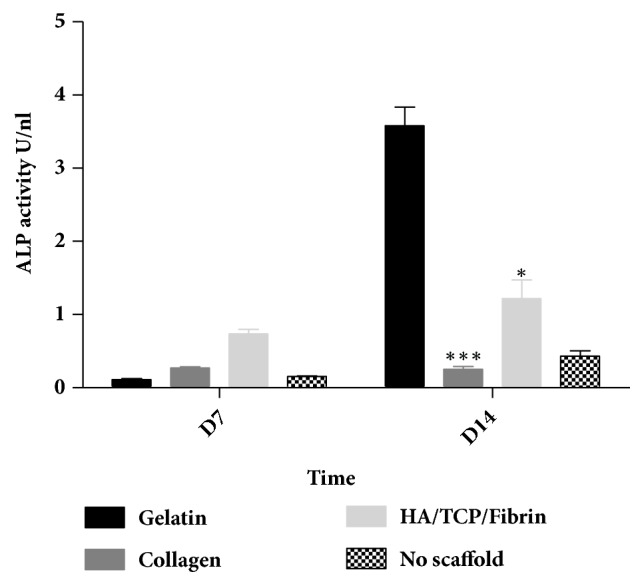
Background. Novel treatments for bone defects, particularly in patients with poor regenerative capacity, are based on bone tissue engineering strategies which include mesenchymal stem cells (MSCs), bioactive factors, and convenient scaffold supports. Objective. In this study, we aimed at comparing the potential for different scaffolds to induce osteogenic differentiation of human maxillary Schneiderian sinus membrane- (hMSSM-) derived cells. Methods. hMSSM-derived cells were seeded on gelatin, collagen, or Hydroxyapatite β-Tricalcium phosphate-Fibrin (Ha β-TCP-Fibrin) scaffolds. Cell viability was determined using an MTT assay. Alizarin red staining method, Alkaline phosphatase (ALP) activity assay, and quantitative real-time PCR analysis were performed to assess hMSSM-derived cells osteogenic differentiation. Results. Cell viability, calcium deposition, ALP activity, and osteoblastic markers transcription levels were most striking in gelatin scaffold-embedded hMSSM-derived cells. Conclusion. Our findings suggest a promising potential for gelatin-hMSSM-derived cell construct for treating bone defects.
Overview
The claims and statistics of this paper haven’t been checked yet.
Free: it reads the open-access text and checks the first 5 claims that cite a source we can check. Create a free account to check every claim.
Integrity signals
Registry
Cites
Statistics
Figures
Verification
Claims the paper makes
The claims and statistics of this paper haven’t been checked yet.
Free: it reads the open-access text and checks the first 5 claims that cite a source we can check. Create a free account to check every claim.
Claims other papers make about this one
Each is checked against this paper’s own text: does it say what the citing paper says it does?
The source backs part of the claim, not all of it — or backs it for a different population, condition or comparison.
In the citing paper
“Also, the release profile successfully extended to 21 days, meaning proper time to complete in vitro osteogenic differentiation of stem cells (Bou Assaf et al., 2019) (Figure 5).”
From Osteogenesis Improvement of Gelatin-Based Nanocomposite Scaffold by Loading Zoledronic Acid (2022) · cites this paper as Bou Assaf et al., 2019
Experimental — accuracy not yet measured
Self-check
Percentages, sums and reported differences re-computed from the paper’s own numbers.
The self-check needs the paper’s full text.
Citations
Cites
Angiogenesis in cancer and other diseases
Carmeliet, P., & Jain, R. K. (2000) · Nature · doi:10.1038/35025220 · Cited by 9,070 · cited 1×
“Following implantation to the injured site, the diffusing interstitial fluid will be the only source of nourishment for the cells on the biomaterial [14, 15].”
BackgroundInfluentialGiannoudis, P. V., Dinopoulos, H., & Tsiridis, E. (2005) · Injury · doi:10.1016/j.injury.2005.07.029 · Cited by 2,078
Huang, G. T.-J., Gronthos, S., & Shi, S. (2009) · Journal of Dental Research · doi:10.1177/0022034509340867 · Cited by 1,871
Scaffolds for bone tissue engineering: state of the art and new perspectives
Roseti, L., Parisi, V., Petretta, M., Cavallo, C., Desando, G., Bartolotti, I., & Grigolo, B. (2017) · Materials Science and Engineering: C · doi:10.1016/j.msec.2017.05.017 · Cited by 1,320 · cited 2×
“This is achieved by cultivating osteogenic-progenitor cells within 3D scaffolds, under conditions favoring bone formation [13].”
BackgroundScaffold Design for Bone Regeneration
Polo-Corrales, L., Latorre-Esteves, M., & Ramirez-Vick, J. E. (2014) · Journal of Nanoscience and Nanotechnology · doi:10.1166/jnn.2014.9127 · Cited by 945
Application of Collagen Scaffold in Tissue Engineering: Recent Advances and New Perspectives
Dong, C., & Lv, Y. (2016) · Polymers · doi:10.3390/polym8020042 · Cited by 851 · cited 3×
“Moreover, previous studies showed that the utility of collagen scaffolds, in vitro, is challenged by their rapid degradation [48, 49].”
BackgroundInfluentialLaurencin, C., Khan, Y., & El-Amin, S. F. (2006) · Expert Review of Medical Devices · doi:10.1586/17434440.3.1.49 · Cited by 716 · cited 1×
“Such limitations encouraged the search for clinically relevant engineered structures, designated as bone graft substitutes, which constitute a combination of artificial extracellular matrix (ECM) scaffold, bone progenitor cells that can differentiate into osteoblasts, and/or growth factors [4].”
BackgroundAutogenous Bone Graft: Donor Sites and Techniques
Myeroff, C., & Archdeacon, M. (2011) · Journal of Bone and Joint Surgery · doi:10.2106/jbjs.j.01513 · Cited by 637
Meinel, L., Karageorgiou, V., Fajardo, R., Snyder, B., Shinde-Patil, V., Zichner, L., Kaplan, D., Langer, R., & Vunjak-Novakovic, G. (2004) · Annals of Biomedical Engineering · doi:10.1023/b:abme.0000007796.48329.b4 · Cited by 561
Regulation of Osteoblast Formation and Function
Aubin, J. E. (2001) · Reviews in Endocrine and Metabolic Disorders · doi:10.1023/a:1010011209064 · Cited by 465
Cited by
Manoochehri, H., Ghorbani, M., Moghaddam, M. M., Nourani, M. R., Makvandi, P., & Sharifi, E. (2022) · Scientific Reports · doi:10.1038/s41598-022-14329-0 · Cited by 59
“Calcium content was determined given that a molecule alizarin red binds with two molecules of calcium 28 .”
BackgroundRetractedKalaiyarasan, G., Veerapandian, M., JebaMercy, G., Balamurugan, K., & Joseph, J. (2019) · ACS Biomaterials Science & Engineering · doi:10.1021/acsbiomaterials.9b00394 · Cited by 51
Sawadkar, P., Mandakhbayar, N., Patel, K. D., Buitrago, J. O., Kim, T. H., Rajasekar, P., Lali, F., Kyriakidis, C., Rahmani, B., Mohanakrishnan, J., et al. (2021) · Journal of Tissue Engineering · doi:10.1177/20417314211019238 · Cited by 51
Wang, J., Sun, Y., Liu, Y., Yu, J., Sun, X., Wang, L., & Zhou, Y. (2022) · Cell Communication and Signaling · doi:10.1186/s12964-022-00844-0 · Cited by 47
Li, L., Wang, B., Zhou, X. W., Ding, H., Sun, C., Wang, Y., Zhang, F., & Zhao, J. (2022) · Cell Cycle · doi:10.1080/15384101.2022.2125751 · Cited by 32
“Since both ALP staining and Alizarin Red S staining could be employed to evaluate the osteogenic differentiation [32], then these two staining were conducted in our study as well, with more colored areas discovered on day 14 post the osteogenic differentiation induction (Figure 1e,f, magnification: × 200).”
MethodResultAssaf, R. B., Zibara, K., Fayyad‐Kazan, M., Al-Nemer, F., Cordahi, M., Khairallah, S., Badran, B. M., & Berbéri, A. (2019) · Stem Cells International · doi:10.1155/2019/4185942 · Cited by 18
“To date, a wide variety of synthetic and natural scaffolds have been applied in regenerative medicine [20].”
BackgroundSelf-citationRogulska, O. Y., Trufanova, N. A., Petrenko, Y., Repin, N. V., Grischuk, V. P., Ashukina, N., Bondarenko, S., Ivanov, G. V., Анатольевна, П. Е., Lozinsky, V. I., et al. (2021) · Journal of Biomedical Materials Research Part B Applied Biomaterials · doi:10.1002/jbm.b.34927 · Cited by 18
Berbéri, A., Fayyad‐Kazan, M., Ayoub, S., Assaf, R. B., Sabbagh, J., Ghassibe‐Sabbagh, M., & Badran, B. M. (2021) · Tissue and Cell · doi:10.1016/j.tice.2021.101515 · Cited by 14
Self-citationKhaled Wassif, R., Daihom, B. A., & Maniruzzaman, M. (2024) · International Journal of Pharmaceutics · doi:10.1016/j.ijpharm.2024.124898 · Cited by 14
Osteogenesis Improvement of Gelatin-Based Nanocomposite Scaffold by Loading Zoledronic Acid
Abdulahy, S. B., Esmaeili Bidhendi, M., Vaezi, M. R., & Moosazadeh Moghaddam, M. (2022) · Frontiers in Bioengineering and Biotechnology · doi:10.3389/fbioe.2022.890583 · Cited by 13
Behera, M., Rajput, M., Acharya, S., Nadammal, N., Suwas, S., & Chatterjee, K. (2021) · Biomedical Materials · doi:10.1088/1748-605x/ac0453 · Cited by 13
Vasoactive intestinal peptide exerts an osteoinductive effect in human mesenchymal stem cells
Castro, D. M., Arribas‐Castaño, P., García‐López, I., Gutiérrez‐Cañas, I., Pérez‐García, S., Lamana, A., Villanueva‐Romero, R., Cabrera‐Martín, A., Tecza, K., Martínez, C., et al. (2024) · BioFactors · doi:10.1002/biof.2062 · Cited by 12
Yoo, K.-H., Kim, Y. S., Kim, Y., Bae, M., & Yoon, S.-Y. (2022) · Frontiers in Bioengineering and Biotechnology · doi:10.3389/fbioe.2022.993126 · Cited by 11
Liu, Y., Wang, J., Zhai, P., Ren, S., Wang, Z., Peng, P., Du, L., Li, L., Zhang, Y., & Zhou, Y. (2021) · Stem Cells International · doi:10.1155/2021/8868004 · Cited by 9
“such as gelatin scaffolds and simvastatin were utilized [9, 10].”
MethodBiocompatibility of ZrO2 vs. Y-TZP Alloys: Influence of Their Composition and Surface Topography
Tchinda, A., Chézeau, L., Pierson, G., Njiwa, R. K., Rihn, B. H., & Bravetti, P. (2022) · Materials · doi:10.3390/ma15134655 · Cited by 8
Yousefiasl, S., Manoochehri, H., & Sharifi, E. (2023) · Polymers for Advanced Technologies · doi:10.1002/pat.6053 · Cited by 9
Rajput, M., Nilawar, S., & Chatterjee, K. (2023) · Regenerative Engineering and Translational Medicine · doi:10.1007/s40883-022-00286-7 · Cited by 10
Abdolahinia, E. D., Golestani, S., Seif, S., Afra, N., Aflatoonian, K., Jalalian, A., Valizadeh, N., & Abdollahinia, E. D. (2023) · Tissue and Cell · doi:10.1016/j.tice.2023.102281 · Cited by 10
Zhang, A., Chen, Z., Yu, X., Zhang, L., & Song, Q. (2020) · International Journal of Peptide Research and Therapeutics · doi:10.1007/s10989-020-10058-y · Cited by 6
“It is worth noting that the previously reported times used in ALP assays for treating hBMSCs with osteogenic agents vary considerably from hours to days (Esposito et al. 2012; Liu et al. 2017; Assaf et al. 2019).”
BackgroundSwapna, Y., Mathew, C. T., & Thomas, J. K. (2023) · Journal of Inorganic and Organometallic Polymers and Materials · doi:10.1007/s10904-023-02628-6 · Cited by 4
ÖZGENÇ, Ö., & Özen, A. (2023) · Ankara Üniversitesi Veteriner Fakültesi Dergisi · doi:10.33988/auvfd.1130705 · Cited by 3
Characterization of the stemness and osteogenic potential of oral and sinus mucosal cells
Chen, M., Tai, W., Cheng, N., Chang, C., & Chang, P. (2021) · Journal of the Formosan Medical Association · doi:10.1016/j.jfma.2021.06.017 · Cited by 3
Jaramillo, N., Moreno, A. I., Arenas, R. L. S., Ospina, V., Peláez-Vargas, A., García-Negrete, C. A., & Paucar, C. G. (2021) · MRS Advances · doi:10.1557/s43580-021-00036-x · Cited by 3
Zhou, Y., Jiang, R., Zeng, J., Chen, Y., Ren, J., Chen, S., & Nie, E. (2023) · Heliyon · doi:10.1016/j.heliyon.2023.e20305 · Cited by 1
“One of the factors that determine the new bone formation in this region is the osteogenic differentiation potential of human maxillary sinus mesenchymal stem cells [10,11].”
BackgroundWang, J., Sun, Y., Liu, Y., Yu, J., Sun, X., Wang, L., & Zhou, Y. (2022) · Figshare · doi:10.6084/m9.figshare.20080964
Taha, R. R. O. O., El-Khazragy, N. N., Ibrahim, S. H., & Hassan, N. (2026) · BMC Oral Health · doi:10.1186/s12903-026-08221-w
“Mineralized nodules were visualized and quantified by measuring the absorbance of the extracted stain at 540 nm [40].”
Metadata
- Authors
- Bou Assaf, R., Fayyad-Kazan, M., Al-Nemer, F., Makki, R., Fayyad-Kazan, H., Badran, B., & Berbéri, A.
- Affiliations
- Department of Oral and Maxillofacial Surgery, Faculty of Dentistry, Lebanese University, Beirut, Lebanon
- Laboratory of Cancer Biology and Molecular Immunology, Faculty of Sciences-I, Lebanese University, Hadath- Beirut, Lebanon
- Lebanese University (LB)
- Corresponding author
- Berbéri, Antoine
- Venue
- BioMed Research International
- Publisher
- Wiley
- Published
- 2019-01-15
- Volume
- 2019
- Pages
- 1-10
- ISSN
- 1110-7243 (ISSN-L)
- 2314-6133
- 2314-6141
- PMC
- PMC6350594
- OpenAlex
- W2910534223
- Cited by
- 25
- References
- 68
- Citations by year
- 2026: 1 · 2024: 1 · 2023: 6 · 2022: 7 · 2021: 7 · 2020: 1 · 2019: 2
- FWCI
- 1.50
- Type
- journal article
- Language
- en
- Open access
- hybrid
- doi.org
- Locations
- BioMed Research International (publishedVersion, cc-by)
- Europe PMC (PubMed Central) (publishedVersion, cc-by)
- PubMed Central (publishedVersion, cc-by)
- PubMed (publishedVersion)
- DOAJ (DOAJ: Directory of Open Access Journals) (submittedVersion)
- Funders
- Lebanese University (18840)
- National Council for Scientific Research (18840)
- Topics
- Physical Sciences › Engineering › Biomedical Engineering › Bone Tissue Engineering Materials
- Health Sciences › Dentistry › Oral Surgery › Dental Implant Techniques and Outcomes
- Health Sciences › Dentistry › Periodontics › Periodontal Regeneration and Treatments
- Keywords
- osteogenic differentiation, bone tissue engineering, bone scaffolds, gelatin scaffolds, collagen scaffolds, bone defects, alkaline phosphatase activity, calcium deposition, cell viability
- MeSH terms
- Alkaline Phosphatase, Bone and Bones, Cell Differentiation, Cell Survival, Cells, Cultured, Collagen, Humans, Nasal Mucosa, Osteoblasts, Osteogenesis, Tissue Engineering, Tissue Scaffolds, Mesenchymal Stem Cells
About these checks
Registry, retraction, Cites and statistics results are computed, not judged, with one exception: a printed reference that no index lists is read once by a model before it counts as a citation error. Claims are extracted by a model and kept only when their quote appears verbatim in the text; each cited source is then checked, with a model’s help, for whether it says what the claim relies on. Those verdicts can be wrong — read the claim’s quote and the cited source before relying on one.
Statistics and arithmetic are recomputed, not judged.
Confidence bands are shown only for fields calibrated on our annotated test set. None is calibrated yet, so no band is shown.
What counts as a claim ›How we measure confidence ›How we check this ›
Are you an author, or do you see a problem with this page? Request a review
Data sources
Bibliographic data: Semantic Scholar, OpenAlex, Crossref.
Contains information from the Semantic Scholar Academic Graph Datasets, made available under the ODC Attribution License (ODC-BY 1.0).
Semantic Scholar’s data is described in: Kinney, R., et al. (2023). The Semantic Scholar Open Data Platform. arXiv:2301.10140.
