

Intelligent Intrusion Detection System for VANET Using Machine Learning and Deep Learning Approaches
Open accessThe DOI matches its Crossref record; 49 of the 49 references it cites were found in a registry or an index.
Abstract
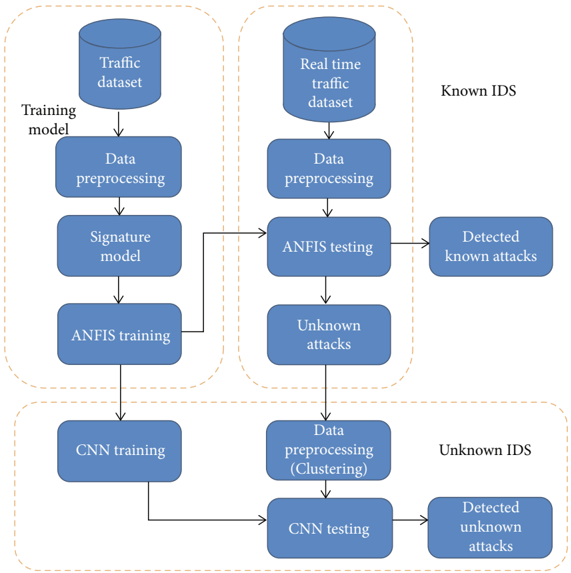
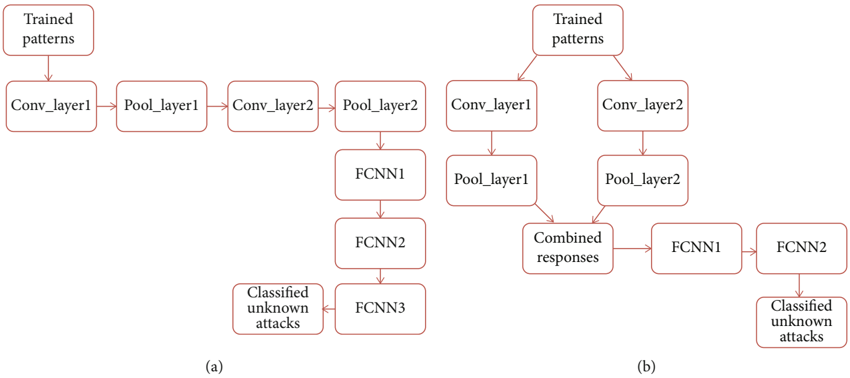
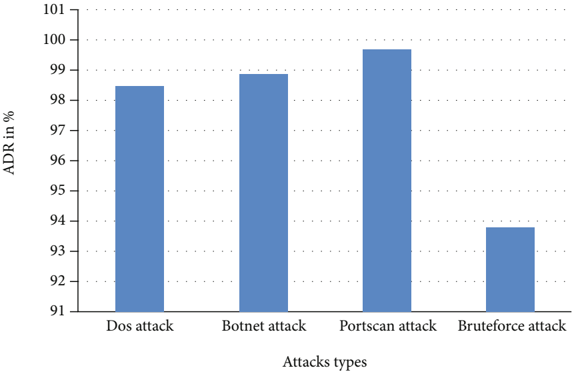
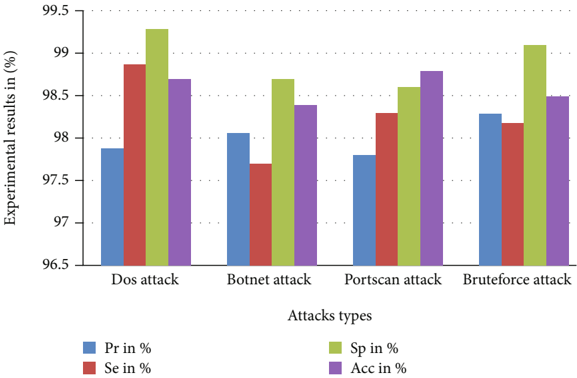
Detecting the attacks in Vehicular Ad hoc Network (VANET) system is very important to provide more secure and reliable communication between all vehicles in the system. In this article, an effective Intelligent Intrusion Detection System (IDS) is proposed using machine learning and deep learning approaches such as Adaptive Neuro Fuzzy Inference System (ANFIS) and Convolutional Neural Networks (CNN), respectively. The existing methods focus on detecting only the known attacks in VANET environment. This limitation is overcome by proposing the Intelligent IDS system using soft computing techniques. The proposed method consists of Known IDS (KIDS) and Unknown IDS (UIDS) modules, which detect both known attacks and unknown attacks. The KIDS module uses ANFIS classification module to detect the known malicious attacks, whereas the UIDS module uses a deep learning algorithm to detect the unknown attacks in VANET. Modified LeeNET (MLNET) architecture is proposed in this article to identify the type of unknown attacks. In this work, DoS attacks, Botnet attacks, PortScan attacks, and Brute Force attacks are detected using this hybrid learning algorithm. The proposed system obtains 96.9% of Pr, 98.3% of Se, 98.7% of Sp, and 98.6% of Acc and consumed 1.75 s for detecting the DoS attack on i‐VANET dataset. The proposed system obtains 98.1% of Pr, 98.9% of Se, 98.1% of Sp, and 98.1% of Acc and consumed 0.95 s for detecting the Botnet attack. The proposed system obtains 98.7% of Pr, 99.1% of Se, 98.9% of Sp, and 99.2% of Acc and consumed 1.38 s for detecting the PortScan attack. The proposed system obtains 99.1of Pr, 97.8% of Se, 98.7% of Sp, and 98.5% of Acc and consumed 1.29 s for detecting the Brute Force attack. The developed methodology is tested on the real‐time CIC‐IDS 2017 dataset, and the experimental results are compared with other state‐of‐the‐art methods.
Overview
The claims and statistics of this paper haven’t been checked yet.
Free: it reads the open-access text and checks the first 5 claims that cite a source we can check. Create a free account to check every claim.
Integrity signals
Registry
Cites
Statistics
Figures
Verification
Claims the paper makes
The claims and statistics of this paper haven’t been checked yet.
Free: it reads the open-access text and checks the first 5 claims that cite a source we can check. Create a free account to check every claim.
Claims other papers make about this one
Each is checked against this paper’s own text: does it say what the citing paper says it does?
The source backs part of the claim, not all of it — or backs it for a different population, condition or comparison.
In the citing paper
“DDoS attacks overwhelm networks with malicious traffic, delaying or blocking critical safety messages, increasing packet loss, and risking accidents6,8–11.”
From A Hybrid Deep Learning Model for Detection and Mitigation of DDoS Attacks in VANETs (2025) · cites this paper as [10]
Experimental — accuracy not yet measured
Self-check
Percentages, sums and reported differences re-computed from the paper’s own numbers.
The self-check needs the paper’s full text.
Citations
Cites
Investigating Ad Transparency Mechanisms in Social Media: A Case Study of Facebook's Explanations
Andreou, A., Venkatadri, G., Goga, O., Gummadi, K. P., Loiseau, P., & Mislove, A. (2018) · Proceedings 2018 Network and Distributed System Security Symposium · doi:10.14722/ndss.2018.23191 · Cited by 1,477
Intrusion Detection System Using Deep Neural Network for In-Vehicle Network Security
Kang, M.-J., & Kang, J.-W. (2016) · PLOS ONE · doi:10.1371/journal.pone.0155781 · Cited by 678 · cited 1×
“[24] implemented deep learning architecture for the detection of anomaly nodes in the VANET system.”
MethodA novel hybrid intrusion detection method integrating anomaly detection with misuse detection
Kim, G., Lee, S., & Kim, S. (2014) · Expert Systems with Applications · doi:10.1016/j.eswa.2013.08.066 · Cited by 589
PACP: An Efficient Pseudonymous Authentication-Based Conditional Privacy Protocol for VANETs
Huang, D., Misra, S., Verma, M., & Xue, G. (2011) · IEEE Transactions on Intelligent Transportation Systems · doi:10.1109/tits.2011.2156790 · Cited by 238
A Distributed Key Management Framework with Cooperative Message Authentication in VANETs
Hao, Y., Cheng, Y., Zhou, C., & Song, W. (2011) · IEEE Journal on Selected Areas in Communications · doi:10.1109/jsac.2011.110311 · Cited by 222 · cited 1×
“Hao [27] used an encryption-based key management system for detecting the various attacks in IDS system of the VANET environment.”
MethodA Hierarchical Hybrid Intrusion Detection Approach in IoT Scenarios
Bovenzi, G., Aceto, G., Ciuonzo, D., Persico, V., & Pescape, A. (2020) · GLOBECOM 2020 - 2020 IEEE Global Communications Conference · doi:10.1109/globecom42002.2020.9348167 · Cited by 186 · cited 1×
“[46] developed a model used for intrusion detection framework using Internet of Things (IoT) with the help of machine learning models.”
MethodVWCA: An efficient clustering algorithm in vehicular ad hoc networks
Daeinabi, A., Pour Rahbar, A. G., & Khademzadeh, A. (2011) · Journal of Network and Computer Applications · doi:10.1016/j.jnca.2010.07.016 · Cited by 180 · cited 1×
“[28] proposed a vehicular weighing clustering algorithm (VWCA) for improving the security level of the nodes in VANET.”
MethodDistributed Privacy-Preserving Collaborative Intrusion Detection Systems for VANETs
Zhang, T., & Zhu, Q. (2018) · IEEE Transactions on Signal and Information Processing over Networks · doi:10.1109/tsipn.2018.2801622 · Cited by 168 · cited 1×
“[15] improved the intrusion detection system of VANET using distributed preserving approach.”
Method5G Vehicular Network Resource Management for Improving Radio Access Through Machine Learning
Khan, S., Khattak, H. A., Almogren, A., Shah, M. A., Ud Din, I., Alkhalifa, I., & Guizani, M. (2020) · IEEE Access · doi:10.1109/access.2020.2964697 · Cited by 157 · cited 1×
“VANET is the recent efficient wireless technology which is presently used in many intelligent transportation networks [1–3], carpooling [4], and even using fifth-generation small-cell networks [5, 6].”
MethodIntrusion Detection Using Deep Belief Network and Probabilistic Neural Network
Zhao, G., Zhang, C., & Zheng, L. (2017) · 22017 IEEE International Conference on Computational Science and Engineering (CSE) and IEEE International Conference on Embedded and Ubiquitous Computing (EUC) · doi:10.1109/cse-euc.2017.119 · Cited by 149 · cited 1×
“[26] utilized two classification models, DBF and Probabilistic Neural Network (PNN), for detecting intrusion in the VANET system.”
MethodKumar, R., Kumar, P., Tripathi, R., Gupta, G. P., Kumar, N., & Hassan, M. M. (2022) · IEEE Transactions on Intelligent Transportation Systems · doi:10.1109/tits.2021.3098636 · Cited by 148 · cited 1×
“[39] used blockchain model with deep learning for a privacy-preserving secure framework in the VANET system.”
MethodIrshad, A., Usman, M., Chaudhry, S. A., Naqvi, H. A., & Shafiq, M. (2020) · IEEE Transactions on Industry Applications · doi:10.1109/tia.2020.2966160 · Cited by 136 · cited 1×
“[36] proposed a security key authentication system for the VANET system to provide reliable and secure access to vehicle users.”
Data Mining Techniques in Intrusion Detection Systems: A Systematic Literature Review
Salo, F., Injadat, M., Nassif, A. B., Shami, A., & Essex, A. (2018) · IEEE Access · doi:10.1109/access.2018.2872784 · Cited by 131
Classification Approach for Intrusion Detection in Vehicle Systems
Alshammari, A., A. Zohdy, M., Debnath, D., & Corser, G. (2018) · Wireless Engineering and Technology · doi:10.4236/wet.2018.94007 · Cited by 131 · cited 2×
“[19] designed an advanced IDS module in VANET using different classification methods.”
MethodKitsune: An Ensemble of Autoencoders for Online Network Intrusion Detection
Mirsky, Y., Doitshman, T., Elovici, Y., & Shabtai, A. (2018) · Proceedings 2018 Network and Distributed System Security Symposium · doi:10.14722/ndss.2018.23204 · Cited by 128
Kumar, P., Gupta, G. P., Tripathi, R., Garg, S., & Hassan, M. M. (2021) · IEEE Transactions on Intelligent Transportation Systems · doi:10.1109/tits.2021.3122368 · Cited by 120 · cited 1×
“[41] proposed a security strategy that uses artificial intelligence models to understand cyber-attacks and can proficiently protect IoT-enabled Maritime Transportation System (MTS) data.”
BackgroundGope, P., & Sikdar, B. (2019) · IEEE Transactions on Smart Grid · doi:10.1109/tsg.2019.2908698 · Cited by 119
Secure Real-Time Traffic Data Aggregation With Batch Verification for Vehicular Cloud in VANETs
Shen, J., Liu, D., Chen, X., Li, J., Kumar, N., & Vijayakumar, P. (2019) · IEEE Transactions on Vehicular Technology · doi:10.1109/tvt.2019.2946935 · Cited by 117 · cited 1×
“[30] developed a data aggregation approach for VANET to improve security performance.”
MethodGayathri, N. B., Thumbur, G., Reddy, P. V. G. D. P., & Rahman, M. Z. U. (2018) · IEEE Access · doi:10.1109/access.2018.2845464 · Cited by 113 · cited 1×
“[32] used certificateless approach to prove the authentication scheme in the VANET environment.”
MethodNayyar, A. (2018) · 2018 International Conference on Advances in Big Data, Computing and Data Communication Systems (icABCD) · doi:10.1109/icabcd.2018.8465130 · Cited by 113
P2SF-IoV: A Privacy-Preservation-Based Secured Framework for Internet of Vehicles
Kumar, R., Kumar, P., Tripathi, R., Gupta, G. P., & Kumar, N. (2022) · IEEE Transactions on Intelligent Transportation Systems · doi:10.1109/tits.2021.3102581 · Cited by 111 · cited 1×
“[40] developed a privacy preservation model for the VANET system to provide privacy and security in C-ITS infrastructure.”
MethodShams, E. A., Rizaner, A., & Ulusoy, A. H. (2018) · Computers & Security · doi:10.1016/j.cose.2018.06.008 · Cited by 93 · cited 2×
“[21] developed a machine learning classifier-based intrusion detection system for detecting the various forceful attacks in networks.”
BackgroundLiang, J., Chen, J., Zhu, Y., & Yu, R. (2019) · Applied Soft Computing · doi:10.1016/j.asoc.2018.12.001 · Cited by 92
Sharma, S., Sharma, H., & Sharma, J. B. (2019) · Applied Soft Computing · doi:10.1016/j.asoc.2019.105696 · Cited by 92 · cited 1×
“[43] used Singular Value Decomposition (SVD) method for color image watermarking based on bee colony algorithm.”
MethodZhou, M., Han, L., Lu, H., & Fu, C. (2020) · Computer Networks · doi:10.1016/j.comnet.2020.107174 · Cited by 82
Al‐rimy, B. A. S., Maarof, M. A., Alazab, M., Alsolami, F. J., Shaid, S. Z. M., Ghaleb, F. A. A., Al-Hadhrami, T., & Ali, A. (2020) · IEEE Access · doi:10.1109/access.2020.3012674 · Cited by 71
BDEdge: Blockchain and Deep-Learning for Secure Edge-Envisioned Green CAVs
Kumar, P., Kumar, R., Gupta, G. P., & Tripathi, R. (2022) · IEEE Transactions on Green Communications and Networking · doi:10.1109/tgcn.2022.3165692 · Cited by 70 · cited 1×
“[42] proposed blockchain and deep learning (DL)enabled secure data processing framework for an edgeenvisioned green CAV environment.”
BackgroundNie, L., Li, Y., & Kong, X. (2018) · IEEE Access · doi:10.1109/access.2018.2854842 · Cited by 66 · cited 2×
“[23] methods for the detection of various attacks in VANET environment.”
MethodCarpooling in Connected and Autonomous Vehicles: Current Solutions and Future Directions
Zafar, F., Khattak, H. A., Aloqaily, M., & Hussain, R. (2022) · ACM Computing Surveys · doi:10.1145/3501295 · Cited by 62 · cited 1×
“VANET is the recent efficient wireless technology which is presently used in many intelligent transportation networks [1–3], carpooling [4], and even using fifth-generation small-cell networks [5, 6].”
MethodMahmood, K., Arshad, J., Chaudhry, S. A., & Kumari, S. (2019) · International Journal of Communication Systems · doi:10.1002/dac.4137 · Cited by 58 · cited 1×
“[38] proposed an anonymous identity-based key agreement protocol for maintaining the attack prevention system for the applications of smart grid environments.”
BackgroundA Hybrid Data-driven Model for Intrusion Detection in VANET
Bangui, H., Ge, M., & Buhnova, B. (2021) · Procedia Computer Science · doi:10.1016/j.procs.2021.03.065 · Cited by 58 · cited 2×
“[16] used a hybrid data-driven methodology for detecting the various attacks in the VANET IDS system.”
MethodSecurity in Vehicular Ad Hoc Networks: Challenges and Countermeasures
Mahmood, J., Duan, Z., Yang, Y., Wang, Q., Nebhen, J., & Bhutta, M. N. M. (2021) · Security and Communication Networks · doi:10.1155/2021/9997771 · Cited by 57 · cited 1×
“[35] analyzed and synthesized various problems faced in the security flow of the VANET system.”
BackgroundEnsemble-Based Hybrid Context-Aware Misbehavior Detection Model for Vehicular Ad Hoc Network
Ghaleb, F. A., Maarof, M. A., Zainal, A., Al-rimy, B. A. S., Alsaeedi, A., & Boulila, W. (2019) · Remote Sensing · doi:10.3390/rs11232852 · Cited by 56
Machine Learning-Driven Optimization for Intrusion Detection in Smart Vehicular Networks
Alsarhan, A., Al-Ghuwairi, A.-R., Almalkawi, I. T., Alauthman, M., & Al‐Dubai, A. (2020) · Wireless Personal Communications · doi:10.1007/s11277-020-07797-y · Cited by 54 · cited 2×
“[17] used a rule-based security filter for filtering the anomaly nodes in the VANET system.”
BackgroundMethodHybrid and Multifaceted Context-Aware Misbehavior Detection Model for Vehicular Ad Hoc Network
Ghaleb, F. A., Aizaini Maarof, M., Zainal, A., Al-Rimy, B. A. S., Saeed, F., & Al-Hadhrami, T. (2019) · IEEE Access · doi:10.1109/access.2019.2950805 · Cited by 49
Intelligent intrusion detection system using clustered self organized map
Almiani, M., AbuGhazleh, A., Al-Rahayfeh, A. A., & Razaque, A. (2018) · International Conference on Software Defined Systems (SDS) · doi:10.1109/sds.2018.8370435 · Cited by 48 · cited 1×
“[22] devised a non-linear intrusion detection method for detecting malicious attacks in the VANET system.”
MethodSenior2Local: A Machine Learning Based Intrusion Detection Method for VANETs
Zeng, Y., Qiu, M., Ming, Z., & Liu, M. (2018) · Lecture notes in computer science · doi:10.1007/978-3-030-05755-8_41 · Cited by 47 · cited 2×
“[20] Required minimum hardware resources Complex detection algorithm”
MethodPatel, S. K., & Sonker, A. (2016) · International Journal of Future Generation Communication and Networking · doi:10.14257/ijfgcn.2016.9.6.32 · Cited by 44
Intrusion detection and mitigation of attacks in microgrid using enhanced deep belief network
Danalakshmi, D., Venkatasamy, T. K., Mehbodniya, A., Umar, S. M., & Alam, T. (2022) · Energy Sources Part A Recovery Utilization and Environmental Effects · doi:10.1080/15567036.2021.2023237 · Cited by 40 · cited 1×
“[25] proposed an IDS technique in which the Deep Belief Network is used by enhancing with a rule-based technique to improve the accuracy of the detection rate and reduce the false alarm rate as well.”
MethodSelf-citationContent sharing in Internet of Vehicles: Two matching-based user-association approaches
Chiti, F., Fantacci, R., Gu, Y., & Han, Z. (2016) · Vehicular Communications · doi:10.1016/j.vehcom.2016.11.005 · Cited by 35
An Improved and Privacy-Preserving Mutual Authentication Scheme with Forward Secrecy in VANETs
Yao, M., Wang, X., Gan, Q., Lin, Y., & Huang, C. (2021) · Security and Communication Networks · doi:10.1155/2021/6698099 · Cited by 33 · cited 1×
“[29] proposed mutual authentication method for improving the security enhancement in VANET using a forward secrecy approach.”
MethodNaqvi, I., Chaudhary, A., & Rana, A. (2021) · International Conference on Reliability, Infocom Technologies and Optimization (Trends and Future Directions) (ICRITO) · doi:10.1109/icrito51393.2021.9596141 · Cited by 29 · cited 1×
“[34] detected the malicious activities or any misbehavior activities of the vehicle in VANET using IDS flow.”
MethodGuarino, I., Bovenzi, G., Monda, D. D., Aceto, G., Ciuonzo, D., & Pescapè, A. (2022) · IEEE International Symposium on Measurements & Networking (M&N) · doi:10.1109/mn55117.2022.9887775 · Cited by 28 · cited 1×
“[45] applied a different set of machine learning approaches for identifying intrusion detections with respect to various forms.”
BackgroundMeasurement of IEEE 802.11p Performance for Basic Safety Messages in Vehicular Communications
Rajput, N. S. (2018) · IEEE International Conference on Advanced Networks and Telecommunications Systems · doi:10.1109/ants.2018.8710108 · Cited by 21 · cited 1×
“In this article, CIC-IDS 2017 [48] and i-VANET [49] datasets are used to validate the proposed VANET system using machine and deep learning algorithms.”
MethodIntrusion Detection for Vehicular Ad Hoc Network Based on Deep Belief Network
Vitalkar, R. S., Thorat, S. S., & Rojatkar, D. V. (2021) · Lecture notes on data engineering and communications technologies · doi:10.1007/978-981-16-3728-5_64 · Cited by 18 · cited 2×
“[18] Non-linear testing Complex detection algorithm”
MethodSecuring video cloud storage by ERBAC mechanisms in 5g enabled vehicular networks
Gopi, R., & Rajesh, A. (2017) · Cluster Computing · doi:10.1007/s10586-017-0987-0 · Cited by 17 · cited 1×
“VANET is the recent efficient wireless technology which is presently used in many intelligent transportation networks [1–3], carpooling [4], and even using fifth-generation small-cell networks [5, 6].”
MethodAnalyzing attack strategies against rule-based intrusion detection systems
Parameshwarappa, P., Chen, Z., & Gangopadhyay, A. (2018) · International Conference on Distributed Computing and Networking (ICDCN) · doi:10.1145/3170521.3170522 · Cited by 15
Snir, M., Jin, H., Kasahara, H., Valero, M., Zhang, F., & Zhai, J. (2018) · Lecture notes in computer science · doi:10.1007/978-3-030-05677-3 · Cited by 12
Automated detection of coronary artery disease comparing arterial fat accumulation using CNN
Sinha, D., Sharma, A. K., & Sharma, S. (2022) · Journal of Electronic Imaging · doi:10.1117/1.jei.31.5.051405 · Cited by 5 · cited 1×
“[44] used CNN for the detection of coronary artery disease.”
Method
Research works printed but not linked: 2
- 37. S. M. Faisal and T. Zaidi, "Timestamp based detection of Sybil attack in VANET," International Journal of Network Security, vol. 22, no. 3, pp. 399-410, 2020. · doi:10.6633/ijns.202005_22(3).05
- 45. I. Guarino, G. Bovenzi, D. Di Monda, G. Aceto, D. Ciuonzo, and A. Pescape, "On the use of machine learning approaches for the early classification in network intrusion detection," in 2022 IEEE International Symposium on Measurements & Net- working (M&N), pp. 1-6, Padua, Italy, July 2022.
Cited by
Javaheri, D., Gorgin, S., Lee, J.-A., & Masdari, M. (2023) · Information Sciences · doi:10.1016/j.ins.2023.01.067 · Cited by 119
Rashid, K., Saeed, Y., Ali, A., Jamil, F., Alkanhel, R., & Muthanna, A. (2023) · Sensors · doi:10.3390/s23052594 · Cited by 110
“[47] K-Mean Yes Self-generated VANET NS-3 DDoS 95%”
Saoud, B., Shayea, I. A. M., Yahya, A. E., Shamsan, Z. A., Alhammadi, A., Alawad, M. A., & Alkhrijah, Y. M. (2024) · ICT Express · doi:10.1016/j.icte.2024.05.008 · Cited by 95
Abdel Hakeem, S. A., & Kim, H. (2025) · IEEE Transactions on Intelligent Transportation Systems · doi:10.1109/tits.2025.3558849 · Cited by 90
State-of-the-art authentication and verification schemes in VANETs: A survey
Mazhar, S., Rakib, A., Pan, L., Jiang, F., Anwar, A., Doss, R., & Bryans, J. W. (2024) · Vehicular Communications · doi:10.1016/j.vehcom.2024.100804 · Cited by 76
Metadata
- Authors
- Karthiga, B., Durairaj, D., Nawaz, N., Venkatasamy, T. K., Ramasamy, G., & Hariharasudan, A.
- Affiliations
- Dhanalakshmi Srinivasan Group of Institutions (IN)
- Kingdom University (BH)
- Kalasalingam Academy of Research and Education (IN)
- Corresponding author
- Venkatasamy, Thiruppathy Kesavan
- Venue
- Wireless Communications and Mobile Computing
- Publisher
- Wiley
- Published
- 2022-01
- Volume
- 2022
- Issue
- 1
- ISSN
- 1530-8669 (ISSN-L)
- 1530-8677
- OpenAlex
- W4306153509
- Cited by
- 73
- References
- 47
- Citations by year
- 2026: 10 · 2025: 26 · 2024: 23 · 2023: 14
- FWCI
- 6.99
- Type
- journal article
- Language
- en
- Open access
- hybrid
- doi.org
- Locations
- Wireless Communications and Mobile Computing (publishedVersion, cc-by)
- DOAJ (DOAJ: Directory of Open Access Journals) (submittedVersion)
- Topics
- Physical Sciences › Computer Science › Computer Networks and Communications › Network Security and Intrusion Detection
- Physical Sciences › Engineering › Electrical and Electronic Engineering › Vehicular Ad Hoc Networks (VANETs)
- Physical Sciences › Computer Science › Artificial Intelligence › Adversarial Robustness in Machine Learning
- Keywords
- intrusion detection, vehicular ad hoc networks, VANET security, adaptive neuro-fuzzy inference system, convolutional neural networks, unknown attack detection, denial-of-service attacks, botnet attacks, brute force attacks, hybrid machine learning and deep learning
About these checks
Registry, retraction, Cites and statistics results are computed, not judged, with one exception: a printed reference that no index lists is read once by a model before it counts as a citation error. Claims are extracted by a model and kept only when their quote appears verbatim in the text; each cited source is then checked, with a model’s help, for whether it says what the claim relies on. Those verdicts can be wrong — read the claim’s quote and the cited source before relying on one.
Statistics and arithmetic are recomputed, not judged.
Confidence bands are shown only for fields calibrated on our annotated test set. None is calibrated yet, so no band is shown.
What counts as a claim ›How we measure confidence ›How we check this ›
Are you an author, or do you see a problem with this page? Request a review
Data sources
Bibliographic data: Semantic Scholar, OpenAlex, Crossref.
Contains information from the Semantic Scholar Academic Graph Datasets, made available under the ODC Attribution License (ODC-BY 1.0).
Semantic Scholar’s data is described in: Kinney, R., et al. (2023). The Semantic Scholar Open Data Platform. arXiv:2301.10140.
