

The DOI matches its Crossref record; 43 of the 43 references it cites were found in a registry or an index.
Functional Precision Medicine Provides Clinical Benefit in Advanced Aggressive Hematologic Cancers and Identifies Exceptional Responders
Open accessPublished version of a preprint
Abstract
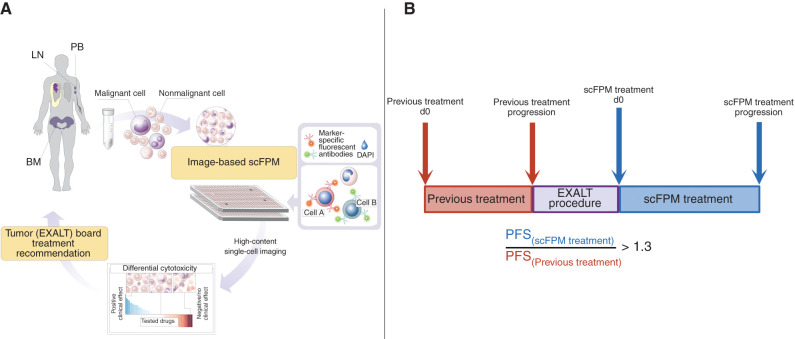
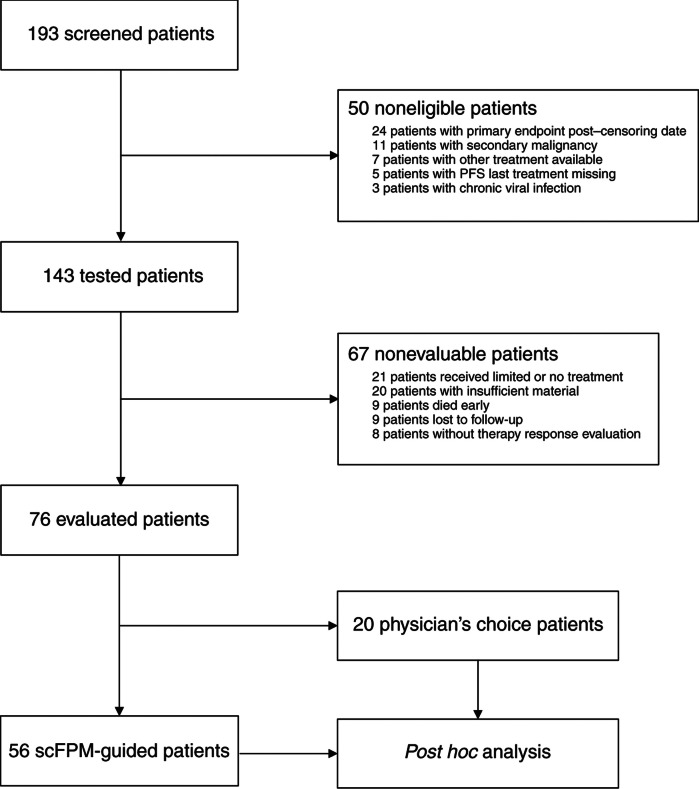
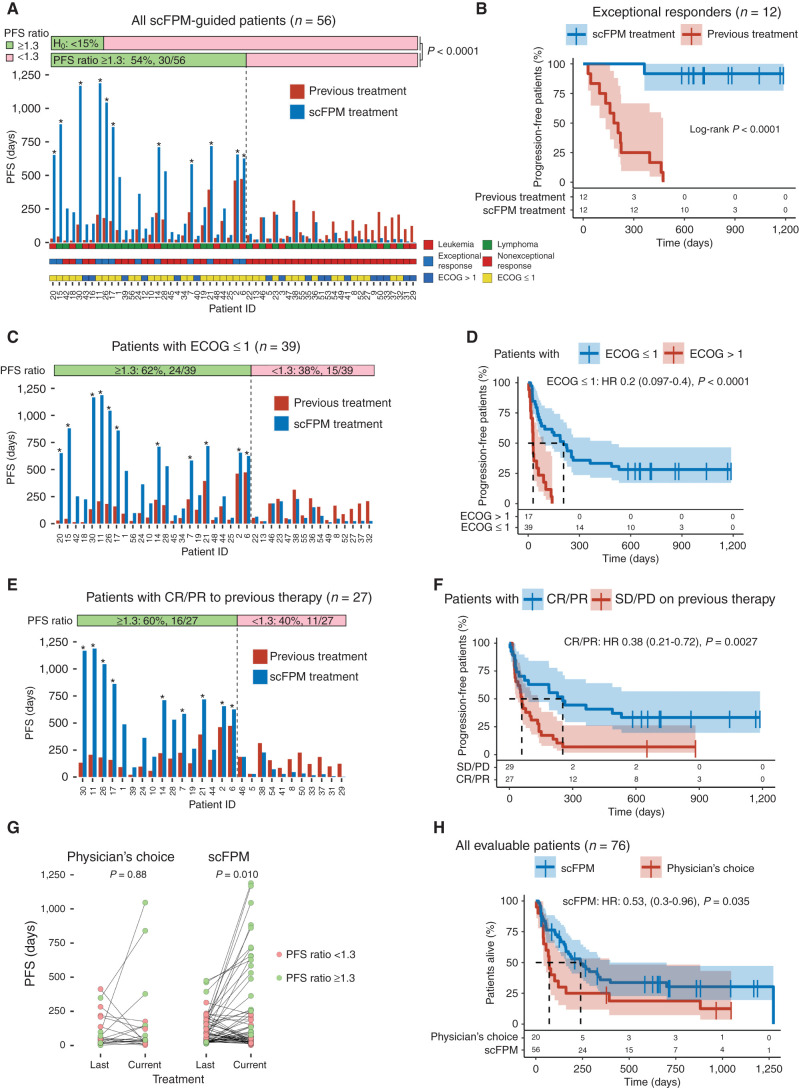
Abstract Personalized medicine aims to match the right drug with the right patient by using specific features of the individual patient's tumor. However, current strategies of personalized therapy matching provide treatment opportunities for less than 10% of patients with cancer. A promising method may be drug profiling of patient biopsy specimens with single-cell resolution to directly quantify drug effects. We prospectively tested an image-based single-cell functional precision medicine (scFPM) approach to guide treatments in 143 patients with advanced aggressive hematologic cancers. Fifty-six patients (39%) were treated according to scFPM results. At a median follow-up of 23.9 months, 30 patients (54%) demonstrated a clinical benefit of more than 1.3-fold enhanced progression-free survival compared with their previous therapy. Twelve patients (40% of responders) experienced exceptional responses lasting three times longer than expected for their respective disease. We conclude that therapy matching by scFPM is clinically feasible and effective in advanced aggressive hematologic cancers. Significance: This is the first precision medicine trial using a functional assay to instruct n-of-one therapies in oncology. It illustrates that for patients lacking standard therapies, high-content assay-based scFPM can have a significant value in clinical therapy guidance based on functional dependencies of each patient's cancer. See related commentary by Letai, p. 290. This article is highlighted in the In This Issue feature, p. 275
Overview
The claims and statistics of this paper haven’t been checked yet.
Run the check — free, no account needed. It reads the open-access text and checks the sources it cites.
Integrity signals
Registry
Cites
Statistics
Figures
Verification
Claims the paper makes
The claims and statistics of this paper haven’t been checked yet.
Run the check — free, no account needed. It reads the open-access text and checks the sources it cites.
Claims other papers make about this one
Each is checked against this paper’s own text: does it say what the citing paper says it does?
The cited source says what the claim attributes to it.
In the citing paper
“High-throughput ex vivo drug screening is a powerful tool to identify effective compounds and drug repurposing candidates,10,11”
From Integrated drug profiling and CRISPR screening identify BCR::ABL1-independent vulnerabilities in chronic myeloid leukemia (2024) · cites this paper as [11]
Self-check
Percentages, sums and reported differences re-computed from the paper’s own numbers.
The self-check needs the paper’s full text.
Citations
Cites
Döhner, H., Estey, E. H., Grimwade, D. J., Amadori, S., Appelbaum, F. R., Büchner, T., Dombret, H., Ebert, B. L., Fenaux, P., Larson, R. A., et al. (2016) · Blood · doi:10.1182/blood-2016-08-733196 · Cited by 5,938 · cited 2×
“Response evaluation was based on RECIL criteria for lymphoma and ELN criteria for 468 leukemia (42,43).”
MethodRecurring mutations found by sequencing an acute myeloid leukemia genome
Mardis, E. R., Ding, L., Dooling, D. J., Larson, D. E., McLellan, M. D., Chen, K., Koboldt, D. C., Fulton, R. S., Delehaunty, K. D., McGrath, S. D., et al. (2009) · New England Journal of Medicine · doi:10.1056/nejmoa0903840 · Cited by 2,219 · cited 1×
“The median time from sampling to scFPM report was 5 (1189 33) days, with longer times accounting for re-staining due to updated immunophenotyping 190 data, and to treatment 21 (4-77) days.”
Principles of cancer therapy: oncogene and non-oncogene addiction
Luo, J., Solimini, N. L., & Elledge, S. J. (2009) · Cell · doi:10.1016/j.cell.2009.02.024 · Cited by 1,765 · cited 2×
“The median time from sampling to scFPM report was 5 (1189 33) days, with longer times accounting for re-staining due to updated immunophenotyping 190 data, and to treatment 21 (4-77) days.”
Outcomes in refractory diffuse large B-cell lymphoma: results from the international SCHOLAR-1 study
Crump, M., Neelapu, S. S., Farooq, U., Neste, É. V. D., Kuruvilla, J. G., Westin, J. R., Link, B. K., Hay, A. E., Cerhan, J. R., Zhu, L., et al. (2017) · Blood · doi:10.1182/blood-2017-03-769620 · Cited by 1,755 · cited 1×
“For T-NHL, 9 months of PFS was considered exceptional, and for aggressive B-NHL and myeloid disease, 18 months was considered exceptional based on the definition by Wheeler and colleagues (26) and others (18, 43, 44).”
BackgroundFunctional genomic landscape of acute myeloid leukaemia
Tyner, J. W., Tognon, C. E., Bottomly, D., Wilmot, B., Kurtz, S. E., Savage, S. L., Long, N., Schultz, A. R., Traer, E. A., Abel, M. L., et al. (2018) · Nature · doi:10.1038/s41586-018-0623-z · Cited by 1,359 · cited 1×
“The median time from sampling to scFPM report was 5 (1189 33) days, with longer times accounting for re-staining due to updated immunophenotyping 190 data, and to treatment 21 (4-77) days.”
Le Tourneau, C., Delord, J.-P., Gonçalves, A., Gavoille, C., Dubot, C., Isambert, N., Campone, M., Trédan, O., Massiani, M.-A., Mauborgne, C., et al. (2015) · The Lancet Oncology · doi:10.1016/s1470-2045(15)00188-6 · Cited by 1,137 · cited 2×
“therapeutic outcome impossible at our current state of knowledge (3).”
BackgroundBRAF Mutations in Hairy-Cell Leukemia
Tiacci, E., Trifonov, V. A., Schiavoni, G., Holmes, A. B., Kern, W., Martelli, M. P., Pucciarini, A., Bigerna, B., Pacini, R., Wells, V. A., et al. (2011) · New England Journal of Medicine · doi:10.1056/nejmoa1014209 · Cited by 1,029 · cited 1×
“Genomic tumor characterization and treatment matching have improved the management of some patients with hematologic malignancies, such as BRAF in hairy cell leukemia (11, 12), IDH1/2 in acute myeloid leukemia ABSTRACT Personalized medicine aims to match the right drug with the right patient by using specific features…”
BackgroundReview of precision cancer medicine: Evolution of the treatment paradigm
Tsimberidou, A. M., Fountzilas, E., Nikanjam, M., & Kurzrock, R. (2020) · Cancer Treatment Reviews · doi:10.1016/j.ctrv.2020.102019 · Cited by 803 · cited 2×
“In contrast, a major 315 setback uniformly described in other personalized medicine trials is patient deterioration or 316 death during time of analysis (4,33).”
BackgroundMassard, C., Michiels, S., Ferté, C., Deley, M. L., Lacroix, L., Hollebecque, A., Verlingue, L., Ileana, E. E., Rosellini, S., Ammari, S., et al. (2017) · Cancer Discovery · doi:10.1158/2159-8290.cd-16-1396 · Cited by 802 · cited 2×
“The median time from sampling to scFPM report was 5 (1189 33) days, with longer times accounting for re-staining due to updated immunophenotyping 190 data, and to treatment 21 (4-77) days.”
BackgroundMolecular profiling of cancer patients enables personalized combination therapy: the I-PREDICT study
Sicklick, J. K., Kato, S., Okamura, R., Schwaederle, M. C., Hahn, M. E., Williams, C. B., De, P. K., Krie, A. K., Piccioni, D. E., Miller, V. A., et al. (2019) · Nature Medicine · doi:10.1038/s41591-019-0407-5 · Cited by 726 · cited 3×
“329 This strategy could raise the limited matching numbers, but has not yet been validated in a 330 prospective fashion (28).”
Background
Research works printed but not linked: 1
- Swerdlow, 2017, WHO classification of tumours of haematopoietic and lymphoid tissues. Rev. 4th ed
Cited by
Sorted by citations
Items 201–207 of 207
Ex Vivo Microtumor Testing to Predict Chemotherapy Responses in Patients with Bladder Cancer
Scholtes, M., Koedoot, E., Ceton, L., Sijsenaar, T. J. P., Montero, M. G., Roeland, C. Z., van Soest, R. J., Leijte, J. A. P., Roshani, H., Korthorst, R. A., et al. (2026) · European Urology Open Science · doi:10.1016/j.euros.2026.07.009
Xiao, Y., Yang, F., Qi, Y.-J., Chen, L., Zhang, H., Zhang, S.-W., Shan, R., Huang, L., Li, J.-J., Jiang, Y.-Z., et al. (2026) · Journal of Clinical Investigation · doi:10.1172/jci202305
“This “exceptional responder” approach has been successfully utilized across various malignancies to generate critical insights into drug mechanisms and advance precision medicine, often despite limited sample sizes (14–18).”
Williams, E. K., Zhang, D. Y., Alese, T. T., Summers, R. J., Musick, J. O., Park, S. I., Tran, R., Kemp, M. L., Porter, C. C., & Lam, W. A. (2026) · Nature Biomedical Engineering · doi:10.1038/s41551-026-01818-0
Live‐cell FRET imaging‐based efficacy prediction of EGFR‐TKIs in EGFR L858R‐mutant NSCLC
Li, X., Dai, L., Yang, P., Li, S., Peng, C., Li, S., Sun, B., Cai, S., Wang, X., & Chen, T. (2026) · Clinical and Translational Medicine · doi:10.1002/ctm2.70878
“39 Live-cell FRET microscopy enables simultaneous analysis of EGFR L858R –GRB2 interactions and cellular phenotypic changes at the single-cell level.”
Markiewicz, H., Murawa, A., Rytelewski, Z., Ślężak, J. K., & Dobosz, P. (2026) · Pharmaceuticals · doi:10.3390/ph19111675
Niedermayer, A., Meyer, L. H., Debatin, K., & Zinngrebe, J. (2026) · Methods in cell biology · doi:10.1016/bs.mcb.2026.10.001
Li, J., Zhang, N., Piao, M., Zhao, J., Wang, Y., Li, C., Li, S., Huang, Z., Li, Y., Xun, Z., et al. (2026) · Cancer and Metastasis Reviews · doi:10.1007/s10555-026-10392-5
“Therefore, translation should prioritize paired longitudinal studies, functional confirmation of candidate dependencies, and prospective trials with explicitly defined biomarker-guided decisions [89, 344].”
Metadata
- Authors
- Kornauth, C., Pemovska, T., Vladimer, G. I., Bayer, G., Bergmann, M., Eder, S., Eichner, R., Erl, M., Esterbauer, H., Exner, R., Felsleitner-Hauer, V., Forte, M., Gaiger, A., Geissler, K., Greinix, H. T., Gstöttner, W., Hacker, M., Hartmann, B. L., Hauswirth, A. W., Heinemann, T., Heintel, D., Hoda, M. A., Hopfinger, G., Jaeger, U., Kazianka, L., Kenner, L., Kiesewetter, B., Krall, N., Krajnik, G., Kubicek, S., Le, T., Lubowitzki, S., Mayerhoefer, M. E., Menschel, E., Merkel, O., Miura, K., Müllauer, L., Neumeister, P., Noesslinger, T., Ocko, K., Öhler, L., Panny, M., Pichler, A., Porpaczy, E., Prager, G. W., Raderer, M., Ristl, R., Ruckser, R., Salamon, J., Schiefer, A.-I., Schmolke, A.-S., Schwarzinger, I., Selzer, E., Sillaber, C., Skrabs, C., Sperr, W. R., Srndic, I., Thalhammer, R., Valent, P., van der Kouwe, E., Vanura, K., Vogt, S., Waldstein, C., Wolf, D., Zielinski, C. C., Zojer, N., Simonitsch-Klupp, I., Superti-Furga, G., Snijder, B., & Staber, P. B.
- Affiliations
- Vienna General Hospital (AT)
- Austrian Academy of Sciences (AT)
- Medical University of Vienna (AT)
- Klinikum Klagenfurt (AT)
- 8Abteilung für Innere Medizin, Krankenhaus der Barmherzigen Brüder Salzburg, Salzburg, Austria.
- Universitätsklinikum Wiener Neustadt (AT)
- Sigmund Freud Privatuniversität Wien (AT)
- Medical University of Graz (AT)
- Landeskrankenhaus Feldkirch (AT)
- ETH Zurich (CH)
- 17Division of Medicine I, Klinik Ottakring, Vienna, Austria.
- 19Third Medical Department, Centre for Oncology and Haematology, Klinik Favoriten, Vienna, Austria.
- Universitätsklinikum St. Pölten (AT)
- Memorial Sloan Kettering Cancer Center (US)
- Hanusch Hospital (AT)
- Nihon University (JP)
- St. Josef-Krankenhaus Wien (AT)
- 29Second Medical Department, Klinik Donaustadt, Vienna, Austria.
- 30Department of Medicine, Landesklinikum Waidhofen a.d. Ybbs, Waidhofen-Ybbs, Austria.
- Ludwig Boltzmann Institute for Hematology and Oncology (AT)
- 1Department of Medicine I, Division of Hematology and Hemostaseology, Medical University of Vienna, Vienna, Austria.
- Innsbruck Medical University (AT)
- 5Department of Pathology, Medical University of Vienna, Vienna, Austria.
- 3CeMM Research Center for Molecular Medicine of the Austrian Academy of Sciences, Vienna, Austria.
- Corresponding author
- Staber, Philipp B.
- ORCID
- Kornauth, Christoph
- Pemovska, Tea
- Vladimer, Gregory I.
- Bergmann, Michael
- Eichner, Ruth
- Esterbauer, Harald
- Exner, Ruth
- Gaiger, Alexander
- Geissler, Klaus
- Hacker, Marcus
- Hartmann, Bernd Lorenz
- Heinemann, Tim
- Hoda, Mir Alireza
- Hopfinger, Georg
- Kazianka, Lukas
- Kenner, Lukas
- Kiesewetter, Barbara
- Krall, Nikolaus
- Kubicek, Stefan
- Le, Trang
- Lubowitzki, Simone
- Mayerhoefer, Marius E.
- Merkel, Olaf
- Miura, Katsuhiro
- Müllauer, Leonhard
- Neumeister, Peter
- Panny, Michael
- Pichler, Alexander
- Porpaczy, Edit
- Prager, Gerald W.
- Ristl, Robin
- Schiefer, Ana-Iris
- Schwarzinger, Ilse
- Selzer, Edgar
- Sperr, Wolfgang R.
- Valent, Peter
- van der Kouwe, Emiel
- Vanura, Katrina
- Waldstein, Cora
- Wolf, Dominik
- Zielinski, Christoph C.
- Snijder, Berend
- Staber, Philipp B.
- Venue
- Cancer Discovery
- Published
- 2021-10-11
- Volume
- 12
- Issue
- 2
- Pages
- 372-387
- ISSN
- 2159-8274 (ISSN-L)
- 2159-8290
- PMC
- PMC9762339
- OpenAlex
- W3205761999
- Cited by
- 206
- References
- 43
- Citations by year
- 2026: 36 · 2025: 47 · 2024: 45 · 2023: 46 · 2022: 29 · 2021: 3
- FWCI
- 20.21
- Type
- journal article
- Language
- en
- Open access
- hybrid
- doi.org
- Licence
- Locations
- Cancer Discovery (publishedVersion, cc-by-nc-nd)
- PubMed Central (publishedVersion, cc-by-nc-nd)
- PubMed (publishedVersion)
- Funders
- Vienna Science and Technology Fund (LS16-034)
- Austrian Science Fund (F4704-B20, F4711-B20, P27132-B20)
- European Molecular Biology Organization (1543-2012, 733-2016)
- Schweizerischer Nationalfonds zur Förderung der Wissenschaftlichen Forschung (PP00P3_163961, PP00P3_194809, CRSII5_193832)
- European Research Council
- Topics
- Health Sciences › Medicine › Hematology › Acute Myeloid Leukemia Research
- Health Sciences › Medicine › Hematology › Chronic Lymphocytic Leukemia Research
- Life Sciences › Biochemistry, Genetics and Molecular Biology › Molecular Biology › Protein Degradation and Inhibitors
- Keywords
- functional precision medicine, hematologic malignancies, high-content imaging, drug response prediction, progression-free survival, exceptional responders
- MeSH terms
- Progression-Free Survival, Adult, Aged, Aged, 80 and over, Austria, Female, Humans, Male, Middle Aged, Cohort Studies, Hematologic Neoplasms, Young Adult, Precision Medicine, Molecular Targeted Therapy
About these checks
Registry, retraction, Cites and statistics results are computed, not judged, with one exception: a printed reference that no index lists is read once by a model before it counts as a citation error. Claims are extracted by a model and kept only when their quote appears verbatim in the text; each cited source is then checked, with a model’s help, for whether it says what the claim relies on. Those verdicts can be wrong — read the claim’s quote and the cited source before relying on one.
Statistics and arithmetic are recomputed, not judged.
Confidence bands are shown only for fields calibrated on our annotated test set. None is calibrated yet, so no band is shown.
What counts as a claim ›How we measure confidence ›How we check this ›
Are you an author, or do you see a problem with this page? Request a review
