

The DOI matches its Crossref record; 26 of the 26 references it cites were found in a registry or an index.
Irrational use of antibiotics in the Moshi Municipality Northern Tanzania: a cross sectional study
Open accessAbstract
INTRODUCTION: Irrational use of antibiotics includes prescription of incorrect doses, self-medication and treatment of non-bacterial illness. As a direct consequence of irrational antibiotic use, resistance to the commonly available antibiotics has been increasing rapidly. This phenomenon is associated with poorer health outcomes, longer hospitalization, increased cost to both the patient and government, and increased mortality. The aim of this study was to determine the prevalence of, and examine factors associated with, irrational use of antibiotics in the Moshi municipality, Northern Tanzania. METHODS: We conducted a cross-sectional descriptive study between April and May 2017 in the Moshi municipality. Twelve drug outlets, of which five were pharmacies and seven accredited drug dispensing outlets (ADDOs), were selected at random. On exiting these outlets, all adults who had purchased antibiotics were interviewed using structured questionnaires. RESULTS: A total of 152 adults were enrolled in this study. The median (QR) age was 31 years (25-42). The majority, 94 (61.8%), of the participants were female. ADDOs contributed 81 (53.3%) and pharmacies contributed 71 (46.7%) of all participants. Overall, 135 (88.8%) of antibiotic purchases were irrational. The most prevalent form of irrational antibiotic use was non-prescription usage; 116 of the 152 (76.3%) purchases fell in this category. Purchases of the incomplete dosage and purchases for non-bacterial illness were also widespread. Poor knowledge about the use of antibiotics had a significant association with irrational use of antibiotics (aOR=5.1, 95% CI: 1.80-15.15). CONCLUSION: Irrational use of antibiotics is highly prevalent in this population. Non-prescription use of antibiotics is the most prevalent form. Poor knowledge about antibiotic use plays a significant role in irrational antibiotic use. There is a need to review the accessibility of antibiotics in drug outlets.
Overview
The claims and statistics of this paper haven’t been checked yet.
Run the check — free, no account needed. It reads the open-access text and checks the sources it cites.
Integrity signals
Registry
Cites
Statistics
Figures
Verification
Claims the paper makes
The claims and statistics of this paper haven’t been checked yet.
Run the check — free, no account needed. It reads the open-access text and checks the sources it cites.
Claims other papers make about this one
Each is checked against this paper’s own text: does it say what the citing paper says it does?
The cited source says what the claim attributes to it.
In the citing paper
“The non-prescription sale of antibiotics is profoundly common practice in LMICs as demonstrated by the high prevalence of the practice identified in simulated clients and questionnaire based surveys [16, 17, 22–33].”
Self-check
Percentages, sums and reported differences re-computed from the paper’s own numbers.
The self-check needs the paper’s full text.
Citations
Cites
Antibiotic resistance threats in the United States, 2019
(U.S.), C. F. D. C. A. P. (2019) · doi:10.15620/cdc:82532 · Cited by 5,782
Antimicrobial resistance: a global multifaceted phenomenon
Prestinaci, F., Pezzotti, P., & Pantosti, A. (2015) · Pathogens and Global Health · doi:10.1179/2047773215y.0000000030 · Cited by 3,296
Global antibiotic consumption 2000 to 2010: an analysis of national pharmaceutical sales data
Boeckel, T. P. V., Gandra, S., Ashok, A., Caudron, Q., Grenfell, B. T., Levin, S. A., & Laxminarayan, R. (2014) · The Lancet Infectious Diseases · doi:10.1016/s1473-3099(14)70780-7 · Cited by 2,355
Non-prescription antimicrobial use worldwide: a systematic review
Morgan, D. J., Okeke, I. N., Laxminarayan, R., Perencevich, E. N., & Weisenberg, S. (2011) · The Lancet Infectious Diseases · doi:10.1016/s1473-3099(11)70054-8 · Cited by 947
Self-medication with Antimicrobial Drugs in Europe
Grigoryan, L., Haaijer‐Ruskamp, F. M., Burgerhof, J. G. M., Mechtler, R., Deschepper, R., Tambić-Andrašević, A., Andrajati, R., Monnet, D. L., Cunney, R., Matteo, A. D., et al. (2006) · Emerging infectious diseases · doi:10.3201/eid1203.050992 · Cited by 588
Antibiotic sales in rural and urban pharmacies in northern Vietnam: an observational study
Nga, D. T. T., Chuc, N. T. K., Hoa, N. P., Hoa, N. Q., Nguyen, N. T. T., Loan, H. T., Toan, T. K., Phuc, H. D., Horby, P., Van Yen, N., et al. (2014) · BMC Pharmacology and Toxicology · doi:10.1186/2050-6511-15-6 · Cited by 228 · cited 6×
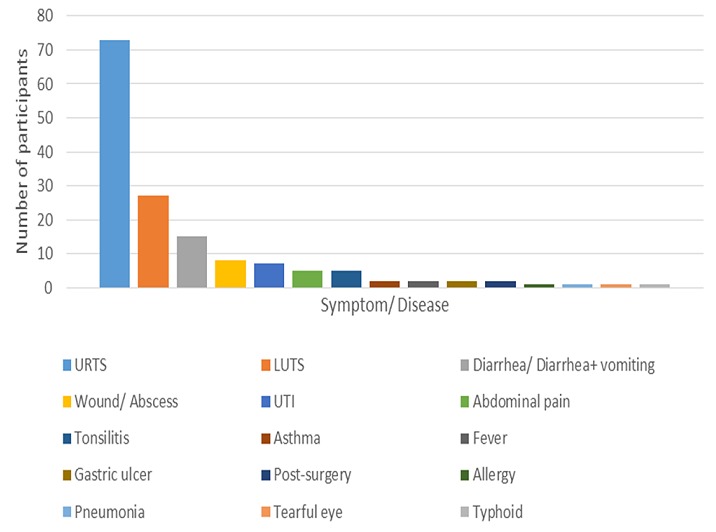
“tract symptoms, diarrhea and wounds have been reported to be the major symptoms to be treated with antibiotics in drug outlets in Ethiopia, Vietnam, China, India and Europe [10, 16, 25-27].”
BackgroundResultInfluentialSelf-medication with antibiotics—Does it really happen in Europe?
Väänänen, M. H., Pietilä, K., & Airaksinen, M. (2005) · Health Policy · doi:10.1016/j.healthpol.2005.07.001 · Cited by 193
Antibiotic Resistance: A Primer and Call to Action
Smith, R. A., M’ikanatha, N. M., & Read, A. F. (2014) · Health Communication · doi:10.1080/10410236.2014.943634 · Cited by 188
Gebeyehu, E., Mekonnen, L. B., & Azage, M. (2015) · PLoS ONE · doi:10.1371/journal.pone.0138179 · Cited by 179
Systematic Review on Irrational Use of Medicines in China and Vietnam
Mao, W., Vu, H. X., Xie, Z., Chen, W. L., & Tang, S. (2015) · PLoS ONE · doi:10.1371/journal.pone.0117710 · Cited by 171
Non-prescription sale and dispensing of antibiotics in community pharmacies in Zambia
Kalungia, A. C., Burger, J. R., Godman, B., Costa, J. D. O., & Simuwelu, C. (2016) · Expert Review of Anti-infective Therapy · doi:10.1080/14787210.2016.1227702 · Cited by 148
Shet, A., Sundaresan, S., & Forsberg, B. C. (2015) · Antimicrobial Resistance and Infection Control · doi:10.1186/s13756-015-0098-8 · Cited by 134
Mshana, S. E., Matee, M. I., & Rweyemamu, M. M. (2013) · Annals of Clinical Microbiology and Antimicrobials · doi:10.1186/1476-0711-12-28 · Cited by 125
SELF-MEDICATION WITH ANTIBIOTICS IN LITHUANIA
Beržanskytė, A., Valintėlienė, R., Haaijer‐Ruskamp, F. M., Gurevičius, R., & Grigoryan, L. (2006) · International Journal of Occupational Medicine and Environmental Health · doi:10.2478/v10001-006-0030-9 · Cited by 108
Over-the-counter acquisition of antibiotics in the Maltese general population
Borg, M., & Scicluna, E. A. (2002) · International Journal of Antimicrobial Agents · doi:10.1016/s0924-8579(02)00194-2 · Cited by 104
Erku, D., Mekuria, A. B., Surrur, A., & Gebresillassie, B. M. (2016) · Drug Healthcare and Patient Safety · doi:10.2147/dhps.s106948 · Cited by 71
Irrational use and non-prescription sale of antibiotics in Nigeria: A need for change
Faculty of Health, S. A. S., Akinyandenu, O., Akinyandenu, A., & Department of Pharmacology, C. O. M. (2014) · Journal of Scientific and Innovative Research · doi:10.31254/jsir.2014.3222 · Cited by 65 · cited 1×
“Here, a significant number of people visit drug outlets before seeing a health worker when they fall ill [7, 14, 15].”
BackgroundChalker, J. C., Vialle-Valentin, C. E., Liana, J., Mbwasi, R., Semali, I. A., Kihiyo, B., Shekalaghe, E., Dillip, A., Kimatta, S. S., Valimba, R., et al. (2015) · Antimicrobial Resistance and Infection Control · doi:10.1186/s13756-015-0075-2 · Cited by 52
Bacteremia and resistant gram-negative pathogens among under-fives in Tanzania
Christopher, A., Mshana, S. E., Kidenya, B. R., Hokororo, A., & Morona, D. (2013) · The Italian Journal of Pediatrics/Italian journal of pediatrics · doi:10.1186/1824-7288-39-27 · Cited by 51
Ilić, K., Jakovljević, E., & Škodrić-Trifunović, V. (2011) · European Journal of Pediatrics · doi:10.1007/s00431-011-1592-5 · Cited by 46
Viberg, N., Kalala, W., Mujinja, P., Tomson, G. B., & Lundborg, C. S. (2010) · BMC Infectious Diseases · doi:10.1186/1471-2334-10-270 · Cited by 46
Ahmed, M., Moremi, N., Mirambo, M. M., Hokororo, A., Mushi, M. F., Seni, J., Kamugisha, E., & Mshana, S. E. (2015) · The Italian Journal of Pediatrics/Italian journal of pediatrics · doi:10.1186/s13052-015-0151-5 · Cited by 42
Patterns of antibiotic use in the community in Denmark
Muscat, M., Monnet, D. L., Klemmensen, T., Grigoryan, L., Jensen, M. H., Andersen, M. T., Haaijer‐Ruskamp, F. M., & Sar (2006) · Scandinavian Journal of Infectious Diseases · doi:10.1080/00365540600606507 · Cited by 41
Minzi, O., & Manyilizu (2013) · Drug Healthcare and Patient Safety · doi:10.2147/dhps.s36409 · Cited by 38
Simba, D., Kakoko, D., Semali, I. A., Kessy, A. T., & Embrey, M. A. (2016) · PLoS ONE · doi:10.1371/journal.pone.0163246 · Cited by 21
Antibiotic Resistance: Challenges and Prospect for Therapy in Developing Countries
Tula, M. Y., Iyoha, O., & Iruolaje, F. (2015) · Journal of Pharmaceutical Research International · doi:10.9734/bjpr/2015/19061 · Cited by 6
Cited by
Sorted by citations
Dhingra, S., Rahman, N. A. A., Peile, E., Rahman, M., Sartelli, M., Hassali, M. A., Islam, T., Islam, S., & Haque, M. (2020) · Frontiers in Public Health · doi:10.3389/fpubh.2020.535668 · Cited by 364
Belachew, S. A., Hall, L., & Selvey, L. A. (2021) · Antimicrobial Resistance and Infection Control · doi:10.1186/s13756-020-00880-w · Cited by 187
Hou, J., Long, X., Wang, X., Li, L., Mao, D., Luo, Y., & Ren, H. (2022) · Journal of Hazardous Materials · doi:10.1016/j.jhazmat.2022.130042 · Cited by 187
Antibacterial Activity of Silver and Its Application in Dentistry, Cardiology and Dermatology
Talapko, J., Matijević, T., Juzbašić, M., Antolović-Požgain, A., & Škrlec, I. (2020) · Microorganisms · doi:10.3390/microorganisms8091400 · Cited by 159
Sono, T. M., Yeika, E., Cook, A., Kalungia, A., Opanga, S. A., Acolatse, J. E. E., Sefah, I. A., Jelić, A. G., Campbell, S., Lorenzetti, G., et al. (2023) · Expert Review of Anti-infective Therapy · doi:10.1080/14787210.2023.2259106 · Cited by 95
Metadata
- Authors
- Mboya, E. A., Sanga, L. A., & Ngocho, J. S.
- Affiliations
- Kilimanjaro Christian Medical Centre (TZ)
- Corresponding author
- Mboya, Erick Alexander
- Venue
- Pan African Medical Journal
- Publisher
- Pan African Medical Journal
- Published
- 2018
- Volume
- 31
- Pages
- 165-165
- ISSN
- 1937-8688 (ISSN-L)
- PMC
- PMC6492205
- OpenAlex
- W2899644500
- Cited by
- 117
- References
- 26
- Citations by year
- 2026: 3 · 2025: 11 · 2024: 13 · 2023: 20 · 2022: 21 · 2021: 32 · 2020: 17
- FWCI
- 7.47
- Type
- journal article
- Language
- en
- Open access
- gold
- doi.org
- Licence
- cc-by
- Locations
- Pan African Medical Journal (publishedVersion, cc-by)
- PubMed Central (publishedVersion, cc-by)
- PubMed (publishedVersion)
- LSHTM Research Online (London School of Hygiene and Tropical Medicine) (acceptedVersion)
- DOAJ (DOAJ: Directory of Open Access Journals) (submittedVersion, cc-by-sa)
- Funders
- Fogarty International Center (D43TW009573)
- Topics
- Health Sciences › Medicine › Infectious Diseases › Antibiotic Use and Resistance
- Health Sciences › Health Professions › Pharmacy › Pharmacy and Medical Practices
- Health Sciences › Medicine › Geriatrics and Gerontology › Pharmaceutical Practices and Patient Outcomes
- Keywords
- inappropriate antibiotic use, self-medication, non-prescription antibiotic use, incomplete antibiotic courses, antibiotic resistance, antibiotic knowledge, Moshi Municipality
- MeSH terms
- Adolescent, Adult, Anti-Bacterial Agents, Cross-Sectional Studies, Dose-Response Relationship, Drug, Nonprescription Drugs, Female, Humans, Health Knowledge, Attitudes, Practice, Male, Middle Aged, Practice Patterns, Physicians', Surveys and Questionnaires, Self Medication, Tanzania, Prevalence, Young Adult, Inappropriate Prescribing
About these checks
Registry, retraction, Cites and statistics results are computed, not judged, with one exception: a printed reference that no index lists is read once by a model before it counts as a citation error. Claims are extracted by a model and kept only when their quote appears verbatim in the text; each cited source is then checked, with a model’s help, for whether it says what the claim relies on. Those verdicts can be wrong — read the claim’s quote and the cited source before relying on one.
Statistics and arithmetic are recomputed, not judged.
Confidence bands are shown only for fields calibrated on our annotated test set. None is calibrated yet, so no band is shown.
What counts as a claim ›How we measure confidence ›How we check this ›
Are you an author, or do you see a problem with this page? Request a review
