

The DOI matches its Crossref record; 64 of the 66 references it cites were found in a registry or an index.
Implicit Gender Bias and the Use of Cardiovascular Tests Among Cardiologists
Open accessAbstract
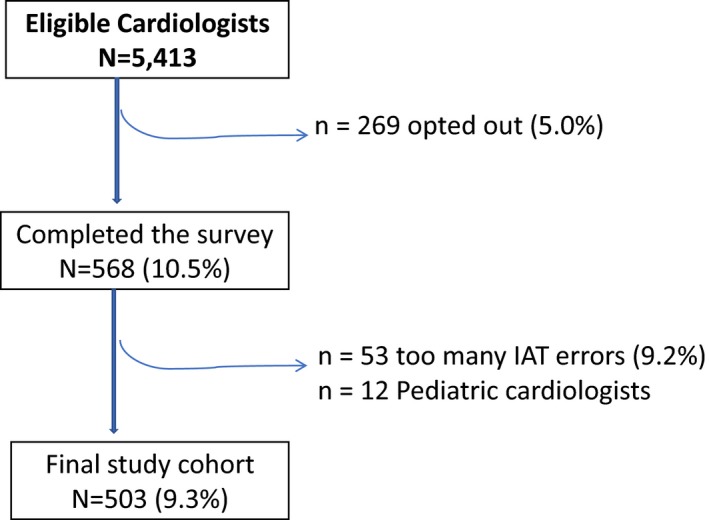
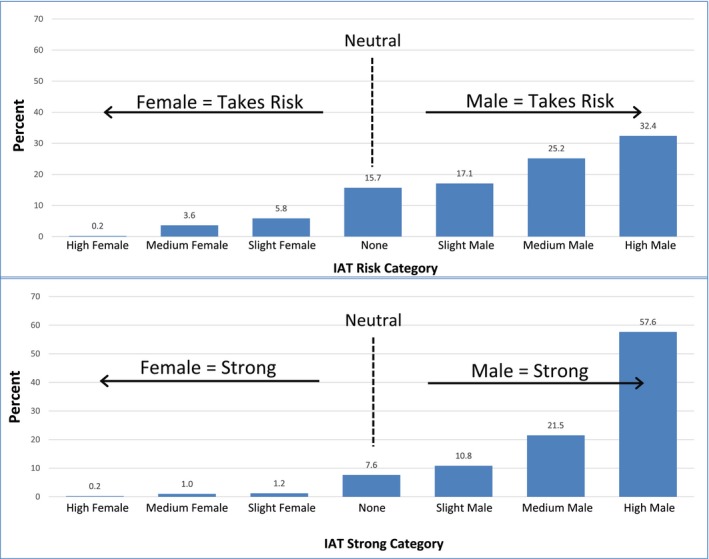
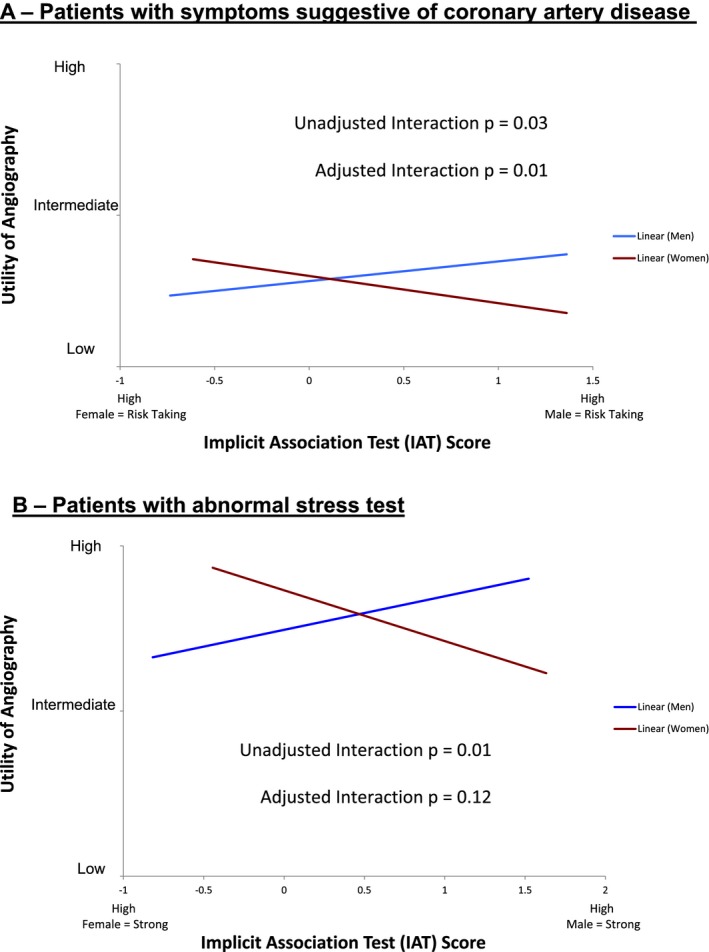
Background: Physicians' gender bias may contribute to gender disparities in cardiovascular testing. We used the Implicit Association Test to examine the association of implicit gender biases with decisions to use cardiovascular tests. Methods and Results: In 2014, cardiologists completed Implicit Association Tests and a clinical vignette with patient gender randomly assigned. The Implicit Association Tests measured implicit gender bias for the characteristics of strength and risk taking. The vignette represented an intermediate likelihood of coronary artery disease regardless of patient gender: chest pain (part 1) followed by an abnormal exercise treadmill test (part 2). Cardiologists rated the likelihood of coronary artery disease and the usefulness of stress testing and angiography for the assigned patient. Of the 503 respondents (9.3% of eligible; 87% male, median age of 45 years, 58% in private practice), the majority associated strength or risk taking implicitly with male more than female patients. The estimated likelihood of coronary artery disease for both parts of the vignette was similar by patient gender. The utility of secondary stress testing after an abnormal exercise treadmill test was rated as “high” more often for female than male patients (32.8% versus 24.3%, P =0.04); this difference did not vary with implicit bias. Angiography was more consistently rated as having “high” utility for male versus female patients (part 1: 19.7% versus 9.8%; part 2: 73.7% versus 64.3%; P <0.05 for both); this difference was larger for cardiologists with higher implicit gender bias on risk taking ( P =0.01). Conclusions: Cardiologists have varying degrees of implicit gender bias. This bias explained some, but not all, of the gender variability in simulated clinical decision‐making for suspected coronary artery disease.
Overview
The claims and statistics of this paper haven’t been checked yet.
Run the check — free, no account needed. It reads the open-access text and checks the sources it cites.
Integrity signals
Registry
Cites
Statistics
Figures
Verification
Claims the paper makes
The claims and statistics of this paper haven’t been checked yet.
Run the check — free, no account needed. It reads the open-access text and checks the sources it cites.
Claims other papers make about this one
Each is checked against this paper’s own text: does it say what the citing paper says it does?
In the citing paper
“Indeed, physicians are typically trained to recognise patterns of angina and myocardial infarction that occur more frequently in men, resulting in women being typically under-diagnosed for coronary artery disease115.”
From Sex and gender differences and biases in artificial intelligence for biomedicine and healthcare (2020) · cites this paper as [115]
Self-check
Percentages, sums and reported differences re-computed from the paper’s own numbers.
The self-check needs the paper’s full text.
Citations
Cites
Measuring individual differences in implicit cognition: the implicit association test
Greenwald, A. G., McGhee, D. E., & Schwartz, J. L. K. (1998) · Journal of Personality and Social Psychology · doi:10.1037/0022-3514.74.6.1464 · Cited by 9,210
Implicit social cognition: Attitudes, self-esteem, and stereotypes
Greenwald, A. G., & Banaji, M. R. (1995) · Psychological Review · doi:10.1037/0033-295x.102.1.4 · Cited by 6,682
Understanding and using the Implicit Association Test: I. An improved scoring algorithm.
Greenwald, A. G., Nosek, B. A., & Banaji, M. R. (2003) · Journal of Personality and Social Psychology · doi:10.1037/0022-3514.85.2.197 · Cited by 5,815
Stereotypes and prejudice: Their automatic and controlled components
Devine, P. G. (1989) · Journal of Personality and Social Psychology · doi:10.1037/0022-3514.56.1.5 · Cited by 5,673
Understanding and using the Implicit Association Test: III. Meta-analysis of predictive validity.
Greenwald, A. G., Poehlman, T. A., Uhlmann, E. L., & Banaji, M. R. (2009) · Journal of Personality and Social Psychology · doi:10.1037/a0015575 · Cited by 3,257
ACC/AHA 2002 Guideline Update for Exercise Testing: Summary Article
Gibbons, R. J., Balady, G. J., Bricker, J. T., CHAITMAN, B. R., Fletcher, G. F., Froelicher, V. F., Mark, D. B., McCallister, B. D., Mooss, A. N., O’Reilly, M. G., et al. (2002) · Circulation · doi:10.1161/01.cir.0000034670.06526.15 · Cited by 2,583
Implicit bias in healthcare professionals: a systematic review
FitzGerald, C., & Hurst, S. (2017) · BMC Medical Ethics · doi:10.1186/s12910-017-0179-8 · Cited by 2,556
The Effect of Race and Sex on Physicians' Recommendations for Cardiac Catheterization
Schulman, K. A., Berlin, J. A., Harless, W., Kerner, J. F., Sistrunk, S., Gersh, B. J., Dubé, R., Taleghani, C. K., Burke, J. E., Williams, S., et al. (1999) · New England Journal of Medicine · doi:10.1056/nejm199902253400806 · Cited by 1,934
Prescriptive Gender Stereotypes and Backlash Toward Agentic Women
Rudman, L. A., & Glick, P. (2001) · Journal of Social Issues · doi:10.1111/0022-4537.00239 · Cited by 1,881
Gender stereotypes stem from the distribution of women and men into social roles.
Eagly, A. H., & Steffen, V. J. (1984) · Journal of Personality and Social Psychology · doi:10.1037/0022-3514.46.4.735 · Cited by 1,848
Research works printed but not linked: 1
- Smedley BD, Stith AY, Nelson AR. Committee on Understanding and Eliminating Racial and Ethnic Disparities in Health Care, Board on Health Sciences Policy, and Institute of Medicine, Unequal Treatment: Confronting Racial and Ethnic Disparities in Health Care. Washington, DC: The National Academies Press; 2003.
Cited by
Sorted by citations
Items 101–149 of 149
Behavioural interventions to increase adherence to palivizumab prophylaxis in children with CHD
Erolu, E., Kıbrıs, Ö., Tosun, Y., Yıldırım, A., Pamukçu, Ö., Başar, E. Z., Babaoğlu, K., Epçaçan, S., Dönmez, Y. N., Giray, D., et al. (2024) · Cardiology in the Young · doi:10.1017/s1047951124024946 · Cited by 2
Addressing the Missing Links in Cardiovascular Aging
Dinetz, E., Zeballos-Palacios, C. L., & Martinez, C. A. (2024) · Clinical Interventions in Aging · doi:10.2147/cia.s457180 · Cited by 2
Disparate Censorship & Undertesting: A Source of Label Bias in Clinical Machine Learning
Chang, T., Sjoding, M. W., & Wiens, J. (2022) · PubMed · doi:10.48550/arxiv.2208.01127 · Cited by 4
Vigen, R., & de Lemos, J. A. (2021) · Clinical Chemistry · doi:10.1093/clinchem/hvab144 · Cited by 2
Sarafraz, L. (2021) · International Journal of Feminist Approaches to Bioethics · doi:10.3138/ijfab-14.2.06 · Cited by 1
Sex and Cardiac Operations: Are We Being Fair to Our Female Patients?
Fitton, C. A., Woodward, M., & Belch, J. J. F. (2025) · Heart Lung and Circulation · doi:10.1016/j.hlc.2024.09.007 · Cited by 1
Doshi, A., Upreti, P., Aggarwal, V., Poppas, A., Soukas, P. A., Abbott, J. D., & Vallabhajosyula, S. (2025) · The American Journal of Cardiology · doi:10.1016/j.amjcard.2025.05.003 · Cited by 1
Maia, K. A. P., Miname, M. H., Maia, F. P., Bittencourt, M. S., Mizuta, M. H., Rocha, V. Z., Chacra, A. P. M., Jannes, C. E., Pereira, A. C., Krieger, J. E., et al. (2025) · Journal of clinical lipidology · doi:10.1016/j.jacl.2025.05.006 · Cited by 1
Kumar, S., Malviya, R., Sridhar, S. B., Shareef, J., & Wadhwa, T. (2025) · Anti-Inflammatory & Anti-Allergy Agents in Medicinal Chemistry · doi:10.2174/0118715230389406250906142050 · Cited by 1
Agnihotri, M., Huang, Y., Dutt, N., Nyamathi, A., Patel, N., Rahmani, A. M., Rodriguez, V., & Agapie, E. (2026) · ACM Transactions on Computing for Healthcare · doi:10.1145/3806831 · Cited by 1
Soffer, M., Cohen, M. W., & Azaiza, F. (2021) · Journal of Racial and Ethnic Health Disparities · doi:10.1007/s40615-021-01008-5 · Cited by 2
Park, J., Seo, E. J., & Bae, S. H. (2021) · Asian Nursing Research · doi:10.1016/j.anr.2021.08.002 · Cited by 1
Schindler, E., & Reddy, P. H. (2023) · Elsevier eBooks · doi:10.1016/b978-0-443-15256-6.00001-5 · Cited by 1
The Impact of Gender and Race When Using the GRACE ACS Score to Predict Mortality
Ogbu, I. R., Ayutyanont, N., Wilson, S., & Akhondi, H. A. (2023) · HCA Healthcare Journal of Medicine · doi:10.36518/2689-0216.1426 · Cited by 1
Tegg, N. L., Ahmed, S. B., Southern, D. A., Shlakhter, O., & Norris, C. M. (2023) · CJC Open · doi:10.1016/j.cjco.2023.09.003 · Cited by 1
Munguía-Galaviz, F. J., Salazar-González, H., & Echavarría, R. (2024) · Integrated science · doi:10.1007/978-3-031-64288-3_13 · Cited by 1
Improving Cardiovascular Care for Women: An Evidenced‐Based Practice Project
Babeaux, R. T. (2025) · Worldviews on Evidence-Based Nursing · doi:10.1111/wvn.70018 · Cited by 1
From background to solutions: Eliminating sex gaps in clinical electrophysiology practice
Amuthan, R., & Curtis, A. B. (2022) · Heart Rhythm O2 · doi:10.1016/j.hroo.2022.09.004 · Cited by 2
Ordovas, K. G. (2021) · Radiographics · doi:10.1148/rg.2021210202 · Cited by 1
Núñez, M., Allende, M. I., González, F., Cavada, G., Anderson, C. S., & Venturelli, P. M. (2023) · medRxiv · doi:10.1101/2023.11.22.23298935 · Cited by 1
Collins, B. (2018) · Digital Access to Scholarship at Harvard (DASH) (Harvard University)
Indian Journal of Cardiovascular Diseases in Women: Charting a New Course!
Alugubelli, N. R., & Alla, V. M. (2020) · Indian Journal of Cardiovascular Disease in Women · doi:10.1055/s-0040-1709373
Sex Differences in Young Adults Who Experience Myocardial Infarction
DeFilippis, E. M., Wu, W. Y., Lau, E. S., Blankstein, R., & Divakaran, S. (2020) · Current Treatment Options in Cardiovascular Medicine · doi:10.1007/s11936-020-00870-6
Marcaccio, C., & Schermerhorn, M. (2021) · Vascular Disease in Women · doi:10.1016/b978-0-12-822959-0.00006-7
Riesgo cardiovascular en la mujer diabética
Molina, D. I., & Salazar-Espinosa, J. F. (2021) · Revista Colombiana de Cardiología · doi:10.24875/rccar.m21000077
Boudec, J. L., Félix, S., Gachoud, D., Monti, M., Barazzoni, M. S., & Clair, C. (2020) · Research Square · doi:10.21203/rs.3.rs-61600/v1
MANIFESTAÇÕES NEUROLÓGICAS CAUSADAS PELA INFECÇÃO POR SARS-COV-2: UMA REVISÃO DE LITERATURA
Gasparoto, V. G., Ferreira, C. L. D. S., Talarico, A. L. D. S. C., Silqueira, B. G., Cazeloto, A. C. V., & Papassidero, P. C. (2022) · doi:10.22533/at.ed.70822240610
Faria, T. V. V., Agostinho, S. R., Lopes, P. D. A. C., Nose, A. L. Y., & Maciel, T. A. D. S. (2022) · doi:10.22533/at.ed.7082224069
Neto, J. F. D. A., de Lima, L. F. G., Neto, O. D. C. F., Dias, A. J. A., Lemos, N. B., Diniz, A. M. S., & Severo, L. (2022) · doi:10.22533/at.ed.7082224068
O VALOR SEMIÓTICO DO SINAL DE SOARES EM VIDEOLAPAROSCOPIA: SINAL DE PROBABILIDADE OU DE PRESUNÇÃO
Barbosa, C. D. A., da Cunha, A. J., Fernandes, M. M., Santiago, T. C., de Souza, F. A. M., da Cunha, D. H., Tannús, L. M. D. S., Guimarães, M. F., & de Oliveira, A. L. M. F. (2022) · doi:10.22533/at.ed.70822240611
A IMPORTÂNCIA DOS MÉTODOS NÃO FARMACOLÓGICOS NO TRATAMENTO DA DEPRESSÃO
Drillard, I. D. O., Zacarias, W. R., Siqueira, B. D. R., Cunha, C. A. P., Coelho, L. S. Z., Barbieri, V. X., da Costa, E. D. C., Duarte, M. E. D. C., & Júnior, H. S. D. F. (2022) · doi:10.22533/at.ed.7082224061
PANORAMA EPIDEMIOLÓGICO DOS INTERNADOS POR SEPTICEMIA NO BRASIL (2016-2020)
Francis, G. H. F., Júnior, P. R. H., Machado, N. D. O. F., Costa, V. E. N., Telhada, A. A. C. M., Esteves, G. S., Neto, R. M. B., Côrtes, J. V. D. R., Bastos, R. M., & Côrtes, P. P. D. R. (2022) · doi:10.22533/at.ed.7082224065
EFEITOS DA REABILITAÇÃO NA CAPACIDADE FUNCIONAL DE PACIENTES COM COVID-19
Corrêa, M. S. D. S., Moura, N. L. C., & Fernandes, G. A. (2022) · doi:10.22533/at.ed.7082224064
ATUAÇÃO DA FISIOTERAPIA ONCOLÓGICA NOS CUIDADOS PALIATIVOS EM CRIANÇAS COM OSTEOSSARCOMA
Mendonça, A. R. T., Figueiredo, D. T., da Silva, J. S., Júnior, W. C. C., Tavera, G. C., Neves, W. P., Amorim, J. D. D. O., Santana, M. D. A., Cardoso, A. C. D. A., Castelo, E. A. M., et al. (2022) · doi:10.22533/at.ed.7082224062
SUBTRATAMENTO DA DOR EM MULHERES: COMO OS PAPÉIS DE GÊNERO INFLUENCIAM ESSA DISPARIDADE?
Ribas, L. A., Silva, Y. L., de Menezes, M. D. M. C., Júnior, P. R. H., de Oliveira, J. B., Gomes, J. Y. H., Amorim, T. A., Montalvão, A. M., Oliveira, B. G., Pinheiro, M. T., et al. (2022) · doi:10.22533/at.ed.70822240620
Escepticismo y feminismo Una alianza posible
Quintero, C. G., & Wolf, A. B. (2023) · Ideas y Valores · doi:10.15446/ideasyvalores.v72n10supl.111019
Basilar artery occlusion management: An international survey of gender influence on management
Peacock, M., Drumm, B., Klein, P., Raymond, J., Huo, X., Chen, Y., Abdalkader, M. K., Schonewille, W. J., Liu, X., Hu, W., et al. (2024) · Interventional Neuroradiology · doi:10.1177/15910199241265590
Kotani, K. (2025) · Health Science Reports · doi:10.1002/hsr2.70997
Robinson, R. (2025) · medRxiv · doi:10.1101/2025.08.15.25333803
Frauen und Herz-Kreislauf-Erkrankungen – warum ist ein geschlechtersensibler Ansatz unverzichtbar?
Sido, V., & Oertelt‐Prigione, S. (2025) · Die Innere Medizin · doi:10.1007/s00108-025-02025-w
From the margins to the center: Transforming cardiovascular care for women
Wade, J., Ameyaw, E. K., & Lassi, Z. S. (2025) · Women s Health · doi:10.1177/17455057251406947
What can IR learn from disability studies? Debility, capacity and power in the case of COVID-19
Hobbs, J. (2025) · European Journal of International Relations · doi:10.1177/13540661251401764 · Cited by 1
Pilot investigation into the influence of racial implicit bias on physician clinical reasoning
González, C. M., Deno, M. L., Ark, T. K., Helft, M., Connor, D. M., Kalet, A. L., Burgess, D. J., Samuel, M. T., Fisher, M. R., & Durning, S. J. (2026) · Diagnosis · doi:10.1515/dx-2025-0123
Platanis, M. J., McDonnell, K. K., Slone, S., Thamman, R., & Wickersham, K. E. (2026) · medRxiv · doi:10.64898/2026.01.29.26345174
Ruiz-Nodar, J. M., Quesada, J., López‐Pineda, A., Cordero, A., Soriano, C., Arrarte, V., Sánchez-Ferrer, F., & Bertomeu‐González, V. (2026) · The Journal of Cardiovascular Nursing · doi:10.1097/jcn.0000000000001275
On the contextuality of gender biases in pain care: theory and evidence
Bernardes, S. F., & Samulowitz, A. (2026) · Health Psychology Review · doi:10.1080/17437199.2026.2643504
Maughan, B. C., Jarman, A. F., Westafer, L. M., Holmes, J. F., Kline, J. A., Casey, S. D., Patrick, N., & Vinson, D. R. (2026) · Research and Practice in Thrombosis and Haemostasis · doi:10.1016/j.rpth.2026.106791
Miller, S., Simpson, J., Flores, C., Ritz, E., Luger, D., Altenburg, M., & Volgman, A. S. (2026) · Journal of the American Heart Association · doi:10.1161/jaha.125.048298
Lindahl, B., Nordenskjöld, A. M., Pasupathy, S., Tavella, R., Agewall, S., Atar, D., Baron, T., Bergström, O., Erlinge, D., Gale, C. P., et al. (2026) · American Heart Journal Plus Cardiology Research and Practice · doi:10.1016/j.ahjo.2026.100856
Metadata
- Authors
- Daugherty, S. L., Blair, I. V., Havranek, E. P., Furniss, A., Dickinson, L. M., Karimkhani, E., Main, D. S., & Masoudi, F. A.
- Affiliations
- University of Colorado Anschutz (US)
- University of Colorado Boulder (US)
- Denver Health Medical Center (US)
- University of Colorado Denver (US)
- Corresponding author
- Daugherty, Stacie L.
- ORCID
- Venue
- Journal of the American Heart Association
- Published
- 2017-12-02
- Volume
- 6
- Issue
- 12
- ISSN
- 2047-9980 (ISSN-L)
- PMC
- PMC5779009
- OpenAlex
- W2769597399
- Cited by
- 150
- References
- 66
- Citations by year
- 2026: 10 · 2025: 17 · 2024: 18 · 2023: 21 · 2022: 27 · 2021: 30 · 2020: 18 · 2019: 7 · 2018: 2
- FWCI
- 6.93
- Type
- journal article
- Language
- en
- Open access
- gold
- doi.org
- Licence
- cc-by-nc
- Locations
- Journal of the American Heart Association (publishedVersion, cc-by-nc)
- PubMed Central (publishedVersion, cc-by-nc)
- PubMed (publishedVersion)
- CU Scholar (University of Colorado Boulder) (submittedVersion, cc-by-nd)
- DOAJ (DOAJ: Directory of Open Access Journals) (submittedVersion)
- Funders
- National Heart, Lung, and Blood Institute (R01HL133343, K08HL103776)
- Topics
- Health Sciences › Medicine › Public Health, Environmental and Occupational Health › Sex and Gender in Healthcare
- Social Sciences › Gender Studies › Diversity and Career in Medicine
- Health Sciences › Medicine › Family Practice › Clinical Reasoning and Diagnostic Skills
- Keywords
- implicit gender bias, gender disparities, cardiovascular testing, cardiologists, coronary artery disease, stress testing, angiography, treadmill exercise testing, clinical decision-making, Implicit Association Test, patient gender
- MeSH terms
- Clinical Decision-Making, Cardiologists, Exercise Test, Humans, Sex Factors, United States, Sex Distribution, Healthcare Disparities
About these checks
Registry, retraction, Cites and statistics results are computed, not judged, with one exception: a printed reference that no index lists is read once by a model before it counts as a citation error. Claims are extracted by a model and kept only when their quote appears verbatim in the text; each cited source is then checked, with a model’s help, for whether it says what the claim relies on. Those verdicts can be wrong — read the claim’s quote and the cited source before relying on one.
Statistics and arithmetic are recomputed, not judged.
Confidence bands are shown only for fields calibrated on our annotated test set. None is calibrated yet, so no band is shown.
What counts as a claim ›How we measure confidence ›How we check this ›
Are you an author, or do you see a problem with this page? Request a review
