

Difference-in-Differences Estimators of Intertemporal Treatment Effects
Open accessThe DOI matches its Crossref record, with a small difference in title or year; 82 of the 82 references it cites were found in a registry or an index; 28 of the 40 sources its claims cite were checked for support.
Abstract
We study treatment-effect estimation using panel data. The treatment may be nonbinary, nonabsorbing, and the outcome may be affected by treatment lags. We make a parallel-trends assumption and propose event-study estimators of the effect of being exposed to a weakly higher treatment dose for ℓ periods. We also propose normalized estimators that estimate a weighted average of the effects of the current treatment and its lags. We also analyze commonly used two-way fixed-effects regressions. Unlike our estimators, they can be biased in the presence of heterogeneous treatment effects. A local-projection version of those regressions is biased even with homogeneous effects.
Overview
CoChat Summary
TL;DR
The paper develops difference-in-differences estimators for panel data where treatment can be nonbinary, nonabsorbing, and have lagged effects, without imposing homogeneous treatment effects. It proposes reduced-form and normalized event-study estimators plus a cost-benefit parameter, shows common TWFE dynamic regressions can be biased or contaminated, and revisits banking deregulation effects.
Key findings
- The proposed \(DID_\ell\) and normalized \(DID^n_\ell\) estimators are conditionally unbiased under no-anticipation and parallel trends conditional on the period-one treatment; \(DID^n_\ell\) estimates a weighted average of the current treatment and its first \(\ell-1\) lags, and a weighted sum of \(DID_\ell\)’s yields a cost-benefit parameter interpretable as an average total effect per unit of treatment.
- In a census of 100 highly cited AER papers from 2015–2019, 26 estimate TWFE regressions, but only four have a binary-and-staggered treatment; among the 20 non-binary/non-staggered papers, 11 estimate only static TWFE and nine estimate dynamic effects using intensity-period FE, local-projection, or distributed-lag regressions.
- The paper shows those three common TWFE dynamic methods may not estimate a convex combination of the paper’s \(\delta_{g,\ell}\) effects, may violate no-sign reversal, and local-projection panel regressions are contaminated by other exposure lengths and can be biased or wrong-signed even with constant effects.
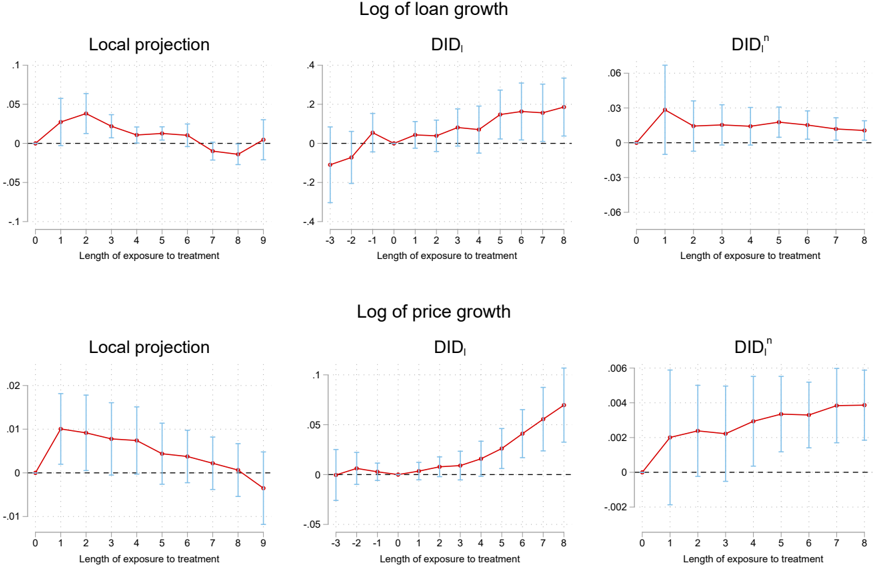
- In the banking-deregulation application, local-projection coefficients are positive and significant through \(\ell=5\), insignificant at \(\ell=6,7,9\), and significantly negative at \(\ell=8\); the paper’s \(DID_1=0.043\) (s.e. \(0.035\)), \(DID_3=0.081\) (s.e. \(0.049\)), \(DID_5=0.148\) (s.e. \(0.064\)), placebos jointly insignificant (\(p=0.400\)), and the test that \(\ell \mapsto DID^n_\ell\) is constant is not rejected (\(p=0.328\)). For house prices, \(DID_1=0.003\) (s.e. \(0.004\)), \(DID_4=0.016\) (s.e. \(0.009\)), \(DID_5=0.026\) (s.e. \(0.010\)), and placebos are jointly insignificant (\(p=0.703\)).
Methods
- Panel of \(G\) groups observed over \(T\) periods, with dynamic potential outcomes allowing current outcomes to depend on current and lagged treatments; identifying assumptions include no anticipation, parallel trends for the status-quo outcome conditional on the period-one treatment, and a no-crossing condition, plus a design restriction requiring groups with the same period-one treatment and variation in first-treatment-change timing.
- Estimators compare switchers to not-yet-switchers with the same period-one treatment; the paper aggregates group-level \(DID_{g,\ell}\)’s into event-study effects, proposes normalized versions, placebo estimators, and asymptotic inference as \(G\to\infty\) under independent groups and regularity conditions, with confidence intervals conservative unless groups are i.i.d.
- Application revisits Favara and Imbs (2015) using 1994–2005 county-level banking deregulation data; treatment is the number of restrictions lifted (0–4); eight states never deregulate, 33 deregulate once, eight twice, and one three times; 38 of 42 deregulating states first do so in 1995–1998; \(DID_1\) and \(DID_8\) apply to 905 and 773 counties, respectively, and only three placebos apply to more than 50% of the 905 counties whose treatment changes at least once.
Limitations
- The paper states that the initial-conditions problem is not accounted for in the baseline notation; Assumption 1 rules out continuous period-one treatment, extremely non-persistent treatment, and no or universal treatment change; Assumption 4 may be implausible for some baseline-treatment values; \(\delta_\ell\)’s interpretation is complicated outside Design 1; \(\delta^n_\ell\) averages different lags and individual lag slopes are not estimable under Assumptions 3–4; cost-benefit analysis requires converting outcomes to monetary equivalents and assumes linear, non-stochastic treatment costs; inference is conservative in the i.n.i.d. setup unless groups are i.i.d.; and the local-projection issues are specific to the panel Regression 2, absent in time-series local projections and in Dube et al. (2023).
- The paper states placebos may fail to detect parallel-trends violations large enough to substantially bias \(DID_\ell\); in the application, only three placebos apply to more than 50% of the 905 counties, parallel trends can only be tested over three years whereas eight years are needed for \(DID_8\), loan-volume placebos are relatively large and imprecisely estimated, and \(DID_9\)–\(DID_{11}\) are not reported because they apply to small subsamples (357, 238, and 1 county).
- Evident from the text: several application estimates are imprecise (e.g., \(DID_1=0.043\) with s.e. \(0.035\); \(DID^n_1\) is much larger but imprecisely estimated); the paper proves weights sum to less than one in binary-and-staggered designs but only finds this in the non-binary/non-staggered application without a formal proof; and the design-conditional parameters may only partially uncover the structural function mapping current, lagged, and future treatments to outcomes.
Model-written summary. Check it against the paper before relying on it.
Integrity signals
Registry
Cites
Statistics
Figures
Verification
Claims the paper makes
19 Valid · 10 Not valid · 7 Not checked · 214 Own results and interpretations
Some cited sources support this claim and some don’t — read each source’s verdict below.
In the paper
“de Chaisemartin and D'Haultfœuille (2018) and de Chaisemartin and D'Haultfœuille (2020) had already noted that in a model assuming away effects of lagged treatments on the outcome, parallel trends across groups with different baseline treatments essentially rules out time-varying effects.”
What the sources say
- Partly supportedcites de Chaisemartin and D'Haultfœuille (2018) sourceExperimental — accuracy not yet measured
Section 2.2 says that the average treatment effect among units treated at baseline must be stable over time for the Wald-DID result. But it presents this as Assumption 4, separate from the common-trends Assumption 3; it does not say that parallel trends across groups with different baseline treatments itself rules out time-varying effects. Section 2.3 instead proposes an estimator that does not require that stability assumption. (LLM, conf=0.78)
- Disputedcites de Chaisemartin and D'Haultfœuille (2020) sourceExperimental — accuracy not yet measured
Split into 2 atoms — 1 confirmed, 0 partially supported, 1 disputed, 0 misattributed, 0 unverifiable. Expand the claim to see per-atom verdicts.
Checked by a reasoning model — may be wrong.
plain- Asserted: passes — The authors put it forward as true.
- Checkable: passes — It can be checked against evidence.
- Load-bearing: passes — The paper’s conclusions depend on it.
- Based: passes — The paper gives a reason why it holds.
- Partly supported
Every source the paper cites for this claim was checked and supports it.
In the paper
“DID 1 also reduces to the DID M estimator of de Chaisemartin and D'Haultfœuille (2020).”
What the sources say
- Supportedcites de Chaisemartin and D'Haultfœuille (2020) source
Section 4 (‘An alternative estimator’) defines DID_M as the authors’ estimator and describes it as a weighted average of the component DID estimators. The citation identifies the estimator to which the citing authors say DID_1 reduces; it does not attribute their reduction result to this source. (LLM, conf=0.90)
plainstates a cause- Asserted: passes — The authors put it forward as true.
- Checkable: passes — It can be checked against evidence.
- Load-bearing: unclear — It is unclear whether the paper’s conclusions depend on it.
- Based: passes — The paper gives a reason why it holds.
- Supported
The cited sources support only part of this claim — read each source’s verdict below.
In the paper
“In non-binary and/or non-staggered designs, when all groups are untreated at period one, DID ℓ is equivalent to the estimator obtained by: 1. redefining the treatment as an indicator equal to one if group g has ever received a non-zero treatment at t , as Deryugina (2017) or Krolikowski (2018), among others, have done in their empirical analysis; 2. computing the estimator of θ es ( ℓ -1) of Calla”
What the sources say
- Partly supportedcites Callaway and Sant'Anna (2021) sourceExperimental — accuracy not yet measured
Split into 2 atoms — 1 confirmed, 1 partially supported, 0 disputed, 0 misattributed, 0 unverifiable. Expand the claim to see per-atom verdicts.
- Not checked — no full text of the sourcecites Deryugina (2017) source
- Supportedcites Krolikowski (2018) source
Split into 2 atoms — 2 confirmed, 0 partially supported, 0 disputed, 0 misattributed, 0 unverifiable. Expand the claim to see per-atom verdicts.
plain- Asserted: passes — The authors put it forward as true.
- Checkable: passes — It can be checked against evidence.
- Load-bearing: unclear — It is unclear whether the paper’s conclusions depend on it.
- Based: passes — The paper gives a reason why it holds.
- Rests on an assumption not shown here.
- Partly supported
Every source the paper cites for this claim was checked and supports it.
In the paper
“In binary and staggered designs, our DID ℓ estimators reduce to the estimators of the event-study parameters θ es ( ℓ -1) of Callaway and Sant'Anna (2021), using not-yet-treated as controls.”
What the sources say
- Supportedcites Callaway and Sant'Anna (2021) source
Section 3.1.1 (page unavailable) defines Callaway and Sant’Anna’s event-study parameter θ_es(e), with event time e measured from treatment adoption. Section 2.3 (page unavailable) explicitly allows not-yet-treated groups as controls. The statement that the citing authors’ DID_l estimators reduce to those estimators is their own comparison, not a result attributed to this source. (LLM, conf=0.86)
plainstates a cause- Asserted: passes — The authors put it forward as true.
- Checkable: passes — It can be checked against evidence.
- Load-bearing: unclear — It is unclear whether the paper’s conclusions depend on it.
- Based: passes — The paper gives a reason why it holds.
- Supported
The cited sources that could be checked couldn’t confirm or dispute this claim.
In the paper
“These findings differ sharply from those obtained by Favara and Imbs (2015).”
What the sources say
- Could not verifycites Favara and Imbs (2015) sourceExperimental — accuracy not yet measured
The cited paper’s Credit Supply and the Price of Housing section reports findings on the response of lending to branching deregulation. The citing sentence does not identify what “these findings” are, so our copy cannot establish whether they differ sharply from Favara and Imbs’s findings. (LLM, conf=0.76)
boosted- Asserted: passes — The authors put it forward as true.
- Checkable: passes — It can be checked against evidence.
- Load-bearing: passes — The paper’s conclusions depend on it.
- Based: passes — The paper gives a reason why it holds.
- Could not verify
140 more claims · 6 with their cited sources checked
Create a free account to see all 250 claims and every source verdict.
- It may state two separate claims as one. 52
- Probably not a substantial claim. 60
- Borderline: one of the tests for a substantial claim is unclear. 1
- The quote only partly states this claim. 2
Claims other papers make about this one
Each is checked against this paper’s own text: does it say what the citing paper says it does?
The cited source says what the claim attributes to it.
In the citing paper
“I estimate Equation ( 1) using the estimator developed by de Chaisemartin and D'Haultfœuille (2026), hereafter dCDH, to accommodate the possibility that websites may re-allow the OAI-SearchBot crawler after having blocked it, causing the treatment status indicator, 𝐷𝐷 𝑖𝑖,𝑡𝑡 , to switch off.”
From Opting Out of Generative AI? Training Data, Search Visibility, and the Traffic Rankings of News Publishers (2026) · cites this paper as de Chaisemartin and D'Haultfœuille (2026)
In the citing paper
“The dCDH estimator, like many modern DID estimators, constructs counterfactual outcomes from untreated units and incorporates covariates within the estimation procedure rather than through a conventional regression specification.”
From Opting Out of Generative AI? Training Data, Search Visibility, and the Traffic Rankings of News Publishers (2026) · cites this paper as de Chaisemartin & D'Haultfœuille (2026)
In the citing paper
“The dCDH estimator, however, accommodates treatment reversals, so the baseline specification retains these websites in the sample.”
From Opting Out of Generative AI? Training Data, Search Visibility, and the Traffic Rankings of News Publishers (2026) · cites this paper as de Chaisemartin C, D'Haultfœuille X (2026)
Self-check
Percentages, sums and reported differences re-computed from the paper’s own numbers.
Each contradiction between two passages listed here was confirmed by an independent check.
Rated minor: it would not touch a result — a value no result rests on, a p-value that stays on the same side of the significance level, or a conflict that is clerical, resolved elsewhere in the paper, or outside its own findings.
In the paper
§ 1.1 Placebo estimators
“One may have L pl = -1, if all groups that switch treatment do so for the first time at period 2.”
§ 1.1 Placebo estimators
“Then, let L pl = max g { min( T g -F g +1 , F g -2) } .”
Citations
Cites
How Much Should We Trust Differences-in-Differences Estimates?
Bertrand, M., Duflo, E., & Mullainathan, S. (2004) · The Quarterly Journal of Economics · doi:10.1162/003355304772839588 · Cited by 10,641
Mostly Harmless Econometrics: An Empiricist's Companion
Angrist, J. D., & Pischke, J.-S. (2009) · doi:10.1515/9781400829828 · Cited by 9,467
Difference-in-Differences with multiple time periods
Callaway, B., & Sant’Anna, P. H. C. (2021) · Journal of Econometrics · doi:10.1016/j.jeconom.2020.12.001 · Cited by 9,126
Difference-in-differences with variation in treatment timing
Goodman-Bacon, A. (2021) · Journal of Econometrics · doi:10.1016/j.jeconom.2021.03.014 · Cited by 8,046
Estimating dynamic treatment effects in event studies with heterogeneous treatment effects
Sun, L., & Abraham, S. (2021) · Journal of Econometrics · doi:10.1016/j.jeconom.2020.09.006 · Cited by 5,518
Mostly Harmless Econometrics: An Empiricist's Companion
Angrist, J. D., & Pischke, J.-S. (2008) · doi:10.2307/j.ctvcm4j72 · Cited by 5,051
Two-Way Fixed Effects Estimators with Heterogeneous Treatment Effects
de Chaisemartin, C., & D’Haultfœuille, X. (2020) · American Economic Review · doi:10.1257/aer.20181169 · Cited by 5,031
Self-citationEstimation and Inference of Impulse Responses by Local Projections
Jordà, Ò. (2005) · American Economic Review · doi:10.1257/0002828053828518 · Cited by 4,677
Identification and estimation of local average treatment effects
Imbens, G. W., & Angrist, J. D. (1994) · Econometrica · doi:10.2307/2951620 · Cited by 4,101
Robins, J. (1986) · Mathematical Modelling · doi:10.1016/0270-0255(86)90088-6 · Cited by 2,451
Cited by
Items 101–200 of 746
Innovation-driven cities: Reconciling economic growth and ecological sustainability
Chen, F., Zhu, L., Zhang, H., & Li, Y. (2025) · Sustainable Cities and Society · doi:10.1016/j.scs.2025.106230 · Cited by 17
Rent-Seeking through collective bargaining: Teachers unions and education production☆
Cook, J., Lavertu, S., & Miller, C. (2021) · Economics of Education Review · doi:10.1016/j.econedurev.2021.102193 · Cited by 19
Inference in difference‐in‐differences: How much should we trust in independent clusters?
Ferman, B. (2023) · Journal of Applied Econometrics · doi:10.1002/jae.2955 · Cited by 24
Mobile Internet and the Rise of Communitarian PoliticsPreprint
Manacorda, M., Tabellini, G., & Tesei, A. (2023) · SSRN Electronic Journal · doi:10.2139/ssrn.4411693 · Cited by 19
Changes in Health Care Workers’ Economic Outcomes Following Medicaid Expansion
Matta, S., Chatterjee, P., & Venkataramani, A. S. (2024) · JAMA · doi:10.1001/jama.2023.27014 · Cited by 14
Jiao, J., Zhang, Q., Jiang, R., & Lyu, G. (2025) · Journal of Transport Geography · doi:10.1016/j.jtrangeo.2025.104170 · Cited by 17
Do urgent care centers reduce Medicare spending?
Currie, J., Karpova, A., & Zeltzer, D. (2023) · Journal of Health Economics · doi:10.1016/j.jhealeco.2023.102753 · Cited by 13
Does patent pledge reduce pollution and carbon emissions? Evidence from China
Gong, Y., Cao, H., & Yuan, L. (2024) · Environmental Research · doi:10.1016/j.envres.2024.118274 · Cited by 16
Synthetic Difference-In-Differences Estimation With Staggered Treatment TimingPreprint
Porreca, Z. J. (2022) · SSRN Electronic Journal · doi:10.2139/ssrn.4015931 · Cited by 14
Two-Way Fixed Effects and Differences-in-Differences Estimators with Several TreatmentsPreprint
de Chaisemartin, C., & D’Haultfœuille, X. (2022) · SSRN Electronic Journal · doi:10.2139/ssrn.4037008 · Cited by 17
Self-citationCompetition and Defaults in Online SearchPreprint
Decarolis, F., Li, M., & Paternollo, F. (2023) · SSRN Electronic Journal · doi:10.2139/ssrn.4660406 · Cited by 20
Tax incentives and environmental performance: The pay-as-you-throw policy in Emilia-Romagna, Italy
Matteo, D. D., & Guadagno, E. (2024) · Journal of Cleaner Production · doi:10.1016/j.jclepro.2024.143659 · Cited by 17
The Labor Market Effects of Legal Restrictions on Worker Mobility
Johnson, M. S., Lavetti, K., & Lipsitz, M. (2025) · Journal of Political Economy · doi:10.1086/736217 · Cited by 32
Distelhorst, G., & Shin, J. (2023) · Journal of Accounting Research · doi:10.1111/1475-679x.12472 · Cited by 18
Desbureaux, S., Kabore, I., Vaglietti, G., Baghai, M., Lindsey, P. A., Robson, A., Delacote, P., & Leblois, A. (2024) · Proceedings of the National Academy of Sciences · doi:10.1073/pnas.2411348121 · Cited by 21
Organizational Capacity and Profit Shifting
Bilicka, K., & Scur, D. (2021) · Journal of Public Economics · doi:10.1016/j.jpubeco.2024.105179 · Cited by 22
Intergenerational health effects of Medicaid
Noghanibehambari, H. (2022) · Economics & Human Biology · doi:10.1016/j.ehb.2022.101114 · Cited by 30
The Local Economic Impacts of Prisons
Chirakijja, J. (2022) · The Review of Economics and Statistics · doi:10.1162/rest_a_01267 · Cited by 24
Mobile Internet and the Rise of Communitarian PoliticsPreprint
Manacorda, M., Tabellini, G., & Tesei, A. (2022) · SSRN Electronic Journal · doi:10.2139/ssrn.4235470 · Cited by 16
The Deterrent Effect of Tort Law: Evidence from Medical Malpractice Reform
Zabinski, Z., & Black, B. S. (2013) · Journal of Health Economics · doi:10.1016/j.jhealeco.2022.102638 · Cited by 25
The employment effects of working time reductions: Sector‐level evidence from European reforms
Batut, C., Garnero, A., & Tondini, A. (2022) · Industrial Relations A Journal of Economy and Society · doi:10.1111/irel.12323 · Cited by 12
Arnold, D. R., King, J. S., Fulton, B. D., Montague, A. D., Gudiksen, K. L., Greaney, T. L., & Scheffler, R. M. (2024) · Health Services Research · doi:10.1111/1475-6773.14291 · Cited by 12
Thombs, R. P., Zhang, W., & Sovacool, B. K. (2025) · Environmental Research Letters · doi:10.1088/1748-9326/adbfae · Cited by 12
Mafia doesn't live here anymore: Antimafia policies and housing prices
Calamunci, F. M., Ferrante, L., Scebba, R., & Torrisi, G. (2023) · Journal of Regional Science · doi:10.1111/jors.12647 · Cited by 12
Zirgulis, A. (2023) · Regional Studies · doi:10.1080/00343404.2023.2228358 · Cited by 11
Wang, W., Yang, Z., Chen, J., & Liu, J. (2025) · Economic Modelling · doi:10.1016/j.econmod.2025.107024 · Cited by 15
Urban Political Structure and Inequality: Political Economy Lessons from Early Modern German Cities
Schaff, F. (2024) · The Journal of Economic History · doi:10.1017/s0022050724000135 · Cited by 11
Voters’ influence on local tax policy
Allers, M., & Rienks, H. (2024) · European Journal of Political Economy · doi:10.1016/j.ejpoleco.2024.102575 · Cited by 12
How distortive are turnover taxes? Evidence from China
Xing, J., Bilicka, K., Hou, X., & Raei, S. (2024) · Journal of Development Economics · doi:10.1016/j.jdeveco.2024.103332 · Cited by 18
Globalization and Conflicts: the Good, the Bad, and the Ugly of Corporations in Africa
Sonno, T. (2024) · The Economic Journal · doi:10.1093/ej/ueae103 · Cited by 36
Gone with the wind? Impacts of hurricanes on college enrollment and completion
Liu, F., Geng, K., & Chen, F. (2025) · Journal of Environmental Economics and Management · doi:10.1016/j.jeem.2025.103203 · Cited by 23
From fees to free: User fee removal, maternal health care utilization and child health in Zambia
Renard, Y. (2022) · World Development · doi:10.1016/j.worlddev.2022.105891 · Cited by 14
Read my lips? Taxes and elections
Fuest, C., Gründler, K., Potrafke, N., et al. (2024) · Journal of Public Economics · doi:10.1016/j.jpubeco.2024.105149 · Cited by 10
Pafadnam, N. A. R. (2024) · European Journal of Political Economy · doi:10.1016/j.ejpoleco.2024.102584 · Cited by 18
Pi, Y., & Wang, Y. (2024) · Transportation Research Part A Policy and Practice · doi:10.1016/j.tra.2024.104334 · Cited by 17
Digital gratification: short video consumption and mental health in rural China
Zhang, C., & Zhu, B. (2025) · Frontiers in Public Health · doi:10.3389/fpubh.2025.1536191 · Cited by 17
Urbanization and land finance dependence: Insights from China
Chen, S., Tian, C., Dong, S., et al. (2025) · Economic Modelling · doi:10.1016/j.econmod.2025.107253 · Cited by 10
Public environmental complaints and regulatory intensity
Zhang, J., Elliott, R., Zhang, B., & Liu, M. (2025) · Journal of Environmental Economics and Management · doi:10.1016/j.jeem.2025.103221 · Cited by 13
Competition and bank dividends
Chronopoulos, D. K., Johari, E. E. C., Scholtens, B., Sobiech, A. L., Wilson, J. O. S., & Yılmaz, M. H. (2023) · Journal of International Money and Finance · doi:10.1016/j.jimonfin.2023.102898 · Cited by 13
Weill, J., Stigler, M., Deschênes, O., & Springborn, M. (2021) · National Bureau of Economic Research · doi:10.3386/w29550 · Cited by 13
Guo, H., & Yuqin, Z. H. U. (2026) · Agricultural and Food Economics · doi:10.1186/s40100-025-00437-8 · Cited by 9
The development of ski areas and its relation to the Alpine economy in Switzerland
Troxler, P., Roller, M., & Tanner, M. B. (2024) · Zeitschrift für schweizerische Statistik und Volkswirtschaft/Schweizerische Zeitschrift für Volkswirtschaft und Statistik/Swiss journal of economics and statistics · doi:10.1186/s41937-024-00127-0 · Cited by 11
Road to health: Evidence from subway construction in China
Chen, F., Zuo, W., & Chen, Z. (2024) · Cities · doi:10.1016/j.cities.2024.105427 · Cited by 8
Huang, M., Chen, S., & Yuan, Y. (2025) · Sustainable Development · doi:10.1002/sd.3425 · Cited by 9
The impacts of health shocks on household labor supply and domestic production
Meo, G. D., & Eryilmaz, O. (2025) · Journal of Health Economics · doi:10.1016/j.jhealeco.2025.102992 · Cited by 16
Institutions and conservation: The case of protected areas
Bareille, F., Wolfersberger, J., & Zavalloni, M. (2022) · Journal of Environmental Economics and Management · doi:10.1016/j.jeem.2022.102768 · Cited by 17
Windfall money and outbound tourism: A natural experiment from lottery winnings
Boto‐García, D., Muñiz, Á., & Pérez, L. (2023) · Tourism Economics · doi:10.1177/13548166231203042 · Cited by 8
Pengcheng, H., Sun, Z., Li, L., et al. (2024) · Frontiers in Public Health · doi:10.3389/fpubh.2024.1323359 · Cited by 9
Harvey, A. L., & Mattia, T. (2022) · Journal of Urban Economics · doi:10.1016/j.jue.2022.103459 · Cited by 8
Contract Terms, Employment Shocks, and Default in Credit Cards
Castellanos, S. G., Hernández, D. J., Aprajit Mahajan, B., Prous, E. A., & Seira, E. (2018) · National Bureau of Economic Research · doi:10.3386/w24849 · Cited by 9
Maternal Mortality and Women’s Political Power
Bhalotra, S. R., Clarke, D., Gomes, J., & Venkataramani, A. S. (2022) · National Bureau of Economic Research · doi:10.3386/w30103 · Cited by 17
How Distortive are Turnover Taxes? Evidence from Replacing Turnover Tax with VAT
Xing, J., Bilicka, K., Hou, X., & Raei, S. (2022) · National Bureau of Economic Research · doi:10.3386/w29650 · Cited by 14
The Unintended Consequences of Financial SanctionsPreprint
Keerati, R. (2022) · SSRN Electronic Journal · doi:10.2139/ssrn.4049281 · Cited by 34
Taxes Depress Corporate Borrowing: Evidence from Private Firms
Ivanov, I., Pettit, L., & Whited, T. M. (2024) · National Bureau of Economic Research · doi:10.3386/w32398 · Cited by 10
The chained difference-in-differences
Bellégo, C., Benatia, D., & Dortet‐Bernadet, V. (2024) · Journal of Econometrics · doi:10.1016/j.jeconom.2024.105783 · Cited by 20
The labour market effects of cash transfers to the unemployed: Evidence from South Africa
Bhorat, H. I., & Köhler, T. (2024) · World Development · doi:10.1016/j.worlddev.2024.106889 · Cited by 14
Xiong, B., Fang, J., & Li, W. (2025) · Journal of Management Information Systems · doi:10.1080/07421222.2025.2452019 · Cited by 8
Foreign banks and firms’ export dynamics: Evidence from China’s banking reform
Fernandes, A. P., & Duanmu, J. (2025) · Journal of Development Economics · doi:10.1016/j.jdeveco.2025.103474 · Cited by 10
Deiana, C., & Giua, L. (2023) · Journal of Environmental Economics and Management · doi:10.1016/j.jeem.2023.102797 · Cited by 8
Full-Time Schools and Educational Trajectories: Evidence from High-Stakes Exams
Cabrera‐Hernández, F., Padilla‐Romo, M., & Peluffo, C. (2022) · Economics of Education Review · doi:10.1016/j.econedurev.2023.102443 · Cited by 18
Exposure to wildfires and health outcomes of vulnerable people: Evidence from US data
Zheng, J. (2023) · Economics & Human Biology · doi:10.1016/j.ehb.2023.101311 · Cited by 11
Pricing Rules for Pes Auctions: Evidence from a Field Experiment
Balmford, B., Collins, J., Day, B., Lindsay, L., & Peacock, J. (2022) · Journal of Environmental Economics and Management · doi:10.1016/j.jeem.2023.102889 · Cited by 11
Stratmann, T., Bjoerkheim, M., & Koopman, C. (2024) · Southern Economic Journal · doi:10.1002/soej.12710 · Cited by 10
Unemployment Insurance Reforms and Labour Market Dynamics
Hartung, B., Jung, P., & Kuhn, M. (2025) · The Review of Economic Studies · doi:10.1093/restud/rdaf019 · Cited by 8
Addressing Environmental Justice through In-Kind Court Settlements
Campa, P., & Muehlenbachs, L. A. (2024) · American Economic Journal Economic Policy · doi:10.1257/pol.20210432 · Cited by 13
The unequal impact of raising the retirement age: Employment response and program substitution
Ardito, C. (2021) · IZA Journal of Labor Economics · doi:10.2478/izajole-2021-0003 · Cited by 16
Public health departments and the mortality transition in Latin America: Evidence from Puerto Rico
Marein, B. (2022) · Journal of Development Economics · doi:10.1016/j.jdeveco.2022.102980 · Cited by 14
Dynamic regression discontinuity under treatment effect heterogeneity
Hsu, Y.-C., & Shen, S. (2024) · Quantitative Economics · doi:10.3982/qe2150 · Cited by 16
Causal Inference with Differences-in-Differences: Credible Answers to Hard QuestionsPreprint
de Chaisemartin, C., & D’Haultfœuille, X. (2023) · SSRN Electronic Journal · doi:10.2139/ssrn.4487202 · Cited by 32
Self-citationThe Dark Side of Social Media: Recommender Algorithms and Mental Health
Mandile, S. (2026) · CESifo · doi:10.65864/0209bsp0yi · Cited by 15
Identifying and Estimating Effects of Sustained Interventions under Parallel Trends Assumptions
Renson, A., Hudgens, M. G., Keil, A. P., Zivich, P. N., & Aiello, A. E. (2023) · Biometrics · doi:10.1111/biom.13862 · Cited by 19
Akanni, L., Lenhart, O., & Morton, A. (2024) · Journal of Policy Analysis and Management · doi:10.1002/pam.22592 · Cited by 7
Efficiency and Water Use: Dynamic Effects of Irrigation Technology Adoption
Cameron-Harp, M. V., & Hendricks, N. P. (2024) · Journal of the Association of Environmental and Resource Economists · doi:10.1086/732140 · Cited by 10
Time-varying rates prompt different responses as a function of home energy efficiency
White, L. V., Aisbett, E., & Shen, C. (2024) · Energy and Buildings · doi:10.1016/j.enbuild.2024.114549 · Cited by 9
Thomas, R. L., Millett, C. J., Soares, R. D. S., & Hone, T. (2024) · Social Science & Medicine · doi:10.1016/j.socscimed.2024.117222 · Cited by 11
Chervier, C., Atmadja, S., Nofyanza, S., Annisa, C. N., Nurfatriani, F., Kristiningrum, R., Sahide, M. A. K., Suhardiman, A., & Umar, S. (2024) · Ecological Economics · doi:10.1016/j.ecolecon.2024.108418 · Cited by 12
Digital Wings: The Effect of Digital Technology Adoption on Market Power
Tang, H., & Xu, G. (2025) · Journal of Economics & Management Strategy · doi:10.1111/jems.12630 · Cited by 8
Lin, L., He, M., & Zai, X. (2025) · Economics & Human Biology · doi:10.1016/j.ehb.2025.101495 · Cited by 9
Wang, C., Wu, S., & Zheng, J. (2025) · Journal of Asian Economics · doi:10.1016/j.asieco.2025.101991 · Cited by 7
State Repeal of Nonmedical Vaccine Exemptions and Kindergarten Vaccination Rates
Bald, A., Gold, S., & Yang, Y. T. (2025) · Archives of Pediatrics and Adolescent Medicine · doi:10.1001/jamapediatrics.2025.4185 · Cited by 13
Chort, I., & Öktem, B. (2022) · American Journal of Agricultural Economics · doi:10.1111/ajae.12441 · Cited by 16
Mixed effects modelling of excess mortality and COVID-19 lockdowns in Thailand
Durante, A. C., Lacaza, R., Lapitan, P., Kochhar, N., Tan, E. S., & Thomas, M. (2024) · Scientific Reports · doi:10.1038/s41598-024-58358-3 · Cited by 10
Fast Friends: The Impact of Short-Term Visits on Firms’ Invention Outcomes
Kang, H., & Eklund, J. C. (2024) · Organization Science · doi:10.1287/orsc.2021.16081 · Cited by 14
How does civilization promote happiness? Insights from the Civilized Cities Program in China
Zhu, P., Hu, Y., & Zhang, N. (2024) · Humanities and Social Sciences Communications · doi:10.1057/s41599-024-03539-8 · Cited by 9
The effect of parental health shocks on living arrangements and employment
Bergeot, J., Ferrari, I., & Gao, Y. (2024) · Health Economics · doi:10.1002/hec.4893 · Cited by 7
Sowing the seeds of sustainability: how does green finance reform shape corporate ESG performance?
Liu, W., Ning, Y., Zhao, Z., et al. (2024) · Applied Economics · doi:10.1080/00036846.2024.2428438 · Cited by 7
Raided by the storm: How three decades of thunderstorms shaped U.S. incomes and wages
Coronese, M., Crippa, F., Lamperti, F., Chiaromonte, F., & Andrea Roventini, B. (2024) · Journal of Environmental Economics and Management · doi:10.1016/j.jeem.2024.103074 · Cited by 9
Arenas-Arroyo, E., Fernández‐Kranz, D., & Nollenberger, N. (2025) · Journal of Health Economics · doi:10.1016/j.jhealeco.2025.103014 · Cited by 34
Two-Way Fixed Effects and Differences-in-Differences Estimators with Several TreatmentsPreprint
de Chaisemartin, C., & D’Haultfœuille, X. (2022) · SSRN Electronic Journal · doi:10.2139/ssrn.4249593 · Cited by 7
Self-citationHeterogeneous and Racialized Impacts of State Incarceration Policies on Birth Outcomes in the U.S.
Boen, C., Bair, E. F., Lee, H. E., & Venkataramani, A. S. (2023) · National Bureau of Economic Research · doi:10.3386/w31888 · Cited by 7
Saaritsa, S., Simanainen, E., & Ristola, M. (2023) · European Review of Economic History · doi:10.1093/ereh/head011 · Cited by 9
Bi, S., Zhang, W., Yan, Z., & Appolloni, A. (2024) · Business Strategy and the Environment · doi:10.1002/bse.3944 · Cited by 6
Magnitude and decomposition of the solar rebound: Evidence from Swiss households
Bigler, P. (2025) · Journal of Environmental Economics and Management · doi:10.1016/j.jeem.2025.103194 · Cited by 12
Gupta, V., & Dubey, A. K. (2023) · Applied Economics · doi:10.1080/00036846.2023.2244250 · Cited by 8
Labor empowerment in corporate boards: The devil is in the details
Harnay, S., Manseri, R., & Rebérioux, A. (2024) · Industrial Relations A Journal of Economy and Society · doi:10.1111/irel.12363 · Cited by 6
How the Smart Energy Can Contribute towards Achieving the Sustainable Development Goal 7
Tang, J. (2024) · Sustainability · doi:10.3390/su16177822 · Cited by 7
Long-term employment effects of the minimum wage in Germany: New data and estimators
Caliendo, M., Olthaus, R., & Pestel, N. (2024) · Labour Economics · doi:10.1016/j.labeco.2024.102648 · Cited by 6
Wang, M., & Sun, L. (2025) · Environment Development and Sustainability · doi:10.1007/s10668-025-06083-w · Cited by 6
Miteva, D. A., Ellis, E. A., Ellis, P. W., Sills, E. O., Griscom, B. W., Rodríguez-Ward, D., Naples, C., & Uematsu, C. (2025) · Ecological Economics · doi:10.1016/j.ecolecon.2025.108658 · Cited by 9
The impact of tropical cyclone exposure on infant mortality in low- and middle-income countries
Wang, Z., Jing, R., Heft‐Neal, S., Clark‐Ginsberg, A., Guha‐Sapir, D., Bendavid, E., & Wagner, Z. (2025) · Science Advances · doi:10.1126/sciadv.adt9640 · Cited by 11
Metadata
- Authors
- de Chaisemartin, C., & D’Haultfœuille, X.
- Affiliations
- Sciences Po Paris, Economics Department
- Centre de Recherche en Économie et Statistique (FR)
- Venue
- Review of Economics and Statistics
- Publisher
- MIT Press
- Published
- 2026-07
- Volume
- 108
- Issue
- 4
- Pages
- 863-880
- ISSN
- 0034-6535 (ISSN-L)
- 1530-9142
- OpenAlex
- W3041109582
- Cited by
- 740
- References
- 81
- Citations by year
- 2026: 147
- FWCI
- 63.78
- Type
- journal article
- Language
- en
- Open access
- green
- doi.org
- Locations
- The Review of Economics and Statistics (publishedVersion)
- SSRN Electronic Journal (publishedVersion)
- National Bureau of Economic Research (publishedVersion)
- SSRN Electronic Journal (acceptedVersion)
- RePEc: Research Papers in Economics (submittedVersion)
- arXiv (Cornell University) (submittedVersion)
- HAL (submittedVersion, cc-by-nc-nd)
- HAL (submittedVersion, cc-by-nc)
- HAL (submittedVersion)
- arXiv (Cornell University)
- Funders
- European Commission
- Agence Nationale de la Recherche (ANR-17-CE26-0015, ANR-17)
- HORIZON EUROPE European Research Council (101043899)
- Topics
- Physical Sciences › Mathematics › Statistics and Probability › Advanced Causal Inference Techniques
- Social Sciences › Economics, Econometrics and Finance › Economics and Econometrics › Spatial and Panel Data Analysis
- Physical Sciences › Mathematics › Statistics and Probability › Statistical Methods and Bayesian Inference
- Keywords
- difference-in-differences, parallel trends assumption, treatment effect heterogeneity, two-way fixed effects, local projections, panel data
About these checks
Registry, retraction, Cites and statistics results are computed, not judged, with one exception: a printed reference that no index lists is read once by a model before it counts as a citation error. Claims are extracted by a model and kept only when their quote appears verbatim in the text; each cited source is then checked, with a model’s help, for whether it says what the claim relies on. Those verdicts can be wrong — read the claim’s quote and the cited source before relying on one.
The claim verdicts this report counts are experimental: their accuracy is not yet measured.
A language model drew the claims from the paper on 2026-09-29, under version 3 of the claim definition (model deepseek-v4.1-flash, prompt extract-v3).
A second model labelled each claim on 2026-09-29 (model jev-1.13-20260917, definition revision gold-guideline-v0.2).
Cited sources are checked with a language model’s help (gpt-6-sol).
Statistics and arithmetic are recomputed, not judged.
Confidence bands are shown only for fields calibrated on our annotated test set. None is calibrated yet, so no band is shown.
What counts as a claim ›How we measure confidence ›How we check this ›
Are you an author, or do you see a problem with this page? Request a review
Data sources
Bibliographic data: Semantic Scholar, OpenAlex, Crossref.
Contains information from the Semantic Scholar Academic Graph Datasets, made available under the ODC Attribution License (ODC-BY 1.0).
Semantic Scholar’s data is described in: Kinney, R., et al. (2023). The Semantic Scholar Open Data Platform. arXiv:2301.10140.
