

The DOI matches its Crossref record, with a small difference in title or year; 82 of the 82 references it cites were found in a registry or an index; 28 of the 40 sources its claims cite were checked for support.
Difference-in-Differences Estimators of Intertemporal Treatment Effects
Open accessAbstract
We study treatment-effect estimation using panel data. The treatment may be nonbinary, nonabsorbing, and the outcome may be affected by treatment lags. We make a parallel-trends assumption and propose event-study estimators of the effect of being exposed to a weakly higher treatment dose for ℓ periods. We also propose normalized estimators that estimate a weighted average of the effects of the current treatment and its lags. We also analyze commonly used two-way fixed-effects regressions. Unlike our estimators, they can be biased in the presence of heterogeneous treatment effects. A local-projection version of those regressions is biased even with homogeneous effects.
Overview
CoChat Summary
TL;DR
The paper develops difference-in-differences estimators for panel data where treatment can be nonbinary, nonabsorbing, and have lagged effects, without imposing homogeneous treatment effects. It proposes reduced-form and normalized event-study estimators plus a cost-benefit parameter, shows common TWFE dynamic regressions can be biased or contaminated, and revisits banking deregulation effects.
Key findings
- The proposed \(DID_\ell\) and normalized \(DID^n_\ell\) estimators are conditionally unbiased under no-anticipation and parallel trends conditional on the period-one treatment; \(DID^n_\ell\) estimates a weighted average of the current treatment and its first \(\ell-1\) lags, and a weighted sum of \(DID_\ell\)’s yields a cost-benefit parameter interpretable as an average total effect per unit of treatment.
- In a census of 100 highly cited AER papers from 2015–2019, 26 estimate TWFE regressions, but only four have a binary-and-staggered treatment; among the 20 non-binary/non-staggered papers, 11 estimate only static TWFE and nine estimate dynamic effects using intensity-period FE, local-projection, or distributed-lag regressions.
- The paper shows those three common TWFE dynamic methods may not estimate a convex combination of the paper’s \(\delta_{g,\ell}\) effects, may violate no-sign reversal, and local-projection panel regressions are contaminated by other exposure lengths and can be biased or wrong-signed even with constant effects.
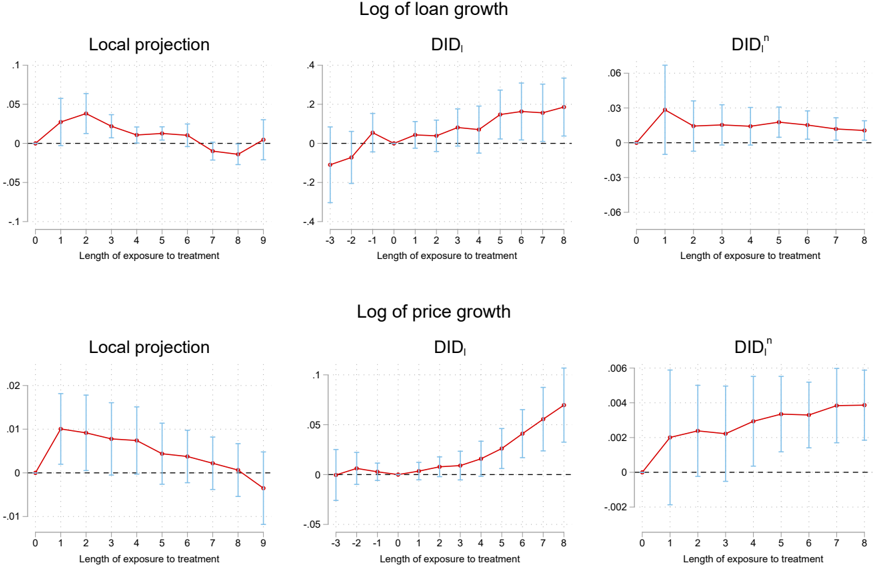
- In the banking-deregulation application, local-projection coefficients are positive and significant through \(\ell=5\), insignificant at \(\ell=6,7,9\), and significantly negative at \(\ell=8\); the paper’s \(DID_1=0.043\) (s.e. \(0.035\)), \(DID_3=0.081\) (s.e. \(0.049\)), \(DID_5=0.148\) (s.e. \(0.064\)), placebos jointly insignificant (\(p=0.400\)), and the test that \(\ell \mapsto DID^n_\ell\) is constant is not rejected (\(p=0.328\)). For house prices, \(DID_1=0.003\) (s.e. \(0.004\)), \(DID_4=0.016\) (s.e. \(0.009\)), \(DID_5=0.026\) (s.e. \(0.010\)), and placebos are jointly insignificant (\(p=0.703\)).
Methods
- Panel of \(G\) groups observed over \(T\) periods, with dynamic potential outcomes allowing current outcomes to depend on current and lagged treatments; identifying assumptions include no anticipation, parallel trends for the status-quo outcome conditional on the period-one treatment, and a no-crossing condition, plus a design restriction requiring groups with the same period-one treatment and variation in first-treatment-change timing.
- Estimators compare switchers to not-yet-switchers with the same period-one treatment; the paper aggregates group-level \(DID_{g,\ell}\)’s into event-study effects, proposes normalized versions, placebo estimators, and asymptotic inference as \(G\to\infty\) under independent groups and regularity conditions, with confidence intervals conservative unless groups are i.i.d.
- Application revisits Favara and Imbs (2015) using 1994–2005 county-level banking deregulation data; treatment is the number of restrictions lifted (0–4); eight states never deregulate, 33 deregulate once, eight twice, and one three times; 38 of 42 deregulating states first do so in 1995–1998; \(DID_1\) and \(DID_8\) apply to 905 and 773 counties, respectively, and only three placebos apply to more than 50% of the 905 counties whose treatment changes at least once.
Limitations
- The paper states that the initial-conditions problem is not accounted for in the baseline notation; Assumption 1 rules out continuous period-one treatment, extremely non-persistent treatment, and no or universal treatment change; Assumption 4 may be implausible for some baseline-treatment values; \(\delta_\ell\)’s interpretation is complicated outside Design 1; \(\delta^n_\ell\) averages different lags and individual lag slopes are not estimable under Assumptions 3–4; cost-benefit analysis requires converting outcomes to monetary equivalents and assumes linear, non-stochastic treatment costs; inference is conservative in the i.n.i.d. setup unless groups are i.i.d.; and the local-projection issues are specific to the panel Regression 2, absent in time-series local projections and in Dube et al. (2023).
- The paper states placebos may fail to detect parallel-trends violations large enough to substantially bias \(DID_\ell\); in the application, only three placebos apply to more than 50% of the 905 counties, parallel trends can only be tested over three years whereas eight years are needed for \(DID_8\), loan-volume placebos are relatively large and imprecisely estimated, and \(DID_9\)–\(DID_{11}\) are not reported because they apply to small subsamples (357, 238, and 1 county).
- Evident from the text: several application estimates are imprecise (e.g., \(DID_1=0.043\) with s.e. \(0.035\); \(DID^n_1\) is much larger but imprecisely estimated); the paper proves weights sum to less than one in binary-and-staggered designs but only finds this in the non-binary/non-staggered application without a formal proof; and the design-conditional parameters may only partially uncover the structural function mapping current, lagged, and future treatments to outcomes.
Model-written summary. Check it against the paper before relying on it.
Integrity signals
Registry
Cites
Statistics
Figures
Verification
Claims the paper makes
19 Valid · 10 Not valid · 7 Not checked · 214 Own results and interpretations
Some cited sources support this claim and some don’t — read each source’s verdict below.
In the paper
“de Chaisemartin and D'Haultfœuille (2018) and de Chaisemartin and D'Haultfœuille (2020) had already noted that in a model assuming away effects of lagged treatments on the outcome, parallel trends across groups with different baseline treatments essentially rules out time-varying effects.”
What the sources say
- Partly supportedcites de Chaisemartin and D'Haultfœuille (2018) sourceExperimental — accuracy not yet measured
Section 2.2 says that the average treatment effect among units treated at baseline must be stable over time for the Wald-DID result. But it presents this as Assumption 4, separate from the common-trends Assumption 3; it does not say that parallel trends across groups with different baseline treatments itself rules out time-varying effects. Section 2.3 instead proposes an estimator that does not require that stability assumption. (LLM, conf=0.78)
- Disputedcites de Chaisemartin and D'Haultfœuille (2020) sourceExperimental — accuracy not yet measured
Split into 2 atoms — 1 confirmed, 0 partially supported, 1 disputed, 0 misattributed, 0 unverifiable. Expand the claim to see per-atom verdicts.
Checked by a reasoning model — may be wrong.
plain- Asserted: passes — The authors put it forward as true.
- Checkable: passes — It can be checked against evidence.
- Load-bearing: passes — The paper’s conclusions depend on it.
- Based: passes — The paper gives a reason why it holds.
- Partly supported
Every source the paper cites for this claim was checked and supports it.
In the paper
“DID 1 also reduces to the DID M estimator of de Chaisemartin and D'Haultfœuille (2020).”
What the sources say
- Supportedcites de Chaisemartin and D'Haultfœuille (2020) source
Section 4 (‘An alternative estimator’) defines DID_M as the authors’ estimator and describes it as a weighted average of the component DID estimators. The citation identifies the estimator to which the citing authors say DID_1 reduces; it does not attribute their reduction result to this source. (LLM, conf=0.90)
plainstates a cause- Asserted: passes — The authors put it forward as true.
- Checkable: passes — It can be checked against evidence.
- Load-bearing: unclear — It is unclear whether the paper’s conclusions depend on it.
- Based: passes — The paper gives a reason why it holds.
- Supported
The cited sources support only part of this claim — read each source’s verdict below.
In the paper
“In non-binary and/or non-staggered designs, when all groups are untreated at period one, DID ℓ is equivalent to the estimator obtained by: 1. redefining the treatment as an indicator equal to one if group g has ever received a non-zero treatment at t , as Deryugina (2017) or Krolikowski (2018), among others, have done in their empirical analysis; 2. computing the estimator of θ es ( ℓ -1) of Calla”
What the sources say
- Partly supportedcites Callaway and Sant'Anna (2021) sourceExperimental — accuracy not yet measured
Split into 2 atoms — 1 confirmed, 1 partially supported, 0 disputed, 0 misattributed, 0 unverifiable. Expand the claim to see per-atom verdicts.
- Not checked — no full text of the sourcecites Deryugina (2017) source
- Supportedcites Krolikowski (2018) source
Split into 2 atoms — 2 confirmed, 0 partially supported, 0 disputed, 0 misattributed, 0 unverifiable. Expand the claim to see per-atom verdicts.
plain- Asserted: passes — The authors put it forward as true.
- Checkable: passes — It can be checked against evidence.
- Load-bearing: unclear — It is unclear whether the paper’s conclusions depend on it.
- Based: passes — The paper gives a reason why it holds.
- Rests on an assumption not shown here.
- Partly supported
Every source the paper cites for this claim was checked and supports it.
In the paper
“In binary and staggered designs, our DID ℓ estimators reduce to the estimators of the event-study parameters θ es ( ℓ -1) of Callaway and Sant'Anna (2021), using not-yet-treated as controls.”
What the sources say
- Supportedcites Callaway and Sant'Anna (2021) source
Section 3.1.1 (page unavailable) defines Callaway and Sant’Anna’s event-study parameter θ_es(e), with event time e measured from treatment adoption. Section 2.3 (page unavailable) explicitly allows not-yet-treated groups as controls. The statement that the citing authors’ DID_l estimators reduce to those estimators is their own comparison, not a result attributed to this source. (LLM, conf=0.86)
plainstates a cause- Asserted: passes — The authors put it forward as true.
- Checkable: passes — It can be checked against evidence.
- Load-bearing: unclear — It is unclear whether the paper’s conclusions depend on it.
- Based: passes — The paper gives a reason why it holds.
- Supported
The cited sources that could be checked couldn’t confirm or dispute this claim.
In the paper
“These findings differ sharply from those obtained by Favara and Imbs (2015).”
What the sources say
- Could not verifycites Favara and Imbs (2015) sourceExperimental — accuracy not yet measured
The cited paper’s Credit Supply and the Price of Housing section reports findings on the response of lending to branching deregulation. The citing sentence does not identify what “these findings” are, so our copy cannot establish whether they differ sharply from Favara and Imbs’s findings. (LLM, conf=0.76)
boosted- Asserted: passes — The authors put it forward as true.
- Checkable: passes — It can be checked against evidence.
- Load-bearing: passes — The paper’s conclusions depend on it.
- Based: passes — The paper gives a reason why it holds.
- Could not verify
140 more claims · 6 with their cited sources checked
Create a free account to see all 250 claims and every source verdict.
- It may state two separate claims as one. 52
- Probably not a substantial claim. 60
- Borderline: one of the tests for a substantial claim is unclear. 1
- The quote only partly states this claim. 2
Claims other papers make about this one
Each is checked against this paper’s own text: does it say what the citing paper says it does?
The cited source says what the claim attributes to it.
In the citing paper
“I estimate Equation ( 1) using the estimator developed by de Chaisemartin and D'Haultfœuille (2026), hereafter dCDH, to accommodate the possibility that websites may re-allow the OAI-SearchBot crawler after having blocked it, causing the treatment status indicator, 𝐷𝐷 𝑖𝑖,𝑡𝑡 , to switch off.”
From Opting Out of Generative AI? Training Data, Search Visibility, and the Traffic Rankings of News Publishers (2026) · cites this paper as de Chaisemartin and D'Haultfœuille (2026)
In the citing paper
“The dCDH estimator, like many modern DID estimators, constructs counterfactual outcomes from untreated units and incorporates covariates within the estimation procedure rather than through a conventional regression specification.”
From Opting Out of Generative AI? Training Data, Search Visibility, and the Traffic Rankings of News Publishers (2026) · cites this paper as de Chaisemartin & D'Haultfœuille (2026)
In the citing paper
“The dCDH estimator, however, accommodates treatment reversals, so the baseline specification retains these websites in the sample.”
From Opting Out of Generative AI? Training Data, Search Visibility, and the Traffic Rankings of News Publishers (2026) · cites this paper as de Chaisemartin C, D'Haultfœuille X (2026)
Self-check
Percentages, sums and reported differences re-computed from the paper’s own numbers.
Each contradiction between two passages listed here was confirmed by an independent check.
Rated minor: it would not touch a result — a value no result rests on, a p-value that stays on the same side of the significance level, or a conflict that is clerical, resolved elsewhere in the paper, or outside its own findings.
In the paper
§ 1.1 Placebo estimators
“One may have L pl = -1, if all groups that switch treatment do so for the first time at period 2.”
§ 1.1 Placebo estimators
“Then, let L pl = max g { min( T g -F g +1 , F g -2) } .”
Citations
Cites
How Much Should We Trust Differences-in-Differences Estimates?
Bertrand, M., Duflo, E., & Mullainathan, S. (2004) · The Quarterly Journal of Economics · doi:10.1162/003355304772839588 · Cited by 10,641
Mostly Harmless Econometrics: An Empiricist's Companion
Angrist, J. D., & Pischke, J.-S. (2009) · doi:10.1515/9781400829828 · Cited by 9,467
Difference-in-Differences with multiple time periods
Callaway, B., & Sant’Anna, P. H. C. (2021) · Journal of Econometrics · doi:10.1016/j.jeconom.2020.12.001 · Cited by 9,126
Difference-in-differences with variation in treatment timing
Goodman-Bacon, A. (2021) · Journal of Econometrics · doi:10.1016/j.jeconom.2021.03.014 · Cited by 8,046
Estimating dynamic treatment effects in event studies with heterogeneous treatment effects
Sun, L., & Abraham, S. (2021) · Journal of Econometrics · doi:10.1016/j.jeconom.2020.09.006 · Cited by 5,518
Mostly Harmless Econometrics: An Empiricist's Companion
Angrist, J. D., & Pischke, J.-S. (2008) · doi:10.2307/j.ctvcm4j72 · Cited by 5,051
Two-Way Fixed Effects Estimators with Heterogeneous Treatment Effects
de Chaisemartin, C., & D’Haultfœuille, X. (2020) · American Economic Review · doi:10.1257/aer.20181169 · Cited by 5,031
Self-citationEstimation and Inference of Impulse Responses by Local Projections
Jordà, Ò. (2005) · American Economic Review · doi:10.1257/0002828053828518 · Cited by 4,677
Identification and estimation of local average treatment effects
Imbens, G. W., & Angrist, J. D. (1994) · Econometrica · doi:10.2307/2951620 · Cited by 4,101
Robins, J. (1986) · Mathematical Modelling · doi:10.1016/0270-0255(86)90088-6 · Cited by 2,451
Semiparametric Difference-in-Differences Estimators
Abadie, A. (2005) · The Review of Economic Studies · doi:10.1111/0034-6527.00321 · Cited by 2,286
Revisiting Event-Study Designs: Robust and Efficient Estimation
Borusyak, K., Jaravel, X., & Spiess, J. (2024) · Review of Economic Studies · doi:10.1093/restud/rdae007 · Cited by 2,280
Railroads of the Raj: Estimating the Impact of Transportation Infrastructure
Donaldson, D. (2018) · American Economic Review · doi:10.1257/aer.20101199 · Cited by 1,634
Empirical Strategies in Labor Economics
Angrist, J. D., & Krueger, A. B. (1999) · Handbook of Labor Economics · doi:10.1016/s1573-4463(99)03004-7 · Cited by 1,628
Estimating the Effect of Training Programs on Earnings
Ashenfelter, O. (1978) · The Review of Economics and Statistics · doi:10.2307/1924332 · Cited by 1,515
Integrated Public Use Microdata Series
Ruggles, S., Genadek, K., Goeken, R., Grover, J., & Sobek, M. (2015) · Institute for Social Research and Data Innovation · doi:10.18128/d010.v6.0 · Cited by 1,485
The Surprisingly Swift Decline of US Manufacturing Employment
Pierce, J. R., & Schott, P. K. (2016) · American Economic Review · doi:10.1257/aer.20131578 · Cited by 1,363
Policy Uncertainty, Trade, and Welfare: Theory and Evidence for China and the United States
Handley, K., & Limão, N. (2017) · American Economic Review · doi:10.1257/aer.20141419 · Cited by 988
WTO Accession and Performance of Chinese Manufacturing Firms
Brandt, L., Van Biesebroeck, J., Wang, L., & Zhang, Y. (2017) · American Economic Review · doi:10.1257/aer.20121266 · Cited by 856
Long-Run Impacts of Childhood Access to the Safety Net
Hoynes, H., Schanzenbach, D. W., & Almond, D. (2016) · American Economic Review · doi:10.1257/aer.20130375 · Cited by 809
Pretest with Caution: Event-Study Estimates after Testing for Parallel Trends
Roth, J. (2022) · American Economic Review: Insights · doi:10.1257/aeri.20210236 · Cited by 769
Does Credit Competition Affect Small‐Firm Finance?
RICE, T., & STRAHAN, P. E. (2010) · The Journal of Finance · doi:10.1111/j.1540-6261.2010.01555.x · Cited by 684
This Mine is Mine! How Minerals Fuel Conflicts in Africa
Berman, N., Couttenier, M., Rohner, D., & Thoenig, M. (2017) · American Economic Review · doi:10.1257/aer.20150774 · Cited by 683
Trade Liberalization and Regional Dynamics
Dix-Carneiro, R., & Kovak, B. K. (2017) · American Economic Review · doi:10.1257/aer.20161214 · Cited by 650
The Value of Democracy: Evidence from Road Building in Kenya
Burgess, R., Jedwab, R., Miguel, E., Morjaria, A., & Padró i Miquel, G. (2015) · American Economic Review · doi:10.1257/aer.20131031 · Cited by 648
Credit Supply and the Price of Housing
Favara, G., & Imbs, J. (2015) · American Economic Review · doi:10.1257/aer.20121416 · Cited by 621
The Nonparametric Identification of Treatment Effects in Duration Models
Abbring, J. H., & van den Berg, G. J. (2003) · Econometrica · doi:10.1111/1468-0262.00456 · Cited by 616
Railroads of the Raj: Estimating the Impact of Transportation Infrastructure
Donaldson, D. (2010) · National Bureau of Economic Research · doi:10.3386/w16487 · Cited by 579
Do Recessions Accelerate Routine-Biased Technological Change? Evidence from Vacancy Postings
Hershbein, B., & Kahn, L. B. (2018) · American Economic Review · doi:10.1257/aer.20161570 · Cited by 573
Trafficking Networks and the Mexican Drug War
Dell, M. (2015) · American Economic Review · doi:10.1257/aer.20121637 · Cited by 553
Two-way fixed effects and differences-in-differences with heterogeneous treatment effects: a survey
de Chaisemartin, C., & D’Haultfœuille, X. (2023) · The Econometrics Journal · doi:10.1093/ectj/utac017 · Cited by 522
Self-citationInterest Rate Pass-Through: Mortgage Rates, Household Consumption, and Voluntary Deleveraging
Di Maggio, M., Kermani, A., Keys, B. J., Piskorski, T., Ramcharan, R., Seru, A., & Yao, V. (2017) · American Economic Review · doi:10.1257/aer.20141313 · Cited by 505
What Drives Differences in Management Practices?
Bloom, N., Brynjolfsson, E., Foster, L., Jarmin, R., Patnaik, M., Saporta-Eksten, I., & Van Reenen, J. (2019) · American Economic Review · doi:10.1257/aer.20170491 · Cited by 502
Angrist, J. D. (1998) · Econometrica · doi:10.2307/2998558 · Cited by 490
Networks and Misallocation: Insurance, Migration, and the Rural-Urban Wage Gap
Munshi, K., & Rosenzweig, M. (2016) · American Economic Review · doi:10.1257/aer.20131365 · Cited by 482
Gender Quotas and the Crisis of the Mediocre Man: Theory and Evidence from Sweden
Besley, T., Folke, O., Persson, T., & Rickne, J. (2017) · American Economic Review · doi:10.1257/aer.20160080 · Cited by 480
Fetzer, T. (2019) · American Economic Review · doi:10.1257/aer.20181164 · Cited by 470
How Do Electricity Shortages Affect Industry? Evidence from India
Allcott, H., Collard-Wexler, A., & O'Connell, S. D. (2016) · American Economic Review · doi:10.1257/aer.20140389 · Cited by 466
Revisiting Event Study Designs
Borusyak, K., & Jaravel, X. (2016) · SSRN Electronic Journal · doi:10.2139/ssrn.2826228 · Cited by 463
Who Benefits from State Corporate Tax Cuts? A Local Labor Markets Approach with Heterogeneous Firms
Suárez Serrato, J. C., & Zidar, O. (2016) · American Economic Review · doi:10.1257/aer.20141702 · Cited by 452
Commuting, Migration, and Local Employment Elasticities
Monte, F., Redding, S. J., & Rossi-Hansberg, E. (2018) · American Economic Review · doi:10.1257/aer.20151507 · Cited by 435
Diamond, R., McQuade, T., & Qian, F. (2019) · American Economic Review · doi:10.1257/aer.20181289 · Cited by 423
Marginal Mean Models for Dynamic Regimes
Murphy, S. A., van der Laan, M. J., Robins, J. M., & Conduct Problems Prevention Research Group (2001) · Journal of the American Statistical Association · doi:10.1198/016214501753382327 · Cited by 393
Endogenous Skill Acquisition and Export Manufacturing in Mexico
Atkin, D. (2016) · American Economic Review · doi:10.1257/aer.20120901 · Cited by 393
Do Higher Corporate Taxes Reduce Wages? Micro Evidence from Germany
Fuest, C., Peichl, A., & Siegloch, S. (2018) · American Economic Review · doi:10.1257/aer.20130570 · Cited by 385
Equal but Inequitable: Who Benefits from Gender-Neutral Tenure Clock Stopping Policies?
Antecol, H., Bedard, K., & Stearns, J. (2018) · American Economic Review · doi:10.1257/aer.20160613 · Cited by 368
Naritomi, J. (2019) · American Economic Review · doi:10.1257/aer.20160658 · Cited by 353
Two-way Fixed Effects Estimators with Heterogeneous Treatment Effects
de Chaisemartin, C., & D'Haultfoeuille, X. (2019) · doi:10.3386/w25904 · Cited by 350
Fuzzy differences-in-differences
de Chaisemartin, C., & D’HaultfŒuille, X. (2018) · The Review of Economic Studies · doi:10.1093/restud/rdx049 · Cited by 324
Self-citationThe Fiscal Cost of Hurricanes: Disaster Aid versus Social Insurance
Deryugina, T. (2017) · American Economic Journal: Economic Policy · doi:10.1257/pol.20140296 · Cited by 308
Disentangling the Effects of a Banking Crisis: Evidence from German Firms and Counties
Huber, K. (2018) · American Economic Review · doi:10.1257/aer.20161534 · Cited by 299
Schmidheiny, K., & Siegloch, S. (2020) · doi:10.2139/ssrn.3571164 · Cited by 295
Schmidheiny, K., & Siegloch, S. (2023) · Journal of Applied Econometrics · doi:10.1002/jae.2971 · Cited by 293
Nominal Wage Rigidity in Village Labor Markets
Kaur, S. (2019) · American Economic Review · doi:10.1257/aer.20141625 · Cited by 204
Two-way fixed effects and differences-in-differences estimators with several treatments
de Chaisemartin, C., & D’Haultfœuille, X. (2023) · Journal of Econometrics · doi:10.1016/j.jeconom.2023.105480 · Cited by 188
Self-citationDifference-in-Differences with a Continuous Treatment
Callaway, B., Goodman-Bacon, A., & Sant'Anna, P. (2024) · SSRN Electronic Journal · doi:10.2139/ssrn.4716682 · Cited by 180
Interpreting pre-trends as anticipation: Impact on estimated treatment effects from tort reform
Malani, A., & Reif, J. (2015) · Journal of Public Economics · doi:10.1016/j.jpubeco.2015.01.001 · Cited by 178
Do Recessions Accelerate Routine-Biased Technological Change? Evidence from Vacancy Postings
Hershbein, B. J., & Kahn, L. B. (2016) · SSRN Electronic Journal · doi:10.2139/ssrn.2756503 · Cited by 172
Alternative diff-in-diffs estimators with several pretreatment periods
Mora, R., & Reggio, I. G. (2017) · Econometric Reviews · doi:10.1080/07474938.2017.1348683 · Cited by 144
A Local Projections Approach to Difference-in-Differences
Dubé, A., Girardi, D., Jordà, Ò., & Taylor, A. M. (2023) · National Bureau of Economic Research · doi:10.3386/w31184 · Cited by 141
This Mine is Mine! How Minerals Fuel Conflicts in AfricaPreprint
Berman, N., Couttenier, M., Rohner, D., et al. (2015) · SSRN Electronic Journal · doi:10.2139/ssrn.2627073 · Cited by 140
Do Higher Corporate Taxes Reduce Wages? Micro Evidence from GermanyPreprint
Fuest, C., Peichl, A., & Siegloch, S. (2013) · SSRN Electronic Journal · doi:10.2139/ssrn.2294421 · Cited by 132
Google Scholar’s Ranking Algorithm : An Introductory OverviewPreprint
Beel, J., & Gipp, B. (2009) · Cited by 126
Instrumental Variable Estimation with a Stochastic Monotonicity Assumption
Small, D. S., Tan, Z., Ramsahai, R. R., Lorch, S. A., & Brookhart, M. A. (2017) · Statistical Science · doi:10.1214/17-sts623 · Cited by 83
Revisiting Event Study Designs: Robust and Efficient Estimation
(2021) · doi:10.48550/arxiv.2108.12419 · Cited by 76
East, C. N., Miller, S., Page, M., & Wherry, L. R. (2023) · American Economic Review · doi:10.1257/aer.20210937 · Cited by 73
Choosing a Control Group for Displaced Workers
Krolikowski, P. (2018) · ILR Review · doi:10.1177/0019793917743707 · Cited by 70
A Local Projections Approach to Difference-in-DifferencesPreprint
Dubé, A., Girardi, D., Jordà, Ò., & Taylor, A. M. (2023) · SSRN Electronic Journal · doi:10.2139/ssrn.4433863 · Cited by 66
Difference-in-Differences for Continuous Treatments and Instruments with StayersPreprint
de Chaisemartin, C., D’Haultfœuille, X., Pasquier, F., & Vázquez-Baré, G. (2022) · SSRN Electronic Journal · doi:10.2139/ssrn.4011782 · Cited by 64
Self-citationDifference‐in‐differences when the treatment status is observed in only one period
Botosaru, I., & Gutierrez, F. H. (2017) · Journal of Applied Econometrics · doi:10.1002/jae.2583 · Cited by 61
Panel Experiments and Dynamic Causal Effects: A Finite Population Perspective
Bojinov, I., Rambachan, A., & Shephard, N. (2021) · Quantitative Economics · doi:10.3982/qe1744 · Cited by 60
Fuzzy differences-in-differences
de Chaisemartin, C., & D’Haultfœuille, X. (2017) · doi:10.1920/wp.cem.2015.6915 · Cited by 56
Self-citationWTO Accession and Performance of Chinese Manufacturing FirmsPreprint
Brandt, L., Biesebroeck, J. V., Wang, L., & Zhang, Y. (n.d.) · RePEc: Research Papers in Economics · Cited by 56
Cox, G., & Shi, X. (2023) · The Review of Economic Studies · doi:10.1093/restud/rdac015 · Cited by 48
East, C. N., Miller, S., Page, M., & Wherry, L. (2017) · National Bureau of Economic Research · doi:10.3386/w23810 · Cited by 45
Causal Inference with Differences-in-Differences: Credible Answers to Hard QuestionsPreprint
de Chaisemartin, C., & D’Haultfœuille, X. (2023) · SSRN Electronic Journal · doi:10.2139/ssrn.4487202 · Cited by 32
Self-citationOn the L p convergence of sums of independent random variables
Hall, P. V. (1977) · Mathematical Proceedings of the Cambridge Philosophical Society · doi:10.1017/s0305004100054104 · Cited by 19
Difference-in-Differences When Treatment Status Is Observed in Only One PeriodPreprint
Botosaru, I., & Gutierrez, F. H. (2014) · SSRN Electronic Journal · doi:10.2139/ssrn.2377483 · Cited by 11
Difference-in-Differences Estimators for Treatments Continuously Distributed at Every Period
de Chaisemartin, C., D'Haultfœuille, X., Pasquier, F., Sow, D., & Vazquez-Bare, G. (2022) · arXiv · doi:10.48550/arxiv.2201.06898 · Cited by 4
Self-citationSubgroup Difference in Differences to Identify Effect Modification Without a Control Group
Shahn, Z. (2023) · arXiv · doi:10.48550/arxiv.2306.11030 · Cited by 3
A Robust Permutation Test for Subvector Inference in Linear Regressions
D'Haultfœuille, X., & Tuvaandorj, P. (2022) · arXiv · doi:10.48550/arxiv.2205.06713
Self-citationDifference-in-Differences Estimators of Intertemporal Treatment Effects
de Chaisemartin, C., & d'Haultfoeuille, X. (2021) · SSRN Electronic Journal · doi:10.2139/ssrn.3731856
Cited by
What's trending in difference-in-differences? A synthesis of the recent econometrics literature
Roth, J., Sant’Anna, P. H. C., Bilinski, A., & Poe, J. (2023) · Journal of Econometrics · doi:10.1016/j.jeconom.2023.03.008 · Cited by 2,027
Two-Way Fixed Effects, the Two-Way Mundlak Regression, and Difference-in-Differences Estimators
Wooldridge, J. M. (2021) · SSRN / The Econometrics Journal · doi:10.2139/ssrn.3906345 · Cited by 714
Revisiting event study designs: robust and efficient estimation
(2022) · arXiv (preprint) · doi:10.47004/wp.cem.2022.1122 · Cited by 607
Two-way fixed effects and differences-in-differences with heterogeneous treatment effects: a survey
de Chaisemartin, C., & D’Haultfœuille, X. (2023) · The Econometrics Journal · doi:10.1093/ectj/utac017 · Cited by 522
Self-citationAn Introductory Guide to Event Study Models
Miller, D. L. (2023) · Journal of Economic Perspectives · doi:10.1257/jep.37.2.203 · Cited by 360
Metadata
- Authors
- de Chaisemartin, C., & D’Haultfœuille, X.
- Affiliations
- Sciences Po Paris, Economics Department
- Centre de Recherche en Économie et Statistique (FR)
- Venue
- Review of Economics and Statistics
- Publisher
- MIT Press
- Published
- 2026-07
- Volume
- 108
- Issue
- 4
- Pages
- 863-880
- ISSN
- 0034-6535 (ISSN-L)
- 1530-9142
- OpenAlex
- W3041109582
- Cited by
- 740
- References
- 81
- Citations by year
- 2026: 147
- FWCI
- 63.78
- Type
- journal article
- Language
- en
- Open access
- green
- doi.org
- Locations
- The Review of Economics and Statistics (publishedVersion)
- SSRN Electronic Journal (publishedVersion)
- National Bureau of Economic Research (publishedVersion)
- SSRN Electronic Journal (acceptedVersion)
- RePEc: Research Papers in Economics (submittedVersion)
- arXiv (Cornell University) (submittedVersion)
- HAL (submittedVersion, cc-by-nc-nd)
- HAL (submittedVersion, cc-by-nc)
- HAL (submittedVersion)
- arXiv (Cornell University)
- Funders
- European Commission
- Agence Nationale de la Recherche (ANR-17-CE26-0015, ANR-17)
- HORIZON EUROPE European Research Council (101043899)
- Topics
- Physical Sciences › Mathematics › Statistics and Probability › Advanced Causal Inference Techniques
- Social Sciences › Economics, Econometrics and Finance › Economics and Econometrics › Spatial and Panel Data Analysis
- Physical Sciences › Mathematics › Statistics and Probability › Statistical Methods and Bayesian Inference
- Keywords
- difference-in-differences, parallel trends assumption, treatment effect heterogeneity, two-way fixed effects, local projections, panel data
About these checks
Registry, retraction, Cites and statistics results are computed, not judged, with one exception: a printed reference that no index lists is read once by a model before it counts as a citation error. Claims are extracted by a model and kept only when their quote appears verbatim in the text; each cited source is then checked, with a model’s help, for whether it says what the claim relies on. Those verdicts can be wrong — read the claim’s quote and the cited source before relying on one.
The claim verdicts this report counts are experimental: their accuracy is not yet measured.
A language model drew the claims from the paper on 2026-09-29, under version 3 of the claim definition (model deepseek-v4.1-flash, prompt extract-v3).
A second model labelled each claim on 2026-09-29 (model jev-1.13-20260917, definition revision gold-guideline-v0.2).
Cited sources are checked with a language model’s help (gpt-6-sol).
Statistics and arithmetic are recomputed, not judged.
Confidence bands are shown only for fields calibrated on our annotated test set. None is calibrated yet, so no band is shown.
What counts as a claim ›How we measure confidence ›How we check this ›
Are you an author, or do you see a problem with this page? Request a review
Data sources
Bibliographic data: Semantic Scholar, OpenAlex, Crossref.
Contains information from the Semantic Scholar Academic Graph Datasets, made available under the ODC Attribution License (ODC-BY 1.0).
Semantic Scholar’s data is described in: Kinney, R., et al. (2023). The Semantic Scholar Open Data Platform. arXiv:2301.10140.
