

Difference-in-Differences Estimators of Intertemporal Treatment Effects
Open accessThe DOI matches its Crossref record, with a small difference in title or year; 82 of the 82 references it cites were found in a registry or an index; 28 of the 40 sources its claims cite were checked for support.
Abstract
We study treatment-effect estimation using panel data. The treatment may be nonbinary, nonabsorbing, and the outcome may be affected by treatment lags. We make a parallel-trends assumption and propose event-study estimators of the effect of being exposed to a weakly higher treatment dose for ℓ periods. We also propose normalized estimators that estimate a weighted average of the effects of the current treatment and its lags. We also analyze commonly used two-way fixed-effects regressions. Unlike our estimators, they can be biased in the presence of heterogeneous treatment effects. A local-projection version of those regressions is biased even with homogeneous effects.
Overview
CoChat Summary
TL;DR
The paper develops difference-in-differences estimators for panel data where treatment can be nonbinary, nonabsorbing, and have lagged effects, without imposing homogeneous treatment effects. It proposes reduced-form and normalized event-study estimators plus a cost-benefit parameter, shows common TWFE dynamic regressions can be biased or contaminated, and revisits banking deregulation effects.
Key findings
- The proposed \(DID_\ell\) and normalized \(DID^n_\ell\) estimators are conditionally unbiased under no-anticipation and parallel trends conditional on the period-one treatment; \(DID^n_\ell\) estimates a weighted average of the current treatment and its first \(\ell-1\) lags, and a weighted sum of \(DID_\ell\)’s yields a cost-benefit parameter interpretable as an average total effect per unit of treatment.
- In a census of 100 highly cited AER papers from 2015–2019, 26 estimate TWFE regressions, but only four have a binary-and-staggered treatment; among the 20 non-binary/non-staggered papers, 11 estimate only static TWFE and nine estimate dynamic effects using intensity-period FE, local-projection, or distributed-lag regressions.
- The paper shows those three common TWFE dynamic methods may not estimate a convex combination of the paper’s \(\delta_{g,\ell}\) effects, may violate no-sign reversal, and local-projection panel regressions are contaminated by other exposure lengths and can be biased or wrong-signed even with constant effects.
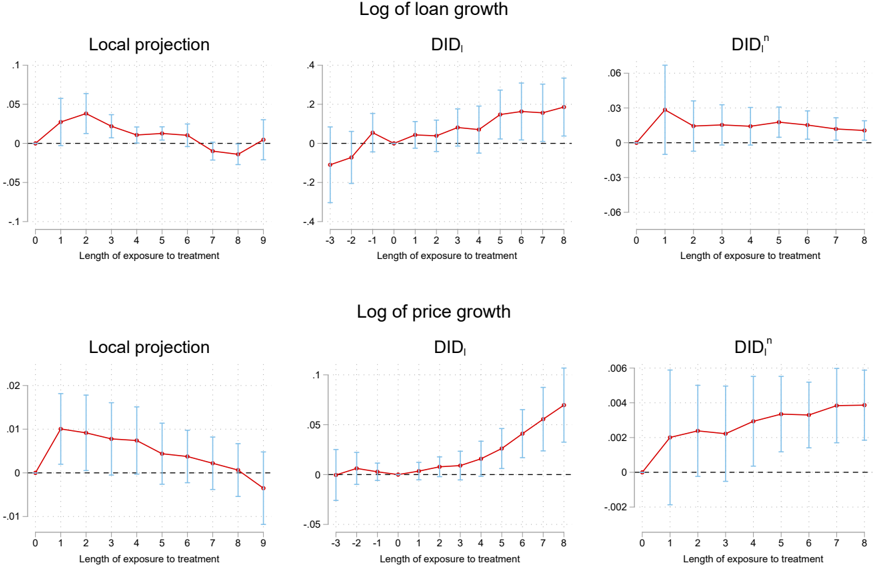
- In the banking-deregulation application, local-projection coefficients are positive and significant through \(\ell=5\), insignificant at \(\ell=6,7,9\), and significantly negative at \(\ell=8\); the paper’s \(DID_1=0.043\) (s.e. \(0.035\)), \(DID_3=0.081\) (s.e. \(0.049\)), \(DID_5=0.148\) (s.e. \(0.064\)), placebos jointly insignificant (\(p=0.400\)), and the test that \(\ell \mapsto DID^n_\ell\) is constant is not rejected (\(p=0.328\)). For house prices, \(DID_1=0.003\) (s.e. \(0.004\)), \(DID_4=0.016\) (s.e. \(0.009\)), \(DID_5=0.026\) (s.e. \(0.010\)), and placebos are jointly insignificant (\(p=0.703\)).
Methods
- Panel of \(G\) groups observed over \(T\) periods, with dynamic potential outcomes allowing current outcomes to depend on current and lagged treatments; identifying assumptions include no anticipation, parallel trends for the status-quo outcome conditional on the period-one treatment, and a no-crossing condition, plus a design restriction requiring groups with the same period-one treatment and variation in first-treatment-change timing.
- Estimators compare switchers to not-yet-switchers with the same period-one treatment; the paper aggregates group-level \(DID_{g,\ell}\)’s into event-study effects, proposes normalized versions, placebo estimators, and asymptotic inference as \(G\to\infty\) under independent groups and regularity conditions, with confidence intervals conservative unless groups are i.i.d.
- Application revisits Favara and Imbs (2015) using 1994–2005 county-level banking deregulation data; treatment is the number of restrictions lifted (0–4); eight states never deregulate, 33 deregulate once, eight twice, and one three times; 38 of 42 deregulating states first do so in 1995–1998; \(DID_1\) and \(DID_8\) apply to 905 and 773 counties, respectively, and only three placebos apply to more than 50% of the 905 counties whose treatment changes at least once.
Limitations
- The paper states that the initial-conditions problem is not accounted for in the baseline notation; Assumption 1 rules out continuous period-one treatment, extremely non-persistent treatment, and no or universal treatment change; Assumption 4 may be implausible for some baseline-treatment values; \(\delta_\ell\)’s interpretation is complicated outside Design 1; \(\delta^n_\ell\) averages different lags and individual lag slopes are not estimable under Assumptions 3–4; cost-benefit analysis requires converting outcomes to monetary equivalents and assumes linear, non-stochastic treatment costs; inference is conservative in the i.n.i.d. setup unless groups are i.i.d.; and the local-projection issues are specific to the panel Regression 2, absent in time-series local projections and in Dube et al. (2023).
- The paper states placebos may fail to detect parallel-trends violations large enough to substantially bias \(DID_\ell\); in the application, only three placebos apply to more than 50% of the 905 counties, parallel trends can only be tested over three years whereas eight years are needed for \(DID_8\), loan-volume placebos are relatively large and imprecisely estimated, and \(DID_9\)–\(DID_{11}\) are not reported because they apply to small subsamples (357, 238, and 1 county).
- Evident from the text: several application estimates are imprecise (e.g., \(DID_1=0.043\) with s.e. \(0.035\); \(DID^n_1\) is much larger but imprecisely estimated); the paper proves weights sum to less than one in binary-and-staggered designs but only finds this in the non-binary/non-staggered application without a formal proof; and the design-conditional parameters may only partially uncover the structural function mapping current, lagged, and future treatments to outcomes.
Model-written summary. Check it against the paper before relying on it.
Integrity signals
Registry
Cites
Statistics
Figures
Verification
Claims the paper makes
19 Valid · 10 Not valid · 7 Not checked · 214 Own results and interpretations
Some cited sources support this claim and some don’t — read each source’s verdict below.
In the paper
“de Chaisemartin and D'Haultfœuille (2018) and de Chaisemartin and D'Haultfœuille (2020) had already noted that in a model assuming away effects of lagged treatments on the outcome, parallel trends across groups with different baseline treatments essentially rules out time-varying effects.”
What the sources say
- Partly supportedcites de Chaisemartin and D'Haultfœuille (2018) sourceExperimental — accuracy not yet measured
Section 2.2 says that the average treatment effect among units treated at baseline must be stable over time for the Wald-DID result. But it presents this as Assumption 4, separate from the common-trends Assumption 3; it does not say that parallel trends across groups with different baseline treatments itself rules out time-varying effects. Section 2.3 instead proposes an estimator that does not require that stability assumption. (LLM, conf=0.78)
- Disputedcites de Chaisemartin and D'Haultfœuille (2020) sourceExperimental — accuracy not yet measured
Split into 2 atoms — 1 confirmed, 0 partially supported, 1 disputed, 0 misattributed, 0 unverifiable. Expand the claim to see per-atom verdicts.
Checked by a reasoning model — may be wrong.
plain- Asserted: passes — The authors put it forward as true.
- Checkable: passes — It can be checked against evidence.
- Load-bearing: passes — The paper’s conclusions depend on it.
- Based: passes — The paper gives a reason why it holds.
- Partly supported
Every source the paper cites for this claim was checked and supports it.
In the paper
“DID 1 also reduces to the DID M estimator of de Chaisemartin and D'Haultfœuille (2020).”
What the sources say
- Supportedcites de Chaisemartin and D'Haultfœuille (2020) source
Section 4 (‘An alternative estimator’) defines DID_M as the authors’ estimator and describes it as a weighted average of the component DID estimators. The citation identifies the estimator to which the citing authors say DID_1 reduces; it does not attribute their reduction result to this source. (LLM, conf=0.90)
plainstates a cause- Asserted: passes — The authors put it forward as true.
- Checkable: passes — It can be checked against evidence.
- Load-bearing: unclear — It is unclear whether the paper’s conclusions depend on it.
- Based: passes — The paper gives a reason why it holds.
- Supported
The cited sources support only part of this claim — read each source’s verdict below.
In the paper
“In non-binary and/or non-staggered designs, when all groups are untreated at period one, DID ℓ is equivalent to the estimator obtained by: 1. redefining the treatment as an indicator equal to one if group g has ever received a non-zero treatment at t , as Deryugina (2017) or Krolikowski (2018), among others, have done in their empirical analysis; 2. computing the estimator of θ es ( ℓ -1) of Calla”
What the sources say
- Partly supportedcites Callaway and Sant'Anna (2021) sourceExperimental — accuracy not yet measured
Split into 2 atoms — 1 confirmed, 1 partially supported, 0 disputed, 0 misattributed, 0 unverifiable. Expand the claim to see per-atom verdicts.
- Not checked — no full text of the sourcecites Deryugina (2017) source
- Supportedcites Krolikowski (2018) source
Split into 2 atoms — 2 confirmed, 0 partially supported, 0 disputed, 0 misattributed, 0 unverifiable. Expand the claim to see per-atom verdicts.
plain- Asserted: passes — The authors put it forward as true.
- Checkable: passes — It can be checked against evidence.
- Load-bearing: unclear — It is unclear whether the paper’s conclusions depend on it.
- Based: passes — The paper gives a reason why it holds.
- Rests on an assumption not shown here.
- Partly supported
Every source the paper cites for this claim was checked and supports it.
In the paper
“In binary and staggered designs, our DID ℓ estimators reduce to the estimators of the event-study parameters θ es ( ℓ -1) of Callaway and Sant'Anna (2021), using not-yet-treated as controls.”
What the sources say
- Supportedcites Callaway and Sant'Anna (2021) source
Section 3.1.1 (page unavailable) defines Callaway and Sant’Anna’s event-study parameter θ_es(e), with event time e measured from treatment adoption. Section 2.3 (page unavailable) explicitly allows not-yet-treated groups as controls. The statement that the citing authors’ DID_l estimators reduce to those estimators is their own comparison, not a result attributed to this source. (LLM, conf=0.86)
plainstates a cause- Asserted: passes — The authors put it forward as true.
- Checkable: passes — It can be checked against evidence.
- Load-bearing: unclear — It is unclear whether the paper’s conclusions depend on it.
- Based: passes — The paper gives a reason why it holds.
- Supported
The cited sources that could be checked couldn’t confirm or dispute this claim.
In the paper
“These findings differ sharply from those obtained by Favara and Imbs (2015).”
What the sources say
- Could not verifycites Favara and Imbs (2015) sourceExperimental — accuracy not yet measured
The cited paper’s Credit Supply and the Price of Housing section reports findings on the response of lending to branching deregulation. The citing sentence does not identify what “these findings” are, so our copy cannot establish whether they differ sharply from Favara and Imbs’s findings. (LLM, conf=0.76)
boosted- Asserted: passes — The authors put it forward as true.
- Checkable: passes — It can be checked against evidence.
- Load-bearing: passes — The paper’s conclusions depend on it.
- Based: passes — The paper gives a reason why it holds.
- Could not verify
140 more claims · 6 with their cited sources checked
Create a free account to see all 250 claims and every source verdict.
- It may state two separate claims as one. 52
- Probably not a substantial claim. 60
- Borderline: one of the tests for a substantial claim is unclear. 1
- The quote only partly states this claim. 2
Claims other papers make about this one
Each is checked against this paper’s own text: does it say what the citing paper says it does?
The cited source says what the claim attributes to it.
In the citing paper
“I estimate Equation ( 1) using the estimator developed by de Chaisemartin and D'Haultfœuille (2026), hereafter dCDH, to accommodate the possibility that websites may re-allow the OAI-SearchBot crawler after having blocked it, causing the treatment status indicator, 𝐷𝐷 𝑖𝑖,𝑡𝑡 , to switch off.”
From Opting Out of Generative AI? Training Data, Search Visibility, and the Traffic Rankings of News Publishers (2026) · cites this paper as de Chaisemartin and D'Haultfœuille (2026)
In the citing paper
“The dCDH estimator, like many modern DID estimators, constructs counterfactual outcomes from untreated units and incorporates covariates within the estimation procedure rather than through a conventional regression specification.”
From Opting Out of Generative AI? Training Data, Search Visibility, and the Traffic Rankings of News Publishers (2026) · cites this paper as de Chaisemartin & D'Haultfœuille (2026)
In the citing paper
“The dCDH estimator, however, accommodates treatment reversals, so the baseline specification retains these websites in the sample.”
From Opting Out of Generative AI? Training Data, Search Visibility, and the Traffic Rankings of News Publishers (2026) · cites this paper as de Chaisemartin C, D'Haultfœuille X (2026)
Self-check
Percentages, sums and reported differences re-computed from the paper’s own numbers.
Each contradiction between two passages listed here was confirmed by an independent check.
Rated minor: it would not touch a result — a value no result rests on, a p-value that stays on the same side of the significance level, or a conflict that is clerical, resolved elsewhere in the paper, or outside its own findings.
In the paper
§ 1.1 Placebo estimators
“One may have L pl = -1, if all groups that switch treatment do so for the first time at period 2.”
§ 1.1 Placebo estimators
“Then, let L pl = max g { min( T g -F g +1 , F g -2) } .”
Citations
Cites
How Much Should We Trust Differences-in-Differences Estimates?
Bertrand, M., Duflo, E., & Mullainathan, S. (2004) · The Quarterly Journal of Economics · doi:10.1162/003355304772839588 · Cited by 10,641
Mostly Harmless Econometrics: An Empiricist's Companion
Angrist, J. D., & Pischke, J.-S. (2009) · doi:10.1515/9781400829828 · Cited by 9,467
Difference-in-Differences with multiple time periods
Callaway, B., & Sant’Anna, P. H. C. (2021) · Journal of Econometrics · doi:10.1016/j.jeconom.2020.12.001 · Cited by 9,126
Difference-in-differences with variation in treatment timing
Goodman-Bacon, A. (2021) · Journal of Econometrics · doi:10.1016/j.jeconom.2021.03.014 · Cited by 8,046
Estimating dynamic treatment effects in event studies with heterogeneous treatment effects
Sun, L., & Abraham, S. (2021) · Journal of Econometrics · doi:10.1016/j.jeconom.2020.09.006 · Cited by 5,518
Mostly Harmless Econometrics: An Empiricist's Companion
Angrist, J. D., & Pischke, J.-S. (2008) · doi:10.2307/j.ctvcm4j72 · Cited by 5,051
Two-Way Fixed Effects Estimators with Heterogeneous Treatment Effects
de Chaisemartin, C., & D’Haultfœuille, X. (2020) · American Economic Review · doi:10.1257/aer.20181169 · Cited by 5,031
Self-citationEstimation and Inference of Impulse Responses by Local Projections
Jordà, Ò. (2005) · American Economic Review · doi:10.1257/0002828053828518 · Cited by 4,677
Identification and estimation of local average treatment effects
Imbens, G. W., & Angrist, J. D. (1994) · Econometrica · doi:10.2307/2951620 · Cited by 4,101
Robins, J. (1986) · Mathematical Modelling · doi:10.1016/0270-0255(86)90088-6 · Cited by 2,451
Cited by
Items 301–400 of 746
Melacrinis, F. M. S. F., & Felice, E. (2025) · Cliometrica · doi:10.1007/s11698-025-00321-x · Cited by 2
Visualization, Identification, and Estimation in the Linear Panel Event-Study Design
Freyaldenhoven, S., Hansen, C., Pérez, J. P., & Shapiro, J. M. (2025) · Cambridge University Press eBooks · doi:10.1017/9781009589727.011 · Cited by 7
Femicides, anti-violence centers, and policy targeting
Cerqua, A., Giannantoni, C., Letta, M., & Pinto, G. (2025) · European Economic Review · doi:10.1016/j.euroecorev.2025.105221 · Cited by 7
Li, X., Liu, F., Yan, J., & Yin, N. (2025) · Journal of Health Economics · doi:10.1016/j.jhealeco.2025.103097 · Cited by 3
Zhang, B., Zhang, Y., Cao, L., & Sun, C. (2025) · Economic Analysis and Policy · doi:10.1016/j.eap.2025.11.025 · Cited by 3
Effects of organized guarding on mortality from human–elephant conflict in northeast India
Sekar, N., Bhatt, T., Deomurari, A., Sharma, S., Kumari, P., Kayina, A., & Somanathan, E. (2026) · Conservation Biology · doi:10.1111/cobi.70204 · Cited by 3
Cao, Z.-D., Maioli, S., Williams, N. L., & Woodhouse, D. (2026) · Journal of Development Studies · doi:10.1080/00220388.2026.2618668 · Cited by 1
Balancing Acts: Unveiling the Dynamics of Post Removal on Social Media User-Generated Content
Shan, G., & Qiu, L. (2026) · Information Systems Research · doi:10.1287/isre.2023.0750 · Cited by 4
Sun, L., Li, Y., Yao, S., et al. (2026) · Cities · doi:10.1016/j.cities.2026.106959 · Cited by 2
From Mines to Minds: Education in Zambia’s Mining Regions from 1920 to 1990
Juif, D., & Maravall, L. (2026) · European Review of Economic History · doi:10.1093/ereh/heag010 · Cited by 2
Gbadegesin, T. K. (2026) · Applied Energy · doi:10.1016/j.apenergy.2026.127987 · Cited by 2
Effect of rail transit on crime: Evidence from new São Paulo stations
Ostrensky, V. P., Batista, T. B., & Bortolini, E. (2022) · Journal of Experimental Criminology · doi:10.1007/s11292-022-09503-3 · Cited by 4
Do IMF Programs Stimulate Private Sector Investment?
Bomprezzi, P., Marchesi, S., & Turk-Ariss, R. (2022) · IMF Working Paper · doi:10.5089/9798400216800.001 · Cited by 3
Rule of Law Enhancement, Innovation Incentives, and Business Performance: Evidence from China’s IPCs
Wang, H. E., Liu, C., Yu, Y., & Xiaodan, L. (2024) · Journal of the Knowledge Economy · doi:10.1007/s13132-024-02195-2 · Cited by 2
Effects of mergers and acquisitions on food quality
Blundell, W., Devadoss, S., & Luckstead, J. (2024) · Economics Letters · doi:10.1016/j.econlet.2024.111980 · Cited by 2
Knowledge source switching under state interventions of latecomer regions: A case study of Shenzhen
Yang, J., & Liu, W. (2024) · Technology in Society · doi:10.1016/j.techsoc.2024.102730 · Cited by 5
Melo, A. (2024) · Journal of Population Economics · doi:10.1007/s00148-024-01048-1 · Cited by 3
Is Stakeholder Orientation Related to Corporate Tax Avoidance? New Evidence
Lin, K. Z., Yang, S., & Zou, H. (2025) · Accounting Horizons · doi:10.2308/horizons-2023-148 · Cited by 2
Did recreational marijuana legalization increase crime in the long run?
Lee, S. (2025) · International Review of Law and Economics · doi:10.1016/j.irle.2025.106246 · Cited by 3
Cil, D., Fjelde, H., Hultman, L., Metternich, N. W., & Nilsson, D. (2025) · British Journal of Political Science · doi:10.1017/s0007123424000516 · Cited by 2
Is there moral hazard in medical savings accounts? Evidence from Singapore
Sun, J. Y. (2025) · Journal of Economic Behavior & Organization · doi:10.1016/j.jebo.2025.106938 · Cited by 2
Mair, L., & Mosler, M. (2025) · European Journal of Political Economy · doi:10.1016/j.ejpoleco.2025.102682 · Cited by 4
Can Public Investment in Community Colleges Draw Adult Learners Away from For-Profits?
McGuinness, S. (2025) · Education Finance and Policy · doi:10.1162/edfp.a.21 · Cited by 3
How taxes affect growth: evidence from cross-country panel data
Kawano, L., Olson, J. S., Slemrod, J., & Hsieh, M. H. (2025) · International Tax and Public Finance · doi:10.1007/s10797-025-09901-z · Cited by 17
Liu, X., & Liang, Y. (2025) · Energy Economics · doi:10.1016/j.eneco.2025.108796 · Cited by 2
Blanco-Cazeaux, I., Ferté, T., Bruzek, C., Gaudart, M., Ngabdo, K., Wittwer, J., & Francis-Oliviero, F. (2025) · Public Health · doi:10.1016/j.puhe.2025.105962 · Cited by 3
The economic effects of prison closures on local communities
Chirakijja, J. (2023) · Economics Letters · doi:10.1016/j.econlet.2023.111155 · Cited by 2
Petersen, J., Seguin, M., Alexiou, A., Cornelsen, L., Courtin, É., Cummins, S., Marks, D., & Egan, M. (2022) · BMJ Open · doi:10.1136/bmjopen-2021-057711 · Cited by 3
Children's Social Care and Early Intervention Policy in England
Anderberg, D., & Olympiou, C. (2020) · Economica · doi:10.1111/ecca.12473 · Cited by 3
Steuart, S. R., & Bradford, W. D. (2024) · Emerald Group Publishing Limited eBooks · doi:10.1108/s0573-855520240000297009 · Cited by 2
Treatment Effects in Interactive Fixed Effects ModelsPreprint
Callaway, B., & Karami, S. (2020) · arXiv (Cornell University) · Cited by 3
The Local Economic Impacts of PrisonsPreprint
Chirakijja, J. (2021) · SSRN Electronic Journal · doi:10.2139/ssrn.3794967 · Cited by 2
Continuing Patent Applications at the USPTOPreprint
Righi, C., Cannito, D., & Vladasel, T. L. (2021) · SSRN Electronic Journal · doi:10.2139/ssrn.3924927 · Cited by 2
How Distortive are Turnover Taxes? Evidence from Replacing Turnover Tax with VATPreprint
Xing, J., Bilicka, K., & Hou, X. (2022) · SSRN Electronic Journal · doi:10.2139/ssrn.4009411 · Cited by 4
Two-Way Fixed Effects and Differences-in-Differences Estimators with Several TreatmentsPreprint
de Chaisemartin, C., & D’Haultfœuille, X. (2022) · SSRN Electronic Journal · doi:10.2139/ssrn.4038668 · Cited by 4
Self-citationLahey, J., & Wanamaker, M. (2022) · National Bureau of Economic Research · doi:10.3386/w30201 · Cited by 2
Making Activation for Young Welfare Recipients MandatoryPreprint
Dahl, E. S., & Hernaes, O. (2022) · SSRN Electronic Journal · doi:10.2139/ssrn.4114730 · Cited by 2
How Do Multinational Companies Respond to Destination-based Taxes?Preprint
Simone, L. D., & Olbert, M. (2022) · SSRN Electronic Journal · doi:10.2139/ssrn.4125715 · Cited by 2
Spillovers in the Charitable Market: Evidence from Reputation ShocksPreprint
Xu, D. (2022) · SSRN Electronic Journal · doi:10.2139/ssrn.4206456 · Cited by 2
Deep Trade Agreements and International Migration: The Role of Visa Provisions
Levelu, A., Mayda, A. M., & Orefice, G. (2023) · World Bank, Washington, DC eBooks · doi:10.1596/1813-9450-10324 · Cited by 2
The Largest Insurance Expansion in History: Saving One Million Lives Per Year in China
B, J. G. A., Lin, M., & Yi, J. (2023) · National Bureau of Economic Research · doi:10.3386/w31423 · Cited by 2
Do Renewable Energies Create Local Jobs?Preprint
Fabra, N., Chacón, E. G., Lacuesta, A., et al. (2023) · SSRN Electronic Journal · doi:10.2139/ssrn.4579987 · Cited by 2
Access to Care and Physician-Practice Growth after the Interstate Medical Licensure CompactPreprint
Deyo, D., Ghosh, S., & Plemmons, A. (2024) · SSRN Electronic Journal · doi:10.2139/ssrn.4755497 · Cited by 6
Loss of Peers and Individual Worker Performance: Evidence from H-1b Visa DenialsPreprint
Choudhury, P., Doran, K. B., Marinoni, A., et al. (2024) · SSRN Electronic Journal · doi:10.2139/ssrn.4748662 · Cited by 2
Stratmann, T., Bjoerkheim, M., & Koopman, C. (2024) · SSRN Electronic Journal · doi:10.2139/ssrn.4826590 · Cited by 2
The Impacts of Health Shocks on Household Labor Supply and Domestic ProductionPreprint
Meo, G. D., & Eryilmaz, O. (2024) · SSRN Electronic Journal · doi:10.2139/ssrn.4864143 · Cited by 2
Student Loan ForgivenessPreprint
Dinerstein, M., Koustas, D., Yannelis, C., & Earnest, S. (2024) · SSRN Electronic Journal · doi:10.2139/ssrn.4899176 · Cited by 6
Slavs Only: Open Xenophobia and Racial Disparities in Rental HousingPreprint
Avetian, V., & Veterinarov, V. (2024) · SSRN Electronic Journal · doi:10.2139/ssrn.4983808 · Cited by 2
The Effect of Urgent Care Centers on Emergency Department Attendance and Waiting TimesPreprint
Bristow, P. J., Lenzen, S., & Connelly, L. B. (2025) · SSRN Electronic Journal · doi:10.2139/ssrn.5243075 · Cited by 2
Dodge, E., Neggers, Y., Pande, R., & Moore, C. T. (2025) · SSRN Electronic Journal · doi:10.2139/ssrn.5257207 · Cited by 3
Don't Downsize This! Social Reactions to Mass Dismissals on Twitter
Bassanini, A. P., Caroli, E., Ferreira, B. C., et al. (2024) · Industrial Relations A Journal of Economy and Society · doi:10.1111/irel.12386 · Cited by 1
Does Premium Version Adoption in mHealth Improve User Engagement and Health-Related Outcomes?
Jiang, Y., Uetake, K., & Yang, N. (2026) · Marketing Science · doi:10.1287/mksc.2022.0437 · Cited by 1
Spending at Baccalaureate-Granting Community Colleges: A Focus on Institutional Aid
Wright-Kim, J. M. (2023) · Community College Journal of Research and Practice · doi:10.1080/10668926.2023.2201925 · Cited by 1
College Access and Adult Health
Cowan, B., & Tefft, N. (2023) · American Journal of Health Economics · doi:10.1086/729165 · Cited by 8
Jain, R., & Dubey, A. K. (2024) · Empirical Economics · doi:10.1007/s00181-024-02672-2 · Cited by 1
Bloomfield, J. (2024) · Empirical Economics · doi:10.1007/s00181-024-02679-9 · Cited by 1
Fabre, B., & Sangnier, M. (2024) · Journal of Public Economics · doi:10.1016/j.jpubeco.2024.105276 · Cited by 4
The Dynamic and Heterogeneous Effects of COVID‐19 Vaccination Mandates in the USA
Nguyen, M., Hoang, V.-N. V., Nghiem, S. H., & Nguyen, T. L. A. (2024) · Health Economics · doi:10.1002/hec.4923 · Cited by 4
Catastrophic health expenditure during healthcare financing reform: Evidence from Kazakhstan
Sarsenbayeva, A., & Alpysbayeva, D. (2025) · Social Science & Medicine · doi:10.1016/j.socscimed.2025.117824 · Cited by 3
Effects of Mergers and Acquisitions on U.S. Agri‐Food Trade
Blundell, W., Devadoss, S., & Luckstead, J. (2025) · Review of International Economics · doi:10.1111/roie.12800 · Cited by 1
Brehm, J., Pestel, N., Schaffner, S., & Schmitz, L. (2025) · Journal of Environmental Economics and Management · doi:10.1016/j.jeem.2025.103165 · Cited by 7
Hou, J., Jiang, L., Ma, X., & Gopal, A. (2025) · Information Systems Research · doi:10.1287/isre.2023.0137 · Cited by 6
Output divergence in fixed exchange rate regimes
Chen, Y., & Ward, F. (2025) · Journal of International Economics · doi:10.1016/j.jinteco.2025.104115 · Cited by 1
In-kind government assistance and crowd-out of charitable services: Evidence from free school meals
Ruffini, K., Ozturk, O. D., & Pekgün, P. (2025) · Journal of Public Economics · doi:10.1016/j.jpubeco.2025.105391 · Cited by 5
Doerr, L. M., Leppert, E. B., & Maennig, W. (2025) · Economic Analysis and Policy · doi:10.1016/j.eap.2025.07.004 · Cited by 3
Markowski, J. H. (2025) · Milbank Quarterly · doi:10.1111/1468-0009.70031 · Cited by 1
Effects of the Minimum Wage on Employment of Young Adults With Cognitive Disabilities
Chiswick, B. R., Corman, H., Dave, D., & Reichman, N. E. (2025) · Southern Economic Journal · doi:10.1002/soej.70043 · Cited by 1
Educational expansion reforms and intergenerational educational mobility in Norway
Rogne, A., & Frisli, S. (2025) · Social Forces · doi:10.1093/sf/soaf101 · Cited by 3
Deregulation derailed: evidence from services markets liberalization in Croatia
Grajzl, P., Ćorić, B., & Srhoj, S. (2025) · Public Choice · doi:10.1007/s11127-025-01305-1 · Cited by 1
Community-based outcomes of interlocal cooperation in social services
Bel, G., Bühler, J., & Puey, E. P. (2025) · Public Management Review · doi:10.1080/14719037.2025.2533366 · Cited by 1
Schubert, T., Darold, D. L., & Will, M. (2025) · Socio-Economic Planning Sciences · doi:10.1016/j.seps.2025.102287 · Cited by 2
Bank lending and interest-on-excess-reserves: Effects of Central Banks on the global credit supply
Erten, İ. (2025) · Journal of International Financial Markets Institutions and Money · doi:10.1016/j.intfin.2025.102185 · Cited by 1
The unchanging divide: housework and labor responsibilities in late family stages
Moro, B. R. (2025) · SERIEs · doi:10.1007/s13209-025-00314-z · Cited by 1
The effects of universal free lunch provision on student achievement: Evidence from South Korea
Kim, Y. (2025) · Journal of Economic Behavior & Organization · doi:10.1016/j.jebo.2025.107161 · Cited by 1
Unintended Consequences of Anti-Money-Laundering Regulations
Colella, F., Maskus, K. E., & Peri, A. (2025) · The Economic Journal · doi:10.1093/ej/ueaf086 · Cited by 2
Funding Stabilization and the Performance of Public Agencies: Evidence From Ohio Libraries
Enami, A., Byington, K., & Alm, J. R. (2025) · Southern Economic Journal · doi:10.1002/soej.12795 · Cited by 1
Can fiscal rules improve banking system stability in developing countries?
Coulibaly, Y., & Diallo, A. C. (2025) · Journal of Macroeconomics · doi:10.1016/j.jmacro.2025.103724 · Cited by 1
Minimum Wage Policies and Obstetric Disorders in the U.S.
McGovern, M. E., Rokicki, S., Ahn, H., & Reichman, N. E. (2025) · American Journal of Preventive Medicine · doi:10.1016/j.amepre.2025.108156 · Cited by 1
Insurance against risk? Cost and compensation of job loss in different welfare states
Bedük, S., Fasang, A. E., Harkness, S., et al. (2025) · Socio-Economic Review · doi:10.1093/ser/mwaf066 · Cited by 1
Do bilateral labor agreements increase migration? Global evidence from 1960 to 2020
Shrestha, M., Kaila, H. K., Cha’ngom, N., & Adhikari, S. (2025) · Journal of Development Economics · doi:10.1016/j.jdeveco.2025.103673 · Cited by 2
Metsä‐Simola, N., Volotinen, L., & Martikainen, P. (2025) · Journal of Epidemiology & Community Health · doi:10.1136/jech-2025-223966 · Cited by 1
Effects of state funding cuts on program offerings at public universities
Gicheva, D. (2025) · Economics of Education Review · doi:10.1016/j.econedurev.2025.102748 · Cited by 1
Connected national capital: Corporations in colonial and independent Egypt
Artunç, C., & Saleh, M. (2025) · Journal of Development Economics · doi:10.1016/j.jdeveco.2025.103697 · Cited by 2
Dost, M. (2025) · Perspectives on Politics · doi:10.1017/s1537592725103277 · Cited by 2
The EMU Effect on Trade: A Re‐Assessment Accounting for Staggered Treatment Adoption
Mora, C. D., Pérez, S. E., Gil‐Pareja, S., & Rios‐Avila, F. (2025) · World Economy · doi:10.1111/twec.70028 · Cited by 2
Firms under fire! How insecurity affects formal firms’ existence
Neri–Lainé, M. (2026) · Journal of Development Economics · doi:10.1016/j.jdeveco.2025.103714 · Cited by 1
Kikuta, K. (2026) · American Political Science Review · doi:10.1017/s0003055425101366 · Cited by 1
Rahman, M. M., & Marsh, T. L. (2026) · American Journal of Agricultural Economics · doi:10.1002/ajae.70045 · Cited by 1
Only in my backyard: The effect of flood exposure on environmental behavior
徐铭遥 (2026) · Journal of Environmental Economics and Management · doi:10.1016/j.jeem.2026.103300 · Cited by 3
Biagini, L., Severini, S., & Antonioli, F. (2026) · Resources Conservation and Recycling · doi:10.1016/j.resconrec.2026.108853 · Cited by 4
When the neighbors are watching: Immigrant integration policy and housing wealth
Carillo, M. F., Piemontese, L., & Russo, F. F. (2026) · Journal of Urban Economics · doi:10.1016/j.jue.2026.103844 · Cited by 1
Legalization and innovation in the cannabis market
Wang, L. X., & Chan, N. W. (2026) · International Journal of Industrial Organization · doi:10.1016/j.ijindorg.2026.103272 · Cited by 1
Bridging the gap: The effect of National Operational Program (PON) on primary school performance
Benedetto, M. A. D., Silipo, D. B., & Ciccarelli, C. (2026) · Economics of Education Review · doi:10.1016/j.econedurev.2026.102776 · Cited by 1
Autocratization through academic capture: When and how would-be autocrats threaten academic freedom
Panaro, A. V. (2026) · International Journal of Educational Research · doi:10.1016/j.ijer.2026.102984 · Cited by 3
Forest management plan validation gradually reduces forest loss in Congo Basin concessions
Houngbedji, K., Bouvier, M., Leblois, A., Makak, J.-S., & Mertens, B. (2026) · Communications Earth & Environment · doi:10.1038/s43247-026-03429-8 · Cited by 1
Deforestation-focused policies do not reduce degradation in the Brazilian Amazon
Cammelli, F., Gibbs, H., Gollnow, F., Levy, S. A., Stigler, M., & Garrett, R. D. (2026) · Proceedings of the National Academy of Sciences · doi:10.1073/pnas.2507793123 · Cited by 5
School Breaks and Crime: Quasi-Experimental Evidence from Sweden
Jakobsson, N., Gerell, M., Kristensson, P., & Støre, S. J. (2026) · Journal of Quantitative Criminology · doi:10.1007/s10940-026-09681-7 · Cited by 1
Legality certification and firm performance: Evidence from Italy’s anti-mafia white list
Alfano, M. R., Cantabene, C., & Iudicibus, A. D. (2026) · Economic Systems · doi:10.1016/j.ecosys.2026.101421 · Cited by 2
Cui, X., Li, X., & Yin, S. (2026) · Corporate Social Responsibility and Environmental Management · doi:10.1002/csr.70821 · Cited by 1
Is There a Policy That Reduces Mass Public Shooting Deaths?
Moody, C. E. (2023) · Economics Law and Policy · doi:10.22158/elp.v6n2p15 · Cited by 1
Metadata
- Authors
- de Chaisemartin, C., & D’Haultfœuille, X.
- Affiliations
- Sciences Po Paris, Economics Department
- Centre de Recherche en Économie et Statistique (FR)
- Venue
- Review of Economics and Statistics
- Publisher
- MIT Press
- Published
- 2026-07
- Volume
- 108
- Issue
- 4
- Pages
- 863-880
- ISSN
- 0034-6535 (ISSN-L)
- 1530-9142
- OpenAlex
- W3041109582
- Cited by
- 740
- References
- 81
- Citations by year
- 2026: 147
- FWCI
- 63.78
- Type
- journal article
- Language
- en
- Open access
- green
- doi.org
- Locations
- The Review of Economics and Statistics (publishedVersion)
- SSRN Electronic Journal (publishedVersion)
- National Bureau of Economic Research (publishedVersion)
- SSRN Electronic Journal (acceptedVersion)
- RePEc: Research Papers in Economics (submittedVersion)
- arXiv (Cornell University) (submittedVersion)
- HAL (submittedVersion, cc-by-nc-nd)
- HAL (submittedVersion, cc-by-nc)
- HAL (submittedVersion)
- arXiv (Cornell University)
- Funders
- European Commission
- Agence Nationale de la Recherche (ANR-17-CE26-0015, ANR-17)
- HORIZON EUROPE European Research Council (101043899)
- Topics
- Physical Sciences › Mathematics › Statistics and Probability › Advanced Causal Inference Techniques
- Social Sciences › Economics, Econometrics and Finance › Economics and Econometrics › Spatial and Panel Data Analysis
- Physical Sciences › Mathematics › Statistics and Probability › Statistical Methods and Bayesian Inference
- Keywords
- difference-in-differences, parallel trends assumption, treatment effect heterogeneity, two-way fixed effects, local projections, panel data
About these checks
Registry, retraction, Cites and statistics results are computed, not judged, with one exception: a printed reference that no index lists is read once by a model before it counts as a citation error. Claims are extracted by a model and kept only when their quote appears verbatim in the text; each cited source is then checked, with a model’s help, for whether it says what the claim relies on. Those verdicts can be wrong — read the claim’s quote and the cited source before relying on one.
The claim verdicts this report counts are experimental: their accuracy is not yet measured.
A language model drew the claims from the paper on 2026-09-29, under version 3 of the claim definition (model deepseek-v4.1-flash, prompt extract-v3).
A second model labelled each claim on 2026-09-29 (model jev-1.13-20260917, definition revision gold-guideline-v0.2).
Cited sources are checked with a language model’s help (gpt-6-sol).
Statistics and arithmetic are recomputed, not judged.
Confidence bands are shown only for fields calibrated on our annotated test set. None is calibrated yet, so no band is shown.
What counts as a claim ›How we measure confidence ›How we check this ›
Are you an author, or do you see a problem with this page? Request a review
Data sources
Bibliographic data: Semantic Scholar, OpenAlex, Crossref.
Contains information from the Semantic Scholar Academic Graph Datasets, made available under the ODC Attribution License (ODC-BY 1.0).
Semantic Scholar’s data is described in: Kinney, R., et al. (2023). The Semantic Scholar Open Data Platform. arXiv:2301.10140.
