

The DOI matches its Crossref record; 76 of the 77 references it cites were found in a registry or an index.
Cognitive Dysfunction and Anxious-Impulsive Personality Traits Are Endophenotypes for Drug Dependence
Open accessAbstract
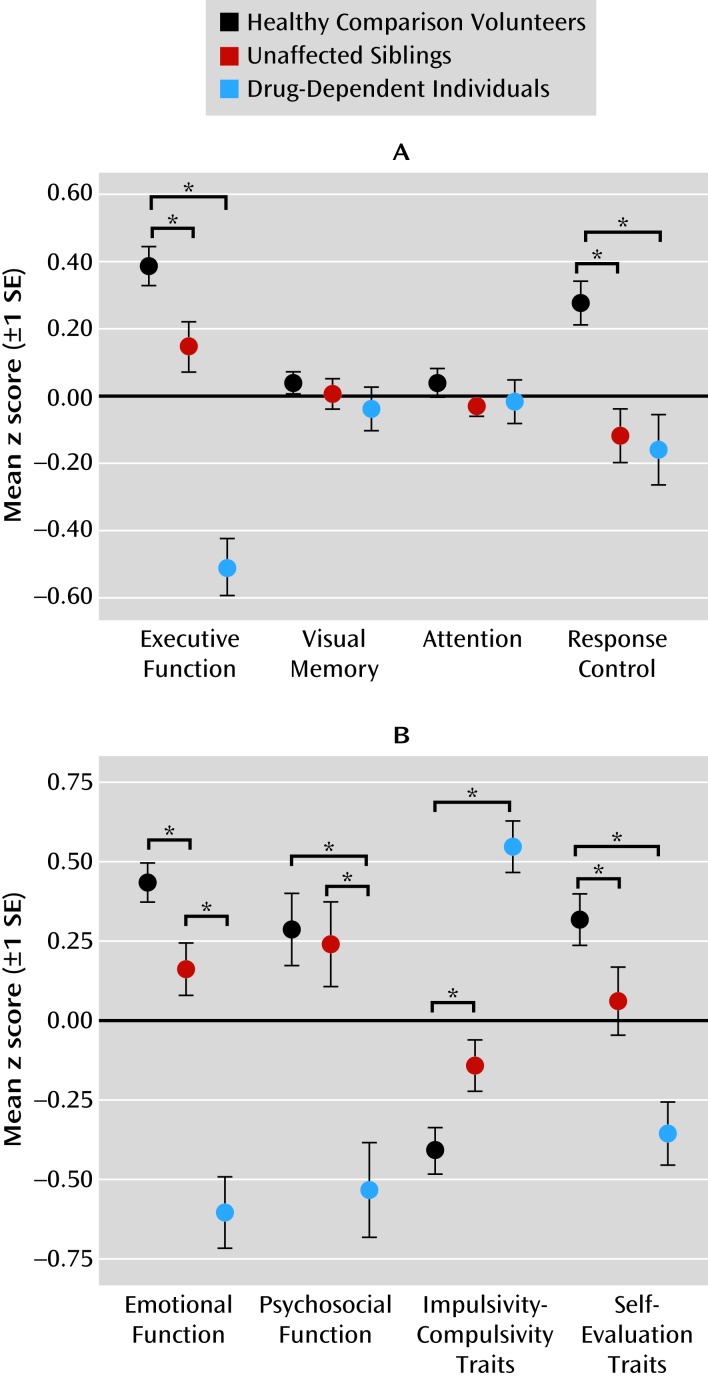
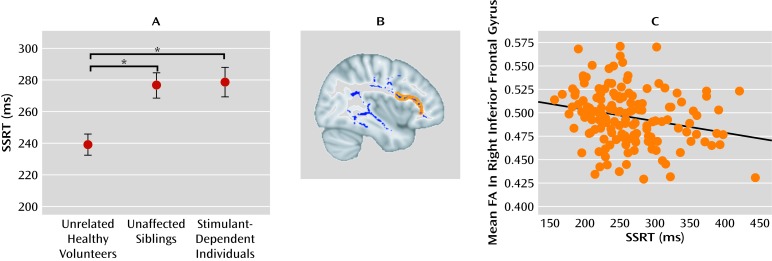
OBJECTIVE: Not everyone who takes drugs becomes addicted, but the likelihood of developing drug addiction is greater in people with a family history of drug or alcohol dependence. Relatively little is known about how genetic risk mediates the development of drug dependence. By comparing the phenotypic profile of individuals with and without a family history of addiction, the authors sought to clarify the extent to which cognitive dysfunction and personality traits are shared by family members--and therefore likely to have predated drug dependence--and which aspects are specific to drug-dependent individuals. METHOD: The authors assessed cognitive function and personality traits associated with drug dependence in stimulant-dependent individuals (N=50), their biological siblings without a history of drug dependence (N=50), and unrelated healthy volunteers (N=50). RESULTS: Cognitive function was significantly impaired in the stimulant-dependent individuals across a range of domains. Deficits in executive function and response control were identified in both the stimulant-dependent individuals and in their non-drug-dependent siblings. Drug-dependent individuals and their siblings also exhibited elevated anxious-impulsive personality traits relative to healthy comparison volunteers. CONCLUSIONS: Deficits in executive function and response regulation as well as anxious-impulsive personality traits may represent endophenotypes associated with the risk of developing cocaine or amphetamine dependence. The identification of addiction endophenotypes may be useful in facilitating the rational development of therapeutic and preventive strategies.
Overview
The claims and statistics of this paper haven’t been checked yet.
Run the check — free, no account needed. It reads the open-access text and checks the sources it cites.
Integrity signals
Registry
Cites
Statistics
Figures
Verification
Claims the paper makes
The claims and statistics of this paper haven’t been checked yet.
Run the check — free, no account needed. It reads the open-access text and checks the sources it cites.
Claims other papers make about this one
Each is checked against this paper’s own text: does it say what the citing paper says it does?
The source backs part of the claim, not all of it — or backs it for a different population, condition or comparison.
In the citing paper
“dependence to AMP or cocaine is influenced by anxious‐impulsive personality traits (Ersche et al., 2012).”
From Systematic reviews of the acute effects of amphetamine on working memory and other cognitive performances in healthy individuals, with a focus on the potential influence of personality traits (2023) · cites this paper as Ersche et al., 2012
Experimental — accuracy not yet measuredThe cited source says what the claim attributes to it.
In the citing paper
“stimulant‐dependent subjects and their non‐stimulant‐dependent siblings have impairments in response control and executive function, relative to healthy volunteers (Ersche et al., 2012).”
From Systematic reviews of the acute effects of amphetamine on working memory and other cognitive performances in healthy individuals, with a focus on the potential influence of personality traits (2023) · cites this paper as Ersche et al., 2012
Self-check
Percentages, sums and reported differences re-computed from the paper’s own numbers.
The self-check needs the paper’s full text.
Citations
Cites
SAUNDERS, J. B., AASLAND, O. G., BABOR, T. F., DE LA FUENTE, J. R., & GRANT, M. (1993) · Addiction · doi:10.1111/j.1360-0443.1993.tb02093.x · Cited by 13,597
Statistical Methods for Psychology.
Gudgeon, A. C., & Howell, D. C. (1994) · Journal of the Royal Statistical Society Series D (The Statistician) · doi:10.2307/2348956 · Cited by 8,277
The Endophenotype Concept in Psychiatry: Etymology and Strategic Intentions
Gottesman, I. I., & Gould, T. D. (2003) · American Journal of Psychiatry · doi:10.1176/appi.ajp.160.4.636 · Cited by 5,615
Hawkins, J. D., Catalano, R. F., & Miller, J. Y. (1992) · Psychological Bulletin · doi:10.1037/0033-2909.112.1.64 · Cited by 5,428
Whiteside, S. P., & Lynam, D. R. (2001) · Personality and Individual Differences · doi:10.1016/s0191-8869(00)00064-7 · Cited by 4,123
Regier, D. A. (1990) · JAMA · doi:10.1001/jama.1990.03450190043026 · Cited by 3,962
Casey, B. J., Jones, R. M., & Hare, T. A. (2008) · Annals of the New York Academy of Sciences · doi:10.1196/annals.1440.010 · Cited by 3,345
Cognitive and affective development in adolescence
Steinberg, L. (2005) · Trends in Cognitive Sciences · doi:10.1016/j.tics.2004.12.005 · Cited by 2,978
The Neural Basis of Addiction: A Pathology of Motivation and Choice
Kalivas, P. W., & Volkow, N. D. (2005) · American Journal of Psychiatry · doi:10.1176/appi.ajp.162.8.1403 · Cited by 2,757
Goldstein, R. Z., & Volkow, N. D. (2002) · American Journal of Psychiatry · doi:10.1176/appi.ajp.159.10.1642 · Cited by 2,667
Research works printed but not linked: 3
- 10.1037/0022-3514.51.3.564 · DOI
- Ersche KD, Addict Disord Their Treatment
- First MB, 2002, Structured Clinical Interview for DSM-IV-TR Axis I Disorders, Research Version, Non-Patient Edition (SCID-I/NP)
Cited by
Sorted by citations
Drug addiction: updating actions to habits to compulsions ten years on
Everitt, B. J., & Robbins, T. W. (2016) · Annual Review of Psychology · doi:10.1146/annurev-psych-122414-033457 · Cited by 1,225
Self-citationSnyder, H. R., Miyake, A., & Hankin, B. L. (2015) · Frontiers in Psychology · doi:10.3389/fpsyg.2015.00328 · Cited by 946
“, 2013), substance use (e.g., Nigg et al., 2006; Ersche et al., 2012), physical health (e.”
BackgroundFrom the ventral to the dorsal striatum: devolving views of their roles in drug addiction
Everitt, B. J., & Robbins, T. W. (2013) · Neuroscience & Biobehavioral Reviews · doi:10.1016/j.neubiorev.2013.02.010 · Cited by 675
Self-citationZilverstand, A., Huang, A., Alia‐Klein, N., & Goldstein, R. Z. (2018) · Neuron · doi:10.1016/j.neuron.2018.03.048 · Cited by 598
Fineberg, N. A., Chamberlain, S. R., Goudriaan, A. E., Stein, D. J., Vanderschuren, L. J. M. J., Gillan, C. M., Shekar, S., Gorwood, P. A. P. M., Voon, V., Morein-Zamir, S., et al. (2014) · CNS Spectrums · doi:10.1017/s1092852913000801 · Cited by 488
Self-citation
Metadata
- Authors
- Ersche, K. D., Turton, A. J., Chamberlain, S. R., Müller, U., Bullmore, E. T., & Robbins, T. W.
- Affiliations
- University of Cambridge (GB)
- Corresponding author
- Ersche, Karen D.
- Venue
- American Journal of Psychiatry
- Published
- 2012-09
- Volume
- 169
- Issue
- 9
- Pages
- 926-936
- ISSN
- 0002-953X (ISSN-L)
- 1535-7228
- PMC
- PMC3533378
- OpenAlex
- W2128615125
- Cited by
- 252
- References
- 77
- Citations by year
- 2026: 5 · 2025: 5 · 2024: 8 · 2023: 9 · 2022: 20 · 2021: 11 · 2020: 43 · 2019: 30 · 2018: 17 · 2017: 15 · 2016: 12 · 2015: 19 · 2014: 31 · 2013: 21 · 2012: 6
- FWCI
- 18.44
- Type
- journal article
- Language
- en
- Open access
- green
- www.ncbi.nlm.nih.gov
- Licence
- cc-by-nc
- Locations
- American Journal of Psychiatry (publishedVersion)
- PubMed Central (publishedVersion, cc-by-nc)
- PubMed (publishedVersion)
- ePrints Soton (University of Southampton) (submittedVersion)
- Funders
- Eli Lilly and Company
- GlaxoSmithKline
- Wellcome Trust (093875)
- University of Cambridge
- European College of Neuropsychopharmacology
- H. Lundbeck A/S
- Medical Research Council
- Topics
- Health Sciences › Medicine › Epidemiology › Substance Abuse Treatment and Outcomes
- Life Sciences › Neuroscience › Cellular and Molecular Neuroscience › Neurotransmitter Receptor Influence on Behavior
- Life Sciences › Neuroscience › Cognitive Neuroscience › Neural and Behavioral Psychology Studies
- Keywords
- endophenotypes, drug addiction, stimulant use disorder, cocaine dependence, amphetamine dependence, cognitive impairment, executive function, response control, family history of addiction, biological siblings
- MeSH terms
- Adult, Anxiety, Cognition Disorders, Family Health, Female, Humans, Impulsive Behavior, Male, Neuropsychological Tests, Personality Assessment, Case-Control Studies, Substance-Related Disorders, Siblings, Endophenotypes
About these checks
Registry, retraction, Cites and statistics results are computed, not judged, with one exception: a printed reference that no index lists is read once by a model before it counts as a citation error. Claims are extracted by a model and kept only when their quote appears verbatim in the text; each cited source is then checked, with a model’s help, for whether it says what the claim relies on. Those verdicts can be wrong — read the claim’s quote and the cited source before relying on one.
Statistics and arithmetic are recomputed, not judged.
Confidence bands are shown only for fields calibrated on our annotated test set. None is calibrated yet, so no band is shown.
What counts as a claim ›How we measure confidence ›How we check this ›
Are you an author, or do you see a problem with this page? Request a review
