

The DOI matches its Crossref record; 76 of the 77 references it cites were found in a registry or an index.
Cognitive Dysfunction and Anxious-Impulsive Personality Traits Are Endophenotypes for Drug Dependence
Open accessAbstract
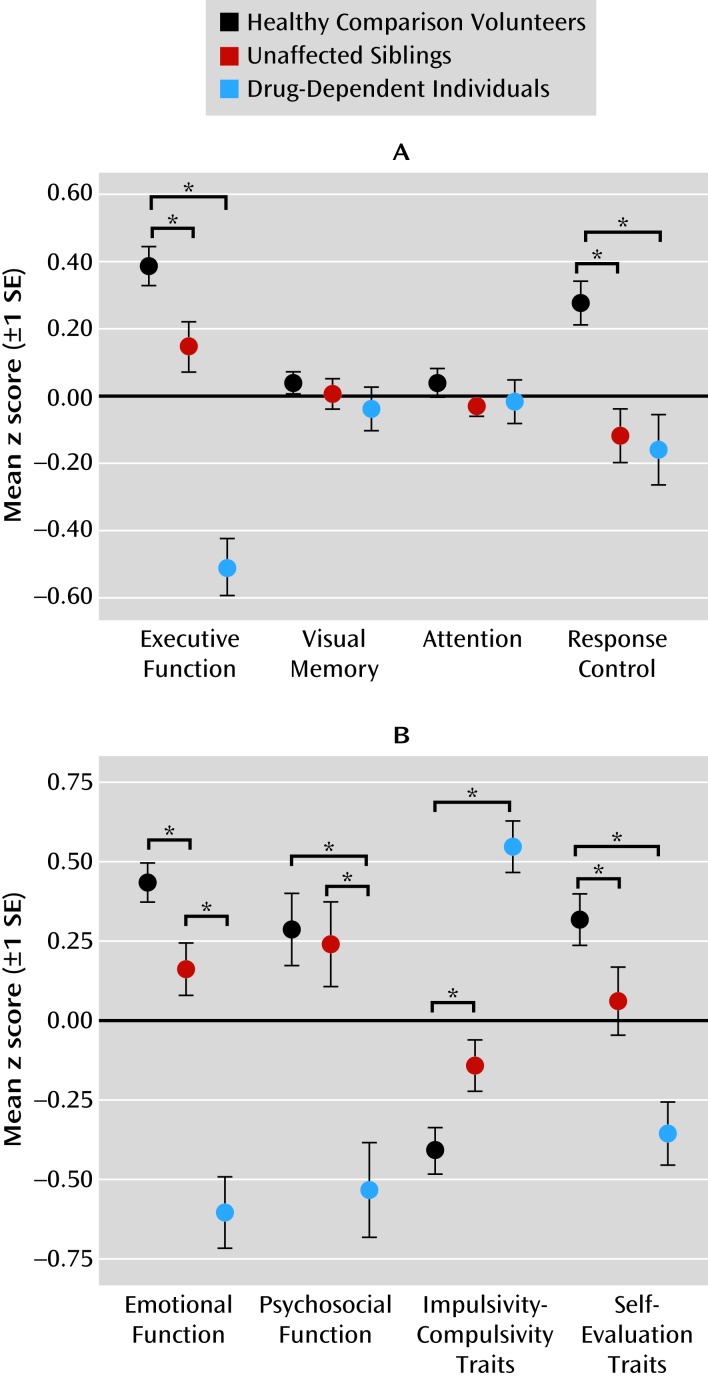
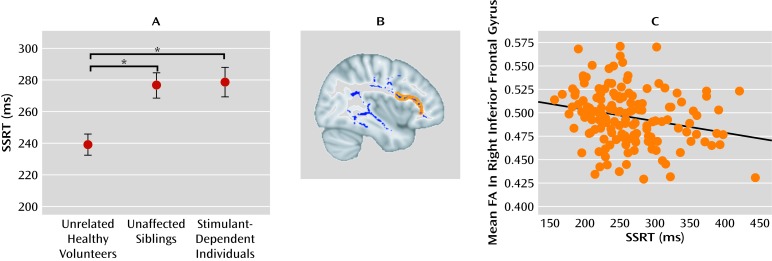
OBJECTIVE: Not everyone who takes drugs becomes addicted, but the likelihood of developing drug addiction is greater in people with a family history of drug or alcohol dependence. Relatively little is known about how genetic risk mediates the development of drug dependence. By comparing the phenotypic profile of individuals with and without a family history of addiction, the authors sought to clarify the extent to which cognitive dysfunction and personality traits are shared by family members--and therefore likely to have predated drug dependence--and which aspects are specific to drug-dependent individuals. METHOD: The authors assessed cognitive function and personality traits associated with drug dependence in stimulant-dependent individuals (N=50), their biological siblings without a history of drug dependence (N=50), and unrelated healthy volunteers (N=50). RESULTS: Cognitive function was significantly impaired in the stimulant-dependent individuals across a range of domains. Deficits in executive function and response control were identified in both the stimulant-dependent individuals and in their non-drug-dependent siblings. Drug-dependent individuals and their siblings also exhibited elevated anxious-impulsive personality traits relative to healthy comparison volunteers. CONCLUSIONS: Deficits in executive function and response regulation as well as anxious-impulsive personality traits may represent endophenotypes associated with the risk of developing cocaine or amphetamine dependence. The identification of addiction endophenotypes may be useful in facilitating the rational development of therapeutic and preventive strategies.
Overview
The claims and statistics of this paper haven’t been checked yet.
Run the check — free, no account needed. It reads the open-access text and checks the sources it cites.
Integrity signals
Registry
Cites
Statistics
Figures
Verification
Claims the paper makes
The claims and statistics of this paper haven’t been checked yet.
Run the check — free, no account needed. It reads the open-access text and checks the sources it cites.
Claims other papers make about this one
Each is checked against this paper’s own text: does it say what the citing paper says it does?
The source backs part of the claim, not all of it — or backs it for a different population, condition or comparison.
In the citing paper
“dependence to AMP or cocaine is influenced by anxious‐impulsive personality traits (Ersche et al., 2012).”
From Systematic reviews of the acute effects of amphetamine on working memory and other cognitive performances in healthy individuals, with a focus on the potential influence of personality traits (2023) · cites this paper as Ersche et al., 2012
Experimental — accuracy not yet measuredThe cited source says what the claim attributes to it.
In the citing paper
“stimulant‐dependent subjects and their non‐stimulant‐dependent siblings have impairments in response control and executive function, relative to healthy volunteers (Ersche et al., 2012).”
From Systematic reviews of the acute effects of amphetamine on working memory and other cognitive performances in healthy individuals, with a focus on the potential influence of personality traits (2023) · cites this paper as Ersche et al., 2012
Self-check
Percentages, sums and reported differences re-computed from the paper’s own numbers.
The self-check needs the paper’s full text.
Citations
Cites
SAUNDERS, J. B., AASLAND, O. G., BABOR, T. F., DE LA FUENTE, J. R., & GRANT, M. (1993) · Addiction · doi:10.1111/j.1360-0443.1993.tb02093.x · Cited by 13,597
Statistical Methods for Psychology.
Gudgeon, A. C., & Howell, D. C. (1994) · Journal of the Royal Statistical Society Series D (The Statistician) · doi:10.2307/2348956 · Cited by 8,277
The Endophenotype Concept in Psychiatry: Etymology and Strategic Intentions
Gottesman, I. I., & Gould, T. D. (2003) · American Journal of Psychiatry · doi:10.1176/appi.ajp.160.4.636 · Cited by 5,615
Hawkins, J. D., Catalano, R. F., & Miller, J. Y. (1992) · Psychological Bulletin · doi:10.1037/0033-2909.112.1.64 · Cited by 5,428
Whiteside, S. P., & Lynam, D. R. (2001) · Personality and Individual Differences · doi:10.1016/s0191-8869(00)00064-7 · Cited by 4,123
Regier, D. A. (1990) · JAMA · doi:10.1001/jama.1990.03450190043026 · Cited by 3,962
Casey, B. J., Jones, R. M., & Hare, T. A. (2008) · Annals of the New York Academy of Sciences · doi:10.1196/annals.1440.010 · Cited by 3,345
Cognitive and affective development in adolescence
Steinberg, L. (2005) · Trends in Cognitive Sciences · doi:10.1016/j.tics.2004.12.005 · Cited by 2,978
The Neural Basis of Addiction: A Pathology of Motivation and Choice
Kalivas, P. W., & Volkow, N. D. (2005) · American Journal of Psychiatry · doi:10.1176/appi.ajp.162.8.1403 · Cited by 2,757
Goldstein, R. Z., & Volkow, N. D. (2002) · American Journal of Psychiatry · doi:10.1176/appi.ajp.159.10.1642 · Cited by 2,667
Chambers, R. A., Taylor, J. R., & Potenza, M. N. (2003) · American Journal of Psychiatry · doi:10.1176/appi.ajp.160.6.1041 · Cited by 1,719
How does stress increase risk of drug abuse and relapse?
Sinha, R. (2001) · Psychopharmacology · doi:10.1007/s002130100917 · Cited by 1,505
Impulsivity as a determinant and consequence of drug use: a review of underlying processes
de Wit, H. (2009) · Addiction Biology · doi:10.1111/j.1369-1600.2008.00129.x · Cited by 1,415
Pechtel, P., & Pizzagalli, D. A. (2011) · Psychopharmacology · doi:10.1007/s00213-010-2009-2 · Cited by 1,352
Prefrontal executive and cognitive functions in rodents: neural and neurochemical substrates
Dalley, J. W., Cardinal, R. N., & Robbins, T. W. (2004) · Neuroscience & Biobehavioral Reviews · doi:10.1016/j.neubiorev.2004.09.006 · Cited by 1,329
Self-citationDevelopment of a rational scale to assess the harm of drugs of potential misuse
Nutt, D., King, L. A., Saulsbury, W., & Blakemore, C. (2007) · The Lancet · doi:10.1016/s0140-6736(07)60464-4 · Cited by 1,302
Self-esteem in a broad-spectrum approach for mental health promotion
Mann, M. (2004) · Health Education Research · doi:10.1093/her/cyg041 · Cited by 1,252
The genetics of addictions: uncovering the genes
Goldman, D., Oroszi, G., & Ducci, F. (2005) · Nature Reviews Genetics · doi:10.1038/nrg1635 · Cited by 1,099
Familial Transmission of Substance Use Disorders
Merikangas, K. R., Stolar, M., Stevens, D. E., Goulet, J., Preisig, M. A., Fenton, B., Zhang, H., O'Malley, S. S., & Rounsaville, B. J. (1998) · Archives of General Psychiatry · doi:10.1001/archpsyc.55.11.973 · Cited by 783
Neurobiological similarities in depression and drug dependence: a self-medication hypothesis
Markou, A. (1998) · Neuropsychopharmacology · doi:10.1016/s0893-133x(97)00113-9 · Cited by 767
Comorbidity of substance use disorders with mood and anxiety disorders
Merikangas, K. R., Mehta, R. L., Molnar, B. E., Walters, E. E., Swendsen, J. D., Aguilar‐Gaxiola, S., Bijl, R. V., Borges, G. L. G., Caraveo-Anduaga, J. J., DeWit, D. J., et al. (1998) · Addictive Behaviors · doi:10.1016/s0306-4603(98)00076-8 · Cited by 747
Tsuang, M. T., Lyons, M. J., Meyer, J. M., Doyle, T., Eisen, S. A., Goldberg, J., True, W., Lin, N., Toomey, R., & Eaves, L. (1998) · Archives of General Psychiatry · doi:10.1001/archpsyc.55.11.967 · Cited by 710
Drug dependence: stress and dysregulation of brain reward pathways
Kreek, M. J., & Koob, G. F. (1998) · Drug and Alcohol Dependence · doi:10.1016/s0376-8716(98)00064-7 · Cited by 696
Kendler, K. S., Jacobson, K. C., Prescott, C. A., & Neale, M. C. (2003) · American Journal of Psychiatry · doi:10.1176/appi.ajp.160.4.687 · Cited by 693
Neurobehavioral disinhibition in childhood predicts early age at onset of substance use disorder
Tarter, R. E., Kirisci, L., Mezzich, A., Cornelius, J. R., Pajer, K., Vanyukov, M., Gardner, W., Blackson, T., & Clark, D. (2003) · American Journal of Psychiatry · doi:10.1176/appi.ajp.160.6.1078 · Cited by 655
Bradley, R. G., Binder, E. B., Epstein, M. P., Tang, Y., Nair, H. P., Liu, W., Gillespie, C. F., Berg, T., Evces, M., Newport, D. J., et al. (2008) · Archives of General Psychiatry · doi:10.1001/archgenpsychiatry.2007.26 · Cited by 643
NIGG, J. T., WONG, M. M., MARTEL, M. M., JESTER, J. M., PUTTLER, L. I., GLASS, J. M., ADAMS, K. M., FITZGERALD, H. E., & ZUCKER, R. A. (2006) · Journal of the American Academy of Child & Adolescent Psychiatry · doi:10.1097/01.chi.0000199028.76452.a9 · Cited by 549
Abnormal Brain Structure Implicated in Stimulant Drug Addiction
Ersche, K. D., Jones, P. S., Williams, G. B., Turton, A. J., Robbins, T. W., & Bullmore, E. T. (2012) · Science · doi:10.1126/science.1214463 · Cited by 546
Self-citationAutomatic and effortful processing in depression.
Hartlage, S., Alloy, L. B., Vázquez, C., & Dykman, B. (1993) · Psychological Bulletin · doi:10.1037/0033-2909.113.2.247 · Cited by 523
Impaired inhibitory control of behavior in chronic cocaine users
Fillmore, M. T., & Rush, C. R. (2002) · Drug and Alcohol Dependence · doi:10.1016/s0376-8716(01)00206-x · Cited by 519
Newcomb, M. D., & Harlow, L. L. (1986) · Journal of Personality and Social Psychology · doi:10.1037//0022-3514.51.3.564 · Cited by 469
Diagnostic Validity of the Drug Abuse Screening Test in the Assessment of DSM‐III Drug Disorders
Gavin, D. R., ROSS, H. E., & Skinner, H. A. (1989) · British Journal of Addiction · doi:10.1111/j.1360-0443.1989.tb03463.x · Cited by 454
Profiles of Cognitive Dysfunction in Chronic Amphetamine and Heroin Abusers
Ornstein, T. (2000) · Neuropsychopharmacology · doi:10.1016/s0893-133x(00)00097-x · Cited by 445
Neurocognitive endophenotypes of obsessive-compulsive disorder
Menzies, L., Achard, S., Chamberlain, S. R., Fineberg, N., Chen, C.-H., del Campo, N., Sahakian, B. J., Robbins, T. W., & Bullmore, E. (2007) · Brain · doi:10.1093/brain/awm205 · Cited by 443
Self-citationBrodsky, B. S., Oquendo, M., Ellis, S. P., Haas, G. L., Malone, K. M., & Mann, J. J. (2001) · American Journal of Psychiatry · doi:10.1176/appi.ajp.158.11.1871 · Cited by 438
Deficits in response inhibition associated with chronic methamphetamine abuse
Monterosso, J. R., Aron, A. R., Cordova, X., Xu, J., & London, E. D. (2005) · Drug and Alcohol Dependence · doi:10.1016/j.drugalcdep.2005.02.002 · Cited by 425
Drug Addiction Endophenotypes: Impulsive Versus Sensation-Seeking Personality Traits
Ersche, K. D., Turton, A. J., Pradhan, S., Bullmore, E. T., & Robbins, T. W. (2010) · Biological Psychiatry · doi:10.1016/j.biopsych.2010.06.015 · Cited by 422
Self-citationErsche, K. D., Barnes, A., Jones, P. S., Morein-Zamir, S., Robbins, T. W., & Bullmore, E. T. (2011) · Brain · doi:10.1093/brain/awr138 · Cited by 389
Self-citationVerdejo‐García, A., & Pérez-Garcı́a, M. (2006) · Psychopharmacology · doi:10.1007/s00213-006-0632-8 · Cited by 318
Profile of Executive and Memory Function Associated with Amphetamine and Opiate Dependence
Ersche, K. D., Clark, L., London, M., Robbins, T. W., & Sahakian, B. J. (2006) · Neuropsychopharmacology · doi:10.1038/sj.npp.1300889 · Cited by 311
Self-citationInitial validation of two opiate craving questionnaires
Franken, I. H. A., Hendriks, V. M., & van den Brink, W. (2002) · Addictive Behaviors · doi:10.1016/s0306-4603(01)00201-5 · Cited by 308
Newman, J. P., & Wallace, J. F. (1993) · Clinical Psychology Review · doi:10.1016/s0272-7358(05)80002-9 · Cited by 292
Ernst, M., Romeo, R. D., & Andersen, S. L. (2008) · Pharmacology Biochemistry and Behavior · doi:10.1016/j.pbb.2008.12.013 · Cited by 250
Merikangas, K. R., Dierker, L. C., & Szatmari, P. (1998) · Journal of Child Psychology and Psychiatry · doi:10.1017/s0021963098002522 · Cited by 244
Meda, S. A., Stevens, M. C. G., Potenza, M. N., Pittman, B. P., Gueorguieva, R. V., Andrews, M. M., Thomas, A. D., Muska, C. E., Hylton, J. L., & Pearlson, G. D. (2009) · Behavioural Pharmacology · doi:10.1097/fbp.0b013e32833113a3 · Cited by 224
Fernández-Serrano, M. J., Pérez-Garcı́a, M., Schmidt‐RioValle, J., & Verdejo‐García, A. (2009) · Journal of Psychopharmacology · doi:10.1177/0269881109349841 · Cited by 224
The reality of comorbidity: Depression and drug abuse
Volkow, N. D. (2004) · Biological Psychiatry · doi:10.1016/j.biopsych.2004.07.007 · Cited by 218
Dielman, T. E., Campanelli, P., Shope, J. T., & Butchart, A. T. (1987) · Health Education Quarterly · doi:10.1177/109019818701400207 · Cited by 196
The self-regulating brain: cortical-subcortical feedback and the development of intelligent action.
Lewis, M. D., & Todd, R. M. (2007) · Cognitive Development · doi:10.1016/j.cogdev.2007.08.004 · Cited by 194
The Neuropsychology of Cocaine Addiction: Recent Cocaine Use Masks Impairment
Woicik, P. A., Moeller, S. J., Nelly Alia-klein, A., Maloney, T., Lukasik, T. M., Yeliosof, O., Wang, G., Volkow, N. D., & Goldstein, R. Z. (2008) · Neuropsychopharmacology · doi:10.1038/npp.2008.60 · Cited by 187
Genetic Vulnerability and Susceptibility to Substance Dependence
Bierut, L. J. (2011) · Neuron · doi:10.1016/j.neuron.2011.02.015 · Cited by 181
Self-Efficacy and the Addictive Behaviors
DiClemente, C. C. (1986) · Journal of Social and Clinical Psychology · doi:10.1521/jscp.1986.4.3.302 · Cited by 176
Cerebral metabolic dysfunction and impaired vigilance in recently abstinent methamphetamine abusers
London, E. D., Berman, S. M., Voytek, B., Simon, S. L., Mandelkern, M. A., Monterosso, J., Thompson, P. M., Brody, A. L., Geaga, J. A., Hong, M. S., et al. (2005) · Biological Psychiatry · doi:10.1016/j.biopsych.2005.04.039 · Cited by 136
Tomasi, D. G., Goldstein, R. Z., Telang, F., Maloney, T., Alia‐Klein, N., Caparelli, E. C., & Volkow, N. D. (2007) · Brain Research · doi:10.1016/j.brainres.2007.06.102 · Cited by 131
Social skills and attitudes associated with substance use behaviors among young adolescents
Barkin, S. L., Smith, K. S., & DuRant, R. H. (2002) · Journal of Adolescent Health · doi:10.1016/s1054-139x(01)00405-0 · Cited by 130
Behavioral self-regulation: Correlates and 2 year follow-ups for boys at risk for substance abuse
Dawes, M. A., Tarter, R. E., & Kirisci, L. (1997) · Drug and Alcohol Dependence · doi:10.1016/s0376-8716(97)01359-8 · Cited by 122
Childhood Trauma and Impulsivity. Possible Relevance to Suicidal Behavior
Roy, A. (2005) · Archives of Suicide Research · doi:10.1080/13811110590903990 · Cited by 94
Vanyukov, M. M., Kirisci, L., Moss, L., Tarter, R. E., Reynolds, M. D., Maher, B. S., Kirillova, G. P., Ridenour, T., & Clark, D. B. (2009) · Behavior Genetics · doi:10.1007/s10519-009-9269-9 · Cited by 88
Pace-Schott, E. F., Morgan, P. T., Malison, R. T., Hart, C. L., Edgar, C., Walker, M., & Stickgold, R. (2008) · The American Journal of Drug and Alcohol Abuse · doi:10.1080/00952990701764821 · Cited by 88
Parallel studies of cocaine-related neural and cognitive impairment in humans and monkeys
Beveridge, T. J. R., Gill, K. E., Hanlon, C. A., & Porrino, L. J. (2008) · Philosophical Transactions of the Royal Society B Biological Sciences · doi:10.1098/rstb.2008.0102 · Cited by 87
Childhood trauma, impulsivity, and executive functioning in crack cocaine users
Narvaez, J. C. D. M., Magalhães, P. V. D. S., Trindade, E. K., Vieira, D. C., Kauer‐Sant’Anna, M., Gama, C. S., DIEMEN, L. V., Kapczinski, N. S., & Kapczinski, F. P. (2011) · Comprehensive Psychiatry · doi:10.1016/j.comppsych.2011.04.058 · Cited by 78
Depression and Stimulant Dependence
Kosten, T. R., Markou, A., & Koob, G. F. (1998) · The Journal of Nervous and Mental Disease · doi:10.1097/00005053-199812000-00001 · Cited by 77
Acheson, A., Richard, D. M., Mathias, C. W., & Dougherty, D. M. (2011) · Drug and Alcohol Dependence · doi:10.1016/j.drugalcdep.2011.02.001 · Cited by 69
Self-efficacy as a predictor of smoking behavior in young adolescents
Lawrance, L., & Rubinson, L. G. (1986) · Addictive Behaviors · doi:10.1016/0306-4603(86)90015-8 · Cited by 68
Stephenson, M. T., & Helme, D. W. (2006) · Journal of Drug Education · doi:10.2190/y223-2623-7716-2235 · Cited by 61
Beveridge, T. J. R., Smith, H. R., Daunais, J. B., Nader, M. A., & Porrino, L. J. (2006) · European Journal of Neuroscience · doi:10.1111/j.1460-9568.2006.04788.x · Cited by 58
Drugs and the Future: Brain Science, Addiction and Society
Hall, W. (2007) · Addiction · doi:10.1111/j.1360-0443.2007.01927.x · Cited by 57
Peripheral biomarkers of cognitive response to dopamine receptor agonist treatment
Ersche, K. D., Roiser, J. P., Lucas, M., Domenici, E., Robbins, T. W., & Bullmore, E. T. (2010) · Psychopharmacology · doi:10.1007/s00213-010-2087-1 · Cited by 55
Self-citationGooding, D. C., Burroughs, S. A., & Boutros, N. N. (2008) · Psychiatry Research · doi:10.1016/j.psychres.2007.11.019 · Cited by 46
Predictive factors for illicit drug use among young people: a literature review
Frisher, M., CROME, I. B., Macleod, J., Bloor, R. N., & Hickman, M. (2007) · Cited by 35
Drugs and the Future: Brain Science, Addiction and Society
Stimson, G. V., Nutt, D., Robbins, T. W., Ince, M., & Jackson, A. (2006) · Cited by 35
Self-citationAddictions and their familiality in Iceland
Tyrfingsson, Þ., Thorgeirsson, T. E., Geller, F., Rúnarsdóttir, V. Á., Hansdóttir, I., Björnsdóttir, G., Wiste, A. K., Jónsdóttir, G. A., Stefánsson, H., Gulcher, J. R., et al. (2010) · Annals of the New York Academy of Sciences · doi:10.1111/j.1749-6632.2009.05151.x · Cited by 29
Who Do You Think Is in Control in Addiction? A Pilot Study on Drug-related Locus of Control Beliefs
Ersche, K. D., Turton, A. J., Croudace, T. J., & Štochl, J. (2012) · Addictive Disorders & Their Treatment · doi:10.1097/adt.0b013e31823da151 · Cited by 29
Self-citationThe Developmental Behavior Genetics of Drug Involvement: Overview and Comments
Zucker, R. A. (2006) · Behavior Genetics · doi:10.1007/s10519-006-9070-y · Cited by 17
Predictive factors for illicit drug use among young people: A literature review
Ifans, J. (2007) · Probation Journal · doi:10.1177/02645505070540030802 · Cited by 17
Utility of CANTAB in functional neuroimaging
Lee, A. C. H., Owen, A. M., Rogers, R. D., Sahakian, B. J., & Robbins, T. W. (2000) · Cambridge University Press eBooks · doi:10.1017/cbo9780511470998.028 · Cited by 12
Self-citation
Research works printed but not linked: 3
- 10.1037/0022-3514.51.3.564 · DOI
- Ersche KD, Addict Disord Their Treatment
- First MB, 2002, Structured Clinical Interview for DSM-IV-TR Axis I Disorders, Research Version, Non-Patient Edition (SCID-I/NP)
Cited by
Sorted by citations
Drug addiction: updating actions to habits to compulsions ten years on
Everitt, B. J., & Robbins, T. W. (2016) · Annual Review of Psychology · doi:10.1146/annurev-psych-122414-033457 · Cited by 1,225
Self-citationSnyder, H. R., Miyake, A., & Hankin, B. L. (2015) · Frontiers in Psychology · doi:10.3389/fpsyg.2015.00328 · Cited by 946
“, 2013), substance use (e.g., Nigg et al., 2006; Ersche et al., 2012), physical health (e.”
BackgroundFrom the ventral to the dorsal striatum: devolving views of their roles in drug addiction
Everitt, B. J., & Robbins, T. W. (2013) · Neuroscience & Biobehavioral Reviews · doi:10.1016/j.neubiorev.2013.02.010 · Cited by 675
Self-citationZilverstand, A., Huang, A., Alia‐Klein, N., & Goldstein, R. Z. (2018) · Neuron · doi:10.1016/j.neuron.2018.03.048 · Cited by 598
Fineberg, N. A., Chamberlain, S. R., Goudriaan, A. E., Stein, D. J., Vanderschuren, L. J. M. J., Gillan, C. M., Shekar, S., Gorwood, P. A. P. M., Voon, V., Morein-Zamir, S., et al. (2014) · CNS Spectrums · doi:10.1017/s1092852913000801 · Cited by 488
Self-citation
Metadata
- Authors
- Ersche, K. D., Turton, A. J., Chamberlain, S. R., Müller, U., Bullmore, E. T., & Robbins, T. W.
- Affiliations
- University of Cambridge (GB)
- Corresponding author
- Ersche, Karen D.
- Venue
- American Journal of Psychiatry
- Published
- 2012-09
- Volume
- 169
- Issue
- 9
- Pages
- 926-936
- ISSN
- 0002-953X (ISSN-L)
- 1535-7228
- PMC
- PMC3533378
- OpenAlex
- W2128615125
- Cited by
- 252
- References
- 77
- Citations by year
- 2026: 5 · 2025: 5 · 2024: 8 · 2023: 9 · 2022: 20 · 2021: 11 · 2020: 43 · 2019: 30 · 2018: 17 · 2017: 15 · 2016: 12 · 2015: 19 · 2014: 31 · 2013: 21 · 2012: 6
- FWCI
- 18.44
- Type
- journal article
- Language
- en
- Open access
- green
- www.ncbi.nlm.nih.gov
- Licence
- cc-by-nc
- Locations
- American Journal of Psychiatry (publishedVersion)
- PubMed Central (publishedVersion, cc-by-nc)
- PubMed (publishedVersion)
- ePrints Soton (University of Southampton) (submittedVersion)
- Funders
- Eli Lilly and Company
- GlaxoSmithKline
- Wellcome Trust (093875)
- University of Cambridge
- European College of Neuropsychopharmacology
- H. Lundbeck A/S
- Medical Research Council
- Topics
- Health Sciences › Medicine › Epidemiology › Substance Abuse Treatment and Outcomes
- Life Sciences › Neuroscience › Cellular and Molecular Neuroscience › Neurotransmitter Receptor Influence on Behavior
- Life Sciences › Neuroscience › Cognitive Neuroscience › Neural and Behavioral Psychology Studies
- Keywords
- endophenotypes, drug addiction, stimulant use disorder, cocaine dependence, amphetamine dependence, cognitive impairment, executive function, response control, family history of addiction, biological siblings
- MeSH terms
- Adult, Anxiety, Cognition Disorders, Family Health, Female, Humans, Impulsive Behavior, Male, Neuropsychological Tests, Personality Assessment, Case-Control Studies, Substance-Related Disorders, Siblings, Endophenotypes
About these checks
Registry, retraction, Cites and statistics results are computed, not judged, with one exception: a printed reference that no index lists is read once by a model before it counts as a citation error. Claims are extracted by a model and kept only when their quote appears verbatim in the text; each cited source is then checked, with a model’s help, for whether it says what the claim relies on. Those verdicts can be wrong — read the claim’s quote and the cited source before relying on one.
Statistics and arithmetic are recomputed, not judged.
Confidence bands are shown only for fields calibrated on our annotated test set. None is calibrated yet, so no band is shown.
What counts as a claim ›How we measure confidence ›How we check this ›
Are you an author, or do you see a problem with this page? Request a review
