

A double-blind, randomized, placebo-controlled trial of Lactobacillus helveticus and Bifidobacterium longum for the symptoms of depression
Open accessThe DOI matches its Crossref record; 52 of the 52 references it cites were found in a registry or an index.
Abstract
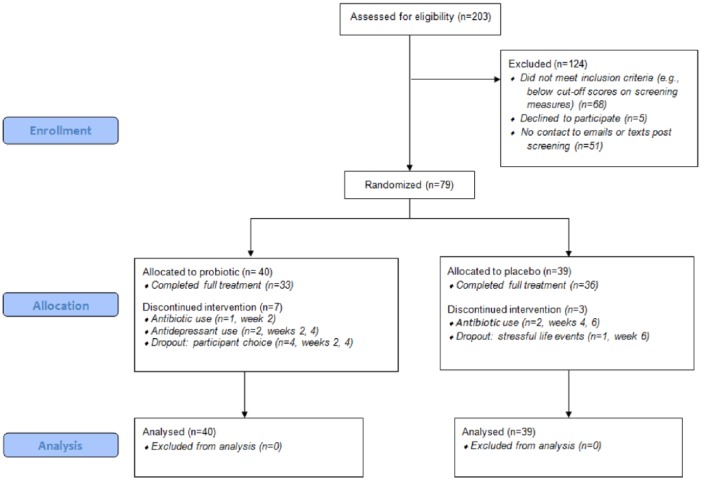
Objectives: This trial investigated whether probiotics improved mood, stress and anxiety in a sample selected for low mood. We also tested whether the presence or severity of irritable bowel syndrome symptoms, and levels of proinflammatory cytokines, brain-derived neurotrophic factor and other blood markers, would predict or impact treatment response. Method: Seventy-nine participants (10 dropouts) not currently taking psychotropic medications with at least moderate scores on self-report mood measures were randomly allocated to receive either a probiotic preparation (containing Lactobacillus helveticus and Bifidobacterium longum ) or a matched placebo, in a double-blind trial for 8 weeks. Data were analysed as intent-to-treat. Results: No significant difference was found between the probiotic and placebo groups on any psychological outcome measure (Cohen’s d range = 0.07–0.16) or any blood-based biomarker. At end-point, 9 (23%) of those in the probiotic group showed a ⩾60% change on the Montgomery–Åsberg Depression Rating Scale (responders), compared to 10 (26%) of those in the placebo group ( χ 1 2 = 0 . 107 , p = ns). Baseline vitamin D level was found to moderate treatment effect on several outcome measures. Dry mouth and sleep disruption were reported more frequently in the placebo group. Conclusions: This study found no evidence that the probiotic formulation is effective in treating low mood, or in moderating the levels of inflammatory and other biomarkers. The lack of observed effect on mood symptoms may be due to the severity, chronicity or treatment resistance of the sample; recruiting an antidepressant-naive sample experiencing mild, acute symptoms of low mood, may well yield a different result. Future studies taking a preventative approach or using probiotics as an adjuvant treatment may also be more effective. Vitamin D levels should be monitored in future studies in the area. The results of this trial are preliminary; future studies in the area should not be discouraged.
Overview
The claims and statistics of this paper haven’t been checked yet.
Free: it reads the open-access text and checks the first 5 claims that cite a source we can check. Create a free account to check every claim.
Integrity signals
Registry
Cites
Statistics
Figures
Verification
Claims the paper makes
The claims and statistics of this paper haven’t been checked yet.
Free: it reads the open-access text and checks the first 5 claims that cite a source we can check. Create a free account to check every claim.
Claims other papers make about this one
Each is checked against this paper’s own text: does it say what the citing paper says it does?
The cited source doesn’t support the claim as written.
In the citing paper
“Such clinical relevance has also been observed in previous probiotic intervention studies, where probiotics showed beneficial but sometimes non-significant effects on depressive symptoms and anxiety [38,39,40].”
From The Impact of Weizmannia coagulans BC99 on Anxiety and Depression: An 8-Week Clinical Pilot Study Through the Gut Microbiota–Brain Axis (2025) · cites this paper as [38]
Checked by a reasoning model — may be wrong.
Experimental — accuracy not yet measured
Self-check
Percentages, sums and reported differences re-computed from the paper’s own numbers.
The self-check needs the paper’s full text.
Citations
Cites
A new depression scale designed to be sensitive to change
Montgomery, S. A., & Åsberg, M. (1979) · British Journal of Psychiatry · doi:10.1192/bjp.134.4.382 · Cited by 13,962 · cited 1×
“The Montgomery–Åsberg Depression Rating Scale (MADRS) is a well-validated 10-item clinician-rated diagnostic questionnaire designed to measure the severity of depressive episodes (Montgomery and Åsberg, 1979).”
MethodJournal of Clinical Psychiatry
(2018) · Journal of Clinical Psychiatry · doi:10.5505/kpd · Cited by 13,651
Molecular Mechanisms of Depression: Perspectives on New Treatment Strategies
Lang, U. E., & Borgwardt, S. (2013) · Cellular Physiology and Biochemistry · doi:10.1159/000350094 · Cited by 8,475
(1995) · Cited by 6,909
A Meta-Analysis of Cytokines in Major Depression
Dowlati, Y., Herrmann, N., Swardfager, W., Liu, H., Sham, L., Reim, E. K., & Lanctôt, K. L. (2010) · Biological Psychiatry · doi:10.1016/j.biopsych.2009.09.033 · Cited by 4,729 · cited 4×
“, 2014) suggesting some possible common factors in aetiology, such as an increase in systemic inflammation, which has been observed in both disorders (Dowlati et al., 2010; Liebregts et al., 2007).”
BackgroundInfluentialMind-altering microorganisms: the impact of the gut microbiota on brain and behaviour
Cryan, J. F., & Dinan, T. G. (2012) · Nature Reviews Neuroscience · doi:10.1038/nrn3346 · Cited by 4,572 · cited 2×
“Gut–brain axis research suggests that bacteria in the gastrointestinal (GI) tract also communicate with the central nervous system in the absence of an immune response (Cryan and Dinan, 2012; Keightley et al., 2015).”
BackgroundBravo, J. A., Forsythe, P., Chew, M. V., Escaravage, E., Savignac, H. M., Dinan, T. G., Bienenstock, J., & Cryan, J. F. (2011) · Proceedings of the National Academy of Sciences · doi:10.1073/pnas.1102999108 · Cited by 3,888 · cited 1×
“However, these reviews rely mainly on evidence from animal studies in which certain probiotic strains have affected emotional behaviour and brain activity (e.g. Bravo et al., 2011; Messaoudi et al., 2010).”
BackgroundRush, A. J., Trivedi, M. H., Ibrahim, H. M., Carmody, T. J., Arnow, B., Klein, D. N., Markowitz, J. C., Ninan, P. T., Kornstein, S., Manber, R., et al. (2003) · Biological Psychiatry · doi:10.1016/s0006-3223(02)01866-8 · Cited by 3,829 · cited 1×
“The QIDS-SR16 is a 16-item self-rated questionnaire designed to assess the severity of depressive symptoms (Rush et al., 2003).”
BackgroundGut feelings: the emerging biology of gut-brain communication
Mayer, E. A. (2011) · Nature Reviews Neuroscience · doi:10.1038/nrn3071 · Cited by 1,726 · cited 1×
“Many papers have explored the links among gut microbes, brain and behaviour (e.g. Collins et al., 2012; Mayer, 2011; Thakur et al., 2014).”
BackgroundFRANCIS, C. Y., MORRIS, J., & WHORWELL, P. J. (1997) · Alimentary Pharmacology & Therapeutics · doi:10.1046/j.1365-2036.1997.142318000.x · Cited by 1,708 · cited 1×
“Irritable Bowel Syndrome Symptom Severity Scale (IBS-SSS) is a five 100-point sliding scale that assesses the severity and frequency of abdominal pain, the severity of abdominal distention, dissatisfaction with bowel habits and interference with quality of life (Francis et al., 1997).”
Background
Research works printed but not linked: 1
- Thakur AK Shakya A Husain GM (2014) Gut-microbiota and mental health: Current and future perspectives. Journal of Pharmacology and Clinical Toxicology 2: 1016.
Cited by
Items 201–300 of 325
Hu, J., Zhang, Y., Liu, C., Gkaravella, A., & Yu, J. (2025) · Journal of Pediatric Gastroenterology and Nutrition · doi:10.1002/jpn3.70092 · Cited by 11
“21,22 25 Moreover, no systematic review focused on children and adolescents.”
Zhang, L., Chen, K., Li, S., Liu, S. K., & Wang, Z. (2025) · Current Issues in Molecular Biology · doi:10.3390/cimb47121061 · Cited by 13
“Notably, several high-profile randomized controlled trials of probiotic supplementation (psychobiotics) have failed to demonstrate substantial antidepressant effects over the placebo in broad MDD populations [103,104].”
Dong, H., Tang, X., Ye, J., & Xiao, W. (2023) · Annals of General Psychiatry · doi:10.1186/s12991-023-00458-x · Cited by 12
“rhamnosus have been confirmed to improve cognitive function and alleviate stress-induced anxiety/ depressive-like behaviors in animal experiments [4, 5, 14, 23, 28, 29].”
BackgroundInfluentialModulation of gut-brain axis improves microbiome, metabolism, and mood
Talbott, S. M., Talbott, J. A., Stephens, B. J., & Oddou, M. P. (2020) · Functional Foods in Health and Disease · doi:10.31989/ffhd.v10i1.685 · Cited by 10
“Bifidobacterium longum R0175 [22-24] GABA/Anxiety Lallemand Health Solutions, Mon-”
BackgroundShirani, M., Bagherniya, M., Sadeghi, O., Tehrani, H. G., Eskandari, M. H., Sharma, M., & Askari, G. (2025) · Nutrition Journal · doi:10.1186/s12937-025-01240-3 · Cited by 14
“…longum at the selected dose is supported by previous studies showing improvements in mood disorders and anxiety in healthy individuals [35], as well as reductions in depression, stress, CRP levels, and sleep disturbances in patients with depression following 8-week supplementation [43].”
Efficacy of bifidobacterium-related preparations on depression: the first meta-analysis
Huang, R., & Liu, Y. (2024) · Frontiers in Psychiatry · doi:10.3389/fpsyt.2024.1463848 · Cited by 14
Effects of Daily Probiotic Supplementation on Football Player’s Stress and Anxiety
Adikari, A. M. G. C. P., Adikari, A. M. G. C. P., Appukutty, M., & Kuan, G. (2019) · International Conference on Physical Education, Sport, and Health (ACPES) · doi:10.2991/acpes-19.2019.1 · Cited by 12
“Even though some studies showed decrement of the anxiety, depression and stress parameters after administrating probiotic supplements utilizing a different form of probiotics, dosages and supplement durations, the difference between two groups is not significant [8,12,16,21,40,41,42].”
BackgroundSkowrońska, A., Gawlik-Kotelnicka, O., Margulska, A., & Strzelecki, D. (2023) · Metabolites · doi:10.3390/metabo13020182 · Cited by 11
Microbiome-Induced Autoimmunity and Novel Therapeutic Intervention
Evrensel, A. (2023) · Advances in experimental medicine and biology · doi:10.1007/978-981-19-7376-5_4 · Cited by 11
Gut microbiome in atypical depression
Busch, A., Roy, S., Helbing, D. L., Čolić, L., Opel, N., Besteher, B., Walter, M., Bauer, M. W., & Refisch, A. (2024) · Journal of Affective Disorders · doi:10.1016/j.jad.2024.01.060 · Cited by 13
Gut-Microbiota-Brain Axis and Depression
Evrensel, A., & Ceylan, M. E. (2017) · Springer eBooks · doi:10.1007/978-981-10-6580-4_17 · Cited by 12
Analysis methods for the gut microbiome in neuropsychiatric and neurodegenerative disorders
Song, J. G., Yu, M., Lee, B., Lee, J., Hwang, S.-H., Na, D., & Kim, H. W. (2022) · Computational and Structural Biotechnology Journal · doi:10.1016/j.csbj.2022.02.024 · Cited by 10
“followed seventynine participants who received probiotics (Lactobacillus helveticus and Bifidobacterium longum) or placebo for 8 weeks [143].”
BackgroundGut microbiota in anxiety and depression: Pathogenesis and therapeutics
Bibbò, S., Fusco, S., Ianiro, G., Settanni, C. R., Ferrarese, D., Grassi, C., Cammarota, G., & Gasbarrini, A. (2022) · Frontiers in Gastroenterology · doi:10.3389/fgstr.2022.1019578 · Cited by 16
“longum R0175) failed to improve depressive symptoms in individuals with low mood not currently taking psychotropic medications (65).”
BackgroundBisle, E., Varadarajan, S., & Kolassa, I. (2024) · Brain Behavior & Immunity - Health · doi:10.1016/j.bbih.2024.100790 · Cited by 13
“In a randomized controlled trial by Romijn et al. (2017) no difference between probiotic and placebo group were found, but higher blood vitamin D levels were significantly associated with improved depressive symptoms after probiotic treatment (Romijn et al., 2017).”
BackgroundMethodResultDai, L.-Y., Chen, R.-R., Chen, H.-R., Yin, J.-H., Huang, Z., Yin, B.-W., & Liu, X.-Y. (2025) · World Journal of Psychiatry · doi:10.5498/wjp.v15.i5.98436 · Cited by 15
Elahinejad, V., Khorasanian, A. S., Tehrani‐Doost, M., Khosravi‐Darani, K., Mirsepassi, Z., Effatpanah, M., Askari‐Rabori, R., Tajadod, S., & Jazayeri, S. (2025) · Food Science & Nutrition · doi:10.1002/fsn3.4698 · Cited by 14
Antioch, I., Ilie, O., Ciobica, A. S., Doroftei, B., & Fornaro, M. (2020) · Medicina · doi:10.3390/medicina56100504 · Cited by 12
Souzedo, F. B., Bizarro, L., & de Pereira, A. P. A. (2020) · Jornal Brasileiro de Psiquiatria · doi:10.1590/0047-2085000000285 · Cited by 39
Adıgüzel, E., Yılmaz, Ş. G., Atabılen, B., & Şeref, B. (2025) · Behavioural Brain Research · doi:10.1016/j.bbr.2025.115595 · Cited by 7
Hunjan, G., Shah, S. S., Kosey, S., & Aran, K. R. (2025) · Journal of Neural Transmission · doi:10.1007/s00702-025-02938-8 · Cited by 9
Slykerman, R. F., Davies, N., & Donohoe, R. (2025) · Nutrition and Health · doi:10.1177/02601060241305682 · Cited by 8
“…2016; Andersson et al., 2016; De Oliveira et al., 2023; Mäkelä et al., 2023; Messaoudi et al., 2011; Moloney et al., 2021; Patterson et al., 2020; Romijn et al., 2017; Talbott et al., 2020; Wang et al., 2019) and adults with a diagnosed mental health disorder ( n = 5) (Gawlik-Kotelnicka et al.,…”
Reigada, L. C., Buchanan, E. M., Hazeltine, D., Shakil, H., & Polokowski, A. R. (2021) · Journal of Affective Disorders Reports · doi:10.1016/j.jadr.2021.100141 · Cited by 10
Cao, J., Yu, L., Zhao, J., Zhang, H., Chen, W., Xue, Y., & Zhai, Q. (2023) · Food Science and Human Wellness · doi:10.26599/fshw.2022.9250153 · Cited by 6
Frost, R., Zamri, A., Mathew, S., Salame, A., Bhanu, C., Bhamra, S. K., Bazo‐Alvarez, J. C., Heinrich, M., & Walters, K. R. (2025) · Frontiers in Pharmacology · doi:10.3389/fphar.2025.1609605 · Cited by 7
Sulaiman, N. N. Y., Nizam, N. B. M., Noor, N. A. M., Lim, S. M., Ramasamy, K., Alabsi, A. M., & Fareez, I. M. (2025) · Nutritional Neuroscience · doi:10.1080/1028415x.2025.2531357 · Cited by 8
“However, not all high-dose or long-duration treatments yielded significant results, as seen in Romijn, Rucklidge [30] and Chahwan, Kwan [29], indicating that the relationship between intervention characteristics and outcomes is not straightforward and warrants further investigation.”
Killeen, S. L., Mealy, G., Brennan, K., Cotter, P. D., Yelverton, C. A., Saldova, R., Groeger, D., van Sinderen, D., Doyle, S., & McAuliffe, F. M. (2023) · Cytokine · doi:10.1016/j.cyto.2023.156458 · Cited by 6
A probiotic amylase blend reduces gastrointestinal symptoms in a randomised clinical study
Monica, M. B. L., Raub, B. J., Lopez, H. L., & Ziegenfuss, T. N. (2023) · Beneficial Microbes · doi:10.1163/18762891-20230043 · Cited by 7
Nutritional and Microbial Qualities of Fermented Cereal-Based Porridges Produced in Northern Benin
Karimou, R., Noumavo, A. D. P., Aboudou, K., Boya, B., Assouma, F. F., Salami, H. A., Konmy, B. B. S., Houngbo, H. Y., Adjanohoun, A., Baba‐Moussa, L., et al. (2024) · Journal of Food Quality · doi:10.1155/2024/7200190 · Cited by 8
Llopis, I., Miguel, N. S., & Serrano, M. Á. (2025) · Applied Sciences · doi:10.3390/app15084564 · Cited by 14
Kaur, S., Jangli, A., Giridharan, V. V., & Dandekar, M. P. (2025) · Psychoneuroendocrinology · doi:10.1016/j.psyneuen.2025.107615 · Cited by 9
Hong, S., Yu, M., Zheng, Y., Wang, S., Zhang, J., Pan, B., Situ, H., Guo, L., Zhong, S., Chen, Y., et al. (2026) · Chinese Medicine · doi:10.1186/s13020-025-01283-y · Cited by 7
Microbial therapeutic tools for human brain disorders: A current overview
Borrego-Ruiz, A., & Borrego, J. J. (2025) · Brain Disorders · doi:10.1016/j.dscb.2025.100262 · Cited by 8
Filho, A. S. S., Souza, T. B., Martins, J. L. R., Dietz, G. P. H., Fernandes, K. F., de Sá, S., Inácio, P. A., Oliveira-Silva, I., Pedrino, G. R., Aprigliano, V., et al. (2026) · Pharmaceuticals · doi:10.3390/ph19010156 · Cited by 7
“Probiotics and prebiotics may complement antidepressant therapy through convergent modulation of the microbiota–gut–brain axis [1,10,23,64,72,78,79].”
Wang, L., Zhang, S., Liu, Y., Li, D., Tian, G., Li, X., & Li, Y. (2026) · Scientific Reports · doi:10.1038/s41598-026-41801-y · Cited by 8
Ong, J. S., Liu, Y.-W., Liong, M., Choi, S. B., Tsai, Y.-C., & Low, W. Y. (2020) · Genomics · doi:10.1016/j.ygeno.2020.06.052 · Cited by 4
Influence and Selection of Probiotics on Depressive Disorders in Occupational Health: Scoping Review
Picó-Monllor, J. A., Sala-Segura, E., Tobares, R. A., Moreno-Ochando, A., Hernández-Teruel, A., & Navarro‐López, V. (2023) · Nutrients · doi:10.3390/nu15163551 · Cited by 7
“There were also two publications [42,54] for t e year 2023 and only one publication per year for 2017 [50] and 2018 [38].”
BackgroundMethodResultInfluentialProbiotics in Depression Management: Efficacy, Mechanisms and Future Directions
Lee, L. (2025) · Progress In Microbes & Molecular Biology · doi:10.36877/pmmb.a0000459 · Cited by 10
A Microbial Relationship Between Irritable Bowel Syndrome and Depressive Symptoms
Perez, N. B., Wright, F., & Vorderstrasse, A. A. (2020) · Biological Research For Nursing · doi:10.1177/1099800420940787 · Cited by 7
“Excluding potential study participants with a psychiatric history (e.g., diagnosis of depressive disorders, antidepressant use; Azpiroz et al., 2017; Labus et al., 2017; Romijn et al., 2017; Yusof et al., 2017) may have skewed the sample depressive symptoms scores towards the low to normal range, limiting the ability…”
BackgroundMethodResultInfluentialSterrett, J. D., Andersen, N. D., & Lowry, C. A. (2022) · Progress in inflammation research · doi:10.1007/978-3-030-91051-8_10 · Cited by 4
Bahji, A., Brietzke, E. M., Cooke, N. C. A., Clement, F. M., Frey, B. N., Hofmeister, M., Kennedy, S. H., Lam, R. W. M., Milev, R. V., Moinul, D., et al. (2025) · The Canadian Journal of Psychiatry · doi:10.1177/07067437251394363 · Cited by 5
Amini, M., Motevaseli, E., Zahmatkesh, M., Yousefi, Z., Esmaeil-Jamaat, E., Hassanzadeh, G., & Mokhtari, T. (2026) · Molecular Neurobiology · doi:10.1007/s12035-025-05656-0 · Cited by 6
“Another study found that an eight-week course of Bifidobacterium longum and Lactobacillus helveticus reduced depressive symptoms [35].”
Lakshmi, B. A., Buddolla, V., Gubbiyappa, K. S., Suneetha, M., & Kim, Y. J. (2026) · Progress in Neuro-Psychopharmacology and Biological Psychiatry · doi:10.1016/j.pnpbp.2026.111636 · Cited by 4
The Effect of Probiotic Lactic Acid Bacteria on the Symptoms of Mental Disorders
Novikova, V. A., Bondarenko, K. D., Сазонов, А. Э., & Розанов, А. С. (2024) · Nanobiotechnology Reports · doi:10.1134/s2635167624602092 · Cited by 4
Sahebi, K., Arianejad, M., Azadi, S., Hosseinpour-Soleimani, F., Kazemi, R., Tajbakhsh, A., & Negahdaripour, M. (2025) · European Journal of Pharmacology · doi:10.1016/j.ejphar.2025.177630 · Cited by 3
Supplements and Natural Remedies for Depression
Mischoulon, D., & Iovieno, N. (2018) · Springer eBooks · doi:10.1007/978-3-319-97241-1_15 · Cited by 3
The effect of probiotics on depressive symptoms: A meta-analysis of randomized controlled trails
Silva, V. P. O. E., Silva, M. P. O. E., Sobrinho, C. R. W., Marques, R. C., Júnior, F. C. D. S., & Aroucha, M. L. (2021) · Research Society and Development · doi:10.33448/rsd-v10i9.18359 · Cited by 3
“…patients (Chung et al., 2014; Lee et al., 2021; Messaoudi et al., 2011; Mohammadi et al., 2016; Nishida et al., 2019; Nishihira et al., 2014; ÖstlundLagerström et al., 2016; Romijn et al., 2017; Siegel & Conklin, 2020; Smith-ryan et al., n.d.; Steenbergen et al., 2015; Venkataraman et al., 2021).”
BackgroundInfluentialCurrent Insights into the Use of Probiotics and Fatty Acids in Alleviating Depression
Gao, H., He, C., Xin, S., Hua, R., Du, Y., Wang, B., Gong, F., Yu, X., Pan, L., Gao, L., et al. (2023) · Microorganisms · doi:10.3390/microorganisms11082018 · Cited by 3
Potential of Probiotics as an Adjunct for Patients with Major Depressive Disorder
Cang, W., Wu, J., Ding, R., Wang, W., Li, N., Shi, H., Shi, L. S., Lee, Y. K., & Wu, R. (2022) · Molecular Nutrition & Food Research · doi:10.1002/mnfr.202101057 · Cited by 7
Suplementação com probióticos e depressão: estratégia terapêutica?
de Moraes, A. L. F., Bueno, R. G. A. L., Fuentes-Rojas, M., & Antunes, A. E. C. (2019) · Revista de Ciências Médicas · doi:10.24220/2318-0897v28n1a4455 · Cited by 15
Lactic acid bacteria and Bifidobacterium as potential psychotherapeutics
Dey, G. (2023) · Elsevier eBooks · doi:10.1016/b978-0-323-91930-2.00004-3 · Cited by 2
Dong, S., Hao, F., Xue, B., Wu, S., Zhong, R., Liao, Z., Han, H., & Fang, X. (2025) · Food Science and Human Wellness · doi:10.26599/fshw.2024.9250201 · Cited by 2
Role of Gut Microbiota in Psychiatric Disorders: From Mechanistic Insights to Therapeutic Strategies
Kim, Y. S., Woo, S., Ha, E., Ahn, S., Kim, E., Kim, S. I., Lim, W., & Kim, S. (2026) · Journal of Korean Medical Science · doi:10.3346/jkms.2026.41.e78 · Cited by 3
Sinha, P., Chatterjee, P., Kathiresan, P., Raju, K. S., Panwar, R., Mukherjee, A., Kumar, G., Cherian, J. J., Velayuthan, A., Chakrawarty, A., et al. (2026) · Journal of the American Geriatrics Society · doi:10.1111/jgs.70530 · Cited by 4
Shokr, M. M., Abu-Elsaoud, A. M., & Raish, S. M. A. (2026) · Molecular Neurobiology · doi:10.1007/s12035-026-06065-7 · Cited by 3
Affektive Störungen am Beispiel der unipolaren Depression
Köhler, S., & Walter, H. (2020) · Springer eBooks · doi:10.1007/978-3-662-59038-6_12 · Cited by 4
Alexandru, B. A., Rat, L. A., Moldovan, A. F., MIHANCEA, P., & Mariș, L. (2022) · Medicina · doi:10.3390/medicina58060763 · Cited by 3
“We also tested whether the presence or severity of symptoms of IBS and the levels of proinflammatory cytokines, brain-derived neurotrophic factor, and other blood markers would predict or influence response to treatment [53].”
BackgroundCoelho, T., & Kerpel, R. (2022) · Revista Científica Multidisciplinar Núcleo do Conhecimento · doi:10.32749/nucleodoconhecimento.com.br/nutrition/psychobiotics · Cited by 2
“…probiotics were used as an adjunct treatment to an antidepressant medication, constituting a probability that the effects would take longer than 8 weeks to occur if they were not supplemented with the medication, so test durations should be studied more closely precision (ROMIJN et al., 2017).”
MethodBertani, L., Balestrini, L., Chico, L., Scala, G. D., Geri, F., Tornar, A., & Belcari, C. (2024) · Minerva Gastroenterology · doi:10.23736/s2724-5985.23.03563-5 · Cited by 3
The microbiota-gut-brain axis and bipolar disorder
Gomes‐da‐Costa, S., Salagre, E., Camino, S., Vázquez, G. H., & Grande, I. (2020) · Elsevier eBooks · doi:10.1016/b978-0-12-819182-8.00023-5 · Cited by 1
The Interplay Between Use of Biological Therapies, Psychological State, and the Microbiome in IBD
Tavakoli, P., Vollmer-Conna, U. S., Hadži-Pavlović, D., Vázquez-Campos, X., & Grimm, M. (2022) · Frontiers in Medicine · doi:10.3389/fmed.2022.788992 · Cited by 1
The gut brain axis, effect of dietary changes and probiotics supplement on depression symptoms
Mohamed, S. H. A.-A., Khafagy, G. M., Sayed, I. T. E., & Hussein, H. A. (2024) · PharmaNutrition · doi:10.1016/j.phanu.2024.100424 · Cited by 2
Hajyani, S., Ebrahimi, M. T., Sadeghi, A., Ahrabi, N. Z., & Yadegar, A. (2025) · Archives of Physiology and Biochemistry · doi:10.1080/13813455.2025.2507749 · Cited by 2
“…and indicate that the beneficial effect of probiotic supplements, whether formulated as single-species or multi-species, is not associated with the improvement of inflammatory cytokines (Kajander et al., 2008, Madempudi et al., 2019, Romijn et al., 2017, Yoon et al., 2018, Han et al., 2017).”
Wiącek, J., Skonieczna‐Żydecka, K., Łoniewski, I., Deli, C. K., Fatouros, I. G., Jamurtas, A. Z., Moszczyńska, D., & Karolkiewicz, J. (2025) · Microorganisms · doi:10.3390/microorganisms13061284 · Cited by 2
“In contrast, another study in individuals with low mood reported no significant changes in mood or inflammatory markers [48], while a separate trial in patients with major depressive disorder found reductions in depression scores, alongside changes in tryptophan metabolism, suggesting potential…”
Efficacy of probiotic intervention in unmedicated depression: a systematic review and meta-analysis
Haiyan, L., Dan, W., Wan, X., Xiuxiu, C., Ye, L., Zhiguo, C., & Liu, T. (2026) · Frontiers in Psychiatry · doi:10.3389/fpsyt.2025.1608238 · Cited by 3
Role of Gut Microbiota and Probiotic in Chronic Fatigue Syndrome
Sharma, A., Wakode, S. R., Sharma, S., & Fayaz, F. (2022) · Springer eBooks · doi:10.1007/978-981-16-6760-2_9 · Cited by 2
Günüç, S., & Şendemir, A. (2022) · Psikiyatride Guncel Yaklasimlar - Current Approaches in Psychiatry · doi:10.18863/pgy.1034963 · Cited by 3
“…showed that probiotic supplements had positive effects against stress, depression, anxiety and inflammation in individuals, failure to observe these contributions in every individual was explained with different accompanying factors that vary from one individual to another (Romijn et al. 2017).”
Depressive Störungen in der Adoleszenz: Aktuelle Studienlage zur Mikrobiota-Darm-Hirn-Achse
Kandsperger, S., Brunner, R. M., Rupprecht, R., & Baghai, T. C. (2023) · Zeitschrift für Kinder- und Jugendpsychiatrie und Psychotherapie · doi:10.1024/1422-4917/a000917 · Cited by 4
‘Burger, Chips and a Side Order of Depression to Go Please’
Marsh, G. (2023) · British Journal of Psychotherapy · doi:10.1111/bjp.12847 · Cited by 1
Probióticos na redução de sintomas de ansiedade e depressão: uma revisão integrativa
Costa, B. C., Azevedo, G. S. D. S., Ferreira, P. H. A., & Almeida, L. M. R. (2020) · REVISTA CIÊNCIAS EM SAÚDE · doi:10.21876/rcshci.v10i4.1014 · Cited by 7
Probiotic Bacteria in the Correction of Depression Symptoms, Their Active Genes and Proteins
Poluektova, E. U., & Даниленко, В. Н. (2021) · Russian Journal of Genetics · doi:10.1134/s102279542109009x · Cited by 2
Inflammation, stress, and gut-brain axis as therapeutic targets in bipolar disorder
Vaccariello, E. D., & Nguyen, T. T. (2022) · Elsevier eBooks · doi:10.1016/b978-0-12-821398-8.00008-4 · Cited by 2
Probiotic Supplementation in Major Depressive Disorders
Shukla, R., Handa, M., & Kumar, A. (2022) · Springer eBooks · doi:10.1007/978-981-16-6760-2_7 · Cited by 1
Neuro-inflammation dans les maladies neurologiques. Rôle des probiotiques
Joffre, C., Dinel, A., & Layé, S. (2018) · Phytothérapie · doi:10.3166/phyto-2018-0093
Socializing the Gut in Probiotics Experimentation: Calibrating Microbiota and Science Policy
Gruber, D., & Kalin, J. P. (2019) · World Medical & Health Policy · doi:10.1002/wmh3.325
Coelho, T., & Kerpel, R. (2022) · Revista Científica Multidisciplinar Núcleo do Conhecimento · doi:10.32749/nucleodoconhecimento.com.br/nutrizione/psicobiotici
Coelho, T., & Kerpel, R. (2022) · Revista Científica Multidisciplinar Núcleo do Conhecimento · doi:10.32749/nucleodoconhecimento.com.br/nutrition-fr/psychobiotiques · Cited by 1
“(ROMIJN et al., 2017). https://www.nucleodoconhecimento.com.br RC: 119092 Disponible en: https://www.nucleodoconhecimento.com.br/nutrition-fr/psychobiotiques En revanche, les chercheurs ont envisagé d'analyser différentes souches et délais d'intervention.”
BackgroundCoelho, T., & Kerpel, R. (2022) · Revista Científica Multidisciplinar Núcleo do Conhecimento · doi:10.32749/nucleodoconhecimento.com.br/nutricion/psicobioticos-en-el-tratamiento
Coelho, T., & Kerpel, R. (2022) · Revista Científica Multidisciplinar Núcleo do Conhecimento · doi:10.32749/nucleodoconhecimento.com.br/ru/118840
Coelho, T., & Kerpel, R. (2022) · Revista Científica Multidisciplinar Núcleo do Conhecimento · doi:10.32749/nucleodoconhecimento.com.br/nutricao/psicobioticos
Coelho, T., & Kerpel, R. (2022) · Revista Científica Multidisciplinar Núcleo do Conhecimento · doi:10.32749/nucleodoconhecimento.com.br/ernahrung/psychobiotika
Biologische Grundlagen depressiver Erkrankungen
Köhler, S., & Walter, H. (2022) · Elsevier eBooks · doi:10.1016/b978-3-437-23031-8.00008-x · Cited by 1
Affective Disorders Using the Example of Unipolar Depression
Köhler, S., & Walter, H. (2023) · Springer eBooks · doi:10.1007/978-3-662-65774-4_12
Whether supplementary probiotic treatment has clinical effect on patients with depression?
Liu, J., & Chen, J. (2023) · Clinical Nutrition Open Science · doi:10.1016/j.nutos.2023.05.001
Eczacılıkta Güncel Araştırmalar
Yamalı, C., Erdönmez, E., Yuca, H., Kalaycı, B., Gökgöz, S., Paşayeva, L., Arslan, A. K. K., Şerbetçi, T., Aydoğan, Y. M., Yüce, H., et al. (2023) · Akademisyen Kitabevi eBooks · doi:10.37609/akya.2541 · Cited by 3
Foster, J. A., & Clarke, G. A. (2024) · Elsevier eBooks · doi:10.1016/b978-0-12-814800-6.00006-6
Farina, G. S., Nirta, L., MediSpeak Communications, B., de Oliveira, L. M. L., Rospiglioni, J. L. C., Vespasiano, C. F. P., Adium SA, S. P., Woite, N. L., Zahran, I. A. R., Checo, M., et al. (2024) · Principles and Practice of Clinical Research Journal · doi:10.21801/ppcrj.2024.102.5
Kalantidi, V., Kantilafti, M., Lamnisos, D., & Chrysostomou, S. (2024) · The North African Journal of Food and Nutrition Research · doi:10.51745/najfnr.8.18.106-117
“Lastly, no discernible decrease in depression symptoms (p = 0.99) was observed in the study by Romijn et al. (2017) (intervention 8 weeks; Lactobacillus helveticus and Bifidobacterium longum , ≥ 3×10 9 CFU/1.5 g).”
InfluentialAdvancements in Gut Microbiota Research: A Critical Review
Ahmed, S., & Regmi, P. (2024) · medtigo Journal of Medicine · doi:10.63096/medtigo3062236
Psikobiyotikler ve Ruhsal Hastalıklar: Bir Gözden Geçirme
ÖZ, M. (2025) · İstanbul Gelişim Üniversitesi Sosyal Bilimler Dergisi · doi:10.17336/igusbd.1312044
Talbott, S., Stephens, B. M., Talbott, J. A., Oddou, M. P., & Aoki, F. (2026) · Journal of Medicinal Food · doi:10.1177/1096620x261448041
“…weight management bene fi ts of probiotics, 27 – 34 as well as reductions in anxiety and depression levels with speci fi c probiotic strains, 5,35 – 39 while it has been acknowledged that probiotic effects are strain-speci fi c. 19 Lactiplantibacillus plantarum ( L. plantarum ) species can inhabit…”
Lenzoni, S., Hunter, K. A., Heym, N., Heasman, B. C., Blanco, S., Walton, G., Gibson, G. R., Poveda, C. G., Baguley, T. S., Wang, G., et al. (2025) · Psychopharmacology · doi:10.1007/s00213-025-06878-9
“How - ever, other studies reported null effects of prebiotics (i.e., non-digestible nutrients degraded by microbiota to lead to health benefits) with Lactobacillus on depressive symptoms (L. helveticus; Romijn et al. 2017 ; Romijn and Rucklidge 2015) or stress-related measures (Kelly et al. 2017).”
Moshfeghinia, R., & Pasalar, M. (2025) · Journal of Psychiatric Research · doi:10.1016/j.jpsychires.2025.09.028
Probióticos: Um guia prático de prescrição personalizada
Ribeiro, F. L. E., Ascenso, A., Landeiro, J., Miranda, J. V., Crespo, S., & Pinto, R. (2025) · Research Society and Development · doi:10.33448/rsd-v14i11.50174
Oprea, A., Steinman, J., Huang, G. T.-W., Soyinka, O., Brookbank, M., Abesteh, J., Hartman, M., McEvoy, A., Dionne, J. C., Milev, R. V., et al. (2025) · The Canadian Journal of Psychiatry · doi:10.1177/07067437251394369
“37 Three of these studies 33,35,36 ( n = 155) used probiotic intervention and concluded reduction in depressive symptoms while two studies ( n = 150) also used probiotic intervention 34,37 did not fi nd a signi fi cant difference in depressive symptoms between intervention and control groups.”
Hao, W., Ma, Q., Wang, L., Yuan, N., Gan, H. T., He, L., Li, X., Huang, J., & Chen, J. (2024) · Figshare · doi:10.6084/m9.figshare.26682949
Hao, W., Ma, Q., Wang, L., Yuan, N., Gan, H. T., He, L., Li, X., Huang, J., & Chen, J. (2024) · Figshare · doi:10.6084/m9.figshare.26682946
Dong, H., Tang, X., Ye, J., & Xiao, W. (2024) · Figshare · doi:10.6084/m9.figshare.26608299
Dong, H., Tang, X., Ye, J., & Xiao, W. (2024) · Figshare · doi:10.6084/m9.figshare.26608308
Hao, W., Ma, Q., Wang, L., Yuan, N., Gan, H. T., He, L., Li, X., Huang, J., & Chen, J. (2024) · Figshare · doi:10.6084/m9.figshare.26682943
Dong, H., Tang, X., Ye, J., & Xiao, W. (2024) · Figshare · doi:10.6084/m9.figshare.26608296
Metadata
- Authors
- Romijn, A. R., Rucklidge, J. J., Kuijer, R. G., & Frampton, C.
- Affiliations
- University of South Wales (GB)
- University of Canterbury (NZ)
- University of Otago (NZ)
- Corresponding author
- Romijn, Amy R
- Venue
- Australian & New Zealand Journal of Psychiatry
- Publisher
- SAGE Publications
- Published
- 2017-01-10
- Volume
- 51
- Issue
- 8
- Pages
- 810-821
- ISSN
- 0004-8674 (ISSN-L)
- 1440-1614
- PMC
- PMC5518919
- OpenAlex
- W2571547641
- Semantic Scholar
- 732436ebcd0ae0183da91bf92ebb5d25c540a2f5
- Cited by
- 323
- References
- 52
- Citations by year
- 2026: 27 · 2025: 34 · 2024: 50 · 2023: 41 · 2022: 45 · 2021: 30 · 2020: 31 · 2019: 32 · 2018: 24 · 2017: 8
- FWCI
- 29.24
- Type
- journal article
- Language
- en
- Open access
- hybrid
- doi.org
- Licence
- cc-by-nc
- journals.sagepub.com/page/policies/text-and-data-mining-license (tdm)
- Locations
- Australian & New Zealand Journal of Psychiatry (publishedVersion, cc-by-nc)
- PubMed Central (publishedVersion, cc-by-nc)
- PubMed (publishedVersion)
- Funders
- Lallemand Health Solutions
- Topics
- Life Sciences › Agricultural and Biological Sciences › Food Science › Probiotics and Fermented Foods
- Life Sciences › Neuroscience › Biological Psychiatry › Tryptophan and brain disorders
- Life Sciences › Biochemistry, Genetics and Molecular Biology › Molecular Biology › Gut microbiota and health
- Keywords
- probiotics, Lactobacillus helveticus, Bifidobacterium longum, depression, depressive mood, irritable bowel syndrome, inflammatory cytokines, brain-derived neurotrophic factor, vitamin D, antidepressant response, anxiety, stress, sleep disruption, xerostomia
- MeSH terms
- Bifidobacterium longum, Adult, Affect, Anxiety, Depression, Double-Blind Method, Female, Humans, Male, Middle Aged, Registries, Stress, Psychological, Outcome Assessment, Health Care, Probiotics, Lactobacillus helveticus
About these checks
Registry, retraction, Cites and statistics results are computed, not judged, with one exception: a printed reference that no index lists is read once by a model before it counts as a citation error. Claims are extracted by a model and kept only when their quote appears verbatim in the text; each cited source is then checked, with a model’s help, for whether it says what the claim relies on. Those verdicts can be wrong — read the claim’s quote and the cited source before relying on one.
Statistics and arithmetic are recomputed, not judged.
Confidence bands are shown only for fields calibrated on our annotated test set. None is calibrated yet, so no band is shown.
What counts as a claim ›How we measure confidence ›How we check this ›
Are you an author, or do you see a problem with this page? Request a review
Data sources
Bibliographic data: Semantic Scholar, OpenAlex, Crossref.
Contains information from the Semantic Scholar Academic Graph Datasets, made available under the ODC Attribution License (ODC-BY 1.0).
Semantic Scholar’s data is described in: Kinney, R., et al. (2023). The Semantic Scholar Open Data Platform. arXiv:2301.10140.
