

A double-blind, randomized, placebo-controlled trial of Lactobacillus helveticus and Bifidobacterium longum for the symptoms of depression
Open accessThe DOI matches its Crossref record; 52 of the 52 references it cites were found in a registry or an index.
Abstract
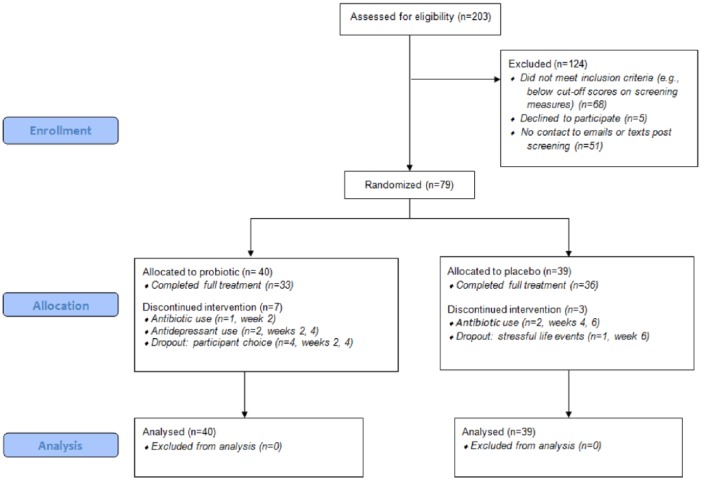
Objectives: This trial investigated whether probiotics improved mood, stress and anxiety in a sample selected for low mood. We also tested whether the presence or severity of irritable bowel syndrome symptoms, and levels of proinflammatory cytokines, brain-derived neurotrophic factor and other blood markers, would predict or impact treatment response. Method: Seventy-nine participants (10 dropouts) not currently taking psychotropic medications with at least moderate scores on self-report mood measures were randomly allocated to receive either a probiotic preparation (containing Lactobacillus helveticus and Bifidobacterium longum ) or a matched placebo, in a double-blind trial for 8 weeks. Data were analysed as intent-to-treat. Results: No significant difference was found between the probiotic and placebo groups on any psychological outcome measure (Cohen’s d range = 0.07–0.16) or any blood-based biomarker. At end-point, 9 (23%) of those in the probiotic group showed a ⩾60% change on the Montgomery–Åsberg Depression Rating Scale (responders), compared to 10 (26%) of those in the placebo group ( χ 1 2 = 0 . 107 , p = ns). Baseline vitamin D level was found to moderate treatment effect on several outcome measures. Dry mouth and sleep disruption were reported more frequently in the placebo group. Conclusions: This study found no evidence that the probiotic formulation is effective in treating low mood, or in moderating the levels of inflammatory and other biomarkers. The lack of observed effect on mood symptoms may be due to the severity, chronicity or treatment resistance of the sample; recruiting an antidepressant-naive sample experiencing mild, acute symptoms of low mood, may well yield a different result. Future studies taking a preventative approach or using probiotics as an adjuvant treatment may also be more effective. Vitamin D levels should be monitored in future studies in the area. The results of this trial are preliminary; future studies in the area should not be discouraged.
Overview
The claims and statistics of this paper haven’t been checked yet.
Free: it reads the open-access text and checks the first 5 claims that cite a source we can check. Create a free account to check every claim.
Integrity signals
Registry
Cites
Statistics
Figures
Verification
Claims the paper makes
The claims and statistics of this paper haven’t been checked yet.
Free: it reads the open-access text and checks the first 5 claims that cite a source we can check. Create a free account to check every claim.
Claims other papers make about this one
Each is checked against this paper’s own text: does it say what the citing paper says it does?
The cited source doesn’t support the claim as written.
In the citing paper
“Such clinical relevance has also been observed in previous probiotic intervention studies, where probiotics showed beneficial but sometimes non-significant effects on depressive symptoms and anxiety [38,39,40].”
From The Impact of Weizmannia coagulans BC99 on Anxiety and Depression: An 8-Week Clinical Pilot Study Through the Gut Microbiota–Brain Axis (2025) · cites this paper as [38]
Checked by a reasoning model — may be wrong.
Experimental — accuracy not yet measured
Self-check
Percentages, sums and reported differences re-computed from the paper’s own numbers.
The self-check needs the paper’s full text.
Citations
Cites
A new depression scale designed to be sensitive to change
Montgomery, S. A., & Åsberg, M. (1979) · British Journal of Psychiatry · doi:10.1192/bjp.134.4.382 · Cited by 13,962 · cited 1×
“The Montgomery–Åsberg Depression Rating Scale (MADRS) is a well-validated 10-item clinician-rated diagnostic questionnaire designed to measure the severity of depressive episodes (Montgomery and Åsberg, 1979).”
MethodJournal of Clinical Psychiatry
(2018) · Journal of Clinical Psychiatry · doi:10.5505/kpd · Cited by 13,651
Molecular Mechanisms of Depression: Perspectives on New Treatment Strategies
Lang, U. E., & Borgwardt, S. (2013) · Cellular Physiology and Biochemistry · doi:10.1159/000350094 · Cited by 8,475
(1995) · Cited by 6,909
A Meta-Analysis of Cytokines in Major Depression
Dowlati, Y., Herrmann, N., Swardfager, W., Liu, H., Sham, L., Reim, E. K., & Lanctôt, K. L. (2010) · Biological Psychiatry · doi:10.1016/j.biopsych.2009.09.033 · Cited by 4,729 · cited 4×
“, 2014) suggesting some possible common factors in aetiology, such as an increase in systemic inflammation, which has been observed in both disorders (Dowlati et al., 2010; Liebregts et al., 2007).”
BackgroundInfluentialMind-altering microorganisms: the impact of the gut microbiota on brain and behaviour
Cryan, J. F., & Dinan, T. G. (2012) · Nature Reviews Neuroscience · doi:10.1038/nrn3346 · Cited by 4,572 · cited 2×
“Gut–brain axis research suggests that bacteria in the gastrointestinal (GI) tract also communicate with the central nervous system in the absence of an immune response (Cryan and Dinan, 2012; Keightley et al., 2015).”
BackgroundBravo, J. A., Forsythe, P., Chew, M. V., Escaravage, E., Savignac, H. M., Dinan, T. G., Bienenstock, J., & Cryan, J. F. (2011) · Proceedings of the National Academy of Sciences · doi:10.1073/pnas.1102999108 · Cited by 3,888 · cited 1×
“However, these reviews rely mainly on evidence from animal studies in which certain probiotic strains have affected emotional behaviour and brain activity (e.g. Bravo et al., 2011; Messaoudi et al., 2010).”
BackgroundRush, A. J., Trivedi, M. H., Ibrahim, H. M., Carmody, T. J., Arnow, B., Klein, D. N., Markowitz, J. C., Ninan, P. T., Kornstein, S., Manber, R., et al. (2003) · Biological Psychiatry · doi:10.1016/s0006-3223(02)01866-8 · Cited by 3,829 · cited 1×
“The QIDS-SR16 is a 16-item self-rated questionnaire designed to assess the severity of depressive symptoms (Rush et al., 2003).”
BackgroundGut feelings: the emerging biology of gut-brain communication
Mayer, E. A. (2011) · Nature Reviews Neuroscience · doi:10.1038/nrn3071 · Cited by 1,726 · cited 1×
“Many papers have explored the links among gut microbes, brain and behaviour (e.g. Collins et al., 2012; Mayer, 2011; Thakur et al., 2014).”
BackgroundFRANCIS, C. Y., MORRIS, J., & WHORWELL, P. J. (1997) · Alimentary Pharmacology & Therapeutics · doi:10.1046/j.1365-2036.1997.142318000.x · Cited by 1,708 · cited 1×
“Irritable Bowel Syndrome Symptom Severity Scale (IBS-SSS) is a five 100-point sliding scale that assesses the severity and frequency of abdominal pain, the severity of abdominal distention, dissatisfaction with bowel habits and interference with quality of life (Francis et al., 1997).”
Background
Research works printed but not linked: 1
- Thakur AK Shakya A Husain GM (2014) Gut-microbiota and mental health: Current and future perspectives. Journal of Pharmacology and Clinical Toxicology 2: 1016.
Cited by
Items 301–325 of 325
Hao, W., Ma, Q., Wang, L., Yuan, N., Gan, H. T., He, L., Li, X., Huang, J., & Chen, J. (2024) · Figshare · doi:10.6084/m9.figshare.26682952
Hao, W., Ma, Q., Wang, L., Yuan, N., Gan, H. T., He, L., Li, X., Huang, J., & Chen, J. (2024) · Figshare · doi:10.6084/m9.figshare.26682964
Zhang, Q., Chen, B., Zhang, J., Dong, J., Ma, J., Zhang, Y., Jin, K., & Lu, J. (2023) · Figshare · doi:10.6084/m9.figshare.23606947
Dong, H., Tang, X., Ye, J., & Xiao, W. (2024) · Figshare · doi:10.6084/m9.figshare.26608305
Hao, W., Ma, Q., Wang, L., Yuan, N., Gan, H. T., He, L., Li, X., Huang, J., & Chen, J. (2024) · Figshare · doi:10.6084/m9.figshare.26682961
Hao, W., Ma, Q., Wang, L., Yuan, N., Gan, H. T., He, L., Li, X., Huang, J., & Chen, J. (2024) · Figshare · doi:10.6084/m9.figshare.26682955
Dong, H., Tang, X., Ye, J., & Xiao, W. (2024) · Figshare · doi:10.6084/m9.figshare.26608302
Hao, W., Ma, Q., Wang, L., Yuan, N., Gan, H. T., He, L., Li, X., Huang, J., & Chen, J. (2024) · Figshare · doi:10.6084/m9.figshare.26682958
Anachad, O., Taha, W., Saadoune, C., Assioui, H., Fenjar, I., Thaifa, I., Bennis, F., & Chegdani, F. (2026) · Bacteria · doi:10.3390/bacteria5010004
“L. helveticus is known for its production of GABA and lactate, while B. longum generates folate, riboflavin, and kynurenic acid, among others [9].”
Shirani, M., Bagherniya, M., Sadeghi, O., Tehrani, H. G., Eskandari, M. H., Sharma, M., & Askari, G. (2026) · International Journal of Reproductive BioMedicine (IJRM) · doi:10.18502/ijrm.v23i11.20547
“Additionally, a recent trial has shown that supplementation with L. helveticus and B. longum has a beneficial effect on CRP levels, depression, anxiety, stress indicators, and sleep quality (9).”
Zibaei, A., Masoumi, A., & Jafari, S. M. (2026) · Food Hydrocolloids for Health · doi:10.1016/j.fhfh.2026.100279
MICROBIOTA-GUT-BRAIN AXIS IN MAJOR DEPRESSION: PATHOPHYSIOLOGY AND PSYCHOBIOTIC INTERVENTIONS
Pietrzak, J., Błonka, D., Jaskulska, A., Skudzińska, M., Wołk, K., Pohrybieniuk, J., Kochański, F., Grys, M. I., Bartold, M., & Rajczyk, K. (2026) · International Journal of Innovative Technologies in Social Science · doi:10.31435/ijitss.1(49).2026.4809
Taghavi, S.-A., Sadri, M., Hashemimohammadabad, M., Hashemimohammadabad, N., Hashemimohammadabad, Z., & Bazarganipour, F. (2026) · The Journal of Sexual Medicine · doi:10.1093/jsxmed/qdag043
The gut-brain axis: Exploring the bidirectional relationship between diet and mental health
Sasidharan, S., & Dhillon, H. S. (2026) · Annals of the National Academy of Medical Sciences (India) · doi:10.25259/anams_194_2025
The Role of Gut Microbiome in Mental Health: A Systematic Review with Narrative SynthesisPreprint
Sharmeen, S., Biswas, S., Akter, K., Sheherin, S., Abdullah, R., Mia, M. J., & Chandra, B. (2026) · Research Square · doi:10.21203/rs.3.rs-9672071/v1
Probiotics unveiled: bridging general health benefits to the era of precision medicine
Ullah, M., Rizwan, M., Waheed, M. I., Alam, M. S., Jan, S. U., Raza, A., Shahid, M. F., Andoh, V., & Chen, Y. (2026) · World Journal of Microbiology and Biotechnology · doi:10.1007/s11274-026-05143-1
“Clinical trials have demonstrated that other probiotic strains, including Bifidobacterium longum and Lactobacillus helveticus , are effective in alleviating symp - toms of moderate and mild depression (Romijn et al. 2017 ).”
Liu, H., Kuang, X., & Zheng, X. (2026) · Nutrients · doi:10.3390/nu18142364
“Human psychobiotic studies in non-seasonal depressive populations have also yielded non-uniform clinical and mechanistic findings [75–78].”
Gao, T., Liu, X., Mi, W., Shi, L., Wang, X., Zhu, D., Geng, F., Fu, Y., Yang, Y., Li, X., et al. (2026) · Journal of Internal Medicine · doi:10.1111/joim.70137 · Cited by 2
Anjum, N., Ahmed, Z., Anjum, F., & Liaqat, S. (2026) · Nutritional Neuroscience · doi:10.1080/1028415x.2026.2703621
Jin, S., Li, C., Sun, N., & Zheng, X. (2026) · Nutrition Reviews · doi:10.1093/nutrit/nuag117
Velissaridou, A., Adamantidi, T., Bourgani, A., & Τσούπρας, Α. (2026) · Elsevier eBooks · doi:10.1016/b978-0-443-27500-5.00028-9
Zhang, Y., Pei, C., Zhang, D., & Liu, J. (2026) · Frontiers in Medicine · doi:10.3389/fmed.2026.1957715
The Microbiota-Gut-Brain Axis in Neurological and Neuropsychiatric Disorders: A Literature Review
Brar, H., Do, N., Kelser, C., Pattipati, S. N., & Nalamolu, K. R. (2026) · Cureus · doi:10.7759/cureus.118684
Marano, G., Conci, L., Farsakh, L., Traversi, G., Mazza, O., Ricozzi, V., Rotondaro, S., Migliore, A., Capristo, E., Franceschini, G., et al. (2026) · ALPHA PSYCHIATRY · doi:10.31083/ap54121
Gut microbial metabolites: linking gut–immune–brain crosstalk to mental and neuropsychiatric health
Wu, Y., Xie, X., Lyu, W., Xu, J.-E., Fan, F., Mao, R., Pan, S., Zhang, L., & Fu, M. (2026) · Frontiers in Immunology · doi:10.3389/fimmu.2026.1993237
Metadata
- Authors
- Romijn, A. R., Rucklidge, J. J., Kuijer, R. G., & Frampton, C.
- Affiliations
- University of South Wales (GB)
- University of Canterbury (NZ)
- University of Otago (NZ)
- Corresponding author
- Romijn, Amy R
- Venue
- Australian & New Zealand Journal of Psychiatry
- Publisher
- SAGE Publications
- Published
- 2017-01-10
- Volume
- 51
- Issue
- 8
- Pages
- 810-821
- ISSN
- 0004-8674 (ISSN-L)
- 1440-1614
- PMC
- PMC5518919
- OpenAlex
- W2571547641
- Semantic Scholar
- 732436ebcd0ae0183da91bf92ebb5d25c540a2f5
- Cited by
- 323
- References
- 52
- Citations by year
- 2026: 27 · 2025: 34 · 2024: 50 · 2023: 41 · 2022: 45 · 2021: 30 · 2020: 31 · 2019: 32 · 2018: 24 · 2017: 8
- FWCI
- 29.24
- Type
- journal article
- Language
- en
- Open access
- hybrid
- doi.org
- Licence
- cc-by-nc
- journals.sagepub.com/page/policies/text-and-data-mining-license (tdm)
- Locations
- Australian & New Zealand Journal of Psychiatry (publishedVersion, cc-by-nc)
- PubMed Central (publishedVersion, cc-by-nc)
- PubMed (publishedVersion)
- Funders
- Lallemand Health Solutions
- Topics
- Life Sciences › Agricultural and Biological Sciences › Food Science › Probiotics and Fermented Foods
- Life Sciences › Neuroscience › Biological Psychiatry › Tryptophan and brain disorders
- Life Sciences › Biochemistry, Genetics and Molecular Biology › Molecular Biology › Gut microbiota and health
- Keywords
- probiotics, Lactobacillus helveticus, Bifidobacterium longum, depression, depressive mood, irritable bowel syndrome, inflammatory cytokines, brain-derived neurotrophic factor, vitamin D, antidepressant response, anxiety, stress, sleep disruption, xerostomia
- MeSH terms
- Bifidobacterium longum, Adult, Affect, Anxiety, Depression, Double-Blind Method, Female, Humans, Male, Middle Aged, Registries, Stress, Psychological, Outcome Assessment, Health Care, Probiotics, Lactobacillus helveticus
About these checks
Registry, retraction, Cites and statistics results are computed, not judged, with one exception: a printed reference that no index lists is read once by a model before it counts as a citation error. Claims are extracted by a model and kept only when their quote appears verbatim in the text; each cited source is then checked, with a model’s help, for whether it says what the claim relies on. Those verdicts can be wrong — read the claim’s quote and the cited source before relying on one.
Statistics and arithmetic are recomputed, not judged.
Confidence bands are shown only for fields calibrated on our annotated test set. None is calibrated yet, so no band is shown.
What counts as a claim ›How we measure confidence ›How we check this ›
Are you an author, or do you see a problem with this page? Request a review
Data sources
Bibliographic data: Semantic Scholar, OpenAlex, Crossref.
Contains information from the Semantic Scholar Academic Graph Datasets, made available under the ODC Attribution License (ODC-BY 1.0).
Semantic Scholar’s data is described in: Kinney, R., et al. (2023). The Semantic Scholar Open Data Platform. arXiv:2301.10140.
