

A double-blind, randomized, placebo-controlled trial of Lactobacillus helveticus and Bifidobacterium longum for the symptoms of depression
Open accessThe DOI matches its Crossref record; 52 of the 52 references it cites were found in a registry or an index.
Abstract
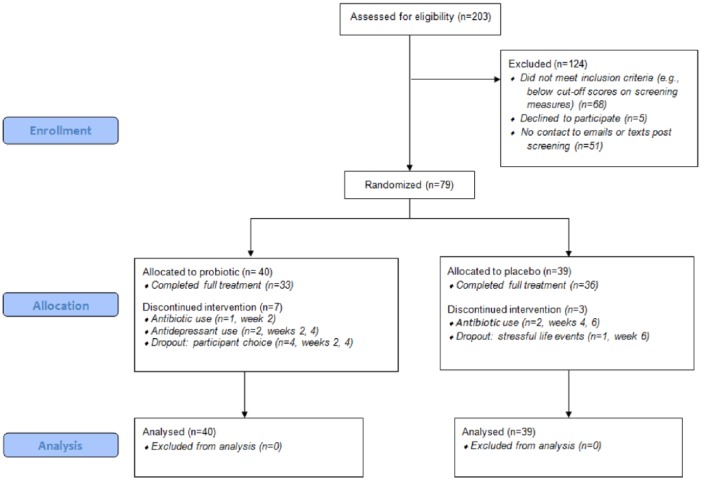
Objectives: This trial investigated whether probiotics improved mood, stress and anxiety in a sample selected for low mood. We also tested whether the presence or severity of irritable bowel syndrome symptoms, and levels of proinflammatory cytokines, brain-derived neurotrophic factor and other blood markers, would predict or impact treatment response. Method: Seventy-nine participants (10 dropouts) not currently taking psychotropic medications with at least moderate scores on self-report mood measures were randomly allocated to receive either a probiotic preparation (containing Lactobacillus helveticus and Bifidobacterium longum ) or a matched placebo, in a double-blind trial for 8 weeks. Data were analysed as intent-to-treat. Results: No significant difference was found between the probiotic and placebo groups on any psychological outcome measure (Cohen’s d range = 0.07–0.16) or any blood-based biomarker. At end-point, 9 (23%) of those in the probiotic group showed a ⩾60% change on the Montgomery–Åsberg Depression Rating Scale (responders), compared to 10 (26%) of those in the placebo group ( χ 1 2 = 0 . 107 , p = ns). Baseline vitamin D level was found to moderate treatment effect on several outcome measures. Dry mouth and sleep disruption were reported more frequently in the placebo group. Conclusions: This study found no evidence that the probiotic formulation is effective in treating low mood, or in moderating the levels of inflammatory and other biomarkers. The lack of observed effect on mood symptoms may be due to the severity, chronicity or treatment resistance of the sample; recruiting an antidepressant-naive sample experiencing mild, acute symptoms of low mood, may well yield a different result. Future studies taking a preventative approach or using probiotics as an adjuvant treatment may also be more effective. Vitamin D levels should be monitored in future studies in the area. The results of this trial are preliminary; future studies in the area should not be discouraged.
Overview
The claims and statistics of this paper haven’t been checked yet.
Free: it reads the open-access text and checks the first 5 claims that cite a source we can check. Create a free account to check every claim.
Integrity signals
Registry
Cites
Statistics
Figures
Verification
Claims the paper makes
The claims and statistics of this paper haven’t been checked yet.
Free: it reads the open-access text and checks the first 5 claims that cite a source we can check. Create a free account to check every claim.
Claims other papers make about this one
Each is checked against this paper’s own text: does it say what the citing paper says it does?
The cited source doesn’t support the claim as written.
In the citing paper
“Such clinical relevance has also been observed in previous probiotic intervention studies, where probiotics showed beneficial but sometimes non-significant effects on depressive symptoms and anxiety [38,39,40].”
From The Impact of Weizmannia coagulans BC99 on Anxiety and Depression: An 8-Week Clinical Pilot Study Through the Gut Microbiota–Brain Axis (2025) · cites this paper as [38]
Checked by a reasoning model — may be wrong.
Experimental — accuracy not yet measured
Self-check
Percentages, sums and reported differences re-computed from the paper’s own numbers.
The self-check needs the paper’s full text.
Citations
Cites
A new depression scale designed to be sensitive to change
Montgomery, S. A., & Åsberg, M. (1979) · British Journal of Psychiatry · doi:10.1192/bjp.134.4.382 · Cited by 13,962 · cited 1×
“The Montgomery–Åsberg Depression Rating Scale (MADRS) is a well-validated 10-item clinician-rated diagnostic questionnaire designed to measure the severity of depressive episodes (Montgomery and Åsberg, 1979).”
MethodJournal of Clinical Psychiatry
(2018) · Journal of Clinical Psychiatry · doi:10.5505/kpd · Cited by 13,651
Molecular Mechanisms of Depression: Perspectives on New Treatment Strategies
Lang, U. E., & Borgwardt, S. (2013) · Cellular Physiology and Biochemistry · doi:10.1159/000350094 · Cited by 8,475
(1995) · Cited by 6,909
A Meta-Analysis of Cytokines in Major Depression
Dowlati, Y., Herrmann, N., Swardfager, W., Liu, H., Sham, L., Reim, E. K., & Lanctôt, K. L. (2010) · Biological Psychiatry · doi:10.1016/j.biopsych.2009.09.033 · Cited by 4,729 · cited 4×
“, 2014) suggesting some possible common factors in aetiology, such as an increase in systemic inflammation, which has been observed in both disorders (Dowlati et al., 2010; Liebregts et al., 2007).”
BackgroundInfluentialMind-altering microorganisms: the impact of the gut microbiota on brain and behaviour
Cryan, J. F., & Dinan, T. G. (2012) · Nature Reviews Neuroscience · doi:10.1038/nrn3346 · Cited by 4,572 · cited 2×
“Gut–brain axis research suggests that bacteria in the gastrointestinal (GI) tract also communicate with the central nervous system in the absence of an immune response (Cryan and Dinan, 2012; Keightley et al., 2015).”
BackgroundBravo, J. A., Forsythe, P., Chew, M. V., Escaravage, E., Savignac, H. M., Dinan, T. G., Bienenstock, J., & Cryan, J. F. (2011) · Proceedings of the National Academy of Sciences · doi:10.1073/pnas.1102999108 · Cited by 3,888 · cited 1×
“However, these reviews rely mainly on evidence from animal studies in which certain probiotic strains have affected emotional behaviour and brain activity (e.g. Bravo et al., 2011; Messaoudi et al., 2010).”
BackgroundRush, A. J., Trivedi, M. H., Ibrahim, H. M., Carmody, T. J., Arnow, B., Klein, D. N., Markowitz, J. C., Ninan, P. T., Kornstein, S., Manber, R., et al. (2003) · Biological Psychiatry · doi:10.1016/s0006-3223(02)01866-8 · Cited by 3,829 · cited 1×
“The QIDS-SR16 is a 16-item self-rated questionnaire designed to assess the severity of depressive symptoms (Rush et al., 2003).”
BackgroundGut feelings: the emerging biology of gut-brain communication
Mayer, E. A. (2011) · Nature Reviews Neuroscience · doi:10.1038/nrn3071 · Cited by 1,726 · cited 1×
“Many papers have explored the links among gut microbes, brain and behaviour (e.g. Collins et al., 2012; Mayer, 2011; Thakur et al., 2014).”
BackgroundFRANCIS, C. Y., MORRIS, J., & WHORWELL, P. J. (1997) · Alimentary Pharmacology & Therapeutics · doi:10.1046/j.1365-2036.1997.142318000.x · Cited by 1,708 · cited 1×
“Irritable Bowel Syndrome Symptom Severity Scale (IBS-SSS) is a five 100-point sliding scale that assesses the severity and frequency of abdominal pain, the severity of abdominal distention, dissatisfaction with bowel habits and interference with quality of life (Francis et al., 1997).”
BackgroundThe interplay between the intestinal microbiota and the brain
Collins, S. M., Surette, M., & Bercik, P. (2012) · Nature Reviews Microbiology · doi:10.1038/nrmicro2876 · Cited by 1,611 · cited 1×
“Many papers have explored the links among gut microbes, brain and behaviour (e.g. Collins et al., 2012; Mayer, 2011; Thakur et al., 2014).”
BackgroundSo depression is an inflammatory disease, but where does the inflammation come from?
Berk, M., Williams, L. J., Jacka, F. N., O’Neil, A., Pasco, J. A., Moylan, S., Allen, N. B., Stuart, A. L., Hayley, A. C., Byrne, M. L., et al. (2013) · BMC Medicine · doi:10.1186/1741-7015-11-200 · Cited by 1,423 · cited 2×
“Australian & New Zealand Journal of Psychiatry, 51(8) (Berk et al., 2013; Maes, 2011) and gut disorders such as IBS (Fond et al.”
BackgroundMessaoudi, M., Lalonde, R., Violle, N., Javelot, H., Desor, D., Nejdi, A., Bisson, J.-F., Rougeot, C., Pichelin, M., Cazaubiel, M., et al. (2011) · British Journal of Nutrition · doi:10.1017/s0007114510004319 · Cited by 1,324 · cited 7×
“Randomized controlled trials using probiotics and assessing psychological outcomes typically have a sample size of 40–75 (Akkasheh et al., 2016; Dickerson et al., 2014; Diop et al., 2008; Messaoudi et al., 2010).”
BackgroundMethodInfluentialPsychobiotics: A novel class of psychotropic
Dinan, T. G., Stanton, C., & Cryan, J. F. (2013) · Biological Psychiatry · doi:10.1016/j.biopsych.2013.05.001 · Cited by 1,287 · cited 2×
“Dinan et al. (2013) coined the term ‘psychobiotics’ to describe probiotic bacteria that produces a health benefit in patients with psychiatric illness.”
BackgroundConsumption of fermented milk product with probiotic modulates brain activity
Tillisch, K., Labus, J., Kilpatrick, L., Jiang, Z., Stains, J., Ebrat, B., Guyonnet, D., Legrain–Raspaud, S., Trotin, B., Naliboff, B., et al. (2013) · Gastroenterology · doi:10.1053/j.gastro.2013.02.043 · Cited by 1,192 · cited 1×
“Tillisch et al. (2013) provided the first demonstration that probiotics affect brain activity in healthy humans using functional magnetic resonance imaging (fMRI).”
BackgroundBerk, M., Kapczinski, F., Andreazza, A. C., Dean, O. M., Giorlando, F., Maes, M., Yücel, M., Gama, C. S., Dodd, S., Dean, B., et al. (2011) · Neuroscience & Biobehavioral Reviews · doi:10.1016/j.neubiorev.2010.10.001 · Cited by 1,178
Malhi, G. S., Bassett, D., Boyce, P., Bryant, R., Fitzgerald, P. B., Fritz, K., Hopwood, M., Lyndon, B., Mulder, R., Murray, G., et al. (2015) · Australian & New Zealand Journal of Psychiatry · doi:10.1177/0004867415617657 · Cited by 842 · cited 2×
“…outlined in the clinical practice guidelines for mood disorders recently published by the Royal Australian and New Zealand College of Psychiatrists (Malhi et al., 2015) adhere very much to the conventional model for treatment of mood disorders; this new understanding of the aetiology of mental…”
BackgroundVitamin D deficiency and depression in adults: systematic review and meta-analysis
Anglin, R. E. S., Samaan, Z., Walter, S. D., & McDonald, S. D. (2013) · British Journal of Psychiatry · doi:10.1192/bjp.bp.111.106666 · Cited by 820 · cited 2×
“, 2011), which is interesting given the association between vitamin D and low mood (Anglin et al., 2013), and could be an effect moderator in any interventional research using probiotics for low mood; we therefore measured blood levels of vitamin D.”
BackgroundThe psychotherapy dose-response effect and its implications for treatment delivery services.
Hansen, N. B., Lambert, M. J., & Forman, E. M. (2002) · Clinical Psychology: Science and Practice · doi:10.1093/clipsy.9.3.329 · Cited by 783 · cited 1×
“This decision was taken on the basis of dose–response research that suggests that sudden improvements during long-term psychotherapy (more than 15 sessions) are only as likely as spontaneous remission (see Hansen et al., 2002 for a review).”
Method(2001) · PubMed · Cited by 780
Akkasheh, G., Kashani-Poor, Z., Tajabadi-Ebrahimi, M., Jafari, P., Akbari, H., Taghizadeh, M., Memarzadeh, M. R., Asemi, Z., & Esmaillzadeh, A. (2016) · Nutrition · doi:10.1016/j.nut.2015.09.003 · Cited by 767 · cited 5×
“To our knowledge, the only previous trial to have assessed mood outcomes after probiotic administration in a symptomatic sample is a trial by Akkasheh et al. (2016), which reported positive effects of probiotics on BDI scores compared with placebo (although this effect was attenuated by…”
BackgroundResultInfluentialSteenbergen, L., Sellaro, R., van Hemert, S., Bosch, J. A., & Colzato, L. S. (2015) · Brain, Behavior, and Immunity · doi:10.1016/j.bbi.2015.04.003 · Cited by 671 · cited 1×
“Since the 2015 review, Steenbergen et al. (2015) reported that a multispecies probiotic formulation reduced cognitive reactivity to sad mood significantly more than placebo in a healthy sample; however, there was no effect of probiotics on Beck Depression Inventory (BDI) scores in this study.”
BackgroundProbiotics: Definition, Sources, Selection, and Uses
Sanders, M. E. (2008) · Clinical Infectious Diseases · doi:10.1086/523341 · Cited by 661 · cited 1×
“…idea that supplemented probiotic bacteria – ‘live microorganisms that, when administered in adequate amounts, confer a health benefit on the host’ (Sanders, 2008: 58) – could be used as a treatment for major depressive disorder (MDD) was suggested, in modern times, by Logan and Katzman (2005).”
Immune Activation in Patients With Irritable Bowel Syndrome
Liebregts, T., Adam, B., Bredack, C., Röth, A., Heinzel, S., Lester, S., Downie–Doyle, S., Smith, E., Drew, P., Talley, N. J., et al. (2007) · Gastroenterology · doi:10.1053/j.gastro.2007.01.046 · Cited by 660 · cited 2×
“, 2014) suggesting some possible common factors in aetiology, such as an increase in systemic inflammation, which has been observed in both disorders (Dowlati et al., 2010; Liebregts et al., 2007).”
BackgroundFond, G., Loundou, A., Hamdani, N., Boukouaci, W., Dargel, A., Oliveira, J., Roger, M., Tamouza, R., Leboyer, M., & Boyer, L. (2014) · European Archives of Psychiatry and Clinical Neuroscience · doi:10.1007/s00406-014-0502-z · Cited by 647 · cited 4×
“, 2013; Maes, 2011) and gut disorders such as IBS (Fond et al., 2014).”
BackgroundInfluentialMessaoudi, M., Violle, N., Bisson, J.-F., Desor, D., Javelot, H., & Rougeot, C. (2011) · Gut Microbes · doi:10.4161/gmic.2.4.16108 · Cited by 574 · cited 2×
“, 2010) and psychological outcomes in a human study (Messaoudi et al., 2011).”
BackgroundMethodMaes, M. (2011) · Progress in Neuro-Psychopharmacology and Biological Psychiatry · doi:10.1016/j.pnpbp.2010.06.014 · Cited by 544 · cited 2×
“Australian & New Zealand Journal of Psychiatry, 51(8) (Berk et al., 2013; Maes, 2011) and gut disorders such as IBS (Fond et al.”
BackgroundEuropean Archives of Psychiatry and Clinical Neuroscience
(2013) · European Archives of Psychiatry and Clinical Neuroscience · doi:10.1007/406.1433-8491 · Cited by 507
Maes, M., Kubera, M., Leunis, J.-C., & Berk, M. (2012) · Journal of Affective Disorders · doi:10.1016/j.jad.2012.02.023 · Cited by 446 · cited 2×
“Existing evidence suggests that depression is associated with increased permeability of the gut wall (Maes et al., 2012), increased immune and inflammatory activation Australian & New Zealand Journal of Psychiatry, 51(8) (Berk et al., 2013; Maes, 2011) and gut disorders such as IBS (Fond et al.,…”
BackgroundPärtty, A., Kalliomäki, M., Wacklin, P., Salminen, S., & Isolauri, E. (2015) · Pediatric Research · doi:10.1038/pr.2015.51 · Cited by 397 · cited 1×
“Pärtty et al. (2015) provided probiotics or a placebo for 6 months in infancy and found a group difference in occurrences of attention-deficit/hyperactivity disorder (ADHD) and autism spectrum disorder (ASD) at 13 years of age.”
BackgroundKullisaar, T., Songisepp, E., Mikelsaar, M., Zilmer, K., Vihalemm, T., & Zilmer, M. (2003) · British Journal of Nutrition · doi:10.1079/bjn2003896 · Cited by 294 · cited 2×
“Indeed, probiotic strains have been shown to lower proinflammatory cytokines (Lin et al., 2008) and oxidative stress (Kullisaar et al., 2003) in humans, both of which are associated with Objectives: This trial investigated whether probiotics improved mood, stress and anxiety in a sample selected…”
BackgroundMüller, M. (2003) · Journal of Affective Disorders · doi:10.1016/s0165-0327(02)00120-9 · Cited by 282 · cited 1×
“Severity cut-offs used were as follows: none/recovered (0–8), mild (9–17), moderate (18–34) and severe (⩾35) (Müller et al., 2003); response was defined as >60% reduction in score from baseline.”
MethodMajor depressive disorder: probiotics may be an adjuvant therapy
Logan, A. C., & Katzman, M. (2005) · Medical Hypotheses · doi:10.1016/j.mehy.2004.08.019 · Cited by 271 · cited 3×
“These underlying biological factors support a proposal made by Logan and Katzman (2005) that probiotics could be used as a treatment for depression.”
BackgroundV ITAMIN D AND ITS A NALOGS AS R EGULATORS OF I MMUNE A CTIVATION AND A NTIGEN P RESENTATION
Griffin, M. D., Xing, N., & Kumar, R. (2003) · Annual Review of Nutrition · doi:10.1146/annurev.nutr.23.011702.073114 · Cited by 248 · cited 2×
“Given the modulatory effects of vitamin D on the immune system (Battersby et al., 2012) and its role in immune cell development and function (Griffin et al., 2003), it is possible that the vitamin D status of the host could have an effect on the relationship between the gut microbiota and the…”
BackgroundProbiotic Lactobacillus reuteri suppress proinflammatory cytokines via c-Jun
Lin, Y. P., Thibodeaux, C. H., Peña, J. A., Ferry, G. D., & Versalovic, J. (2008) · Inflammatory Bowel Diseases · doi:10.1002/ibd.20448 · Cited by 234 · cited 2×
“Indeed, probiotic strains have been shown to lower proinflammatory cytokines (Lin et al., 2008) and oxidative stress (Kullisaar et al., 2003) in humans, both of which are associated with Objectives: This trial investigated whether probiotics improved mood, stress and anxiety in a sample selected…”
BackgroundLy, N. P., Litonjua, A., Gold, D. R., & Celedón, J. C. (2011) · Journal of Allergy and Clinical Immunology · doi:10.1016/j.jaci.2011.02.015 · Cited by 214 · cited 2×
“Emerging evidence suggests that vitamin D is an important modifier of the effects of the intestinal flora on inflammatory processes (Ly et al., 2011), which is interesting given the association between vitamin D and low mood (Anglin et al.”
BackgroundArseneault-Bréard, J., Rondeau, I., Gilbert, K., Girard, S.-A., Tompkins, T. A., Godbout, R., & Rousseau, G. (2012) · British Journal of Nutrition · doi:10.1017/s0007114511005137 · Cited by 205 · cited 2×
“The probiotic formulation used in this trial has shown positive effects on both emotional behaviour in animal studies (Arseneault-Breard et al., 2012; Messaoudi et al., 2010) and psychological outcomes in a human study (Messaoudi et al.”
MethodThe improved Clinical Global Impression Scale (iCGI): development and validation in depression
Kadouri, A., Corruble, E., & Falissard, B. (2007) · BMC Psychiatry · doi:10.1186/1471-244x-7-7 · Cited by 200 · cited 1×
“The Improved Clinical Global Impressions (iCGI) scale includes two clinician-rated measures that assess clinical severity on a 7-point scale at the time of rating (severity scale, ICGI-S) and treatment response from baseline on a 13-point scale (improvement scale, iCGI-I) (Kadouri et al., 2007).”
MethodThe relevance of oxidative stress status in first episode and recurrent depression
Stefanescu, C., & Ciobica, A. (2012) · Journal of Affective Disorders · doi:10.1016/j.jad.2012.05.022 · Cited by 179 · cited 2×
“Email: amy.romijn@southwales.ac.uk Australian & New Zealand Journal of Psychiatry, 51(8) mood disorders (Ascoli et al., 2016; Dowlati et al., 2010; Stefanescu and Ciobica, 2012).”
BackgroundDickerson, F. B., Stallings, C., Origoni, A., Katsafanas, E., Savage, C. L. G., Schweinfurth, L. A. B., Goga, J., Khushalani, S., & Yolken, R. H. (2014) · The Primary Care Companion For CNS Disorders · doi:10.4088/pcc.13m01579 · Cited by 166 · cited 1×
“Randomized controlled trials using probiotics and assessing psychological outcomes typically have a sample size of 40–75 (Akkasheh et al., 2016; Dickerson et al., 2014; Diop et al., 2008; Messaoudi et al., 2010).”
Diop, L., Guillou, S., & Durand, H. (2008) · Nutrition Research · doi:10.1016/j.nutres.2007.10.001 · Cited by 162 · cited 1×
“Randomized controlled trials using probiotics and assessing psychological outcomes typically have a sample size of 40–75 (Akkasheh et al., 2016; Dickerson et al., 2014; Diop et al., 2008; Messaoudi et al., 2010).”
Wallace, T. D., Bradley, S., Buckley, N. D., & Green-Johnson, J. M. (2003) · Journal of Food Protection · doi:10.4315/0362-028x-66.3.466 · Cited by 138 · cited 3×
“The lack of effect on inflammatory markers is somewhat unexpected given the elevated inflammatory profile of our sample, and given the probable anti-inflammatory effects of some probiotics, including some Lactobacillus strains and B. Longum (Haskey and Dahl, 2009; Wallace et al., 2003).”
BackgroundKaplan, B. J., Rucklidge, J. J., Romijn, A., & McLeod, K. (2015) · Clinical Psychological Science · doi:10.1177/2167702614555413 · Cited by 132 · cited 1×
“…a potential primary or adjuvant treatment for mood is especially important in light of the emerging research suggesting a novel biological aetiology of mood disorders, such as the relationship with inflammatory/immune response and mitochondrial dysfunction (see Kaplan et al. (2015) for a review).”
BackgroundSelf-citationPathways in gut-brain communication: Evidence for distinct gut-to-brain and brain-to-gut syndromes
Keightley, P. C., Koloski, N. A., & Talley, N. J. (2015) · Australian & New Zealand Journal of Psychiatry · doi:10.1177/0004867415569801 · Cited by 97 · cited 2×
“Gut–brain axis research suggests that bacteria in the gastrointestinal (GI) tract also communicate with the central nervous system in the absence of an immune response (Cryan and Dinan, 2012; Keightley et al., 2015).”
BackgroundBested, A. C., Logan, A. C., & Selhub, E. M. (2013) · Gut Pathogens · doi:10.1186/1757-4749-5-4 · Cited by 84 · cited 1×
“A number of narrative reviews suggest manipulation of gut microbiota composition (usually via ingestion of probiotic supplements) as an intervention for psychological outcomes (e.g. Bested et al., 2013; Cryan and Dinan, 2012; Dinan et al., 2013; Keightley et al., 2015).”
BackgroundSolving the Antidepressant Efficacy Question: Effect Sizes in Major Depressive Disorder
Vöhringer, P. A., & Ghaemi, S. N. (2011) · Clinical Therapeutics · doi:10.1016/j.clinthera.2011.11.019 · Cited by 82 · cited 2×
“Given that most modern antidepressant studies have reported effect sizes of 0.2–0.4 (Vöhringer and Ghaemi, 2011), it is likely that our study was underpowered to detect an effect of probiotics.”
BackgroundInfluentialSystematic review of evidence to support the theory of psychobiotics
Romijn, A. R., & Rucklidge, J. J. (2015) · Nutrition Reviews · doi:10.1093/nutrit/nuv025 · Cited by 81 · cited 2×
“A recent systematic review found that the human research assessing the impact of probiotics on psychological outcomes is limited, and that the few existing human trials assessed the effect of various probiotic strains on mood in healthy samples only (Romijn and Rucklidge, 2015).”
BackgroundResultSelf-citationNew Zealand socio-economic index 2006
Milne, B. J., Byun, U., & Lee, A. (2013) · ResearchSpace (University of Auckland) · Cited by 80
Vitamin D in Early Childhood and the Effect on Immunity to Mycobacterium tuberculosis
Battersby, A. J., Kampmann, B., & Burl, S. (2012) · Clinical and Developmental Immunology · doi:10.1155/2012/430972 · Cited by 48 · cited 2×
“Given the modulatory effects of vitamin D on the immune system (Battersby et al., 2012) and its role in immune cell development and function (Griffin et al., 2003), it is possible that the vitamin D status of the host could have an effect on the relationship between the gut microbiota and the…”
BackgroundThe role of macrophage polarization on bipolar disorder: Identifying new therapeutic targets
Ascoli, B. M., Géa, L. P., Colombo, R., Barbé-Tuana, F. M., Kapczinski, F., & Rosa, A. R. (2016) · Australian & New Zealand Journal of Psychiatry · doi:10.1177/0004867416642846 · Cited by 40 · cited 2×
“Email: amy.romijn@southwales.ac.uk Australian & New Zealand Journal of Psychiatry, 51(8) mood disorders (Ascoli et al., 2016; Dowlati et al., 2010; Stefanescu and Ciobica, 2012).”
BackgroundSynbiotic Therapy Improves Quality of Life and Reduces Symptoms in Pediatric Ulcerative Colitis
Haskey, N., & Dahl, W. J. (2009) · ICAN Infant Child & Adolescent Nutrition · doi:10.1177/1941406409332930 · Cited by 21 · cited 3×
“The lack of effect on inflammatory markers is somewhat unexpected given the elevated inflammatory profile of our sample, and given the probable anti-inflammatory effects of some probiotics, including some Lactobacillus strains and B. Longum (Haskey and Dahl, 2009; Wallace et al., 2003).”
BackgroundOutcome assessment in depressed hospitalized patient.
Caldecott-Hazard, S., & Rc, H. (1995) · PubMed · Cited by 6
Research works printed but not linked: 1
- Thakur AK Shakya A Husain GM (2014) Gut-microbiota and mental health: Current and future perspectives. Journal of Pharmacology and Clinical Toxicology 2: 1016.
Cited by
Cryan, J. F., O'Riordan, K. J., Cowan, C. S. M., Sandhu, K. V., Bastiaanssen, T. F. S., Boehme, M., Codagnone, M. G., Cussotto, S., Fulling, C., Golubeva, A. V., et al. (2019) · Physiological Reviews · doi:10.1152/physrev.00018.2018 · Cited by 5,286
Liu, R. T., Walsh, R. F. L., & Sheehan, A. E. (2019) · Neuroscience & Biobehavioral Reviews · doi:10.1016/j.neubiorev.2019.03.023 · Cited by 564
“…Marcos et al., 2004; Messaoudi et al., 2011; Östlund-Lagerström et al., 2016; Pinto-Sanchez et al., 2017; Reale et al., 2012; Roman et al., 2018; Romijn et al., 2017; Sanchez et al., 2017; Sashihara et al., 2013; Shinkai et al., 2013; Simrén et al., 2010; Slykerman et al., 2017; Steenbergen et…”
BackgroundInfluentialThe Gut–Brain Axis and the Microbiome: Mechanisms and Clinical Implications
Osadchiy, V., Martin, C. R., & Mayer, E. A. (2019) · Clinical Gastroenterology and Hepatology · doi:10.1016/j.cgh.2018.10.002 · Cited by 555
Kazemi, A., Noorbala, A. A., Azam, K., Eskandari, M. H., & Djafarian, K. (2019) · Clinical Nutrition · doi:10.1016/j.clnu.2018.04.010 · Cited by 534
Slykerman, R. F., Hood, F., Wickens, K., Thompson, J. M. D., Barthow, C., Murphy, R., Kang, J., Rowden, J., Stone, P., Crane, J., et al. (2017) · EBioMedicine · doi:10.1016/j.ebiom.2017.09.013 · Cited by 422
“However, not all studies have demonstrated a significant positive effect of probiotic treatment on mood outcomes (Romijn and Rucklidge, 2015; Romijn et al., 2017).”
Background
Metadata
- Authors
- Romijn, A. R., Rucklidge, J. J., Kuijer, R. G., & Frampton, C.
- Affiliations
- University of South Wales (GB)
- University of Canterbury (NZ)
- University of Otago (NZ)
- Corresponding author
- Romijn, Amy R
- Venue
- Australian & New Zealand Journal of Psychiatry
- Publisher
- SAGE Publications
- Published
- 2017-01-10
- Volume
- 51
- Issue
- 8
- Pages
- 810-821
- ISSN
- 0004-8674 (ISSN-L)
- 1440-1614
- PMC
- PMC5518919
- OpenAlex
- W2571547641
- Semantic Scholar
- 732436ebcd0ae0183da91bf92ebb5d25c540a2f5
- Cited by
- 323
- References
- 52
- Citations by year
- 2026: 27 · 2025: 34 · 2024: 50 · 2023: 41 · 2022: 45 · 2021: 30 · 2020: 31 · 2019: 32 · 2018: 24 · 2017: 8
- FWCI
- 29.24
- Type
- journal article
- Language
- en
- Open access
- hybrid
- doi.org
- Licence
- cc-by-nc
- journals.sagepub.com/page/policies/text-and-data-mining-license (tdm)
- Locations
- Australian & New Zealand Journal of Psychiatry (publishedVersion, cc-by-nc)
- PubMed Central (publishedVersion, cc-by-nc)
- PubMed (publishedVersion)
- Funders
- Lallemand Health Solutions
- Topics
- Life Sciences › Agricultural and Biological Sciences › Food Science › Probiotics and Fermented Foods
- Life Sciences › Neuroscience › Biological Psychiatry › Tryptophan and brain disorders
- Life Sciences › Biochemistry, Genetics and Molecular Biology › Molecular Biology › Gut microbiota and health
- Keywords
- probiotics, Lactobacillus helveticus, Bifidobacterium longum, depression, depressive mood, irritable bowel syndrome, inflammatory cytokines, brain-derived neurotrophic factor, vitamin D, antidepressant response, anxiety, stress, sleep disruption, xerostomia
- MeSH terms
- Bifidobacterium longum, Adult, Affect, Anxiety, Depression, Double-Blind Method, Female, Humans, Male, Middle Aged, Registries, Stress, Psychological, Outcome Assessment, Health Care, Probiotics, Lactobacillus helveticus
About these checks
Registry, retraction, Cites and statistics results are computed, not judged, with one exception: a printed reference that no index lists is read once by a model before it counts as a citation error. Claims are extracted by a model and kept only when their quote appears verbatim in the text; each cited source is then checked, with a model’s help, for whether it says what the claim relies on. Those verdicts can be wrong — read the claim’s quote and the cited source before relying on one.
Statistics and arithmetic are recomputed, not judged.
Confidence bands are shown only for fields calibrated on our annotated test set. None is calibrated yet, so no band is shown.
What counts as a claim ›How we measure confidence ›How we check this ›
Are you an author, or do you see a problem with this page? Request a review
Data sources
Bibliographic data: Semantic Scholar, OpenAlex, Crossref.
Contains information from the Semantic Scholar Academic Graph Datasets, made available under the ODC Attribution License (ODC-BY 1.0).
Semantic Scholar’s data is described in: Kinney, R., et al. (2023). The Semantic Scholar Open Data Platform. arXiv:2301.10140.
