

A double-blind, randomized, placebo-controlled trial of Lactobacillus helveticus and Bifidobacterium longum for the symptoms of depression
Open accessThe DOI matches its Crossref record; 52 of the 52 references it cites were found in a registry or an index.
Abstract
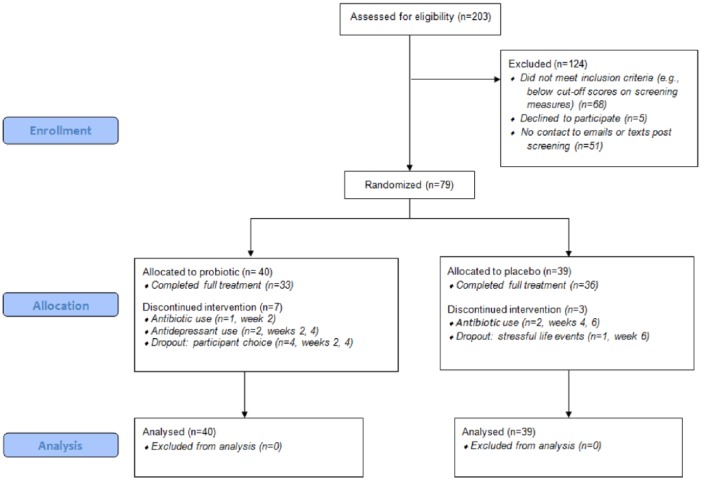
Objectives: This trial investigated whether probiotics improved mood, stress and anxiety in a sample selected for low mood. We also tested whether the presence or severity of irritable bowel syndrome symptoms, and levels of proinflammatory cytokines, brain-derived neurotrophic factor and other blood markers, would predict or impact treatment response. Method: Seventy-nine participants (10 dropouts) not currently taking psychotropic medications with at least moderate scores on self-report mood measures were randomly allocated to receive either a probiotic preparation (containing Lactobacillus helveticus and Bifidobacterium longum ) or a matched placebo, in a double-blind trial for 8 weeks. Data were analysed as intent-to-treat. Results: No significant difference was found between the probiotic and placebo groups on any psychological outcome measure (Cohen’s d range = 0.07–0.16) or any blood-based biomarker. At end-point, 9 (23%) of those in the probiotic group showed a ⩾60% change on the Montgomery–Åsberg Depression Rating Scale (responders), compared to 10 (26%) of those in the placebo group ( χ 1 2 = 0 . 107 , p = ns). Baseline vitamin D level was found to moderate treatment effect on several outcome measures. Dry mouth and sleep disruption were reported more frequently in the placebo group. Conclusions: This study found no evidence that the probiotic formulation is effective in treating low mood, or in moderating the levels of inflammatory and other biomarkers. The lack of observed effect on mood symptoms may be due to the severity, chronicity or treatment resistance of the sample; recruiting an antidepressant-naive sample experiencing mild, acute symptoms of low mood, may well yield a different result. Future studies taking a preventative approach or using probiotics as an adjuvant treatment may also be more effective. Vitamin D levels should be monitored in future studies in the area. The results of this trial are preliminary; future studies in the area should not be discouraged.
Overview
The claims and statistics of this paper haven’t been checked yet.
Free: it reads the open-access text and checks the first 5 claims that cite a source we can check. Create a free account to check every claim.
Integrity signals
Registry
Cites
Statistics
Figures
Verification
Claims the paper makes
The claims and statistics of this paper haven’t been checked yet.
Free: it reads the open-access text and checks the first 5 claims that cite a source we can check. Create a free account to check every claim.
Claims other papers make about this one
Each is checked against this paper’s own text: does it say what the citing paper says it does?
The cited source doesn’t support the claim as written.
In the citing paper
“Such clinical relevance has also been observed in previous probiotic intervention studies, where probiotics showed beneficial but sometimes non-significant effects on depressive symptoms and anxiety [38,39,40].”
From The Impact of Weizmannia coagulans BC99 on Anxiety and Depression: An 8-Week Clinical Pilot Study Through the Gut Microbiota–Brain Axis (2025) · cites this paper as [38]
Checked by a reasoning model — may be wrong.
Experimental — accuracy not yet measured
Self-check
Percentages, sums and reported differences re-computed from the paper’s own numbers.
The self-check needs the paper’s full text.
Citations
Cites
A new depression scale designed to be sensitive to change
Montgomery, S. A., & Åsberg, M. (1979) · British Journal of Psychiatry · doi:10.1192/bjp.134.4.382 · Cited by 13,962 · cited 1×
“The Montgomery–Åsberg Depression Rating Scale (MADRS) is a well-validated 10-item clinician-rated diagnostic questionnaire designed to measure the severity of depressive episodes (Montgomery and Åsberg, 1979).”
MethodJournal of Clinical Psychiatry
(2018) · Journal of Clinical Psychiatry · doi:10.5505/kpd · Cited by 13,651
Molecular Mechanisms of Depression: Perspectives on New Treatment Strategies
Lang, U. E., & Borgwardt, S. (2013) · Cellular Physiology and Biochemistry · doi:10.1159/000350094 · Cited by 8,475
(1995) · Cited by 6,909
A Meta-Analysis of Cytokines in Major Depression
Dowlati, Y., Herrmann, N., Swardfager, W., Liu, H., Sham, L., Reim, E. K., & Lanctôt, K. L. (2010) · Biological Psychiatry · doi:10.1016/j.biopsych.2009.09.033 · Cited by 4,729 · cited 4×
“, 2014) suggesting some possible common factors in aetiology, such as an increase in systemic inflammation, which has been observed in both disorders (Dowlati et al., 2010; Liebregts et al., 2007).”
BackgroundInfluentialMind-altering microorganisms: the impact of the gut microbiota on brain and behaviour
Cryan, J. F., & Dinan, T. G. (2012) · Nature Reviews Neuroscience · doi:10.1038/nrn3346 · Cited by 4,572 · cited 2×
“Gut–brain axis research suggests that bacteria in the gastrointestinal (GI) tract also communicate with the central nervous system in the absence of an immune response (Cryan and Dinan, 2012; Keightley et al., 2015).”
BackgroundBravo, J. A., Forsythe, P., Chew, M. V., Escaravage, E., Savignac, H. M., Dinan, T. G., Bienenstock, J., & Cryan, J. F. (2011) · Proceedings of the National Academy of Sciences · doi:10.1073/pnas.1102999108 · Cited by 3,888 · cited 1×
“However, these reviews rely mainly on evidence from animal studies in which certain probiotic strains have affected emotional behaviour and brain activity (e.g. Bravo et al., 2011; Messaoudi et al., 2010).”
BackgroundRush, A. J., Trivedi, M. H., Ibrahim, H. M., Carmody, T. J., Arnow, B., Klein, D. N., Markowitz, J. C., Ninan, P. T., Kornstein, S., Manber, R., et al. (2003) · Biological Psychiatry · doi:10.1016/s0006-3223(02)01866-8 · Cited by 3,829 · cited 1×
“The QIDS-SR16 is a 16-item self-rated questionnaire designed to assess the severity of depressive symptoms (Rush et al., 2003).”
BackgroundGut feelings: the emerging biology of gut-brain communication
Mayer, E. A. (2011) · Nature Reviews Neuroscience · doi:10.1038/nrn3071 · Cited by 1,726 · cited 1×
“Many papers have explored the links among gut microbes, brain and behaviour (e.g. Collins et al., 2012; Mayer, 2011; Thakur et al., 2014).”
BackgroundFRANCIS, C. Y., MORRIS, J., & WHORWELL, P. J. (1997) · Alimentary Pharmacology & Therapeutics · doi:10.1046/j.1365-2036.1997.142318000.x · Cited by 1,708 · cited 1×
“Irritable Bowel Syndrome Symptom Severity Scale (IBS-SSS) is a five 100-point sliding scale that assesses the severity and frequency of abdominal pain, the severity of abdominal distention, dissatisfaction with bowel habits and interference with quality of life (Francis et al., 1997).”
Background
Research works printed but not linked: 1
- Thakur AK Shakya A Husain GM (2014) Gut-microbiota and mental health: Current and future perspectives. Journal of Pharmacology and Clinical Toxicology 2: 1016.
Cited by
Items 101–200 of 325
Rode, J., Edebol Carlman, H. M. T., König, J., Hutchinson, A. N., Thunberg, P., Persson, J., & Brummer, R. J. (2022) · Cells · doi:10.3390/cells11182922 · Cited by 50
“However, the literature about potential psychological effects of probiotics of the species Bifidobacterium longum, Lactobacillus helveticus and Lactiplantibacillus plantarum is equivocal, with some studies reporting effects and others reporting none [11,15,18,35,58].”
BackgroundHuman Gut Microbiota for Diagnosis and Treatment of Depression
Averina, O. V., Poluektova, E. U., Zorkina, Y., Kovtun, A. S., & Даниленко, В. Н. (2024) · International Journal of Molecular Sciences · doi:10.3390/ijms25115782 · Cited by 59
“For instance, the probiotic Cerebiome ( Lactobacillus helveticus R0052 and Bifidobacterium longum R0175) did not exhibit antidepressant properties in one study [157] but did in several others [158,159].”
BackgroundMaternal separation in rodents: a journey from gut to brain and nutritional perspectives
Rincel, M., & Darnaudéry, M. (2019) · Proceedings of The Nutrition Society · doi:10.1017/s0029665119000958 · Cited by 54
Agnihotri, N., & Mohajeri, M. H. (2022) · International Journal of Molecular Sciences · doi:10.3390/ijms232415934 · Cited by 50
Skowron, K., Budzyńska, A., Wiktorczyk-Kapischke, N., Chomacka, K., Grudlewska‐Buda, K., Wilk, M., Wałecka-Zacharska, E., Andrzejewska, M., & Gospodarek-Komkowska, E. (2022) · International Journal of Molecular Sciences · doi:10.3390/ijms23147820 · Cited by 56
“[86] reported no significant changes after supplementation with Lactobacillus helveticus and Bifidobacterium longum, both in depression (depression not diagnosed by a doctor) and in the level of inflammatory markers.”
BackgroundWallace, C. J. K., Foster, J. A., Soares, C. N., & Milev, R. V. (2019) · Neuropsychobiology · doi:10.1159/000496406 · Cited by 54
Probiotics in human mental health and diseases—A minireview
Sivamaruthi, B. S., Prasanth, M. I., Kesika, P., & Chaiyasut, C. (2021) · Tropical Journal of Pharmaceutical Research · doi:10.4314/tjpr.v18i4.29 · Cited by 44
“helveticus) showed no significant beneficial effects in treating mood disorders [44].”
BackgroundSikorska, M., Antosik-Wójcińska, A. Z., & Dominiak, M. (2023) · International Journal of Molecular Sciences · doi:10.3390/ijms24043081 · Cited by 58
“Interleukin 6 (IL-6) [14,21,23,28,33] 50% (1/2) 0% (0/2) 100% (1/1)”
BackgroundResultInfluentialThomann, A., Mak, J. W. Y., Zhang, J., Wüstenberg, T., Ebert, M. P., Sung, J. J. �., Bernstein, C. N., Reindl, W., & Ng, S. C. (2020) · Alimentary Pharmacology & Therapeutics · doi:10.1111/apt.15787 · Cited by 47
Vasiliu, O. (2023) · Frontiers in Psychiatry · doi:10.3389/fpsyt.2023.1074736 · Cited by 42
“A trial that enrolled 79 participants with mood symptoms selfevaluated as being of at least moderate severity, randomly assigned to a probiotic (Lactobacillus helveticus and Bifidobacterium longum) or an inactive compound, in a double-blind, 8 weeks trial (26).”
BackgroundInfluentialTyagi, P., Tasleem, M., Prakash, S., & Chouhan, G. (2020) · Food Research International · doi:10.1016/j.foodres.2020.109489 · Cited by 42
Decraecker, L., Looze, D. A. D., Hirsch, D. P., Schepper, H. U. D., Arts, J., Caenepeel, P., Bredenoord, A. J., Kolkman, J. J., Bellens, K., Beek, K. V., et al. (2024) · Gut · doi:10.1136/gutjnl-2023-331634 · Cited by 57
Adikari, A. M. G. C. P., Appukutty, M., & Kuan, G. (2020) · Nutrients · doi:10.3390/nu12071920 · Cited by 41
“A similar approach was taken by the previous researchers to select the study samples similar to the present study [39,44,46].”
ResultMoody microbiome: Challenges and chances
Kuo, P.-H., & Chung, Y.-C. E. (2019) · Journal of the Formosan Medical Association · doi:10.1016/j.jfma.2018.09.004 · Cited by 40
Chen, Y., Meng, P., Cheng, S., Jia, Y., Wen, Y. F., Yang, X., Yao, Y., Pan, C., Li, C., Zhang, H., et al. (2021) · Molecular Brain · doi:10.1186/s13041-021-00843-1 · Cited by 47
The Putative Antidepressant Mechanisms of Probiotic Bacteria: Relevant Genes and Proteins
Poluektova, E., Yunes, R. А., & Даниленко, В. Н. (2021) · Nutrients · doi:10.3390/nu13051591 · Cited by 44
“The combination of these two strains has proven effective in reducing the symptoms of depression [36,40,46], despite some authors failing to confirm their antidepressant action [47].”
Stress, inflammation, microbiome and depression
Medina-Rodriguez, E. M., Cruz, A. A., Abreu, J. C. D., & Beurel, E. (2023) · Pharmacology Biochemistry and Behavior · doi:10.1016/j.pbb.2023.173561 · Cited by 46
Forssten, S. D., Ouwehand, A. C., Griffin, S. M., & Patterson, E. (2022) · Nutrients · doi:10.3390/nu14030568 · Cited by 45
Sah, R. K., Nandan, A., Athira, K. V., Prashant, S. K., Sankaran, S., Jose, A., Venkidasamy, B., & Nile, S. H. (2023) · Asian Journal of Psychiatry · doi:10.1016/j.ajp.2023.103861 · Cited by 44
Misera, A., Liśkiewicz, P., Łoniewski, I., Skonieczna-Żydecka, K., & Samochowiec, J. (2021) · Pharmaceuticals · doi:10.3390/ph14100952 · Cited by 34
“[27] observed anti-inflammatory effects of probiotics which, however, have not been confirmed in other studies [28,45].”
ResultÖnning, G., Montelius, C., Hillman, M., & Larsson, N. (2023) · Nutrients · doi:10.3390/nu15153466 · Cited by 38
Liu, Y., Xiao, W., Yu, L., Tian, F., Wang, G., Lu, W., Narbad, A., Chen, W., & Zhai, Q. (2021) · Food & Function · doi:10.1039/d0fo02616f · Cited by 37
From isoniazid to psychobiotics: the gut microbiome as a new antidepressant target
Butler, M. I., Sandhu, K., Cryan, J. F., & Dinan, T. G. (2019) · British Journal of Hospital Medicine · doi:10.12968/hmed.2019.80.3.139 · Cited by 32
Mohammadshahi, M., Haghighat, N., Shayanpour, S., Haghighizadeh, M. H., Rahmdel, S., & Rajaei, M. (2021) · Indian Journal of Nephrology · doi:10.4103/ijn.ijn_341_19 · Cited by 44
Aghamohammad, S., Sepehr, A., Miri, S. T., Najafi, S., Pourshafie, M. R., & Rohani, M. (2022) · Canadian Journal of Gastroenterology and Hepatology · doi:10.1155/2022/2045572 · Cited by 40
“especially in the intestinal epithelial cells, and the reduction of symptoms in patients with ulcerative colitis have been demonstrated [5].”
BackgroundZhao, Z., Xiao, G., Xia, J., Guo, H., Yang, X., Jiang, Q., Wang, H., Hu, J., & Zhang, C. (2023) · Journal of Affective Disorders · doi:10.1016/j.jad.2023.09.018 · Cited by 41
Sempach, L., Doll, J. P. K., Limbach, V., Marzetta, F., Schaub, A.-C., Schneider, E., Kettelhack, C., Mählmann, L., Schweinfurth, N., Ibberson, M. R., et al. (2024) · Translational Psychiatry · doi:10.1038/s41398-024-03030-7 · Cited by 38
“Some studies found that probiotic supplementation reduces hs-CRP [8], and decreases IL-6 gene expression levels [25], although other studies reported no changes for these cytokines [26 – 28].”
BackgroundPostbiotics and parabiotics derived from bacteria and yeast: current trends and future perspectives
Franco, W. (2024) · CyTA - Journal of Food · doi:10.1080/19476337.2024.2425838 · Cited by 38
“They observed improvements in memory performance and a reduction in subjective stress levels (Romijn et al., 2017).”
Sushma, G., Vaidya, B., Sharma, S., Devabattula, G., Bishnoi, M., Kondepudi, K. K., & Sharma, S. S. (2023) · Neuropharmacology · doi:10.1016/j.neuropharm.2023.109480 · Cited by 34
Refisch, A., Şen, Z. D., Klassert, T. E., Busch, A., Besteher, B., Danyeli, L. V., Helbing, D. L., Schulze‐Späte, U., Stallmach, A., Bauer, M. W., et al. (2023) · Neuropharmacology · doi:10.1016/j.neuropharm.2023.109568 · Cited by 38
Moshfeghinia, R., Nemati, H., Ebrahimi, A., Shekouh, D., Karami, S., Eraghi, M. M., Mohagheghzadeh, H., Hunter, J., & Pasalar, M. (2025) · Journal of Psychiatric Research · doi:10.1016/j.jpsychires.2025.05.053 · Cited by 38
A psychobiotic approach to the treatment of depression: A systematic review and meta-analysis
Zhu, H., Tian, P., Zhao, J., Zhang, H., Wang, G., & Chen, W. (2022) · Journal of Functional Foods · doi:10.1016/j.jff.2022.104999 · Cited by 34
A Reciprocal Link Between Gut Microbiota, Inflammation and Depression: A Place for Probiotics?
Eltokhi, A., & Sommer, I. E. (2022) · Frontiers in Neuroscience · doi:10.3389/fnins.2022.852506 · Cited by 36
Walden, K. E., Moon, J. M., Hagele, A. M., Allen, L. E., Gaige, C. J., Krieger, J. M., Jäger, R., Mumford, P. W., Pane, M., & Kerksick, C. M. (2023) · Frontiers in Nutrition · doi:10.3389/fnut.2023.1219313 · Cited by 46
Gut Biome and Mental Health: Do Probiotics Work?
Madabushi, J. S., Khurana, P., Gupta, N., & Gupta, M. (2023) · Cureus · doi:10.7759/cureus.40293 · Cited by 44
“The study found no positive correlation between probiotics and low mood, but additional research on probiotics' role in mental health conditions was encouraged [43].”
BackgroundDepression-associated gut microbes, metabolites and clinical trials
Wang, M., Song, Z., Lai, S., Tang, F., Dou, L., & Yang, F. (2024) · Frontiers in Microbiology · doi:10.3389/fmicb.2024.1292004 · Cited by 35
Minayo, M. D. S., Miranda, I., & Telhado, R. S. (2021) · Ciência & Saúde Coletiva · doi:10.1590/1413-81232021269.21342020 · Cited by 87
Varied Composition and Underlying Mechanisms of Gut Microbiome in Neuroinflammation
Farooq, R. K., Alamoudi, W., Alhibshi, A., Rehman, S., Sharma, A. R., & Abdulla, F. A. (2022) · Microorganisms · doi:10.3390/microorganisms10040705 · Cited by 34
Lalitsuradej, E., Sirilun, S., Sittiprapaporn, P., Sivamaruthi, B. S., Pintha, K., Tantipaiboonwong, P., Khongtan, S., Fukngoen, P., Peerajan, S., & Chaiyasut, C. (2022) · Foods · doi:10.3390/foods11050759 · Cited by 30
“The previous study investigated the outcome of probiotics treatment on stress, mood, and anxiety in depression [27].”
BackgroundAbildgaard, A. M., Kern, T., Pedersen, O. B., Hansen, T. F., Wegener, G., & Lund, S. A. (2018) · European Neuropsychopharmacology · doi:10.1016/j.euroneuro.2018.10.011 · Cited by 30
Xie, S., Wang, C., Song, J., Zhang, Y., Wang, H., Chen, X., & Suo, H. (2024) · Journal of Agricultural and Food Chemistry · doi:10.1021/acs.jafc.4c03870 · Cited by 27
Impact of the gut microbiome composition on social decision-making
Falkenstein, M., Simon, M., Mantri, A., Weber, B., Koban, L., & Plaßmann, H. (2024) · PNAS Nexus · doi:10.1093/pnasnexus/pgae166 · Cited by 37
Karczewski, J., Zielińska, A., Staszewski, R., Eder, P., Dobrowolska, A., & Souto, E. B. (2022) · International Journal of Molecular Sciences · doi:10.3390/ijms23116145 · Cited by 26
Misera, A., Łoniewski, I., Palma, J., Kulaszyńska, M., Czarnecka, W., Kaczmarczyk, M., Liśkiewicz, P., Samochowiec, J., & Skonieczna‐Żydecka, K. (2023) · Frontiers in Microbiology · doi:10.3389/fmicb.2023.1125022 · Cited by 30
“(2020) observed the anti-inflammatory effects of probiotics, which, however, have not been confirmed in other studies (Romijn et al., 2017; Rudzki et al., 2019).”
ResultKinoshita, T., Maruyama, K., Suyama, K., Nishijima, M., Akamatsu, K., Jogamoto, A., Katakami, K., & Saito, I. (2021) · BMC Gastroenterology · doi:10.1186/s12876-021-01793-7 · Cited by 33
Joseph, J. M., & Law, C. (2019) · Neuroscience & Biobehavioral Reviews · doi:10.1016/j.neubiorev.2018.11.010 · Cited by 26
“Thus far, two double-blind investigations have been conducted with patients diagnosed with significant anxiety or depression symptoms (Akkasheh et al., 2016; Romijn et al., 2017).”
The Therapeutic Role of Exercise and Probiotics in Stressful Brain Conditions
Martínez‐Guardado, I., Arboleya, S., Pérez, F. J. G., Kaliszewska, A., Gueimonde, M., & Arias, N. (2022) · International Journal of Molecular Sciences · doi:10.3390/ijms23073610 · Cited by 27
“[216] did not showed any evidence that the same probiotic formulation was effective in treating low mood.”
BackgroundPhytotherapy of mood disorders in the light of microbiota-gut-brain axis.
Korczak, M., Pilecki, M. W., Granica, S., Gorczynska, A., Pawłowska, K. A., & Piwowarski, J. P. (2023) · Phytomedicine · doi:10.1016/j.phymed.2023.154642 · Cited by 31
Precision medicine in perinatal depression in light of the human microbiome
Bernabé, B. P., Maki, P. M., Dowty, S. M., Salas, M. L. C., Cralle, L. E., Shah, Z., & Gilbert, J. A. (2020) · Psychopharmacology · doi:10.1007/s00213-019-05436-4 · Cited by 31
“While combinations of nutrition and probiotics may prevent mild and moderate depression, it might be unlikely that they could be enough to treat severe depression based on the current results from clinical trials in the general population (Kelly et al. 2017; Romijn et al. 2017).”
BackgroundZhao, X., Lin, T., Jiang, W., Lin, Y., Xiao, L., Tian, Y., Ma, K., Zhang, C., Ji, F., Mahsa, G. C., et al. (2024) · Journal of Agricultural and Food Chemistry · doi:10.1021/acs.jafc.4c07895 · Cited by 29
Probiotics in Psychosocial Stress and Anxiety. A Systematic Review
Vitellio, P., Chira, A., Angelis, M. D., Dumitrascu, D. L., & Portincasa, P. (2020) · Journal of Gastrointestinal and Liver Diseases · doi:10.15403/jgld-352 · Cited by 29
“, 2017 [14] 79 Patients with moderate selfreported mood alteration average age 36 years Randomized double blind placebo-controlled study 8 weeks 1 x 10¹⁰ CFU/g of B.”
BackgroundMethodInfluentialPRO-DEMET Randomized Controlled Trial on Probiotics in Depression—Pilot Study Results
Gawlik-Kotelnicka, O., Margulska, A., Skowrońska, A., & Strzelecki, D. (2023) · Nutrients · doi:10.3390/nu15061400 · Cited by 27
“lations with depressive disorders [49,57,58].”
Microbiota-Gut-Brain Axis in Major Depression: A New Therapeutic Approach
Kim, I. B., Park, S., & Kim, Y. (2023) · Advances in experimental medicine and biology · doi:10.1007/978-981-19-7376-5_10 · Cited by 33
The gut–brain connection: microbes’ influence on mental health and psychological disorders
Ataei, P., Kalantari, H., Bodnar, T. S., & Turner, R. J. (2026) · Frontiers in Microbiomes · doi:10.3389/frmbi.2025.1701608 · Cited by 41
Abildgaard, A. M., Kern, T., Pedersen, O. B., Hansen, T. F., Lund, S. A., & Wegener, G. (2020) · European Neuropsychopharmacology · doi:10.1016/j.euroneuro.2020.09.001 · Cited by 24
Psychobiotics as a novel strategy for alleviating anxiety and depression
Zou, R., Tian, P., Xu, M., Zhu, H., Zhao, J., Zhang, H., Chen, W., & Wang, G. (2021) · Journal of Functional Foods · doi:10.1016/j.jff.2021.104718 · Cited by 35
Lin, S.-K. K., Kuo, P., Hsu, C., Chiu, Y.-H., & Chen, C.-H. (2024) · Asian Journal of Psychiatry · doi:10.1016/j.ajp.2024.104210 · Cited by 30
Beyond digestion: Exploring how the gut microbiota modulates human social behaviors
Abavisani, M., Faraji, N., Ebadpour, N., Kesharwani, P., & Sahebkar, A. (2024) · Neuroscience · doi:10.1016/j.neuroscience.2024.11.068 · Cited by 27
Psychobiotics in Depression: Sources, Metabolites, and Treatment—A Systematic Review
Śliwka, A., Polak‐Berecka, M., Zdybel, K., Zelek-Molik, A., & Waśko, A. (2025) · Nutrients · doi:10.3390/nu17132139 · Cited by 32
“Reininghaus et al. (2020) and Romijn et al. (2017) did not observe statistically significant differences between the groups receiving psychobiotics and placebo [86,87].”
Calgaro, M., Pandolfo, M., Salvetti, E., Marotta, A., Larini, I., Pane, M., Amoruso, A., Casale, A. D., Vitulo, N., Fiorio, M., et al. (2021) · Beneficial Microbes · doi:10.3920/bm2020.0137 · Cited by 21
Tong, J., Satyanarayanan, S. K., & Su, H. (2020) · Brain Behavior and Immunity · doi:10.1016/j.bbi.2020.08.027 · Cited by 26
Li, J., Zhao, J., Ze, X., Li, L., Li, Y., Zhou, Z., Wu, S., Jia, W., Liu, M., Li, Y., et al. (2024) · Food & Function · doi:10.1039/d4fo01684j · Cited by 27
Kamal, N., Saharan, B. S., Duhan, J. S., Kumar, A., Chaudhary, P., Goyal, C., Kumar, M., Goyat, N., Sindhu, M., & Mudgil, P. (2024) · Medicine in Microecology · doi:10.1016/j.medmic.2024.100118 · Cited by 27
Disentangling What We Know About Microbes and Mental Health
Reid, G. (2019) · Frontiers in Endocrinology · doi:10.3389/fendo.2019.00081 · Cited by 22
Pan, B., Pan, Y., Huang, Y., Yi, M., Hu, Y., Lian, X., Shi, H., Wang, M., Xiang, G., Yang, W., et al. (2025) · BMC Psychiatry · doi:10.1186/s12888-024-06438-z · Cited by 26
Gawlik-Kotelnicka, O., Margulska, A., Płeska, K., Skowrońska, A., & Strzelecki, D. (2024) · Nutrients · doi:10.3390/nu16091389 · Cited by 28
“Romijn et al. revealed that the baseline vitamin D level influenced the treatment effect of probiotics [46].”
BackgroundResultMottawea, W., Sultan, S., Landau, K., Bordenave, N., & Hammami, R. (2020) · Nutrients · doi:10.3390/nu12092669 · Cited by 22
Nasr, N. (2018) · International Journal of Current Microbiology and Applied Sciences · doi:10.20546/ijcmas.2018.708.296 · Cited by 21
“Authors mentioned that this result may be due to the severity, chronicity or treatment resistance of the sample and acute symptoms of low mood of the participants, also using probiotics in future as an adjuvant treatment may be more effective (Romijn et al., 2017).”
Background“Gut–brain axis”: Review of the role of the probiotics in anxiety and depressive disorders
Gambaro, E., Gramaglia, C. M., Baldon, G., Chirico, E., Martelli, M. I., Renolfi, A., & Zeppegno, P. (2020) · Brain and Behavior · doi:10.1002/brb3.1803 · Cited by 24
“…2014) 8 weeks in 7 studies (30.1%), (Akkasheh et al., 2016; Chahwan et al., 2019; Feher et al., 2014; Kato-Kataoka et al., 2016; Rao et al., 2009; Romijn et al., 2017; Vaghef-Mehrabany et al., 2014) 6 weeks in 4 studies (17.4%), (Guyonnet et al., 2007; LorenzoZúñiga et al., 2014; Marcos et al.,…”
BackgroundMethodInfluentialProbiotics as a Treatment for “Metabolic Depression”? A Rationale for Future Studies
Gawlik-Kotelnicka, O., & Strzelecki, D. (2021) · Pharmaceuticals · doi:10.3390/ph14040384 · Cited by 20
Harvey, J., Jones, D. B., & Wright, D. H. (1990) · PubMed Central · Cited by 21
Probiotics-targeting new milestones from gut health to mental health
Dey, G., & Mookherjee, S. (2021) · FEMS Microbiology Letters · doi:10.1093/femsle/fnab096 · Cited by 18
Madison, C. A., Kuempel, J., Albrecht, G. L., Hillbrick, L., Jayaraman, A., Safe, S. H., Chapkin, R. S., & Eitan, S. (2022) · Journal of Affective Disorders · doi:10.1016/j.jad.2022.04.106 · Cited by 19
Zhang, Y., Zhang, R., Liu, P., Wang, J., Gao, M., Zhang, J., Yang, J., Yang, C., Zhang, Y., & Sun, N. (2022) · Frontiers in Neuroscience · doi:10.3389/fnins.2022.926450 · Cited by 20
Essmat, N., Karádi, D. Á., Zádor, F., Király, K. P., Fürst, S., & Al‐Khrasani, M. (2023) · Molecules · doi:10.3390/molecules28237766 · Cited by 20
“− [194] Epilepsy a mixture of pro/prebiotics and vitamins for one month Rats Probiotics did not significantly affect the duration and number of spike-and-wave discharges.”
BackgroundCampanale, A., Inserra, A., & Comai, S. (2024) · Progress in Neuro-Psychopharmacology and Biological Psychiatry · doi:10.1016/j.pnpbp.2024.111058 · Cited by 20
“However, several studies reported no superiority of probiotics to placebo in MDD (Browne et al., 2021; Reininghaus et al., 2020a; Romijn et al., 2017).”
BackgroundAn insight into the health beneficial of probiotics dairy products: a critical review
He, J., Li, W., Deng, J., Lin, Q., Bai, J., Zhang, L., & Fang, Y. (2022) · Critical Reviews in Food Science and Nutrition · doi:10.1080/10408398.2022.2090493 · Cited by 22
“In a double-blind study of 79 participants not taking psycho-tropic drugs, the probiotic confidante had no significant effect on treating depression or regulating inflammation, possibly because of the severity of the samples and the length of the experiments (Romijn et al. 2017).”
BackgroundRole of the gut microbiome in psychological symptoms associated with inflammatory bowel diseases
Atanasova, K., Knödler, L.-L., Reindl, W., Ebert, M. P. A., & Thomann, A. (2025) · Seminars in Immunopathology · doi:10.1007/s00281-025-01036-x · Cited by 25
Add-on probiotics for inflammatory depression – A double-blind randomized placebo-controlled trial
Veibäck, G. S., Lindahl, J., Suneson, K., Tjernberg, J., Ståhl, D., Landberg, R., Asp, M., Kjellberg, A., Falknäs, F., Sjöberg, K., et al. (2025) · Brain Behavior and Immunity · doi:10.1016/j.bbi.2025.06.002 · Cited by 25
When the microbiome helps the brain‐current evidence
Drljača, J., Milosevic, N. P., Milanović, M., Abenavoli, L., & Milić, N. (2023) · CNS Neuroscience & Therapeutics · doi:10.1111/cns.14076 · Cited by 21
From gut to brain: understanding the role of microbiota in inflammatory bowel disease
Wang, S., Zhou, S., Han, Z., Yu, B., Xu, Y., Lin, Y., Chen, Y., Jin, Z., Li, Y., Cao, Q., et al. (2024) · Frontiers in Immunology · doi:10.3389/fimmu.2024.1384270 · Cited by 22
Nikolova, V. L., Cleare, A. J., Young, A. H., & Stone, J. M. (2025) · Journal of Affective Disorders · doi:10.1016/j.jad.2025.01.153 · Cited by 23
Gawlik-Kotelnicka, O., Skowrońska, A., Margulska, A., Czarnecka, K. H., Łoniewski, I., Skonieczna‐Żydecka, K., & Strzelecki, D. (2021) · Journal of Clinical Medicine · doi:10.3390/jcm10071342 · Cited by 20
Herman, A. (2019) · Psychiatria Polska · doi:10.12740/pp/92392 · Cited by 24
“[41] przeprowadzili badanie polegające na podaży przez 8 tygodni probiotyku zawierającego Lactobacillus helveticus R0052, Bifidobacterium longum R017579 (szczep I-1722 według French National Collection of Cultures of Microorganisms [CNCM], Institut Pasteur, Paryż, Francja) i Bifidobacterium longum R0175 (CNCM: szczep…”
BackgroundTherapeutic Implications of the Microbial Hypothesis of Mental Illness
Savitz, J. B., & Yolken, R. H. (2022) · Current topics in behavioral neurosciences · doi:10.1007/7854_2022_368 · Cited by 16
Yang, P., Zhou, Q. S., Zhang, Y., Jia, M., Li, R., Qu, Q., Li, Z., Feng, M., Tian, Y., Ren, W., et al. (2024) · Current Microbiology · doi:10.1007/s00284-024-04035-7 · Cited by 16
“…7.40 ± 0.62 × 10 8 Streptococcus thermophilus [25] 10 8 Bifidobacterium adolescentis [26] 5.60 ± 0.54 × 10 8 Lactobacillus reuteri [27] 10 8 Lactobacillus helveticus [28] 4.08 ± 0.52 × 10 8 Bifidobacterium longum [29] 10 8 time for L. rhamnosus in the APS medium was found to be 36 h (Fig.”
InfluentialHashemi, R., Raouf, M. M. H. M., Salih, T. S., Feyzpour, M., Eskandarioun, M., Nezamabadipour, N., & Gandomkar, H. (2025) · BMC Nutrition · doi:10.1186/s40795-025-01152-9 · Cited by 17
Niculescu, I., Quirt, H., Arora, T., Borsook, T. K., Green, R., Ford, B. Q., & Iaboni, A. (2021) · JMIR Aging · doi:10.2196/29021 · Cited by 16
“02) and has been validated in people with depression [38,39].”
BackgroundPositive Effects of Probiotic Therapy in Patients with Post-Infectious Fatigue
Obermoser, K., Brigo, N., Schroll, A., Monfort‐Lanzas, P., Gostner, J. M., Engl, S., Geisler, S., Knoll, M., Schennach, H., Weiß, G., et al. (2023) · Metabolites · doi:10.3390/metabo13050639 · Cited by 15
“However, they point out that recruiting a patient cohort with mild, acute symptoms of low mood, compared to a patient group with a history of treatment resistance, may well result in a very different outcome [49].”
BackgroundBadrfam, R., Zandifar, A., Hajialigol, A., Rashidian, M., Schmidt, N. B., Morabito, D. M., Qorbani, M., Shahrestanaki, E., & Natanzi, M. M. (2024) · Psychopharmacology · doi:10.1007/s00213-024-06577-x · Cited by 17
“…Depression Anxiety Stress Scales (DASS)) (along with depression symptoms of the same severity) who had a history of taking some courses of antide-pressants and were not receiving pharmacological treatment at the time of the study were associated with no improvement in symptoms (Romijn et al. 2017).”
Marano, G., Sfratta, G., Marzo, E. M., Cozzo, G., Abate, F., Traversi, G., Mazza, O., Capristo, E., Gaetani, E., & Mazza, M. (2025) · Children · doi:10.3390/children12111561 · Cited by 21
“Early studies indicated that probiotics could attenuate depressive symptoms and decrease inflammatory markers [163,164], yet later randomized controlled trials reported inconsistent improvements in mood, anxiety, and stress [165].”
Zhang, J., Zhu, L., Meng, Q., Wang, Z., & Zhu, H. (2025) · BMC Psychiatry · doi:10.1186/s12888-025-07644-z · Cited by 24
Foshati, S., Akhlaghi, M., & Babajafari, S. (2022) · Food & Function · doi:10.1039/d2fo01330d · Cited by 14
Lv, J., Lang, G., Wang, Q., Zhao, W., Shi, D., Zhou, Z., Shen, Y., He, X., Han, S., & Li, L. (2024) · Microbial Biotechnology · doi:10.1111/1751-7915.70016 · Cited by 18
The role of the gut microbiota in the pathophysiology of mental and neurological disorders
Pusceddu, M. M., & Bas-Prior, J. M. D. (2020) · Psychiatric Genetics · doi:10.1097/ypg.0000000000000255 · Cited by 15
“7 μmol/L) Double-blind, randomized, placebo-controlled trial (Romijn et al., 2017) 79 antidepressant-free depressed subjects underwent either probiotics (L.”
BackgroundGut–brain axis in health and brain disease
Olasunkanmi, O. I., Zheng, L., & Zheng, P. (2026) · Chinese Medical Journal · doi:10.1097/cm9.0000000000003920 · Cited by 14
“For example, a double-blind randomized trial by Romijn et al [267] found that probiotics did not significantly improve mood, anxiety, stress, or related biomarkers.”
Drug and gut microbe relationships: Moving beyond antibiotics
Kumbhare, S. V., Pedroso, I., Ugalde, J. A., Márquez‐Miranda, V., Sinha, R., & Almonacid, D. E. (2023) · Drug Discovery Today · doi:10.1016/j.drudis.2023.103797 · Cited by 14
Murack, M., Kadamani, A. K., Guindon-Riopel, A., Traynor, O. H., Iqbal, U., Bronner, S., Messier, C., & Ismail, N. (2024) · Psychoneuroendocrinology · doi:10.1016/j.psyneuen.2024.107146 · Cited by 12
Piazzesi, A., & Putignani, L. (2022) · Frontiers in Microbiology · doi:10.3389/fmicb.2022.958346 · Cited by 14
Tie, S., Pan, Y., Pang, C., Saman, A., Dong, Y., Fang, S., Zhu, J., Wu, Y., & Gu, S. (2025) · Nutrients · doi:10.3390/nu17193087 · Cited by 11
“Such clinical relevance has also been observed in previous probiotic intervention studies, where probiotics showed beneficial but sometimes non-significant effects on depressive symptoms and anxiety [38–40].”
Metadata
- Authors
- Romijn, A. R., Rucklidge, J. J., Kuijer, R. G., & Frampton, C.
- Affiliations
- University of South Wales (GB)
- University of Canterbury (NZ)
- University of Otago (NZ)
- Corresponding author
- Romijn, Amy R
- Venue
- Australian & New Zealand Journal of Psychiatry
- Publisher
- SAGE Publications
- Published
- 2017-01-10
- Volume
- 51
- Issue
- 8
- Pages
- 810-821
- ISSN
- 0004-8674 (ISSN-L)
- 1440-1614
- PMC
- PMC5518919
- OpenAlex
- W2571547641
- Semantic Scholar
- 732436ebcd0ae0183da91bf92ebb5d25c540a2f5
- Cited by
- 323
- References
- 52
- Citations by year
- 2026: 27 · 2025: 34 · 2024: 50 · 2023: 41 · 2022: 45 · 2021: 30 · 2020: 31 · 2019: 32 · 2018: 24 · 2017: 8
- FWCI
- 29.24
- Type
- journal article
- Language
- en
- Open access
- hybrid
- doi.org
- Licence
- cc-by-nc
- journals.sagepub.com/page/policies/text-and-data-mining-license (tdm)
- Locations
- Australian & New Zealand Journal of Psychiatry (publishedVersion, cc-by-nc)
- PubMed Central (publishedVersion, cc-by-nc)
- PubMed (publishedVersion)
- Funders
- Lallemand Health Solutions
- Topics
- Life Sciences › Agricultural and Biological Sciences › Food Science › Probiotics and Fermented Foods
- Life Sciences › Neuroscience › Biological Psychiatry › Tryptophan and brain disorders
- Life Sciences › Biochemistry, Genetics and Molecular Biology › Molecular Biology › Gut microbiota and health
- Keywords
- probiotics, Lactobacillus helveticus, Bifidobacterium longum, depression, depressive mood, irritable bowel syndrome, inflammatory cytokines, brain-derived neurotrophic factor, vitamin D, antidepressant response, anxiety, stress, sleep disruption, xerostomia
- MeSH terms
- Bifidobacterium longum, Adult, Affect, Anxiety, Depression, Double-Blind Method, Female, Humans, Male, Middle Aged, Registries, Stress, Psychological, Outcome Assessment, Health Care, Probiotics, Lactobacillus helveticus
About these checks
Registry, retraction, Cites and statistics results are computed, not judged, with one exception: a printed reference that no index lists is read once by a model before it counts as a citation error. Claims are extracted by a model and kept only when their quote appears verbatim in the text; each cited source is then checked, with a model’s help, for whether it says what the claim relies on. Those verdicts can be wrong — read the claim’s quote and the cited source before relying on one.
Statistics and arithmetic are recomputed, not judged.
Confidence bands are shown only for fields calibrated on our annotated test set. None is calibrated yet, so no band is shown.
What counts as a claim ›How we measure confidence ›How we check this ›
Are you an author, or do you see a problem with this page? Request a review
Data sources
Bibliographic data: Semantic Scholar, OpenAlex, Crossref.
Contains information from the Semantic Scholar Academic Graph Datasets, made available under the ODC Attribution License (ODC-BY 1.0).
Semantic Scholar’s data is described in: Kinney, R., et al. (2023). The Semantic Scholar Open Data Platform. arXiv:2301.10140.
