

A double-blind, randomized, placebo-controlled trial of Lactobacillus helveticus and Bifidobacterium longum for the symptoms of depression
Open accessThe DOI matches its Crossref record; 52 of the 52 references it cites were found in a registry or an index.
Abstract
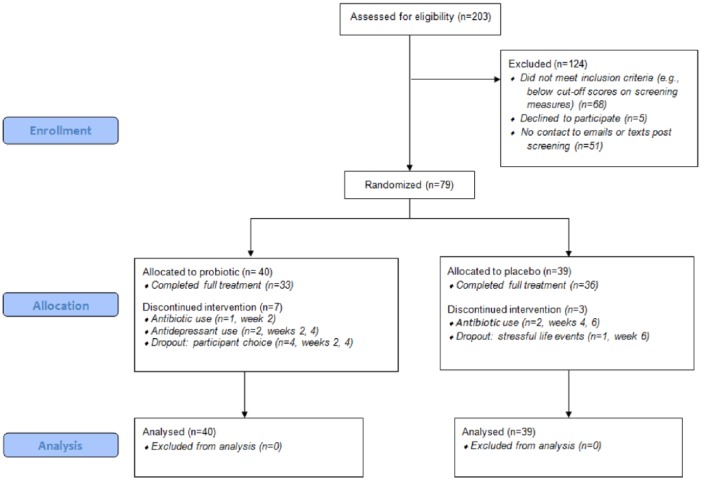
Objectives: This trial investigated whether probiotics improved mood, stress and anxiety in a sample selected for low mood. We also tested whether the presence or severity of irritable bowel syndrome symptoms, and levels of proinflammatory cytokines, brain-derived neurotrophic factor and other blood markers, would predict or impact treatment response. Method: Seventy-nine participants (10 dropouts) not currently taking psychotropic medications with at least moderate scores on self-report mood measures were randomly allocated to receive either a probiotic preparation (containing Lactobacillus helveticus and Bifidobacterium longum ) or a matched placebo, in a double-blind trial for 8 weeks. Data were analysed as intent-to-treat. Results: No significant difference was found between the probiotic and placebo groups on any psychological outcome measure (Cohen’s d range = 0.07–0.16) or any blood-based biomarker. At end-point, 9 (23%) of those in the probiotic group showed a ⩾60% change on the Montgomery–Åsberg Depression Rating Scale (responders), compared to 10 (26%) of those in the placebo group ( χ 1 2 = 0 . 107 , p = ns). Baseline vitamin D level was found to moderate treatment effect on several outcome measures. Dry mouth and sleep disruption were reported more frequently in the placebo group. Conclusions: This study found no evidence that the probiotic formulation is effective in treating low mood, or in moderating the levels of inflammatory and other biomarkers. The lack of observed effect on mood symptoms may be due to the severity, chronicity or treatment resistance of the sample; recruiting an antidepressant-naive sample experiencing mild, acute symptoms of low mood, may well yield a different result. Future studies taking a preventative approach or using probiotics as an adjuvant treatment may also be more effective. Vitamin D levels should be monitored in future studies in the area. The results of this trial are preliminary; future studies in the area should not be discouraged.
Overview
The claims and statistics of this paper haven’t been checked yet.
Free: it reads the open-access text and checks the first 5 claims that cite a source we can check. Create a free account to check every claim.
Integrity signals
Registry
Cites
Statistics
Figures
Verification
Claims the paper makes
The claims and statistics of this paper haven’t been checked yet.
Free: it reads the open-access text and checks the first 5 claims that cite a source we can check. Create a free account to check every claim.
Claims other papers make about this one
Each is checked against this paper’s own text: does it say what the citing paper says it does?
The cited source doesn’t support the claim as written.
In the citing paper
“Such clinical relevance has also been observed in previous probiotic intervention studies, where probiotics showed beneficial but sometimes non-significant effects on depressive symptoms and anxiety [38,39,40].”
From The Impact of Weizmannia coagulans BC99 on Anxiety and Depression: An 8-Week Clinical Pilot Study Through the Gut Microbiota–Brain Axis (2025) · cites this paper as [38]
Checked by a reasoning model — may be wrong.
Experimental — accuracy not yet measured
Self-check
Percentages, sums and reported differences re-computed from the paper’s own numbers.
The self-check needs the paper’s full text.
Citations
Cites
A new depression scale designed to be sensitive to change
Montgomery, S. A., & Åsberg, M. (1979) · British Journal of Psychiatry · doi:10.1192/bjp.134.4.382 · Cited by 13,962 · cited 1×
“The Montgomery–Åsberg Depression Rating Scale (MADRS) is a well-validated 10-item clinician-rated diagnostic questionnaire designed to measure the severity of depressive episodes (Montgomery and Åsberg, 1979).”
MethodJournal of Clinical Psychiatry
(2018) · Journal of Clinical Psychiatry · doi:10.5505/kpd · Cited by 13,651
Molecular Mechanisms of Depression: Perspectives on New Treatment Strategies
Lang, U. E., & Borgwardt, S. (2013) · Cellular Physiology and Biochemistry · doi:10.1159/000350094 · Cited by 8,475
(1995) · Cited by 6,909
A Meta-Analysis of Cytokines in Major Depression
Dowlati, Y., Herrmann, N., Swardfager, W., Liu, H., Sham, L., Reim, E. K., & Lanctôt, K. L. (2010) · Biological Psychiatry · doi:10.1016/j.biopsych.2009.09.033 · Cited by 4,729 · cited 4×
“, 2014) suggesting some possible common factors in aetiology, such as an increase in systemic inflammation, which has been observed in both disorders (Dowlati et al., 2010; Liebregts et al., 2007).”
BackgroundInfluentialMind-altering microorganisms: the impact of the gut microbiota on brain and behaviour
Cryan, J. F., & Dinan, T. G. (2012) · Nature Reviews Neuroscience · doi:10.1038/nrn3346 · Cited by 4,572 · cited 2×
“Gut–brain axis research suggests that bacteria in the gastrointestinal (GI) tract also communicate with the central nervous system in the absence of an immune response (Cryan and Dinan, 2012; Keightley et al., 2015).”
BackgroundBravo, J. A., Forsythe, P., Chew, M. V., Escaravage, E., Savignac, H. M., Dinan, T. G., Bienenstock, J., & Cryan, J. F. (2011) · Proceedings of the National Academy of Sciences · doi:10.1073/pnas.1102999108 · Cited by 3,888 · cited 1×
“However, these reviews rely mainly on evidence from animal studies in which certain probiotic strains have affected emotional behaviour and brain activity (e.g. Bravo et al., 2011; Messaoudi et al., 2010).”
BackgroundRush, A. J., Trivedi, M. H., Ibrahim, H. M., Carmody, T. J., Arnow, B., Klein, D. N., Markowitz, J. C., Ninan, P. T., Kornstein, S., Manber, R., et al. (2003) · Biological Psychiatry · doi:10.1016/s0006-3223(02)01866-8 · Cited by 3,829 · cited 1×
“The QIDS-SR16 is a 16-item self-rated questionnaire designed to assess the severity of depressive symptoms (Rush et al., 2003).”
BackgroundGut feelings: the emerging biology of gut-brain communication
Mayer, E. A. (2011) · Nature Reviews Neuroscience · doi:10.1038/nrn3071 · Cited by 1,726 · cited 1×
“Many papers have explored the links among gut microbes, brain and behaviour (e.g. Collins et al., 2012; Mayer, 2011; Thakur et al., 2014).”
BackgroundFRANCIS, C. Y., MORRIS, J., & WHORWELL, P. J. (1997) · Alimentary Pharmacology & Therapeutics · doi:10.1046/j.1365-2036.1997.142318000.x · Cited by 1,708 · cited 1×
“Irritable Bowel Syndrome Symptom Severity Scale (IBS-SSS) is a five 100-point sliding scale that assesses the severity and frequency of abdominal pain, the severity of abdominal distention, dissatisfaction with bowel habits and interference with quality of life (Francis et al., 1997).”
Background
Research works printed but not linked: 1
- Thakur AK Shakya A Husain GM (2014) Gut-microbiota and mental health: Current and future perspectives. Journal of Pharmacology and Clinical Toxicology 2: 1016.
Cited by
Cryan, J. F., O'Riordan, K. J., Cowan, C. S. M., Sandhu, K. V., Bastiaanssen, T. F. S., Boehme, M., Codagnone, M. G., Cussotto, S., Fulling, C., Golubeva, A. V., et al. (2019) · Physiological Reviews · doi:10.1152/physrev.00018.2018 · Cited by 5,286
Liu, R. T., Walsh, R. F. L., & Sheehan, A. E. (2019) · Neuroscience & Biobehavioral Reviews · doi:10.1016/j.neubiorev.2019.03.023 · Cited by 564
“…Marcos et al., 2004; Messaoudi et al., 2011; Östlund-Lagerström et al., 2016; Pinto-Sanchez et al., 2017; Reale et al., 2012; Roman et al., 2018; Romijn et al., 2017; Sanchez et al., 2017; Sashihara et al., 2013; Shinkai et al., 2013; Simrén et al., 2010; Slykerman et al., 2017; Steenbergen et…”
BackgroundInfluentialThe Gut–Brain Axis and the Microbiome: Mechanisms and Clinical Implications
Osadchiy, V., Martin, C. R., & Mayer, E. A. (2019) · Clinical Gastroenterology and Hepatology · doi:10.1016/j.cgh.2018.10.002 · Cited by 555
Kazemi, A., Noorbala, A. A., Azam, K., Eskandari, M. H., & Djafarian, K. (2019) · Clinical Nutrition · doi:10.1016/j.clnu.2018.04.010 · Cited by 534
Slykerman, R. F., Hood, F., Wickens, K., Thompson, J. M. D., Barthow, C., Murphy, R., Kang, J., Rowden, J., Stone, P., Crane, J., et al. (2017) · EBioMedicine · doi:10.1016/j.ebiom.2017.09.013 · Cited by 422
“However, not all studies have demonstrated a significant positive effect of probiotic treatment on mood outcomes (Romijn and Rucklidge, 2015; Romijn et al., 2017).”
BackgroundMicrobiota-Gut-Brain Axis: New Therapeutic Opportunities
Long-Smith, C., O'Riordan, K. J., Clarke, G., Stanton, C., Dinan, T. G., & Cryan, J. F. (2020) · Annual Review of Pharmacology and Toxicology · doi:10.1146/annurev-pharmtox-010919-023628 · Cited by 419
A meta-analysis of the use of probiotics to alleviate depressive symptoms
Ng, Q. X., Peters, C., Ho, C. Y. X., Lim, D. Y., & Yeo, W.-S. (2018) · Journal of Affective Disorders · doi:10.1016/j.jad.2017.11.063 · Cited by 357
Cross talk: the microbiota and neurodevelopmental disorders
Kelly, J. R., Minuto, C., Cryan, J. F., Clarke, G., & Dinan, T. G. (2017) · Frontiers in Neuroscience · doi:10.3389/fnins.2017.00490 · Cited by 271
Chahwan, B., Kwan, S., Isik, A., van Hemert, S., Burke, C., & Roberts, L. (2019) · Journal of Affective Disorders · doi:10.1016/j.jad.2019.04.097 · Cited by 256
“The gut microbiota is recognised to play a significant role in human health and disease (Gareau et al., 2010; McCusker and Kelley, 2013; Round and Mazmanian, 2009; Sekirov et al., 2010).”
BackgroundThe Microbiome in Psychology and Cognitive Neuroscience
Sarkar, A., Harty, S., Lehto, S. M., Moeller, A. H., Dinan, T. G., Dunbar, R. I. M., Cryan, J. F., & Burnet, P. W. J. (2018) · Trends in Cognitive Sciences · doi:10.1016/j.tics.2018.04.006 · Cited by 232
Alli, S. R., Gorbovskaya, I., Liu, J. C. W., Kolla, N. J., Brown, L., & Müller, D. J. (2022) · International Journal of Molecular Sciences · doi:10.3390/ijms23094494 · Cited by 202
“Romijn 2017 [72] DB RCT New Zealand Low mood (N = 79) QIDS-SR16 ≥ 11; DASS-42-D ≥ 14 Pro: 35.”
You’ve got male: Sex and the microbiota-gut-brain axis across the lifespan
Jaggar, M., Rea, K., Spichak, S., Dinan, T. G., & Cryan, J. F. (2020) · Frontiers in Neuroendocrinology · doi:10.1016/j.yfrne.2019.100815 · Cited by 200
Luca, M., Di Mauro, M., Di Mauro, M., & Luca, A. (2019) · Oxidative Medicine and Cellular Longevity · doi:10.1155/2019/4730539 · Cited by 190
“In fact, while some studies demonstrated the efficacy of probiotic augmentation in the reduction of depressive symptoms in drug-resistant patients [91, 92], the administration of probiotics alone seems to be ineffective [93].”
BackgroundEffects of Probiotics on Cognitive Reactivity, Mood, and Sleep Quality
Marotta, A., Sarno, E., Del Casale, A., Pane, M., Mogna, L., Amoruso, A., Felis, G. E., & Fiorio, M. (2019) · Frontiers in Psychiatry · doi:10.3389/fpsyt.2019.00164 · Cited by 186
“Among the existing literature on this topic, some studies showed no effects of probiotics on mood (10), but other found promising data.”
BackgroundRong, H., Xie, X.-H., Zhao, J., Lai, W.-T., Wang, M.-B., Xu, D., Liu, Y.-H., Guo, Y.-Y., Xu, S.-X., Deng, W.-F., et al. (2019) · Journal of Psychiatric Research · doi:10.1016/j.jpsychires.2019.03.017 · Cited by 185
Leaky gut biomarkers in depression and suicidal behavior
Ohlsson, L., Gustafsson, A., Lavant, E., Suneson, K., Brundin, L., Westrin, Å., Ljunggren, L., & Lindqvist, D. (2019) · Acta Psychiatrica Scandinavica · doi:10.1111/acps.12978 · Cited by 180
“Moreover, some (41, 42), but not all (43), clinical trials report that probiotics may alleviate symptoms of depression and anxiety, further supporting a mechanistic relationship between dysbiosis and psychiatric symptoms.”
BackgroundTwo Faces of Fermented Foods—The Benefits and Threats of Its Consumption
Skowron, K., Budzyńska, A., Grudlewska-Buda, K., Wiktorczyk-Kapischke, N., Andrzejewska, M., Wałecka-Zacharska, E., & Gospodarek-Komkowska, E. (2022) · Frontiers in Microbiology · doi:10.3389/fmicb.2022.845166 · Cited by 160
The gut microbiome and mental health: implications for anxiety- and trauma-related disorders
Malan-Muller, S., Valles-Colomer, M., Raes, J., Lowry, C. A., Seedat, S., & Hemmings, S. M. J. (2018) · OMICS: A Journal of Integrative Biology · doi:10.1089/omi.2017.0077 · Cited by 161
“…to investigate whether an 8-week-long treatment with a probiotic preparation, containing Lactobacillus helveticus and B. longum , had an effect on mood, stress, and anxiety in an antidepressant-naive sample of 79 individuals, selected for low mood (based on self-report data) (Romijn et al., 2017).”
Gutted! Unraveling the Role of the Microbiome in Major Depressive Disorder
Bastiaanssen, T. F. S., Cussotto, S., Claesson, M. J., Clarke, G., Dinan, T. G., & Cryan, J. F. (2020) · Harvard Review of Psychiatry · doi:10.1097/hrp.0000000000000243 · Cited by 159
Lee, H. J., Hong, J. K., Kim, J.-K., Kim, D., Jang, S. W., Han, S.-W., & Yoon, I. (2021) · Nutrients · doi:10.3390/nu13082660 · Cited by 193
“One study showed a correlation [14], whereas others did not [13,15].”
ResultGut Microbiota in Anxiety and Depression: Unveiling the Relationships and Management Options
Kumar, A., Pramanik, J., Goyal, N., Chauhan, D., Sivamaruthi, B. S., Prajapati, B. G., & Chaiyasut, C. (2023) · Pharmaceuticals · doi:10.3390/ph16040565 · Cited by 154
“longum Human Improvement of Beck’s Depression Inventory score [187,188]”
Hao, W., Ma, Q., Wang, L., Yuan, N., Gan, H., He, L., Li, X., Huang, J., & Chen, J. (2024) · Microbiome · doi:10.1186/s40168-024-01756-6 · Cited by 143
Gut Microbiota: A Perspective for Psychiatrists
Rea, K., Dinan, T. G., & Cryan, J. F. (2020) · Neuropsychobiology · doi:10.1159/000504495 · Cited by 141
Chronic Stress-Induced Depression and Anxiety Priming Modulated by Gut-Brain-Axis Immunity
Westfall, S., Caracci, F., Estill, M., Frolinger, T., Shen, L., & Pasinetti, G. M. (2021) · Frontiers in Immunology · doi:10.3389/fimmu.2021.670500 · Cited by 139
“with depression has been shown before as exogenous Lactobacillus supplementation attenuates symptoms of depression in humans (57) while reduced abundance of Lactobacillus and Bifidobacterium showed possible clinical associations with MDD (58).”
BackgroundRole of the intestinal microbiome, intestinal barrier and psychobiotics in depression
Trzeciak, P., & Herbet, M. (2021) · Nutrients · doi:10.3390/nu13030927 · Cited by 139
Yang, Z., Li, J., Gui, X., Shi, X., Bao, Z., Han, H., & Li, M. D. (2020) · Molecular Psychiatry · doi:10.1038/s41380-020-0729-1 · Cited by 153
“helveticus and Bifidobacterium longum)- and placebotreated groups (Table 4) [103].”
BackgroundDickerson, F., Adamos, M., Katsafanas, E., Khushalani, S., Origoni, A., Savage, C., Schweinfurth, L., Stallings, C., Sweeney, K., Goga, J., et al. (2018) · Bipolar Disorders · doi:10.1111/bdi.12652 · Cited by 137
The role of the microbiome in the neurobiology of social behaviour
Sarkar, A., Harty, S., Johnson, K. V. ‐., Moeller, A. H., Carmody, R. N., Lehto, S. M., Erdman, S. E., Dunbar, R. I. M., & Burnet, P. W. J. (2020) · Biological Reviews · doi:10.1111/brv.12603 · Cited by 135
“Moreover, some experiments and meta-analyses have not found consistent psychological effects of probiotic consumption (Romijn & Rucklidge, 2015; Kelly et al., 2017; Romijn et al., 2017).”
BackgroundGetachew, B., Aubee, J. I., Schottenfeld, R. S., Csoka, A. B., Thompson, K. M., & Tizabi, Y. (2018) · BMC Microbiology · doi:10.1186/s12866-018-1373-7 · Cited by 134
The Microbiota-Inflammasome Hypothesis of Major Depression
Inserra, A., Rogers, G. B., Licinio, J., & Wong, M. (2018) · BioEssays · doi:10.1002/bies.201800027 · Cited by 134
Haghighat, N., Rajabi, S., & Mohammadshahi, M. (2021) · Nutritional Neuroscience · doi:10.1080/1028415x.2019.1646975 · Cited by 133
“However, few clinical trials with controversial results examined the effect of probiotic supplementation on serum BDNF in patients with irritable bowel syndrome (IBS) [19], healthy subjects [20], schizophrenia [21] and functional constipation [22].”
BackgroundKazemi, A., Soltani, S., Ghorabi, S., Keshtkar, A., Daneshzad, E., Nasri, F., & Mazloomi, S. M. (2020) · Clinical Nutrition · doi:10.1016/j.clnu.2019.04.004 · Cited by 131
Chao, L., Liu, C., Sutthawongwadee, S., Li, Y., Lv, W., Chen, W., Yu, L., Zhou, J., Guo, A., Li, Z., et al. (2020) · Frontiers in Neurology · doi:10.3389/fneur.2020.00421 · Cited by 125
Probiotics for the treatment of depressive symptoms: An anti-inflammatory mechanism?
Park, C., Brietzke, E., Rosenblat, J. D., Musial, N., Zuckerman, H., Ragguett, R.-M., Pan, Z., Rong, C., Fus, D., & McIntyre, R. S. (2018) · Brain, Behavior, and Immunity · doi:10.1016/j.bbi.2018.07.006 · Cited by 123
The Role of Nutrition and the Gut-Brain Axis in Psychiatry: A Review of the Literature
Mörkl, S., Wagner-Skacel, J., Lahousen, T., Lackner, S., Holasek, S. J., Bengesser, S. A., Painold, A., Holl, A. K., & Reininghaus, E. (2020) · Neuropsychobiology · doi:10.1159/000492834 · Cited by 125
Effect of probiotics on depressive symptoms: a meta-analysis of human studies
Goh, K. K., Liu, Y.-W., Kuo, P.-H., Chung, Y.-C. E., Lu, M.-L., & Chen, C.-H. (2019) · Psychiatry Research · doi:10.1016/j.psychres.2019.112568 · Cited by 123
Reis, D. J., Ilardi, S. S., & Punt, S. E. W. (2018) · PLOS ONE · doi:10.1371/journal.pone.0199041 · Cited by 123
Rudzki, L., Stone, T. W., Maes, M. H. J., Misiak, B., Samochowiec, J., & Szulc, A. (2021) · Progress in Neuro-Psychopharmacology and Biological Psychiatry · doi:10.1016/j.pnpbp.2020.110240 · Cited by 153
Wallace, C. J. K., & Milev, R. V. (2021) · Frontiers in Psychiatry · doi:10.3389/fpsyt.2021.618279 · Cited by 119
“This study used the same probiotic supplement as the present study, however, contrary to our findings, did not find any significant improvements on the MADRS, QIDS-SR16, Clinical Global Impressions scale (CGI), Global Assessment of Functioning (GAF), or Depression, Anxiety, and Stress Scale (DASS-42) (8) after 8 weeks.”
ResultGut–Brain Axis and Mood Disorder
Liu, L., & Zhu, G. (2018) · Frontiers in Psychiatry · doi:10.3389/fpsyt.2018.00223 · Cited by 119
“They suggest that the reason for their result was that their intervention time or the amount of samples were sufficient, when using probiotics as a single treatment, it might need more than 8 years to have an effect on mood (37).”
BackgroundInfluentialThe Microbiota-Gut-Immune-Glia (MGIG) Axis in Major Depression
Rudzki, L., & Maes, M. (2020) · Molecular Neurobiology · doi:10.1007/s12035-020-01961-y · Cited by 111
“Furthermore, growing clinical data confirms the therapeutic effects of so-called psychobiotics in those disorders (32, 48-64).”
BackgroundKnuesel, T., & Mohajeri, M. H. (2021) · Nutrients · doi:10.3390/nu14010037 · Cited by 109
Effects of regulating intestinal microbiota on anxiety symptoms: A systematic review
Yang, B., Wei, J., Ju, P., & Chen, J. (2019) · General Psychiatry · doi:10.1136/gpsych-2019-100056 · Cited by 110
The Gut Microbiota Links Dietary Polyphenols With Management of Psychiatric Mood Disorders
Westfall, S., & Pasinetti, G. M. (2019) · Frontiers in Neuroscience · doi:10.3389/fnins.2019.01196 · Cited by 113
Nikolova, V., Cleare, A., Young, A., & Stone, J. (2021) · Journal of Clinical Medicine · doi:10.3390/jcm10040647 · Cited by 106
“Romijn (2017) [33] New Zealand Depressive symptoms, QIDS-SR At least moderate 79 35 y 79% Standalone 8 weeks L.”
BackgroundResultInfluentialMills, S., Yang, B. K., Smith, G., Stanton, C., & Ross, R. P. (2023) · Gut Microbes · doi:10.1080/19490976.2023.2186098 · Cited by 126
Effect of prebiotics, probiotics, synbiotics on depression: results from a meta-analysis
Zhang, Q., Chen, B., Zhang, J., Dong, J., Ma, J., Zhang, Y., Jin, K., & Lü, J. (2023) · BMC Psychiatry · doi:10.1186/s12888-023-04963-x · Cited by 128
Sun, N., Zhang, J., Wang, J., Liu, Z., Wang, X., Kang, P., Yang, C., Liu, P., & Zhang, K. (2022) · Psychiatry and Clinical Neurosciences · doi:10.1111/pcn.13368 · Cited by 127
“In animal studies, for instance, probiotics have also been found to improve depression-like behavior in rats and mice, whereas others have found no difference between probiotics and placebos in improving depression symptoms.(33) Currently, more studies have shown that probiotics have a positive effect on depression sy…”
ResultShi, S., Zhang, Q., Sang, Y., Ge, S., Wang, Q., Wang, R., & He, J. (2022) · Nutrients · doi:10.3390/nu15010051 · Cited by 118
Microbiota-gut-brain research: A critical analysis
Hooks, K. B., Konsman, J. P., & O'Malley, M. A. (2019) · Behavioral and Brain Sciences · doi:10.1017/s0140525x18002133 · Cited by 98
Psychobiotics: the Influence of Gut Microbiota on the Gut-Brain Axis in Neurological Disorders
Oroojzadeh, P., Bostanabad, S. Y., & Lotfi, H. (2022) · Journal of Molecular Neuroscience · doi:10.1007/s12031-022-02053-3 · Cited by 130
Prebiotic and Probiotic Modulation of the Microbiota–Gut–Brain Axis in Depression
Radford-Smith, D. E., & Anthony, D. C. (2023) · Nutrients · doi:10.3390/nu15081880 · Cited by 96
Effects of nutritional interventions on BDNF concentrations in humans: a systematic review
Gravesteijn, E., Mensink, R. P., & Plat, J. (2021) · Nutritional Neuroscience · doi:10.1080/1028415x.2020.1865758 · Cited by 109
“with Lactobacillus helveticus and Bifidobacterium longum in subjects with depressive symptoms did not [58].”
You, Y., Wang, R., Li, J., Cao, F., Zhang, Y., & Ma, X. (2024) · Applied Physiology, Nutrition, and Metabolism · doi:10.1139/apnm-2023-0550 · Cited by 102
Probiotic, Prebiotic, and Brain Development
Cerdó, T., Ruíz, A., Suárez, A., & Campoy, C. (2017) · Nutrients · doi:10.3390/nu9111247 · Cited by 92
“[81], administering a multispecies probiotic containing L.”
BackgroundInfluentialMan and the Microbiome: A New Theory of Everything?
Butler, M. I., Cryan, J. F., & Dinan, T. G. (2019) · Annual Review of Clinical Psychology · doi:10.1146/annurev-clinpsy-050718-095432 · Cited by 90
Vaghef-Mehrabany, E., Maleki, V., Behrooz, M., Ranjbar, F., & Ebrahimi-Mameghani, M. (2020) · Clinical Nutrition · doi:10.1016/j.clnu.2019.06.004 · Cited by 89
Merkouris, E., Mavroudi, T., Miliotas, D., Tsiptsios, D., Serdari, A., Christidi, F., Doskas, T. K., Mueller, C., & Tsamakis, K. (2024) · Microorganisms · doi:10.3390/microorganisms12020411 · Cited by 113
“Romijin et al. [58] suggested that the lack of effect of probiotics on psychological outcomes in their study was due to the length of the intervention period (8 weeks), sample size or the fact that there was no other treatments used other than probiotics.”
BackgroundHeidarzadeh-Rad, N., Gökmen-Özel, H., Kazemi, A., Almasi, N., & Djafarian, K. (2020) · Journal of Neurogastroenterology and Motility · doi:10.5056/jnm20079 · Cited by 86
“27,28 The fact that Romijn et al 29 observed no effect of this psychobiotic on BDNF levels in medication-free depressed patients argues for a role of this formulation in enhancing the response to antidepressants, possibly by increasing BDNF levels.”
Cao, C., Liu, M., Qu, S., Huang, R., Qi, M.-Z., Zhu, Z., Zheng, J., Chen, Z., Wang, Z., Han, Z., et al. (2020) · Journal of Ethnopharmacology · doi:10.1016/j.jep.2020.113055 · Cited by 90
Heym, N., Heasman, B. C., Hunter, K., Blanco, S. R., Wang, G. Y., Siegert, R., Cleare, A., Gibson, G. R., Kumari, V., & Sumich, A. L. (2019) · Psychopharmacology · doi:10.1007/s00213-019-05230-2 · Cited by 83
Le Morvan de Sequeira, C., Hengstberger, C., Enck, P., & Mack, I. (2022) · Nutrients · doi:10.3390/nu14030621 · Cited by 82
“(2017) [66] NZL Depression 8 79 (79); f: 78.”
InfluentialEfficacy of probiotics on anxiety-A meta-analysis of randomized controlled trials
Liu, B., He, Y., Wang, M., Liu, J., Ju, Y., Zhang, Y., Liu, T., Li, L., & Li, Q. (2018) · Depression and Anxiety · doi:10.1002/da.22811 · Cited by 81
Tremblay, A., Lingrand, L., Maillard, M., Feuz, B., & Tompkins, T. A. (2020) · Progress in Neuro-Psychopharmacology and Biological Psychiatry · doi:10.1016/j.pnpbp.2020.110142 · Cited by 96
The brain-gut-microbiota interplay in depression: A key to design innovative therapeutic approaches
Varesi, A., Campagnoli, L. I. M., Chirumbolo, S., Candiano, B., Carrara, A., Ricevuti, G., Esposito, C., & Pascale, A. (2023) · Pharmacological Research · doi:10.1016/j.phrs.2023.106799 · Cited by 94
Rudzki, L., & Szulc, A. (2018) · Frontiers in Psychiatry · doi:10.3389/fpsyt.2018.00205 · Cited by 80
Gut-brain axis: A matter of concern in neuropsychiatric disorders…!
Naveed, M., Zhou, Q.-G., Chu, X., Taleb, A., Meng, F. J., Ahmed, B., Zhang, Y., Fukunaga, K., & Han, F. (2020) · Progress in Neuro-Psychopharmacology and Biological Psychiatry · doi:10.1016/j.pnpbp.2020.110051 · Cited by 106
Welcome, M. O. (2019) · NeuroMolecular Medicine · doi:10.1007/s12017-019-08547-5 · Cited by 83
El Dib, R., Periyasamy, A. G., de Barros, J. L., França, C. G., Senefonte, F. L., Vesentini, G., Alves, M. G. O., Rodrigues, J. V. D. S., Gomaa, H., Gomes Júnior, J. R., et al. (2021) · Clinical Nutrition ESPEN · doi:10.1016/j.clnesp.2021.07.027 · Cited by 75
Chen, H., Kuo, P., Hsu, C., Chiu, Y.-H., Liu, Y.-W., Lu, M., & Chen, C.-H. (2021) · Nutrients · doi:10.3390/nu13113731 · Cited by 86
“In contrast, a recent study found no significant changes in depression severity and inflammatory markers after 8-week intervention of Lactobacillus helveticus and Bifidobacterium longum in participants with depressive symptoms [37].”
ResultNutrition-based interventions for mood disorders
Martins, L. B., Tibães, J. R. B., Sanches, M., Jacka, F. N., Berk, M., & Teixeira, A. L. (2021) · Expert Review of Neurotherapeutics · doi:10.1080/14737175.2021.1881482 · Cited by 85
Novel Pharmacological Approaches to the Treatment of Depression
Elias, E., Zhang, A. Y., & Manners, M. T. (2022) · Life · doi:10.3390/life12020196 · Cited by 90
Psychobiotics as treatment for anxiety, depression, and related symptoms: a systematic review
Smith, K. S., Greene, M. W., Babu, J. R., & Frugé, A. D. (2019) · Nutritional Neuroscience · doi:10.1080/1028415x.2019.1701220 · Cited by 88
“Within the probiotic group, those with high Vitamin D levels at baseline displayed greater improvement in mood and functioning than those with low Vitamin D levels [52].”
BackgroundStevens, B. R., Roesch, L., Thiago, P., Russell, J. T., Pepine, C. J., Holbert, R. C., Raizada, M. K., & Triplett, E. W. (2021) · Molecular Psychiatry · doi:10.1038/s41380-020-0652-5 · Cited by 70
Asad, A., Kirk, M., Zhu, S., Dong, X. Z., & Gao, M. (2024) · Nutrition Reviews · doi:10.1093/nutrit/nuae177 · Cited by 113
Antibiotics and mental health: the good, the bad and the ugly
Dinan, K., & Dinan, T. (2022) · Journal of Internal Medicine · doi:10.1111/joim.13543 · Cited by 69
Salami, M. (2021) · Frontiers in Neuroscience · doi:10.3389/fnins.2021.613120 · Cited by 67
Kazemi, A., Noorbala, A. A., Azam, K., & Djafarian, K. (2019) · Journal of Functional Foods · doi:10.1016/j.jff.2018.11.041 · Cited by 67
The Role of Probiotics and Their Metabolites in the Treatment of Depression
Jach, M. E., Serefko, A., Szopa, A., Sajnaga, E., Golczyk, H., Santos, L. S., Borowicz, K. K., & Sieniawska, E. (2023) · Molecules · doi:10.3390/molecules28073213 · Cited by 90
Lv, F., Chen, S., Wang, L., Jiang, R., Tian, H., Li, J., Yao, Y., & Zhuo, C. (2017) · Oncotarget · doi:10.18632/oncotarget.21284 · Cited by 66
“However, a double-blind, randomized, placebo-controlled clinical trial that assessed the effects of probiotics as a primary treatment for MDD did not find that a combination of probiotics improved depression symptoms [73].”
BackgroundNikolova, V., Zaidi, S. Y., Young, A. H., Cleare, A. J., & Stone, J. M. (2019) · Therapeutic Advances in Psychopharmacology · doi:10.1177/2045125319859963 · Cited by 66
Gondalia, S. V., Parkinson, L., Stough, C. K. K., & Scholey, A. B. (2019) · Psychopharmacology · doi:10.1007/s00213-019-05248-6 · Cited by 77
“The human gastrointestinal (GI) tract contains 1 × 10¹³ to 1 × 10¹⁴ microorganisms, commonly referred to as gut microbiota (Sender et al. 2016).”
BackgroundKelly, J. R., Keane, V. O., Cryan, J. F., Clarke, G., & Dinan, T. G. (2019) · Gastroenterology Clinics of North America · doi:10.1016/j.gtc.2019.04.006 · Cited by 65
Flux, M. C., & Lowry, C. A. (2020) · Neurobiology of Disease · doi:10.1016/j.nbd.2019.104578 · Cited by 65
Glenny, E. M., Bulik-Sullivan, E. C., Tang, Q., Bulik, C. M., & Carroll, I. M. (2017) · Current Psychiatry Reports · doi:10.1007/s11920-017-0797-3 · Cited by 65
Dehghani, F., Abdollahi, S., Shidfar, F., Clark, C. C. T., & Soltani, S. (2022) · Nutritional Neuroscience · doi:10.1080/1028415x.2022.2110664 · Cited by 72
“reflux disease (GERD) symptoms, and gastritis), headache, and changes in appetite [20,31,44,46,47]; while, the remaining studies reported no adverse effects [21,45], or did not provide such information”
BackgroundInfluentialThompson, K. G., Rainer, B. M., Antonescu, C. M., Florea, L., Mongodin, E. F., Kang, S., & Chien, A. L.-L. (2020) · Annals of Dermatology · doi:10.5021/ad.2020.32.1.21 · Cited by 71
Mosquera, F. E. C., Martinez, S. L., & Liscano, Y. (2024) · Nutrients · doi:10.3390/nu16091352 · Cited by 88
“Reininghaus et al., 2020 [36] and Romijn et al., 2017 [38] both illustrate that while psychobiotics significantly improve psychiatric symptoms over time, comparative studies between different groups using varying scales like HDRS and BDI-II show no significant differences, pointing to the…”
BackgroundMethodResultInfluentialNadeem, I., Rahman, M. Z., Ad‐Dab'bagh, Y., & Akhtar, M. (2019) · Psychiatry and Clinical Neurosciences · doi:10.1111/pcn.12804 · Cited by 61
Major Depressive Disorder and gut microbiota – Association not causation. A scoping review
Łoniewski, I., Misera, A., Skonieczna-Żydecka, K., Kaczmarczyk, M., Kaźmierczak-Siedlecka, K., Misiak, B., Marlicz, W., & Samochowiec, J. (2021) · Progress in Neuro-Psychopharmacology and Biological Psychiatry · doi:10.1016/j.pnpbp.2020.110111 · Cited by 61
Johnson, D., Letchumanan, V., Thum, C. C., Thurairajasingam, S., & Lee, L. (2023) · Nutrients · doi:10.3390/nu15061382 · Cited by 78
Altered fecal microbiota composition in the Flinders sensitive line rat model of depression
Tillmann, S., Abildgaard, A., Winther, G., & Wegener, G. (2019) · Psychopharmacology · doi:10.1007/s00213-018-5094-2 · Cited by 61
“In depressed patients, Akkasheh et al. (2015) found lower Beck Depression Inventory total scores after 8 weeks of probiotic supplementation, while Romijn et al. (2017) did not find evidence for antidepressant effects or changes in inflammatory markers.”
BackgroundRoss, K. (2023) · EXPLORE · doi:10.1016/j.explore.2023.02.007 · Cited by 75
Strain-specific effects of probiotics on depression and anxiety: a meta-analysis
Rahmannia, M., Poudineh, M., Mirzaei, R., Aalipour, M. A., Bonjar, A. H. S., Goudarzi, M., Kheradmand, A., Aslani, H. R., Sadeghian, M., Nasiri, M. J., et al. (2024) · Gut Pathogens · doi:10.1186/s13099-024-00634-8 · Cited by 81
Zhang, M., Li, A., Yang, Q., Li, J., Wang, L., Liu, X., Huang, Y., & Liu, L. (2021) · Frontiers in Cellular and Infection Microbiology · doi:10.3389/fcimb.2021.665159 · Cited by 69
“Some species ofMucispirillum are related to intestinal inflammation caused by intestinal “leakage”, and intestinal leakage is also a key factor in the comorbidity of depression and intestinal diseases (Kunugi, 2016; Romijn et al., 2017).”
BackgroundHofmeister, M., Clement, F., Patten, S., Li, J., Dowsett, L. E., Farkas, B., Mastikhina, L., Egunsola, O., Diaz, R., Cooke, N. C. A., et al. (2021) · CMAJ Open · doi:10.9778/cmajo.20200283 · Cited by 53
Probiotics Affect One‐Carbon Metabolites and Catecholamines in a Genetic Rat Model of Depression
Tillmann, S., Awwad, H. M., Eskelund, A. R., Treccani, G., Geisel, J., Wegener, G., & Obeid, R. (2018) · Molecular Nutrition & Food Research · doi:10.1002/mnfr.201701070 · Cited by 54
Ullah, H., Minno, A. D., Esposito, C., El-Seedi, H. R., Khalifa, S. A. M., Baldi, A., Greco, A., Santonastaso, S., Cioffi, V., Sperandeo, R., et al. (2022) · Biomedicine & Pharmacotherapy · doi:10.1016/j.biopha.2022.113930 · Cited by 60
Chen, C.-Y., Wang, Y., Lei, L., & Zhang, Y. (2024) · Life Sciences · doi:10.1016/j.lfs.2024.122815 · Cited by 60
The gut microbiome in psychiatry: A primer for clinicians
Ameringen, M. V., Turna, J., Patterson, B. A., Pipe, A., Mao, R. Q., Anglin, R., & Surette, M. G. (2019) · Depression and Anxiety · doi:10.1002/da.22936 · Cited by 54
Metadata
- Authors
- Romijn, A. R., Rucklidge, J. J., Kuijer, R. G., & Frampton, C.
- Affiliations
- University of South Wales (GB)
- University of Canterbury (NZ)
- University of Otago (NZ)
- Corresponding author
- Romijn, Amy R
- Venue
- Australian & New Zealand Journal of Psychiatry
- Publisher
- SAGE Publications
- Published
- 2017-01-10
- Volume
- 51
- Issue
- 8
- Pages
- 810-821
- ISSN
- 0004-8674 (ISSN-L)
- 1440-1614
- PMC
- PMC5518919
- OpenAlex
- W2571547641
- Semantic Scholar
- 732436ebcd0ae0183da91bf92ebb5d25c540a2f5
- Cited by
- 323
- References
- 52
- Citations by year
- 2026: 27 · 2025: 34 · 2024: 50 · 2023: 41 · 2022: 45 · 2021: 30 · 2020: 31 · 2019: 32 · 2018: 24 · 2017: 8
- FWCI
- 29.24
- Type
- journal article
- Language
- en
- Open access
- hybrid
- doi.org
- Licence
- cc-by-nc
- journals.sagepub.com/page/policies/text-and-data-mining-license (tdm)
- Locations
- Australian & New Zealand Journal of Psychiatry (publishedVersion, cc-by-nc)
- PubMed Central (publishedVersion, cc-by-nc)
- PubMed (publishedVersion)
- Funders
- Lallemand Health Solutions
- Topics
- Life Sciences › Agricultural and Biological Sciences › Food Science › Probiotics and Fermented Foods
- Life Sciences › Neuroscience › Biological Psychiatry › Tryptophan and brain disorders
- Life Sciences › Biochemistry, Genetics and Molecular Biology › Molecular Biology › Gut microbiota and health
- Keywords
- probiotics, Lactobacillus helveticus, Bifidobacterium longum, depression, depressive mood, irritable bowel syndrome, inflammatory cytokines, brain-derived neurotrophic factor, vitamin D, antidepressant response, anxiety, stress, sleep disruption, xerostomia
- MeSH terms
- Bifidobacterium longum, Adult, Affect, Anxiety, Depression, Double-Blind Method, Female, Humans, Male, Middle Aged, Registries, Stress, Psychological, Outcome Assessment, Health Care, Probiotics, Lactobacillus helveticus
About these checks
Registry, retraction, Cites and statistics results are computed, not judged, with one exception: a printed reference that no index lists is read once by a model before it counts as a citation error. Claims are extracted by a model and kept only when their quote appears verbatim in the text; each cited source is then checked, with a model’s help, for whether it says what the claim relies on. Those verdicts can be wrong — read the claim’s quote and the cited source before relying on one.
Statistics and arithmetic are recomputed, not judged.
Confidence bands are shown only for fields calibrated on our annotated test set. None is calibrated yet, so no band is shown.
What counts as a claim ›How we measure confidence ›How we check this ›
Are you an author, or do you see a problem with this page? Request a review
Data sources
Bibliographic data: Semantic Scholar, OpenAlex, Crossref.
Contains information from the Semantic Scholar Academic Graph Datasets, made available under the ODC Attribution License (ODC-BY 1.0).
Semantic Scholar’s data is described in: Kinney, R., et al. (2023). The Semantic Scholar Open Data Platform. arXiv:2301.10140.
