

Sorting Insiders From Co-Workers: Remote Synchronous Computer-Mediated Triage for Investigating Insider Attacks
Open accessThe DOI matches its Crossref record, with a small difference in title or year; 76 of the 76 references it cites were found in a registry or an index; 9 of the 53 sources its claims cite were checked for support.
Abstract
OBJECTIVE: for quickly highlighting persons of interest after an insider attack. BACKGROUND: Insiders maliciously exploit legitimate access to impair the confidentiality and integrity of organizations. The globalisation of organisations and advancement of information technology means employees are often dispersed across national and international sites, working around the clock, often remotely. Hence, investigating insider attacks is challenging. However, the cognitive demands associated with masking insider activity offer opportunities. Drawing on cognitive approaches to deception and understanding of deception-conveying features in textual responses, we developed InSort, a remote computer-mediated triage. METHOD: During a 6-hour immersive simulation, participants worked in teams, examining password protected, security sensitive databases and exchanging information during an organized crime investigation. Twenty-five percent were covertly incentivized to act as an 'insider' by providing information to a provocateur. RESULTS: Responses to InSort questioning revealed insiders took longer to answer investigation relevant questions, provided impoverished responses, and their answers were less consistent with known evidence about their behaviours than co-workers. CONCLUSION: Findings demonstrate InSort has potential to expedite information gathering and investigative processes following an insider attack. APPLICATION: InSort is appropriate for application by non-specialist investigators and can be quickly altered as a function of both environment and event. InSort offers a clearly defined, well specified, approach for use across insider incidents, and highlights the potential of technology for supporting complex time critical investigations.
Overview
CoChat Summary
## TL;DR
This paper develops and tests InSort, a remote synchronous text-based triage for identifying persons of interest after an insider attack. In a 6-hour simulation with 60 participants, insiders took longer, wrote less, and showed more answer-evidence inconsistency than co-workers.
## Key findings
- Insiders took significantly longer to complete InSort than non-insiders: 696s vs 340s; F(1,54)=187.81, p < .001, ηp²=0.88.
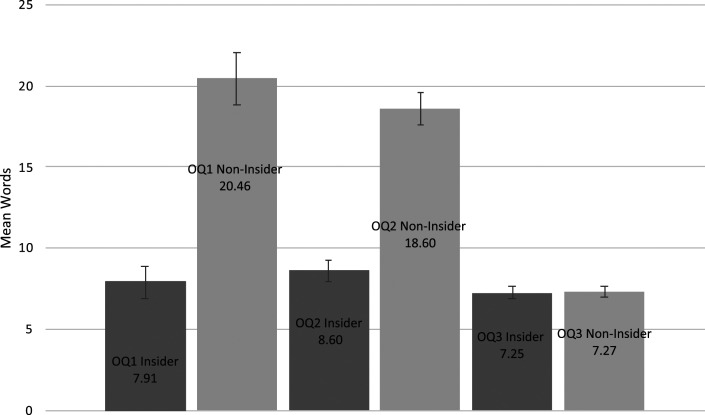
- For open target questions, insiders wrote fewer words than non-insiders: significant group effects for OQ1 and OQ2, with non-insiders writing 3 times more words on OQ1 and 2.5 times more words on OQ2.
- Insiders provided less information in open responses: significant group effects for total information items in OQ1, F(1,36)=9.485, p=.003, ηp²=0.22 and OQ2, F(1,36)=34.75, p < .001, ηp²=0.49.
- Insiders were more inconsistent with known evidence on closed target questions: U=43.00, z=-5.046, p < .001; insiders’ median answer-evidence inconsistency was 22.07 vs 15.85 for non-insiders.
- In feedback, insiders rated InSort as more demanding and reported lower confidence in their answers: F(1,59)=39.11, p < .001, ηp²=0.67 for demand and F(1,59)=45.41, p < .001, ηp²=0.62 for confidence.
## Methods
- The study used a 6-hour immersive simulation in the iCOS serious game, with participants working in teams investigating organized crime using password-protected databases; 25% were covertly incentivized to act as insiders.
- 60 participants were paid £50; teams were randomly assigned to Fraud, Human Trafficking, or Narcotics, with four roles per team.
- InSort included 56 questions (including repeated yes/no and open target questions), and analyses used two-way ANOVAs, Mann-Whitney tests, and coding of open responses into information items.
## Limitations
- The authors state that the simulation differed from the real world, including the absence of a “world” outside the simulation and the fact that insiders were chosen at random without controlling/measuring personality, motivation, or personal circumstances.
- They note that they compared known insiders to co-workers as a first step; they explicitly say more research is required to determine how to distinguish signal from noise when insider status is unknown.
- Evident from the text: the study was conducted in a controlled serious-game simulation with a small sample from one experimental setting, so generalizability to real organizational incidents is limited.
Model-written summary. Check it against the paper before relying on it.
Integrity signals
Registry
Cites
Statistics
Figures
Verification
Claims the paper makes
7 Valid · 2 Not valid · 15 Not checked · 39 Own results and interpretations
The sources with a verdict support this claim; the rest weren’t checked yet, have no full text we could read, or their verdicts aren’t rated yet.
In the paper
“Hence, providing a convincing false account is more demanding than completing legitimate activity and then providing a truthful account.”
§ Sorting Insiders From Co-Workers: Remote Synchronous Computer-Mediated Triage for Investigating Insider Attacks > Introduction > Masking Malicious Behaviour
What the sources say
- Not checked — no full text of the sourcecites K. Colwell et al., 2007 matched to “Assessment Criteria Indicative of Deception (ACID): an integrated system of investigative interviewing and detecting deception” (2007) source
- Not matchedcites Kohan et al., 2020
An author–year citation the paper’s reference list doesn’t settle. We don’t search these by name.
- Supportedcites Vrij et al., 2017 matched to “Psychological Perspectives on Interrogation” (2017) source
In Section III (Assessing Credibility) our copy states the premise the citing sentence paraphrases: 'lying is often more difficult than truth-telling in interview settings' and 'If lying already requires more cognitive resources than truth telling, liars will have fewer cognitive resources left over to deal with such additional requests.' The complementary contrast — truth tellers recounting activities they actually performed from memory ('tell all they remember about their activities'; 'truth tellers rely on their memory of the event') versus liars who must fabricate and track a plausible story ('liars lack the necessary imagination or creativity to add the same amount of plausible detail as truth tellers'; 'Liars need to keep track of their lies') — appears in the same section and in Future research, so the 'more demanding' framing is carried by the source. The paper credits the empirical basis to Christ et al. (2009) but adopts and relies on the premise as the foundation of the cognitive credibility assessment approach it reviews, so this is not a bare attribution to another work; the only softening is the source's 'often'/'if' hedging against the citing sentence's flat assertion. (LLM, conf=0.82)
plainstates a cause- Asserted: passes — The authors put it forward as true.
- Checkable: passes — It can be checked against evidence.
- Load-bearing: passes — The paper’s conclusions depend on it.
- Based: passes — The paper gives a reason why it holds.
The cited sources support only part of this claim — read each source’s verdict below.
In the paper
“Increased cognitive load in such circumstances (e.g., Bhatt et al., 2009; Jiang et al., 2015) can result in differential verbal behaviours between liars and truthtellers.”
§ Sorting Insiders From Co-Workers: Remote Synchronous Computer-Mediated Triage for Investigating Insider Attacks > Introduction > Masking Malicious Behaviour
What the sources say
- Not matchedcites Bhatt et al., 2009
An author–year citation the paper’s reference list doesn’t settle. We don’t search these by name.
- Partly supportedcites Jiang et al., 2015 matched to “Decoding the processing of lying using functional connectivity MRI” (2015) sourceExperimental — accuracy not yet measured
The Discussion (Deception-modulated network; page unavailable) links lying to greater cognitive load, and the Results (Behavioral data; page unavailable) report longer reaction times for lying than truth-telling. But participants responded by button press, not verbally, and the study did not test whether increasing cognitive load causes differences in verbal behaviour. (LLM, conf=0.86)
plainstates a possible cause- Asserted: passes — The authors put it forward as true.
- Checkable: passes — It can be checked against evidence.
- Load-bearing: passes — The paper’s conclusions depend on it.
- Based: passes — The paper gives a reason why it holds.
- Not matched
The sources with a verdict support this claim; the rest weren’t checked yet, have no full text we could read, or their verdicts aren’t rated yet.
In the paper
“Liars often provide less consistent or coherent verbal accounts lacking informational content, with fewer event details (Bogaard et al., 2016; DePaulo et al., 2003; Hartwig et al., 2011).”
§ Sorting Insiders From Co-Workers: Remote Synchronous Computer-Mediated Triage for Investigating Insider Attacks > Introduction > Masking Malicious Behaviour
What the sources say
- Supportedcites Bogaard et al., 2016 matched to “Strong, but Wrong: Lay People’s and Police Officers’ Beliefs about Verbal and Nonverbal Cues to Deception” (2016) source
The Introduction says that liars generally tell less coherent stories and include more contradictions. In Results > Closed questions, Table 4 identifies fewer details and less perceptual, spatial, and temporal information as empirically supported cues of deception. The cited paper thus supports the claim about coherence, consistency, and event-related detail; its results on participants’ beliefs are not the sole basis for that support. (LLM, conf=0.88)
- Not checked — no full text of the sourcecites DePaulo et al., 2003 matched to “Cues to deception” (2003) source
- Not checked — no full text of the sourcecites Hartwig et al., 2011 matched to “Detecting deception in suspects: verbal cues as a function of interview strategy” (2011) source
plainstates an association- Asserted: passes — The authors put it forward as true.
- Checkable: passes — It can be checked against evidence.
- Load-bearing: passes — The paper’s conclusions depend on it.
- Based: passes — The paper gives a reason why it holds.
- Supported
The cited sources that could be checked couldn’t confirm or dispute this claim.
In the paper
“Our results confirm findings of previous research in face-to-face and remote person-to-person contexts that questioning strategies which maximize cognitive burden can amplify signals of deception (e.g., Bogaard et al., 2016; DePaulo et al., 2003; Pentland et al., 2017), highlighting the potential of remote automated CMC.”
§ Sorting Insiders From Co-Workers: Remote Synchronous Computer-Mediated Triage for Investigating Insider Attacks > Discussion
What the sources say
- Could not verifycites Bogaard et al., 2016 matched to “Strong, but Wrong: Lay People’s and Police Officers’ Beliefs about Verbal and Nonverbal Cues to Deception” (2016) sourceExperimental — accuracy not yet measured
The Methods describe a questionnaire about beliefs concerning deception cues, and the Discussion says the study did not examine actual deception-detection performance. Searches for cognitive burden, cognitive load, and questioning strategies found no passage showing that such strategies amplify deception signals. (LLM, conf=0.77)
- Not checked — no full text of the sourcecites DePaulo et al., 2003 matched to “Cues to deception” (2003) source
- Not checked — no full text of the sourcecites Pentland et al., 2017 matched to “A Video-Based Screening System for Automated Risk Assessment Using Nuanced Facial Features” (2017) source
plainstates a cause- Asserted: passes — The authors put it forward as true.
- Checkable: passes — It can be checked against evidence.
- Load-bearing: passes — The paper’s conclusions depend on it.
- Based: passes — The paper gives a reason why it holds.
- Could not verify
The cited sources support only part of this claim — read each source’s verdict below.
In the paper
“Our results are also consistent with cognitive load explanations of deceptive communication (Fenn et al., 2015; Ho et al., 2016).”
§ Sorting Insiders From Co-Workers: Remote Synchronous Computer-Mediated Triage for Investigating Insider Attacks > Discussion
What the sources say
- Supportedcites Fenn et al., 2015 matched to “A reverse order interview does not aid deception detection regarding intentions” (2015) source
The Introduction’s “Cognitive Approach to Deception Detection” section describes cognitive-load explanations of lying. The Experiment 1 Results and Discussion find that interview order changed apparent cognitive load, while the Conclusion qualifies the explanation: high load can make truth tellers look like liars. The citation supports the broad reference to cognitive-load explanations, though not a claim that greater load reliably distinguishes liars. (LLM, conf=0.87)
- Not matchedcites Ho et al., 2016
This doesn’t read as a citation we can look up.
plainstates an association- Asserted: passes — The authors put it forward as true.
- Checkable: passes — It can be checked against evidence.
- Load-bearing: unclear — It is unclear whether the paper’s conclusions depend on it.
- Based: passes — The paper gives a reason why it holds.
- Supported
26 more claims
Create a free account to see all 63 claims and to verify the 9 references still open.
- Probably not a substantial claim. 25
- It may state two separate claims as one. 14
Statistics that don’t add up
Each reported p-value recomputed from its test statistic and degrees of freedom, each partial η² from its F, and each ratio, mean difference or B printed with a p checked against its own confidence interval.
Rated minor: it would not touch a result — a value no result rests on, a p-value that stays on the same side of the significance level, or a conflict that is clerical, resolved elsewhere in the paper, or outside its own findings.
In the paper
“F (1, 36) = 9.485, p = .003”
§ Sorting Insiders From Co-Workers: Remote Synchronous Computer-Mediated Triage for Investigating Insider Attacks > Results > Word Count and Information Content (H2)
Reported p = .003 · recomputed p = .004
Rated minor: it would not touch a result — a value no result rests on, a p-value that stays on the same side of the significance level, or a conflict that is clerical, resolved elsewhere in the paper, or outside its own findings.
In the paper
“F (1, 59) = 7.22, p = .009, η p 2 = 0.41”
§ Sorting Insiders From Co-Workers: Remote Synchronous Computer-Mediated Triage for Investigating Insider Attacks > Results > Post InSort Feedback (H4)
Reported ηp² = .41 · recomputed ηp² = .1090
Rated minor: it would not touch a result — a value no result rests on, a p-value that stays on the same side of the significance level, or a conflict that is clerical, resolved elsewhere in the paper, or outside its own findings.
In the paper
“F (1, 59) = 39.11, p < .001, η p 2 = 0.67”
§ Sorting Insiders From Co-Workers: Remote Synchronous Computer-Mediated Triage for Investigating Insider Attacks > Results > Post InSort Feedback (H4)
Reported ηp² = .67 · recomputed ηp² .39861–.39866
Rated minor: it would not touch a result — a value no result rests on, a p-value that stays on the same side of the significance level, or a conflict that is clerical, resolved elsewhere in the paper, or outside its own findings.
In the paper
“F (1, 59) = 45.41, p < .001, η p 2 = 0.62”
§ Sorting Insiders From Co-Workers: Remote Synchronous Computer-Mediated Triage for Investigating Insider Attacks > Results > Post InSort Feedback (H4)
Reported ηp² = .62 · recomputed ηp² = .4349
Statistics recomputed
Every reported test result, recomputed from its test statistic and degrees of freedom. A result shows as not adding up only once an independent check has confirmed it.
- Doesn’t add upF(1, 36) = 9.485reported p = .003 · recomputed p = .004
“F (1, 36) = 9.485, p = .003”
- ConsistentF(1, 36) = 12.866reported p = .001 · recomputed p < .001
“F (1, 36) = 12.866, p = .001”
- ConsistentF(1, 36) = 23.95reported p < .001 · recomputed p < .001
“F (1, 36) = 23.95, p < .001”
- ConsistentF(1, 36) = 34.75reported p < .001 · recomputed p < .001
“F (1, 36) = 34.75, p < .001”
- ConsistentF(1, 36) = 29.268reported p < .001 · recomputed p < .001
“F (1, 36) = 29.268, p < .001”
4 more recomputed tests
Create a free account to see every test the Stats check recomputed.
Self-check
Percentages, sums and reported differences re-computed from the paper’s own numbers.
Rated major: it would touch a result — a value a result rests on, reported and recomputed p-values on opposite sides of the significance level, two passages that conflict with no sign which is right, or a cited work retracted before this paper was published.
In the paper
“Two-way ANOVAs revealed a significant main effect of group (insider, non-insider), F (1, 54) = 187.81 p < .001, η p 2 = 0.88.”
§ Sorting Insiders From Co-Workers: Remote Synchronous Computer-Mediated Triage for Investigating Insider Attacks > Results > Duration (H1)
Reported 0.88 · recomputed 3.477963
Citations
Cites
DePaulo, B. M., Lindsay, J. J., Malone, B. E., Muhlenbruck, L., Charlton, K., & Cooper, H. (2003) · Psychological Bulletin · doi:10.1037/0033-2909.129.1.74 · Cited by 2,479 · cited 3×
“…person-to-person contexts that questioning strategies which maximize cognitive burden can amplify signals of deception (e.g., Bogaard et al., 2016; DePaulo et al., 2003; Pentland et al., 2017), highlighting the potential of remote automated CMC. Open questions increased the information…”
BackgroundAccuracy of Deception Judgments
Bond, C. F., & DePaulo, B. M. (2006) · Personality and Social Psychology Review · doi:10.1207/s15327957pspr1003_2 · Cited by 1,953 · cited 2×
“…al., 2020; Ormerod & Dando, 2015; Sporer, 2016; Vrij et al., 2010), which have yielded over 70% accuracy where the base rate of deceivers was just 1:1000 (Dando & Ormerod, 2020; Ormerod & Dando, 2015), compared with a typical detection rate of 54% (e.g., Bond & DePaulo, 2006; Hauch et al., 2016).”
BackgroundResultVerbal and Nonverbal Communication of Deception
Zuckerman, M., DePaulo, B. M., & Rosenthal, R. (1981) · Advances in Experimental Social Psychology · doi:10.1016/s0065-2601(08)60369-x · Cited by 1,341 · cited 1×
“Insider responses to open target questions were shorter, suggesting they were seeking to appear credible and cooperative, simultaneously being cautious in responding (see Schuetzler et al., 2019; Sporer, 2016; Zuckerman et al., 1981).”
BackgroundTruth-Default Theory (TDT): A Theory of Human Deception and Deception Detection
Levine, T. R. (2014) · Journal of Language and Social Psychology · doi:10.1177/0261927x14535916 · Cited by 585
Pitfalls and Opportunities in Nonverbal and Verbal Lie Detection
Vrij, A., Granhag, P. A., & Porter, S. (2010) · Psychological Science in the Public Interest · doi:10.1177/1529100610390861 · Cited by 522 · cited 1×
“…techniques (e.g., Blandon-Gitlin et al., 2014; Dando & Bull, 2011; Dando & Ormerod, 2020; Hamlin et al., 2020; Ormerod & Dando, 2015; Sporer, 2016; Vrij et al., 2010), which have yielded over 70% accuracy where the base rate of deceivers was just 1:1000 (Dando & Ormerod, 2020; Ormerod & Dando,…”
MethodHawaii international conference on system sciences
Schultz, E. E. (1992) · ACM SIGCHI Bulletin · doi:10.1145/134421.134436 · Cited by 517
Zhou, L., Burgoon, J. K., Nunamaker, J. F., & Twitchell, D. (2004) · Group Decision and Negotiation · doi:10.1023/b:grup.0000011944.62889.6f · Cited by 440 · cited 3×
“Thus, InSort is interactive (e.g., Lee et al., 2009; S´anchez-Junquera et al., 2020; Zhou et al., 2004), demanding higher levels of cognitive engagement (Burgoon et al., 2010).”
BackgroundHoneypots: catching the insider threat
Spitzner, L. (2004) · 19th Annual Computer Security Applications Conference, 2003. Proceedings. · doi:10.1109/csac.2003.1254322 · Cited by 364 · cited 2×
“Understanding of insider behaviours and psychological characteristics is improving 43 (e.g., Costa, et al., 2016; Elmrabit et al., 2020; Greitzer et al., 2018; Spitzner, 2003; Taylor et 44 al., 2013).”
BackgroundStrategic use of evidence during police interviews: When training to detect deception works.
Hartwig, M., Granhag, P. A., Strömwall, L. A., & Kronkvist, O. (2006) · Law and Human Behavior · doi:10.1007/s10979-006-9053-9 · Cited by 287 · cited 1×
“While insiders were consistent in textual responses, responses to target questions were inconsistent with evidence, which mirrors results in face-to-face contexts (Hartwig et al., 2006; Sukumar et al., 2018).”
ResultEmbodied Conversational Agent-Based Kiosk for Automated Interviewing
Nunamaker, J. F., Derrick, D. C., Elkins, A. C., Burgoon, J. K., & Patton, M. W. (2011) · Journal of Management Information Systems · doi:10.2753/mis0742-1222280102 · Cited by 280 · cited 1×
“…ndings regarding the ef fi cacy of automated screening systems for detecting deception at border crossings and in job interviews, further indicating that textual response content and response behaviours are important (see Chattopadhyay et al., 2018; Nunamaker et al., 2011; Schuetzler, et al., 2019).”
BackgroundHomoliak, I., Toffalini, F., Guarnizo, J., Elovici, Y., & Ochoa, M. (2020) · ACM Computing Surveys · doi:10.1145/3303771 · Cited by 255
Looking Good and Lying to Do It: Deception as an Impression Management Strategy in Job Interviews
Weiss, B., & Feldman, R. S. (2006) · Journal of Applied Social Psychology · doi:10.1111/j.0021-9029.2006.00055.x · Cited by 249 · cited 1×
“Hence, insiders have an impression management goal (L. H. Colwell et al., 2006; Weiss & Feldman, 2006).”
BackgroundDetecting Deception: Current Challenges and Cognitive Approaches
(2014) · UvA-DARE (University of Amsterdam) · doi:10.1002/9781118510001 · Cited by 234
Evaluation of Machine Learning Algorithms for Anomaly Detection
Elmrabit, N., Zhou, F., Li, F., & Zhou, H. (2020) · 2020 International Conference on Cyber Security and Protection of Digital Services (Cyber Security) · doi:10.1109/cybersecurity49315.2020.9138871 · Cited by 212 · cited 1×
“Understanding of insider behaviours and psychological characteristics is improving (e.g., Costa, et al., 2016; Elmrabit et al., 2020; Greitzer et al., 2018; Spitzner, 2003; Taylor et al., 2013).”
BackgroundDetecting Deception through Linguistic Analysis
Burgoon, J. K., Blair, J. P., Qin, T., & Nunamaker, J. F. (2003) · Lecture Notes in Computer Science · doi:10.1007/3-540-44853-5_7 · Cited by 209
Information Manipulation Theory 2: A Propositional Theory of Deceptive Discourse Production
McCornack, S. A., Morrison, K., Paik, J. E., Wisner, A. M., & Zhu, X. (2014) · Journal of Language and Social Psychology · doi:10.1177/0261927x14534656 · Cited by 209
Automated testing with targeted event sequence generation
Jensen, C. S., Prasad, M. R., & Møller, A. (2013) · Proceedings of the 2013 International Symposium on Software Testing and Analysis · doi:10.1145/2483760.2483777 · Cited by 200
Posey, C., Roberts, T. L., Lowry, P. B., Bennett, R. J., & Courtney, J. F. (2013) · MIS Quarterly · doi:10.25300/misq/2013/37.4.09 · Cited by 198 · cited 1×
“Insiders exploit privileged access to damage organizations (see Mills et al., 2017; Posey et al., 2013).”
BackgroundDoes Training Improve the Detection of Deception? A Meta-Analysis
Hauch, V., Sporer, S. L., Michael, S. W., & Meissner, C. A. (2016) · Communication Research · doi:10.1177/0093650214534974 · Cited by 187 · cited 3×
“Insider responses to open target questions were shorter, suggesting they were seeking to appear credible and cooperative, simultaneously being cautious in responding (see Schuetzler et al., 2019; Sporer, 2016; Zuckerman et al., 1981).”
BackgroundResultImpact and Key Challenges of Insider Threats on Organizations and Critical Businesses
Saxena, N., Hayes, E., Bertino, E., Ojo, P., Choo, K.-K. R., & Burnap, P. (2020) · Electronics · doi:10.3390/electronics9091460 · Cited by 136 · cited 1×
“However, few insider investigative techniques exist (Maybury, 2006) because knowledge derived from one attack is not necessarily relevant to others (e.g., CPNI, 2020; Saxena et al., 2020).”
BackgroundBogaard, G., Meijer, E. H., Vrij, A., & Merckelbach, H. (2016) · PLOS ONE · doi:10.1371/journal.pone.0156615 · Cited by 123 · cited 2×
“…in face-to-face and remote person-to-person contexts that questioning strategies which maximize cognitive burden can amplify signals of deception (e.g., Bogaard et al., 2016; DePaulo et al., 2003; Pentland et al., 2017), highlighting the potential of remote automated CMC. Open questions increased…”
BackgroundPsychological Perspectives on Interrogation
Vrij, A., Meissner, C. A., Fisher, R. P., Kassin, S. M., Morgan, C. A., & Kleinman, S. M. (2017) · Perspectives on Psychological Science · doi:10.1177/1745691617706515 · Cited by 116 · cited 1×
“This disparity offers opportunities for detection (e.g., K. Colwell et al., 2007; Kohan et al., 2020; Vrij et al., 2017).”
BackgroundScenario-Based Insider Threat Detection From Cyber Activities
Chattopadhyay, P., Wang, L., & Tan, Y.-P. (2018) · IEEE Transactions on Computational Social Systems · doi:10.1109/tcss.2018.2857473 · Cited by 115 · cited 1×
“…ndings regarding the ef fi cacy of automated screening systems for detecting deception at border crossings and in job interviews, further indicating that textual response content and response behaviours are important (see Chattopadhyay et al., 2018; Nunamaker et al., 2011; Schuetzler, et al., 2019).”
BackgroundJournal of Police and Criminal Psychology
(2013) · Journal of Police and Criminal Psychology · doi:10.1007/11896.1936-6469 · Cited by 115
Colwell, K., Hiscock‐Anisman, C. K., Memon, A., Taylor, L., & Prewett, J. (2007) · Journal of Investigative Psychology and Offender Profiling · doi:10.1002/jip.73 · Cited by 108 · cited 1×
“This disparity offers opportunities for detection (e.g., K. Colwell et al., 2007; Kohan et al., 2020; Vrij et al., 2017).”
BackgroundDeception and Cognitive Load: Expanding Our Horizon with a Working Memory Model
Sporer, S. L. (2016) · Frontiers in Psychology · doi:10.3389/fpsyg.2016.00420 · Cited by 107 · cited 2×
“Insider responses to open target questions were shorter, suggesting they were seeking to appear credible and cooperative, simultaneously being cautious in responding (see Schuetzler et al., 2019; Sporer, 2016; Zuckerman et al., 1981).”
BackgroundDando, C. J., & Bull, R. (2011) · Journal of Investigative Psychology and Offender Profiling · doi:10.1002/jip.145 · Cited by 101 · cited 3×
“Differences can be enhanced by tactical questioning techniques (e.g., Blandon-Gitlin et al., 2014; Dando & Bull, 2011; Dando & Ormerod, 2020; Hamlin et al., 2020; Ormerod & Dando, 2015; Sporer, 2016; Vrij et al., 2010), which have yielded over 70% accuracy where the base rate of deceivers was just…”
BackgroundResultSelf-citationVredeveldt, A., Koppen, P. J. V., & Granhag, P. A. (2014) · Springer eBooks · doi:10.1007/978-1-4614-9642-7_10 · Cited by 98 · cited 1×
“Some target questions are repeated, accentuating between-question inconsistencies and contradictions, which can be indicative of deceit (Blair et al., 2018; Chan & Bull, 2014; Vredeveldt et al., 2014).”
BackgroundThe effect of conversational agent skill on user behavior during deception
Schuetzler, R. M., Grimes, G. M., & Giboney, J. S. (2019) · Computers in Human Behavior · doi:10.1016/j.chb.2019.03.033 · Cited by 95 · cited 3×
“Insider responses to open target questions were shorter, suggesting they were seeking to appear credible and cooperative, simultaneously being cautious in responding (see Schuetzler et al., 2019; Sporer, 2016; Zuckerman et al., 1981).”
Background“What Is Computer-Mediated Communication?”—An Introduction to the Special Issue
Yao, M. Z., & Ling, R. (2020) · Journal of Computer-Mediated Communication · doi:10.1093/jcmc/zmz027 · Cited by 91 · cited 1×
“Organizations can gather information from employees simultaneously, irrespective of location, offering speed, volume, and reach (e.g., Lew et al., 2018; Pang et al., 2018; Yao & Ling, 2020).”
BackgroundPang, A., Shin, W., Lew, Z., & Walther, J. B. (2018) · Journal of Marketing Communications · doi:10.1080/13527266.2016.1269019 · Cited by 87
Lying about facial recognition: An fMRI study
Bhatt, S., Mbwana, J., Adeyemo, A., Sawyer, A. T., Hailu, A., & VanMeter, J. W. (2008) · Brain and Cognition · doi:10.1016/j.bandc.2008.08.033 · Cited by 86 · cited 2×
“Increased cognitive load in such circumstances (e.g., Bhatt et al., 2009; Jiang et al., 2015) can result in differential verbal behaviours between liars and truthtellers.”
BackgroundLew, Z., Walther, J. B., Pang, A., & Shin, W. (2018) · Journal of Computer-Mediated Communication · doi:10.1093/jcmc/zmy009 · Cited by 86 · cited 2×
“Organizations can gather information from employees simultaneously, irrespective of location, offering speed, volume, and reach (e.g., Lew et al., 2018; Pang et al., 2018; Yao & Ling, 2020).”
BackgroundVendemia, J. M. C., Buzan, R. F., & Simon-Dack, S. L. (2005) · Behavioural Neurology · doi:10.1155/2005/804026 · Cited by 85 · cited 1×
“For example, deception-conveying features can sometimes include wordy replies with low information (e.g., Pollina et al., 2017; Vendemia et al., 2005) and more expressions of uncertainty (Zhou et al., 2004).”
BackgroundCognitive-load approaches to detect deception: searching for cognitive mechanisms
Blandón-Gitlin, I., Fenn, E., Masip, J., & Yoo, A. H. (2014) · Trends in Cognitive Sciences · doi:10.1016/j.tics.2014.05.004 · Cited by 84 · cited 1×
“Differences can be enhanced by tactical questioning techniques (e.g., Blandon-Gitlin et al., 2014; Dando & Bull, 2011; Dando & Ormerod, 2020; Hamlin et al., 2020; Ormerod & Dando, 2015; Sporer, 2016; Vrij et al., 2010), which have yielded over 70% accuracy where the base rate of deceivers was just…”
BackgroundPhillips, E., Oxburgh, G. E., Gavin, A., & Myklebust, T. (2011) · Journal of Police and Criminal Psychology · doi:10.1007/s11896-011-9093-z · Cited by 81 · cited 1×
“Information items in response to open target questions (OQ1, OQ2 and OQ3) were calculated by summing the number of correct, discrete, quanti fi able investigation relevant information (IRI) items (see Oxburgh et al., 2012: Phillips et al., 2012 for more on IRI).”
MethodReforming Investigative Interviewing in Canada
Snook, B., Eastwood, J., Stinson, M., Tedeschini, J., & House, J. C. (2010) · Canadian Journal of Criminology and Criminal Justice · doi:10.3138/cjccj.52.2.215 · Cited by 74 · cited 1×
“…al., 2016; DePaulo et al., 2003; Pentland et al., 2017), highlighting the potential of remote automated CMC. Open questions increased the information harvested, eliciting an individual ’ s version of the truth, which can be explored for veracity (e.g., Kontogianni et al., 2020; Snook et al., 2010).”
BackgroundOxburgh, G. E., Ost, J., & Cherryman, J. (2010) · Psychology Crime and Law · doi:10.1080/1068316x.2010.481624 · Cited by 70 · cited 1×
“Information items in response to open target questions (OQ1, OQ2 and OQ3) were calculated by summing the number of correct, discrete, quanti fi able investigation relevant information (IRI) items (see Oxburgh et al., 2012: Phillips et al., 2012 for more on IRI).”
MethodHo, S. M., Hancock, J. T., Booth, C., & Liu, X. (2016) · Journal of Management Information Systems · doi:10.1080/07421222.2016.1205924 · Cited by 67 · cited 1×
“Our results are also consistent with cognitive load explanations of deceptive communication (Fenn et al., 2015; Ho et al., 2016).”
ResultDando, C. J., Bull, R., Ormerod, T. C., & Sandham, A. L. (2013) · Legal and Criminological Psychology · doi:10.1111/lcrp.12016 · Cited by 64 · cited 1×
“Tactical questioning, concerning known or veri fi - able information are spread throughout InSort rather than clustered at the beginning or end, which improves the veracity performance by interviewers and observers (Dando et al., 2015; Levine, 2018).”
BackgroundSelf-citationA meta‐analytic review of the timing for disclosing evidence when interviewing suspects
Oleszkiewicz, S., & Watson, S. J. (2020) · Applied Cognitive Psychology · doi:10.1002/acp.3767 · Cited by 62 · cited 1×
“In face-to-face contexts participants are often unaware of information known by interviewers, which is fundamental to the success of tactical and strategic interviewing techniques (e.g., see Oleszkiewicz & Watson, 2021).”
BackgroundDecoding the processing of lying using functional connectivity MRI
Jiang, W., Liu, H., Zeng, L., Liao, J., Shen, H., Luo, A., Hu, D., & Wang, W. (2015) · Behavioral and Brain Functions · doi:10.1186/s12993-014-0046-4 · Cited by 61 · cited 2×
“Increased cognitive load in such circumstances (e.g., Bhatt et al., 2009; Jiang et al., 2015) can result in differential verbal behaviours between liars and truthtellers.”
BackgroundTwyman, N. W., Lowry, P. B., Burgoon, J. K., & Nunamaker, J. F. (2014) · Journal of Management Information Systems · doi:10.1080/07421222.2014.995535 · Cited by 60 · cited 1×
“Computer-mediated communication screening is increasingly used to support decision-making where there are high volumes of traf fi c such as for pre-screening job applicants and completing employee credibility assessments (Jenson et al., 2013; Twyman et al., 2014).”
BackgroundDetecting insider threats through language change.
Taylor, P. J., Dando, C. J., Ormerod, T. C., Ball, L. J., Jenkins, M. C., Sandham, A., & Menacere, T. (2013) · Law and Human Behavior · doi:10.1037/lhb0000032 · Cited by 59 · cited 5×
“The game, known as Con fi dential Operations Simulation (iCOS: see Taylor et al., 2013), was played over a series of competitive rounds.”
BackgroundInfluentialSelf-citationOrmerod, T. C., & Dando, C. J. (2015) · Journal of Experimental Psychology: General · doi:10.1037/xge0000030 · Cited by 57 · cited 3×
“These question types and their tactical presentation makes it challenging for insiders to provide a coherent account (e.g., Dando & Bull, 2011; Dando & Ormerod, 2020; Ormerod & Dando, 2015).”
BackgroundResultSelf-citationDetecting deception in suspects: verbal cues as a function of interview strategy
Hartwig, M., Granhag, P. A., Stromwall, L., Wolf, A. G., Vrij, A., & Hjelmsäter, E. R. A. (2011) · Psychology, Crime & Law · doi:10.1080/10683160903446982 · Cited by 50 · cited 1×
“Liars often provide less consistent or coherent verbal accounts lacking informational content, with fewer event details (Bogaard et al., 2016; DePaulo et al., 2003; Hartwig et al., 2011).”
BackgroundHow good are we at detecting deception? A review of current techniques and theories
Nortje, A., & Tredoux, C. G. (2019) · South African Journal of Psychology · doi:10.1177/0081246318822953 · Cited by 48 · cited 1×
“…that occur during face-to-face interactions that can negatively impact investigations, potentially reducing false positives and negatives (e.g., Bond & DePaulo, 2006; Dando & Ormerod, 2017; Markowitz, 2020; Matsumoto et al., 2011; Meissner & Lyles, 2019; Nortje & Tredoux, 2019; Walsh et al., 2018).”
BackgroundNonverbal Communication Theories of Interaction Adaptation
Burgoon, J. K., Floyd, K., & Guerrero, L. K. (2010) · Sage eBooks · doi:10.4135/9781412982818.n6 · Cited by 39
Kontogianni, F., Hope, L., Taylor, P. J., Vrij, A., & Gabbert, F. (2020) · Applied Cognitive Psychology · doi:10.1002/acp.3675 · Cited by 39 · cited 1×
“…al., 2016; DePaulo et al., 2003; Pentland et al., 2017), highlighting the potential of remote automated CMC. Open questions increased the information harvested, eliciting an individual ’ s version of the truth, which can be explored for veracity (e.g., Kontogianni et al., 2020; Snook et al., 2010).”
BackgroundSelf-citationLevine, T. R., Blair, J. P., & Carpenter, C. J. (2017) · Legal and Criminological Psychology · doi:10.1111/lcrp.12115 · Cited by 38
Colwell, L. H., Miller, H. A., Lyons, P. M., & Miller, R. S. (2006) · Police Quarterly · doi:10.1177/1098611104273293 · Cited by 36 · cited 1×
“Hence, insiders have an impression management goal (L. H. Colwell et al., 2006; Weiss & Feldman, 2006).”
BackgroundA Video-Based Screening System for Automated Risk Assessment Using Nuanced Facial Features
Pentland, S. J., Twyman, N. W., Burgoon, J. K., Nunamaker, J. F., & Diller, C. B. R. (2017) · Journal of Management Information Systems · doi:10.1080/07421222.2017.1393304 · Cited by 35 · cited 2×
“…that questioning strategies which maximize cognitive burden can amplify signals of deception (e.g., Bogaard et al., 2016; DePaulo et al., 2003; Pentland et al., 2017), highlighting the potential of remote automated CMC. Open questions increased the information harvested, eliciting an…”
BackgroundAnalyzing Decision Logs to Understand Decision Making in Serious Crime Investigations
Dando, C. J., & Ormerod, T. C. (2017) · Human Factors The Journal of the Human Factors and Ergonomics Society · doi:10.1177/0018720817727899 · Cited by 32 · cited 1×
“…that occur during face-to-face interactions that can negatively impact investigations, potentially reducing false positives and negatives (e.g., Bond & DePaulo, 2006; Dando & Ormerod, 2017; Markowitz, 2020; Matsumoto et al., 2011; Meissner & Lyles, 2019; Nortje & Tredoux, 2019; Walsh et al., 2018).”
BackgroundSelf-citationSOFIT: Sociotechnical and Organizational Factors for Insider Threat
Greitzer, F., Purl, J., Leong, Y. M., & Becker, D. E. S. (2018) · 2018 IEEE Security and Privacy Workshops (SPW) · doi:10.1109/spw.2018.00035 · Cited by 32 · cited 1×
“Understanding of insider behaviours and psychological characteristics is improving (e.g., Costa, et al., 2016; Elmrabit et al., 2020; Greitzer et al., 2018; Spitzner, 2003; Taylor et al., 2013).”
BackgroundWei, Y., Chow, K.-P., & Yiu, S.-M. (2021) · Forensic Science International: Digital Investigation · doi:10.1016/j.fsidi.2021.301126 · Cited by 32 · cited 1×
“Insider attacks are increasing in number and magnitude, with potential to undermine national and international security, cause fi nancial loss and reputational damage (e.g., Legg, 2017; Wei et al., 2021).”
BackgroundAn Insider Threat Indicator Ontology
Costa, D., Albrethsen, M. J., Collins, M. L., Perl, S. J., Silowash, G., & Spooner, D. (2022) · Figshare · doi:10.1184/r1/19125686 · Cited by 31
Lee, C.-C., Welker, R. B., & Odom, M. D. (2009) · Journal of Information Systems · doi:10.2308/jis.2009.23.1.24 · Cited by 30 · cited 2×
“Thus, InSort is interactive (e.g., Lee et al., 2009; S´anchez-Junquera et al., 2020; Zhou et al., 2004), demanding higher levels of cognitive engagement (Burgoon et al., 2010).”
BackgroundInterview based connectivity analysis of EEG in order to detect deception
Kohan, M. D., Nasrabadi, A. M., sharifi, A., & Shamsollahi, M. B. (2019) · Medical Hypotheses · doi:10.1016/j.mehy.2019.109517 · Cited by 30
Improving Professional Observers’ Veracity Judgements by Tactical Interviewing
Sandham, A. L., Dando, C. J., Bull, R., & Ormerod, T. C. (2020) · Journal of Police and Criminal Psychology · doi:10.1007/s11896-020-09391-1 · Cited by 29
Self-citationPredict insider threats using human behaviors
Mills, J. U., Stuban, S. M. F., & Dever, J. R. (2017) · IEEE Engineering Management Review · doi:10.1109/emr.2017.2667218 · Cited by 28 · cited 1×
“Insiders exploit privileged access to damage organizations (see Mills et al., 2017; Posey et al., 2013).”
BackgroundThe Role of Consistency in Detecting Deception: The Superiority of Correspondence over Coherence
Blair, J. P., Reimer, T. O., & Levine, T. R. (2018) · Communication Studies · doi:10.1080/10510974.2018.1447492 · Cited by 27 · cited 2×
“Although the consistency across time literature in face-to-face contexts is mixed, our fi ndings suggest deceivers can be as consistent, sometimes more so than truthtellers (e.g., Blair et al., 2018; Clemens & Grolig, 2019; Masip et al., 2018).”
BackgroundA reverse order interview does not aid deception detection regarding intentions
Fenn, E., McGuire, M., Langben, S., & Blandón-Gitlin, I. (2015) · Frontiers in Psychology · doi:10.3389/fpsyg.2015.01298 · Cited by 25 · cited 1×
“Our results are also consistent with cognitive load explanations of deceptive communication (Fenn et al., 2015; Ho et al., 2016).”
ResultThe deception faucet: A metaphor to conceptualize deception and its detection
Markowitz, D. M. (2020) · New Ideas in Psychology · doi:10.1016/j.newideapsych.2020.100816 · Cited by 25 · cited 1×
“…that occur during face-to-face interactions that can negatively impact investigations, potentially reducing false positives and negatives (e.g., Bond & DePaulo, 2006; Dando & Ormerod, 2017; Markowitz, 2020; Matsumoto et al., 2011; Meissner & Lyles, 2019; Nortje & Tredoux, 2019; Walsh et al., 2018).”
BackgroundMasking domain-specific information for cross-domain deception detection
Sánchez-Junquera, J., Villaseñor-Pineda, L., Montes-y-Gómez, M., Rosso, P., & Stamatatos, E. (2020) · Pattern Recognition Letters · doi:10.1016/j.patrec.2020.04.020 · Cited by 24 · cited 1×
“Thus, InSort is interactive (e.g., Lee et al., 2009; S´anchez-Junquera et al., 2020; Zhou et al., 2004), demanding higher levels of cognitive engagement (Burgoon et al., 2010).”
BackgroundMeissner, C. A., & Lyles, A. M. (2019) · Journal of Applied Research in Memory and Cognition · doi:10.1016/j.jarmac.2019.07.001 · Cited by 19 · cited 1×
“…that occur during face-to-face interactions that can negatively impact investigations, potentially reducing false positives and negatives (e.g., Bond & DePaulo, 2006; Dando & Ormerod, 2017; Markowitz, 2020; Matsumoto et al., 2011; Meissner & Lyles, 2019; Nortje & Tredoux, 2019; Walsh et al., 2018).”
BackgroundClemens, F., & Grolig, T. (2019) · Psychology, Crime & Law · doi:10.1080/1068316x.2019.1597093 · Cited by 15 · cited 1×
“Although the consistency across time literature in face-to-face contexts is mixed, our fi ndings suggest deceivers can be as consistent, sometimes more so than truthtellers (e.g., Blair et al., 2018; Clemens & Grolig, 2019; Masip et al., 2018).”
BackgroundNoncoercive human intelligence gathering
Dando, C. J., & Ormerod, T. C. (2020) · Journal of Experimental Psychology: General · doi:10.1037/xge0000724 · Cited by 14 · cited 3×
“Differences can be enhanced by tactical questioning techniques (e.g., Blandon-Gitlin et al., 2014; Dando & Bull, 2011; Dando & Ormerod, 2020; Hamlin et al., 2020; Ormerod & Dando, 2015; Sporer, 2016; Vrij et al., 2010), which have yielded over 70% accuracy where the base rate of deceivers was just…”
BackgroundResultSelf-citationMasip, J., Martínez, C., Blandón-Gitlin, I., Sánchez, N., Herrero, C., & Ibabe, I. (2018) · Frontiers in Psychology · doi:10.3389/fpsyg.2017.02207 · Cited by 12 · cited 1×
“Although the consistency across time literature in face-to-face contexts is mixed, our fi ndings suggest deceivers can be as consistent, sometimes more so than truthtellers (e.g., Blair et al., 2018; Clemens & Grolig, 2019; Masip et al., 2018).”
BackgroundA Psychometric Investigation into the Structure of Deception Strategy Use
Hamlin, I., Taylor, P. J., Cross, L., MacInnes, K., & van der Zee, S. (2020) · Journal of Police and Criminal Psychology · doi:10.1007/s11896-020-09380-4 · Cited by 12
Self-citation(2006) · Defense Technical Information Center (DTIC) · Cited by 11
The Effect of Co-Offender Planning on Verbal Deception
Chan, S., & Bull, R. (2013) · Psychiatry Psychology and Law · doi:10.1080/13218719.2013.835703 · Cited by 10 · cited 1×
“Some target questions are repeated, accentuating between-question inconsistencies and contradictions, which can be indicative of deceit (Blair et al., 2018; Chan & Bull, 2014; Vredeveldt et al., 2014).”
BackgroundDe Rosa, J., Hiscock‐Anisman, C., Blythe, A., Bogaard, G., Hally, A., & Colwell, K. (2019) · Journal of Investigative Psychology and Offender Profiling · doi:10.1002/jip.1519 · Cited by 10
Human-Machine Decision Support Systems for Insider Threat Detection
Legg, P. (2017) · Data analytics · doi:10.1007/978-3-319-59439-2_2 · Cited by 9 · cited 1×
“Insider attacks are increasing in number and magnitude, with potential to undermine national and international security, cause fi nancial loss and reputational damage (e.g., Legg, 2017; Wei et al., 2021).”
BackgroundSukumar, D., Wade, K. A., & Hodgson, J. S. (2018) · Law and Human Behavior · doi:10.1037/lhb0000278 · Cited by 9 · cited 1×
“While insiders were consistent in textual responses, responses to target questions were inconsistent with evidence, which mirrors results in face-to-face contexts (Hartwig et al., 2006; Sukumar et al., 2018).”
ResultTriage decision-making by welfare fraud investigators.
Walsh, D., Dando, C. J., & Ormerod, T. C. (2018) · Journal of Applied Research in Memory and Cognition · doi:10.1016/j.jarmac.2018.01.002 · Cited by 7 · cited 1×
“…that occur during face-to-face interactions that can negatively impact investigations, potentially reducing false positives and negatives (e.g., Bond & DePaulo, 2006; Dando & Ormerod, 2017; Markowitz, 2020; Matsumoto et al., 2011; Meissner & Lyles, 2019; Nortje & Tredoux, 2019; Walsh et al., 2018).”
Self-citationPollina, D. A., Woods, R. J., Salyer, C. D., Leffingwell, T. G., Cooper, C., & Rohrbaugh, J. W. (2017) · International Journal of Human-Computer Studies · doi:10.1016/j.ijhcs.2016.07.003 · Cited by 3 · cited 2×
“For example, deception-conveying features can sometimes include wordy replies with low information (e.g., Pollina et al., 2017; Vendemia et al., 2005) and more expressions of uncertainty (Zhou et al., 2004).”
Background
Research works printed but not linked: 7
- Clearswift Insider Threat Index. (2017). https://www.clearswift.com/about-us/pr/press-releases/insider-threat-74-security-incidents-come-extended-enterprise-not-hacking-groups
- Jenkins M. C. Dando C. J. (2012). Computer-mediated investigative interviews: A potential screening tool for the detection of insider threat. In Proceedings of the 10th Biennial Conference of the International Conference of Forensic Linguistics. Center for Forensic Linguistics.
- Levine T. R. (2018). Scientific evidence and cue theories in deception research: Reconciling findings from meta-analyses and primary experiments. International Journal of Communication, 12(19), 2461– 2479. 10.1080/19312458.2017.1411471 · DOI
- Matsumoto D. Hwang H. S. Skinner L. Frank M. (2011). Evaluating truthfulness and detecting deception. FBI L. Enforcement Bull, 80, 1.
- National Law review. (2020). Frequency and cost of insider threats continue to increase. https://www.natlawreview.com/article/frequency-and-cost-insider-threats-continue-to-increase
- Trzeciak R. (2019). SEI cyber minute: Insider threat mitigation, we can help!. Carnegie Mellon University Software Engineering Institute Pittsburgh United States.
- Walczyk J. J. Grifith D. A. Yates R. Visconte S. Simoneaux B. (2013). Eye movements and other cognitive cues to rehearsed and unrehearsed deception when interrogated about a mock crime. Applied Psychology in Criminal Justice, 9(1), 1– 23
Cited by
Insider threat mitigation: Systematic literature review
Inayat, U., Farzan, M., Mahmood, S., Zia, M. F., Hussain, S., & Pallonetto, F. (2024) · Ain Shams Engineering Journal · doi:10.1016/j.asej.2024.103068 · Cited by 81
Dando, C. J., Taylor, P. J., & Sandham, A. L. (2023) · Frontiers in Psychology · doi:10.3389/fpsyg.2023.1152904 · Cited by 12
Self-citationMuñiz, D. Á., Pérez-Miguel, L., Miguel, Muñoz, A. M., Larriva-Novo, X. A., Álvarez-Campana, M., & Rivera, D. (2025) · Computers & Security · doi:10.1016/j.cose.2025.104743 · Cited by 12
Dando, C. J., Sandham, A. L., Sibbons, C., & Taylor, P. J. (2024) · PLoS ONE · doi:10.1371/journal.pone.0310384 · Cited by 3
Self-citationA Framework to Reconstruct Digital Forensics Evidence via Goal-Oriented Modeling
Ogundiran, A., Chi, H., Yan, J., et al. (2023) · IEEE International Conference on AI in Cybersecurity (ICAIC) · doi:10.1109/icaic57335.2023.10044180 · Cited by 2
“Finally, one challenge for IoT forensics is heterogeneous information and dataset, we will test our approach in real-world case such as smart home or smart city [32].”
Background
Metadata
- Authors
- Dando, C. J., Taylor, P. J., Menacere, T., Ormerod, T. C., Ball, L. J., & Sandham, A. L.
- Affiliations
- University of Westminster (GB)
- Lancaster University (GB)
- University of Sussex (GB)
- University of Lancashire (GB)
- University of Gloucestershire (GB)
- Corresponding author
- Dando, Coral J.
- Venue
- Human Factors: The Journal of the Human Factors and Ergonomics Society
- Publisher
- SAGE Publications
- Published
- 2022-03-07
- Volume
- 66
- Issue
- 1
- Pages
- 145-157
- ISSN
- 0018-7208 (ISSN-L)
- 1547-8181
- PMC
- PMC10756022
- OpenAlex
- W3216334198
- Semantic Scholar
- 029e069f65e24a6dda78b802a9fab36c8d79d036
- Cited by
- 10
- References
- 74
- Citations by year
- 2026: 1 · 2025: 2 · 2024: 5 · 2023: 2
- FWCI
- 2.13
- Type
- journal article
- Language
- en
- Open access
- hybrid
- doi.org
- Locations
- Human Factors The Journal of the Human Factors and Ergonomics Society (publishedVersion, cc-by)
- PubMed Central (publishedVersion, cc-by)
- PubMed (publishedVersion)
- Research Repository (University of Gloucestershire) (acceptedVersion)
- CLOK (University of Central Lancashire) (acceptedVersion)
- Research Repository (University of Gloucestershire) (submittedVersion)
- Lancaster EPrints (Lancaster University) (submittedVersion)
- WestminsterResearch (University of Westminster) (submittedVersion, cc-by)
- Figshare (submittedVersion, cc-by)
- Funders
- UK Government (Project Ref. LUR 46.851)
- Topics
- Social Sciences › Psychology › Social Psychology › Deception detection and forensic psychology
- Physical Sciences › Computer Science › Information Systems › Information and Cyber Security
- Physical Sciences › Computer Science › Information Systems › Digital and Cyber Forensics
- Keywords
- insider attacks, deception detection, remote triage, investigative questioning, organizational security
- MeSH terms
- Algorithms, Computer Simulation, Computers, Humans, Triage, Computer Security
About these checks
Registry, retraction, Cites and statistics results are computed, not judged, with one exception: a printed reference that no index lists is read once by a model before it counts as a citation error. Claims are extracted by a model and kept only when their quote appears verbatim in the text; each cited source is then checked, with a model’s help, for whether it says what the claim relies on. Those verdicts can be wrong — read the claim’s quote and the cited source before relying on one.
The claim verdicts this report counts are experimental: their accuracy is not yet measured.
A language model drew the claims from the paper on 2026-10-10, under version 3 of the claim definition (model deepseek-v4.1-flash, prompt extract-v3).
A second model labelled each claim on 2026-10-10 (model jev-1.13-20260917, definition revision gold-guideline-v0.2).
Cited sources are checked with a language model’s help (qwen3.8-omni-flash and gpt-6-sol).
Statistics and arithmetic are recomputed, not judged.
Confidence bands are shown only for fields calibrated on our annotated test set. None is calibrated yet, so no band is shown.
What counts as a claim ›How we measure confidence ›How we check this ›
Are you an author, or do you see a problem with this page? Request a review
Data sources
Bibliographic data: Semantic Scholar, OpenAlex, Crossref.
Contains information from the Semantic Scholar Academic Graph Datasets, made available under the ODC Attribution License (ODC-BY 1.0).
Semantic Scholar’s data is described in: Kinney, R., et al. (2023). The Semantic Scholar Open Data Platform. arXiv:2301.10140.
