

The Ba'athist blackout? Selective goods provision and political violence in the Syrian civil war
Open accessThe DOI matches its Crossref record; 35 of the 37 references it cites were found in a registry or an index, and 1 are not checked yet; 9 of the 49 sources its claims cite were checked for support.
Abstract
Many authoritarian regimes selectively provide critical segments of the population with privileged access to goods and services, expecting political support in return. This article is interested in the effects of this regime strategy: Is violent opposition less likely to occur in subnational regions bound to the ruling elite through such patron–client networks? For its empirical analysis, the article makes use of crowdsourcing data on the number and geospatial distribution of fatalities in the Syrian civil war from March 2011 to November 2012. In terms of selective goods provision, the focus is on the electricity sector. Satellite images of the earth at night are used to proxy spatial variations in the public distribution of electricity in times of power shortages. These data are complemented with information from the last Syrian population census of 2004. Estimations from fixed effect logit models lend support to the hypothesis that the risk of violence has been lower in subdistricts that have been favored by the ruling regime in terms of preferential access to material goods. This hypothesis is further corroborated with qualitative evidence from Syrian localities.
Verified 2026-11-22 · 1 reference not checked yet
Overview
CoChat Summary
## TL;DR
The paper argues that selective state provision of electricity in Syria functioned as patronage and was associated with lower subnational violence during the early civil war. Using nightlights and crowdsourced fatality data for 261 Syrian subdistricts, the authors find that subdistricts favored in electricity provision had a lower risk of violence.
## Key findings
- The analysis covers 261 Syrian subdistricts and violence from March 2011 to November 2012; the authors report that their main fixed-effects logit models support the hypothesis that violence risk was lower in favored subdistricts.
- In the main model, moving from the 5th to the 95th percentile of the first main electricity variable lowered the predicted risk of violence from 43% to approximately 4% on average across governorates.
- For the nightlight change-rate measure, the predicted risk of violence dropped from 33% to 4% in a similar simulation.
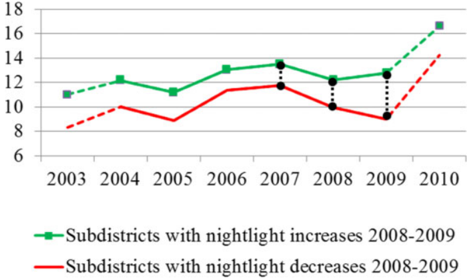
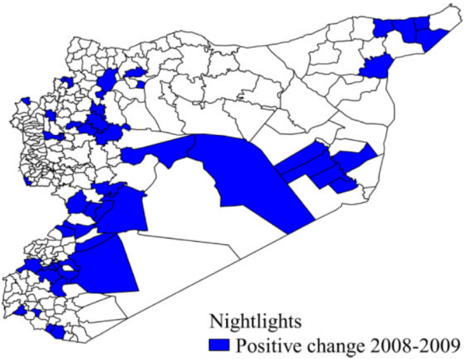
- Subdistricts with an increase in light output from 2008 to 2009 showed a 16% lower risk of experiencing violence than other subdistricts; in Table I, the associated coefficient is -1.849 with p = 0.008.
- Robustness checks using alternative fatality thresholds (5, 10, 20, 50), a shorter outcome window, count models, and exclusions of certain governorates were reported as broadly consistent with the main findings.
## Methods
- Cross-sectional subdistrict-level study of Syria; the sample began with 274 subdistricts and was reduced to 261 after excluding the nine Golan Heights subdistricts and four geographically irregular subdistricts.
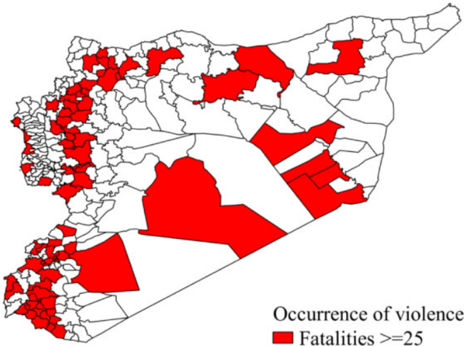
- Dependent variable: binary indicator of violence in March 2011–November 2012, coded using a threshold of 25 reported deaths based on crowdsourced Syria Tracker fatality data.
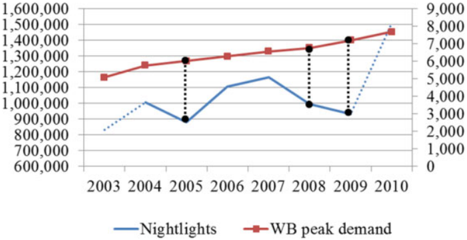
- Main explanatory variables: three electricity-provision measures derived from annual nighttime satellite imagery for 2004–2009—absolute change in mean light output from 2007 to 2009, relative change, and a dummy for whether light output increased from 2008 to 2009.
- Main analysis: fixed-effects logit models with governorate-level fixed effects, clustered standard errors where possible, plus robustness checks using alternative thresholds and count models.
## Limitations
- The authors explicitly state that they cannot make strong causal claims because the study is based on a cross-sectional analysis alone.
- They note that collapsing fatalities into a binary measure loses “substantial amounts of information” from the data.
- Evident from the text: the electricity measure is a proxy based on nightlights, so it may not perfectly capture actual patron-client favoritism or electricity access at the local level.
Model-written summary. Check it against the paper before relying on it.
Integrity signals
Registry
Cites
Statistics
Figures
Verification
Claims the paper makes
9 Valid · 6 Not valid · 26 Not checked · 79 Own results and interpretations
The cited sources support only part of this claim — read each source’s verdict below.
In the paper
“According to Fabrice Balanche (2011), it was precisely the decreased availability of financial resources in times of economic liberalization that contributed to the continuing and in some cases increased importance of patron-client networks.”
What the sources say
- Partly supportedcites Balanche, 2011 matched to “Géographie de la révolte syrienne” (2011) sourceExperimental — accuracy not yet measured
In “Les transitions économique et démographique produisent une crise sociale” (page unavailable), Balanche says the state no longer has the means to fund its previous policies and that economic liberalization concentrates growth among regime associates. “La périphérie du territoire alaouite” (page unavailable) describes privileged access through networks of power amid worsening economic conditions. The paper does not say that reduced financial resources caused patron-client networks to retain or increase their importance. (LLM, conf=0.84)
plainstates a cause- Asserted: passes — The authors put it forward as true.
- Checkable: passes — It can be checked against evidence.
- Load-bearing: unclear — It is unclear whether the paper’s conclusions depend on it.
- Based: passes — The paper gives a reason why it holds.
- Partly supported
The cited sources support only part of this claim — read each source’s verdict below.
In the paper
“De Cha ˆtel (2014) shows that during the harsh drought years of 2006 to 2009 in the agriculture-based northeast, the regime provided emergency help first and foremost to those selected, well-connected farmers who had already profited from the distribution of state land and subsidized fertilizers (see also Balanche, 2011).”
What the sources say
- Not checked — no full text of the sourcecites De Châtel, 2014 matched to “The role of drought and climate change in the Syrian uprising: Untangling the triggers of the revolution” (2014) source
- Partly supportedcites Balanche, 2011 matched to “Géographie de la révolte syrienne” (2011) sourceExperimental — accuracy not yet measured
Split into 2 atoms — 0 confirmed, 2 partially supported, 0 disputed, 0 misattributed, 0 unverifiable. Expand the claim to see per-atom verdicts.
boostedstates a cause- Asserted: passes — The authors put it forward as true.
- Checkable: passes — It can be checked against evidence.
- Load-bearing: passes — The paper’s conclusions depend on it.
- Based: passes — The paper gives a reason why it holds.
The cited sources support only part of this claim — read each source’s verdict below.
In the paper
“those areas with strong ties have remained calm”
What the sources say
- Not checked — no full text of the sourcecites Leenders & Heydemann, 2012 matched to “Popular mobilization in Syria: Opportunity and threat, and the social networks of the early risers” (2012) source
- Not matchedcites Balanche (2013)
An author–year citation the paper’s reference list doesn’t settle. We don’t search these by name.
- Partly supportedcites Ismail, 2013 matched to “Urban subalterns in the Arab revolutions: Cairo and Damascus in comparative perspective” (2013) sourceExperimental — accuracy not yet measured
In “Elements of Urban Division: Subalternity in Informal Quarters” (page unavailable), the paper says the clientelized quarter Mezza 86 maintained a loyalist position during the uprising. It does not say such areas remained calm during the civil war; it also reports that young men from clientelized quarters joined groups attacking demonstrations. (LLM, conf=0.84)
plainstates an association- Asserted: passes — The authors put it forward as true.
- Checkable: passes — It can be checked against evidence.
- Load-bearing: passes — The paper’s conclusions depend on it.
- Based: passes — The paper gives a reason why it holds.
The cited sources support only part of this claim — read each source’s verdict below.
In the paper
“Taken together, there is ample qualitative evidence supporting the claim that the selective redistribution of scarce resources took place in areas where the regime had strong clientelist networks.”
What the sources say
- Not checked — no full text of the sourcecites Leenders & Heydemann, 2012 matched to “Popular mobilization in Syria: Opportunity and threat, and the social networks of the early risers” (2012) source
- Not matchedcites Balanche (2013)
An author–year citation the paper’s reference list doesn’t settle. We don’t search these by name.
- Partly supportedcites Ismail, 2013 matched to “Urban subalterns in the Arab revolutions: Cairo and Damascus in comparative perspective” (2013) sourceExperimental — accuracy not yet measured
In “Elements of Urban Division: Subalternity in Informal Quarters” (page unavailable), the paper describes employment, bureaucratic favors, housing, and infrastructure provision in clientelized Damascus quarters. This supports selective benefits linked to regime clients, but the passages do not establish that scarce resources were redistributed specifically to areas with strong clientelist networks. (LLM, conf=0.83)
boostedstates an association- Asserted: passes — The authors put it forward as true.
- Checkable: passes — It can be checked against evidence.
- Load-bearing: passes — The paper’s conclusions depend on it.
- Based: passes — The paper gives a reason why it holds.
The cited sources support only part of this claim — read each source’s verdict below.
In the paper
“Detailed qualitative studies of different Syrian localities since early 2011 strongly indicate that villages, towns, or cities without ties to dense regime-based patron-client networks before the uprising have indeed been very likely to experience violence in the early phase of the civil war.”
What the sources say
- Not checked — no full text of the sourcecites Leenders & Heydemann, 2012 matched to “Popular mobilization in Syria: Opportunity and threat, and the social networks of the early risers” (2012) source
- Not matchedcites Balanche (2013)
An author–year citation the paper’s reference list doesn’t settle. We don’t search these by name.
- Partly supportedcites Ismail, 2013 matched to “Urban subalterns in the Arab revolutions: Cairo and Damascus in comparative perspective” (2013) sourceExperimental — accuracy not yet measured
In “Elements of Urban Division: Subalternity in Informal Quarters” (page unavailable), Ismail contrasts clientelized quarters that supplied forces attacking demonstrations with excluded quarters in conflict with the regime. “The Socio-Spatiality of the Syrian Uprising” (page unavailable) likewise describes attacks on participating quarters in Homs. These local accounts support a link between regime ties and violence, but not the broader claim that villages, towns, or cities lacking dense patron-client ties were very likely to experience violence in the early civil war. (LLM, conf=0.84)
boostedstates an association- Asserted: passes — The authors put it forward as true.
- Checkable: passes — It can be checked against evidence.
- Load-bearing: passes — The paper’s conclusions depend on it.
- Based: passes — The paper gives a reason why it holds.
59 more claims · 1 with their cited sources checked
Create a free account to see all 120 claims and every source verdict.
- It may state two separate claims as one. 28
- Probably not a substantial claim. 35
- The quote only partly states this claim. 1
Citations
Cites
Greed and grievance in civil war
Collier, P. (2004) · Oxford Economic Papers · doi:10.1093/oep/gpf064 · Cited by 6,101
The Logic of Political Survival
Bueno de Mesquita, B., Smith, A., Siverson, R. M., & Morrow, J. D. (2003) · doi:10.7551/mitpress/4292.001.0001 · Cited by 4,217 · cited 2×
“Bueno de Mesquita et al. (2003) argue that public spending can be used to ‘buy’ allegiance and thus reduce the risk that the people will support challengers to the ruling elite.”
BackgroundArmed Conflict 1946-2001: A New Dataset
GLEDITSCH, N. P., WALLENSTEEN, P., ERIKSSON, M., SOLLENBERG, M., & STRAND, H. (2002) · Journal of Peace Research · doi:10.1177/0022343302039005007 · Cited by 3,846 · cited 1×
“Column 2 estimates the logit model with our measure of changes in light outputs between 2007 and 2009, controlling for confounding factors and including fixed effects at the governorate level.”
MethodAuthoritarian Institutions and the Survival of Autocrats
Gandhi, J., & Przeworski, A. (2007) · Comparative Political Studies · doi:10.1177/0010414007305817 · Cited by 1,523 · cited 2×
“Thus, ruling elites may try to win and uphold support by providing material incentives, such as economic benefits or specific tax rates (Acemoglu, Verdier & Robinson, 2004; Gandhi & Przeworski, 2007).”
BackgroundThe three pillars of stability: Legitimation, repression, and co-optation in autocratic regimes
Gerschewski, J. (2013) · Democratization · doi:10.1080/13510347.2013.738860 · Cited by 1,053 · cited 2×
“civil war, crowdsourcing, nightlights, public goods, Syria”
Background7. Fixed-Effects Negative Binomial Regression Models
Allison, P. D., & Waterman, R. P. (2002) · Sociological Methodology · doi:10.1111/1467-9531.00117 · Cited by 1,029
The Political Economy of Dictatorship
Wintrobe, R. (1998) · doi:10.1017/cbo9781139174916 · Cited by 1,008
Why Minorities Rebel: A Global Analysis of Communal Mobilization and Conflict since 1945
Gurr, T. R. (1993) · International Political Science Review · doi:10.1177/019251219301400203 · Cited by 628
Kleptocracy and Divide-and-Rule: A Model of Personal Rule
Acemoglu, D., Verdier, T., & Robinson, J. A. (2004) · Journal of the European Economic Association · doi:10.1162/154247604323067916 · Cited by 581
De Châtel, F. (2014) · Middle Eastern Studies · doi:10.1080/00263206.2013.850076 · Cited by 318
Research works printed but not linked: 13
- Balanche, Fabrice (2013) Syrie : Guerre civile et internationalisation du conflit [Syria: Civil war and internationalization of the conflict]. Eurorient 49(May) (http://halshs.archivesouvertes.fr/halshs-00841955).
- BBC Monitoring Middle East (2007) Syrian press highlights, 29 January.
- Bussmann, Margit (2009) Staatskapazita ¨t und Bu ¨rgerkriege: Peitsche oder Zuckerbrot? [State capacity and civil war: Carrot or stick?] In: Margit Bussmann, Andreas Hasenclever & Gerald Schneider (eds) Identita ¨t, Institutionen und O ¨ konomie: Ursachen innenpolitischer Gewalt [ Identities, Institutions and Economy: Causes of Intrastate Violence ]. Wiesbaden: VS Verlag fu ¨r Sozialwissenschaften, 258-282.
- European Union, 2012, Council Implementing Regulation (EU) No 266/2012
- International Crisis Group (2011a) Popular protest in North Africa and the Middle East (VI): The Syrian people's slow motion revolution. Middle East/North Africa Report 108. Brussels (http://www.crisisgroup.org/ * /media/files/middle %20east%20north%20africa/iraq%20syria%20lebanon/syria/ 108-%20popular%20protest%20in%20north%20africa%20 and%20the%20middle%20east%20vi%20-%20the%20 syrian%20peoples%20slow-motion%20revolution.pdf).
- International Crisis Group, 2011, Popular protest in North Africa and the Middle East (VI): The Syrian regime’s slow motion suicide
- International Crisis Group, 2012, Syria’s phase of radicalisation
- International Crisis Group (2012b) Syria's mutating conflict. Middle East/North Africa Report 128. Brussels (http://www. crisisgroup.org/ * /media/files/middle%20east%20north% 20africa/iraq%20syria%20lebanon/syria/128-syrias-mutatingconflict.pdf).
- Karaki, Sami; Farid Chaaban, Riad Chedid, Toufic Mezher, Ali Hamzeh, Ahmad Harb & Fayez Abdulla (2005) Electric energy access in Jordan, Lebanon and Syria. World Resource Review 17(3): 410-482.
- Leetaru, Kalev & Philip Schrodt (2013) GDELT: Global data on events, language, and tone, 1979-2012. Paper presented at the Annual Conference of the International Studies Association, April, San Diego, CA (http://data. gdeltproject.org/documentation/ISA.2013.GDELT.pdf).
- Naylor, 2007, Tired of energy ills, Syrians doubt the West is to blame, New York Times
- Oxford Business Group (2010) The Report: Syria 2010. Oxford: Oxford Business Group.
- Xiaohua, Jia (2007) Syria plagued by electricity deficiency. Xinhua General News Service 8 July. ALEXANDERDEJUAN,b. 1979, PhD in Political Science (Eberhard Karls University Tu ¨bingen, 2010); Research Fellow, German Institute of Global and Area Studies (2012- ); current main interest: violent conflict and state building; most recent articles published in Political Geography , Conflict Management and Peace Science , and Civil Wars. ANDRE ´ BANK, b. 1977, PhD in Political Science (Philipps University Marburg, 2010); Research Fellow, German Institute of Global and Area Studies (2010- ); current main interest: authoritarianism and Middle East conflicts; most recent articles published in Democratization , PVS , and Third World Quarterly.
Cited by
Malejacq, R., & Mukhopadhyay, D. (2016) · Perspectives on Politics · doi:10.1017/s1537592716002899 · Cited by 172
Climatic Stress, Internal Migration, and Syrian Civil War Onset
Ash, K., & Obradovich, N. (2020) · Journal of Conflict Resolution · doi:10.1177/0022002719864140 · Cited by 116
“Thus, we include a measure of the share of urban population as a percentage of total population derived from the 2004 Syrian census (Central Bureau of Statistics, 2004) by De Juan and Bank (2015).”
MethodDynamics of Political Protests
Klein, G. R., & Regan, P. M. (2018) · International Organization · doi:10.1017/s0020818318000061 · Cited by 124
Ethnic Integration and Development in China
Han, E., & Paik, C. (2017) · World Development · doi:10.1016/j.worlddev.2016.12.010 · Cited by 78
“This is especially so when an authoritarian regime does not rely upon a narrow power base, such as perhaps the Assad regime in Syria (De Juan & Bank, 2015).”
BackgroundHigashijima, M. (2021) · University of Michigan Press eBooks · doi:10.3998/mpub.11978139 · Cited by 81
Thomson, H. (2018) · Comparative Political Studies · doi:10.1177/0010414018758757 · Cited by 43
Climatic Stress, Internal Migration, and Syrian Civil War Onset
Ash, K., & Obradovich, N. (2019) · DSpace@MIT (Massachusetts Institute of Technology) · doi:10.25384/sage.c.4590695.v1 · Cited by 38
Authoritarian Regime Learning: Comparative Insights from the Arab UprisingsPreprint
Bank, A., & Edel, M. (2015) · SSRN Electronic Journal · doi:10.2139/ssrn.2615708 · Cited by 42
Self-citationWelfare spending and political conflict in Latin America, 1970–2010
Justino, P., & Martorano, B. (2018) · World Development · doi:10.1016/j.worlddev.2018.03.005 · Cited by 54
Governance Interventions in Conflict-Affected Countries
Justino, P. (2018) · The Journal of Development Studies · doi:10.1080/00220388.2018.1487053 · Cited by 46
Insurgent courts in civil wars: the three pathways of (trans)formation in today’s Syria (2012–2017)
Schwab, R. (2018) · Small Wars and Insurgencies · doi:10.1080/09592318.2018.1497290 · Cited by 42
Climate change, water and future cooperation and development in the Euphrates-Tigris basin
Mueller, A., Detges, A., Pohl, B., Reuter, M. H., Rochowski, L., Volkholz, J., & Woertz, E. (2021) · doi:10.55317/casc017 · Cited by 44
“For instance, de Juan and Bank (2015) describe how Ba’athist governments in Syria have privileged certain regions and prioritised service delivery to political supporters, thereby fuelling grievances and discontent among neglected communities.”
BackgroundCOVID-19 Fatalities and Internal Conflict: Does Government Economic Support Matter?
Farzanegan, M. R., & Gholipour, H. F. (2021) · European Journal of Political Economy · doi:10.1016/j.ejpoleco.2023.102368 · Cited by 37
“De Juan and Bank (2015) also showed similar results by using regional data during the Syrian civil war.”
The Crime-Conflict Nexus and the Civil War in Syria
Steenkamp, C. (2017) · Stability International Journal of Security and Development · doi:10.5334/sta.522 · Cited by 23
ASSESSING THE ROLE OF SOCIAL MEDIA AND DIGITAL TECHNOLOGY IN VIOLENCE REPORTING
(17435046), T. R., & (19280797), G. M. (2018) · Contemporary Readings in Law and Social Justice · doi:10.22381/crlsj10220181 · Cited by 36
“In extreme cases, high fatalities mean that there might not be anyone left alive around to witness or report the violence (De Juan and Bank 2015 Appendix 1: 1).”
BackgroundInfluentialState Networks and Intra-Ethnic Group Variation in the 2011 Syrian Uprising
Mazur, K. (2018) · Comparative Political Studies · doi:10.1177/0010414018806536 · Cited by 28
“Activist-gathered databases of challenger deaths, such as the Violations Documentation Center in Syria (2016) data and the Syria Tracker data employed by De Juan and Bank (2015), feature fine-grained spatial and temporal disaggregation.”
BackgroundMethodKaragiannopoulou, A., Tsertou, A., Tsimiklis, G., & Amditis, A. (2022) · Remote Sensing · doi:10.3390/rs14051263 · Cited by 31
“Misclassifications in CS Datasets (A) Classification Task (CT) Several articles [3,7,83,84,124,125] adopted the most common validation procedure, where crowdsourced data are tested either by using a reference dataset [75,94,95,126] validated by experts [46,64,69,78] or independent groups of people [100] and CS dataset…”
BackgroundMethodInfluentialFabbe, K., Hazlett, C. J., & Sınmazdemir, T. (2017) · SSRN Electronic Journal · doi:10.2139/ssrn.3039099 · Cited by 21
“By July 2012, the initial protests that were largely semi-urban and peaceful, had turned into a brutal civil war, fought between the Syrian government forces and multiple rebel factions, including both secular and Islamist groups (McHugo, 2014; De Juan and Bank, 2015).”
BackgroundUtržan, D. S., & Wieling, E. A. (2018) · Family Process · doi:10.1111/famp.12408 · Cited by 27
Alnafrah, I., & Mouselli, S. (2019) · Journal of the Knowledge Economy · doi:10.1007/s13132-019-0582-0 · Cited by 19
Comparing ‘New’ and ‘Old’ Media for Violence Monitoring and Crisis Response: Evidence from Kenya
Dowd, C., Justino, P., Kishi, R., & Marchais, G. (2020) · Research & Politics · doi:10.1177/2053168020937592 · Cited by 22
The Genesis of Rebellion: Governance, Grievance, and Mutiny in the Age of Sail
Pfaff, S. J., & Hechter, M. (2020) · Cambridge University Press eBooks · doi:10.1017/9781108149853 · Cited by 26
Resilience, conflict and areas of limited statehood in Iraq, Lebanon and Syria
Huber, D. V., & Woertz, E. (2021) · Democratization · doi:10.1080/13510347.2021.1940967 · Cited by 18
Security sector spending and public safety in South Sudan, 2006–2018
Mayai, A. T. (2020) · African Security Review · doi:10.1080/10246029.2020.1813784 · Cited by 10
Parreira, C. (2020) · Journal of Peace Research · doi:10.1177/0022343320940768 · Cited by 10
“The DMSP-OLS annual data provide an accurate assessment of spatial variation in the overall quantity and quality of electricity at a highly localized level, as various studies have demonstrated (Agnew et al., 2008; Golden & Min, 2013; Min & Gaba, 2014; De Juan & Bank, 2015).”
ResultAmaya, M. C. A. (2024) · World Development · doi:10.1016/j.worlddev.2024.106604 · Cited by 9
On-Side fighting in civil war: The logic of mortal alignment in Syria
Schulhofer-Wohl, J. (2020) · Rationality and Society · doi:10.1177/1043463120966989 · Cited by 9
“On the war’s onset and evolution, see also Ismail (2011), Leenders and Heydemann (2012), Burgat and Paoli (2013), Hokayem (2013), Droz-Vincent (2014), De Juan and Bank (2015), Abboud (2018), and Baczko et al. (2016).”
BackgroundIdentifying and Correcting Signal Shift in DMSP-OLS Data
Ash, K., & Mazur, K. (2020) · Remote Sensing · doi:10.3390/rs12142219 · Cited by 6
“We focus on Syria because it is the basis for an influential recent study by De Juan and Bank [31] examining the relationship between public goods provision and violence in the 2011 Syrian uprising.”
BackgroundMethodInfluentialThe Genesis of Rebellion: Governance, Grievance, and Mutiny in the Age of Sail
Pfaff, S. J., & Hechter, M. (2020) · Cited by 6
Re-enacting the international order, or: why the Syrian state did not disappear
Grzybowski, J. (2021) · Review of International Studies · doi:10.1017/s0260210521000243 · Cited by 7
Abou‐Ismail, R., Gronfeldt, B., & Marinthe, G. (2024) · International Journal of Intercultural Relations · doi:10.1016/j.ijintrel.2024.101954 · Cited by 6
Confronting the Caliphate: Civil Resistance in Jihadist Proto-States
Svensson, I., Finnbogason, D., Krause, D., Lorenzo, L. M., & Hawach, N. (2022) · doi:10.1093/oso/9780197605608.001.0001 · Cited by 7
Morrison, C. (2018) · Environment and Urbanization · doi:10.1177/0956247818804343 · Cited by 4
Syrian Refugees in Turkey and the Politics of Postconflict Reconciliation
Fabbe, K., & Sınmazdemir, T. (2018) · Review of Middle East Studies · doi:10.1017/rms.2018.90 · Cited by 4
The City is the Medium and Satellite Imagery Are a Prism
Hoek, J. V. D. (2021) · Wiley eBooks · doi:10.1002/9781119625865.ch15 · Cited by 5
COVID-19 Fatalities and Internal Conflict: Does Government Economic Support Matter?Preprint
Farzanegan, M. R., & Gholipour, H. F. (2021) · SSRN Electronic Journal · doi:10.2139/ssrn.3945274 · Cited by 4
International Peace Efforts in the Syrian Civil War: The ‘Inevitable’ Failure?
Kadıoğlu, İ. A. (2020) · Türkiye Ortadoğu Çalışmaları Dergisi · doi:10.26513/tocd.661254 · Cited by 12
Opposition Visions for Preserving Syria's Ethnic-Sectarian MosaicPreprint
Mahmoud, R., & Rosiny, S. (2015) · SSRN Electronic Journal · doi:10.2139/ssrn.2687029 · Cited by 3
Ethnicity and Strategic Repression of Protest during the 2011 Syrian Uprising
Ash, K., & Mazur, K. (2025) · Perspectives on Politics · doi:10.1017/s153759272510279x · Cited by 2
Thriving on chaos: the war in Darfur and the transformation of the authoritarian coalition
Mahé, A.-L. (2016) · Égypte/Monde arabe · doi:10.4000/ema.3590 · Cited by 4
“…research on which area of Syria still had electricity despite a period of power shortages highlights one of the many ways to identify if not who exactly the members of the winning coalition are, but at least the portions of the population that are favoured by the regime (De Juan and Bank 2015).”
BackgroundSyria, Productive Antinomy, and the Study of Civil War
Schulhofer-Wohl, J. (2018) · Perspectives on Politics · doi:10.1017/s1537592718003171 · Cited by 4
“4 For example, Roemer 1985; Reynal-Querol 2002; Hegre and Sambanis 2006; Sambanis and SchulhoferWohl 2009; Berman et al. 2011; Cederman et al. 2011; Chacón, Robinson, and Torvik 2011; Sambanis and Shayo 2013; De Juan and Bank 2015; Gohdes 2015; Zhukov 2016.”
BackgroundSURİYELİ ÜNİVERSİTE ÖĞRENCİLERİNİN GÖÇ NEDENLERİ VE DENEYİMLERİ: NİTEL BİR ÇALIŞMA
Özgür Salih, K. A. Y. A. (2021) · Trakya Eğitim Dergisi · doi:10.24315/tred.757304 · Cited by 2
Thomson, H. (2015) · SSRN Electronic Journal · doi:10.2139/ssrn.2597070 · Cited by 2
Hirvonen, K., Machado, E., & Simons, A. M. (2024) · WIDER Working Paper Series · doi:10.35188/unu-wider/2024/541-7 · Cited by 3
Hobson, C. (2016) · Australian Journal Of International Affairs · doi:10.1080/10357718.2016.1243225 · Cited by 1
Do Fiscal Policy Outcomes Promote Ethno-Religious Stability in African States?
Olasehinde‐Williams, G., & Bekun, F. V. (2024) · Journal of the Knowledge Economy · doi:10.1007/s13132-023-01686-y · Cited by 2
“According to De Juan and Bank (2015), sub-districts of Syria with better electricity supply are less prone to violent conflict.”
Leader Psychology and Civil War Behavior
Smith, G. E. (2018) · STARS (University of Central Florida)
A Persuasive Peace: Syrian Refugees' Attitudes Towards Compromise and Civil War TerminationPreprint
Fabbe, K., Hazlett, C. J., & Sınmazdemir, T. (2018) · SSRN Electronic Journal · doi:10.2139/ssrn.3182484
Pfaff, S. J., & Hechter, M. (2020) · Cambridge University Press eBooks · doi:10.1017/9781108149853.008
Pfaff, S. J., & Hechter, M. (2020) · Cambridge University Press eBooks · doi:10.1017/9781108149853.009
Insurgency and Solidarity: The Mass Mutinies at Spithead and the Nore
Pfaff, S. J., & Hechter, M. (2020) · Cambridge University Press eBooks · doi:10.1017/9781108149853.006
One and All: The Anatomy of Mutiny
Pfaff, S. J., & Hechter, M. (2020) · Cambridge University Press eBooks · doi:10.1017/9781108149853.004
Appendix A Drawing the Sample and Archival Sources
Pfaff, S. J., & Hechter, M. (2020) · Cambridge University Press eBooks · doi:10.1017/9781108149853.010
Appendix D Estimating the Frequency and Severity of Punishment in the Royal Navy
Pfaff, S., & Hechter, M. (2020) · Cambridge University Press eBooks · doi:10.1017/9781108149853.013
Discipline, Punishment and the Fear of Insurrection
Pfaff, S. J., & Hechter, M. (2020) · Cambridge University Press eBooks · doi:10.1017/9781108149853.007
Pfaff, S. J., & Hechter, M. (2020) · Cambridge University Press eBooks · doi:10.1017/9781108149853.001
Pfaff, S. J., & Hechter, M. (2020) · Cambridge University Press eBooks · doi:10.1017/9781108149853.016
Governance and Social Order in the Age of Sail
Pfaff, S. J., & Hechter, M. (2020) · Cambridge University Press eBooks · doi:10.1017/9781108149853.003
Pfaff, S. J., & Hechter, M. (2020) · Cambridge University Press eBooks · doi:10.1017/9781108149853.014
Appendix C Estimating Time to Defection at the Nore Mutiny
Pfaff, S. J., & Hechter, M. (2020) · Cambridge University Press eBooks · doi:10.1017/9781108149853.012
Appendix B Predicting the Odds of Mutiny
Pfaff, S. J., & Hechter, M. (2020) · Cambridge University Press eBooks · doi:10.1017/9781108149853.011
Why Seamen Rebelled: The Causes of Mutiny
Pfaff, S. J., & Hechter, M. (2020) · Cambridge University Press eBooks · doi:10.1017/9781108149853.005
Pfaff, S. J., & Hechter, M. (2020) · Cambridge University Press eBooks · doi:10.1017/9781108149853.015
Pfaff, S. J., & Hechter, M. (2020) · Cambridge University Press eBooks · doi:10.1017/9781108149853.002
Svensson, I., Finnbogason, D., Krause, D., Lorenzo, L. M., & Hawach, N. (2022) · Oxford University Press eBooks · doi:10.1093/oso/9780197605608.002.0008
Research on Jihadist Terrorism, Rebel Governance, and Civil Resistance: Toward a Synergy
Svensson, I., Finnbogason, D., Krause, D., Lorenzo, L. M., & Hawach, N. (2022) · Oxford University Press eBooks · doi:10.1093/oso/9780197605608.003.0002
Abbreviations of Organizations Referenced in the Book
Svensson, I., Finnbogason, D., Krause, D., Lorenzo, L. M., & Hawach, N. (2022) · Oxford University Press eBooks · doi:10.1093/oso/9780197605608.002.0007
Civil Resistance Against Jihadists: How?
Svensson, I., Finnbogason, D., Krause, D., Lorenzo, L. M., & Hawach, N. (2022) · Oxford University Press eBooks · doi:10.1093/oso/9780197605608.003.0004
Svensson, I., Finnbogason, D., Krause, D., Lorenzo, L. M., & Hawach, N. (2022) · Oxford University Press eBooks · doi:10.1093/oso/9780197605608.002.0005
Civil Resistance Against Jihadists: Why Is It Successful?
Svensson, I., Finnbogason, D., Krause, D., Lorenzo, L. M., & Hawach, N. (2022) · Oxford University Press eBooks · doi:10.1093/oso/9780197605608.003.0006 · Cited by 1
Civil Resistance Against Jihadists: Who?
Svensson, I., Finnbogason, D., Krause, D., Lorenzo, L. M., & Hawach, N. (2022) · Oxford University Press eBooks · doi:10.1093/oso/9780197605608.003.0005
Civil Resistance in Jihadist Proto-States: A Neglected Potential?
Svensson, I., Finnbogason, D., Krause, D., Lorenzo, L. M., & Hawach, N. (2022) · Oxford University Press eBooks · doi:10.1093/oso/9780197605608.003.0001
Svensson, I., Finnbogason, D., Krause, D., Lorenzo, L. M., & Hawach, N. (2022) · Oxford University Press eBooks · doi:10.1093/oso/9780197605608.002.0006
When Does Civil Resistance Against Jihadists Occur?
Svensson, I., Finnbogason, D., Krause, D., Lorenzo, L. M., & Hawach, N. (2022) · Oxford University Press eBooks · doi:10.1093/oso/9780197605608.003.0003
Svensson, I., Finnbogason, D., Krause, D., Lorenzo, L. M., & Hawach, N. (2022) · Oxford University Press eBooks · doi:10.1093/oso/9780197605608.003.0007
Svensson, I., Finnbogason, D., Krause, D., Lorenzo, L. M., & Hawach, N. (2022) · Oxford University Press eBooks · doi:10.1093/oso/9780197605608.002.0003
The Dictator's Dilemma at the Ballot Box
(2018) · University of Michigan Press eBooks · doi:10.1353/book.101420
The Cutting Edge of Research on Peace and ConflictPreprint
Donnay, K., & Bhavnani, R. (2025) · SSRN Electronic Journal · doi:10.2139/ssrn.5384764
Preserving Syria’s Cultural Heritage in a Post-Assad Era: Challenges, Strategies, and Opportunities
Sabrine, I., & Traoui, C. (2026) · Springer eBooks · doi:10.1007/978-3-032-16754-5_5
Metadata
- Authors
- De Juan, A., & Bank, A.
- Affiliations
- German Institute of Global and Area Studies
- German Institute for Global and Area Studies (DE)
- ORCID
- Bank, André
- Venue
- Journal of Peace Research
- Publisher
- Oxford University Press (OUP)
- Published
- 2015-01-01
- Volume
- 52
- Issue
- 1
- Pages
- 91-104
- ISSN
- 0022-3433 (ISSN-L)
- 1460-3578
- OpenAlex
- W2079668072
- Cited by
- 81
- References
- 35
- Citations by year
- 2026: 1 · 2025: 2 · 2024: 4 · 2023: 1 · 2022: 16 · 2021: 7 · 2020: 24 · 2019: 4 · 2018: 13 · 2017: 3 · 2016: 4 · 2015: 2
- FWCI
- 24.32
- Type
- journal article
- Language
- en
- Open access
- green
- www.ssoar.info
- Licence
- academic.oup.com/pages/standard-publication-reuse-rights (vor)
- journals.sagepub.com/page/policies/text-and-data-mining-license (tdm)
- Locations
- Journal of Peace Research (publishedVersion)
- Social Science Open Access Repository (GESIS – Leibniz Institute for the Social Sciences) (submittedVersion)
- KOPS (University of Konstanz) (submittedVersion)
- Funders
- Deutsche Forschungsgemeinschaft
- Topics
- Social Sciences › Sociology and Political Science › Political Conflict and Governance
- Social Sciences › Sociology and Political Science › Middle East Politics and Society
- Social Sciences › Economics, Econometrics and Finance › General Economics, Econometrics and Finance › Natural Resources and Economic Development
- Keywords
- patronage, authoritarian regimes, political violence, Syrian civil war, electricity access, nighttime satellite imagery, Ba'athism, subnational regions, political support, violence risk
About these checks
Registry, retraction, Cites and statistics results are computed, not judged, with one exception: a printed reference that no index lists is read once by a model before it counts as a citation error. Claims are extracted by a model and kept only when their quote appears verbatim in the text; each cited source is then checked, with a model’s help, for whether it says what the claim relies on. Those verdicts can be wrong — read the claim’s quote and the cited source before relying on one.
The claim verdicts this report counts are experimental: their accuracy is not yet measured.
A language model drew the claims from the paper on 2026-10-11, under version 3 of the claim definition (model deepseek-v4.1-flash, prompt extract-v3).
A second model labelled each claim on 2026-10-11 (model jev-1.13-20260917, definition revision gold-guideline-v0.2).
Cited sources are checked with a language model’s help (gpt-6-sol).
Statistics and arithmetic are recomputed, not judged.
Confidence bands are shown only for fields calibrated on our annotated test set. None is calibrated yet, so no band is shown.
What counts as a claim ›How we measure confidence ›How we check this ›
Are you an author, or do you see a problem with this page? Request a review
Data sources
Bibliographic data: Semantic Scholar, OpenAlex, Crossref.
Contains information from the Semantic Scholar Academic Graph Datasets, made available under the ODC Attribution License (ODC-BY 1.0).
Semantic Scholar’s data is described in: Kinney, R., et al. (2023). The Semantic Scholar Open Data Platform. arXiv:2301.10140.
