

Listening Effort Across Non-Native and Regional Accents: A Pupillometry Study
Open accessThe DOI matches its Crossref record; 84 of the 84 references it cites were found in a registry or an index; none of the 80 sources its claims cite is checked for support yet.
Abstract
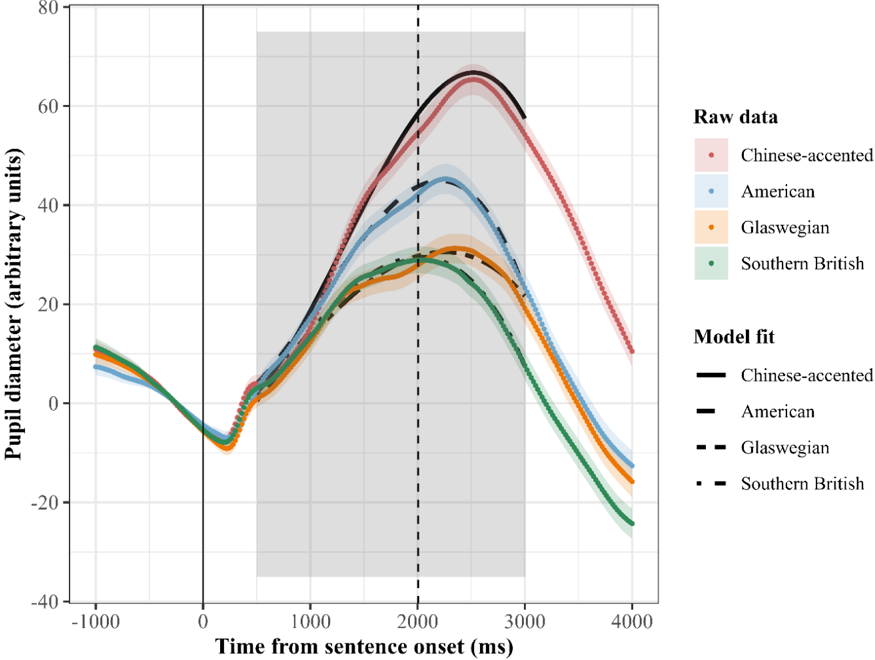
Previous work has shown that L2-accented speech incurs a processing cost even when accurately understood. It remains unknown, however, whether an online processing cost is found when listeners process speech produced in L1 accents that are not their own. In this study, we examine this question by using comparative pupil dilation as a measure of cognitive load. Participants from the South of England heard sentences produced in four different accents: Southern British English (the listeners’ own familiar accent), American English (a standard L1 accent widely used in media), Glaswegian English (a less-familiar regional L1 accent), and Mandarin Chinese-accented English (an L2 English accent). Results show that Chinese-accented speech elicited significantly larger pupil dilation responses compared with Southern British English. Speech from less-familiar L1 accents elicited pupil dilation responses of different shapes and trajectories, suggesting differences in processing of these accents. Furthermore, participants showed larger mean pupil dilation when they heard relatively less-familiar L1 American-accented speech than when hearing Glaswegian English. Interestingly, this effect was found despite participants self-reporting that they were less familiar with the Glaswegian accent and found it more effortful to comprehend compared with American English. These results suggest that accurately perceived and highly intelligible L1 accents such as American English also incur a cognitive cost in processing, but to a smaller extent compared with L2-accented speech. We discuss the implications of our findings for the relationship between exposure, subjective effortfulness measures, and pupil dilation responses.
Overview
CoChat Summary
TL;DR
Using pupillometry with Southern British English listeners, this study finds that accurately understood speech in less-familiar L1 accents (American, Glaswegian) as well as L2 Mandarin-accented English incurs greater online processing cost than the listeners' own accent, but the two non-local L1 accents elicited differently shaped pupil responses. Subjective effortfulness ratings and self-reported exposure did not align with the objective pupil measures.
Key findings
- Chinese-accented English elicited the largest overall pupil dilation and steepest increase relative to Southern British English (β = −22.97, SE = 5.15, p < 0.001 for magnitude; β = −188.02, SE = 23.097, p < 0.001 for the linear term), replicating McLaughlin & Van Engen (2020) in a UK listener population.
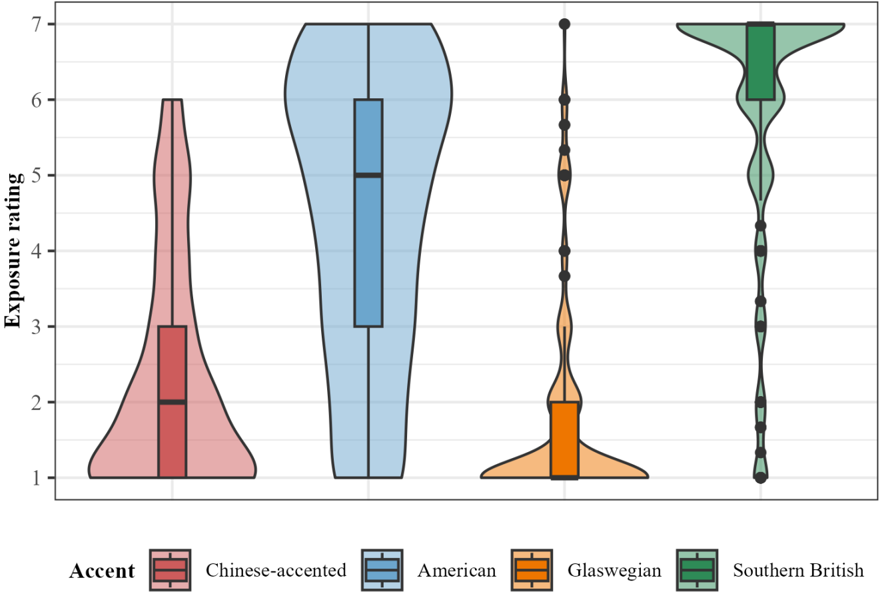
- American English showed a steeper dilation slope than Southern British English (β = −62.24, SE = 23.96, p = 0.046) and a significantly higher mean pupil dilation in the static measure (p = 0.036), despite participants reporting high exposure to it (mean exposure 4.54 vs 5.94 for Southern British English).
- Glaswegian English elicited a significantly flatter curve than American English (β = 34.29, SE = 12.83, p = 0.038), suggesting a more prolonged peak, and an earlier peak than both Chinese-accented (β = 25.57, SE = 7.66, p = 0.004) and American English (β = 21.46, SE = 7.62, p = 0.025); no significant differences emerged between Glaswegian and Southern British English on any static measure.
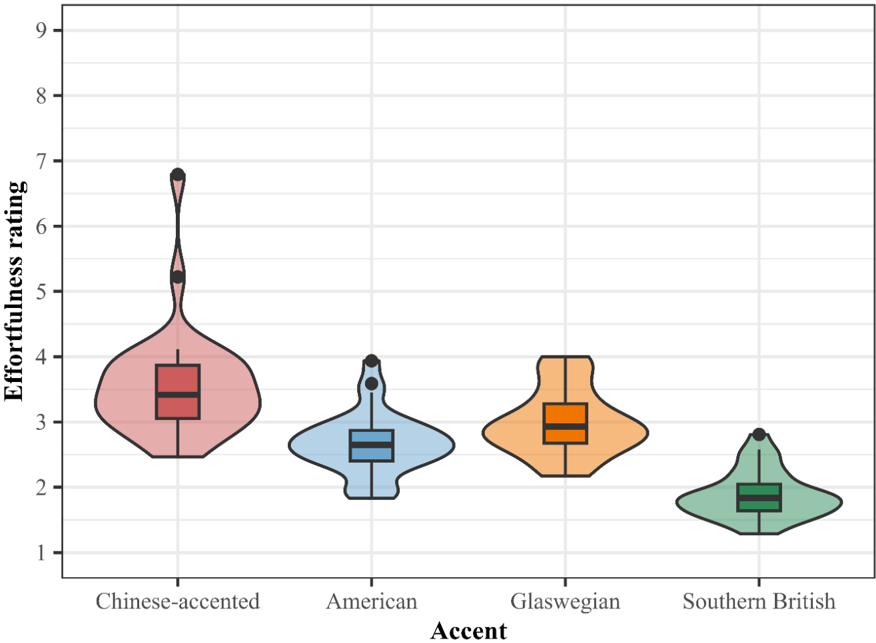
- Subjective effortfulness ratings ranked Chinese-accented highest and Southern British English lowest, but American and Glaswegian did not differ significantly (β = −0.303, SE = 0.145, p = 0.1636), and self-reported exposure did not improve model fit for any static pupil measure (e.g., mean dilation: χ² = 0.0221, df = 1, p = 0.8818).
Methods
- 60 adult native speakers of Southern British English (48 F; 10 M; 1 Other; 1 preferred not to say), born and raised in the South of England, aged 18–30 (mean 19.9, SD = 2.6), screened audiometrically at ≤25 dB; 17 additional participants were excluded (hearing test failure n = 10, birthplace n = 3, parental origin n = 2) plus 2 for equipment malfunction.
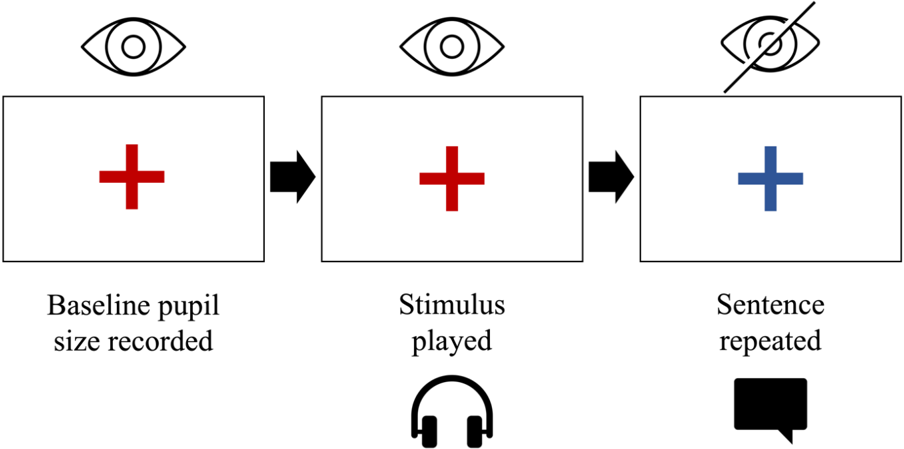
- Pupil size recorded with an Eyelink 1000 Plus while participants heard 120 six-word sentences (30 per accent) in four accents — Southern British, American, Glaswegian, and Mandarin Chinese-accented English — and repeated them aloud; native-accent sentences were acoustically lengthened to match the Chinese-accented speaker's average duration (no significant length differences across accents, F(3, 116) = 0.434, p = 0.729).
- Analyses: only accurately repeated trials were analysed (236 trials, 3.28%, excluded for keyword errors; 368 trials, 5.1%, excluded for >50% missing pupil data); growth curve analysis with orthogonal polynomial terms (linear, quadratic, cubic) in lme4, plus exploratory linear mixed-effects models on static measures (mean dilation, peak dilation, peak latency) with accent and log-transformed exposure as predictors.
Limitations
- The authors state the study was not set up to test the Perceptual Distance versus Different Processes hypotheses, as they had no measure of perceptual or acoustic distance between accents, and so cannot draw firm conclusions about their relative validity.
- The authors note that normalizing speech rate across accents means the impact of cross-dialectal speech rate differences on processing cannot be determined here, and that their data do not allow conclusive explanation of why American and Glaswegian English evoked different pupil response patterns (they offer speculation about affective valence, surprisal, and stereotypes).
- The authors state that future work should replicate the L2 finding with a wider range of speakers of Mandarin Chinese or other L1s, since only one speaker per accent was used; they also note sentences were not counterbalanced across speakers, and that accents were treated as ideologically neutral although sociolinguistic work shows accents carry ideological and affective information.
Model-written summary. Check it against the paper before relying on it.
Integrity signals
Registry
Cites
Statistics
Figures
Verification
Claims the paper makes
0 Valid · 0 Not valid · 46 Not checked · 104 Own results and interpretations
A result the paper reports from its own data — it cites no other source for it, so there is none to check. The quote shows it is in the paper.
In the paper
“there were no significant differences found in the average sentence length across accent types after lengthening, as assessed by an ANOVA (F(3, 116) = 0.434, p = 0.729).”
§ Full title: Listening effort across non-native and regional accents: a pupillometry study > 2.2 Stimuli
plain- Asserted: passes — The authors put it forward as true.
- Checkable: passes — It can be checked against evidence.
- Load-bearing: passes — The paper’s conclusions depend on it.
- Based: passes — The paper gives a reason why it holds.
- Rests on an assumption not shown here.
A result the paper reports from its own data — it cites no other source for it, so there is none to check. The quote shows it is in the paper.
In the paper
“A post-hoc pairwise comparison with Tukey adjustment conducted between accents using emmeans (Lenth, 2023) revealed significant differences in reported exposure ratings between all four accents (Table 1).”
§ Full title: Listening effort across non-native and regional accents: a pupillometry study > 3.1 Accent exposure ratings
plain- Asserted: passes — The authors put it forward as true.
- Checkable: passes — It can be checked against evidence.
- Load-bearing: unclear — It is unclear whether the paper’s conclusions depend on it.
- Based: passes — The paper gives a reason why it holds.
- Rests on an assumption not shown here.
A result the paper reports from its own data — it cites no other source for it, so there is none to check. The quote shows it is in the paper.
In the paper
“Results show that Chinese-accented speech elicited significantly larger pupil dilation responses compared to Southern British English.”
§ Full title: Listening effort across non-native and regional accents: a pupillometry study > Abstract
plainstates a cause- Asserted: passes — The authors put it forward as true.
- Checkable: passes — It can be checked against evidence.
- Load-bearing: passes — The paper’s conclusions depend on it.
- Based: passes — The paper gives a reason why it holds.
- Rests on an assumption not shown here.
A result the paper reports from its own data — it cites no other source for it, so there is none to check. The quote shows it is in the paper.
In the paper
“Results from this model revealed exposure ratings for Southern British English to be significantly higher than those for the other three accents.”
§ Full title: Listening effort across non-native and regional accents: a pupillometry study > 3.1 Accent exposure ratings
plain- Asserted: passes — The authors put it forward as true.
- Checkable: passes — It can be checked against evidence.
- Load-bearing: unclear — It is unclear whether the paper’s conclusions depend on it.
- Based: passes — The paper gives a reason why it holds.
- Rests on an assumption not shown here.
A result the paper reports from its own data — it cites no other source for it, so there is none to check. The quote shows it is in the paper.
In the paper
“Speech from less-familiar L1 accents elicited pupil dilation responses of different shapes and trajectories, suggesting differences in processing of these accents.”
§ Full title: Listening effort across non-native and regional accents: a pupillometry study > Abstract
hedgedstates a cause- Asserted: passes — The authors put it forward as true.
- Checkable: passes — It can be checked against evidence.
- Load-bearing: passes — The paper’s conclusions depend on it.
- Based: passes — The paper gives a reason why it holds.
- Rests on an assumption not shown here.
93 more claims
Create a free account to see all 150 claims and to verify the 66 references still open.
- Probably not a substantial claim. 36
- It may state two separate claims as one. 25
- The quote only partly states this claim. 1
Statistics recomputed
Every reported test result, recomputed from its test statistic and degrees of freedom. A result shows as not adding up only once an independent check has confirmed it.
- ConsistentF(3, 116) = 0.434reported p = .729 · recomputed p = .729
“F(3, 116) = 0.434, p = .729”
Self-check
Percentages, sums and reported differences re-computed from the paper’s own numbers.
Each contradiction between two passages listed here was confirmed by an independent check.
Rated major: it would touch a result — a value a result rests on, reported and recomputed p-values on opposite sides of the significance level, two passages that conflict with no sign which is right, or a cited work retracted before this paper was published.
In the paper
“| Southern British -American | 0.644 | 0.145 | 117 | <0.001 |”
§ Full title: Listening effort across non-native and regional accents: a pupillometry study > 5. Conclusions
Reported 0.644 · recomputed -0.644
Rated major: it would touch a result — a value a result rests on, reported and recomputed p-values on opposite sides of the significance level, two passages that conflict with no sign which is right, or a cited work retracted before this paper was published.
In the paper
§ Full title: Listening effort across non-native and regional accents: a pupillometry study > 3.3 GCA results
“Lastly, differences in peak latency (ot3) were observed, with Glaswegian English eliciting an earlier peak dilation than Chinese-accented (β = 25.57,SE = 7.66, p = 0.004) and American English (β = 21.46,SE = 7.62, p = 0.025).”
§ Full title: Listening effort across non-native and regional accents: a pupillometry study > 4. Discussion
“Specifically, Glaswegian English elicited a significantly flatter trajectory and later peak compared to American English, despite the two accents receiving comparable ratings on the subjective effortfulness measures.”
Rated minor: it would not touch a result — a value no result rests on, a p-value that stays on the same side of the significance level, or a conflict that is clerical, resolved elsewhere in the paper, or outside its own findings.
In the paper
§ Full title: Listening effort across non-native and regional accents: a pupillometry study > 3.4 Testing effects of accent exposure on static dilation measures
“The EXPOSURE variable was the average of the exposure ratings across the four different domains for each accent, for each participant calculated in Section 3.1 (Figure 2).”
§ Full title: Listening effort across non-native and regional accents: a pupillometry study > 3.1 Accent exposure ratings
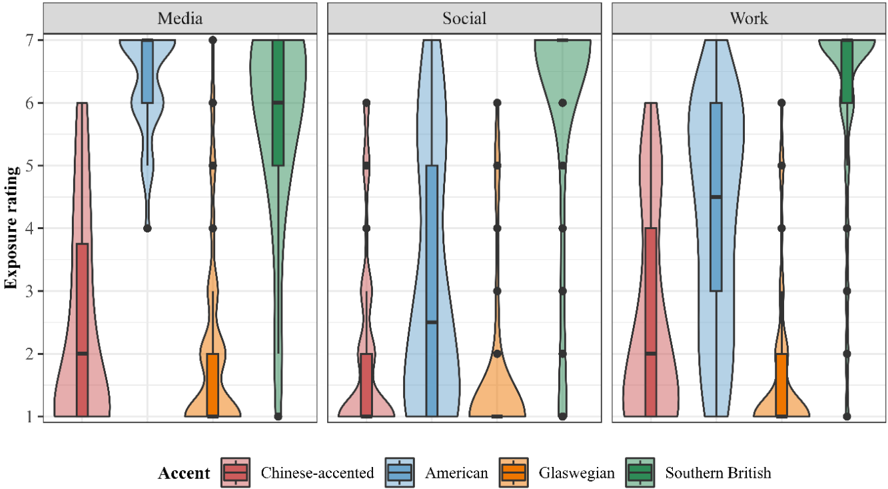
“Figure 2 shows participants' reported accent exposure ratings averaged across exposure in work settings, social settings, and in the media (see Appendix A for the full questionnaire).”
Rated minor: it would not touch a result — a value no result rests on, a p-value that stays on the same side of the significance level, or a conflict that is clerical, resolved elsewhere in the paper, or outside its own findings.
In the paper
§ Full title: Listening effort across non-native and regional accents: a pupillometry study > 3.2 Effortfulness ratings
“Model results showing Southern British English to be rated as significantly more effortful than the other three accents prompted us to run a post-hoc pairwise comparison with Tukey adjustment to determine whether similar results were found between other accents.”
§ Full title: Listening effort across non-native and regional accents: a pupillometry study > 3.2 Effortfulness ratings
“In sum, the results in this section show effortfulness ratings to be highest for the L2 Chinese-accented English, lowest for the local, L1 Southern British English, and roughly similar for the non-local L1 American and Glaswegian English accents.”
Rated minor: it would not touch a result — a value no result rests on, a p-value that stays on the same side of the significance level, or a conflict that is clerical, resolved elsewhere in the paper, or outside its own findings.
In the paper
“GE -AmE 5.41 36.1 116 0.9988 0.9988”
§ Full title: Listening effort across non-native and regional accents: a pupillometry study > 5. Conclusions
Reported 0.9988 · recomputed 0.149861
Citations
Cites
R: A Language and Environment for Statistical Computing
R Core Team (2025) · doi:10.32614/r.manuals · Cited by 352,181
Fitting Linear Mixed-Effects Models Using lme4
Bates, D., Mächler, M., Bolker, B., & Walker, S. (2015) · Journal of Statistical Software · doi:10.18637/jss.v067.i01 · Cited by 86,835
Praat : doing phonetics by computer [Computer program]
Boersma, P. (2011) · Medical Entomology and Zoology · Cited by 4,110
The pupil as a measure of emotional arousal and autonomic activation
Bradley, M. M., Miccoli, L., Escrig, M. A., & Lang, P. J. (2008) · Psychophysiology · doi:10.1111/j.1469-8986.2008.00654.x · Cited by 1,919
Pupil Diameter and Load on Memory
Kahneman, D., & Beatty, J. (1966) · Science · doi:10.1126/science.154.3756.1583 · Cited by 1,617
Foreign Accent, Comprehensibility, and Intelligibility in the Speech of Second Language Learners
Munro, M. J., & Derwing, T. M. (1995) · Language Learning · doi:10.1111/j.1467-1770.1995.tb00963.x · Cited by 1,545
Hearing Impairment and Cognitive Energy: The Framework for Understanding Effortful Listening (FUEL)
Pichora-Fuller, M. K., Kramer, S. E., Eckert, M. A., Edwards, B., Hornsby, B. W. Y., Humes, L. E., Lemke, U., Lunner, T., Matthen, M., Mackersie, C. L., et al. (2016) · Ear & Hearing · doi:10.1097/aud.0000000000000312 · Cited by 1,318
Pupil Size in Relation to Mental Activity during Simple Problem-Solving
Hess, E. H., & Polt, J. M. (1964) · Science · doi:10.1126/science.143.3611.1190 · Cited by 1,169
Pupillometry: Psychology, Physiology, and Function
Mathôt, S. (2018) · Journal of Cognition · doi:10.5334/joc.18 · Cited by 900
Rubin, D. L. (1992) · Research in Higher Education · doi:10.1007/bf00973770 · Cited by 731
Peelle, J. E. (2018) · Ear & Hearing · doi:10.1097/aud.0000000000000494 · Cited by 672
Rapid adaptation to foreign-accented English
Clarke, C. M., & Garrett, M. F. (2004) · The Journal of the Acoustical Society of America · doi:10.1121/1.1815131 · Cited by 625
Cognition counts: A working memory system for ease of language understanding (ELU)
Rönnberg, J., Rudner, M., Foo, C., & Lunner, T. (2008) · International Journal of Audiology · doi:10.1080/14992020802301167 · Cited by 489
Pupil Response as an Indication of Effortful Listening: The Influence of Sentence Intelligibility
Zekveld, A. A., Kramer, S. E., & Festen, J. M. (2010) · Ear & Hearing · doi:10.1097/aud.0b013e3181d4f251 · Cited by 437
Zekveld, A. A., Kramer, S. E., & Festen, J. M. (2011) · Ear & Hearing · doi:10.1097/aud.0b013e31820512bb · Cited by 432
Pupillometry as a measure of cognitive effort in younger and older adults
Piquado, T., Isaacowitz, D., & Wingfield, A. (2010) · Psychophysiology · doi:10.1111/j.1469-8986.2009.00947.x · Cited by 390
The effect of experience on the perception and representation of dialect variants
Sumner, M., & Samuel, A. G. (2009) · Journal of Memory and Language · doi:10.1016/j.jml.2009.01.001 · Cited by 359
Comprehension of familiar and unfamiliar native accents under adverse listening conditions.
Adank, P., Evans, B. G., Stuart-Smith, J., & Scott, S. K. (2009) · Journal of Experimental Psychology: Human Perception and Performance · doi:10.1037/a0013552 · Cited by 355
Winn, M. B., Wendt, D., Koelewijn, T., & Kuchinsky, S. E. (2018) · Trends in Hearing · doi:10.1177/2331216518800869 · Cited by 339
The Pupil Dilation Response to Auditory Stimuli: Current State of Knowledge
Zekveld, A. A., Koelewijn, T., & Kramer, S. E. (2018) · Trends in Hearing · doi:10.1177/2331216518777174 · Cited by 306
The Impact of Auditory Spectral Resolution on Listening Effort Revealed by Pupil Dilation
Winn, M. B., Edwards, J. R., & Litovsky, R. Y. (2015) · Ear & Hearing · doi:10.1097/aud.0000000000000145 · Cited by 278
Does a regional accent perturb speech processing?
Floccia, C., Goslin, J., Girard, F., & Konopczynski, G. (2006) · Journal of Experimental Psychology: Human Perception and Performance · doi:10.1037/0096-1523.32.5.1276 · Cited by 277
Articulation rate across dialect, age, and gender
Jacewicz, E., Fox, R. A., O'Neill, C., & Salmons, J. (2009) · Language Variation and Change · doi:10.1017/s0954394509990093 · Cited by 270
Rönnberg, J. (2003) · International Journal of Audiology · doi:10.3109/14992020309074626 · Cited by 268
Pupil Dilation Uncovers Extra Listening Effort in the Presence of a Single-Talker Masker
Koelewijn, T., Zekveld, A. A., Festen, J. M., & Kramer, S. E. (2012) · Ear & Hearing · doi:10.1097/aud.0b013e3182310019 · Cited by 227
Television Can Also be a Factor in Language Change: Evidence from an Urban Dialect
Stuart-Smith, J., Pryce, G., Timmins, C., & Gunter, B. (2013) · Language · doi:10.1353/lan.2013.0041 · Cited by 208
Kuchinsky, S. E., Ahlstrom, J. B., Vaden, K. I., Cute, S. L., Humes, L. E., Dubno, J. R., & Eckert, M. A. (2013) · Psychophysiology · doi:10.1111/j.1469-8986.2012.01477.x · Cited by 203
Listening effort and accented speech
Van Engen, K. J., & Peelle, J. E. (2014) · Frontiers in Human Neuroscience · doi:10.3389/fnhum.2014.00577 · Cited by 187
Ohlenforst, B., Zekveld, A. A., Lunner, T., Wendt, D., Naylor, G., Wang, Y., Versfeld, N. J., & Kramer, S. E. (2017) · Hearing Research · doi:10.1016/j.heares.2017.05.012 · Cited by 185
Regional and Foreign Accent Processing in English: Can Listeners Adapt?
Floccia, C., Butler, J., Goslin, J., & Ellis, L. (2009) · Journal of Psycholinguistic Research · doi:10.1007/s10936-008-9097-8 · Cited by 182
Social Expectation Improves Speech Perception in Noise
McGowan, K. B. (2015) · Language and Speech · doi:10.1177/0023830914565191 · Cited by 180
Resource allocation and fluid intelligence: Insights from pupillometry
van der Meer, E., Beyer, R., Horn, J., Foth, M., Bornemann, B., Ries, J., Kramer, J., Warmuth, E., Heekeren, H. R., & Wartenburger, I. (2010) · Psychophysiology · doi:10.1111/j.1469-8986.2009.00884.x · Cited by 173
Expectations and speech intelligibility
Babel, M., & Russell, J. (2015) · The Journal of the Acoustical Society of America · doi:10.1121/1.4919317 · Cited by 169
Categorization of regional and foreign accent in 5- to 7-year-old British children
Floccia, C., Butler, J., Girard, F., & Goslin, J. (2009) · International Journal of Behavioral Development · doi:10.1177/0165025409103871 · Cited by 151
Borghini, G., & Hazan, V. (2018) · Frontiers in Neuroscience · doi:10.3389/fnins.2018.00152 · Cited by 127
An ERP investigation of regional and foreign accent processing
Goslin, J., Duffy, H., & Floccia, C. (2012) · Brain and Language · doi:10.1016/j.bandl.2012.04.017 · Cited by 109
Processing changes when listening to foreign-accented speech
Romero-Rivas, C., Martin, C. D., & Costa, A. (2015) · Frontiers in Human Neuroscience · doi:10.3389/fnhum.2015.00167 · Cited by 105
Effects of Speech Clarity on Recognition Memory for Spoken Sentences
Engen, K. J. V., Chandrasekaran, B., & Smiljanić, R. (2012) · PLoS ONE · doi:10.1371/journal.pone.0043753 · Cited by 104
Wendt, D., Dau, T., & Hjortkjær, J. (2016) · Frontiers in Psychology · doi:10.3389/fpsyg.2016.00345 · Cited by 99
Perception of Dialect Variation in Noise: Intelligibility and Classification
Clopper, C. G., & Bradlow, A. R. (2008) · Language and Speech · doi:10.1177/0023830908098539 · Cited by 86
Pupillometry reveals changes in physiological arousal during a sustained listening task.
McGarrigle, R., Dawes, P., Stewart, A. J., Kuchinsky, S. E., & Munro, K. J. (2017) · Psychophysiology · doi:10.1111/psyp.12772 · Cited by 84
Perception and awareness of accents in young children
Girard, F., Floccia, C., & Goslin, J. (2008) · British Journal of Developmental Psychology · doi:10.1348/026151007x251712 · Cited by 70
Individual Variations in Effort: Assessing Pupillometry for the Hearing Impaired
Wagner, A. E., Nagels, L., Toffanin, P., Opie, J. M., & Başkent, D. (2019) · Trends in Hearing · doi:10.1177/2331216519845596 · Cited by 63
Task-evoked pupil response for accurately recognized accented speech
McLaughlin, D. J., & Van Engen, K. J. (2020) · The Journal of the Acoustical Society of America · doi:10.1121/10.0000718 · Cited by 59
The neural processing of foreign-accented speech and its relationship to listener bias
Yi, H., Smiljanić, R., & Chandrasekaran, B. (2014) · Frontiers in Human Neuroscience · doi:10.3389/fnhum.2014.00768 · Cited by 57
Pupillary responses to affective words in bilinguals’ first versus second language
Toivo, W., & Scheepers, C. (2019) · PLOS ONE · doi:10.1371/journal.pone.0210450 · Cited by 56
Rapid adaptation to fully intelligible nonnative-accented speech reduces listening effort
Brown, V. A., McLaughlin, D. J., Strand, J. F., & Van Engen, K. J. (2020) · Quarterly Journal of Experimental Psychology · doi:10.1177/1747021820916726 · Cited by 55
Pupillary Changes during a Decision-Making Task
Simpson, H. M., & Hale, S. M. (1969) · Perceptual and Motor Skills · doi:10.2466/pms.1969.29.2.495 · Cited by 52
Mutual Intelligibility of Standard and Regional Dutch Language Varieties
Impe, L., Geeraerts, D., & Speelman, D. (2008) · International Journal of Humanities and Arts Computing · doi:10.3366/e1753854809000330 · Cited by 52
Eyes and ears: Using eye tracking and pupillometry to understand challenges to speech recognition
Van Engen, K. J., & McLaughlin, D. J. (2018) · Hearing Research · doi:10.1016/j.heares.2018.04.013 · Cited by 52
ACCDIST: a metric for comparing speakers' accents
Huckvale, M. A. (2004) · Interspeech (USB) · doi:10.21437/interspeech.2004-29 · Cited by 51
Task-Related Vigilance During Word Recognition in Noise for Older Adults with Hearing Loss
Kuchinsky, S. E., Vaden, K. I., Ahlstrom, J. B., Cute, S. L., Humes, L. E., Dubno, J. R., & Eckert, M. A. (2015) · Experimental Aging Research · doi:10.1080/0361073x.2016.1108712 · Cited by 51
British attitudes towards six varieties of English in the USA and Britain
Hiraga, Y. (2005) · World Englishes · doi:10.1111/j.0883-2919.2005.00411.x · Cited by 47
Kutlu, E., Tiv, M., Wulff, S., & Titone, D. A. (2021) · Applied Linguistics · doi:10.1093/applin/amab072 · Cited by 47
Perception of non‐native speech
Baese‐Berk, M. M., McLaughlin, D. J., & McGowan, K. B. (2020) · Language and Linguistics Compass · doi:10.1111/lnc3.12375 · Cited by 44
Perception of Dialect Variation
Clopper, C. G., & Pisoni, D. B. (2008) · Blackwell Publishing Ltd eBooks · doi:10.1002/9780470757024.ch13 · Cited by 41
Baese-Berk, M. M., Levi, S. V., & Van Engen, K. J. (2023) · The Journal of the Acoustical Society of America · doi:10.1121/10.0016806 · Cited by 39
Shechter, A., & Share, D. L. (2020) · Psychological Science · doi:10.1177/0956797620958638 · Cited by 36
Smith, R. H., Holmes-Elliott, S., Pettinato, M., & Knight, R. (2014) · Quarterly Journal of Experimental Psychology · doi:10.1080/17470218.2013.822009 · Cited by 32
Got experience? PMN amplitudes to foreign-accented speech modulated by listener experience
Porretta, V., Tremblay, A., & Bolger, P. (2017) · Journal of Neurolinguistics · doi:10.1016/j.jneuroling.2017.03.002 · Cited by 32
Eyes Wide Open: Pupillary Response to a Foreign Accent Varying in Intelligibility
Porretta, V., & Tucker, B. V. (2019) · Frontiers in Communication · doi:10.3389/fcomm.2019.00008 · Cited by 30
Investigating the Reliability of Pupillometry as a Measure of Individualized Listening Effort
Neagu, M.-B., Kressner, A. A., Relaño-Iborra, H., Bækgaard, P., Dau, T., & Wendt, D. (2023) · Trends in Hearing · doi:10.1177/23312165231153288 · Cited by 28
Controlled and automatic perceptions of a sociolinguistic marker
D'Onofrio, A. (2018) · Language Variation and Change · doi:10.1017/s095439451800008x · Cited by 23
Stringer, L., & Iverson, P. (2019) · Journal of Speech Language and Hearing Research · doi:10.1044/2019_jslhr-s-17-0414 · Cited by 23
Resilience of English vowel perception across regional accent variation
Shaw, J. A., Best, C. T., Docherty, G., Evans, B. G., Foulkes, P., Hay, J., & Mulak, K. (2018) · Laboratory Phonology: Journal of the Association for Laboratory Phonology · doi:10.5334/labphon.87 · Cited by 21
Colby, S., & McMurray, B. (2021) · Journal of Speech, Language, and Hearing Research · doi:10.1044/2021_jslhr-20-00583 · Cited by 18
The effect of long-term second dialect exposure on sentence transcription in noise
Walker, A. (2018) · Journal of Phonetics · doi:10.1016/j.wocn.2018.08.001 · Cited by 15
Salience is in the eye of the beholder: Increased pupil size reflects acoustically salient variables
Boswijk, V., Loerts, H., & Hilton, N. H. (2020) · Ampersand · doi:10.1016/j.amper.2020.100061 · Cited by 14
The Influence of Visual Uncertainty on Word Surprisal and Processing Effort
Ankener, C. S., Sekicki, M., & Staudte, M. (2018) · Frontiers in Psychology · doi:10.3389/fpsyg.2018.02387 · Cited by 13
Zekveld, A. A., van Scheepen, J. A. M., Versfeld, N. J., Kramer, S. E., & van Steenbergen, H. (2020) · Journal of Speech Language and Hearing Research · doi:10.1044/2020_jslhr-20-00107 · Cited by 13
Phonetic Detail and the Role of Exposure in Dialect Imitation
D’Imperio, M., & German, J. S. (2015) · HAL · Cited by 12
Perception of Dialect Variation
Clopper, C. G. (2021) · The Handbook of Speech Perception · doi:10.1002/9781119184096.ch13 · Cited by 11
Yao, Y., Connell, K., & Politzer-Ahles, S. (2023) · Bilingualism: Language and Cognition · doi:10.1017/s1366728922000931 · Cited by 11
Shaw, J. A., Foulkes, P., Hay, J. B., Evans, B. G., Docherty, G., Mulak, K. E., & Best, C. T. (2023) · Laboratory Phonology Journal of the Association for Laboratory Phonology · doi:10.16995/labphon.6436 · Cited by 9
Media and Second Dialect Acquisition
Nycz, J. (2019) · Annual Review of Applied Linguistics · doi:10.1017/s0267190519000060 · Cited by 6
Relating pronunciation distance metrics to intelligibility across English accents
Bent, T., Henry, M., Holt, R. F., & Lind-Combs, H. (2024) · Journal of Phonetics · doi:10.1016/j.wocn.2024.101357 · Cited by 6
Best, C. T., Shaw, J. A., & Clancy, E. (2013) · Interspeech 2013 · doi:10.21437/interspeech.2013-504 · Cited by 5
An ERP investigation of accented isolated single word processing
Thomas, T., Martin, C. D., & Caffarra, S. (2022) · Neuropsychologia · doi:10.1016/j.neuropsychologia.2022.108349 · Cited by 4
The impact of speaker accent on discourse processing: A frequency investigation
Thomas, T., Martin, C. D., & Caffarra, S. (2024) · Brain and Language · doi:10.1016/j.bandl.2024.105509 · Cited by 3
Kunkel, S. (2025) · Linguistics Vanguard · doi:10.1515/lingvan-2024-0247 · Cited by 2
Self-citation(2012) · doi:10.1044/1092-4388(2012/11-0260
(2000)
(2020) · Scholarly Commons (University of Pennsylvania)
(2023) · UCL Discovery (University College London)
Research works printed but not linked: 1
- Mirman, D. (2014). Growth curve analysis and visualization using R. Chapman and Hall/CRC.
Cited by
Mekheimer, M. A. A. G. (2026) · BMC Psychology · doi:10.1186/s40359-026-04684-2 · Cited by 3
Inayat, S., Ali, K., & Akhtar, T. (2026) · Social science review archives. · doi:10.70670/sra.v4i1.2129 · Cited by 2
Metadata
- Authors
- Barnard, M., Kunkel, S., Lamarque, R., & Chong, A. J.
- Affiliations
- Queen Mary University of London (GB)
- Corresponding author
- Chong, Adam J.
- Venue
- Language and Speech
- Publisher
- SAGE Publications
- Published
- 2025-12-17
- Pages
- 238309251389573-238309251389573
- ISSN
- 0023-8309 (ISSN-L)
- 1756-6053
- OpenAlex
- W4417425987
- Cited by
- 2
- References
- 84
- Citations by year
- 2026: 2
- FWCI
- 1.03
- Type
- journal article
- Language
- en
- Open access
- hybrid
- doi.org
- Licence
- cc-by
- creativecommons.org/licenses/by/4.0/ (vor)
- journals.sagepub.com/page/policies/text-and-data-mining-license (tdm)
- Locations
- Language and Speech (publishedVersion, cc-by)
- OSF Preprints (OSF Preprints) (submittedVersion, cc-by)
- PubMed (publishedVersion)
- Oxford University Research Archive (ORA) (University of Oxford) (acceptedVersion)
- Funders
- Queen Mary University of London (Research Startup Funds)
- Topics
- Social Sciences › Psychology › Experimental and Cognitive Psychology › Phonetics and Phonology Research
- Social Sciences › Linguistics and Language › Linguistic Variation and Morphology
- Life Sciences › Neuroscience › Cognitive Neuroscience › Neurobiology of Language and Bilingualism
- Keywords
- listening effort, regional accents, pupil dilation, cognitive load, American English, Southern British English, speech perception, listener familiarity, subjective effort
About these checks
Registry, retraction, Cites and statistics results are computed, not judged, with one exception: a printed reference that no index lists is read once by a model before it counts as a citation error. Claims are extracted by a model and kept only when their quote appears verbatim in the text; each cited source is then checked, with a model’s help, for whether it says what the claim relies on. Those verdicts can be wrong — read the claim’s quote and the cited source before relying on one.
A language model drew the claims from the paper on 2026-11-19, under version 3 of the claim definition (model deepseek-v4.1-flash, prompt extract-v3).
A second model labelled each claim on 2026-11-19 (model jev-1.13-20260917, definition revision gold-guideline-v0.2).
Statistics and arithmetic are recomputed, not judged.
Confidence bands are shown only for fields calibrated on our annotated test set. None is calibrated yet, so no band is shown.
What counts as a claim ›How we measure confidence ›How we check this ›
Are you an author, or do you see a problem with this page? Request a review
Data sources
Bibliographic data: Semantic Scholar, OpenAlex, Crossref.
Contains information from the Semantic Scholar Academic Graph Datasets, made available under the ODC Attribution License (ODC-BY 1.0).
Semantic Scholar’s data is described in: Kinney, R., et al. (2023). The Semantic Scholar Open Data Platform. arXiv:2301.10140.
