

The DOI matches its Crossref record, with a small difference in title or year; 1 of the 1 references it cites were found in a registry or an index.
How do Funeral Practices Impact Bereaved Relatives' Mental Health, Grief and Bereavement? A Mixed Methods Review with Implications for COVID-19
Open accessAbstract
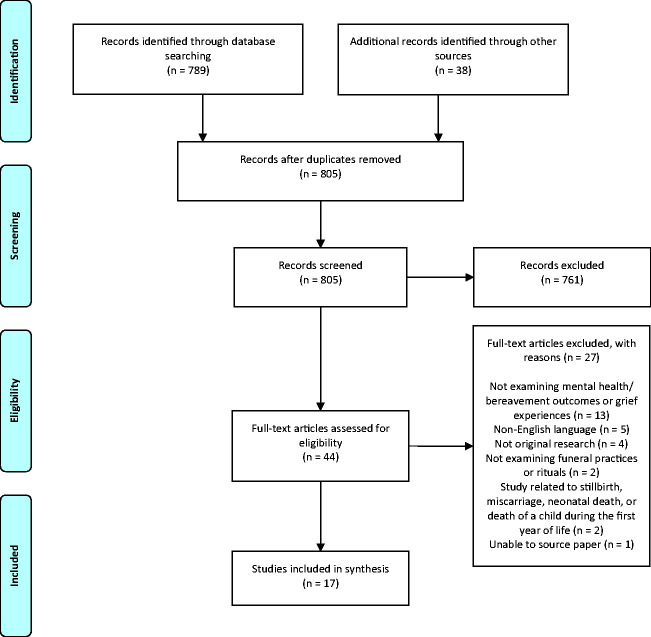
Those who are bereaved during the current COVID-19 pandemic are subject to restrictions on funeral sizes and practices. We conducted a rapid review synthesising the quantitative and qualitative evidence regarding the effect of funeral practices on bereaved relatives’ mental health and bereavement outcomes. Searches of MEDLINE, PsycINFO, KSR Evidence, and COVID-related resources were conducted. 805 records were screened; 17 studies of variable quality were included. Current evidence regarding the effect of funeral practices on bereaved relatives’ mental health and bereavement outcomes is inconclusive. Five observational studies found benefits from funeral participation while six did not. However, qualitative research provides additional insight: the benefit of after-death rituals including funerals depends on the ability of the bereaved to shape those rituals and say goodbye in a way which is meaningful for them. Findings highlight the important role of funeral officiants during the pandemic. Research is needed to better understand the experiences and sequalae of grief and bereavement during COVID-19.
Overview
The claims and statistics of this paper haven’t been checked yet.
Run the check — free, no account needed. It reads the open-access text and checks the sources it cites.
Integrity signals
Registry
Cites
Statistics
Figures
Verification
Claims the paper makes
The claims and statistics of this paper haven’t been checked yet.
Run the check — free, no account needed. It reads the open-access text and checks the sources it cites.
Self-check
Percentages, sums and reported differences re-computed from the paper’s own numbers.
The self-check needs the paper’s full text.
Citations
Cites
Bereavement Support on the Frontline of COVID-19: Recommendations for Hospital Clinicians
Selman, L. E., Chao, D., Sowden, R., Marshall, S., Chamberlain, C., & Koffman, J. (2020) · Journal of Pain and Symptom Management · doi:10.1016/j.jpainsymman.2020.04.024 · Cited by 261
Self-citation
Research works printed but not linked: 24
- 10.1080/07481187.2017.1407379 · DOI
- 10.1177/0269216318774995 · DOI · Paper page
- 10.1177/0030222820919253 · DOI
- 10.2190/VDHT-MFRC-LY7L-EMN7 · DOI
- 10.1080/07481180500299287 · DOI
- 10.11622/smedj.2020046 · DOI
- 10.2190/HG24-EBR1-503H-C69V · DOI
- 10.2190/MC87-GQMC-VCDV-UL3U · DOI
- 10.2190/QMV2-3NT5-BKD5-6AAV · DOI
- 10.2190/7MG3-KXKH-NMV8-BY90 · DOI
- 10.1177/026921639701100303 · DOI
- 10.1080/07481187.2019.1686090 · DOI
- 10.1111/famp.12336 · DOI
- 10.1080/07481187.2011.553309 · DOI
- 10.1177/105413702236511 · DOI
- Razaq A., Harrison D., Karunanithi S., Barr B., Asaria M., Routen A., Khunti K. (2020) . BAME COVID-19 DEATHS—What do we know? Rapid data and evidence review . https://www.cebm.net/covid-19/bame-covid-19-deaths-what-do-we-know-rapid-data-evidence-review/
- 10.1037/h0079372 · DOI
- Schaal S., 2010, BMC Psychiatry, 10
- 10.1016/S0193-953X(18)30550-1 · DOI
- Schuck D. A., 2020, The Conversation
- 10.1080/07481180903070467 · DOI
- Walter T., Hourizi R., Moncur W., Pitsillides S. (2011). Does the internet change how we die and mourn? Overview and analysis. OMEGA—Journal of Death and Dying, 64(4), 275–302. · DOI
- 10.1097/00004583-198809000-00007 · DOI
- 10.1016/S0033-3182(83)73227-5 · DOI
Cited by
Sorted by citations
Items 101–186 of 186
Aliyaki, H., Momeni, F., Dolatshahi, B., Hosseinzadeh, S., Yousefi, S., & Abdoli, F. (2024) · Palliative & Supportive Care · doi:10.1017/s1478951524000348 · Cited by 10
Khan, T. A., Mohsin, A., Din, S., Qayum, S., & Farooqi, I. (2022) · OMEGA - Journal of Death and Dying · doi:10.1177/00302228221134205 · Cited by 6
“However, the pandemic led to millions of deaths globally, and the SOPs in place (Standard Operating Pro-cedures) restricted visitors from seeing ill persons in hospitals or other care facilities (Burrell & Selman, 2022; Rawlings et al., 2022).”
van Schaik, T., & Wojtkowiak, J. (2022) · Death Studies · doi:10.1080/07481187.2022.2135047 · Cited by 7
Uphoff, E., Zamperoni, V., Yap, J., Simmonds, R., Rodgers, M., Dawson, S., Seymour, C., Kousoulis, A. A., & Churchill, R. C. (2022) · Journal of Mental Health · doi:10.1080/09638237.2022.2069724 · Cited by 5
“Evidence was inconclusive for the effects of the following interventions on mental health symptoms and wellbeing: funeral practices (Burrell & Selman, 2020), psychological support after homicide (Alves-Costa et al., 2019), support services after mass bereavement (Harrop et al., 2020), support after…”
Trauma-Related Distress During the COVID-19 Pandemic In 59 Countries
Ertl, M. M., Trapp, S. K., Alzueta, E., Baker, F. C., Perrin, P. B., Caffarra, S., Yüksel, D., Ramos‐Usuga, D., & Arango‐Lasprilla, J. C. (2022) · The Counseling Psychologist · doi:10.1177/00110000211068112 · Cited by 8
“Bereavement and adjustment to loss of a loved one is likely to be further complicated when after-death rituals do not provide an opportunity to say goodbye in a meaningful way and to engage in activities that promote social support (Burrell & Selman, 2020).”
BackgroundSelman, L., Farnell, D. J. J., Longo, M., Goss, S., Seddon, K., Torrens-Burton, A., Mayland, C., Wakefield, D., Johnston, B., Byrne, A., et al. (2021) · medRxiv · doi:10.1101/2021.09.09.21263341 · Cited by 4
Self-citationMental health innovative solutions in the context of the COVID-19 pandemic
Rocha, A., & Almeida, F. L. (2021) · Journal of Science and Technology Policy Management · doi:10.1108/jstpm-11-2020-0165 · Cited by 8
Supporting the dying and bereaved during COVID-19
Bauld, C. M., Letcher, P., & Olsson, C. A. (2021) · Australian Psychologist · doi:10.1080/00050067.2021.1937924 · Cited by 3
“More research investment in this area is needed (Burrell & Selman, 2020) to help allocate resources needed to support a “good death” in those dying and minimise the potential for disenfranchised or complicated grief for those grieving.”
BackgroundGrief, COVID-19, and the South: Considerations and Recommendations
McDuffie, D. L., Kouchi, K. A. K., Dorman, H. R., Bownes, E., Condon, S., & Crowther, M. (2021) · Omega · doi:10.1177/00302228211029500 · Cited by 4
“A rapid review of the literature by Burrell and Selman (2020) found no conclusive support for improved mental health outcomes relative to the participation in funeral practices.”
BackgroundRitual and Religion: The Role of Cultural Practices in Identity Formation
Munandar, N. C., Lima, L., & Costa, T. (2024) · Journal of Humanities Research Sustainability · doi:10.70177/jhrs.v1i4.1797 · Cited by 3
Grief responses during the COVID-19 pandemic: A qualitative study in Spain
Redondo-Armenteros, A., Pérez-Marfil, M., Fernández-Alcántara, M., García-Caro, M., Cruz-Quintana, F., & Cabañero-Martínez, M. (2024) · Heliyon · doi:10.1016/j.heliyon.2024.e40216 · Cited by 3
“Burrell and Selman ’ s review [40] suggests that active involvement in arranging funerals and adapting them in ways that make sense to the bereaved may be beneficial.”
Kaya, E., Barlas, Z., Barlas, F., Wilson, A. D., & Dönmezler, S. (2024) · Mental Health Religion & Culture · doi:10.1080/13674676.2023.2244905 · Cited by 3
“In a systematic review, several studies were identified that created resources to support with online funerals (see Burrell & Selman, 2020), however it is also acknowledged by the authors that funeral officiants should remain flexible and work with families to tailor online funerals/death rites to…”
Dodd, A., & Guérin, S. (2024) · OMEGA - Journal of Death and Dying · doi:10.1177/00302228241272608 · Cited by 3
“However, in line with other fi ndings (Burrell & Selman, 2022) funeral directors in this study demonstrated great resilience, an ability to adapt to the restrictions and to respond creatively to the needs of the bereaved in dif fi cult circumstances.”
Bolaséll, L. T., Abadi, A. M., Brunnet, A. E., Kristensen, C. H., & Eisma, M. C. (2024) · Death Studies · doi:10.1080/07481187.2024.2381775 · Cited by 3
“Overall, the existing literature provides mixed results regarding the impact of funeral attendance and practices on prolonged grief and related mental health problems (Gamino et al., 2000; Mitima-Verloop et al., 2021; for a review, see Burrell & Selman, 2022).”
Exploring the Values of Education through Post-Death Traditions in Indonesia
Japarudin, J., & Fitria, R. (2023) · Qalamuna. Jurnal pendidikan, sosial, dan agama · doi:10.37680/qalamuna.v15i1.3977 · Cited by 3
“(Burrell & Selman, 2022)(Long & Buehring, 2014).”
Dealing with Death in a Secular Society: The Case of Muslim Burials in Spain
de León, J. L., & Basterretxea, I. (2023) · Religions · doi:10.3390/rel14070825 · Cited by 3
“Nested Liminalities”: Death, Migration and Pandemic among Georgians in Russia
Gurchiani, K., & Darchiashvili, M. (2023) · Revue européenne de migrations internationales · doi:10.4000/remi.21988 · Cited by 4
Critical Approaches to the Psychology of Emotion
Belli, S. (2023) · doi:10.4324/9781003247999 · Cited by 3
“…sense for what happened, possibly through the creation of meaningful rituals to replace the lost ones (Borghi & Menichetti, 2021) such as lighting a candle, holding a ceremony outdoor (e.g. in a private garden) or collecting songs, photos and stories linked to the departed (Burrell & Selman, 2020).”
BackgroundEgrot, M., Akindès, F., & Kra, F. (2022) · Frontières · doi:10.7202/1095216ar · Cited by 3
Developing a scale to measure social dynamics in funeral ceremonies: A mixed methods approach.
Esmailnia, S., Albuquerque, S., & Coelho, A. (2025) · Death Studies · doi:10.1080/07481187.2025.2559726 · Cited by 2
Anwar, Y., Bachri, S., Utaya, S., Sumarmi, & Mislan (2025) · Environmental Challenges · doi:10.1016/j.envc.2025.101253 · Cited by 2
Campling, N. C., Lund, S., Allam, A., Precious, G., & Myall, M. (2024) · F1000Research · doi:10.12688/f1000research.134193.2 · Cited by 2
Mourning the Covid Way: Effects of COVID-19 on Abatura Funeral Rites and Practices
Bakesia, G., & Orinda, S. (2023) · Science Mundi · doi:10.51867/scimundi.3.1.3 · Cited by 2
“In addition, immense stress is a result of parenting kids through remote learning (Burrell & Selman, 2022).”
Kılıç, C., Güre, M. D. P., Karataş, M., & Duyan, V. (2023) · Journal of religion and health · doi:10.1007/s10943-023-01850-3 · Cited by 2
“Burrell and Selman (2022) also stated that funerals are restricted during COVID-19.”
BackgroundSocial work and funeral service: A proposed framework for practice
Tan, W.-J., Tsang, K.-T. A., Su, J., & Zhao, K.-D. (2023) · International Social Work · doi:10.1177/00208728231173267 · Cited by 2
“Moreover, during the COVID-19 pandemic, some jurisdictions have limited the number of people at funerals, and some places have had mass funerals without family members (Burrell and Selman, 2022 ; Yu et al., 2021).”
Background“COVID robbed me of that”: navigating final conversations and grief during the COVID-19 pandemic
Nickels, B. M., Tenzek, K. E., & Coley, R. (2026) · Communication Quarterly · doi:10.1080/01463373.2026.2628807 · Cited by 1
“Additionally, the inability to access communal support structures, which often play a protective role in mitigating post-loss psychological distress, further challenged adaptive coping mechanisms among bereaved individuals (Burrell & Selman, 2022).”
InfluentialKogan, L. R., Currin-McCulloch, J. A., Packman, W. L., & Bussolari, C. J. (2026) · Animals · doi:10.3390/ani16020202 · Cited by 1
“The literature on grief rituals suggests that marking transitions can foster meaning-making and emotional adjustment [63–65].”
Forsythe, D., & Davis, K. (2025) · Journal of Palliative Care · doi:10.1177/08258597251392312 · Cited by 1
Yehene, E., Gershfeld-Litvin, A., & Hamama‐Raz, Y. (2025) · Death Studies · doi:10.1080/07481187.2025.2574888 · Cited by 1
Hidaka, Y., Shimokihara, S., Akasaki, Y., Maruta, M., Han, G., Kamasaki, T., Kumura, Y., Kukizaki, W., Nakahara, R., Makizako, H., et al. (2025) · Clinical Gerontologist · doi:10.1080/07317115.2025.2538105 · Cited by 1
“A recent study showed that the psychological effects of mourning rituals during the COVID-19 pandemic are influenced not only by participation but also by whether the rituals are perceived as meaningful by the bereaved (Burrell & Selman, 2022).”
Núñez, L., Lewins, K., & Cooper, S. (2025) · Medical Humanities · doi:10.1136/medhum-2024-013206 · Cited by 1
Susanti, H., Mudiyanselage, S. P. K., Indrayani, N. L. D., Ariani, T. A., Tsai, H., Keliat, B. A., & Lin, M. (2025) · Family Process · doi:10.1111/famp.70022 · Cited by 2
Komarnytskyi, D., Sylenko, L., & Tуtykalo, R. (2024) · Baltic Journal of Economic Studies · doi:10.30525/2256-0742/2024-10-5-211-221 · Cited by 1
Wie ging es Trauernden in der Corona-Pandemie? Eine qualitative Studie
Blank, D., & Baumann, K. (2024) · Spiritual Care · doi:10.1515/spircare-2024-0037 · Cited by 1
Paul, F. A., Bhat, N., Dar, D. R., Ganie, A. U. R., Zargar, W. A., Ali, A., Saikia, P., Basistha, B., Akhter, R., & Choudhary, G. (2024) · Mental Health Religion & Culture · doi:10.1080/13674676.2024.2369869 · Cited by 1
“During COVID-19 the restriction on the size of gatherings has created difficulties for customary Muslim funerals, affecting the capacity to support and console the bereaved and adhere to customs (Burrell & Selman, 2020).”
Towards an Understanding of Embodiment in Digital Space – A Practical Theological Perspective
Matthee, N. (2024) · Religion and Development · doi:10.30965/27507955-20230034 · Cited by 1
Chilwalo, B. N., Rantho, K. M., Hasheela, M. W., & Matlakala, F. K. (2024) · Environment and Social Psychology · doi:10.54517/esp.v9i3.2188 · Cited by 2
“Thus, we say African communities understand the transformative power of collective mourning, recognizing that by coming together, individuals can find solace, share memories, and collectively honour the life of the deceased [8,14,15] .”
BackgroundInfluentialFighting for Connection: A Socially Distanced Grief Experience
Sheppard, T., Lush, S., & Strickland, J. T. (2023) · Illness Crisis & Loss · doi:10.1177/10541373231216347 · Cited by 1
“The fi ndings of a mixed-methods review by Burrell and Selman (2020) suggested that it is not the number of people who can attend the funeral or the type of ceremony, it is how meaningful the occasion is to the bereaved.”
Perception of Psychology Students on Cremation
Sumicad, R., Apostol, E. L., Gutang, S., Añana, S. M. V., Cañete, J. M. D., Cagay, J. V., & Echavez, R. R. (2023) · British Journal of Philosophy Sociology and History · doi:10.32996/pjpsh.2023.3.2..4 · Cited by 1
“On the other hand, another study states that funerals should be meaningful and helpful for grieving families, letting them feel in control and get social support despite existing constraints (Burrell & Selman, 2020).”
BackgroundDeath rites disrupted: coronavirus, ‘lockdown’ laws and the altered social ritual of the funeral
Conway, H. (2023) · Northern Ireland Legal Quarterly · doi:10.53386/nilq.v74i2.1094 · Cited by 1
Gabay, G., & Tarabeih, M. (2022) · OMEGA - Journal of Death and Dying · doi:10.1177/00302228221137393 · Cited by 1
“Previous studies called to explore the experience of Muslims in death and grief from COVID-19 through qualitative studies (Burrell, & Selman, 2020).”
Birrell, J., Woodthorpe, K., Stroebe, M., Rumble, H., Schut, H. A. W., Corden, A., Anadria, D., Smith, Y., & Newsom, C. (2020) · Bereavement Care · doi:10.1080/02682621.2020.1828774 · Cited by 1
Grief and Bereavement in Hong Kong during the COVID-19 Pandemic
Wu, X. I., Turnbull, M. L., Yung, A. H. W., & Watson, B. M. (2022) · Open Journal of Social Sciences · doi:10.4236/jss.2022.107017 · Cited by 1
Sio, C., Mann, A., Jia, Q.-M., & Lee, L.-H. (2026) · doi:10.48550/arxiv.2610.30734
“Ritualized farewells play an important role in acknowledging grief, providing social support, and maintaining symbolic bonds with the deceased [10,24,48,56].”
Changing Dynamics in the Burial and Mourning Traditions in Africa: Lessons from Zimbabwe and Lesotho
Malimabe, M., Muyambo, T., & Leshota, P. (2026) · Genealogy · doi:10.3390/genealogy10040129
Digital mourning: Revisiting COVID-era #funeral discourse on Twitter
Makita, M., Caswell, G., & Más-Bleda, A. (2026) · Death Studies · doi:10.1080/07481187.2026.2716625
Tahan na’t Bumangon: Lived Experiences of Kapampangan Bereaved Family Due to an OFW Covid-19 Death
Concepcion, J., Lacson, R., Miranda, J., Punzalan, L. C., & Ramos, J. (2026) · PUNLA · doi:10.67730/gcaz7353
Kurotori, I., Kawaguchi, K., Sunohara, S., Kondo, K., & Tamakoshi, A. (2026) · Death Studies · doi:10.1080/07481187.2026.2690127
Psychosocial Death Education in Schools: Insights from Experienced Practitioners
Iacona, E., Rigo, M., Moroni, S., Bosetti, L., & Testoni, I. (2026) · OBM Neurobiology · doi:10.21926/obm.neurobiol.2602338
Golden, T. L., Ng, T. W. C., Mohanty, A., Block, S. J., Tiedemann, A., & Magsamen, S. H. (2026) · Frontiers in Health Services · doi:10.3389/frhs.2026.1837334
“For example, due to the pandemic’s high death toll, many youth lost close relations during the pandemic — an experience whose difficulty was compounded by lack of access to collective structures for grieving, such as funerals and family gatherings (49).”
Complicated Grief Among People Who Lost Loved Ones to COVID-19 in Panama
Bósquez, E., Oviedo, D. C., Britton, G. B., Tratner, A. E., Rodríguez-Araña, S., & Mon, R. (2026) · COVID · doi:10.3390/covid6050079
“Rituals such as funerals provide not only closure but also social validation of grief and emotional support [44].”
Coelho, A., Albuquerque, S., Delalibera, M., & Batista, J. (2026) · OMEGA - Journal of Death and Dying · doi:10.1177/00302228261443784
Ungureanu, D. (2026) · Modern Africa · doi:10.26806/modafr.v14i1.629
“During the pandemic, as in-person gatherings became restricted, funerals moved online: families livestreamed ceremonies, mourners participated virtually, and digital platforms became central for collective grieving (Burrell and Selman 2022; MacNeil et al. 2021).”
“I had no hug”: The grief and resilience of older women during the COVID-19 pandemic
Teichman, S., Mitchell, B. A., Chaudhury, H., Banerjee, A., & Odom, W. (2026) · Death Studies · doi:10.1080/07481187.2026.2653571
Pillonel, A., Berthod, M.-A., Charrier, P., Clavandier, G., Julier-Costes, M., & Pagnamenta, V. (2025) · Mortality · doi:10.1080/13576275.2025.2535455
“Based on a rapid review of quantitative and qualitative studies conducted prior to the pandemic, Burell and Selman (2020) highlight that the effect of funeral practices on bereavement outcomes is inconclusive, a statement echoing that made by Mitima-Verloop and her colleagues: ‘Empirical findings…”
López-Acevo, C. A., Leal, N. V. G., Castelló, G. G., Álvarez‐Villalobos, N. A., Ruíz-Padilla, J. P., & Ruiz-Hernández, F. G. (2026) · Atención Primaria · doi:10.1016/j.aprim.2026.103481
Xenotrasplantes en receptores en muerte cerebral: resultados y valoración ética
Canabal-Berlanga, A., Salort, J. C. A., Franco, J. I., Lucendo, A. P., & Montero, J. S. R. (2026) · Revista de Bioética y Derecho · doi:10.1344/rbd2026.66.50564
Weathers, E., Cao, F., Coughlan, H., Easton, A., & Keegan, O. (2025) · Frontiers in Public Health · doi:10.3389/fpubh.2025.1611824
Jantjie, N. J., Dube, M., & Tladi-Mapefane, O. (2025) · Social Sciences · doi:10.3390/socsci14120699
“The literature reviewed posits that such immense emotions, without closure and proper social support, could result in psychological problems and complicated grief (Burrell and Selman 2020; Stroebe and Schut 2021).”
When Ambiguous Loss Becomes Certain Loss: Relatives of Missing Persons in Cyprus
Dürü, Ç., Cochliou, D., Keskindağ, B., & Mertan, B. E. (2025) · Journal of Loss and Trauma · doi:10.1080/15325024.2025.2595976
Nicolai, M., Ullrich, A., Ruck, J., Jaspers, B., Bialobrzeski, A., Degutsch, R., Oechsle, K., Radbruch, L., Gágyor, I., & Hettich-Damm, N. (2025) · BMC Palliative Care · doi:10.1186/s12904-025-01860-w
“Most studies ( n = 24) were conducted in European countries [8, 11, 14– 35].”
A look at the mental health of family members with missing loved ones: scoping review.
Legramante, Y. Y. D. S., de Oliveira, P. S., Araujo-Betetti, P. N., dos Santos, F. D., Santos, K. D. S., & Fortuna, C. M. (2025) · Ciência & Saúde Coletiva · doi:10.1590/1413-81232025309.19632023en
Baloyi, V., & Shilubane, H. N. (2025) · International Journal of Adolescence and Youth · doi:10.1080/02673843.2025.2551108
“However, Burrell and Selman (2020) disagree that funeral restrictions in the context of COVID-19 affected the grieving process negatively; rather, they argue it depends on how the bereaved shape rituals in meaningful ways.”
Curd, J., Pierce, B. J., Hong, M., Lee, J., & Nguyễn, T. S. T. (2025) · Journal of Social Work in End-of-Life & Palliative Care · doi:10.1080/15524256.2025.2560829
“Families and caregivers were frequently unable to be physically present at the time of death—forced instead to stand at the window or connect through phone or video as loved ones passed (Burrell & Selman, 2020).”
Grieving away from home: international bereaved graduate students’ grief experiences
Akmese, I., & Foreman, T. (2025) · Mortality · doi:10.1080/13576275.2025.2524722
Lone, A. A., Ganie, A. U. R., Paul, F. A., Mukhter, I., & Gupta, A. (2025) · Mental Health Religion & Culture · doi:10.1080/13674676.2025.2477595
Rosas, L. S., & Esperandio, M. R. G. (2025) · Global bioethics = Problemi di bioetica · doi:10.1080/11287462.2024.2442162
Morais, J. C. C., de Arruda, G. H. B., Melo, C. D. F., & Martins, J. C. D. O. (2024) · Revista Portuguesa de Investigação Comportamental e Social · doi:10.31211/rpics.2024.10.2.340
Shaulis, K., & Garcia, V. (2024) · Hispanic Health Care International · doi:10.1177/15404153241290175
“Social distancing measures did not permit attending burials, wakes, and visiting the bereaved afterwards (Burrell & Selman, 2022; Rivera Rivera et al., 2021).”
Hamama‐Raz, Y. (2024) · Death Studies · doi:10.1080/07481187.2024.2400355
“Nevertheless, a major review (Burrell & Selman, 2022) concluded that the benefit of after-death rituals depends on the ability of the bereaved people to shape those rituals and say goodbye in a way that is meaningful for them, and on whether the ritual demonstrates social support for the bereaved.”
Eka, N., Megawati, M., Wiranata, A. A., & Vienlentia, R. (2023) · Satya Widya: Jurnal Studi Agama · doi:10.33363/swjsa.v6i2.1045
“Selain itu, penelitian observasional menunjukkan bahwa pemakaman dikaitkan dengan manfaat yang signifikan bagi individu yang berduka, memberikan dampak positif pada kesedihan mereka (Burrell & Selman, 2022).”
BackgroundBereavement Experiences of Families of Elderly Individuals Who Died Due to COVID-19
Çaynak, S., & Boyacıoğlu, N. E. (2023) · OMEGA - Journal of Death and Dying · doi:10.1177/00302228231200047
“It is stated that individuals who perform religious rituals, attend funerals and use support systems during the grieving process feel more comfortable (Burrell & Selman, 2022).”
InfluentialCampling, N. C., Lund, S., Allam, A., Precious, G., & Myall, M. (2023) · F1000Research · doi:10.12688/f1000research.134193.1
Galingana, M. P., Cartas, I. M. J., Castillo, J. L. S., Francisco, J. P., Galang, M. J. P., Pacleb, G. A., Pagaragan, L. J. A., & Quitoriano, M. S. (2023) · International Journal of Advanced Research in Science, Communication and Technology · doi:10.48175/ijarsct-12037
Ariani, T. A., & Anggraini, I. R. (2023) · Malahayati Nursing Journal · doi:10.33024/mnj.v5i7.9925
“The findings emphasize the importance of funeral attendants during a pandemic who facilitates the burial process and the application of health protocols (Burrell & Selman, 2020).”
BackgroundEditorial: Health service management and leadership: COVID-style
Dadich, A., Buttiġieġ, S. C., Macassa, G., & West, T. (2023) · Frontiers in Public Health · doi:10.3389/fpubh.2023.1141055
Død, sorg og ritualer under pandemien
Andersen, K. (2022) · Suicidologi/Nytt i suicidologi · doi:10.5617/suicidologi.9995
“Det er viktig å påpeke at dette er studier som er gjort kort tid etter dødsfallet har skjedd, og at vi vet lite om hvordan Covid19 pandemien vil påvirke sorgprosesser på lengre sikt (Burrell & Selman, 2020).”
BackgroundStrategies for Virtual Bereavement Care
Carr, B. M. (2023) · Journal of Christian Nursing · doi:10.1097/cnj.0000000000001027
Quality of Life in the Time of Coronavirus from the Perspective of Social Work
Řezáč, K. (2021) · Caritas et Veritas · doi:10.32725/cetv.2021.011
Kvalita života v době koronaviru z perspektivy sociální práce
Řezáč, K. (2021) · Caritas et Veritas · doi:10.32725/cetv.2021.010
Danzmann, P. S., da Silva, A. C. P., & Guazina, F. M. N. (2021) · ID on line REVISTA DE PSICOLOGIA · doi:10.14295/idonline.v15i55.3016 · Cited by 3
Una mirada a la salud mental de los familiares de personas desaparecidas: revisión de alcance
Legramante, Y. Y. D. S., de Oliveira, P. S., Araujo-Betetti, P. N., dos Santos, F. D., Santos, K. D. S., & Fortuna, C. M. (2025) · Ciência & Saúde Coletiva · doi:10.1590/1413-81232025309.19632023esp
De l’art de ritualiser en contexte pandémique
Fortin, M.-H., Cherblanc, J., & Bergeron‐Leclerc, C. (2025) · Revue québécoise de psychologie · doi:10.7202/1122702ar
Amador, E., Hernández-Chincoya, R., & Riley, A. R. (2023) · Advances in Global Health · doi:10.1525/agh.2023.2048236
Same but Different: The Perceptions of Faith-Based Funeral Providers in a Pandemic
Flynn, E. M. (2023) · Medical Research Archives · doi:10.18103/mra.v11i5.3805
Why Do Digital Afterlives Matter? The Experiences and Motivations of Digital Inheritors
Bassett, D. J. (2022) · Springer eBooks · doi:10.1007/978-3-030-91684-8_5 · Cited by 1
Metadata
- Authors
- Burrell, A., & Selman, L. E.
- Affiliations
- North Bristol NHS Trust, Bristol, UK
- University of Bristol (GB)
- Venue
- OMEGA - Journal of Death and Dying
- Publisher
- SAGE Publications
- Published
- 2020-07-08
- Volume
- 85
- Issue
- 2
- Pages
- 345-383
- ISSN
- 0030-2228 (ISSN-L)
- 1541-3764
- PMC
- PMC9185109
- OpenAlex
- W3042072222
- Cited by
- 199
- References
- 23
- Citations by year
- 2026: 10 · 2025: 29 · 2024: 31 · 2023: 43 · 2022: 34 · 2021: 46 · 2020: 5
- FWCI
- 2.50
- Type
- journal article
- Language
- en
- Open access
- hybrid
- doi.org
- Locations
- OMEGA - Journal of Death and Dying (publishedVersion, cc-by)
- PubMed Central (publishedVersion, cc-by)
- PubMed (publishedVersion)
- Bristol Research (University of Bristol) (submittedVersion, cc-by)
- Funders
- National Institute for Health and Care Research (ACF-2020-25-003)
- National Institute for Health Research Applied Research Collaboration West
- Topics
- Social Sciences › Psychology › Clinical Psychology › Grief, Bereavement, and Mental Health
- Social Sciences › Anthropology › Death, Funerary Practices, and Mourning
- Health Sciences › Medicine › Public Health, Environmental and Occupational Health › Palliative Care and End-of-Life Issues
- Keywords
- funerary practices, bereavement, grief, COVID-19 pandemic, funeral restrictions, farewell, ritual participation
- MeSH terms
- COVID-19, Bereavement, Funeral Rites, Grief, Humans, Mental Health, Pandemics
About these checks
Registry, retraction, Cites and statistics results are computed, not judged, with one exception: a printed reference that no index lists is read once by a model before it counts as a citation error. Claims are extracted by a model and kept only when their quote appears verbatim in the text; each cited source is then checked, with a model’s help, for whether it says what the claim relies on. Those verdicts can be wrong — read the claim’s quote and the cited source before relying on one.
Statistics and arithmetic are recomputed, not judged.
Confidence bands are shown only for fields calibrated on our annotated test set. None is calibrated yet, so no band is shown.
What counts as a claim ›How we measure confidence ›How we check this ›
Are you an author, or do you see a problem with this page? Request a review
