

Which Came First? Assessing Transactional Relationships Between Children’s Violent Media Use and ADHD-Related Behaviors
Open accessThe DOI matches its Crossref record, with a small difference in title or year; 51 of the 51 references it cites were found in a registry or an index.
Abstract
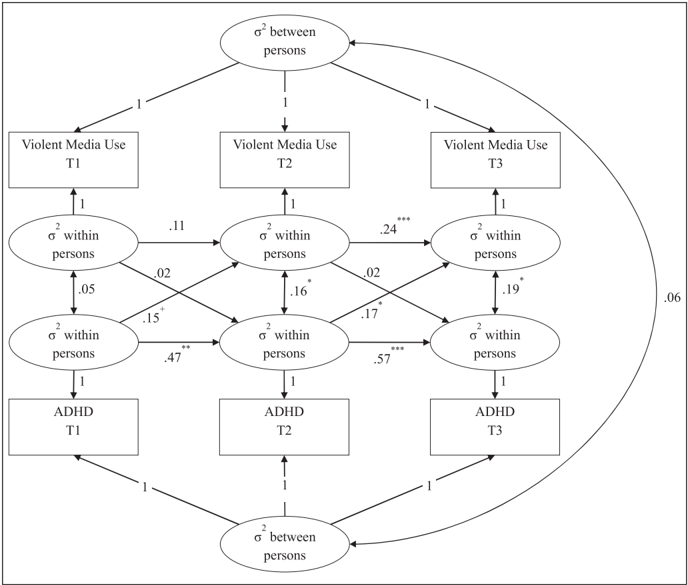
This longitudinal study investigated transactional relationships between violent media use and attention-deficit/hyperactivity disorder (ADHD)–related behaviors among young children (ages 4-8 years). To investigate study hypotheses, we employed a random intercept cross-lagged panel model (RI-CLPM) using structural equation modeling with panel data from 890 children. Results provided evidence in support of a media selection process rather than media effects process, whereby an increase in a child’s ADHD-related behaviors predicted an increase in the child’s violent media use 1 year later. Results indicated that this longitudinal relationship was accounted for by within-child fluctuations over time rather than stable between-child differences. The findings highlight the importance of investigating transactional relationships as well as distinguishing between-person and within-person relationships.
Overview
The claims and statistics of this paper haven’t been checked yet.
Free: it reads the open-access text and checks the first 5 claims that cite a source we can check. Create a free account to check every claim.
Integrity signals
Registry
Cites
Statistics
Figures

Verification
Claims the paper makes
The claims and statistics of this paper haven’t been checked yet.
Free: it reads the open-access text and checks the first 5 claims that cite a source we can check. Create a free account to check every claim.
Claims other papers make about this one
Each is checked against this paper’s own text: does it say what the citing paper says it does?
The cited source says what the claim attributes to it.
In the citing paper
“The cross-lagged parameters of the RI-CLPM reflect individual deviations from their expected score over time, therefore adjustment for inter-individual differences such as gender and socio-economic status as well trait-like characteristics is not needed on the within-person level [6,31,37].”
From Social Media and Mental Health Among Early Adolescents in Sweden: A Longitudinal Study With 2-Year Follow-Up (KUPOL Study). (2021) · cites this paper as [6]
Self-check
Percentages, sums and reported differences re-computed from the paper’s own numbers.
The self-check needs the paper’s full text.
Citations
Cites
Diagnostic and Statistical Manual of Mental Disorders
American Psychiatric Association (2013) · doi:10.1176/appi.books.9780890425596 · Cited by 116,369
A critique of the cross-lagged panel model
Hamaker, E. L., Kuiper, R. M., & Grasman, R. P. P. P. (2015) · Psychological Methods · doi:10.1037/a0038889 · Cited by 4,005 · cited 9×
“…Gentile et al., 2012; Johnson et al., 2007; Stevens et al., 2009), which is not surprising given that it is only very recently that statistical techniques to conduct such refined analyses have emerged (e.g., random intercept cross-lagged panel model [RI-CLPM]; Hamaker et al., 2015; Keijsers, 2016).”
BackgroundMethodInfluentialAnderson, C. A., & Bushman, B. J. (2001) · Psychological Science · doi:10.1111/1467-9280.00366 · Cited by 2,217
Complex Sample Data in Structural Equation Modeling
Muthen, B. O., & Satorra, A. (1995) · Sociological Methodology · doi:10.2307/271070 · Cited by 1,586
The Differential Susceptibility to Media Effects Model
Valkenburg, P. M., & Peter, J. (2013) · Journal of Communication · doi:10.1111/jcom.12024 · Cited by 1,340
Self-citationADHD and the Nature of Self-Control
Hinshaw, S. P. (1998) · Journal of Developmental & Behavioral Pediatrics · doi:10.1097/00004703-199806000-00010 · Cited by 1,194
Slater, M. D. (2007) · Communication Theory · doi:10.1111/j.1468-2885.2007.00296.x · Cited by 1,064
Berry, D., & Willoughby, M. T. (2017) · Child Development · doi:10.1111/cdev.12660 · Cited by 737
DUPAUL, G. J., MCGOEY, K. E., ECKERT, T. L., & VANBRAKLE, J. (2001) · Journal of the American Academy of Child & Adolescent Psychiatry · doi:10.1097/00004583-200105000-00009 · Cited by 698
Attention-deficit hyperactivity disorder and hyperkinetic disorder
Swanson, J., Sergeant, J., Taylor, E., Sonuga-Barke, E., Jensen, P., & Cantwell, D. (1998) · The Lancet · doi:10.1016/s0140-6736(97)11450-7 · Cited by 601
Research works printed but not linked: 3
- Anderson, C. C., & Maguire, T. O. (1978). Effect of TV viewing on the educational performance of elementary school children. Alberta Journal of Educational Research, 24, 156-163.
- Muthén, L. K., & Muthén, B. O. (2015). Mplus user's guide (7th ed.). Los Angeles, CA: Muthén & Muthén.
- Scholte, E. M., & Van der Ploeg, J. D. (2010). ADHD-vragenlijst [ADHD questionnaire] (3rd rev. ed.). Houten, The Netherlands: Bohn Stafleu van Loghum.
Cited by
Thorell, L. B., Burén, J., Ström Wiman, J., Sandberg, D., & Nutley, S. B. (2024) · European Child & Adolescent Psychiatry · doi:10.1007/s00787-022-02130-3 · Cited by 132
“A third study [44] found that screen time for violent media at Time 1 was not related to ADHD symptoms at Time 2.”
BackgroundResultInfluentialBeeres, D. T., Andersson, F., Vossen, H. G. M., & Galanti, M. R. (2021) · Journal of Adolescent Health · doi:10.1016/j.jadohealth.2020.07.042 · Cited by 102
van der Schuur, W. A., Baumgartner, S. E., Sumter, S. R., & Valkenburg, P. M. (2020) · New Media & Society · doi:10.1177/1461444819861956 · Cited by 52
Self-citationGeusens, F., Chen, Y. A., Kerr, B. R., & Moreno, M. A. (2022) · Media Psychology · doi:10.1080/15213269.2022.2138443 · Cited by 10
Vanherle, R., Beyens, I., & Beullens, K. (2023) · Media Psychology · doi:10.1080/15213269.2023.2228684 · Cited by 10
Self-citation
Metadata
- Authors
- Beyens, I., Piotrowski, J. T., & Valkenburg, P. M.
- Affiliations
- University of Amsterdam (NL)
- Corresponding author
- Beyens, Ine
- Venue
- Communication Research
- Publisher
- SAGE Publications
- Published
- 2018-06-22
- Volume
- 47
- Issue
- 8
- Pages
- 1228-1245
- ISSN
- 0093-6502 (ISSN-L)
- 1552-3810
- OpenAlex
- W2609382273
- Cited by
- 21
- References
- 51
- Citations by year
- 2026: 2 · 2025: 7 · 2024: 1 · 2023: 3 · 2022: 5 · 2020: 1 · 2019: 1
- FWCI
- 1.62
- Type
- journal article
- Language
- en
- Open access
- hybrid
- doi.org
- Licence
- Locations
- Communication Research (publishedVersion, cc-by-nc)
- UvA-DARE (University of Amsterdam) (submittedVersion, cc-by-nc)
- Lirias (submittedVersion, cc-by-nc)
- Data Archiving and Networked Services (DANS) (submittedVersion, other-oa)
- Funders
- Seventh Framework Programme (ERC grant agreement No. AdG09 249488-ENTCHILD)
- Nederlandse Organisatie voor Wetenschappelijk Onderzoek (Gravitation Program, Consortium on Individual Deve)
- Topics
- Social Sciences › Education › Child Development and Digital Technology
- Social Sciences › Psychology › Social Psychology › Bullying, Victimization, and Aggression
- Social Sciences › Psychology › Clinical Psychology › Child and Adolescent Psychosocial and Emotional Development
- Keywords
- media violence, attention deficit hyperactivity disorder, young children, transactional relationships, media selection, media influence, within-person variability, between-person differences, children's media use
About these checks
Registry, retraction, Cites and statistics results are computed, not judged, with one exception: a printed reference that no index lists is read once by a model before it counts as a citation error. Claims are extracted by a model and kept only when their quote appears verbatim in the text; each cited source is then checked, with a model’s help, for whether it says what the claim relies on. Those verdicts can be wrong — read the claim’s quote and the cited source before relying on one.
Statistics and arithmetic are recomputed, not judged.
Confidence bands are shown only for fields calibrated on our annotated test set. None is calibrated yet, so no band is shown.
What counts as a claim ›How we measure confidence ›How we check this ›
Are you an author, or do you see a problem with this page? Request a review
How to cite
Cite CoChat for the checks on this page, and the paper for its own findings.
- This page
- CoChat. (2026). Citation check: Which Came First? Assessing Transactional Relationships Between Children’s Violent Media Use and ADHD-Related Behaviors. https://app.cochat.ai/papers/10.1177/0093650218782300
- The paper
- Beyens, I., Piotrowski, J. T., & Valkenburg, P. M. (2020). Which Came First? Assessing Transactional Relationships Between Children’s Violent Media Use and ADHD-Related Behaviors. Communication Research. https://doi.org/10.1177/0093650218782300
Data sources
Bibliographic data: Semantic Scholar, OpenAlex, Crossref.
Contains information from the Semantic Scholar Academic Graph Datasets, made available under the ODC Attribution License (ODC-BY 1.0).
Semantic Scholar’s data is described in: Kinney, R., et al. (2023). The Semantic Scholar Open Data Platform. arXiv:2301.10140.
