

Which Came First? Assessing Transactional Relationships Between Children’s Violent Media Use and ADHD-Related Behaviors
Open accessThe DOI matches its Crossref record, with a small difference in title or year; 51 of the 51 references it cites were found in a registry or an index.
Abstract
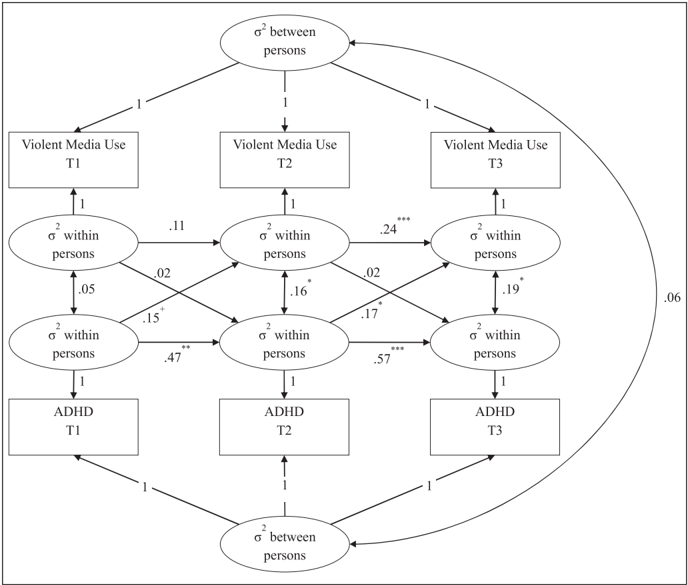
This longitudinal study investigated transactional relationships between violent media use and attention-deficit/hyperactivity disorder (ADHD)–related behaviors among young children (ages 4-8 years). To investigate study hypotheses, we employed a random intercept cross-lagged panel model (RI-CLPM) using structural equation modeling with panel data from 890 children. Results provided evidence in support of a media selection process rather than media effects process, whereby an increase in a child’s ADHD-related behaviors predicted an increase in the child’s violent media use 1 year later. Results indicated that this longitudinal relationship was accounted for by within-child fluctuations over time rather than stable between-child differences. The findings highlight the importance of investigating transactional relationships as well as distinguishing between-person and within-person relationships.
Overview
The claims and statistics of this paper haven’t been checked yet.
Free: it reads the open-access text and checks the first 5 claims that cite a source we can check. Create a free account to check every claim.
Integrity signals
Registry
Cites
Statistics
Figures

Verification
Claims the paper makes
The claims and statistics of this paper haven’t been checked yet.
Free: it reads the open-access text and checks the first 5 claims that cite a source we can check. Create a free account to check every claim.
Claims other papers make about this one
Each is checked against this paper’s own text: does it say what the citing paper says it does?
The cited source says what the claim attributes to it.
In the citing paper
“The cross-lagged parameters of the RI-CLPM reflect individual deviations from their expected score over time, therefore adjustment for inter-individual differences such as gender and socio-economic status as well trait-like characteristics is not needed on the within-person level [6,31,37].”
From Social Media and Mental Health Among Early Adolescents in Sweden: A Longitudinal Study With 2-Year Follow-Up (KUPOL Study). (2021) · cites this paper as [6]
Self-check
Percentages, sums and reported differences re-computed from the paper’s own numbers.
The self-check needs the paper’s full text.
Citations
Cites
Diagnostic and Statistical Manual of Mental Disorders
American Psychiatric Association (2013) · doi:10.1176/appi.books.9780890425596 · Cited by 116,369
A critique of the cross-lagged panel model
Hamaker, E. L., Kuiper, R. M., & Grasman, R. P. P. P. (2015) · Psychological Methods · doi:10.1037/a0038889 · Cited by 4,005 · cited 9×
“…Gentile et al., 2012; Johnson et al., 2007; Stevens et al., 2009), which is not surprising given that it is only very recently that statistical techniques to conduct such refined analyses have emerged (e.g., random intercept cross-lagged panel model [RI-CLPM]; Hamaker et al., 2015; Keijsers, 2016).”
BackgroundMethodInfluentialAnderson, C. A., & Bushman, B. J. (2001) · Psychological Science · doi:10.1111/1467-9280.00366 · Cited by 2,217
Complex Sample Data in Structural Equation Modeling
Muthen, B. O., & Satorra, A. (1995) · Sociological Methodology · doi:10.2307/271070 · Cited by 1,586
The Differential Susceptibility to Media Effects Model
Valkenburg, P. M., & Peter, J. (2013) · Journal of Communication · doi:10.1111/jcom.12024 · Cited by 1,340
Self-citationADHD and the Nature of Self-Control
Hinshaw, S. P. (1998) · Journal of Developmental & Behavioral Pediatrics · doi:10.1097/00004703-199806000-00010 · Cited by 1,194
Slater, M. D. (2007) · Communication Theory · doi:10.1111/j.1468-2885.2007.00296.x · Cited by 1,064
Berry, D., & Willoughby, M. T. (2017) · Child Development · doi:10.1111/cdev.12660 · Cited by 737
DUPAUL, G. J., MCGOEY, K. E., ECKERT, T. L., & VANBRAKLE, J. (2001) · Journal of the American Academy of Child & Adolescent Psychiatry · doi:10.1097/00004583-200105000-00009 · Cited by 698
Attention-deficit hyperactivity disorder and hyperkinetic disorder
Swanson, J., Sergeant, J., Taylor, E., Sonuga-Barke, E., Jensen, P., & Cantwell, D. (1998) · The Lancet · doi:10.1016/s0140-6736(97)11450-7 · Cited by 601
A review of behavioral and biological correlates of sensation seeking
Roberti, J. W. (2004) · Journal of Research in Personality · doi:10.1016/s0092-6566(03)00067-9 · Cited by 578 · cited 1×
“Because low baseline arousal is conceived as an unpleasant physiological state (Eysenck, 1997), children may try to counterbalance this low baseline arousal level by engaging in arousing activities (Roberti, 2004), such as using violent media.”
BackgroundFerguson, C. J. (2015) · Perspectives on Psychological Science · doi:10.1177/1745691615592234 · Cited by 524 · cited 3×
“, Anderson & Maguire, 1978; Christakis, Zimmerman, DiGiuseppe, & McCarty, 2004), two recent meta-analyses illustrate that an in-depth understanding of the media use–ADHD relationship is still lacking (Ferguson, 2015; Nikkelen, Valkenburg, Huizinga, & Bushman, 2014).”
BackgroundCurran, P. J., Howard, A. L., Bainter, S. A., Lane, S. T., & McGinley, J. S. (2014) · Journal of Consulting and Clinical Psychology · doi:10.1037/a0035297 · Cited by 481
Adachi, P., & Willoughby, T. (2015) · European Journal of Developmental Psychology · doi:10.1080/17405629.2014.963549 · Cited by 448
The Immediate Impact of Different Types of Television on Young Children's Executive Function
Lillard, A. S., & Peterson, J. (2011) · Pediatrics · doi:10.1542/peds.2010-1919 · Cited by 393
Associations Between Content Types of Early Media Exposure and Subsequent Attentional Problems
Zimmerman, F. J., & Christakis, D. A. (2007) · Pediatrics · doi:10.1542/peds.2006-3322 · Cited by 356
Video game playing, attention problems, and impulsiveness: evidence of bidirectional causality
Gentile, D. A., Swing, E. L., Lim, C. G., & Khoo, A. (2012) · Psychology of Popular Media Culture · doi:10.1037/a0026969 · Cited by 352
Media use and ADHD-related behaviors in children and adolescents: A meta-analysis
Nikkelen, S. W. C., Valkenburg, P. M., Huizinga, M., & Bushman, B. J. (2014) · Developmental Psychology · doi:10.1037/a0037318 · Cited by 339
Self-citationThe effects of infant media usage: what do we know and what should we learn?
Christakis, D. A. (2009) · Acta Paediatrica · doi:10.1111/j.1651-2227.2008.01027.x · Cited by 304 · cited 1×
“We initially assumed that, based on other research (Christakis, 2009; Swanson et al., 1998), any relationship patterns would emerge early in the developmental life span.”
MethodWhat Causes ADHD? Understanding What Goes Wrong and Why
Hammerman, S., & Rostain, A. L. (2007) · Journal of the American Academy of Child & Adolescent Psychiatry · doi:10.1097/01.chi.0000270794.82078.e2 · Cited by 294
Beauchaine, T. P., Katkin, E. S., Strassberg, Z., & Snarr, J. (2001) · Journal of Abnormal Psychology · doi:10.1037/0021-843x.110.4.610 · Cited by 288
Choice and Preference in Media Use
Knobloch-Westerwick, S. (2014) · doi:10.4324/9781315771359 · Cited by 272
Larsson, H., Anckarsater, H., Råstam, M., Chang, Z., & Lichtenstein, P. (2012) · Journal of Child Psychology and Psychiatry · doi:10.1111/j.1469-7610.2011.02467.x · Cited by 254
Parental monitoring and adolescent problem behaviors: How much do we really know?
Keijsers, L. (2016) · International Journal of Behavioral Development · doi:10.1177/0165025415592515 · Cited by 240
Comparison of Parenting Stress in Different Developmental Disabilities
Gupta, V. B. (2007) · Journal of Developmental and Physical Disabilities · doi:10.1007/s10882-007-9060-x · Cited by 238
Further examination of the immediate impact of television on children's executive function
Lillard, A. S., Drell, M. B., Richey, E. M., Boguszewski, K., & Smith, E. D. (2015) · Developmental Psychology · doi:10.1037/a0039097 · Cited by 210
Knobloch-Westerwick, S. (2015) · Communication Research · doi:10.1177/0093650214539173 · Cited by 202
Johnson, J. G., Cohen, P., Kasen, S., & Brook, J. S. (2007) · Archives of Pediatrics & Adolescent Medicine · doi:10.1001/archpedi.161.5.480 · Cited by 202 · cited 5×
“…to separate relationships at the within-person level from relationships at the between-person level (Ansari & Crosnoe, 2016; Gentile et al., 2012; Johnson et al., 2007; Stevens et al., 2009), which is not surprising given that it is only very recently that statistical techniques to conduct such…”
BackgroundInfluentialYoung children’s video/computer game use: relations with school performance and behavior.
Hastings, E. C., Karas, T. L., Winsler, A., Way, E., Madigan, A., & Tyler, S. (2009) · Issues in Mental Health Nursing · doi:10.1080/01612840903050414 · Cited by 160 · cited 4×
“(2014) yielded a statistically small but significant pooled zero-order correlation between children’s violent media use and ADHD-related behaviors (see also Anderson & Maguire, 1978; Hastings et al., 2009; Kronenberger et al., 2005; Levine & Waite, 2000; Linebarger, 2015).”
BackgroundInfluentialSimultaneous EEG and EDA measures in adolescent attention deficit hyperactivity disorder
Lazzaro, I., Gordon, E., Li, W., Lim, C. L., Plahn, M., Whitmont, S., Clarke, S., Barry, R. J., Dosen, A., & Meares, R. (1999) · International Journal of Psychophysiology · doi:10.1016/s0167-8760(99)00068-9 · Cited by 159 · cited 1×
“First, children with ADHD-related behaviors typically display low baseline arousal levels (Beauchaine, Katkin, Strassberg, & Snarr, 2001; Lazzaro et al., 1999).”
BackgroundStimulant Treatment in Maryland Public Schools
Safer, D. J., & Malever, M. (2000) · Pediatrics · doi:10.1542/peds.106.3.533 · Cited by 142
(2013) · UvA-DARE (University of Amsterdam) · Cited by 132
Self-citationMedia violence exposure and executive functioning in aggressive and control adolescents
Kronenberger, W. G., Mathews, V. P., Dunn, D. W., Wang, Y., Wood, E. A., Giauque, A. L., Larsen, J. J., Rembusch, M. E., Lowe, M. J., & Li, T.-Q. (2005) · Journal of Clinical Psychology · doi:10.1002/jclp.20022 · Cited by 110
Personality and the Biosocial Model of Anti-Social and Criminal Behaviour
Eysenck, H. J. (1997) · Springer eBooks · doi:10.1007/978-1-4757-4648-8_2 · Cited by 105
Review Personality, temperament and ADHD:
White, J. D. (1999) · Personality and Individual Differences · doi:10.1016/s0191-8869(98)00273-6 · Cited by 105
Brief Report: Television Viewing and Risk for Attention Problems in Preschool Children
Miller, C. J., Marks, D. J., Miller, S. R., Berwid, O. G., Kera, E. C., Santra, A., & Halperin, J. M. (2006) · Journal of Pediatric Psychology · doi:10.1093/jpepsy/jsl035 · Cited by 101
Pimentel, M. J., Vieira-Santos, S., Santos, V., & Vale, M. C. (2011) · ADHD Attention Deficit and Hyperactivity Disorders · doi:10.1007/s12402-011-0053-3 · Cited by 97
Hummer, T. A., Wang, Y., Kronenberger, W. G., Mosier, K. M., Kalnin, A. J., Dunn, D. W., & Mathews, V. P. (2010) · Media Psychology · doi:10.1080/15213261003799854 · Cited by 90
Children's Responses to the Screen
Valkenburg, P. M. (2004) · Routledge eBooks · doi:10.4324/9781410610331 · Cited by 82
Self-citationChildren's hyperactivity, television viewing, and the potential for child effects
Ansari, A., & Crosnoe, R. L. (2015) · Children and Youth Services Review · doi:10.1016/j.childyouth.2015.12.018 · Cited by 80
Impaired task switching performance in children with dyslexia but not in children with autism
Poljac, E., Simon, S., Ringlever, L., Kalcik, D., Groen, W. B., Buitelaar, J. K., & Bekkering, H. (2010) · Quarterly Journal of Experimental Psychology · doi:10.1080/17470210902990803 · Cited by 76
Television Viewing and Attentional Abilities in Fourth and Fifth Grade Children
Levine, L. E., & Waite, B. M. (2000) · Journal of Applied Developmental Psychology · doi:10.1016/s0193-3973(00)00060-5 · Cited by 72
Family Conflict and Violent Electronic Media Use in School-Aged Children
Vandewater, E. A., Lee, J. H., & Shim, M.-S. P. (2005) · Media Psychology · doi:10.1207/s1532785xmep0701_4 · Cited by 60
Repeated Exposure to Video Game Play Results in Decreased Blood Pressure Responding
Ballard, M. E., Hamby, R. H., Panee, C. D., & Nivens, E. E. (2006) · Media Psychology · doi:10.1207/s1532785xmep0804_1 · Cited by 59
The Routledge International Handbook of Children, Adolescents and Media
Slavtcheva‐Petkova, V. (2014) · European Journal of Communication · doi:10.1177/0267323114533050a · Cited by 58
Assessing the Reliability and Validity of Television and Game Violence Exposure Measures
Fikkers, K. M., Piotrowski, J. T., & Valkenburg, P. M. (2017) · Communication Research · doi:10.1177/0093650215573863 · Cited by 41
Self-citationThe Limited Informativeness of Meta-Analyses of Media Effects
Valkenburg, P. M. (2015) · Perspectives on Psychological Science · doi:10.1177/1745691615592237 · Cited by 37
Self-citationLinebarger, D. L. (2015) · Psychology of Popular Media Culture · doi:10.1037/ppm0000069 · Cited by 32
Pearce, L. J., & Field, A. P. (2016) · Human Communication Research · doi:10.1111/hcre.12069 · Cited by 27
Stevens, T., Barnard-Brak, L., & To, Y. (2009) · Journal of Early Intervention · doi:10.1177/1053815109338562 · Cited by 17
TV or Not TV: Questions and Answers Regarding Television and ADHD
Acevedo-Polakovich, I. D., Lorch, E. P., & Milich, R. S. (2005) · The ADHD Report · doi:10.1521/adhd.2005.13.6.6 · Cited by 13
Research works printed but not linked: 3
- Anderson, C. C., & Maguire, T. O. (1978). Effect of TV viewing on the educational performance of elementary school children. Alberta Journal of Educational Research, 24, 156-163.
- Muthén, L. K., & Muthén, B. O. (2015). Mplus user's guide (7th ed.). Los Angeles, CA: Muthén & Muthén.
- Scholte, E. M., & Van der Ploeg, J. D. (2010). ADHD-vragenlijst [ADHD questionnaire] (3rd rev. ed.). Houten, The Netherlands: Bohn Stafleu van Loghum.
Cited by
Thorell, L. B., Burén, J., Ström Wiman, J., Sandberg, D., & Nutley, S. B. (2024) · European Child & Adolescent Psychiatry · doi:10.1007/s00787-022-02130-3 · Cited by 132
“A third study [44] found that screen time for violent media at Time 1 was not related to ADHD symptoms at Time 2.”
BackgroundResultInfluentialBeeres, D. T., Andersson, F., Vossen, H. G. M., & Galanti, M. R. (2021) · Journal of Adolescent Health · doi:10.1016/j.jadohealth.2020.07.042 · Cited by 102
van der Schuur, W. A., Baumgartner, S. E., Sumter, S. R., & Valkenburg, P. M. (2020) · New Media & Society · doi:10.1177/1461444819861956 · Cited by 52
Self-citationGeusens, F., Chen, Y. A., Kerr, B. R., & Moreno, M. A. (2022) · Media Psychology · doi:10.1080/15213269.2022.2138443 · Cited by 10
Vanherle, R., Beyens, I., & Beullens, K. (2023) · Media Psychology · doi:10.1080/15213269.2023.2228684 · Cited by 10
Self-citation
Metadata
- Authors
- Beyens, I., Piotrowski, J. T., & Valkenburg, P. M.
- Affiliations
- University of Amsterdam (NL)
- Corresponding author
- Beyens, Ine
- Venue
- Communication Research
- Publisher
- SAGE Publications
- Published
- 2018-06-22
- Volume
- 47
- Issue
- 8
- Pages
- 1228-1245
- ISSN
- 0093-6502 (ISSN-L)
- 1552-3810
- OpenAlex
- W2609382273
- Semantic Scholar
- b8f74a1b7591616b882d635c8d88be095c5f9703
- Cited by
- 21
- References
- 51
- Citations by year
- 2026: 2 · 2025: 7 · 2024: 1 · 2023: 3 · 2022: 5 · 2020: 1 · 2019: 1
- FWCI
- 1.62
- Type
- journal article
- Language
- en
- Open access
- hybrid
- doi.org
- Licence
- Locations
- Communication Research (publishedVersion, cc-by-nc)
- UvA-DARE (University of Amsterdam) (submittedVersion, cc-by-nc)
- Lirias (submittedVersion, cc-by-nc)
- Data Archiving and Networked Services (DANS) (submittedVersion, other-oa)
- Funders
- Seventh Framework Programme (ERC grant agreement No. AdG09 249488-ENTCHILD)
- Nederlandse Organisatie voor Wetenschappelijk Onderzoek (Gravitation Program, Consortium on Individual Deve)
- Topics
- Social Sciences › Education › Child Development and Digital Technology
- Social Sciences › Psychology › Social Psychology › Bullying, Victimization, and Aggression
- Social Sciences › Psychology › Clinical Psychology › Child and Adolescent Psychosocial and Emotional Development
- Keywords
- media violence, attention deficit hyperactivity disorder, young children, transactional relationships, media selection, media influence, within-person variability, between-person differences, children's media use
About these checks
Registry, retraction, Cites and statistics results are computed, not judged, with one exception: a printed reference that no index lists is read once by a model before it counts as a citation error. Claims are extracted by a model and kept only when their quote appears verbatim in the text; each cited source is then checked, with a model’s help, for whether it says what the claim relies on. Those verdicts can be wrong — read the claim’s quote and the cited source before relying on one.
Statistics and arithmetic are recomputed, not judged.
Confidence bands are shown only for fields calibrated on our annotated test set. None is calibrated yet, so no band is shown.
What counts as a claim ›How we measure confidence ›How we check this ›
Are you an author, or do you see a problem with this page? Request a review
Data sources
Bibliographic data: Semantic Scholar, OpenAlex, Crossref.
Contains information from the Semantic Scholar Academic Graph Datasets, made available under the ODC Attribution License (ODC-BY 1.0).
Semantic Scholar’s data is described in: Kinney, R., et al. (2023). The Semantic Scholar Open Data Platform. arXiv:2301.10140.
