

Killing Me Softly: Organizational E-mail Monitoring Expectations’ Impact on Employee and Significant Other Well-Being
Open accessThe DOI matches its Crossref record, with a small difference in title or year; 149 of the 149 references it cites were found in a registry or an index; 4 of the 45 sources its claims cite were checked for support.
Abstract
This paper tests the relationship between organizational expectations to monitor work-related electronic communication during nonwork hours and the health and relationship satisfaction of employees and their significant others. We integrate resource-based theories with research on interruptions to position organizational expectations for e-mail monitoring (OEEM) during nonwork time as a psychological stressor that elicits anxiety due to employee attention allocation conflict. E-mail–triggered anxiety, in turn, negatively affects the health and relationship quality of employees and their significant others. We conducted three studies to test our propositions. Using the experience sampling method with 108 working U.S. adults, Study 1 established within-employee effects of OEEM on anxiety, employee health, and relationship conflict. Study 2 used a sample of 138 dyads of full-time employees and their significant others to replicate detrimental health and relationship effects of OEEM through anxiety. It also showed crossover effects of OEEM on partner health and relationship satisfaction. Finally, Study 3 employed a two-wave data collection method with an online sample of 162 U.S. working adults to provide additional support for the OEEM construct as a distinct and reliable job stressor and replicated findings from Studies 1 and 2. Taken together, our research extends the literature on work-related electronic communication at the interface of work and nonwork boundaries, deepening our understanding of the impact of OEEM on employees and their families’ health and well-being.
Overview
CoChat Summary
TL;DR
Organizational expectations for email monitoring during nonwork time (OEEM) act as a chronic stressor that raises employee anxiety, harming employee health and relationship outcomes and crossing over to significant others. Two studies support anxiety as a mediator, though employee relationship satisfaction was not affected in Study 2 while significant-other outcomes were.
Key findings
- In Study 1 (108 working U.S. adults, 376 experience-sampling observations), OEEM was positively related to anxiety (β = .22, p < .01), as was daily monitoring frequency (β = .23, p < .01). OEEM also had direct effects on health (β = -2.79, p < .01) and daily conflict with a significant other (β = .15, p < .01), with significant indirect effects through anxiety for health (95% CI = -1.07, -.18) and conflict (95% CI = .01, .06).
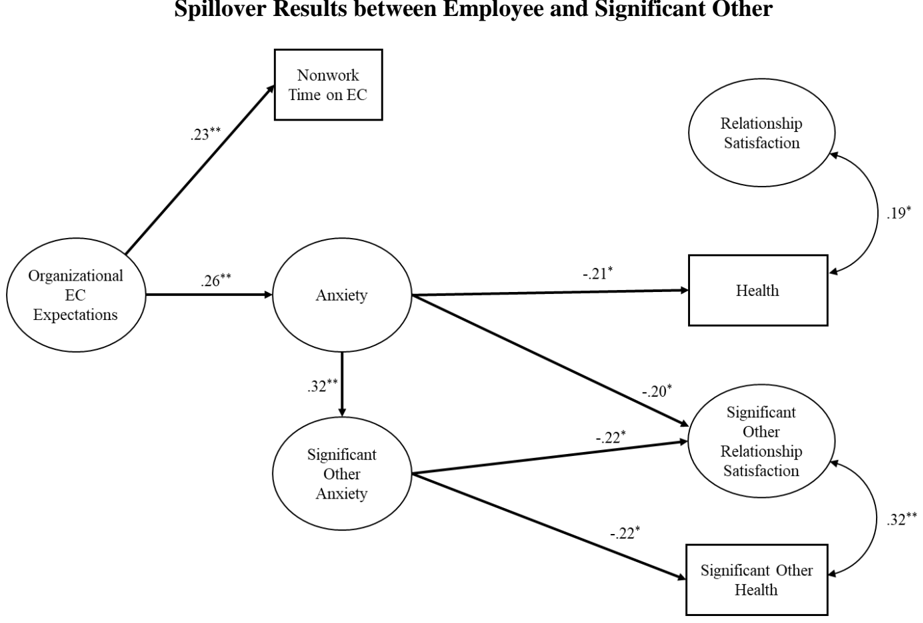
- In Study 2 (138 employee–significant-other dyads), OEEM correlated with employee anxiety (r = .29, p < .01) and the modeled path was significant (β = .26, p < .01). Employee anxiety predicted employee health (β = -.21, p < .05), and the indirect effect of expectations on health through anxiety was significant (95% CI = -.14, -.01); employee relationship satisfaction was not significantly affected.
- Crossover effects were supported: employee anxiety predicted significant-other anxiety (β = .32, p < .01), and the indirect effect of OEEM through employee anxiety was significant (95% CI = .02, .18). Significant-other relationship satisfaction was directly related to employee anxiety (β = -.20, p < .05) and significant-other anxiety (β = -.22, p < .05); significant-other health was related to significant-other anxiety (β = -.22, p < .05), with the indirect effect of expectations through both anxieties only marginally significant (90% CI = -.06, -.01).
- Employee-rated OEEM was positively correlated with manager-rated OEEM in 105 employee–manager matched dyads (r = .44, p < .01), supporting construct validity.
Methods
- Study 1 used experience sampling with 108 working U.S. adults over 4 consecutive days (weekend combined), yielding 376 daily observations; multilevel modeling with HLM tested within-person and cross-level effects.
- Study 2 used 138 full-time employee–significant-other dyads and 105 employee–manager matched dyads; path modeling in Mplus tested direct and indirect effects, with confirmatory factor analysis for the employee measurement model.
- OEEM was measured with three items; anxiety with three STAI short-form items; health with a single 100-point self-rated item; relationship quality/conflict with single- or three-item measures. Controls included gender and time spent on work electronic communication during nonwork time.
Limitations
- The paper states that resource allocation dilemma was not measured directly, and future work should measure domain transitions and role-switching costs.
- The paper states that more longitudinal research and objective health outcomes (e.g., blood pressure, cardiovascular response) are needed beyond experience sampling, cross-sectional data, and self-reports.
- The paper notes that some employees may have experienced anxiety due to not complying with higher expectations; evident from the text, causal inference is limited by the designs, and Study 2 found no significant effect on employee relationship satisfaction despite significant effects on significant-other outcomes.
Model-written summary. Check it against the paper before relying on it.
Integrity signals
Registry
Cites
Statistics
Figures
Verification
Claims the paper makes
4 Valid · 0 Not valid · 24 Not checked · 82 Own results and interpretations
The cited sources support only part of this claim — read each source’s verdict below.
In the paper
“The relationship between chronic stress, anxiety and health outcomes is relatively well established, demonstrating its link to poor physical and mental health and premature mortality (e.g., Keller, Litzelman, Wisk, Maddox, Cheng, Creswell, & Witt, 2012; McEwen, 2017; McEwen & Stellar, 1993; Watson & Pennebaker, 1989)”
What the sources say
- Not checked — no full text of the sourcecites McEwen, 2017 matched to “Allostasis and the Epigenetics of Brain and Body Health Over the Life Course: The Brain on Stress” (2017) source
- Not matchedcites McEwen & Stellar, 1993
An author–year citation the paper’s reference list doesn’t settle. We don’t search these by name.
- Partly supportedcites Keller et al., 2012 matched to “Does the perception that stress affects health matter? The association with health and mortality.” (2012) sourceExperimental — accuracy not yet measured
The Conclusions state that prolonged stress has adverse psychological and physical health effects and is linked to premature mortality. The Results also associate reported stress with poorer health and psychological distress, but the increased mortality risk was found for people who both reported a lot of stress and perceived that it affected their health. The paper does not establish the claimed relationship for anxiety as a separate exposure. (LLM, conf=0.86)
boostedstates an association- Asserted: passes — The authors put it forward as true.
- Checkable: passes — It can be checked against evidence.
- Load-bearing: passes — The paper’s conclusions depend on it.
- Based: passes — The paper gives a reason why it holds.
The sources with a verdict support this claim; the rest weren’t checked yet, have no full text we could read, or their verdicts aren’t rated yet.
In the paper
“In fact, we used a validated health measure that has been tied to objective health outcomes, including hospitalization, chronic disease, and mortality, in other research (DeSalvo, Bloser, Reynolds, He, & Muntner, 2006; Meng et al., 2014; Strawbridge & Walhagen, 1999).”
What the sources say
- Not checked yetcites DeSalvo, Bloser, Reynolds, He, & Muntner, 2006 matched to “Mortality prediction with a single general self-rated health question: A meta-analysis” (2006) source
- Supportedcites Meng et al., 2014 matched to “A Single-Item Self-Rated Health Measure Correlates with Objective Health Status in the Elderly: A Survey in Suburban Beijing” (2014) source
The Discussion reports that self-rated health reflects chronic disease and hospitalization rates, and says previous studies found it predicts mortality. The cited paper therefore supports the measure’s connection to all three outcomes, although its mortality statement reports earlier research rather than a finding of its own. Page numbers were not supplied. (LLM, conf=0.93)
- Not matchedcites Strawbridge & Walhagen, 1999
An author–year citation the paper’s reference list doesn’t settle. We don’t search these by name.
plainstates an association- Asserted: passes — The authors put it forward as true.
- Checkable: passes — It can be checked against evidence.
- Load-bearing: passes — The paper’s conclusions depend on it.
- Based: passes — The paper gives a reason why it holds.
The cited sources support only part of this claim — read each source’s verdict below.
In the paper
“That is, sensing anxiety from the employee and/or experiencing anxiety as a result of the employee's work-related resource allocation and lack of relationship engagement should facilitate contagion effects, where the employee's anxiety in the nonwork domain can be 'caught' by their significant others (Barsade, 2002; Boyar, Maertz, Pearson, & Keough, 2003).”
What the sources say
- Partly supportedcites Barsade, 2002 matched to “The ripple effect: emotional contagion and its influence on group behavior” (2002) sourceExperimental — accuracy not yet measured
Split into 2 atoms — 0 confirmed, 2 partially supported, 0 disputed, 0 misattributed, 0 unverifiable. Expand the claim to see per-atom verdicts.
- Not checked — no full text of the sourcecites Boyar, Maertz, Pearson, & Keough, 2003
hedgedstates a possible cause- Asserted: passes — The authors put it forward as true.
- Checkable: passes — It can be checked against evidence.
- Load-bearing: passes — The paper’s conclusions depend on it.
- Based: passes — The paper gives a reason why it holds.
- Partly supported
A result the paper reports from its own data — it cites no other source for it, so there is none to check. The quote shows it is in the paper.
In the paper
“Further, Study 2 substantiated our OEEM construct using 105 employee-manager matched dyads.”
plain- Asserted: passes — The authors put it forward as true.
- Checkable: passes — It can be checked against evidence.
- Load-bearing: unclear — It is unclear whether the paper’s conclusions depend on it.
- Based: passes — The paper gives a reason why it holds.
A result the paper reports from its own data — it cites no other source for it, so there is none to check. The quote shows it is in the paper.
In the paper
“as well as demonstrated crossover effects of electronic communication expectations on partner health and relationship satisfaction.”
boostedstates an association- Asserted: passes — The authors put it forward as true.
- Checkable: passes — It can be checked against evidence.
- Load-bearing: passes — The paper’s conclusions depend on it.
- Based: passes — The paper gives a reason why it holds.
69 more claims
Create a free account to see all 110 claims and to verify the 6 references still open.
- It may state two separate claims as one. 19
- Probably not a substantial claim. 22
- The quote only partly states this claim. 1
Statistics recomputed
Every reported test result, recomputed from its test statistic and degrees of freedom. A result shows as not adding up only once an independent check has confirmed it.
- Consistentχ²(2) = 200reported p < .01 · recomputed p < .001
“χ 2 (2) = 200, p < .01”
- Consistentχ²(5) = 492reported p < .01 · recomputed p < .001
“χ 2 (5) = 492, p < .01”
Self-check
Percentages, sums and reported differences re-computed from the paper’s own numbers.
Each contradiction between two passages listed here was confirmed by an independent check.
Rated minor: it would not touch a result — a value no result rests on, a p-value that stays on the same side of the significance level, or a conflict that is clerical, resolved elsewhere in the paper, or outside its own findings.
In the paper
§ Results
“Overall, Hypothesis 4a was supported, but Hypothesis 4b was only marginally supported.”
§ The effects of OEEM-triggered anxiety on employee health and marital satisfaction.
“Hypothesis 4: Work email-triggered employee and significant other anxiety will mediate the relationship between organizational expectations to monitor electronic communications and significant other (a) health and (b) relationship quality.”
Citations
Cites
Self-efficacy: Toward a unifying theory of behavioral change
Bandura, A. (1977) · Psychological Review · doi:10.1037/0033-295x.84.2.191 · Cited by 43,925 · cited 1×
“Additionally, this attention dilemma triggered by OEEM can become a constant source of anxiety by overstimulation of employees’ perceptions of their work self-efficacy (Bandura, 1977) for two reasons.”
BackgroundA Theoretical Extension of the Technology Acceptance Model: Four Longitudinal Field Studies
Venkatesh, V., & Davis, F. D. (2000) · Management Science · doi:10.1287/mnsc.46.2.186.11926 · Cited by 23,066 · cited 1×
“To create a more reliable measure of OEEM outside of work that specifically taps into the subjective employee perceptions regarding normative expectations, we combined the two items adapted from Venkatesh and Davis (2000) with a third item taken from Butts, Becker, and Boswell (2015).”
MethodConservation of resources: A new attempt at conceptualizing stress
Hobfoll, S. E. (1989) · American Psychologist · doi:10.1037/0003-066x.44.3.513 · Cited by 18,187
The job demands-resources model of burnout.
Demerouti, E., Bakker, A. B., Nachreiner, F., & Schaufeli, W. B. (2001) · Journal of Applied Psychology · doi:10.1037/0021-9010.86.3.499 · Cited by 13,643 · cited 2×
“Resource-based theories of stress (Bakker & Demerouti, 2007; Bakker, Demerouti, & Dollard, 2008; Demerouti et al., 2001) posit that individual resources are limited and that”
BackgroundThe Job Demands‐Resources model: state of the art
Bakker, A. B., & Demerouti, E. (2007) · Journal of Managerial Psychology · doi:10.1108/02683940710733115 · Cited by 12,996 · cited 4×
“This is in contrast with prior research that accounted for fixed duration of work and family role conflict when someone may bring their work home to finish up tasks or leave work for some time to finish nonwork-related tasks (e.g., Bakker & Demerouti, 2007).”
BackgroundMethodResultInfluentialJournal of personality and social psychology
Armstrong, J. S. (1988) · International Journal of Forecasting · doi:10.1016/0169-2070(88)90126-4 · Cited by 10,485
The emerging field of emotion regulation: an integrative review
Gross, J. J. (1998) · Review of General Psychology · doi:10.1037/1089-2680.2.3.271 · Cited by 9,916
Job demands, job resources, and their relationship with burnout and engagement: a multi‐sample study
Schaufeli, W. B., & Bakker, A. B. (2004) · Journal of Organizational Behavior · doi:10.1002/job.248 · Cited by 9,297 · cited 1×
“All of these items were taken from Van Veldhoven and Meijman (1994), as utilized by Schaufeli and Bakker (2004).”
MethodBaumeister, R. F., Bratslavsky, E., Finkenauer, C., & Vohs, K. D. (2001) · Review of General Psychology · doi:10.1037/1089-2680.5.4.323 · Cited by 7,678
Hobfoll, S. E. (2001) · Applied Psychology · doi:10.1111/1464-0597.00062 · Cited by 7,139
Research works printed but not linked: 8
- American Psychological Association. 2012. Workplace survey: Psychologically healthy workplace program. Retrieved from https:// www.apa.org/news/press/releases/phwa/workplace-survey.pdf.
- Burke, R. J., & Cooper, C. L. 2008. The long work hours culture: Causes, consequences and choices . Bigley, UK: Emerald.
- Bryk A. S., 1996, HLM: Hierarchical linear and nonlinear modeling with the HLM/2L and HLM/3L programs
- Freitas J. C., 2016, Proceedings of the 22nd Americas Conference on Information Systems (AMICS): Surfing the IT Innovation Wave, 460
- Isen, A. M. 1990. The influence of positive and negative affect on cognitive organization: Some implications for development. In N. L. Stein, B. Leventhal, & T. Trabasso (Eds.). Psychological and Biological Approaches to Emotion : 75-94. Hillsdale, NJ: Lawrence Erlbaum.
- Muthén, L. K., & Muthén, B. O. 2015. Mplus User's Guide . Seventh edition. Los Angeles, CA: Muthén & Muthén.
- Nippert-Eng, C. E. 2008. Home and work: Negotiating boundaries through everyday life . Chicago: University of Chicago Press.
- Weiss, H. M., & Cropanzano, R. 1996. Affective events theory: A theoretical discussion of the structure, causes and consequences of affective experiences at work. In B. M. Staw & L. L. Cummings (Eds.), Research in Organizational Behavior , 18: 1-74. Greenwich, UK: JAI Press.
Cited by
The digital workplace and its dark side: An integrative review
Marsh, E., Vallejos, E. P., & Spence, A. (2022) · Computers in Human Behavior · doi:10.1016/j.chb.2021.107118 · Cited by 348
Becker, W. J., Belkin, L. Y., Tuskey, S. E., & Conroy, S. A. (2022) · Human Resource Management · doi:10.1002/hrm.22102 · Cited by 246
Self-citationBelkin, L. Y., Becker, W. J., & Conroy, S. A. (2020) · Group & Organization Management · doi:10.1177/1059601120933143 · Cited by 67
“…such as work–life balance and turnover intentions (TOIs), we not only add empirical evidence to support the role of OEEM as a distinct job stressor (Becker et al., 2019), but also, and importantly, examine its implications on a broader resource level, while demonstrating through which path…”
BackgroundInfluentialSelf-citationEnhancing Pharmacy Faculty Well-Being and Productivity While Reducing Burnout
Kennedy, D. R., Clapp, P., DeLuca, J., Filtz, T. M., Kroon, L. A., Lamberts, J. T., Oliphant, C. M., Prescott, W. A., & Ray, S. D. (2021) · American Journal of Pharmaceutical Education · doi:10.5688/ajpe8764 · Cited by 81
Hu, X., Park, Y., Day, A., & Barber, L. K. (2021) · Occupational Health Science · doi:10.1007/s41542-021-00085-6 · Cited by 59
“…they are expected to monitor their electronic devices for work communications outside of typical work hours, they may have to spend additional resources after work, which can be associated with lack of proper recovery and poor well-being (Becker et al. 2019; Dettmers et al. 2016a; Piszczek 2017).”
BackgroundInfluentialTechnology-assisted supplemental work: A meta-analysis
Kühner, C., Rudolph, C. W., Derks, D., Posch, M., & Zacher, H. (2023) · Journal of Vocational Behavior · doi:10.1016/j.jvb.2023.103861 · Cited by 80
Mitchell, M. S., Hetrick, A. L., Mawritz, M. B., Edwards, B., & Greenbaum, R. L. (2023) · Journal of Management · doi:10.1177/01492063231196553 · Cited by 57
“Given the dif fi culty of stopping routines and switching gears as well as the potential uncertainty of raising bottom-line outcomes adequately (Becker et al., 2021; Cheng & McCarthy, 2018), when SBLM is high, employees experience the need to alter their routines, pushing aside and neglecting normal…”
A Review of Virtual Impression Management Behaviors and Outcomes
Blunden, H., & Brodsky, A. (2024) · Journal of Management · doi:10.1177/01492063231225160 · Cited by 72
“…standpoint, employees report great pressure to respond quickly to their emails to establish and maintain positive reputations in both qualitative (Mazmanian, Orlikowski, & Yates, 2013) and survey-based (Becker, Belkin, Conroy, & Tuskey 2021; Brown, Duck, & Jimmieson, 2014) organizational studies.”
BackgroundGiacosa, E., Alam, G. M., Culasso, F., & Crocco, E. (2023) · Journal of Innovation & Knowledge · doi:10.1016/j.jik.2023.100357 · Cited by 55
Afota, M., Savard, Y. P., Ollier‐Malaterre, A., & Leon, E. A. (2022) · The International Journal of Human Resource Management · doi:10.1080/09585192.2022.2090269 · Cited by 47
“…al., 2016) and perceived availability expectations have been associated with deleterious outcomes for employees such as increased strain and work–life conflicts (e.g., Becker et al., 2019; Belkin et al., 2020; Dettmers, 2017; Dettmers, Bamberg, et al., 2016; Dettmers, Vahle-Hinz, et al., 2016).”
BackgroundOng, J. L., Lau, T., Karsikas, M., Kinnunen, H. O., & Chee, M. W. L. (2021) · Scientific Reports · doi:10.1038/s41598-021-93924-z · Cited by 37
Nsair, V., & Piszczek, M. M. (2021) · Journal of Occupational and Organizational Psychology · doi:10.1111/joop.12361 · Cited by 37
Elshaer, I. A., Azazz, A. M. S., Ghaleb, M. M. S., Abdulaziz, T. A., Mansour, M. A., & Fayyad, S. (2024) · Journal of Open Innovation Technology Market and Complexity · doi:10.1016/j.joitmc.2024.100208 · Cited by 43
Yuan, Q., Kong, J., Liu, C., & Jiang, Y. (2023) · Information Technology and People · doi:10.1108/itp-08-2022-0639 · Cited by 41
Zhang, L., Tekleab, A. G., Piszczek, M. M., & Qiu, Y. (2022) · Journal of Business Research · doi:10.1016/j.jbusres.2022.113551 · Cited by 35
Chen, A., Conroy, S. A., & Crain, T. L. (2024) · Human Resource Management · doi:10.1002/hrm.22240 · Cited by 25
Self-citationWolfers, L. N. (2024) · Communication Theory · doi:10.1093/ct/qtae015 · Cited by 43
Fu, S., Lee, Y. E., Yoon, S., Dimotakis, N. E., Koopman, J., & Tepper, B. J. (2024) · Personnel Psychology · doi:10.1111/peps.12640 · Cited by 27
Digital human skills from the corporate economy and business development
Malkawi, E., & Khayrullina, M. V. (2021) · Ekonomicko-manazerske spektrum · doi:10.26552/ems.2021.1.64-74 · Cited by 23
“Research suggests that in reality, “flexible work boundaries” often turn into “work without boundaries”, compromising employees’ and their families’ health and well-being (Becker et al., 2021).”
BackgroundWang, J., Zhang, Z., & Jia, M. (2023) · Journal of Occupational and Organizational Psychology · doi:10.1111/joop.12425 · Cited by 19
He, X., Gao, Q., Cao, Y., Bian, R., & Wang, X. (. (2024) · PsyCh Journal · doi:10.1002/pchj.747 · Cited by 12
“Second, some studies have found significant inter-day fluctuations in employees ’ workplace telepressure, and that work-place telepressure varies from day to day according to daily workloads and task urgency levels (Becker et al., 2021; Cambier et al., 2019; Y. Park et al., 2020).”
BackgroundAustralia's right to disconnect from work: Beyond rhetoric and towards implementation
Josserand, E., & Boersma, M. (2024) · Journal of Industrial Relations · doi:10.1177/00221856241290625 · Cited by 22
“It is alarming that workers do not need to perform work to experience the negative effects of hyperconnectivity: the knowledge of the existence of a constant fl ow of information and ongoing monitoring can be enough (Becker et al., 2021).”
Bakhai, A., McCauley, L., Stones, L., Khalil, S., Mehta, J., Price, N., Krishnamurthy, V., Parker, L. H. H., & Hughes, D. (2022) · Humanities and Social Sciences Communications · doi:10.1057/s41599-022-01427-7 · Cited by 10
“Higher email load (Stich et al. 2019) demands to reply rapidly (Becker et al. 2021), and organisational norms and expectations to monitor email in non-work hours (Gadeyne 2018; Waldhauser 2019) have been found to be associated with higher levels of stress.”
BackgroundKottwitz, M. U., Wehrt, W., Gerhardt, C., Coelho, D. A., Schmutz, D., & Elfering, A. (2021) · Journal of Business and Psychology · doi:10.1007/s10869-021-09766-z · Cited by 14
Jamil, R. A., Hassan, S. R. U., Khan, T. I., Shah, R., & Nazir, S. (2023) · Management Research Review · doi:10.1108/mrr-12-2021-0875 · Cited by 21
Will after-hours technology-mediated work make employees leave? A mediated moderation model
Sun, X., Zhu, J., Liang, H., Xue, Y., & Yao, B. (2024) · Internet Research · doi:10.1108/intr-08-2022-0595 · Cited by 17
A Theory of Strategic Boundary Control for Remote Work
Perrigino, M. B., & Raveendhran, R. (2025) · Academy of Management Review · doi:10.5465/amr.2023.0207 · Cited by 20
Zhang, N., Sun, X., & Jin, C. (2025) · Behavioral Sciences · doi:10.3390/bs15030256 · Cited by 18
“For example, it may reduce employees’ affective commitment to the organization (Jiang et al., 2020) and trigger anxiety among employees (W. J. Becker et al., 2021).”
Trzebiatowski, T. M. (2023) · Equality Diversity and Inclusion An International Journal · doi:10.1108/edi-11-2022-0305 · Cited by 11
Nilsen, W., Nordberg, T. H., Drange, I., Junker, N. M., Aksnes, S. Y., Cooklin, A., Cho, E., Habib, L., Hokke, S., Olson‐Buchanan, J. B., et al. (2024) · Computers in Human Behavior Reports · doi:10.1016/j.chbr.2024.100444 · Cited by 7
Barber, L. K., Hu, X., Huyen, T., & Jang, S. (2024) · Occupational Health Science · doi:10.1007/s41542-024-00209-8 · Cited by 6
“This includes organizational expectations for email monitoring (Becker et al., 2021), technology-assisted supplement work (Eichberger et al., 2022; Fenner & Renn, 2010), and telepressure (i.e., a motivational state of feeling obligated to respond; Barber & Santuzzi, 2015).”
For whom and under what circumstances does email message batching work?
Wijngaards, I., Pronk, F. R., & Burger, M. J. (2022) · Internet Interventions · doi:10.1016/j.invent.2022.100494 · Cited by 6
“…to examine how email batching relates to dynamic well-being constructs, such as state work engagement (Breevaart et al., 2012) and state emotional exhaustion (Riedl and Thomas, 2019), and whether it has spillovers to well-being in the non-work domain (Becker et al., 2021; Ilies et al., 2007).”
BackgroundCheng, H. X., Zheng, W., Zhou, J., Zhang, G., & Tang, S. (2023) · Applied Psychology · doi:10.1111/apps.12506 · Cited by 9
Experience Sampling Methodology: A Systematic Review and Discussion for Organizational Research
Çan, Ö. (2021) · The Electronic Journal of Business Research Methods · doi:10.34190/jbrm.18.2.005 · Cited by 9
Somebody's watching me: boundary turbulence and its impact on employee engagement
Lemon, L. L., Bawole, C. B., Brinson, N. H., & Amini, B. (2024) · Corporate Communications An International Journal · doi:10.1108/ccij-12-2023-0171 · Cited by 8
Grotto, A. R., & Lyness, K. S. (2021) · Stress and Health · doi:10.1002/smi.3086 · Cited by 6
Tamir, E., & Etgar, R. (2022) · Teachers and Teaching · doi:10.1080/13540602.2022.2151431 · Cited by 4
“Finally, they can be exhausted and harm their well-being, and decreases their productivity (Becker et al., 2021; Van Zoonen et al., 2016).”
BackgroundHussain, F., Memon, M. A., Naeem, H., & Hafeez, S. (2021) · Asian Journal of Business Research · doi:10.14707/ajbr.210109 · Cited by 5
Bath, J., & Markulin, V. (2024) · International Journal of Business and Applied Social Science · doi:10.33642/ijbass.v10n1p1 · Cited by 7
Eyes everywhere: the influence of digital surveillance on employee innovation performance in China
Wang, Y., & Bai, C. (2024) · Asia Pacific Business Review · doi:10.1080/13602381.2024.2371357 · Cited by 7
Hesse, F., Huettermann, H., & Bruch, H. (2025) · Journal of Occupational and Organizational Psychology · doi:10.1111/joop.70067 · Cited by 3
Bridges, C. S., Taylor, T. N., Han, A., et al. (2024) · Clinical Imaging · doi:10.1016/j.clinimag.2024.110118 · Cited by 3
Mo, S., Yu, W., Fang, Y., Su, Y., & Zhao, Y. (2024) · Journal of Vocational Behavior · doi:10.1016/j.jvb.2024.104065 · Cited by 8
Cross-context Validation of a Technostress Scale for the Aging Workforce
Comotti, A., Fattori, A., Tecco, C. D., Bufano, P., Laurino, M., Mastorci, F., Russo, S., Barnini, T., Ferrari, L., Ciocan, C., et al. (2025) · Journal of Occupational and Environmental Medicine · doi:10.1097/jom.0000000000003349 · Cited by 5
Wu, D., & Wang, Z. (2020) · Sustainability · doi:10.3390/su12156092 · Cited by 8
“, higher stress [18], anxiety [19], lower felt trust [20], and reduced satisfaction, intrinsic work motivation, and affective organizational commitment [21].”
BackgroundZhang, C., Piao, X., & Managi, S. (2023) · Social Indicators Research · doi:10.1007/s11205-023-03193-8 · Cited by 3
Workplace Telepressure and Work Rumination: Evidence of Incremental Validity Beyond Workaholism
Barber, L. K., Leslie, S., & Samaniego, A. (2024) · Occupational Health Science · doi:10.1007/s41542-024-00187-x · Cited by 7
“…the need to continuously monitor work-related emails creates attention allocation dilemmas that result in high levels of anxiety and stress due to both the aforementioned task interruptions and anticipatory stress related to what requests might appear in one’s inbox (Becker et al., 2021).”
Nida, B., Saleem, S., Tufail, M. S., & Qamar, B. (2024) · German Journal of Human Resource Management Zeitschrift für Personalforschung · doi:10.1177/23970022241300820 · Cited by 9
Goldflam, K., Crichton, I. C., Coughlin, R. F., Bod, J., Agrawal, P., Bradby, C., & Tsyrulnik, A. (2022) · AEM Education and Training · doi:10.1002/aet2.10724 · Cited by 3
Makowska-Tłomak, E., & Bedyńska, S. (2026) · Behaviour and Information Technology · doi:10.1080/0144929x.2026.2615031 · Cited by 3
“…ICT Availability demand, during the network and remote time, refers to the extent to which an employee is expected to be available and respond to work-related emails and chats (Day et al. 2012; Hu et al. 2021; P. Wang et al. 2023) during and after working hours (Becker et al. 2021; Hu et al. 2021).”
James, A. (2023) · Journal of Applied Philosophy · doi:10.1111/japp.12696 · Cited by 2
Tu, Y., Wang, S., & Lu, L. (2025) · Frontiers in Psychology · doi:10.3389/fpsyg.2025.1678376 · Cited by 4
“This dependence on digital technology may disrupt their work-life balance (Dén-Nagy, 2014), increase burnout due to the constant influx of information (Day et al., 2010), and raise concerns about job security (Ferguson et al., 2016), ultimately leading to emotional exhaustion (Becker et al., 2019).”
Work-related Mobile Instant Messaging Use After Work Hours During Covid-19 Pandemic
Phan, A.-K., & Sethu, S. (2021) · SHS Web of Conferences · doi:10.1051/shsconf/202112404006 · Cited by 4
Ong, J. L., Lau, T., Karsikas, M., et al. (2021) · medRxiv · doi:10.1101/2021.03.15.21253668 · Cited by 2
Kismono, G., Elianto, W., Wibowo, A., Nastiti, T., & Ardianto, H. (2025) · Evidence-based HRM a Global Forum for Empirical Scholarship · doi:10.1108/ebhrm-11-2023-0326 · Cited by 4
Timing is Everything: Lessons From a Trade Union Campaign for a ‘Right to Disconnect’
Murphy, C. (2025) · Industrial Relations Journal · doi:10.1111/irj.70002 · Cited by 4
Bansal, S., Mahipalan, M., & Garg, N. (2025) · Basic and Applied Social Psychology · doi:10.1080/01973533.2025.2540828 · Cited by 1
“Employee well-being is particularly relevant for the study context, as it has substantial implications for work-life balance and familial relationships (Becker et al., 2021; Nabawanuka & Ekmekcioglu, 2022).”
Afota, M., Cañibano, A., Ollier‐Malaterre, A., Savard, Y. P., & Léon, E. (2023) · Hawaii International Conference on System Sciences (HICSS) · doi:10.24251/hicss.2023.563 · Cited by 1
Li, M., Xie, P., & Du, P. (2025) · SSRN Electronic Journal · doi:10.2139/ssrn.5548600 · Cited by 1
The Double-Edged Sword Effect and Mechanism of the Employee’s E-Mail Use
严, 淑. (2022) · Advances in Psychology · doi:10.12677/ap.2022.122044
Pang, Y., & Chen, Y. (2022) · International Conference on Information Management and Management Science (IMMS) · doi:10.1145/3564858.3564892 · Cited by 2
Carneiro, L. L., Moscon, D. C. B., & Gondim, S. (2024) · Ariadna Ediciones eBooks · doi:10.26448/ae9789566276166.92 · Cited by 4
Pieters, W. (2025) · Lecture notes in computer science · doi:10.1007/978-3-031-88881-6_1
Can’t Unplug from Work? Right to Disconnect Laws, Firm Profitability and Employee Work-Life BalancePreprint
Ding, Y., Ma, M., & Niu, Z. (2025) · SSRN Electronic Journal · doi:10.2139/ssrn.5394611
Jia-hui, T., Zhang, M. M., & Zhu, C. J. (2026) · British Journal of Management · doi:10.1111/1467-8551.70046
Digital Minimalism and Data Governance as Coping Responses to Technostress
Fitri, A. (2026) · Advances in computational intelligence and robotics book series · doi:10.4018/979-8-2600-2233-7.ch001 · Cited by 1
Tennakoon, K. L. U. S., & Maillet, V. (2026) · Community Work & Family · doi:10.1080/13668803.2026.2710790
Recovery by Design in Digitally Connected Work Systems
Al-Fahd, S., Al-Khalifa, N., & Al-Turki, O. (2022) · Journal of Applied Organizational Systems and Behavior · doi:10.51847/gsq78vvuu2
Wang, X., Geng, Y., Yi, J., Li, D., Zou, M., Liu, H., & Tang, K. (2026) · Journal of Nursing Management · doi:10.1155/jonm/8204893
Weber, T., & Müller, H. (2026) · Journal of Digital Business and Management Studies · doi:10.68159/j013673270
Recovery From Work: A Closer Look at Organizational Factors That Promote or Hinder Employee Recovery
Casper, A., & Haun, V. C. (2026) · Oxford University Press eBooks · doi:10.1093/9780197692332.003.0009
Metadata
- Authors
- Becker, W. J., Belkin, L. Y., Conroy, S. A., & Tuskey, S.
- Affiliations
- Virginia Tech (US)
- Lehigh University (US)
- Colorado State University (US)
- Corresponding author
- Becker, William J.
- Venue
- Journal of Management
- Publisher
- SAGE Publications
- Published
- 2019-12-12
- Volume
- 47
- Issue
- 4
- Pages
- 1024-1052
- ISSN
- 0149-2063 (ISSN-L)
- 1557-1211
- OpenAlex
- W2995564424
- Cited by
- 73
- References
- 109
- Citations by year
- 2026: 9 · 2025: 12 · 2024: 18 · 2023: 11 · 2022: 10 · 2021: 11 · 2020: 2
- FWCI
- 11.58
- Type
- journal article
- Language
- en
- Open access
- green
- hdl.handle.net
- Licence
- public-domain
- journals.sagepub.com/page/policies/text-and-data-mining-license (tdm)
- Locations
- Journal of Management (publishedVersion)
- VTechWorks (Virginia Tech) (submittedVersion, public-domain)
- Topics
- Social Sciences › Sociology and Political Science › Work-Family Balance Challenges
- Social Sciences › Business, Management and Accounting › Organizational Behavior and Human Resource Management › Cyberloafing and Workplace Behavior
- Social Sciences › Psychology › Social Psychology › Technostress in Professional Settings
- Keywords
- occupational stressors, anxiety, employee health, relationship satisfaction, relationship conflict, significant others, work-nonwork boundaries, resource-based view
About these checks
Registry, retraction, Cites and statistics results are computed, not judged, with one exception: a printed reference that no index lists is read once by a model before it counts as a citation error. Claims are extracted by a model and kept only when their quote appears verbatim in the text; each cited source is then checked, with a model’s help, for whether it says what the claim relies on. Those verdicts can be wrong — read the claim’s quote and the cited source before relying on one.
The claim verdicts this report counts are experimental: their accuracy is not yet measured.
A language model drew the claims from the paper on 2026-10-10, under version 3 of the claim definition (model deepseek-v4.1-flash, prompt extract-v3).
A second model labelled each claim on 2026-10-10 (model jev-1.13-20260917, definition revision gold-guideline-v0.2).
Cited sources are checked with a language model’s help (gpt-6-sol).
Statistics and arithmetic are recomputed, not judged.
Confidence bands are shown only for fields calibrated on our annotated test set. None is calibrated yet, so no band is shown.
What counts as a claim ›How we measure confidence ›How we check this ›
Are you an author, or do you see a problem with this page? Request a review
Data sources
Bibliographic data: Semantic Scholar, OpenAlex, Crossref.
Contains information from the Semantic Scholar Academic Graph Datasets, made available under the ODC Attribution License (ODC-BY 1.0).
Semantic Scholar’s data is described in: Kinney, R., et al. (2023). The Semantic Scholar Open Data Platform. arXiv:2301.10140.
