

The DOI matches its Crossref record; 37 of the 37 references it cites were found in a registry or an index; none of the 33 sources its claims cite is checked for support yet.
Protein intake by master swimmers: Implications for practice in Sports Nutrition—A cross-sectional study
Open accessAbstract
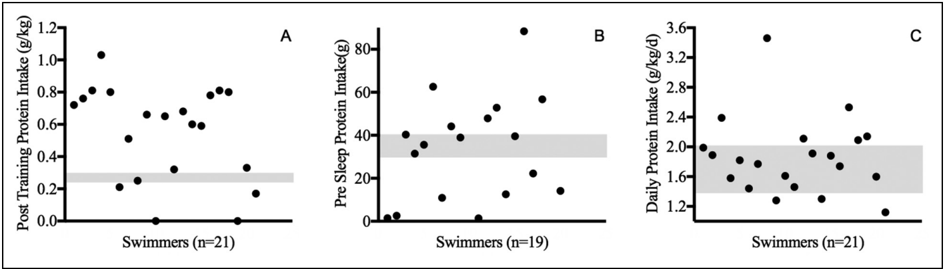
Background: Proteins are essential for the maintenance, repair, and growth of muscle mass. This is particularly important for master athletes because aging has been associated with loss of muscle mass, function, and strength. Moreover, the timing of intake has been shown important for the best protein utilization. Aim: To analyze timing, quantity, and source of dietary protein in competitive master athletes according to current recommendations. Methods: Twenty-one male master swimmers (47.9 ± 10.0 years; 79.2 ± 6.5 kg; 179.1 ± 5.5 cm; 23.5 ± 4.9% body fat; 73.3 ± 4.2% lean mass) participated in this cross-sectional study. Protein intake was analyzed based on 7-day food records, regarding quantity, timing, and sources of intake. Protein intake was evaluated according to current international sports nutrition guidelines, including the International Society of Sports Nutrition Position Stand. Body fat (%) and lean mass (%) were evaluated using dual-energy X-ray absorptiometry. Results: Participants' mean protein intakes were 1.9 ± 0.5 g/kg/day, 0.6 ± 0.2 g/kg/meal post-training, and 33.5 ± 23.9 g during the pre-sleep period. Daily intake was within the recommended values of 1.4 and 2.0 g/kg/day ( p = 0.01 and 0.147, respectively). Mean pre-sleep intake was within the recommendation values of 30–40 g ( p = 0.28 and 0.147, respectively). Most of the daily protein intake was consumed at lunch (66.7 ± 6.9 g) and dinner (48.0 ± 4.5 g). Regarding protein sources, intakes from animal, vegetal, and supplements were, respectively, 65.7%, 29.2%, and 5.1%. Conclusion: Master swimmers presented a total protein intake within the recommendations for a daily basis, but the majority of intake was at lunch and dinner. Protein intake could be better distributed throughout the day to optimize protein synthesis. Guidance on daily protein intake distribution should be reinforced in clinical practice.
Overview
CoChat Summary
TL;DR
In 21 male master swimmers, total daily protein intake averaged 1.9 ± 0.5 g/kg/day, within sports-nutrition recommendations, but intake was concentrated at lunch and dinner and small meals were often below recommended per-meal amounts. Pre-sleep and post-training intakes were generally at or above recommendations, suggesting timing and distribution should be targeted in practice.
Key findings
- Daily protein intake was 1.9 ± 0.5 g/kg/day, within the recommended 1.4–2.0 g/kg/day (p = 0.01 and 0.147, respectively). Protein sources were 65.7% animal, 29.2% vegetable, and 5.1% supplements (exclusively whey); only 8 of 21 swimmers (38%) consumed supplements.
- Protein intake was concentrated in lunch and dinner; Table 3 reports lunch at 65.0 ± 17.3 g and dinner at 46.2 ± 11.7 g, with a significant meal effect (p < 0.001, η² = 0.53). Intake at smaller meals (snacks and supper) was below the recommendation for distribution throughout the day (p < 0.05).
- Post-training protein intake was 0.6 ± 0.2 g/kg/meal, above the 0.25–0.30 g/kg recommendation and approximately twice the recommended amount. Pre-sleep intake was 33.5 ± 23.9 g, within the 30–40 g recommendation (p = 0.28 and 0.147, respectively); 66.7% of swimmers met or exceeded the pre-sleep recommendation.
- Body composition was 23.5 ± 4.9% body fat and 73.3 ± 4.2% lean mass; mean age was 47.9 ± 10.0 years.
Methods
- Cross-sectional study of 21 male master swimmers (79.2 ± 6.5 kg; 179.1 ± 5.5 cm) recruited from four sports centers in Porto Alegre, Brazil. Inclusion criteria included male sex, age 25–65 years, swim training at least 3 times/week, at least 2000 m/day per training, regular swim training for the past 2 years, and official competition in the previous year.
- Protein intake was assessed using 7-consecutive-day food records via the Dietbox smartphone app, with intake expressed as total daily, per meal, post-training, pre-sleep, and by source (animal, vegetable, supplement). Body fat and lean mass were measured by dual-energy X-ray absorptiometry (DXA).
- Intake was compared with current sports nutrition recommendations (total 1.4–2.0 g/kg/day; 20–25 g/meal; post-exercise 0.25–0.30 g/kg within ≤3 h; pre-sleep 30–40 g up to 2 h before sleep). Generalized estimating equations with Bonferroni post-hoc tested meal differences; one-sample t-tests compared intake with recommendations; significance was p ≤ 0.05. Estimated required sample was 17; final sample was 21, with post hoc statistical power of 0.90.
Limitations
- The paper states that protein intake was assessed through food records, which are subject to participant reporting, require engagement, and might alter consumption; it also states that the sample size may not be generalizable to all swimmers and that studies with master athletes typically do not present large samples.
- Evident from the text but not explicitly framed as limitations: the cross-sectional convenience sample was all male, drawn from four sports centers in one city, so findings may not extend to female athletes, other sports, or other regions; self-reported dietary data covered one training week; and only 8 of 21 participants consumed supplements, limiting supplement-related inferences.
Model-written summary. Check it against the paper before relying on it.
Integrity signals
Registry
Cites
Statistics
Figures

Verification
Claims the paper makes
0 Valid · 0 Not valid · 22 Not checked · 22 Own results and interpretations
A result the paper reports from its own data — it cites no other source for it, so there is none to check. The quote shows it is in the paper.
In the paper
“The total daily protein intake of the master swimmers was concentrated on main meals, such as lunch (28.5% of TEI) and dinner (20.5% of TEI), followed by breakfast (8.8% of TEI).”
§ Protein intake by master swimmers: Implications for practice in Sports Nutrition-A cross-sectional study > Results
plainstates an association- Asserted: passes — The authors put it forward as true.
- Checkable: passes — It can be checked against evidence.
- Load-bearing: passes — The paper’s conclusions depend on it.
- Based: passes — The paper gives a reason why it holds.
A result the paper reports from its own data — it cites no other source for it, so there is none to check. The quote shows it is in the paper.
In the paper
“Most of the master swimmers' post-training protein intake was above the recommendation of 0.25-0.30g/kg.”
§ Protein intake by master swimmers: Implications for practice in Sports Nutrition-A cross-sectional study > Results
plain- Asserted: passes — The authors put it forward as true.
- Checkable: passes — It can be checked against evidence.
- Load-bearing: unclear — It is unclear whether the paper’s conclusions depend on it.
- Based: passes — The paper gives a reason why it holds.
A result the paper reports from its own data — it cites no other source for it, so there is none to check. The quote shows it is in the paper.
In the paper
“Protein intake in small meals (snacks and supper) was lower than the recommendation for the distribution of protein intake throughout the day (p < 0.05).”
§ Protein intake by master swimmers: Implications for practice in Sports Nutrition-A cross-sectional study > Results
plain- Asserted: passes — The authors put it forward as true.
- Checkable: passes — It can be checked against evidence.
- Load-bearing: passes — The paper’s conclusions depend on it.
- Based: passes — The paper gives a reason why it holds.
A result the paper reports from its own data — it cites no other source for it, so there is none to check. The quote shows it is in the paper.
In the paper
“At the pre-sleep period, 66.7% of swimmers met the recommendation or ate above the recommended amount of protein intake.”
§ Protein intake by master swimmers: Implications for practice in Sports Nutrition-A cross-sectional study > Results
plain- Asserted: passes — The authors put it forward as true.
- Checkable: passes — It can be checked against evidence.
- Load-bearing: unclear — It is unclear whether the paper’s conclusions depend on it.
- Based: passes — The paper gives a reason why it holds.
A result the paper reports from its own data — it cites no other source for it, so there is none to check. The quote shows it is in the paper.
In the paper
“Protein intake at the pre-sleep period showed great variability among athletes.”
§ Protein intake by master swimmers: Implications for practice in Sports Nutrition-A cross-sectional study > Results
plain- Asserted: passes — The authors put it forward as true.
- Checkable: passes — It can be checked against evidence.
- Load-bearing: unclear — It is unclear whether the paper’s conclusions depend on it.
- Based: passes — The paper gives a reason why it holds.
10 more claims
Create a free account to see all 44 claims and to verify the 26 references still open.
- It may state two separate claims as one. 17
- Probably not a substantial claim. 18
Claims other papers make about this one
Each is checked against this paper’s own text: does it say what the citing paper says it does?
In the citing paper
“Seven studies examined master athletes with an endurance-based background (triathlon, running, swimming) [22,23,24,25,26,27,28]”
From Protein Intake, Physical Performance and Body Composition in Master Athletes—A Short Scoping Review (2025) · cites this paper as [22]
In the citing paper
“Six cross-sectional studies [17,22,29,30,31] and one before–after study [27] reported daily protein intakes, ranging between 1.0 and 1.9 g/kg/d.”
From Protein Intake, Physical Performance and Body Composition in Master Athletes—A Short Scoping Review (2025) · cites this paper as [22]
Self-check
Percentages, sums and reported differences re-computed from the paper’s own numbers.
Each contradiction between two passages listed here was confirmed by an independent check.
Rated major: it would touch a result — a value a result rests on, reported and recomputed p-values on opposite sides of the significance level, two passages that conflict with no sign which is right, or a cited work retracted before this paper was published.
In the paper
§ Protein intake by master swimmers: Implications for practice in Sports Nutrition-A cross-sectional study > Abstract
“Most of the daily protein intake was consumed at lunch (66.7 ± 6.9 g) and dinner (48.0 ± 4.5 g).”
§ Protein intake by master swimmers: Implications for practice in Sports Nutrition-A cross-sectional study > Authors' note
“| Protein | 19.7 ± 10.4 a | 8.3 ± 11.8 b | 65.0 ± 17.3 c | 7.2 ± 4.8 b | 7.8 ± 5.8 b | 46.2 ± 11.7 d | 7.5 ± 5.8 b | <0.001 | 0.53 |”
Rated minor: it would not touch a result — a value no result rests on, a p-value that stays on the same side of the significance level, or a conflict that is clerical, resolved elsewhere in the paper, or outside its own findings.
In the paper
“Twenty-one male master swimmers with a mean age of 47.9 ± 10.0 years were included in the study.More than half (54%, n = 12) of the swimmers were engaged in complementary exercise”
§ Protein intake by master swimmers: Implications for practice in Sports Nutrition-A cross-sectional study > Results
Reported 54 · recomputed 57.142857
Rated minor: it would not touch a result — a value no result rests on, a p-value that stays on the same side of the significance level, or a conflict that is clerical, resolved elsewhere in the paper, or outside its own findings.
In the paper
“| Protein | 19.7 ± 10.4 a | 8.3 ± 11.8 b | 65.0 ± 17.3 c | 7.2 ± 4.8 b | 7.8 ± 5.8 b | 46.2 ± 11.7 d | 7.5 ± 5.8 b | <0.001 | 0.53 |”
§ Protein intake by master swimmers: Implications for practice in Sports Nutrition-A cross-sectional study > Authors' note
Reported 65 · recomputed 67.5
Citations
Cites
Eta squared and partial eta squared as measures of effect size in educational research
Richardson, J. T. E. (2011) · Educational Research Review · doi:10.1016/j.edurev.2010.12.001 · Cited by 3,866
Thomas, D. T., Erdman, K. A., & Burke, L. M. (2016) · Journal of the Academy of Nutrition and Dietetics · doi:10.1016/j.jand.2015.12.006 · Cited by 1,359 · cited 1×
“Besides total daily intake, guidelines for athletes recommend a protein intake of 20 – 25 g or 0.25 – 0.3 g/kg at the main meals (lunch and dinner) as well as at intermediate ones (snacks) (Areta et al., 2013; Jäger et al., 2017; Thomas et al., 2016).”
InfluentialProtein content and amino acid composition of commercially available plant-based protein isolates
Gorissen, S. H. M., Crombag, J. J. R., Senden, J. M. G., Waterval, W. A. H., Bierau, J., Verdijk, L. B., & van Loon, L. J. C. (2018) · Amino Acids · doi:10.1007/s00726-018-2640-5 · Cited by 1,169
Tang, J. E., Moore, D. R., Kujbida, G. W., Tarnopolsky, M. A., & Phillips, S. M. (2009) · Journal of Applied Physiology · doi:10.1152/japplphysiol.00076.2009 · Cited by 998
International Society of Sports Nutrition Position Stand: protein and exercise
Jäger, R., Kerksick, C. M., Campbell, B. I., Cribb, P. J., Wells, S. D., Skwiat, T. M., Purpura, M., Ziegenfuss, T. N., Ferrando, A. A., Arent, S. M., et al. (2017) · Journal of the International Society of Sports Nutrition · doi:10.1186/s12970-017-0177-8 · Cited by 873 · cited 7×
“Products containing animal and dairy proteins contain the highest percentage of branched-chain amino acids (Jäger et al., 2017).”
InfluentialThe aging neuromuscular system and motor performance
Hunter, S. K., Pereira, H. M., & Keenan, K. G. (2016) · Journal of Applied Physiology · doi:10.1152/japplphysiol.00475.2016 · Cited by 532
Wilkinson, S. B., Tarnopolsky, M. A., MacDonald, M. J., MacDonald, J. R., Armstrong, D., & Phillips, S. M. (2007) · The American Journal of Clinical Nutrition · doi:10.1093/ajcn/85.4.1031 · Cited by 530
Areta, J. L., Burke, L. M., Ross, M. L., Camera, D. M., West, D. W. D., Broad, E. M., Jeacocke, N. A., Moore, D. R., Stellingwerff, T., Phillips, S. M., et al. (2013) · The Journal of Physiology · doi:10.1113/jphysiol.2012.244897 · Cited by 495
Yang, Y., Breen, L., Burd, N. A., Hector, A. J., Churchward-Venne, T. A., Josse, A. R., Tarnopolsky, M. A., & Phillips, S. M. (2012) · British Journal of Nutrition · doi:10.1017/s0007114511007422 · Cited by 480
Hawkins, S. A., & Wiswell, R. A. (2003) · Sports Medicine · doi:10.2165/00007256-200333120-00002 · Cited by 422
Research works printed but not linked: 1
- de Mello AV, Villarim WLF, Machado AD, et al. (2015) Assessment of body composition and dietary intake of adolescent swimmers. Revista Brasileira de Medicina do Esporte 21(5): 381–385.
Cited by
Jahan-Mihan, A., Khoury, D. T. D. E., Brewer, G. J., & Chapleau, A. (2025) · Nutrients · doi:10.3390/nu17223528 · Cited by 12
Protein Intake, Physical Performance and Body Composition in Master Athletes—A Short Scoping Review
Franzke, B., Maierhofer, R., & Putz, P. (2025) · Nutrients · doi:10.3390/nu17030498 · Cited by 3
Metadata
- Authors
- Santos de Souza, M., Zaleski Trindade, C. D., Castro, F. A. D. S., Buss, C., & Schneider, C. D.
- Affiliations
- Course of Nutrition, Federal University of Health Sciences of Porto Alegre, Porto Alegre, Brazil
- Aquatic Sports Research Group, Federal University of Rio Grande do Sul, Porto Alegre, Brazil
- Universidade Federal do Rio Grande do Sul (BR)
- Universidade Federal de Ciências da Saúde de Porto Alegre (BR)
- Corresponding author
- Schneider, Cláudia Dornelles
- Venue
- Nutrition and Health
- Publisher
- SAGE Publications
- Published
- 2024-08-31
- Volume
- 31
- Issue
- 3
- Pages
- 1095-1101
- ISSN
- 0260-1060 (ISSN-L)
- 2047-945X
- OpenAlex
- W4402094504
- Semantic Scholar
- e2c566414372c15edef09ef9aa82e56311878fd6
- Cited by
- 2
- References
- 37
- Citations by year
- 2025: 2
- FWCI
- 0.46
- Type
- journal article
- Language
- en
- Open access
- green
- hdl.handle.net
- Licence
- cc-by-nc-sa
- journals.sagepub.com/page/policies/text-and-data-mining-license (tdm)
- Locations
- Nutrition and Health (publishedVersion)
- PubMed (publishedVersion)
- Lume (Universidade Federal do Rio Grande do Sul) (submittedVersion, cc-by-nc-sa)
- Funders
- Coordenação de Aperfeiçoamento de Pessoal de Nível Superior (001)
- Topics
- Health Sciences › Nursing › Nutrition and Dietetics › Muscle metabolism and nutrition
- Health Sciences › Medicine › Orthopedics and Sports Medicine › Sports Performance and Training
- Health Sciences › Medicine › Physiology (medical) › Nutrition and Health in Aging
- Keywords
- protein intake, master swimmers, older athletes, protein timing, protein distribution, protein sources, protein supplements, lean body mass, muscle mass
- MeSH terms
- Adult, Body Composition, Energy Intake, Cross-Sectional Studies, Diet, Dietary Proteins, Humans, Male, Middle Aged, Swimming, Diet Records, Athletes, Sports Nutritional Physiological Phenomena
About these checks
Registry, retraction, Cites and statistics results are computed, not judged, with one exception: a printed reference that no index lists is read once by a model before it counts as a citation error. Claims are extracted by a model and kept only when their quote appears verbatim in the text; each cited source is then checked, with a model’s help, for whether it says what the claim relies on. Those verdicts can be wrong — read the claim’s quote and the cited source before relying on one.
A language model drew the claims from the paper on 2026-11-14, under version 3 of the claim definition (model deepseek-v4.1-flash, prompt extract-v3).
A second model labelled each claim on 2026-11-14 (model jev-1.13-20260917, definition revision gold-guideline-v0.2).
Statistics and arithmetic are recomputed, not judged.
Confidence bands are shown only for fields calibrated on our annotated test set. None is calibrated yet, so no band is shown.
What counts as a claim ›How we measure confidence ›How we check this ›
Are you an author, or do you see a problem with this page? Request a review
How to cite
Cite CoChat for the checks on this page, and the paper for its own findings.
- This page
- CoChat. (2026). Citation check: Protein intake by master swimmers: Implications for practice in Sports Nutrition—A cross-sectional study. https://app.cochat.ai/papers/10.1177/02601060241276918
- The paper
- Santos de Souza, M., Zaleski Trindade, C. D., Castro, F. A. D. S., Buss, C., & Schneider, C. D. (2025). Protein intake by master swimmers: Implications for practice in Sports Nutrition—A cross-sectional study. Nutrition and Health. https://doi.org/10.1177/02601060241276918
Data sources
Bibliographic data: Semantic Scholar, OpenAlex, Crossref.
Contains information from the Semantic Scholar Academic Graph Datasets, made available under the ODC Attribution License (ODC-BY 1.0).
Semantic Scholar’s data is described in: Kinney, R., et al. (2023). The Semantic Scholar Open Data Platform. arXiv:2301.10140.
