

Lack of effect of ketamine on cortical glutamate and glutamine in healthy volunteers: a proton magnetic resonance spectroscopy study
Open accessThe DOI matches its Crossref record; 21 of the 21 references it cites were found in a registry or an index.
Abstract
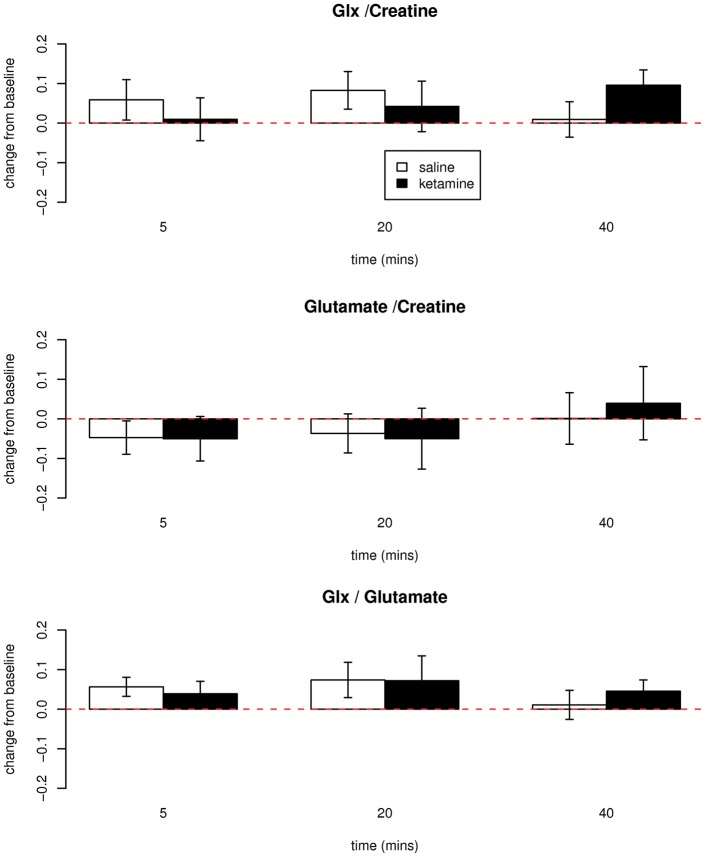
Ketamine is a N-methyl-D-aspartic acid (NMDA) antagonist that has been associated with temporary clinical improvement in patients with depression. Studies using magnetic resonance spectroscopy (MRS) have shown that major depression is associated with decreased levels of glutamate and glutamine (Glx) in the anterior cingulate cortex, which normalize with clinical recovery. The present study aimed to test whether a ketamine infusion would increase cortical Glx levels in healthy volunteers. Healthy volunteers received an intravenous infusion of ketamine (0.5 mg kg −1 , n = 8) or saline ( n = 9) over 40 minutes. MRS measurements were obtained at baseline, during, and at the end of the infusion. The infusion of ketamine had significant effects on mental state but there was no effect of ketamine on the levels of Glx ( F 3,39 = 1.70, p = 0.18) or glutamate ( F 3,39 = 48, p = 0.70). This study suggests that the gradual infusion of low-dose ketamine in antidepressant doses not cause changes in cortical glutamate or glutamine in healthy volunteers that are visible by proton MRS.
Overview
The claims and statistics of this paper haven’t been checked yet.
Free: it reads the open-access text and checks the first 5 claims that cite a source we can check. Create a free account to check every claim.
Integrity signals
Registry
Cites
Statistics
Figures
Verification
Claims the paper makes
The claims and statistics of this paper haven’t been checked yet.
Free: it reads the open-access text and checks the first 5 claims that cite a source we can check. Create a free account to check every claim.
Self-check
Percentages, sums and reported differences re-computed from the paper’s own numbers.
The self-check needs the paper’s full text.
Citations
Cites
Zhang, Y., Brady, M., & Smith, S. (2001) · IEEE Transactions on Medical Imaging · doi:10.1109/42.906424 · Cited by 6,982 · cited 1×
“FMRIB’s Automated Segmentation Tool (FAST) (Zhang et al., 2001) was employed to segment the structural brain images into grey matter, white matter, and CSF, to allow estimation of voxel composition.”
Antidepressant effects of ketamine in depressed patients
Berman, R. M., Cappiello, A., Anand, A., Oren, D. A., Heninger, G. R., Charney, D. S., & Krystal, J. H. (2000) · Biological Psychiatry · doi:10.1016/s0006-3223(99)00230-9 · Cited by 3,856 · cited 2×
“Ketamine is a N-methyl-D-aspartic acid (NMDA) antagonist and clinically used anaesthetic that has been employed in subanaesthetic doses to bring about temporary clinical improvement in patients with treatment-resistant depression (Berman et al., 2000; Zarate et al., 2006).”
A randomized trial of an N-methyl-D-aspartate antagonist in treatment-resistant major depression.
Zarate, C. A., Singh, J. B., Carlson, P. J., Brutsche, N. E., Ameli, R., Luckenbaugh, D. A., Charney, D. S., & Manji, H. K. (2006) · Archives of General Psychiatry · doi:10.1001/archpsyc.63.8.856 · Cited by 3,766 · cited 4×
“Ketamine treatment of depression may have effects after completion of the infusion when clinical benefits can be observed (Zarate et al., 2006).”
InfluentialKrystal, J. H. (1994) · Archives of General Psychiatry · doi:10.1001/archpsyc.1994.03950030035004 · Cited by 3,330 · cited 2×
“The extent of these subjective changes was similar to that reported in other ketamine studies in healthy volunteers (Krystal et al., 1994) and also in depressed patients receiving ketamine for its antidepressant effect (Diazgranados et al.”
The SPQ: A Scale for the Assessment of Schizotypal Personality Based on DSM-III-R Criteria
Raine, A. (1991) · Schizophrenia Bulletin · doi:10.1093/schbul/17.4.555 · Cited by 2,164 · cited 2×
“Baseline personality ratings were measured using the Eysenck Personality Questionnaire (EPQ), Schizotypal Personality Questionnaire (SPQ) (Raine 1991), and Oxford–Liverpool Inventory of Feelings and Experiences (OLIFE) (Mason et al., 2006) in case such factors were associated with response to ketamine.”
MethodMoghaddam, B., Adams, B., Verma, A., & Daly, D. (1997) · The Journal of Neuroscience · doi:10.1523/jneurosci.17-08-02921.1997 · Cited by 1,793 · cited 3×
“In preclinical studies, low-dose ketamine increases glutamate outflow in the prefrontal cortex (Moghaddam et al., 1997).”
InfluentialAutomatic quantitation of localized in vivo1H spectra with LCModel
Provencher, S. W. (2001) · NMR in Biomedicine · doi:10.1002/nbm.698 · Cited by 1,634 · cited 2×
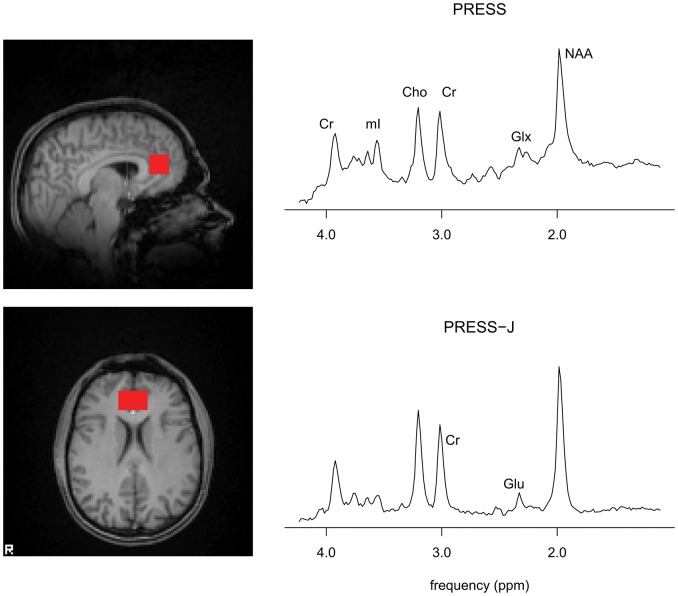
“PRESS data were analysed with LCModel software (Provencher, 2001), using the non-water suppressed data for eddy current correction and water referencing, calculating metabolite concentrations for Glx, myo-inositol, choline and N-acetylaspartate relative to creatine in conventional fashion using metabolite basis spectr…”
Improved Method for Accurate and Efficient Quantification of MRS Data with Use of Prior Knowledge
Vanhamme, L., van den Boogaart, A., & Van Huffel, S. (1997) · Journal of Magnetic Resonance · doi:10.1006/jmre.1997.1244 · Cited by 1,627 · cited 2×
“Measurements from the PRESS-J spectra were performed using AMARES (Advanced method for accurate, robust and efficient spectral fitting) (Vanhamme et al., 1997).”
Homayoun, H., & Moghaddam, B. (2007) · The Journal of Neuroscience · doi:10.1523/jneurosci.2213-07.2007 · Cited by 1,231 · cited 2×
“This is thought to reflect a loss of inhibitory tone from GABAergic interneurons on cortical pyramidal neurons, since NMDA receptors preferentially drive the interneurons in awake cortex (Homayoun et al., 2007).”
BackgroundDiazgranados, N., Ibrahim, L., Brutsche, N. E., Newberg, A., Kronstein, P., Khalife, S., Kammerer, W. A., Quezado, Z., Luckenbaugh, D. A., Salvadore, G., et al. (2010) · Archives of General Psychiatry · doi:10.1001/archgenpsychiatry.2010.90 · Cited by 963 · cited 1×
“The extent of these subjective changes was similar to that reported in other ketamine studies in healthy volunteers (Krystal et al., 1994) and also in depressed patients receiving ketamine for its antidepressant effect (Diazgranados et al., 2010).”
Result
Research works printed but not linked: 1
- First MB Spitzer RL Gibbon M Williams JBW (1997) Structured Clinical Interview for DSM-IV Axis I disorders – Clinician Version (SCID-CV). Washington, DC: American Psychiatric Press
Cited by
Lener, M. S., Niciu, M. J., Ballard, E. D., Park, M., Park, L. T., Nugent, A. C., & Zarate, C. A. (2017) · Biological Psychiatry · doi:10.1016/j.biopsych.2016.05.005 · Cited by 468
“, 2012 (88) Healthy subjects N 5 17 (11 men, 6 women) (1)H-MRS, 3T MRI, 30 3 20 3 20 mm voxel placed in the ACC and mPFC; quantification of Glx, Glu, Gln; images acquired before, during, and after infusion Double-blind, placebo-controlled, single infusion; IV ketamine 0.”
InfluentialAbdallah, C. G., Sanacora, G., Duman, R. S., & Krystal, J. H. (2015) · Annual Review of Medicine · doi:10.1146/annurev-med-053013-062946 · Cited by 422
“1H-MRS studies in healthy subjects reported a transient increase in glutamate or glutamine levels in the PFC (91, 92), although not a consistent one (93).”
BackgroundKetamine for Depression: Where Do We Go from Here?
aan het Rot, M., Zarate, C. A., Charney, D. S., & Mathew, S. J. (2012) · Biological Psychiatry · doi:10.1016/j.biopsych.2012.05.003 · Cited by 418
“In healthy volunteers, ketamine does not appear to affect brain glutamate levels even during IV infusion (55).”
BackgroundCortical GABAergic Dysfunction in Stress and Depression: New Insights for Therapeutic Interventions
Fogaça, M. V., & Duman, R. S. (2019) · Frontiers in Cellular Neuroscience · doi:10.3389/fncel.2019.00087 · Cited by 396
Randomized Controlled Crossover Trial of Ketamine in Obsessive-Compulsive Disorder: Proof-of-Concept
Rodriguez, C. I., Kegeles, L. S., Levinson, A., Feng, T., Marcus, S. M., Vermes, D., Flood, P., & Simpson, H. B. (2013) · Neuropsychopharmacology · doi:10.1038/npp.2013.150 · Cited by 386
“MRS of the effects of ketamine in the prefrontal cortex and other brain regions have been assessed (Rowland et al , 2005; Stone et al , 2012; Taylor et al , 2012; Valentine et al , 2011) and in some cases (but not all) a ketamine-induced increase in glutamatergic compounds has been reported.”
Metadata
- Authors
- Taylor, M. J., Tiangga, E. R., Mhuircheartaigh, R. N., & Cowen, P. J.
- Affiliations
- University of Oxford (GB)
- Centre for Functional Resonance Imaging of the Brain (FMRIB), University of Oxford, Oxford, UK
- Corresponding author
- Taylor, Matthew J
- Venue
- Journal of Psychopharmacology
- Publisher
- SAGE Publications
- Published
- 2011-05-26
- Volume
- 26
- Issue
- 5
- Pages
- 733-737
- ISSN
- 0269-8811 (ISSN-L)
- 1461-7285
- PMC
- PMC3546630
- OpenAlex
- W2153495871
- Cited by
- 66
- References
- 21
- Citations by year
- 2026: 1 · 2025: 3 · 2024: 2 · 2023: 2 · 2022: 3 · 2021: 3 · 2020: 3 · 2019: 5 · 2018: 10 · 2017: 2 · 2016: 9 · 2015: 6 · 2014: 5 · 2013: 7 · 2012: 2
- FWCI
- 3.98
- Type
- journal article
- Language
- en
- Open access
- hybrid
- doi.org
- Licence
- cc-by-nc
- journals.sagepub.com/page/policies/text-and-data-mining-license (tdm)
- Locations
- Journal of Psychopharmacology (publishedVersion, cc-by-nc)
- Europe PMC (PubMed Central) (publishedVersion, cc-by)
- PubMed Central (publishedVersion, cc-by)
- PubMed (publishedVersion)
- Research Portal (King's College London) (submittedVersion, other-oa)
- Funders
- National Institute for Health and Care Research
- Medical Research Council
- Topics
- Health Sciences › Medicine › Pharmacology (medical) › Treatment of Major Depression
- Health Sciences › Medicine › Psychiatry and Mental health › Electroconvulsive Therapy Studies
- Health Sciences › Medicine › Radiology, Nuclear Medicine and Imaging › Advanced MRI Techniques and Applications
- Keywords
- ketamine, glutamate, glutamine, NMDA receptor antagonists, depression, anterior cingulate cortex, low-dose ketamine infusion, healthy volunteers
- MeSH terms
- Adult, Cerebral Cortex, Major Depressive Disorder, Female, Glutamine, Humans, Ketamine, Magnetic Resonance Imaging, Male, Magnetic Resonance Spectroscopy, Protons, Glutamic Acid, Young Adult
About these checks
Registry, retraction, Cites and statistics results are computed, not judged, with one exception: a printed reference that no index lists is read once by a model before it counts as a citation error. Claims are extracted by a model and kept only when their quote appears verbatim in the text; each cited source is then checked, with a model’s help, for whether it says what the claim relies on. Those verdicts can be wrong — read the claim’s quote and the cited source before relying on one.
Statistics and arithmetic are recomputed, not judged.
Confidence bands are shown only for fields calibrated on our annotated test set. None is calibrated yet, so no band is shown.
What counts as a claim ›How we measure confidence ›How we check this ›
Are you an author, or do you see a problem with this page? Request a review
Data sources
Bibliographic data: Semantic Scholar, OpenAlex, Crossref.
Contains information from the Semantic Scholar Academic Graph Datasets, made available under the ODC Attribution License (ODC-BY 1.0).
Semantic Scholar’s data is described in: Kinney, R., et al. (2023). The Semantic Scholar Open Data Platform. arXiv:2301.10140.
