

The DOI matches its Crossref record; 96 of the 96 references it cites were found in a registry or an index.
Barriers to Men’s Help Seeking for Intimate Partner Violence
Open accessAbstract
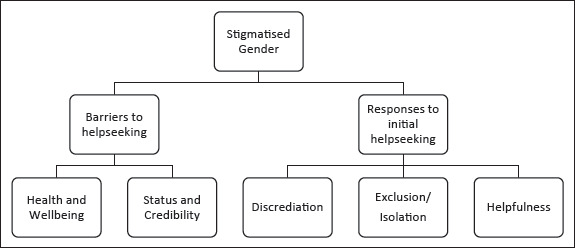
Evidence suggests that male victims of intimate partner violence (IPV) are less likely to seek help for their victimization than female victims. Studies exploring barriers to help seeking are relatively scarce in the United Kingdom (UK) and those that have been undertaken across Europe, United States, Canada, and Australia have tended to rely on small samples of help-seeking men who have self-identified as victims of IPV. With a view to include more male victim voices in the literature, an anonymous qualitative questionnaire was distributed via social media. In total, 147 men (85% from the UK) who self-identified as being subject to abuse from their female partners, completed the questionnaire. The data was subjected to a deductive thematic analysis and one superordinate and two overarching themes were identified. The superordinate theme was stigmatized gender and the two overarching themes (subthemes in parentheses) were barriers prohibiting help seeking (status and credibility, health and well-being) and responses to initial help seeking (discreditation, exclusion/isolation, and helpfulness). The findings are discussed in the context of Overstreet and Quinn’s (2013) interpersonal violence and stigma model and findings from previous research. The conclusions and recommendations promote education and training and advocate a radical change to policy.
Overview
The claims and statistics of this paper haven’t been checked yet.
Run the check — free, no account needed. It reads the open-access text and checks the sources it cites.
Integrity signals
Registry
Cites
Statistics
Figures
Verification
Claims the paper makes
The claims and statistics of this paper haven’t been checked yet.
Run the check — free, no account needed. It reads the open-access text and checks the sources it cites.
Claims other papers make about this one
Each is checked against this paper’s own text: does it say what the citing paper says it does?
The source backs part of the claim, not all of it — or backs it for a different population, condition or comparison.
In the citing paper
“Male victims are less likely to seek help for their victimization than female victims (female 81%, male 57%).”
From Help‐seeking behavior of male victims of intimate partner violence in Japan (2024) · cites this paper as [14]
Experimental — accuracy not yet measuredThe source backs part of the claim, not all of it — or backs it for a different population, condition or comparison.
In the citing paper
“There is no empirical consensus regarding IPV experience prevalence among men, variation in the type of IPV experiences, nor in any differences or unique needs resulting from these experiences (Scott-Storey et al., 2023; Taylor et al., 2022).”
From Experiences and Impacts of Intimate Partner Violence Against Men in Northern Ireland: Qualitative Findings from the Male Experiences of Intimate Partner Violence Study (2026) · cites this paper as Taylor et al., 2022
Experimental — accuracy not yet measuredThe source backs part of the claim, not all of it — or backs it for a different population, condition or comparison.
In the citing paper
“Under-reporting also affects these rates, as many men who have experienced IPV are unaware their experiences meet the definition of abuse (Bates, 2020a, 2020b; Taylor et al., 2022).”
From Experiences and Impacts of Intimate Partner Violence Against Men in Northern Ireland: Qualitative Findings from the Male Experiences of Intimate Partner Violence Study (2026) · cites this paper as Taylor et al., 2022
Experimental — accuracy not yet measuredThe source backs part of the claim, not all of it — or backs it for a different population, condition or comparison.
In the citing paper
“To date, IPV against cisgender women and its impacts have been widely researched, but the experiences of men remain understudied (Scott-Storey et al., 2023; Taylor et al., 2022).”
From Experiences and Impacts of Intimate Partner Violence Against Men in Northern Ireland: Qualitative Findings from the Male Experiences of Intimate Partner Violence Study (2026) · cites this paper as Taylor et al., 2022
Experimental — accuracy not yet measuredThe cited source says what the claim attributes to it.
In the citing paper
“Men are more likely to either not report due to psychosocial and cultural influences, or to not recognise their experiences as IPV (Bates, 2020b; Taylor et al., 2022).”
From Experiences and Impacts of Intimate Partner Violence Against Men in Northern Ireland: Qualitative Findings from the Male Experiences of Intimate Partner Violence Study (2026) · cites this paper as Taylor et al., 2022
The cited source says what the claim attributes to it.
In the citing paper
“They may fail to report due to self and societal stigma, retaliation concerns, and fear of not being believed (Walker et al., 2020; Bates, 2020a; Taylor et al., 2022).”
From Experiences and Impacts of Intimate Partner Violence Against Men in Northern Ireland: Qualitative Findings from the Male Experiences of Intimate Partner Violence Study (2026) · cites this paper as Taylor et al., 2022
The cited source says what the claim attributes to it.
In the citing paper
“Lack of disclosure in men can be driven by the fear that their experiences would be minimised/ignored/not believed, or they themselves would be accused of perpetrating abuse (Walker et al., 2020; Bates, 2020a; Taylor et al., 2022).”
From Experiences and Impacts of Intimate Partner Violence Against Men in Northern Ireland: Qualitative Findings from the Male Experiences of Intimate Partner Violence Study (2026) · cites this paper as Taylor et al., 2022
Self-check
Percentages, sums and reported differences re-computed from the paper’s own numbers.
The self-check needs the paper’s full text.
Citations
Cites
Using thematic analysis in psychology
Braun, V., & Clarke, V. (2006) · Qualitative Research in Psychology · doi:10.1191/1478088706qp063oa · Cited by 194,414 · cited 3×
“The main objective of this final step was to ensure that that the final themes represented the lived experiences of the men in the sample and were contextually meaningful (Braun & Clarke, 2006, 2012; Carpenter & Suto, 2008; Guest et al., 2012).”
BackgroundMethodFereday, J., & Muir-Cochrane, E. (2006) · International Journal of Qualitative Methods · doi:10.1177/160940690600500107 · Cited by 11,829
Stigma: Notes on the Management of Spoiled Identity.
Seeman, M. S., & Goffman, E. (1964) · American Sociological Review · doi:10.2307/2091442 · Cited by 10,716
Qualitative research: Methods in the social sciences
(2006) · PsycEXTRA Dataset · doi:10.1037/e668352010-001 · Cited by 10,619
Link, B. G., & Phelan, J. C. (2001) · Annual Review of Sociology · doi:10.1146/annurev.soc.27.1.363 · Cited by 8,848
Guest, G., MacQueen, K., & Namey, E. (2012) · doi:10.4135/9781483384436 · Cited by 7,924
Sex differences in aggression between heterosexual partners: a meta-analytic review
Archer, J. (2000) · Psychological Bulletin · doi:10.1037/0033-2909.126.5.651 · Cited by 2,507 · cited 1×
“This line of inquiry has also confirmed that men can be the victims and women the perpetrators of IPV (Archer, 2000; Breiding, 2014; Desmarais et al., 2012; Dutton et al., 2005).”
BackgroundPhysical and mental health effects of intimate partner violence for men and women
Coker, A. L., Davis, K. E., Arias, I., Desai, S., Sanderson, M., Brandt, H. M., & Smith, P. H. (2002) · American Journal of Preventive Medicine · doi:10.1016/s0749-3797(02)00514-7 · Cited by 2,258 · cited 2×
“…with their physical and mental health as a result of the abuse they had experienced, including posttraumatic stress disorder (PTSD; e.g., Hines & Douglas, 2011), anxiety and depression (Coker et al., 2002; Próspero, 2007; Próspero & Vohra-Gupta, 2007), and suicidality (McLaughlin et al., 2012).”
BackgroundDoing a thematic analysis: A practical, step-by-step guide for learning and teaching scholars.
Maguire, M., & Delahunt, B. (2017) · All Ireland Journal of Higher Education · doi:10.62707/aishej.v9i3.335 · Cited by 2,099 · cited 1×
“A thematic map was produced to ensure that the codes (extracted data) and the entire data set were represented by the themes and subthemes (Braun & Clarke, 2006; Maguire & Delahunt, 2017).”
Method(1979) · Research Explorer (The University of Manchester) · Cited by 1,905
Research works printed but not linked: 7
- Braun V., 2012, vol. 2: Research designs: Quantitative, qualitative, neuropsychological, and biological, 57
- Breiding M. J., 2014, Morbidity and Mortality Weekly Report. Surveillance Summaries, 63, 1
- Heffernan M., 2011, Wilful blindness: Why we ignore the obvious
- Milligan M. (2019). The response of law enforcement in regards to intimate partner violence on male victims within heterosexual relationships [Doctoral dissertation]. University of West Georgia.
- Pence E., 2003, Creating a process of change for men who batter. An education curriculum
- Piga M. L., 2018, Italian Sociological Review, 8, 339
- Wright C., 2016, Plymouth Law and Criminal Justice Review, 8, 333
Cited by
Sorted by citations
Culture, trauma, and memory in investigative interviews
Vredeveldt, A., Given‐Wilson, Z., & Memon, A. (2023) · Psychology Crime and Law · doi:10.1080/1068316x.2023.2209262 · Cited by 35
“Of course, shame and stigma may also explain why men in Western cultures are less likely to report being victims of intimate partner violence (Taylor et al., 2022).”
McLeod, D. A., Ozturk, B., Butler-King, R. L., & Peek, H. (2023) · Trauma Violence & Abuse · doi:10.1177/15248380231177318 · Cited by 21
“Participants said their friends and family would be shocked and surprised, and some reported expectations that family and friends would not believe them or would downplay the seriousness of the abuse (Taylor et al., 2022; Walker et al., 2020).”
BackgroundInfluentialKim, E. Y. Y., Nelson, L. E., Pereira, T. L., & Shorey, S. (2023) · Trauma Violence & Abuse · doi:10.1177/15248380231209435 · Cited by 29
“The attitudes collectively contribute to the trivialization of victimized men, thereby exacerbating their plight (Bates et al., 2019b; Gerber, 1991; Taylor et al., 2022).”
BackgroundInfluentialStein, C., Flor, L. S., Gil, G., Khalil, M., Herbert, M. E., Aravkin, A. Y., Arrieta, A., Baeza, M. J., Bustreo, F., Cagney, J., et al. (2025) · Nature Human Behaviour · doi:10.1038/s41562-025-02144-2 · Cited by 23
Walklate, S., Fitz‐Gibbon, K., Reeves, E., Meyer, S., & McGowan, J. (2022) · Journal of Criminology · doi:10.1177/26338076221127452 · Cited by 18
“Dominant narratives on masculinity can do a disservice to those men who do not fit within it (see also Taylor et al., 2021) and the consequences of this can carry life-changing impacts in terms of mental health problems and risk of suicide (Scourfield and Evans, 2015).”
Background
Metadata
- Authors
- Taylor, J. C., Bates, E. A., Colosi, A., & Creer, A. J.
- Affiliations
- University of Cumbria (GB)
- Corresponding author
- Taylor, Julie C.
- Venue
- Journal of Interpersonal Violence
- Publisher
- SAGE Publications
- Published
- 2021-08-25
- Volume
- 37
- Issue
- 19-20
- Pages
- NP18417-NP18444
- ISSN
- 0886-2605 (ISSN-L)
- 1552-6518
- PMC
- PMC9554285
- OpenAlex
- W3194102121
- Cited by
- 129
- References
- 96
- Citations by year
- 2026: 30 · 2025: 37 · 2024: 27 · 2023: 27 · 2022: 8
- FWCI
- 8.56
- Type
- journal article
- Language
- en
- Open access
- hybrid
- doi.org
- Licence
- Locations
- Journal of Interpersonal Violence (publishedVersion, cc-by-nc)
- PubMed Central (publishedVersion, cc-by-nc)
- PubMed (publishedVersion)
- Insight (University of Cumbria) (acceptedVersion)
- Topics
- Social Sciences › Health › Intimate Partner and Family Violence
- Social Sciences › Gender Studies › Sexual Assault and Victimization Studies
- Health Sciences › Medicine › Geriatrics and Gerontology › Elder Abuse and Neglect
- Keywords
- intimate partner violence, male victims, help-seeking, help-seeking barriers, gender stigma, victim isolation, health and well-being, gender-based violence, United Kingdom
- MeSH terms
- Intimate Partner Violence, Female, Humans, Male, Men, Surveys and Questionnaires, United States, Violence, Crime Victims
About these checks
Registry, retraction, Cites and statistics results are computed, not judged, with one exception: a printed reference that no index lists is read once by a model before it counts as a citation error. Claims are extracted by a model and kept only when their quote appears verbatim in the text; each cited source is then checked, with a model’s help, for whether it says what the claim relies on. Those verdicts can be wrong — read the claim’s quote and the cited source before relying on one.
Statistics and arithmetic are recomputed, not judged.
Confidence bands are shown only for fields calibrated on our annotated test set. None is calibrated yet, so no band is shown.
What counts as a claim ›How we measure confidence ›How we check this ›
Are you an author, or do you see a problem with this page? Request a review
