

Screens, Teens, and Psychological Well-Being: Evidence From Three Time-Use-Diary Studies
Open accessThe DOI matches its Crossref record; 45 of the 45 references it cites were found in a registry or an index.
Abstract
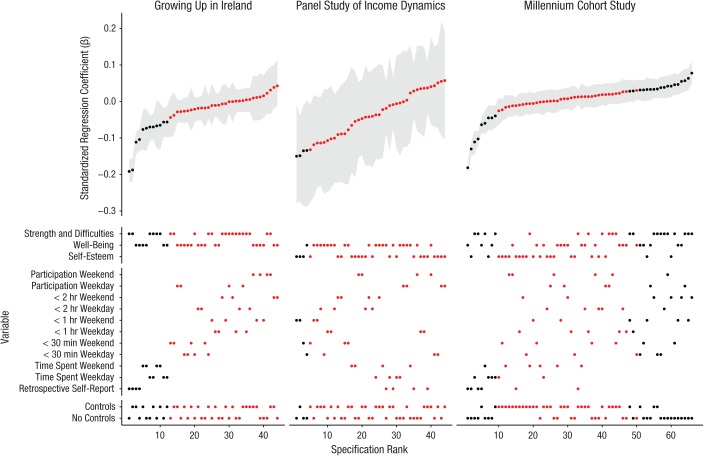
The notion that digital-screen engagement decreases adolescent well-being has become a recurring feature in public, political, and scientific conversation. The current level of psychological evidence, however, is far removed from the certainty voiced by many commentators. There is little clear-cut evidence that screen time decreases adolescent well-being, and most psychological results are based on single-country, exploratory studies that rely on inaccurate but popular self-report measures of digital-screen engagement. In this study, which encompassed three nationally representative large-scale data sets from Ireland, the United States, and the United Kingdom ( N = 17,247 after data exclusions) and included time-use-diary measures of digital-screen engagement, we used both exploratory and confirmatory study designs to introduce methodological and analytical improvements to a growing psychological research area. We found little evidence for substantial negative associations between digital-screen engagement—measured throughout the day or particularly before bedtime—and adolescent well-being.
Overview
The claims and statistics of this paper haven’t been checked yet.
Free: it reads the open-access text and checks the first 5 claims that cite a source we can check. Create a free account to check every claim.
Integrity signals
Registry
Cites
Statistics
Figures
Verification
Claims the paper makes
The claims and statistics of this paper haven’t been checked yet.
Free: it reads the open-access text and checks the first 5 claims that cite a source we can check. Create a free account to check every claim.
Claims other papers make about this one
Each is checked against this paper’s own text: does it say what the citing paper says it does?
The source backs part of the claim, not all of it — or backs it for a different population, condition or comparison.
In the citing paper
“Although the link between social media use and depression is contentious (16, 17), several have nonetheless implicated social media as pervasive and detrimental to psychological well-being.”
From Does Social Media Use Increase Depressive Symptoms? A Reverse Causation Perspective (2021) · cites this paper as [16]
Experimental — accuracy not yet measuredThe cited source says what the claim attributes to it.
In the citing paper
“Therefore, problematic social media use could represent a more clinically meaningful behavior to direct research, as a stronger relationship is seen with adverse mental health symptoms compared to previous studies investigating time spent on social networking sites or screen time in general [23,53,54].”
From Problematic Social Media Use in Adolescents and Young Adults: Systematic Review and Meta-analysis. (2022) · cites this paper as [53]
Self-check
Percentages, sums and reported differences re-computed from the paper’s own numbers.
The self-check needs the paper’s full text.
Citations
Cites
Norman, G. R., Sloan, J. A., & Wyrwich, K. W. (2003) · Medical Care · doi:10.1097/01.mlr.0000062554.74615.4c · Cited by 4,700
An effect size primer: A guide for clinicians and researchers.
Ferguson, C. J. (2009) · Professional Psychology: Research and Practice · doi:10.1037/a0015808 · Cited by 3,467 · cited 3×
“In the preregistration, we also specified a smallest effect size of interest (SESOI; Lakens, Scheel, & Isager, 2017), a concept proposed to avoid the problematic overinterpretation of significant but minimal associations, which are becoming increasingly common in large-scale studies of technology-use outcomes (Ferguso…”
BackgroundResultRobins, R. W., Hendin, H. M., & Trzesniewski, K. H. (2001) · Personality and Social Psychology Bulletin · doi:10.1177/0146167201272002 · Cited by 3,041
(1995) · International Journal of Methods in Psychiatric Research · Cited by 1,847
Goodman, R., Ford, T., Simmons, H., Gatward, R., & Meltzer, H. (2000) · British Journal of Psychiatry · doi:10.1192/bjp.177.6.534 · Cited by 1,818
Twenge, J. M., Joiner, T. E., Rogers, M. L., & Martin, G. N. (2018) · Clinical Psychological Science · doi:10.1177/2167702617723376 · Cited by 1,705
Equivalence Testing for Psychological Research: A Tutorial
Lakens, D., Scheel, A. M., & Isager, P. M. (2018) · Advances in Methods and Practices in Psychological Science · doi:10.1177/2515245918770963 · Cited by 1,560 · cited 1×
“We argue that these effects are therefore too small to merit substantial scientific discussion (Lakens et al., 2017).”
BackgroundThe association between adolescent well-being and digital technology use
Orben, A., & Przybylski, A. K. (2019) · Nature Human Behaviour · doi:10.1038/s41562-018-0506-1 · Cited by 1,500 · cited 8×
“This is in line with results from previous research showing that the association between digital-technology use and well-being often falls below or near this threshold (Ferguson, 2009; Orben & Przybylski, 2019; Twenge, Joiner, Rogers, & Martin, 2017; Twenge, Martin, & Campbell, 2018).”
BackgroundMethodResultInfluentialSelf-citationInternational Journal of Methods in Psychiatric Research
(2006) · International Journal of Methods in Psychiatric Research · doi:10.1002/(issn)1557-0657 · Cited by 1,492
Insufficient Sleep in Adolescents and Young Adults: An Update on Causes and Consequences
Owens, J., ADOLESCENT SLEEP WORKING GROUP, COMMITTEE ON ADOLESCENCE, Au, R., Carskadon, M., Millman, R., Wolfson, A., Braverman, P. K., Adelman, W. P., Breuner, C. C., et al. (2014) · Pediatrics · doi:10.1542/peds.2014-1696 · Cited by 1,413 · cited 1×
“…two exploratory studies detailed above, and from previous literature about the negative effects of technology use during the week on well-being (Harbard et al., 2016; Levenson et al., 2017; Owens, 2014), we derived five specific hypotheses concerning digital engagement and psychological well-being.”
Research works printed but not linked: 2
- Rose G., 1992, The strategy of preventative medicine
- 10.1177/109821400102200202 · doi:10.1177/109821400102200202 · Paper page
Cited by
Items 401–415 of 415
Nocturnal Screen Exposure and Sleep Disturbance
M.Balamurugan, Abror, K., Meyliqulova, M., Svetlana, S., Gozieva, M., Iskandar, S., Zhaksylyk, O., & Raghu, N. (2026) · IGI Global eBooks · doi:10.4018/979-8-2600-2468-3.ch010
Mahala, A., Jayalakshmi, A. V., Chauhan, B., Bauddh, M., & Mahakur, B. K. (2026) · Discover Education · doi:10.1007/s44217-026-01789-z
Opdal, I. M., Bonsaksen, T., Kleppang, A. L., Steigen, A. M., & Stea, T. H. (2026) · Scandinavian Journal of Public Health · doi:10.1177/14034948261459775
Screen Time, Sleep-Interrupted Behaviors, and Depression in a Diverse Sample of Emerging Adults
Huang, C., Tu, B., & Vallario, J. (2026) · Emerging Adulthood · doi:10.1177/21676968261468066
Beyond apps: a method to model full distributions of screen content over time to study media effects
Chi, Y., Cho, M.-J., Molaib, K. M., Sun, X., Robinson, T. N., Ram, N., & Reeves, B. B. (2026) · Communication Methods and Measures · doi:10.1080/19312458.2026.2697199
Digital engagement and adolescent wellbeing: insights from the UK millennium cohort study
Yang, M., Opondo, C., Wang, Y., & Martin, A. (2026) · European Journal of Public Health · doi:10.1093/eurpub/ckag128
Sachdeva, A., Somasundaram, J., & Sharma, K. K. (2026) · Social Science & Medicine · doi:10.1016/j.socscimed.2026.119683
Rethinking Screen Addiction: Patterns of Use and Adolescent Sleep Quality
Yan, X. (2026) · SHS Web of Conferences · doi:10.1051/shsconf/202623604010
Chen, I., Ge, J., Huang, H.-W., Hui, R., Qingqing, L., & Zhou, J. (2026) · Children and Youth Services Review · doi:10.1016/j.childyouth.2026.109292 · Cited by 2
Aktay, A., Bilici, M. V., Karataş, M. V., & Yıldırmaz, A. (2026) · Frontiers in Public Health · doi:10.3389/fpubh.2026.1941229
Ellertsson, A.-S., Ekstrand, J., Hedin, G., Sandlund, C., & Garmy, P. (2026) · Scandinavian Journal of Public Health · doi:10.1177/14034948261485372
Wise Empathy Improves Well-Being on Instagram
Depow, G. J., Oveis, C., Zohar, E., & Inzlicht, M. (2026) · Social Media + Society · doi:10.1177/20563051261487089
Sohn, S.-Y. (2026) · The Korean Journal of Health Service Management · doi:10.12811/kshsm.2026.20.3.067
Metadata
- Authors
- Orben, A., & Przybylski, A. K.
- Affiliations
- University of Oxford (GB)
- Corresponding author
- Orben, Amy
- Venue
- Psychological Science
- Publisher
- SAGE Publications
- Published
- 2019-04-02
- Volume
- 30
- Issue
- 5
- Pages
- 682-696
- ISSN
- 0956-7976 (ISSN-L)
- 1467-9280
- PMC
- PMC6512056
- OpenAlex
- W2934563845
- Semantic Scholar
- e6c7e53870fd75f05f1ede3d931744c6a9ac58c9
- Cited by
- 414
- References
- 44
- Citations by year
- 2026: 34 · 2025: 39 · 2024: 39 · 2023: 54 · 2022: 64 · 2021: 72 · 2020: 94 · 2019: 18
- FWCI
- 124.55
- Type
- journal article
- Language
- en
- Update notices
- correction (2019-06-28)
- Open access
- hybrid
- doi.org
- Licence
- cc-by-nc
- journals.sagepub.com/page/policies/text-and-data-mining-license (tdm)
- Locations
- Psychological Science (publishedVersion, cc-by-nc)
- Europe PMC (PubMed Central) (publishedVersion, cc-by-nc)
- PubMed Central (publishedVersion, cc-by-nc)
- PubMed (publishedVersion)
- OSF Preprints (OSF Preprints) (submittedVersion)
- Funders
- horizon 2020 (IBSEN)
- economic and social research council
- Topics
- Social Sciences › Sociology and Political Science › Impact of Technology on Adolescents
- Social Sciences › Education › Child Development and Digital Technology
- Social Sciences › Psychology › Experimental and Cognitive Psychology › Sleep and related disorders
- Keywords
- screen time, adolescents, psychological well-being, time diaries, self-report validity, cross-national comparison
- MeSH terms
- Screen Time, Diaries as Topic, Adolescent, Child, Child Welfare, Female, United Kingdom, Humans, Ireland, Male, Television, United States, Self Report, Datasets as Topic
About these checks
Registry, retraction, Cites and statistics results are computed, not judged, with one exception: a printed reference that no index lists is read once by a model before it counts as a citation error. Claims are extracted by a model and kept only when their quote appears verbatim in the text; each cited source is then checked, with a model’s help, for whether it says what the claim relies on. Those verdicts can be wrong — read the claim’s quote and the cited source before relying on one.
Statistics and arithmetic are recomputed, not judged.
Confidence bands are shown only for fields calibrated on our annotated test set. None is calibrated yet, so no band is shown.
What counts as a claim ›How we measure confidence ›How we check this ›
Are you an author, or do you see a problem with this page? Request a review
Data sources
Bibliographic data: Semantic Scholar, OpenAlex, Crossref.
Contains information from the Semantic Scholar Academic Graph Datasets, made available under the ODC Attribution License (ODC-BY 1.0).
Semantic Scholar’s data is described in: Kinney, R., et al. (2023). The Semantic Scholar Open Data Platform. arXiv:2301.10140.
