

The DOI matches its Crossref record; 38 of the 41 references it cites were found in a registry or an index, and 3 are not checked yet.
Fighting COVID-19 Misinformation on Social Media: Experimental Evidence for a Scalable Accuracy-Nudge Intervention
Open accessAbstract
Across two studies with more than 1,700 U.S. adults recruited online, we present evidence that people share false claims about COVID-19 partly because they simply fail to think sufficiently about whether or not the content is accurate when deciding what to share. In Study 1, participants were far worse at discerning between true and false content when deciding what they would share on social media relative to when they were asked directly about accuracy. Furthermore, greater cognitive reflection and science knowledge were associated with stronger discernment. In Study 2, we found that a simple accuracy reminder at the beginning of the study (i.e., judging the accuracy of a non-COVID-19-related headline) nearly tripled the level of truth discernment in participants’ subsequent sharing intentions. Our results, which mirror those found previously for political fake news, suggest that nudging people to think about accuracy is a simple way to improve choices about what to share on social media.
Overview
The claims and statistics of this paper haven’t been checked yet.
Run the check — free, no account needed. It reads the open-access text and checks the sources it cites.
Integrity signals
Registry
Cites
Statistics
Figures
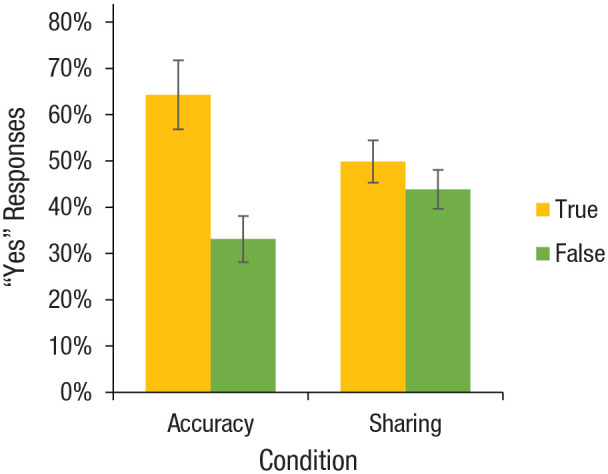
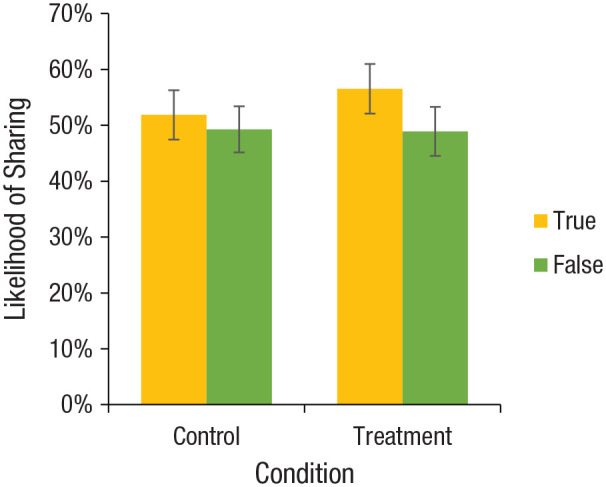
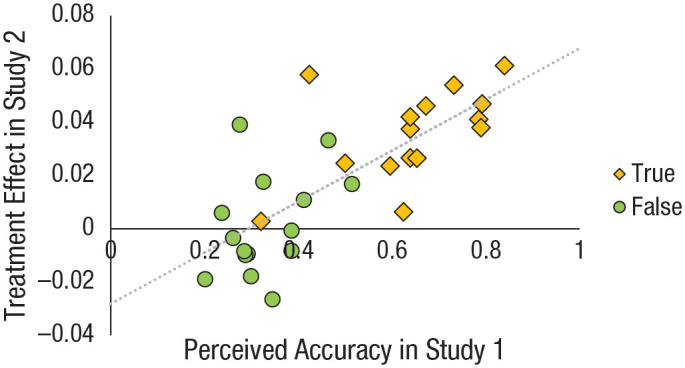
Verification
Claims the paper makes
The claims and statistics of this paper haven’t been checked yet.
Run the check — free, no account needed. It reads the open-access text and checks the sources it cites.
Claims other papers make about this one
Each is checked against this paper’s own text: does it say what the citing paper says it does?
The source backs part of the claim, not all of it — or backs it for a different population, condition or comparison.
In the citing paper
“Under these current plausible COVID-19 vaccine acceptance rates, possible levels of existing protective immunity-though it is unclear whether post-infection immunity confers long-term immunity 29 and the rapidly evolving nature of misinformation surrounding the pandemic 23,30 , it is unclear whether vaccination will reach the levels required for herd immunity.”
From Measuring the impact of COVID-19 vaccine misinformation on vaccination intent in the UK and USA (2021) · cites this paper as [23]
Experimental — accuracy not yet measuredThe cited source says what the claim attributes to it.
In the citing paper
“Experimental work indicates that directing users' attention to accuracy can improve sharing quality and reduce misinformation circulation (Pennycook et al., 2020(Pennycook et al., , 2021;;Roozenbeek et al., 2021).”
From Sensational Headlines, Engagement, and Credibility in Nepal’s Online News (2025) · cites this paper as Pennycook et al., 2020
The cited source says what the claim attributes to it.
In the citing paper
“Pennycook et al. (2020) and Roozenbeek et al. (2021) show that accuracy prompts can modestly improve users' sharing decisions, while Pennycook et al. (2021) argue that shifting attention toward accuracy can reduce misinformation sharing online.”
From Sensational Headlines, Engagement, and Credibility in Nepal’s Online News (2025) · cites this paper as Pennycook et al. (2020)
The check wasn’t confident either way, so it gives no verdict — never disputed.
In the citing paper
“Consistent with this view, a growing number of empirical studies have uncovered evidence that people update their political attitudes and beliefs in line with evidence (e.g., refs. 4,13,27–29) and arguments23,30,31 presented to them.”
From Factual knowledge can reduce attitude polarization (2025) · cites this paper as [28]
Experimental — accuracy not yet measured
Self-check
Percentages, sums and reported differences re-computed from the paper’s own numbers.
The self-check needs the paper’s full text.
Citations
Cites
The case for motivated reasoning.
Kunda, Z. (1990) · Psychological Bulletin · doi:10.1037/0033-2909.108.3.480 · Cited by 9,022 · cited 1×
“A great deal of evidence suggests that people are motivated to seek out, believe, and share politically congenial information (Kahan, Peters, Dawson, & Slovic, 2017; Kunda, 1990; Lee, Shin, & Hong, 2018; Mercier & Sperber, 2011; Shin & Thorson, 2017).”
BackgroundCognitive Reflection and Decision Making
Frederick, S. (2005) · Journal of Economic Perspectives · doi:10.1257/089533005775196732 · Cited by 5,256
Lazer, D. M. J., Baum, M. A., Benkler, Y., Berinsky, A. J., Greenhill, K. M., Menczer, F., Metzger, M. J., Nyhan, B., Pennycook, G., Rothschild, D., et al. (2018) · Science · doi:10.1126/science.aao2998 · Cited by 4,160
Self-citationWhy do humans reason? Arguments for an argumentative theory
Mercier, H., & Sperber, D. (2011) · Behavioral and Brain Sciences · doi:10.1017/s0140525x10000968 · Cited by 2,254
Pennycook, G., & Rand, D. G. (2019) · Cognition · doi:10.1016/j.cognition.2018.06.011 · Cited by 2,022
Self-citationShifting attention to accuracy can reduce misinformation online
Pennycook, G., Epstein, Z., Mosleh, M., Arechar, A. A., Eckles, D., & Rand, D. G. (2021) · Nature · doi:10.1038/s41586-021-03344-2 · Cited by 1,155
Self-citationThe Cognitive Reflection Test as a predictor of performance on heuristics-and-biases tasks
Toplak, M. E., West, R. F., & Stanovich, K. E. (2011) · Memory & Cognition · doi:10.3758/s13421-011-0104-1 · Cited by 1,047
Coppock, A., & McClellan, O. A. (2019) · Research & Politics · doi:10.1177/2053168018822174 · Cited by 987
Berinsky, A. J., Margolis, M. F., & Sances, M. W. (2014) · American Journal of Political Science · doi:10.1111/ajps.12081 · Cited by 951
Fighting misinformation on social media using crowdsourced judgments of news source quality
Pennycook, G., & Rand, D. G. (2019) · Proceedings of the National Academy of Sciences · doi:10.1073/pnas.1806781116 · Cited by 947 · cited 4×
“…2017; Van Bavel & Pereira, 2018), our data are more consistent with recent studies on political misinformation that provide both correlational (Pennycook & Rand, 2019b; including data from Twitter sharing, Mosleh, Pennycook, Arechar, & Rand, 2020) and experimental (Bago, Rand, & Pennycook,…”
BackgroundResultInfluentialSelf-citation
Research works printed but not linked: 2
- Adhanom Ghebreyesus T. (2020, February 15). Munich Security Conference. World Health Organization. Retrieved from https://www.who.int/dg/speeches/detail/munich-security-conference
- Ross R. M., 2019, PsyArXiv
Cited by
Sorted by citations
Measuring the impact of COVID-19 vaccine misinformation on vaccination intent in the UK and USA
Loomba, S., de Figueiredo, A., Piatek, S. J., de Graaf, K., & Larson, H. J. (2021) · Nature Human Behaviour · doi:10.1038/s41562-021-01056-1 · Cited by 1,800
Functional Fear Predicts Public Health Compliance in the COVID-19 Pandemic
Harper, C. A., Satchell, L. P., Fido, D., & Latzman, R. D. (2021) · International Journal of Mental Health and Addiction · doi:10.1007/s11469-020-00281-5 · Cited by 1,564
The psychological drivers of misinformation belief and its resistance to correction
Ecker, U. K. H., Lewandowsky, S., Cook, J., Schmid, P., Fazio, L. K., Brashier, N., Kendeou, P., Vraga, E. K., & Amazeen, M. A. (2022) · Nature Reviews Psychology · doi:10.1038/s44159-021-00006-y · Cited by 1,372
Pennycook, G., & Rand, D. G. (2021) · Trends in Cognitive Sciences · doi:10.1016/j.tics.2021.02.007 · Cited by 1,360
“For example, participants who were asked about the accuracy of a set of headlines rated true headlines as much more accurate than false headlines; but, when asked whether they would share the headlines, veracity had little impact on sharing intentions – both in the context of political headlines [21] (Figure 2A) and h…”
BackgroundInfluentialSelf-citationPuri, N., Coomes, E. A., Haghbayan, H., & Gunaratne, K. (2020) · Human Vaccines & Immunotherapeutics · doi:10.1080/21645515.2020.1780846 · Cited by 1,229
Metadata
- Authors
- Pennycook, G., McPhetres, J., Zhang, Y., Lu, J. G., & Rand, D. G.
- Affiliations
- University of Regina (CA)
- Massachusetts Institute of Technology (US)
- Corresponding author
- Pennycook, Gordon
- Venue
- Psychological Science
- Publisher
- SAGE Publications
- Published
- 2020-06-30
- Volume
- 31
- Issue
- 7
- Pages
- 770-780
- ISSN
- 0956-7976 (ISSN-L)
- 1467-9280
- PMC
- PMC7366427
- OpenAlex
- W3013473577
- Cited by
- 1,715
- References
- 38
- Citations by year
- 2026: 111 · 2025: 188 · 2024: 238 · 2023: 299 · 2022: 329 · 2021: 416 · 2020: 132
- FWCI
- 393.97
- Type
- journal article
- Language
- en
- Open access
- hybrid
- doi.org
- Locations
- Psychological Science (publishedVersion, cc-by)
- PubMed Central (publishedVersion, cc-by)
- PubMed (publishedVersion)
- DSpace@MIT (Massachusetts Institute of Technology) (submittedVersion, cc-by-nc-sa)
- Funders
- miami foundation
- William and Flora Hewlett Foundation
- Omidyar Network
- John Templeton Foundation
- Canadian Institutes of Health Research
- Social Sciences and Humanities Research Council of Canada
- Topics
- Social Sciences › Sociology and Political Science › Misinformation and Its Impacts
- Social Sciences › Communication › Communication and COVID-19 Impact
- Social Sciences › Library and Information Sciences › Academic Publishing and Open Access
- Keywords
- COVID-19 misinformation, social media sharing, truth discernment, fake news, cognitive reflection, scientific knowledge, misinformation prevention, sharing intention
- MeSH terms
- Betacoronavirus, COVID-19, SARS-CoV-2, Adolescent, Adult, Aged, Aged, 80 and over, Communication, Decision Making, Female, Humans, Male, Middle Aged, Pneumonia, Viral, Coronavirus Infections, Information Dissemination, Young Adult, Pandemics, Social Media
About these checks
Registry, retraction, Cites and statistics results are computed, not judged, with one exception: a printed reference that no index lists is read once by a model before it counts as a citation error. Claims are extracted by a model and kept only when their quote appears verbatim in the text; each cited source is then checked, with a model’s help, for whether it says what the claim relies on. Those verdicts can be wrong — read the claim’s quote and the cited source before relying on one.
Statistics and arithmetic are recomputed, not judged.
Confidence bands are shown only for fields calibrated on our annotated test set. None is calibrated yet, so no band is shown.
What counts as a claim ›How we measure confidence ›How we check this ›
Are you an author, or do you see a problem with this page? Request a review
