

Public opinion on basic income: Mapping European support for a radical alternative for welfare provision
Open accessThe DOI matches its Crossref record; 29 of the 29 references it cites were found in a registry or an index; 1 of the 41 sources its claims cite were checked for support.
Abstract
The idea of a universal basic income (BI) is both radical and simple. Obtaining a sufficient citizenship-based income without work obligations is fundamentally opposing the foundations of the welfare systems that are in place nowadays. As BI has gained increasing attention in public debates and among policymakers, questions arise about its social legitimacy. This study is the first to analyse a broad range of explanatory individual and contextual factors that may affect popular support for BI. In addition, we study how BI support is related to support of current welfare provisions, to analyse how radically different people perceive a BI to be. We use a unique survey question – available for 23 European countries, from the recent release of the European Social Survey (2016) –that introduces BI with an extended definition, emphasizing its universal and unconditional character and that it will replace other benefits and services and is paid for by taxes. Results show relatively high, but varying levels of support among European countries and social groups. People who are in a more vulnerable socio-economic position support BI more, as well as political left-wingers, egalitarianists and people who support targeting benefits at the poor. Also, a BI is more supported in countries with higher levels of material deprivation. This pattern of relations on both the individual and contextual levels seems to suggest that it is not the universal character or its unconditionality that makes basic income popular, but rather its redistributive potential. Furthermore, we find that support for UBI is positively related to support for targeted and selective welfare state policies. This indicates that supporters of basic income do not necessarily see it as a radical alternative, but rather as an additional anti-poverty tool.
Overview
CoChat Summary
## TL;DR
This study uses 2016 European Social Survey data from 23 European countries to map support for a basic income and relate it to individual and country-level predictors. Support is relatively high overall, and the authors argue it seems driven less by the scheme’s universal/unconditional design than by its promise of a guaranteed minimum income for the worse off.
## Key findings
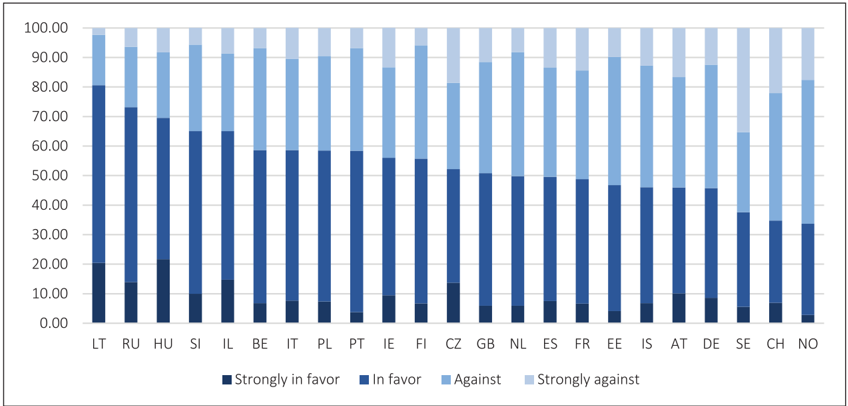
- Across the 23 countries, about 56% of respondents were in favour of a basic income and 44% were against it; support exceeded 45% in 20 out of 23 countries.
- Support was highest in Latvia (over 80% in favour) and lowest in Norway (over 66% against).
- In multilevel models, support was higher among people with lower subjective income, the unemployed, younger people, people on the political left, and those with egalitarian values; there was no significant effect of gender.
- Among welfare-attitude variables, support for a BI was positively related to support for reducing income differences and to support for social investment policies; it was also positively related to support for targeting benefits at the poor and to seeing underuse of benefits as a problem, but negatively related to seeing abuse of benefits as a problem.
- At the country level, material deprivation had a significant positive effect on BI support (0.070* in Model 5; 0.065* in Model 11), while social expenditure had a significant negative effect when entered alone (-0.036 in Model 7) but became insignificant when material deprivation was included.
## Methods
- Cross-sectional comparative study using European Social Survey round 8 (2016) data from 23 European countries; the BI item had 44,387 respondents, with 44,144 answering the BI question and 3,552 “don’t know” responses coded missing.
- BI support was measured with a detailed question defining a BI as a monthly income for everyone that replaces many other benefits, is unconditional, and is paid for by taxes; the main outcome was coded as support vs. no support in exploratory analyses.
- Main analysis combined descriptive statistics with multilevel logistic regression models: individual-level predictors were added in steps (socio-economic, ideological, welfare attitudes), then contextual variables such as unemployment, material deprivation, inequality, social expenditure, GDP per capita, work ethic, and trade union density were tested one at a time and jointly in a final model.
## Limitations
- The authors explicitly state that the study’s interpretations are limited because they are based only on “modest quantitative relations” from a large pooled sample, and that the question of BI’s social legitimacy is “not definitely answered.”
- They note that the survey question, while comprehensive, does not reveal which elements of BI respondents actually reacted to, so interpretation of support is uncertain.
- They say the study is exploratory rather than hypothesis-testing, and the limited number of countries constrained the contextual multilevel models; this is evident from their note that they could only include one contextual variable in Models 4–10 and two in Model 11.
Model-written summary. Check it against the paper before relying on it.
Integrity signals
Registry
Cites
Statistics
Figures
Verification
Claims the paper makes
1 Valid · 2 Not valid · 29 Not checked · 84 Own results and interpretations
A result the paper reports from its own data — it cites no other source for it, so there is none to check. The quote shows it is in the paper.
In the paper
“the fact that younger people are more pro-BI”
plainstates an association- Asserted: passes — The authors put it forward as true.
- Checkable: passes — It can be checked against evidence.
- Load-bearing: unclear — It is unclear whether the paper’s conclusions depend on it.
- Based: passes — The paper gives a reason why it holds.
A result the paper reports from its own data — it cites no other source for it, so there is none to check. The quote shows it is in the paper.
In the paper
“Also, a BI is more supported in countries with higher levels of material deprivation.”
plainstates an association- Asserted: passes — The authors put it forward as true.
- Checkable: passes — It can be checked against evidence.
- Load-bearing: passes — The paper’s conclusions depend on it.
- Based: passes — The paper gives a reason why it holds.
A result the paper reports from its own data — it cites no other source for it, so there is none to check. The quote shows it is in the paper.
In the paper
“People who are in a more vulnerable socio-economic position support BI more”
plainstates an association- Asserted: passes — The authors put it forward as true.
- Checkable: passes — It can be checked against evidence.
- Load-bearing: passes — The paper’s conclusions depend on it.
- Based: passes — The paper gives a reason why it holds.
A result the paper reports from its own data — it cites no other source for it, so there is none to check. The quote shows it is in the paper.
In the paper
“egalitarianists”
plainstates an association- Asserted: passes — The authors put it forward as true.
- Checkable: passes — It can be checked against evidence.
- Load-bearing: passes — The paper’s conclusions depend on it.
- Based: passes — The paper gives a reason why it holds.
A result the paper reports from its own data — it cites no other source for it, so there is none to check. The quote shows it is in the paper.
In the paper
“We also find that people who support other welfare reforms are more supportive of a BI.”
plainstates an association- Asserted: passes — The authors put it forward as true.
- Checkable: passes — It can be checked against evidence.
- Load-bearing: passes — The paper’s conclusions depend on it.
- Based: passes — The paper gives a reason why it holds.
46 more claims
Create a free account to see all 116 claims and every source verdict.
- Probably not a substantial claim. 48
- It may state two separate claims as one. 34
Claims other papers make about this one
Each is checked against this paper’s own text: does it say what the citing paper says it does?
The source backs part of the claim, not all of it — or backs it for a different population, condition or comparison.
In the citing paper
“On the one hand, to the extent that UBI is designed to guarantee a minimum standard of living, it can be seen as an improvement for the financial safety net people who are relatively worse off, irrespective of the generosity of existing welfare state institutions (Roosma & van Oorschot., 2020).”
From COVID-19 and welfare state support: the case of universal basic income (2022) · cites this paper as Roosma & van Oorschot., 2020
Experimental — accuracy not yet measuredThe cited source says what the claim attributes to it.
In the citing paper
“At the macrolevel, support for UBI is higher in countries with higher material deprivation and in countries with lower levels of social spending, while support for UBI is lower in welfare regimes with high social spending (Parolin & Siöland., 2020;Roosma & van Oorschot., 2020).”
From COVID-19 and welfare state support: the case of universal basic income (2022) · cites this paper as Roosma & van Oorschot., 2020
The cited source says what the claim attributes to it.
In the citing paper
“UBI supporters often seem to share a preference for”
From COVID-19 and welfare state support: the case of universal basic income (2022) · cites this paper as Roosma & van Oorschot, 2020
The cited source says what the claim attributes to it.
In the citing paper
“Respondents who identify as left-wing are substantially more supportive of UBI than center-or rightleaning respondents (Roosma & van Oorschot., 2020) but only in countries with generous existing social safety nets (Parolin & Siöland., 2020;Vlandas, 2021).”
From COVID-19 and welfare state support: the case of universal basic income (2022) · cites this paper as Roosma & van Oorschot., 2020
The cited source says what the claim attributes to it.
In the citing paper
“The link between UBI and social investment attitudes has also been made in prior research (Dermont & Weisstanner, 2020;Roosma & van Oorschot., 2020;Schwander & Vlandas, 2020).”
From COVID-19 and welfare state support: the case of universal basic income (2022) · cites this paper as Roosma & van Oorschot., 2020
Citations
Cites
Multilevel analysis : an introduction to basic and advanced multilevel modeling
Snijders, T. A. B., & Bosker, R. (1999) · Cited by 13,957
Increasing Returns, Path Dependence, and the Study of Politics
Pierson, P. (2000) · American Political Science Review · doi:10.2307/2586011 · Cited by 8,094 · cited 1×
“This may be related to the fact that the so-called path dependency of welfare institutions is stronger in more developed welfare states (Boone et al., 2018; Pierson, 2000), with the result that it will be more difficult to gather support for a radical alternative such as BI.”
Background(2011) · Choice Reviews Online · doi:10.5860/choice.48-5169 · Cited by 1,878 · cited 1×
“For instance, from an egalitarian perspective, BI is advocated as an income equalizer and a strong remedy against poverty (Baker, 1992; Van der Veen and Van Parijs, 1986), and as a socialist critique on capitalism as well (Wright, 2010).”
Backgroundvan Oorschot, W. (2006) · Journal of European Social Policy · doi:10.1177/0958928706059829 · Cited by 1,327 · cited 1×
“In this respect, we can also refer to deservingness theory that argues that people are less in favour of benefit schemes that benefit undeserving social groups (Van Oorschot, 2006).”
BackgroundTowards A Social Investment Welfare State?Ideas, Policies and Challenges
(2011) · doi:10.1332/policypress/9781847429247.001.0001 · Cited by 968 · cited 1×
“In addition, the welfare state was criticized for not addressing adequately new social risks with the existing benefits and services (Morel et al., 2012).”
BackgroundPublic Attitudes toward Welfare State Policies: A Comparative Analysis of 24 Nations
Blekesaune, M. (2003) · European Sociological Review · doi:10.1093/esr/19.5.415 · Cited by 724 · cited 1×
“A similar mechanism finds support in welfare attitude studies, where support for more generous welfare benefits and more redistribution is higher in countries where unemployment, poverty and inequality are higher (Blekesaune and Quadagno, 2003; Jeene et al., 2014).”
ResultBasic Income: A Radical Proposal for a Free Society and a Sane Economy
Van Parijs, P., & Vanderborght, Y. (2017) · doi:10.4159/9780674978072 · Cited by 612 · cited 8×
“It is also fundamentally different from the social insurance-based benefit systems in corporate welfare regimes, which rely on wage-related contributions and benefits (Van Parijs and Vanderborght, 2017).”
BackgroundInfluentialThe Political Economy of Active Labor-Market Policy
Bonoli, G. (2010) · Politics & Society · doi:10.1177/0032329210381235 · Cited by 473
de Koster, W., Achterberg, P., & van der Waal, J. (2013) · International Political Science Review · doi:10.1177/0192512112455443 · Cited by 350 · cited 1×
“Especially, working-class people supporting new right-wing parties might argue that a BI is a typical instrument of egalitarians to benefit non-deserving people (De Koster et al., 2013).”
BackgroundArguing for Basic Income: Ethical Foundations for a Radical Reform
PARIJS, P. V. (1992) · DIAL (Catholic University of Leuven) · Cited by 279
Research works printed but not linked: 13
- Andersson, J.O. and Kangas, O. (2002) 'Popular Support for Basic Income in Sweden and Finland', 9th BIEN International Congress, Geneva, 12-14 September.
- Boone, J., Marchal, S., Marx, I., Van Cant, L., Van Lancker, W. and Verbist, G. (2018) Feit en fictie omtrent het basisinkomen in Nederland: een wetenschappelijke verkenning mogelijk gemaakt door Instituut Gak . Antwerpen: Instituut Gak and University of Antwerp.
- Dalia (2017) The EU's Growing Support for Basic Income: Measuring the Change in European Support for Basic Income from April 2016 to March 2017 . Berlin: Dalia Research. - De Koster, W., Achterberg, P. and Van der Waal, J. (2013) 'The New Right and the Welfare State: The Electoral Relevance of Welfare Chauvinism and Welfare Populism in the Netherlands', International Political Science Review 34(1): 3-20.
- Etzioni, A. and Platt, A. (2008) The Social Contract Revisited: A Community Based Guaranteed Income .
- Ipsos (2017) Omnibus Universal Basic Income Topline 2017 . London: Ipsos.
- Jordan, B. (1992) 'Basic Income and the Common Good'. In Van Parijs P (ed.) Arguing for Basic Income: Ethical Foundations for a Radical Reform , pp. 15577. London: Verso.
- Liebig, S. and Mau, S. (2002) 'A Legitimate Guaranteed Minimum Income?', 9th BIEN International Congress, Geneva, 12-14 September.
- Martinelli, L. (2017) Assessing the Case for a Universal Basic Income in the UK (IPR Policy Brief). Bath: Institute for Policy Research, University of Bath.
- Martinelli, L. and De Wispelaere, J. (2017) 'A New Universalism? Varieties of Basic Income and Welfare State Reform', ESPAnet Annual Conference, Lisbon, 14-16 September.
- Organization for Economic Co-operation and Development (OECD) (2017) Basic Income as a Policy Option: Can It Add Up? (Policy Brief on the Future of Work). Paris: OECD.
- Stadelmann-Steffen, I. and Dermont, C. (2017) 'Beyond Complex Welfare Systems: Citizens' Opinion Towards Basic Income Proposals Compared', ECPR General Conference, Oslo, 6-9 September.
- Ullrich, C.G. (2002) 'Prospects for Popular Support of Basic Income (in Case of Unemployment)', 9th BIEN International Congress, Geneva, 12-14 September.
- Van Oorschot, W. and Roosma, F. (2015) 'The Social Legitimacy of Differently Targeted Benefits', ImPRove Working Paper no. 15/11, April. Antwerp: Herman Deleeck Centre for Social Policy, University of Antwerp.
Cited by
Why has the COVID-19 pandemic increased support for universal basic income?
Nettle, D., Johnson, E., Johnson, M., & Saxe, R. (2021) · Humanities and Social Sciences Communications · doi:10.1057/s41599-021-00760-7 · Cited by 99
BUSEMEYER, M. R., & SAHM, A. H. J. (2022) · Journal of Social Policy · doi:10.1017/s0047279421000519 · Cited by 75
Ecological ceiling and social floor: public support for eco-social policies in Sweden
Khan, J., Emilsson, K., Fritz, M., Koch, M., Hildingsson, R., & Johansson, H. (2022) · Sustainability Science · doi:10.1007/s11625-022-01221-z · Cited by 82
“…explanation for this is that respondents in countries with less generous institutional welfare arrangements are positive to introducing a new measure while respondents in more generous welfare states are wary of replacing the existing system with something new (Roosma and van Oorschot 2019).”
BackgroundResultInfluentialA Robin Hood for all: a conjoint experiment on support for basic income
Rincón, L. (2021) · Journal of European Public Policy · doi:10.1080/13501763.2021.2007983 · Cited by 52
“Research on public opinion raises more questions than answers, showing that individuals who support a UBI also support other competing policy alternatives like making cash transfers conditional or targeted on the basis of need (Roosma & Van Oorschot, 2019; Vlandas, 2019, 2020).”
BackgroundCOVID-19 and welfare state support: the case of universal basic income
Weisstanner, D. (2022) · Policy and Society · doi:10.1093/polsoc/puab015 · Cited by 40
Rossetti, F., Roosma, F., Laenen, T., & Abts, K. (2020) · Journal of International and Comparative Social Policy · doi:10.1017/ics.2020.15 · Cited by 51
Self-citationThe left and universal basic income: The role of ideology in individual support
Schwander, H., & Vlandas, T. (2020) · Journal of International and Comparative Social Policy · doi:10.1017/ics.2020.25 · Cited by 36
“Roosma and vanOorschot (2020) confirm the positive correlation between support for redistribution and UBI regardless of ideological orientation.”
BackgroundThe multidimensionality of public support for basic income: a vignette experiment in Belgium
Laenen, T., Hootegem, A. V., & Rossetti, F. (2022) · Journal of European Public Policy · doi:10.1080/13501763.2022.2055112 · Cited by 41
Hüffmeier, J., & Zacher, H. (2021) · Industrial and Organizational Psychology · doi:10.1017/iop.2021.91 · Cited by 33
What’s not to like? Benefit design, funding structure and support for universal basic income
Rincón, L., Vlandas, T., & Hiilamo, H. (2022) · Journal of European Social Policy · doi:10.1177/09589287211072638 · Cited by 44
Snowballing or wilting? What affects public support for varying models of basic income?
Chrisp, J., Pulkka, V.-V., & Rincón, L. (2020) · Journal of International and Comparative Social Policy · doi:10.1017/ics.2020.28 · Cited by 34
Kongshøj, K. (2023) · Humanities and Social Sciences Communications · doi:10.1057/s41599-023-02255-z · Cited by 55
Skivenes, M., & Benbenishty, R. (2022) · Journal of European Social Policy · doi:10.1177/09589287221088172 · Cited by 44
Johnson, M., Johnson, E., & Nettle, D. (2022) · British Politics · doi:10.1057/s41293-022-00220-z · Cited by 32
“In the European Social Survey of 2016, 56% supported the idea of UBI, with the proportion exceeding 45% in 20 of the 23 countries (Roosma & van Oorschot, 2019), while majorities of people find pro-UBI arguments based on provision of security and reduction of bureaucracy convincing (Ipsos MORI,…”
The State of the UBI Debate: Mapping the Arguments for and against UBI
Afscharian, D., Muliavka, V., Ostrowski, M. S., & Siegel, L. (2022) · Basic Income Studies · doi:10.1515/bis-2021-0030 · Cited by 31
Can Conservatives Be Persuaded? Framing Effects on Support for Universal Basic Income in the US
Yeung, E. S. F. (2022) · Political Behavior · doi:10.1007/s11109-022-09824-z · Cited by 33
“Survey responses from the European Social Survey reveal that right-leaning individuals across 23 European countries were much more opposed to UBI (Parolin & Siöland, 2020; Roosma & van Oorschot, 2020).”
Recent advances in understanding welfare attitudes in Europe
van Oorschot, W., Laenen, T., Roosma, F., & Meuleman, B. (2022) · Edward Elgar Publishing eBooks · doi:10.4337/9781802201710.00021 · Cited by 42
Self-citationWhy has the COVID-19 pandemic increased support for Universal Basic Income?Preprint
Nettle, D., Johnson, E., Johnson, M., et al. (2020) · doi:10.31234/osf.io/csr3u · Cited by 19
Herke, B. L., & Vicsek, L. (2022) · International Journal of Social Welfare · doi:10.1111/ijsw.12533 · Cited by 28
Basic Human Values and Attitudes Towards a Universal Basic Income in Europe
Choi, G. (2021) · Basic Income Studies · doi:10.1515/bis-2021-0010 · Cited by 26
Guaranteed Basic Income from the Perspective of Self‐Determination Theory
Howard, J. L. (2024) · Journal of Management Studies · doi:10.1111/joms.13075 · Cited by 17
Zero Poverty Society: Ensuring a Decent Income for All
Marchal, S., & Marx, I. (2024) · doi:10.1093/9780191967771.001.0001 · Cited by 45
Simanainen, M., & Kangas, O. E. (2020) · Journal of International and Comparative Social Policy · doi:10.1017/ics.2020.14 · Cited by 13
Gielens, E., Roosma, F., & Achterberg, P. (2023) · International Journal of Social Welfare · doi:10.1111/ijsw.12607 · Cited by 16
Self-citationBaranowski, M., & Jabkowski, P. (2021) · Economics & Sociology · doi:10.14254/2071-789x.2021/14-2/9 · Cited by 14
Laenen, T., & Gugushvili, D. (2022) · International Journal of Social Welfare · doi:10.1111/ijsw.12546 · Cited by 11
Skivenes, M., & Benbenishty, R. (2022) · Child & Family Social Work · doi:10.1111/cfs.12974 · Cited by 12
Patulny, R., & Spies‐Butcher, B. (2023) · Journal of Sociology · doi:10.1177/14407833231167222 · Cited by 12
“As interest in the policy idea and potential impacts has grown, a complementary literature has emerged on public opinion towards UBI (Baute & Meuleman, 2020; Lee, 2018; Roosma & van Oorschot, 2020).”
BackgroundGielens, E., Roosma, F., & Achterberg, P. (2022) · Social Policy and Society · doi:10.1017/s1474746422000422 · Cited by 12
“Moreover, particularly in the case of UBI, the general public is often underinformed, further fuelling fears of unreliable support measures (Rossetti et al ., 2020, see also Dermont and Weisstanner, 2020; Roosma and van Oorschot, 2020).”
InfluentialSelf-citationAerts, E., Marx, I., & Verbist, G. (2023) · Journal of Social Policy · doi:10.1017/s0047279423000582 · Cited by 32
Between left and right: A discourse network analysis of Universal Basic Income on Dutch Twitter
Gielens, E., Roosma, F., & Achterberg, P. (2023) · Journal of Social Policy · doi:10.1017/s0047279422000976 · Cited by 10
“…coalitional aspects of the UBI debate (e.g. Groot and van der Veen, 2000; Sloman, 2018; Vanderborght, 2006) and representative survey studies on the public legitimacy of UBI (e.g. Roosma and Van Oorschot, 2020; Busemeyer and Sahm, 2021; Rinc´on et al ., 2022, Stadelmann-Steffen and Dermont, 2020).”
Self-citationYang, J., Mohan, G., & Fukushi, K. (2020) · Societies · doi:10.3390/soc10030052 · Cited by 12
“Similarly, using the same data source, the study conducted by Roosma and van Oorschot [8] identified that BI is more supported among people in a weak social-economic position, or in countries with higher levels of material deprivation.”
ResultLee, S. (2020) · Basic Income Studies · doi:10.1515/bis-2021-0013 · Cited by 17
Limits to degrowth? Exploring patterns of support for and resistance against degrowth policies
Kongshøj, K., & Hedegaard, T. F. (2025) · Ecological Economics · doi:10.1016/j.ecolecon.2025.108699 · Cited by 20
Different understandings of welfare benefits among the Dutch public: A focus group study
Lindner, T., de Koster, W., & van der Waal, J. (2022) · Social Policy and Administration · doi:10.1111/spol.12816 · Cited by 10
Lindner, T., Mijs, J. J. B., de Koster, W., & van der Waal, J. (2023) · European Societies · doi:10.1080/14616696.2023.2272263 · Cited by 9
“…in the fi eld of welfare attitudes has been devoted to analyzing public support for a universal basic income (UBI) (Baranowksi and Jabkowski 2021; Kozák 2021; Rincon 2023; Laenen et al. 2023; Lee 2018; Nettle et al. 2021; Roosma and Van Oorschot 2019; Schwander and Vlandas 2020; Vlandas 2021).”
BackgroundResultInfluentialWelfare Euroscepticism and socioeconomic status
Eick, G. M. (2024) · Journal of European Social Policy · doi:10.1177/09589287241231893 · Cited by 12
“Some studies indicate that lower SES groups are indeed more supportive of EU-level social policy (Baute and Meuleman, 2020; Mau, 2005; Roosma and Van Oorschot, 2020), while other studies have found that SES factors have no signi fi cant effect on the Europeanization of social policy (Baute et al.,…”
BackgroundInfluentialFraming basic income in Australia: how the media is shaping the debate
Carroll, L. A., & Engel, S. (2021) · Australian Journal of Political Science · doi:10.1080/10361146.2021.1998344 · Cited by 7
“It was less pertinent in the other countries, a finding also supported by Roosma and van Oorschot (2019).”
BackgroundResultInfluential“Caught in the Middle! Wealth Inequality and Conflict over Redistribution”
Lierse, H., Lascombes, D.-K., & Becker, B. (2022) · Social Justice Research · doi:10.1007/s11211-021-00384-x · Cited by 12
Chrisp, J., Laenen, T., & van Oorschot, W. (2020) · Journal of International and Comparative Social Policy · doi:10.1017/ics.2020.27 · Cited by 8
Self-citationLabour supply reactions to basic income: Insights from 60 years of research
Francisco, C., Otto, A., & Lancker, W. V. (2024) · Socio-Economic Review · doi:10.1093/ser/mwad076 · Cited by 11
Rebuilding Authority in “Lumpen” Communities: The Need for Basic Income to Foster Entitlement
Johnson, M. (2023) · Open Cultural Studies · doi:10.1515/culture-2022-0190 · Cited by 5
Support for unconditional basic income in Spain: A materialist or post‐materialist issue?
Guerendiain‐Gabás, I., de Montes, L. G., Bobowik, M., & Arnoso, M. (2023) · Political Psychology · doi:10.1111/pops.12934 · Cited by 8
COVID‐19 and support for basic income in Korea
Kim, H., Huh, S., & Lee, S. Y. (2024) · International Journal of Social Welfare · doi:10.1111/ijsw.12693 · Cited by 5
D’Orlando, F. (2022) · Basic Income Studies · doi:10.1515/bis-2020-0001 · Cited by 5
Cooperative and conformist behavioural preferences predict the dual dimensions of political ideologyPreprint
Claessens, S., Sibley, C. G., Chaudhuri, A., et al. (2020) · doi:10.31234/osf.io/t7rqb · Cited by 4
Social trust and the support for universal basic income
Gubello, M. (2023) · European Journal of Political Economy · doi:10.1016/j.ejpoleco.2023.102495 · Cited by 7
The efficiency of basic income compared to minimum income schemes
Bollain, J., & Raventós, D. (2024) · Global Political Economy · doi:10.1332/26352257y2023d000000006 · Cited by 4
Sureth, A., Gierke, L. A., Nachtwei, J., Ziegler, M. D., Decker, O., Zenger, M., & Brähler, E. (2024) · Basic Income Studies · doi:10.1515/bis-2023-0023 · Cited by 6
Corruption and the social legitimacy of the welfare state: A comparative cross-national analysis
Bašná, K., & Gugushvili, D. (2025) · Global Social Policy · doi:10.1177/14680181241308409 · Cited by 6
“…of the two mechanisms is more dominant is not clear, as some studies find a positive correlation between country affluence and pro-welfare attitudes (Franetovic and Castillo, 2022), others a negative correlation (Dallinger, 2010), and still others no correlation (Roosma and Van Oorschot, 2020).”
Locally Universal: Universal Basic Income Policies in the Post-Pandemic World-Order
Moraes, J. L., & Freire, C. R. C. (2020) · Glocalism Journal of Culture Politics and Innovation · doi:10.12893/gjcpi.2020.2.4 · Cited by 4
“In fact, it is no wonder that UBI is not unusual in the right or even the far-right political ambiances (Roosma 2020).”
BackgroundInto the unknown: Empirical UBI trials as social Europe’s risk insurance
Afscharian, D., Muliavka, V., Ostrowski, M. S., & Siegel, L. (2022) · European Journal of Social Security · doi:10.1177/13882627221118103 · Cited by 3
Mäntyneva, P., & Hiilamo, H. (2024) · Social Policy and Society · doi:10.1017/s1474746424000137 · Cited by 5
“…in universal basic income has intensified, and the support of it as a capable social security model has increased in a number of welfare states (e.g., Roosma and van Oorschot, 2020; Rinc´on et al., 2022; Spies-Butcher, et al., 2020; Moon and Soohyung, 2020; Lee, 2018; Nettle et al. , 2021).”
Did the COVID-19 pandemic fuel public support for social protection?
Kim, T. (2024) · Journal of Social Policy · doi:10.1017/s004727942400014x · Cited by 17
“Roosma and van Oorschot (2020) relied on the same data to find that the same tendency exists at the individual level as well; people in a more economically vulnerable position are more supportive of UBI.”
Kevins, A. (2022) · Edward Elgar Publishing eBooks · doi:10.4337/9781839104572.00014 · Cited by 5
La paradoja de la redistribución en el Chile actual
Maldonado, L., & Canales, A. (2022) · Revista de Sociología · doi:10.5354/0719-529x.2022.68150 · Cited by 5
Who’s in for no strings: revisiting the determinants of universal basic income support
Rincón, L. (2024) · Journal of Social Policy · doi:10.1017/s0047279424000084 · Cited by 5
“…redistributive policy, the literature on UBI preferences has picked up on the theoretical underpinnings of dualisation research and argued that outsiders should be more favourable to a UBI, a prediction which has received empirical backing (e.g., Vlandas, 2019, 2020; Roosma & van Oorschot, 2020).”
InfluentialPopular support for a universal basic income – still sensitive to playing the immigration card?
Bay, A., Hellevik, T., & Pedersen, A. W. (2024) · European Journal of Social Security · doi:10.1177/13882627241278111 · Cited by 4
“Roosma and van Oorschot (2020), in a comparative analysis of the ESS question, fi nd that support for UBI tends to be higher in countries with less ambitious welfare states and higher levels of material deprivation.”
What explains the popular support for basic income?
Simanainen, M., & Kangas, O. E. (2021) · Edward Elgar Publishing eBooks · doi:10.4337/9781839104855.00019 · Cited by 4
Design Considerations: On Optimal Targeting, Control, and Support
(2024) · Oxford University Press eBooks · doi:10.1093/9780191967771.003.0004 · Cited by 3
Welfare Euroscepticism and Socioeconomic StatusPreprint
Eick, G. M. (2023) · doi:10.31235/osf.io/cvzh5 · Cited by 3
Busemeyer, M. R., & Rinscheid, A. (2025) · Journal of Social Policy · doi:10.1017/s0047279425100871 · Cited by 4
“…Social Survey (ESS) included a question on UBI in its 2016 wave, which has spawned a number of papers on public attitudes (Dermont and Weisstanner, 2020; Parolin and Siöland, 2020; Roosma and Van Oorschot, 2020; Schwander and Vlandas, 2020; Vlandas, 2019, 2021; see below for further details).”
InfluentialMurphy, C., & Turner, T. R. (2022) · International Journal of Care and Caring · doi:10.1332/239788221x16426112519299 · Cited by 2
Public Opinion on Basic Income: What Have We Learnt so Far?
Rincón, L. (2023) · Exploring the basic income guarantee · doi:10.1007/978-3-031-41001-7_14 · Cited by 2
People’s Contrasting Attitudes Towards Universal Basic Income in Sweden and South Korea
Yang, J.-J., Choe, Y., & Nam, Y. (2024) · Social Policy and Society · doi:10.1017/s1474746423000507 · Cited by 3
Posch, M., Hüffmeier, J., Cevik, A., John, J., & Zacher, H. (2024) · Zeitschrift für Arbeits- und Organisationspsychologie A&O · doi:10.1026/0932-4089/a000434 · Cited by 2
Lee, S. (2020) · SSRN Electronic Journal · doi:10.2139/ssrn.3613239 · Cited by 2
Laenen, T., Mulayi, M.-L., Francisco, C., & Lancker, W. V. (2023) · Data in Brief · doi:10.1016/j.dib.2023.109376 · Cited by 3
“The third module assesses a number of sociodemographic characteristics which will structure support for basic income (van Oorschot & Roosma, 2020).”
BackgroundIntroduction to A Research Agenda for Public Attitudes to Welfare
Roosma, F., & Laenen, T. (2023) · Edward Elgar Publishing eBooks · doi:10.4337/9781800887411.00007 · Cited by 2
Self-citationLeopold, F., & Lindenmeier, J. (2024) · Social Policy and Administration · doi:10.1111/spol.13096 · Cited by 1
It's the middle that matters? Income group coalitions in support of redistributive welfare reform
Laenen, T., Roosma, F., & Achterberg, P. (2025) · International Journal of Social Welfare · doi:10.1111/ijsw.70007 · Cited by 3
Self-citationTracing the Scholarly Dialogue on Universal Basic Income: A Comprehensive Bibliometric Analysis
P, D. M., Joseph, M., Jose, J., James, J., Syamkumar, K., Simon, B. K., & Jose, J. (2026) · WSEAS TRANSACTIONS ON BUSINESS AND ECONOMICS · doi:10.37394/23207.2026.23.8 · Cited by 1
Inntektssikring: Har venstre/høyre-dimensjonen betydning for velgerholdninger og politikkutforming?
Bay, A., & Hellevik, T. (2022) · Tidsskrift for velferdsforskning · doi:10.18261/tfv.25.1.2 · Cited by 2
Jóléti állammal kapcsolatos vélemények Magyarországon és az Európai Unióban
Herke, B. L., & Medgyesi, M. (2020) · Társadalmi riport · doi:10.61501/trip.2020.21 · Cited by 4
The State of Means-Tested Minimum Income Protection for People Not in Work
(2024) · Oxford University Press eBooks · doi:10.1093/9780191967771.003.0002 · Cited by 1
Rodríguez, I. R., Álvarez, B., Boso, À., & Casassas, D. (2024) · Social Science Information · doi:10.1177/05390184241298405 · Cited by 1
“Research suggests that it is highly unlikely that all the groups within a particular society will feel exactly the same about introducing a basic income (Laenen et al., 2023; Roosma and Van Oorschot, 2020).”
InfluentialAttitudes Towards Universal Basic Income in Korea Before and After the COVID-19 Pandemic
Yang, J. (2025) · Basic Income Studies · doi:10.1515/bis-2023-0039 · Cited by 1
Running out of time: Public opinions on degrowth in Montréal
Prévost, S. M. (2020) · Spectrum Research Repository (Concordia University)
Basic Income in the Pandemic Era: Another False Start or a New Paradigm of Social Policy?
Kvashnin, Y. D. (2021) · Mezhdunarodnaja jekonomika (The World Economics) · doi:10.33920/vne-04-2112-02
Sekiwu, D., & Ocan, J. (2022) · Advances in educational technologies and instructional design book series · doi:10.4018/978-1-7998-9542-8.ch017 · Cited by 4
Abril, J. E. S. (2022) · Papel Político · doi:10.11144/javeriana.papo26.pfar
Popular Support for the Ideal-Typical Basic Income
Laenen, T. (2023) · Exploring the basic income guarantee · doi:10.1007/978-3-031-29352-8_2
Social Problems Within the Context of Leadership and Public Policies in the Post-COVID Era
Horváthová, Z. (2023) · Springer proceedings in business and economics · doi:10.1007/978-3-031-28131-0_6
Dupoirier, S., Demarque, C., Souville, M., Forissier, S., & Lampropoulos, D. (2023) · Basic Income Studies · doi:10.1515/bis-2022-0014 · Cited by 2
Andreenkova, A. V. (2023) · VESTNIK INSTITUTA SOTZIOLOGII · doi:10.19181/vis.2023.14.4.3
Eick, G. M. (2024) · Edward Elgar Publishing eBooks · doi:10.4337/9781803925530.00014
List of Tables, Figures, and Boxes
Marchal, S., & Marx, I. (2024) · Oxford University Press eBooks · doi:10.1093/9780191967771.002.0004
Minimum Income Protection for Workers: Guaranteed Incomes at the Minimum Wage
(2024) · Oxford University Press eBooks · doi:10.1093/9780191967771.003.0003
Why Minimum Income Protection, What Is It, and How Much Is Enough?
(2024) · Oxford University Press eBooks · doi:10.1093/9780191967771.003.0001
Marchal, S., & Marx, I. (2024) · Oxford University Press eBooks · doi:10.1093/9780191967771.002.0005
What Kind of Minimum Income Protection Is Politically Viable?
(2024) · Oxford University Press eBooks · doi:10.1093/9780191967771.003.0005
Basic Income Advocates, Sober Up
Marx, I. (2024) · Oxford University Press eBooks · doi:10.1093/9780191967771.003.0006 · Cited by 2
(2024) · Oxford University Press eBooks · doi:10.1093/9780191967771.003.0007
Marchal, S., & Marx, I. (2024) · Oxford University Press eBooks · doi:10.1093/9780191967771.003.0008
The Impact of Seafarers' Welfare on the Operational Efficiency of Marine Vessels in Tanzania
Meena, A. E., & Msabaha, J. M. (2024) · International Journal of Innovative Science and Research Technology (IJISRT) · doi:10.38124/ijisrt/ijisrt24sep1406
Airington, Z., Woods, F. A., & Ruscher, J. B. (2024) · Personality and Individual Differences · doi:10.1016/j.paid.2024.113027
Regimes of social minima in Europe: a wide view of policy changes
Pereirinha, J. A., & Pereira, E. S. L. D. F. (2025) · Journal of Poverty and Social Justice · doi:10.1332/17598273y2025d000000039
Berrick, J. D., Burns, K., Pösö, T., Roscoe, J. N., & Skivenes, M. (2025) · International Journal of Adolescence and Youth · doi:10.1080/02673843.2025.2462390 · Cited by 1
“Drawing on policy feedback theory, public attitudes are shaped by the policies and structures of welfare institutions themselves, influencing how people perceive the welfare system’s role and effectiveness (see also Roosma & Van Oorschot, 2020; Svallfors, 1996, 2012; Valarino, 2018).”
Federico, C. M., & Barrett, C. N. (2025) · SocArXiv (OSF Preprints) · doi:10.31235/osf.io/5gxav_v2
The Basic Income and Sustainable Development
Zacher, H., Hüffmeier, J., Koziel, R. J., & Rudolph, C. W. (2025) · Oxford University Press eBooks · doi:10.1093/9780197786161.003.0022
Metadata
- Authors
- Roosma, F., & van Oorschot, W.
- Affiliations
- Tilburg University (NL)
- KU Leuven, Belgium
- Corresponding author
- Roosma, Femke
- ORCID
- Roosma, Femke
- Venue
- Journal of European Social Policy
- Publisher
- SAGE Publications
- Published
- 2019-11-26
- Volume
- 30
- Issue
- 2
- Pages
- 190-205
- ISSN
- 0958-9287 (ISSN-L)
- 1461-7269
- OpenAlex
- W2938967719
- Cited by
- 115
- References
- 24
- Citations by year
- 2026: 5 · 2025: 21 · 2024: 28 · 2023: 16 · 2022: 24 · 2021: 10 · 2020: 11
- FWCI
- 47.59
- Type
- journal article
- Language
- en
- Open access
- hybrid
- doi.org
- Licence
- Locations
- Journal of European Social Policy (publishedVersion, cc-by-nc)
- Research portal (Tilburg University) (publishedVersion, cc-by)
- Lirias (submittedVersion, other-oa)
- Data Archiving and Networked Services (DANS) (submittedVersion, cc-by)
- Topics
- Social Sciences › Political Science and International Relations › Social Policy and Reform Studies
- Social Sciences › Political Science and International Relations › Electoral Systems and Political Participation
- Social Sciences › Political Science and International Relations › Political Philosophy and Ethics
- Keywords
- universal basic income, public opinion, welfare provision, social legitimacy, welfare reform, material deprivation, socioeconomic vulnerability, political ideology, egalitarianism, guaranteed minimum income, European Social Survey
About these checks
Registry, retraction, Cites and statistics results are computed, not judged, with one exception: a printed reference that no index lists is read once by a model before it counts as a citation error. Claims are extracted by a model and kept only when their quote appears verbatim in the text; each cited source is then checked, with a model’s help, for whether it says what the claim relies on. Those verdicts can be wrong — read the claim’s quote and the cited source before relying on one.
The claim verdicts this report counts are experimental: their accuracy is not yet measured.
A language model drew the claims from the paper on 2026-10-10, under version 3 of the claim definition (model deepseek-v4.1-flash, prompt extract-v3).
A second model labelled each claim on 2026-10-10 (model jev-1.13-20260917, definition revision gold-guideline-v0.2).
Statistics and arithmetic are recomputed, not judged.
Confidence bands are shown only for fields calibrated on our annotated test set. None is calibrated yet, so no band is shown.
What counts as a claim ›How we measure confidence ›How we check this ›
Are you an author, or do you see a problem with this page? Request a review
Data sources
Bibliographic data: Semantic Scholar, OpenAlex, Crossref.
Contains information from the Semantic Scholar Academic Graph Datasets, made available under the ODC Attribution License (ODC-BY 1.0).
Semantic Scholar’s data is described in: Kinney, R., et al. (2023). The Semantic Scholar Open Data Platform. arXiv:2301.10140.
