

Public opinion on basic income: Mapping European support for a radical alternative for welfare provision
Open accessThe DOI matches its Crossref record; 29 of the 29 references it cites were found in a registry or an index; 1 of the 41 sources its claims cite were checked for support.
Abstract
The idea of a universal basic income (BI) is both radical and simple. Obtaining a sufficient citizenship-based income without work obligations is fundamentally opposing the foundations of the welfare systems that are in place nowadays. As BI has gained increasing attention in public debates and among policymakers, questions arise about its social legitimacy. This study is the first to analyse a broad range of explanatory individual and contextual factors that may affect popular support for BI. In addition, we study how BI support is related to support of current welfare provisions, to analyse how radically different people perceive a BI to be. We use a unique survey question – available for 23 European countries, from the recent release of the European Social Survey (2016) –that introduces BI with an extended definition, emphasizing its universal and unconditional character and that it will replace other benefits and services and is paid for by taxes. Results show relatively high, but varying levels of support among European countries and social groups. People who are in a more vulnerable socio-economic position support BI more, as well as political left-wingers, egalitarianists and people who support targeting benefits at the poor. Also, a BI is more supported in countries with higher levels of material deprivation. This pattern of relations on both the individual and contextual levels seems to suggest that it is not the universal character or its unconditionality that makes basic income popular, but rather its redistributive potential. Furthermore, we find that support for UBI is positively related to support for targeted and selective welfare state policies. This indicates that supporters of basic income do not necessarily see it as a radical alternative, but rather as an additional anti-poverty tool.
Overview
CoChat Summary
## TL;DR
This study uses 2016 European Social Survey data from 23 European countries to map support for a basic income and relate it to individual and country-level predictors. Support is relatively high overall, and the authors argue it seems driven less by the scheme’s universal/unconditional design than by its promise of a guaranteed minimum income for the worse off.
## Key findings
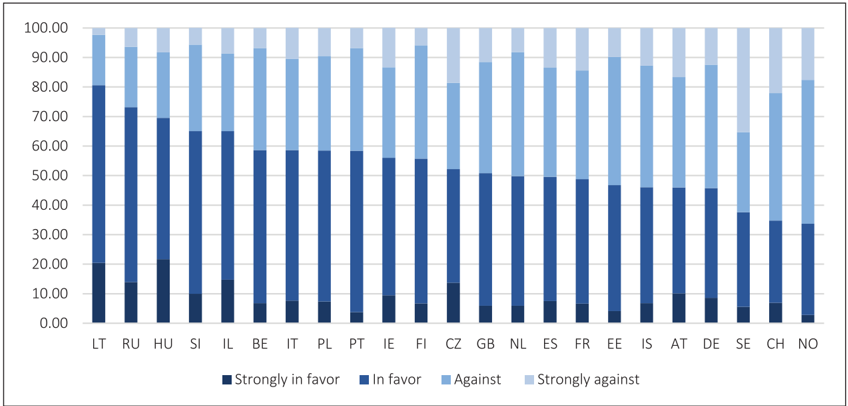
- Across the 23 countries, about 56% of respondents were in favour of a basic income and 44% were against it; support exceeded 45% in 20 out of 23 countries.
- Support was highest in Latvia (over 80% in favour) and lowest in Norway (over 66% against).
- In multilevel models, support was higher among people with lower subjective income, the unemployed, younger people, people on the political left, and those with egalitarian values; there was no significant effect of gender.
- Among welfare-attitude variables, support for a BI was positively related to support for reducing income differences and to support for social investment policies; it was also positively related to support for targeting benefits at the poor and to seeing underuse of benefits as a problem, but negatively related to seeing abuse of benefits as a problem.
- At the country level, material deprivation had a significant positive effect on BI support (0.070* in Model 5; 0.065* in Model 11), while social expenditure had a significant negative effect when entered alone (-0.036 in Model 7) but became insignificant when material deprivation was included.
## Methods
- Cross-sectional comparative study using European Social Survey round 8 (2016) data from 23 European countries; the BI item had 44,387 respondents, with 44,144 answering the BI question and 3,552 “don’t know” responses coded missing.
- BI support was measured with a detailed question defining a BI as a monthly income for everyone that replaces many other benefits, is unconditional, and is paid for by taxes; the main outcome was coded as support vs. no support in exploratory analyses.
- Main analysis combined descriptive statistics with multilevel logistic regression models: individual-level predictors were added in steps (socio-economic, ideological, welfare attitudes), then contextual variables such as unemployment, material deprivation, inequality, social expenditure, GDP per capita, work ethic, and trade union density were tested one at a time and jointly in a final model.
## Limitations
- The authors explicitly state that the study’s interpretations are limited because they are based only on “modest quantitative relations” from a large pooled sample, and that the question of BI’s social legitimacy is “not definitely answered.”
- They note that the survey question, while comprehensive, does not reveal which elements of BI respondents actually reacted to, so interpretation of support is uncertain.
- They say the study is exploratory rather than hypothesis-testing, and the limited number of countries constrained the contextual multilevel models; this is evident from their note that they could only include one contextual variable in Models 4–10 and two in Model 11.
Model-written summary. Check it against the paper before relying on it.
Integrity signals
Registry
Cites
Statistics
Figures
Verification
Claims the paper makes
1 Valid · 2 Not valid · 29 Not checked · 84 Own results and interpretations
A result the paper reports from its own data — it cites no other source for it, so there is none to check. The quote shows it is in the paper.
In the paper
“the fact that younger people are more pro-BI”
plainstates an association- Asserted: passes — The authors put it forward as true.
- Checkable: passes — It can be checked against evidence.
- Load-bearing: unclear — It is unclear whether the paper’s conclusions depend on it.
- Based: passes — The paper gives a reason why it holds.
A result the paper reports from its own data — it cites no other source for it, so there is none to check. The quote shows it is in the paper.
In the paper
“Also, a BI is more supported in countries with higher levels of material deprivation.”
plainstates an association- Asserted: passes — The authors put it forward as true.
- Checkable: passes — It can be checked against evidence.
- Load-bearing: passes — The paper’s conclusions depend on it.
- Based: passes — The paper gives a reason why it holds.
A result the paper reports from its own data — it cites no other source for it, so there is none to check. The quote shows it is in the paper.
In the paper
“People who are in a more vulnerable socio-economic position support BI more”
plainstates an association- Asserted: passes — The authors put it forward as true.
- Checkable: passes — It can be checked against evidence.
- Load-bearing: passes — The paper’s conclusions depend on it.
- Based: passes — The paper gives a reason why it holds.
A result the paper reports from its own data — it cites no other source for it, so there is none to check. The quote shows it is in the paper.
In the paper
“egalitarianists”
plainstates an association- Asserted: passes — The authors put it forward as true.
- Checkable: passes — It can be checked against evidence.
- Load-bearing: passes — The paper’s conclusions depend on it.
- Based: passes — The paper gives a reason why it holds.
A result the paper reports from its own data — it cites no other source for it, so there is none to check. The quote shows it is in the paper.
In the paper
“We also find that people who support other welfare reforms are more supportive of a BI.”
plainstates an association- Asserted: passes — The authors put it forward as true.
- Checkable: passes — It can be checked against evidence.
- Load-bearing: passes — The paper’s conclusions depend on it.
- Based: passes — The paper gives a reason why it holds.
46 more claims
Create a free account to see all 116 claims and every source verdict.
- Probably not a substantial claim. 48
- It may state two separate claims as one. 34
Claims other papers make about this one
Each is checked against this paper’s own text: does it say what the citing paper says it does?
The source backs part of the claim, not all of it — or backs it for a different population, condition or comparison.
In the citing paper
“On the one hand, to the extent that UBI is designed to guarantee a minimum standard of living, it can be seen as an improvement for the financial safety net people who are relatively worse off, irrespective of the generosity of existing welfare state institutions (Roosma & van Oorschot., 2020).”
From COVID-19 and welfare state support: the case of universal basic income (2022) · cites this paper as Roosma & van Oorschot., 2020
Experimental — accuracy not yet measuredThe cited source says what the claim attributes to it.
In the citing paper
“At the macrolevel, support for UBI is higher in countries with higher material deprivation and in countries with lower levels of social spending, while support for UBI is lower in welfare regimes with high social spending (Parolin & Siöland., 2020;Roosma & van Oorschot., 2020).”
From COVID-19 and welfare state support: the case of universal basic income (2022) · cites this paper as Roosma & van Oorschot., 2020
The cited source says what the claim attributes to it.
In the citing paper
“UBI supporters often seem to share a preference for”
From COVID-19 and welfare state support: the case of universal basic income (2022) · cites this paper as Roosma & van Oorschot, 2020
The cited source says what the claim attributes to it.
In the citing paper
“Respondents who identify as left-wing are substantially more supportive of UBI than center-or rightleaning respondents (Roosma & van Oorschot., 2020) but only in countries with generous existing social safety nets (Parolin & Siöland., 2020;Vlandas, 2021).”
From COVID-19 and welfare state support: the case of universal basic income (2022) · cites this paper as Roosma & van Oorschot., 2020
The cited source says what the claim attributes to it.
In the citing paper
“The link between UBI and social investment attitudes has also been made in prior research (Dermont & Weisstanner, 2020;Roosma & van Oorschot., 2020;Schwander & Vlandas, 2020).”
From COVID-19 and welfare state support: the case of universal basic income (2022) · cites this paper as Roosma & van Oorschot., 2020
Citations
Cites
Multilevel analysis : an introduction to basic and advanced multilevel modeling
Snijders, T. A. B., & Bosker, R. (1999) · Cited by 13,957
Increasing Returns, Path Dependence, and the Study of Politics
Pierson, P. (2000) · American Political Science Review · doi:10.2307/2586011 · Cited by 8,094 · cited 1×
“This may be related to the fact that the so-called path dependency of welfare institutions is stronger in more developed welfare states (Boone et al., 2018; Pierson, 2000), with the result that it will be more difficult to gather support for a radical alternative such as BI.”
Background(2011) · Choice Reviews Online · doi:10.5860/choice.48-5169 · Cited by 1,878 · cited 1×
“For instance, from an egalitarian perspective, BI is advocated as an income equalizer and a strong remedy against poverty (Baker, 1992; Van der Veen and Van Parijs, 1986), and as a socialist critique on capitalism as well (Wright, 2010).”
Backgroundvan Oorschot, W. (2006) · Journal of European Social Policy · doi:10.1177/0958928706059829 · Cited by 1,327 · cited 1×
“In this respect, we can also refer to deservingness theory that argues that people are less in favour of benefit schemes that benefit undeserving social groups (Van Oorschot, 2006).”
BackgroundTowards A Social Investment Welfare State?Ideas, Policies and Challenges
(2011) · doi:10.1332/policypress/9781847429247.001.0001 · Cited by 968 · cited 1×
“In addition, the welfare state was criticized for not addressing adequately new social risks with the existing benefits and services (Morel et al., 2012).”
BackgroundPublic Attitudes toward Welfare State Policies: A Comparative Analysis of 24 Nations
Blekesaune, M. (2003) · European Sociological Review · doi:10.1093/esr/19.5.415 · Cited by 724 · cited 1×
“A similar mechanism finds support in welfare attitude studies, where support for more generous welfare benefits and more redistribution is higher in countries where unemployment, poverty and inequality are higher (Blekesaune and Quadagno, 2003; Jeene et al., 2014).”
ResultBasic Income: A Radical Proposal for a Free Society and a Sane Economy
Van Parijs, P., & Vanderborght, Y. (2017) · doi:10.4159/9780674978072 · Cited by 612 · cited 8×
“It is also fundamentally different from the social insurance-based benefit systems in corporate welfare regimes, which rely on wage-related contributions and benefits (Van Parijs and Vanderborght, 2017).”
BackgroundInfluentialThe Political Economy of Active Labor-Market Policy
Bonoli, G. (2010) · Politics & Society · doi:10.1177/0032329210381235 · Cited by 473
de Koster, W., Achterberg, P., & van der Waal, J. (2013) · International Political Science Review · doi:10.1177/0192512112455443 · Cited by 350 · cited 1×
“Especially, working-class people supporting new right-wing parties might argue that a BI is a typical instrument of egalitarians to benefit non-deserving people (De Koster et al., 2013).”
BackgroundArguing for Basic Income: Ethical Foundations for a Radical Reform
PARIJS, P. V. (1992) · DIAL (Catholic University of Leuven) · Cited by 279
Research works printed but not linked: 13
- Andersson, J.O. and Kangas, O. (2002) 'Popular Support for Basic Income in Sweden and Finland', 9th BIEN International Congress, Geneva, 12-14 September.
- Boone, J., Marchal, S., Marx, I., Van Cant, L., Van Lancker, W. and Verbist, G. (2018) Feit en fictie omtrent het basisinkomen in Nederland: een wetenschappelijke verkenning mogelijk gemaakt door Instituut Gak . Antwerpen: Instituut Gak and University of Antwerp.
- Dalia (2017) The EU's Growing Support for Basic Income: Measuring the Change in European Support for Basic Income from April 2016 to March 2017 . Berlin: Dalia Research. - De Koster, W., Achterberg, P. and Van der Waal, J. (2013) 'The New Right and the Welfare State: The Electoral Relevance of Welfare Chauvinism and Welfare Populism in the Netherlands', International Political Science Review 34(1): 3-20.
- Etzioni, A. and Platt, A. (2008) The Social Contract Revisited: A Community Based Guaranteed Income .
- Ipsos (2017) Omnibus Universal Basic Income Topline 2017 . London: Ipsos.
- Jordan, B. (1992) 'Basic Income and the Common Good'. In Van Parijs P (ed.) Arguing for Basic Income: Ethical Foundations for a Radical Reform , pp. 15577. London: Verso.
- Liebig, S. and Mau, S. (2002) 'A Legitimate Guaranteed Minimum Income?', 9th BIEN International Congress, Geneva, 12-14 September.
- Martinelli, L. (2017) Assessing the Case for a Universal Basic Income in the UK (IPR Policy Brief). Bath: Institute for Policy Research, University of Bath.
- Martinelli, L. and De Wispelaere, J. (2017) 'A New Universalism? Varieties of Basic Income and Welfare State Reform', ESPAnet Annual Conference, Lisbon, 14-16 September.
- Organization for Economic Co-operation and Development (OECD) (2017) Basic Income as a Policy Option: Can It Add Up? (Policy Brief on the Future of Work). Paris: OECD.
- Stadelmann-Steffen, I. and Dermont, C. (2017) 'Beyond Complex Welfare Systems: Citizens' Opinion Towards Basic Income Proposals Compared', ECPR General Conference, Oslo, 6-9 September.
- Ullrich, C.G. (2002) 'Prospects for Popular Support of Basic Income (in Case of Unemployment)', 9th BIEN International Congress, Geneva, 12-14 September.
- Van Oorschot, W. and Roosma, F. (2015) 'The Social Legitimacy of Differently Targeted Benefits', ImPRove Working Paper no. 15/11, April. Antwerp: Herman Deleeck Centre for Social Policy, University of Antwerp.
Cited by
Items 101–116 of 116
Weiss, J., Holz, P., & Hörisch, F. (2025) · Zeitschrift für Politikwissenschaft · doi:10.1007/s41358-025-00411-2
Özdemir, N. E., Sarıipek, D. B., Çerev, G., et al. (2025) · SOCIAL WELFARE INTERDISCIPLINARY APPROACH · doi:10.15388/sw.2025.15.5
Kirkpatrick, A. W., & Hmielowski, J. D. (2025) · Basic Income Studies · doi:10.1515/bis-2023-0016 · Cited by 2
“Roosma and van Oorschot (2020) analyzed European Social Survey data and found those with lower subjective income, less formal education, and those without employment, including people in retirement, favored UBI more so than others (Roosma and van Oorschot 2020).”
Searight, H. R., & Dowd, S. I. (2025) · Diversity and inclusion research · doi:10.1007/978-3-031-82900-0_13 · Cited by 1
Bread and Roses: Social re‐presentations for Unconditional Basic Income in the Basque Country
Guerendiain‐Gabás, I., Arnoso, M., & de Montes, L. G. (2025) · British Journal of Social Psychology · doi:10.1111/bjso.12909 · Cited by 1
“Several survey studies have examined public opinion on UBI, showing that support varies across socio-political contexts but tends to be stronger in countries with higher inequality and weaker welfare systems (e.g. Lee, 2018; Parolin & Siöland, 2020; Roosma & van Oorschot, 2020; Yang et al., 2024).”
InfluentialWhy do parties (not) support Universal Basic Income? The case of the UK Liberal Democrats
Sloman, P. (2025) · The British Journal of Politics and International Relations · doi:10.1177/13691481251346690 · Cited by 2
“Several scholars have also used survey data to examine public opinion on UBI and identify the social coalitions which might form around different schemes (Chrisp, Pulkka, and Rincón Garcia 2020; Laenen, 2023; Roosma and van Oorschot, 2020; Vlandas, 2021).”
Mulayi, M.-L. (2025) · Journal of European Social Policy · doi:10.1177/09589287251359727
“In contrast, southeastern European countries, with less comprehensive welfare systems, exhibit notably higher levels of public support for BI (Baranowski and Jabkowski, 2019; Roosma and Van Oorschot, 2020).”
Federico, C. M., & Barrett, C. N. (2025) · SocArXiv (OSF Preprints) · doi:10.31235/osf.io/5gxav_v3
Chaparro, T. S., Frías, V. G., & Gimeno-Ullastres, J. (2025) · Basic Income Studies · doi:10.1515/bis-2023-0043
Political Ideology and Support for Tax-Funded UBI: Political Trust as a Moderation Mechanism
Moon, K.-K., & Lim, J. Y. (2025) · Systems · doi:10.3390/systems13100846
Federico, C. M., & Barrett, C. N. (2025) · Political Behavior · doi:10.1007/s11109-025-10081-z
“Though UBI has historically received intellectual support from some thinkers on the right (e.g., Van Parijs and Vander-1 borght 2017), support for it is somewhat stronger on the left (Roosma and van Oorschot 2019; Vlandas 2019).”
Who wants what, and why? Attitude polarization and political viability of UBI
Becker, B., & Schwander, H. (2025) · Journal of European Social Policy · doi:10.1177/09589287251400044
“According to Roosma and Van Oorschot (2020), an average of 54% of adult citizens in European countries supports the introduction of a UBI.”
Dupoirier, S. (2022) · theses.fr (ABES) · doi:10.70675/fa4af5e2zed23z4220z917bzbfd2e857aab9 · Cited by 2
Holland, S., Bezecsky, Z., Mathur, V., Roberts, L., & Westlake, D. (2026) · Journal of Social Policy · doi:10.1017/s0047279426101524
“These can be linked directly to deserv-ingness criteria such as need, identity and reciprocity (Roosma & Van Oorschot, 2020).”
InfluentialNo constituency for universal basic income? Evidence from seven Latin American countries
Borges, F. A., Franzoni, J. M., & Blofield, M. (2026) · Journal of Social Policy · doi:10.1017/s0047279426101718
Helland, H. S., Pedersen, S. H., & Skivenes, M. (2026) · International Journal of Social Welfare · doi:10.1111/ijsw.70098
Metadata
- Authors
- Roosma, F., & van Oorschot, W.
- Affiliations
- Tilburg University (NL)
- KU Leuven, Belgium
- Corresponding author
- Roosma, Femke
- ORCID
- Roosma, Femke
- Venue
- Journal of European Social Policy
- Publisher
- SAGE Publications
- Published
- 2019-11-26
- Volume
- 30
- Issue
- 2
- Pages
- 190-205
- ISSN
- 0958-9287 (ISSN-L)
- 1461-7269
- OpenAlex
- W2938967719
- Cited by
- 115
- References
- 24
- Citations by year
- 2026: 5 · 2025: 21 · 2024: 28 · 2023: 16 · 2022: 24 · 2021: 10 · 2020: 11
- FWCI
- 47.59
- Type
- journal article
- Language
- en
- Open access
- hybrid
- doi.org
- Licence
- Locations
- Journal of European Social Policy (publishedVersion, cc-by-nc)
- Research portal (Tilburg University) (publishedVersion, cc-by)
- Lirias (submittedVersion, other-oa)
- Data Archiving and Networked Services (DANS) (submittedVersion, cc-by)
- Topics
- Social Sciences › Political Science and International Relations › Social Policy and Reform Studies
- Social Sciences › Political Science and International Relations › Electoral Systems and Political Participation
- Social Sciences › Political Science and International Relations › Political Philosophy and Ethics
- Keywords
- universal basic income, public opinion, welfare provision, social legitimacy, welfare reform, material deprivation, socioeconomic vulnerability, political ideology, egalitarianism, guaranteed minimum income, European Social Survey
About these checks
Registry, retraction, Cites and statistics results are computed, not judged, with one exception: a printed reference that no index lists is read once by a model before it counts as a citation error. Claims are extracted by a model and kept only when their quote appears verbatim in the text; each cited source is then checked, with a model’s help, for whether it says what the claim relies on. Those verdicts can be wrong — read the claim’s quote and the cited source before relying on one.
The claim verdicts this report counts are experimental: their accuracy is not yet measured.
A language model drew the claims from the paper on 2026-10-10, under version 3 of the claim definition (model deepseek-v4.1-flash, prompt extract-v3).
A second model labelled each claim on 2026-10-10 (model jev-1.13-20260917, definition revision gold-guideline-v0.2).
Statistics and arithmetic are recomputed, not judged.
Confidence bands are shown only for fields calibrated on our annotated test set. None is calibrated yet, so no band is shown.
What counts as a claim ›How we measure confidence ›How we check this ›
Are you an author, or do you see a problem with this page? Request a review
Data sources
Bibliographic data: Semantic Scholar, OpenAlex, Crossref.
Contains information from the Semantic Scholar Academic Graph Datasets, made available under the ODC Attribution License (ODC-BY 1.0).
Semantic Scholar’s data is described in: Kinney, R., et al. (2023). The Semantic Scholar Open Data Platform. arXiv:2301.10140.
