

The DOI matches its Crossref record; 113 of the 113 references it cites were found in a registry or an index.
A New Treatment Strategy for Parkinson's Disease through the Gut–Brain Axis: The Glucagon-Like Peptide-1 Receptor Pathway
Open accessAbstract
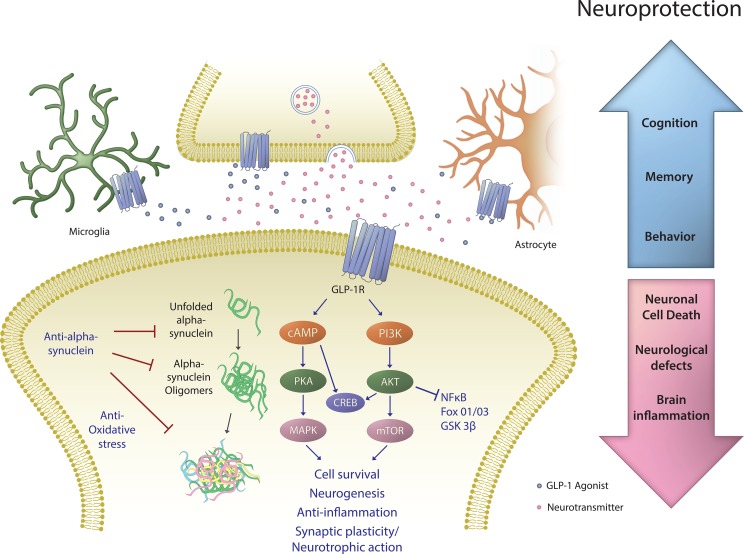
Molecular communications in the gut–brain axis, between the central nervous system and the gastrointestinal tract, are critical for maintaining healthy brain function, particularly in aging. Epidemiological analyses indicate type 2 diabetes mellitus (T2DM) is a risk factor for neurodegenerative disorders including Alzheimer's disease (AD) and Parkinson's diseases (PD) for which aging shows a major correlative association. Common pathophysiological features exist between T2DM, AD, and PD, including oxidative stress, inflammation, insulin resistance, abnormal protein processing, and cognitive decline, and suggest that effective drugs for T2DM that positively impact the gut–brain axis could provide an effective treatment option for neurodegenerative diseases. Glucagon-like peptide-1 (GLP-1)-based antidiabetic drugs have drawn particular attention as an effectual new strategy to not only regulate blood glucose but also decrease body weight by reducing appetite, which implies that GLP-1 could affect the gut–brain axis in normal and pathological conditions. The neurotrophic and neuroprotective effects of GLP-1 receptor (R) stimulation have been characterized in numerous in vitro and in vivo preclinical studies using GLP-1R agonists and dipeptidyl peptidase-4 inhibitors. Recently, the first open label clinical study of exenatide, a long-acting GLP-1 agonist, in the treatment of PD showed long-lasting improvements in motor and cognitive function. Several double-blind clinical trials of GLP-1R agonists including exenatide in PD and other neurodegenerative diseases are already underway or are about to be initiated. Herein, we review the physiological role of the GLP-1R pathway in the gut–brain axis and the therapeutic strategy of GLP-1R stimulation for the treatment of neurodegenerative diseases focused on PD, for which age is the major risk factor.
Overview
The claims and statistics of this paper haven’t been checked yet.
Run the check — free, no account needed. It reads the open-access text and checks the sources it cites.
Integrity signals
Registry
Cites
Statistics
Figures
Verification
Claims the paper makes
The claims and statistics of this paper haven’t been checked yet.
Run the check — free, no account needed. It reads the open-access text and checks the sources it cites.
Claims other papers make about this one
Each is checked against this paper’s own text: does it say what the citing paper says it does?
In the citing paper
“There are studies indicate that GLP-1 has a neuroprotective effect in the central nervous system (CNS), which affects the proliferation and apoptosis of neural cells, improves learning, memory and motor dysfunction, reduces the deposition of Aβ plaques in the brain, decreases the loss of dopaminergic neurons and promotes nerve regeneration (Kim et al. 2017).”
From Therapeutic effect of GLP-1 engineered strain on mice model of Alzheimer’s disease and Parkinson’s disease (2020) · cites this paper as Kim et al. 2017
Self-check
Percentages, sums and reported differences re-computed from the paper’s own numbers.
The self-check needs the paper’s full text.
Citations
Cites
Mutation in the α-Synuclein Gene Identified in Families with Parkinson's Disease
Polymeropoulos, M. H., Lavedan, C., Leroy, E., Ide, S. E., Dehejia, A., Dutra, A., Pike, B., Root, H., Rubenstein, J., Boyer, R., et al. (1997) · Science · doi:10.1126/science.276.5321.2045 · Cited by 8,240
Dauer, W., & Przedborski, S. (2003) · Neuron · doi:10.1016/s0896-6273(03)00568-3 · Cited by 5,469
Chronic Parkinsonism in Humans Due to a Product of Meperidine-Analog Synthesis
Langston, J. W., Ballard, P., Tetrud, J. W., & Irwin, I. (1983) · Science · doi:10.1126/science.6823561 · Cited by 4,914
Overdependence on degraded gist memory in Alzheimer's disease.
Gallo, D. A., Shahid, K. R., Olson, M. A., Solomon, T. M., Schacter, D. L., & Budson, A. E. (2006) · Neuropsychology · doi:10.1037/0894-4105.20.6.625 · Cited by 4,757
Chronic systemic pesticide exposure reproduces features of Parkinson's disease
Betarbet, R. S., Sherer, T., MacKenzie, G. M., Garcia‐Osuna, M., Panov, A. V., & Greenamyre, J. T. (2000) · Nature Neuroscience · doi:10.1038/81834 · Cited by 3,770
Immune attack: the role of inflammation in Alzheimer disease
Heppner, F. L., Ransohoff, R. M., & Becher, B. (2015) · Nature Reviews Neuroscience · doi:10.1038/nrn3880 · Cited by 2,134
How neuroinflammation contributes to neurodegeneration
Ransohoff, R. M. (2016) · Science · doi:10.1126/science.aag2590 · Cited by 1,967 · cited 2×
“Inflammation, oxidative stress, and deficits in neurotransmitters are the common features of the biochemical switch that ultimately results in the activation of the apoptotic pathways that lead to neuronal cell dysfunction and death and eventually to the neurological disorder.(2,25) Interestingly, these pathological e…”
BackgroundThe Role of Oxidative Stress in Parkinson's Disease
Dias, V., Junn, E., & Mouradian, M. M. (2013) · Journal of Parkinson’s Disease · doi:10.3233/jpd-130230 · Cited by 1,845
Molecular Pathways of Neurodegeneration in Parkinson's Disease
Dawson, T. M., & Dawson, V. L. (2003) · Science · doi:10.1126/science.1087753 · Cited by 1,674
Bender, A., Krishnan, K. J., Morris, C. M., Taylor, G. A., Reeve, A. K., Perry, R. H., Jaros, E., Hersheson, J. S., Betts, J., Klopstock, T., et al. (2006) · Nature Genetics · doi:10.1038/ng1769 · Cited by 1,570
Research works printed but not linked: 3
- Guo LX, 2009, Chin Med J (Engl), 122, 2886
- Puddu A, 2013, Mediators Inflamm, 317120
- Heikkila RE, 1987, Adv Neurol, 45, 149
Cited by
Sorted by citations
Items 101–136 of 136
An Overview of Prospective Drugs for Type 1 and Type 2 Diabetes
Wu, P., Liu, Z., Jiang, X., & Fang, H. (2019) · Current Drug Targets · doi:10.2174/1389450120666191031104653 · Cited by 9
Exendin-4 as a Versatile Therapeutic Agent for the Amelioration of Diabetic Changes
Rajabi, H., Ahmadi, M., Aslani, S., Saberianpour, S., & Rahbarghazi, R. (2021) · Advanced Pharmaceutical Bulletin · doi:10.34172/apb.2022.025 · Cited by 9
Ye, F., Liu, Y., Li, S., & Chen, J. D. Z. (2018) · Obesity Surgery · doi:10.1007/s11695-018-3257-1 · Cited by 9
Microbial dipeptidyl peptidases of the S9B family as host-microbe isozymes
Aljumaah, M. R., Roach, J. M., Hu, Y., Gunstad, J., & Azcárate-Peril, M. A. (2025) · Science Advances · doi:10.1126/sciadv.ads5721 · Cited by 11
Steenackers, N., Toumassian, J., Deleus, E., Mertens, A. C., Lannoo, M., Pazmiño, S., van Laar, A. D. E., der Schueren, B. V., & Vangoitsenhoven, R. (2025) · Frontiers in Endocrinology · doi:10.3389/fendo.2025.1569468 · Cited by 13
Disease mechanisms as subtypes: Microbiome
Bonvegna, S., & Cilia, R. (2023) · Handbook of clinical neurology · doi:10.1016/b978-0-323-85555-6.00006-0 · Cited by 8
A Research Update on Exendin-4 as a Novel Molecule Against Parkinson’s Disease
Singh, N. K., Singh, A., Varshney, M., & Agrawal, R. (2023) · Current Molecular Medicine · doi:10.2174/1566524023666230529093314 · Cited by 9
Gut: The gate and key to brain
Zhang, X., & Yang, Y. (2025) · Chinese Medical Journal · doi:10.1097/cm9.0000000000003767 · Cited by 6
De, S., Banerjee, S., Rakshit, P., Banerjee, S., & Kumar, S. K. A. (2024) · Current Diabetes Reviews · doi:10.2174/0115733998291968240429111357 · Cited by 6
Abdelhamid, A. H., Mantawy, E. M., Said, R. S., & El‐Demerdash, E. (2024) · Toxicology and Applied Pharmacology · doi:10.1016/j.taap.2024.116994 · Cited by 6
Targeting Ferroptosis in Parkinson’s: Repurposing Diabetes Drugs as a Promising Treatment
Duţă, C., Muscurel, C., Dogaru, C. B., & Stoian, I. A.-M. (2025) · International Journal of Molecular Sciences · doi:10.3390/ijms26041516 · Cited by 7
Wu, Y., von Hauff, I., Jensen, N., Rossner, M. J., & Wehr, M. C. (2022) · Biosensors · doi:10.3390/bios13010048 · Cited by 6
Prabhakar, P., Ahmed, A. B. A., Chidambaram, S. B., Kumar, A., & Pandian, A. (2023) · International journal of Nutrition Pharmacology Neurological Diseases · doi:10.4103/ijnpnd.ijnpnd_67_22 · Cited by 8
Insulin signalling: new target for Parkinson's treatments?
Poewe, W. H., & Seppi, K. (2017) · The Lancet · doi:10.1016/s0140-6736(17)32101-3 · Cited by 6
Exercise Improves Spatial Learning and Memory Performance through the Central GLP-1 Receptors
Taati, M., Barzegar, P. E. F., & Raisi, A. (2022) · Behavioural Neurology · doi:10.1155/2022/2900628 · Cited by 6
Theranostic in GLP-1R molecular imaging: challenges and emerging opportunities
Xie, Y., Wang, Y., Pei, W., & Chen, Y. (2023) · Frontiers in Molecular Biosciences · doi:10.3389/fmolb.2023.1210347 · Cited by 5
Self-citationNanocarriers to mediate the pathways from diabetes toward Parkinson's disease
De, S., & Kuo, Y. (2024) · Journal of the Taiwan Institute of Chemical Engineers · doi:10.1016/j.jtice.2024.105401 · Cited by 6
Tyagi, R., Vaidya, B., & Sharma, S. S. (2022) · Pharmacological Reports · doi:10.1007/s43440-022-00417-5 · Cited by 4
Manna, S., Banerjee, S., De, A., Banerjee, S., Das, S., Rakshit, P., K, A. K. S., Sen, K. K., & De, S. (2024) · Pharmaceutical Nanotechnology · doi:10.2174/0122117385314533240824090949 · Cited by 4
Zhang, R.-Y., Li, J.-Y., Liu, Y.-N., Zhang, Z.-X., Zhao, J., & Li, F.-J. (2024) · Frontiers in Endocrinology · doi:10.3389/fendo.2024.1408053 · Cited by 3
Dule, N., Marku, A., Galli, A., Pischedda, F., Lama, A., Castagna, M., Marciani, P., Bertuzzi, F., Piccoli, G., & Perego, C. (2025) · Cellular and Molecular Life Sciences · doi:10.1007/s00018-025-05810-w · Cited by 3
Targeting with toxins: an overview of venom peptides in drug delivery
Mazurs, A., Mauriņa, B., Bandere, D., & Logviss, K. (2025) · International Journal of Pharmaceutics · doi:10.1016/j.ijpharm.2025.126193 · Cited by 6
Waheed, I., Sikandri, T., Zaheen, S., Khakwani, M. M. A. K., An, Z., Liu, T., Zhu, C., & Wei, J. (2025) · ACS Chemical Neuroscience · doi:10.1021/acschemneuro.4c00819 · Cited by 3
Sales, P. C. S. L., Neto, A. V. D. S., Costa, L. A., da Fonseca, M. D. M. V., Mendonça, G. D. S., de Araujo, L. V., Araújo, V. S. C., Cardoso, A. M. S., Jordão, P. V. D. S., Araujo, B. D., et al. (2021) · Research Society and Development · doi:10.33448/rsd-v10i2.12788 · Cited by 5
Type 2 Diabetes Mellitus and Parkinson's Disease: An Emerging Link
Teli, S., Shalavadi, M. H., Mangannavar, C. V., & Anawal, L. (2024) · Current Signal Transduction Therapy · doi:10.2174/0115743624334102241115162404 · Cited by 1
Luisetto, M., Khan, F. A., Muhamad, A., Mashori, G. R., Ahmadabadi, B. N., & Latiyshev, O. Y. (2020) · Journal of Neuroscience and Neurological Disorders · doi:10.29328/journal.jnnd.1001028 · Cited by 1
A Mendelian randomization study of glycemic and anthropometric traits and Parkinson’s diseasePreprint
Grover, S., Graf, R., Klein, C., Bruggemann, N., König, I., M, F. D. G., & Sharma, M. (2020) · bioRxiv · doi:10.1101/2020.03.31.017566 · Cited by 1
Resveratrol in pandemic: irritable bowel syndrome and obesity
Paltsyn, A. A., & Sviridkina, N. B. (2021) · Nauchno-prakticheskii zhurnal «Patogenez» · doi:10.25557/2310-0435.2021.03.75-83 · Cited by 1
Exenatide promotes the autophagic function in the diabetic hippocampus: a review
Elsaeed, E. M., Hamad, A., Erfan, O. S., El-Shahat, M. A., & Ebrahim, F. (2022) · Egyptian Journal of Basic and Applied Sciences · doi:10.1080/2314808x.2022.2067388
Advances in Biological and Clinical Research of GLP-1 Receptor Agonists
李, 鑫. (2022) · Advances in Clinical Medicine · doi:10.12677/acm.2022.124430
Andraini, T., Mardatillah, J., Kartinah, N. T., Paramita, N., Santoso, . I. S., Yolanda, S., Puspasari, B. C., & Rusli, H. (2022) · Comparative Exercise Physiology · doi:10.3920/cep220020
Neuroprotective potential of incretinomimetics
Kokin, A. S., Суплотова, Л. А., Сергеевна, Д. Т., & Makarova, O. B. (2023) · Meditsinskiy sovet = Medical Council · doi:10.21518/ms2023-159
Bakkar, N. Z., Arida, R. E., Soliman, A. Y., & EL‐Yazbi, A. F. (2025) · Elsevier eBooks · doi:10.1016/b978-0-443-32852-7.00016-4
Wang, V., Tseng, K.-Y., Kuo, T.-T., Huang, E. Y., Lan, K.-L., Chen, Z.-R., Ma, K.-H., Greig, N. H., Jung, J. H., Choi, H.-I., et al. (2024) · Figshare · doi:10.6084/m9.figshare.26707895
Self-citationStudy of the pair Netrin-1/DCC in Parkinson's diseas
Jasmin, M. (2018) · theses.fr (ABES) · doi:10.70675/a5c587d5zfa52z4a76zb257z2e99fdc6fd11
Valverde, A. (2020) · theses.fr (ABES) · doi:10.70675/f1b70734zf4e3z4870z8fbdz950d831642a7
Metadata
- Authors
- Kim, D. S., Choi, H.-I., Wang, Y., Luo, Y., Hoffer, B. J., & Greig, N. H.
- Affiliations
- National Institutes of Health (US)
- Peptron Inc., Yuseong-gu, Daejeon, Republic of Korea
- National Health Research Institutes (TW)
- Case Western Reserve University (US)
- Corresponding author
- Kim, Dong Seok
- Greig, Nigel H.
- Venue
- Cell Transplantation
- Publisher
- SAGE Publications
- Published
- 2017-09
- Volume
- 26
- Issue
- 9
- Pages
- 1560-1571
- ISSN
- 0963-6897 (ISSN-L)
- 1555-3892
- PMC
- PMC5680957
- OpenAlex
- W2609107212
- Cited by
- 136
- References
- 113
- Citations by year
- 2025: 12 · 2024: 15 · 2023: 15 · 2022: 29 · 2021: 20 · 2020: 19 · 2019: 14 · 2018: 10 · 2017: 2
- FWCI
- 1.64
- Type
- journal article
- Language
- en
- Open access
- gold
- doi.org
- Locations
- Cell Transplantation (publishedVersion, cc-by-nc)
- Europe PMC (PubMed Central) (publishedVersion, cc-by-nc)
- PubMed Central (publishedVersion, cc-by-nc)
- PubMed (publishedVersion)
- DOAJ (DOAJ: Directory of Open Access Journals) (submittedVersion, cc-by-sa)
- Funders
- National Institute of Neurological Disorders and Stroke (R01NS094152)
- Topics
- Health Sciences › Medicine › Clinical Neurology › Parkinson's Disease Mechanisms and Treatments
- Health Sciences › Medicine › Endocrinology, Diabetes and Metabolism › Diabetes Treatment and Management
- Life Sciences › Neuroscience › Cellular and Molecular Neuroscience › Alzheimer's disease research and treatments
- Keywords
- Parkinson's disease, gut-brain axis, GLP-1 receptor agonists, exenatide, type 2 diabetes, neurodegenerative diseases, neuroprotection, aging, DPP-4 inhibitors, oxidative stress, inflammation, insulin resistance, motor and cognitive function
- MeSH terms
- Glucagon-Like Peptide-1 Receptor, Exenatide, Animals, Blood Glucose, Humans, Hypoglycemic Agents, Parkinson Disease, Peptides, Venoms, Neuroprotective Agents, Glucagon-Like Peptide 1
About these checks
Registry, retraction, Cites and statistics results are computed, not judged, with one exception: a printed reference that no index lists is read once by a model before it counts as a citation error. Claims are extracted by a model and kept only when their quote appears verbatim in the text; each cited source is then checked, with a model’s help, for whether it says what the claim relies on. Those verdicts can be wrong — read the claim’s quote and the cited source before relying on one.
Statistics and arithmetic are recomputed, not judged.
Confidence bands are shown only for fields calibrated on our annotated test set. None is calibrated yet, so no band is shown.
What counts as a claim ›How we measure confidence ›How we check this ›
Are you an author, or do you see a problem with this page? Request a review
