

Universality Reconsidered: Diversity in Making Meaning of Facial Expressions
Open accessThe DOI matches its Crossref record; 42 of the 43 references it cites were found in a registry or an index.
Abstract
It has long been claimed that certain facial movements are universally perceived as emotional expressions. The critical tests of this universality thesis were conducted between 1969 and 1975 in small-scale societies in the Pacific using confirmation-based research methods. New studies conducted since 2008 have examined a wider sample of small-scale societies, including on the African and South American continents. They used more discovery-based research methods, providing an important opportunity for reevaluating the universality thesis. These new studies reveal diversity, rather than uniformity, in how perceivers make sense of facial movements, calling the universality thesis into doubt. Instead, they support a perceiver-constructed account of emotion perception that is consistent with the broader literature on perception.
Overview
The claims and statistics of this paper haven’t been checked yet.
Free: it reads the open-access text and checks the first 5 claims that cite a source we can check. Create a free account to check every claim.
Integrity signals
Registry
Cites
Statistics
Figures
Verification
Claims the paper makes
The claims and statistics of this paper haven’t been checked yet.
Free: it reads the open-access text and checks the first 5 claims that cite a source we can check. Create a free account to check every claim.
Claims other papers make about this one
Each is checked against this paper’s own text: does it say what the citing paper says it does?
The source backs part of the claim, not all of it — or backs it for a different population, condition or comparison.
In the citing paper
“The notion that discrete emotion categories can be reliably identified by specific behavioural patterns and/or physiological features has been seriously called into doubt by the marked variability within instances of the same category as well as similarities across categories.”
From A new science of emotion: implications for functional neurological disorder (2022) · cites this paper as [53]
Experimental — accuracy not yet measuredThe cited source says what the claim attributes to it.
In the citing paper
“Lastly, new evidence over the last decade calls into question claims of the universality of emotion categories across cultures.53”
From A new science of emotion: implications for functional neurological disorder (2022) · cites this paper as [53]
Self-check
Percentages, sums and reported differences re-computed from the paper’s own numbers.
The self-check needs the paper’s full text.
Citations
Cites
Core affect and the psychological construction of emotion.
Russell, J. A. (2003) · Psychological Review · doi:10.1037/0033-295x.110.1.145 · Cited by 6,113 · cited 2×
“Affective properties such as pleasantness-unpleasantness (i.e., valence) and high-low activation (i.e., arousal) are consistently perceived in facial movements across industrialized societies (Russell, 2003) and smallscale societies.”
BackgroundConstants across cultures in the face and emotion.
Ekman, P., & Friesen, W. V. (1971) · Journal of Personality and Social Psychology · doi:10.1037/h0030377 · Cited by 5,509 · cited 3×
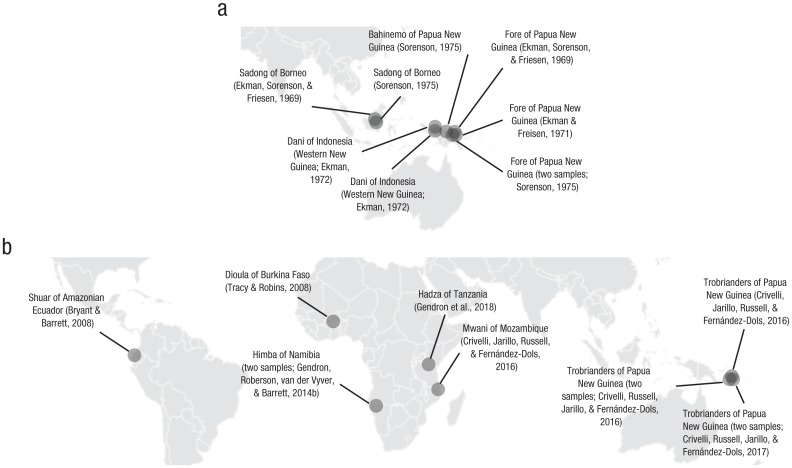
“Second, the Fore samples in Ekman and Friesen (1971) and Sorenson (1975) were the exact same size (189 adults and 130 children) and yielded nearly identical results; they are reported separately because Ekman (1994) indicated that the samples were distinct.”
BackgroundResult(2017) · Cited by 2,433
Self-citationOn the universality and cultural specificity of emotion recognition: a meta-analysis
Elfenbein, H. A., & Ambady, N. (2002) · Psychological Bulletin · doi:10.1037/0033-2909.128.2.203 · Cited by 2,049 · cited 2×
“…perception across cultures (extending beyond studies of small-scale societies) has been designed to validate the universality thesis rather than to discover or rule out diversity in how people make meaning of other people’s facial movements (e.g., Elfenbein & Ambady, 2002; Nelson & Russell, 2013).”
BackgroundMethodPan-cultural elements in facial displays of emotion
Ekman, P., Sorenson, E. R., & Friesen, W. V. (1969) · Science · doi:10.1126/science.164.3875.86 · Cited by 1,775 · cited 1×
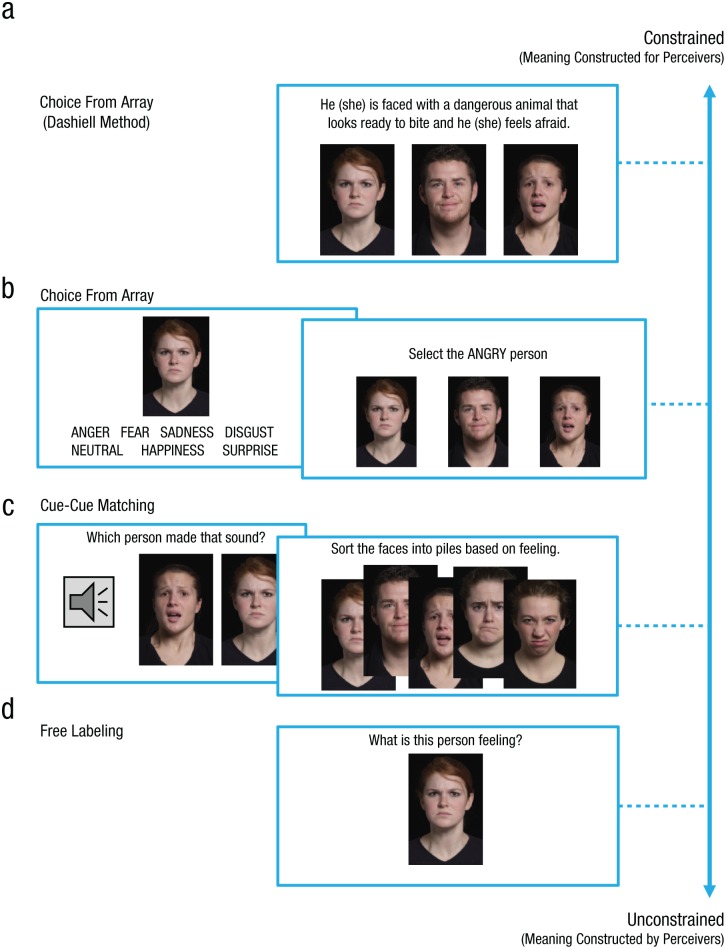
“…labeling None Dani of New Guinea (Indonesia) 34 adults Ekman (1972) X Choice from array (Dashiell method) None Fore of Papua New Guinea 32 adults Ekman, Sorenson, and Friesen (1969)a X Choice from array None Fore of Papua New Guinea 130 children, 189 adults Ekman and Friesen (1971) X Choice…”
MethodRussell, J. A. (1994) · Psychological Bulletin · doi:10.1037/0033-2909.115.1.102 · Cited by 1,640 · cited 9×
“Several of these samples were written up only in brief, resulting in omissions in reporting data and statistical analysis (Russell, 1994).”
BackgroundMethodResultInfluentialThe cultural niche: Why social learning is essential for human adaptation
Boyd, R., Richerson, P. J., & Henrich, J. (2011) · Proceedings of the National Academy of Sciences · doi:10.1073/pnas.1100290108 · Cited by 1,303
The Essential Child: Origins of Essentialism in Everyday Thought
Gelman, S. A. (2003) · doi:10.1093/acprof:oso/9780195154061.001.0001 · Cited by 1,247 · cited 1×
“For example, words often serve as placeholders for undefined mental essences that are thought to cause observable features (Gelman, 2003).”
Strong evidence for universals in facial expressions: A reply to Russell's mistaken critique.
Ekman, P. (1994) · Psychological Bulletin · doi:10.1037//0033-2909.115.2.268 · Cited by 1,130 · cited 1×
“Second, the Fore samples in Ekman and Friesen (1971) and Sorenson (1975) were the exact same size (189 adults and 130 children) and yielded nearly identical results; they are reported separately because Ekman (1994) indicated that the samples were distinct.”
ResultBarrett, L. F., Mesquita, B., & Gendron, M. (2011) · Current Directions in Psychological Science · doi:10.1177/0963721411422522 · Cited by 921
Self-citation
Research works printed but not linked: 1
- Ekman P. (1972). Universals and cultural differences in facial expressions of emotion. In Cole J. (Ed.), Nebraska Symposium on Motivation, 1971: Cultural Psychology (Vol. 19, pp. 207– 282). Lincoln: University of Nebraska Press.
Cited by
Items 101–200 of 205
Culture, Self, and Agency: An Ecosocial View
Kirmayer, L. J., Gómez-Carrillo, A., Langlois‐Thérien, T., Ramstead, M. J. D., & Gold, I. (2020) · Cambridge University Press eBooks · doi:10.1017/9781108695374.012 · Cited by 7
Infants are sensitive to cultural differences in emotions at 11 months
Liu, L., du Toit, M., & Weidemann, G. (2021) · PLoS ONE · doi:10.1371/journal.pone.0257655 · Cited by 10
Representations of facial expressions since Darwin
Perrett, D. I. (2022) · Evolutionary Human Sciences · doi:10.1017/ehs.2022.10 · Cited by 10
“More recent assessment across cultures suggests that there is also diversity in interpretation (Gendron et al., 2018).”
BackgroundKrause, L., & Askew, C. (2021) · Behaviour Research and Therapy · doi:10.1016/j.brat.2021.103992 · Cited by 10
Application of Stereo Digital Image Correlation on Facial Expressions Sensing
Cheng, X., Wang, S., Wei, H., Sun, X., Xin, L., Li, L., Li, C., & Wang, Z. (2024) · Sensors · doi:10.3390/s24082450 · Cited by 6
“Furthermore, the method that combines the FACS with statistical analysis has been employed for cross-cultural studies of expressions [18,19].”
MethodCultural Priming Effects and the Human Brain
Han, S., & Northoff, G. (2020) · Cambridge University Press eBooks · doi:10.1017/9781108695374.011 · Cited by 7
Introduction: Co-constructing Culture, Mind, and Brain
Kirmayer, L. J., Worthman, C. M., & Kitayama, S. (2020) · Cambridge University Press eBooks · doi:10.1017/9781108695374.002 · Cited by 11
Broulidakis, M. J., Kiprijanovska, I., Severs, L., Stankoski, S., Gjoreski, M., Mavridou, I. I., Gjoreski, H., Cox, S., Bradwell, D., Stone, J. M., et al. (2023) · Frontiers in Psychiatry · doi:10.3389/fpsyt.2023.1232433 · Cited by 5
“It should be noted that the precise correspondence between cheek and brow activation and a specific emotion if measured in real-world conditions outside of a constrained experimental task is both idiosyncratic and highly context-dependent (6).”
BackgroundThe perception of emotional prosody in Mandarin Chinese words and sentences
Xiao, C., & Liu, J. (2024) · Second language Research · doi:10.1177/02676583241286748 · Cited by 13
“A long-standing debate is whether the perception of emotions is universal or culturally specific (e.g., Brooks et al., 2019; Ekman et al., 1969; Elfenbein and Ambady, 2003; Gendron et al., 2018; Jack et al., 2012; Matsumoto, 1988).”
Ritual and Religion as Social Technologies of Cooperation
Kavanagh, C. M., Jong, J., & Whitehouse, H. (2020) · Cambridge University Press eBooks · doi:10.1017/9781108695374.016 · Cited by 10
Trait-Based Module for Culturally-Competent Robots
Borgo, S., & Blanzieri, E. (2019) · International Journal of Humanoid Robotics · doi:10.1142/s0219843619500282 · Cited by 7
“Morever, the role of culture in emotions has been recently reasserted[60].”
BackgroundThe Cultural Brain as Historical Artifact
Boddice, R. (2020) · Cambridge University Press eBooks · doi:10.1017/9781108695374.018 · Cited by 10
Pütten, A. M. R.-V. D., Arndt, J., Pieczykolan, A., Pohl, M., & Jung, M. F. (2025) · International Journal of Social Robotics · doi:10.1007/s12369-025-01231-8 · Cited by 7
Tripathi, S., Imai, H., & Adachi, I. (2025) · Scientific Reports · doi:10.1038/s41598-025-90387-4 · Cited by 5
“…and colleagues built a model using fNIRS data to demonstrate its capability for discriminating between affective states on valence and arousal, and their model’s prediction of valence relied heavily on Brodmann regions 9 and 46 41 , which correspond to the dorsolateral prefrontal cortex (DLPFC).”
Real-life intense fear is communicated through context, not facial expressions
Lecker, M., Hallock, S., Danielson, A., Aertrickc, M. V., Kindt, M., & Aviezer, H. (2025) · Proceedings of the National Academy of Sciences · doi:10.1073/pnas.2414677122 · Cited by 7
Effect of Facial Expression Categories and Calculation Methods on Automatic Emotion Recognition
Dupre, D. (2021) · 2021 IEEE International Conference on Pervasive Computing and Communications Workshops and other Affiliated Events (PerCom Workshops) · doi:10.1109/percomworkshops51409.2021.9430999 · Cited by 5
“Notwithstanding the doubts about both the credibility of an emotional readout theory, and the correspondence between specific emotions and their prototypical facial configuration [12], [13], most automatic classifiers are built on these theoretical principles.”
BackgroundMunekata, P. E. S., Pateiro, M., Domínguez, R., Sepúlveda, N., Santos, E. M., & Lorenzo, J. M. (2022) · Elsevier eBooks · doi:10.1016/b978-0-12-822832-6.00001-1 · Cited by 4
Dezecache, G., & Mercier, H. (2024) · Oxford University Press eBooks · doi:10.1093/oxfordhb/9780197544754.013.54 · Cited by 4
The Reward of Musical Emotions and Expectations
Gold, B. P., & Zatorre, R. J. (2020) · Cambridge University Press eBooks · doi:10.1017/9781108695374.021 · Cited by 6
Müller, L., Möhr, C., Cano, C., Camenzind, L., Soborun, Y., & Jonauskaitė, D. (2022) · Art & Perception · doi:10.1163/22134913-bja10041 · Cited by 4
“More recently, studies have been refining this notion by either augmenting the number of prototypical facial expressions (e.g., Cowen and Keltner, 2019) or by reducing the number to identify cross-cultural universals (e.g., Gendron et al., 2018; Jack et al., 2016).”
The Meso-Expression Test (MET): A Novel Assessment of Emotion Perception
LaPalme, M. L., Barsade, S. G., Brackett, M. A., & Floman, J. L. (2023) · Journal of Intelligence · doi:10.3390/jintelligence11070145 · Cited by 7
Mantello, P. A., Ho, T. M., Vuong, Q., & Nguyen, M. (2021) · SocArXiv (OSF Preprints) · doi:10.31235/osf.io/c59aw · Cited by 4
Liang, Y., Goudbeek, M. B., Konopka, A. E., Choi, J., & Broersma, M. (2025) · Language and Speech · doi:10.1177/00238309251318730 · Cited by 4
Pan, Z., Tan, H., Liu, S., & Fang, X. (2025) · Journal of Experimental Social Psychology · doi:10.1016/j.jesp.2025.104836 · Cited by 3
The Psychology of Penalty Kicks
Furley, P., Dicks, M., & Jordet, G. (2020) · Routledge eBooks · doi:10.4324/9781003005568-4 · Cited by 4
Being There: Foundations, Theory, Method
Worthman, C. M. (2020) · Cambridge University Press eBooks · doi:10.1017/9781108695374.007 · Cited by 3
Cañas-Bajo, J. (2020) · Human-computer interaction series · doi:10.1007/978-3-030-53483-7_7 · Cited by 3
Luna, D. S., Bering, J. M., & Halberstadt, J. B. (2022) · International Journal of Science Education Part B · doi:10.1080/21548455.2022.2048119 · Cited by 3
“These differences have been found in their mental instantiation (e.g. subjective experience; Kitayama et al., 2000), related physical action (e.g. expressions; Gendron et al., 2018), and portrayal in cultural artifacts (e.g. picture books; Tsai et al., 2007), among other things.”
BackgroundHeart to Heart: How Your Emotions Affect Other People
Parkinson, B. (2019) · Cited by 3
What we can learn about emotion by talking with the HadzaPreprint
Hoemann, K., Gendron, M., Crittenden, A. N., Mangola, S. M., Dussault, È., Endeko, E. S., Barrett, L. F., & Mesquita, B. (2022) · doi:10.31234/osf.io/sm2cp · Cited by 3
Self-citationInternational Symposium on Technikpsychologie (TecPsy) 2023
Gerber, N., & Zimmermann, V. (2023) · Sciendo eBooks · doi:10.2478/9788366675896 · Cited by 4
Nestor, P. G., & Woodhull, A.-A. (2024) · Journal of Clinical and Experimental Neuropsychology · doi:10.1080/13803395.2024.2348212 · Cited by 3
“However, more recent studies conducted since 2008 have called into question this hypothesis, finding evidence of diversity, rather than uniformity, in perception of facial emotional expressions (Gendron et al., 2018; Jack et al., 2011; Messinger et al., 2012.”
Putting Musical Feelings Into Words: Children's Verbal Descriptions of Music-Evoked Experiences
Owen, C., Egermann, H., & Schiavio, A. (2024) · Music & Science · doi:10.1177/20592043241265318 · Cited by 5
“A potential limitation of this forced-choice approach is that how closely listeners identify with the experimenters ’ response suggestions might not adequately re fl ect their authentic experience (Cespedes-Guevara & Eerola, 2018; Clore et al., 1987; Gendron et al., 2018; Scherer, 2005).”
Dewaele, J., Lorette, P., & Petrides, K. V. (2019) · Dialnet (Universidad de la Rioja) · Cited by 2
Capturing Context Is Not Enough: The Embodied Impact of Story and Emotion in Ethnographic Film
Lemelson, R., & Tucker, A. (2020) · Cambridge University Press eBooks · doi:10.1017/9781108695374.023 · Cited by 2
Stendel, M. S., Ramstead, M. J. D., & Veissière, S. P. L. (2020) · Cambridge University Press eBooks · doi:10.1017/9781108695374.026 · Cited by 2
Simhon, R., Meiran, N., Shvimmer, S., Amihai, L., Yitzhaky, Y., Rosenblatt, J. D., & Gilead, M. (2025) · Affective Science · doi:10.1007/s42761-025-00311-2 · Cited by 3
“…agreement pertains to the valence and arousal of the emotional expression (Criv‑ elli et al., 2016; Crivelli et al., 2017; Gendron et al., 2014; Gendron et al., 2018)—and this minimal information can often be used to “correctly” infer the specific emotion label in a forced‑choice context.”
Affective computing at the edge: A bibliometric analysis of the period 1995-2020Preprint
Ho, T. M., Nguyen, H. T., & Vuong, Q. (2021) · OSF Preprints (OSF Preprints) · doi:10.31219/osf.io/hu54t · Cited by 3
The Neural Mechanisms Underlying Social Norms: Norm Detection, Punishment, and Compliance
Mu, Y., & Gelfand, M. J. (2020) · Cambridge University Press eBooks · doi:10.1017/9781108695374.015 · Cited by 2
Parkinson, B. (2019) · Cambridge University Press eBooks · doi:10.1017/9781108696234.006 · Cited by 1
Why Internal Representations and Their Temporal Dependence Matter for Emotion Inference
Goel, S., & Gendron, M. (2025) · Emotion Review · doi:10.1177/17540739251379801 · Cited by 1
“…promise of various predictive processing accounts of emotion experiences (for review, see Wilkinson et al., 2019), there is relatively limited emphasis on how this framework explains our inferences about other people ’ s emotional states, that is, emotion inference (but see Gendron et al., 2018).”
Self-citationCamerman, E., Kuppens, P., Lavrijsen, J., & Verschueren, K. (2026) · Learning and Individual Differences · doi:10.1016/j.lindif.2026.102868 · Cited by 1
Dols, J. M. F., Crivelli, C., & Durán, J. I. (2026) · Affective Science · doi:10.1007/s42761-025-00351-8 · Cited by 1
Self-citationPutting Emotional Memories in Context: The Constructionist Model of Emotional Memory
West, J. T., Mulligan, N. W., & Lindquist, K. A. (2026) · Perspectives on Psychological Science · doi:10.1177/17456916261425152 · Cited by 2
“In other words, like situational factors and individual differences in conceptual knowledge, culture provides an ongoing context within which emotion construction is situated (Gendron et al., 2018).”
BhavnaNet: A Deep Convolutional Neural Network for Facial Emotion Recognition
Chauhan, K., Jain, R., Maheshwari, R., & Pandey, D. (2022) · International Conference on Computational Intelligence and Sustainable Engineering Solutions (CISES) · doi:10.1109/cises54857.2022.9844377 · Cited by 1
“This manuscript focuses solely on six relevant facial expression classes, which include happy, sad, neutral, angry, surprise, and fear [3].”
BackgroundAL-Saedi, L. M. (2022) · Journal La Multiapp · doi:10.37899/journallamultiapp.v3i5.700 · Cited by 2
Designing an AR Facial Expression System for Human-Robots Collaboration
Tong, Y., Zhang, Q., Munguia‐Galeano, F., & Ji, Z. (2023) · International Conference on Automation and Computing (ICAC) · doi:10.1109/icac57885.2023.10275175 · Cited by 1
“Facial expressions form a universal language among various nonverbal signals by conveying emotional states and feelings [25].”
Smile, You’re on Camera: Investigating the Relationship between Selfie Smiles and Distress
Lind, M. N., Byrne, M. L., Devine, S., & Allen, N. B. (2024) · Journal of Trial and Error · doi:10.36850/8716-5abe · Cited by 2
Uniting theory and data: the promise and challenge of creating an honest model of facial expression
Wohltjen, S., Colón, Y. I., Zhu, Z., Miller, K., Huang, W., Mutlu, B., Li, Y., & Niedenthal, P. M. (2025) · Cognition & Emotion · doi:10.1080/02699931.2024.2446945 · Cited by 1
Kunst, J. R., & Bierwiaczonek, K. (2024) · Psychological Inquiry · doi:10.1080/1047840x.2024.2442938 · Cited by 1
“Moreover, facial stimuli thought to clearly signal assumed “basic” emotions (derived from the Western-centric Ekman tradition; Ekman, 1992) show much less cross-cultural validity than was long assumed (Gendron et al., 2018).”
Kain, W. (2020) · Springer eBooks · doi:10.1007/978-3-662-59288-5_21 · Cited by 1
Cities, Psychosis, and Social Defeat
Sayanvala, F., Bornstein, L., Choudhury, S., Shah, J. L., Weinstock, D., & Gold, I. (2020) · Cambridge University Press eBooks · doi:10.1017/9781108695374.025 · Cited by 1
Stout, D. (2020) · Cambridge University Press eBooks · doi:10.1017/9781108695374.005 · Cited by 1
Choudhury, S., & Berson, J. (2020) · Cambridge University Press eBooks · doi:10.1017/9781108695374.020 · Cited by 1
Parkinson, B. (2019) · Cambridge University Press eBooks · doi:10.1017/9781108696234.002 · Cited by 1
The essentialist and constructivist views of emotions: Implications for parentsPreprint
Ho, T. M. (2020) · OSF Preprints (OSF Preprints) · doi:10.31219/osf.io/78zk6 · Cited by 1
Mantello, P. A., Ho, T. M., Nguyen, M., & Vuong, Q. (2021) · OSF Preprints (OSF Preprints) · doi:10.31219/osf.io/4exjs · Cited by 1
Are We Bored Yet? A Lifespan Perspective on the MAC Model of Boredom and Cognitive EngagementPreprint
Westgate, E. C. (2019) · PsyArXiv (OSF Preprints) · doi:10.31234/osf.io/4h6et · Cited by 2
Equivariant deep generative models
Azari, B. (2022) · Digital Repository Service (Northeastern University) · doi:10.17760/d20449065 · Cited by 1
Baider, F. H. (2019) · TIPA Travaux interdisciplinaires sur la parole et le langage · doi:10.4000/tipa.3173
Berent, I. (2020) · Oxford University Press eBooks · doi:10.1093/oso/9780190061920.003.0010
Parkinson, B. (2019) · Cambridge University Press eBooks · doi:10.1017/9781108696234.007
Social Neuroscience in Global Mental Health: Case Study on Stigma Reduction in Nepal
Kohrt, B. A. (2020) · Cambridge University Press eBooks · doi:10.1017/9781108695374.024 · Cited by 3
Literary Analysis and Weak Theories
Moses, O. (2020) · Cambridge University Press eBooks · doi:10.1017/9781108695374.022
Experience-Dependent Plasticity in the Hippocampus
West, G. L., & Bohbot, V. D. (2020) · Cambridge University Press eBooks · doi:10.1017/9781108695374.019
Facial Activity and Emotion Expression
Parkinson, B. (2019) · Cambridge University Press eBooks · doi:10.1017/9781108696234.003
Author Reply: Aligning Social Relations With Faces, Words, and Emotions
Parkinson, B. (2021) · Emotion Review · doi:10.1177/1754073921999817
“But he is also right that my target article went further by questioning whether facial activity ever really involves the “expression” of “emotional experience” in the first place (see also Fridlund, 1994; Frijda & Tcherkassof, 1997; Gendron et al., 2018).”
BackgroundParkinson, B. (2019) · Cambridge University Press eBooks · doi:10.1017/9781108696234.008
Cáceres, P. (2020) · PsyArXiv (OSF Preprints) · doi:10.31234/osf.io/edrw3
What’s at the Heart of Emotions?
Parkinson, B. (2019) · Cambridge University Press eBooks · doi:10.1017/9781108696234.001
Films as Technological Artefacts
Cañas-Bajo, J. (2021) · Lecture notes in computer science · doi:10.1007/978-3-030-77411-0_13
Investigación filosófica y emociones: La ontología histórica de Ian Hacking como alternativa
Bernal, J. M. Z. (2021) · Daímon · doi:10.6018/daimon.408991 · Cited by 4
How Social Coordination and Cooperation are Achieved
Kirmayer, L. J., Worthman, C. M., Kitayama, S., Lemelson, R., & Cummings, C. A. (2020) · Cambridge University Press eBooks · doi:10.1017/9781108695374.013
Explaining Emotional Influence
Parkinson, B. (2019) · Cambridge University Press eBooks · doi:10.1017/9781108696234.004
Kirmayer, L. J., Worthman, C. M., Kitayama, S., Lemelson, R., & Cummings, C. A. (2020) · Cambridge University Press eBooks · doi:10.1017/9781108695374.001
Parkinson, B. (2019) · Cambridge University Press eBooks · doi:10.1017/9781108696234.011
Parkinson, B. (2019) · Cambridge University Press eBooks · doi:10.1017/9781108696234.005
The Co-emergence of Culture, Mind, and Brain
Kirmayer, L. J., Worthman, C. M., Kitayama, S., Lemelson, R., & Cummings, C. A. (2020) · Cambridge University Press eBooks · doi:10.1017/9781108695374.004
Kirmayer, L. J., Worthman, C. M., Kitayama, S., Lemelson, R., & Cummings, C. A. (2020) · Cambridge University Press eBooks · doi:10.1017/9781108695374.008
Parkinson, B. (2019) · Cambridge University Press eBooks · doi:10.1017/9781108696234.009
Kirmayer, L. J., Worthman, C. M., Kitayama, S., Lemelson, R., & Cummings, C. A. (2020) · Cambridge University Press eBooks · doi:10.1017/9781108695374.017
Emotional AI and Freedom of ThoughtPreprint
Ho, T. M. (2020) · doi:10.31219/osf.io/rjbkq
Hipson, W. E. (2021) · Carleton University's Institutional Repository (MacOdrum Library, Carleton University) · doi:10.22215/etd/2021-14349
Kirmayer, L. J., Worthman, C. M., Kitayama, S., Lemelson, R., & Cummings, C. A. (2020) · Cambridge University Press eBooks · doi:10.1017/9781108695374.029
Parkinson, B. (2019) · Cambridge University Press eBooks · doi:10.1017/9781108696234.010
Temas em evolução do comportamento humano II
Tasso, N. D. A. M., Castro, F. N., & dos Santos, D. B. (2022) · Editora IFRN eBooks · doi:10.15628/editoraifrn.2022.2286
Oggiano, M. (2023) · Springer eBooks · doi:10.1007/978-3-031-43571-3_4
Cultural differences in customer emotionsPreprint
Truong, V. (2024) · Research Square · doi:10.21203/rs.3.rs-4747823/v1 · Cited by 1
Recognition of Emotions in Relation to "Emotional Families"
Petrakova, A. V., Lebedeva, E. I., & Yurchik, E. N. (2024) · Experimental Psychology (Russia) · doi:10.17759/exppsy.2024170301 · Cited by 1
A Smiling Paradox: Exploring the Constructed Nature of Emotions.
Reitsema, A. M., Nijhof, S. L., & Laceulle, O. M. (2024) · Journal of Trial and Error · doi:10.36850/4d60-44a8
Perceiving Emotion: Scripts Versus Emotion Concepts
Eickers, G. (2025) · Erkenntnis · doi:10.1007/s10670-025-00975-z · Cited by 1
“…perception is highly sensitive to context, and thus requires adaptive forms of information processing (Barrett, 2009, 2017; Gendron & Barrett, 2017, 2018; Gendron et al., 2018; Hess & Hareli, 2015; Hess et al., 2009, 2010; Jack & Schyns, 2015, 2017; Russell, 1994, 2003; Scarantino, 2017, 2018).”
In a Sentimental Mood: Emotion, Evolution, and Expression
Odenbaugh, J. (2025) · doi:10.1093/9780197820469.001.0001 · Cited by 1
Moon, S.-J. (2025) · Journal of Digital Contents Society · doi:10.9728/dcs.2025.26.10.2791
Robustness Analysis of Distributed CNN Model Training in Expression Recognition
Li, J. (2026) · IET Biometrics · doi:10.1049/bme2/4107824
Sturm, V. E., & Seeley, W. W. (2026) · Social Cognitive and Affective Neuroscience · doi:10.1093/scan/nsag014 · Cited by 1
“…in emotion perception and expression across cultures (Jack et al. 2012, Gendron et al. 2014a, 2014b, Crivelli et al. 2016, Chen et al. 2018, Gendron et al. 2018) and contexts (Ruiz-Belda et al. 2003, Fern � andez-Dols and Crivelli 2013, Hassin et al. 2013, Crivelli et al. 2015) have also…”
A Cross-cultural Comparison of Facial Emotion Recognition between Germans and the Karamojong
Krippl, M., & Tcherkassof, A. (2026) · Evolutionary Psychological Science · doi:10.1007/s40806-026-00467-5 · Cited by 1
“Sadness (Trobrianders; Crivelli et al., 2016a, 2016b), fear (Mwani; Crivelli et al.(2016a); Hadza, Gendron et al., 2018), anger (Himba; Gendron et al., 2014a, 2014b), and, in our case, disgust emerged as the second-most or most accurately recognized emotion categories.”
Leroy, A. (2020) · theses.fr (ABES) · doi:10.70675/328c0064z0455z4105zbdc7zc458da26cd0c
Emotions and Philosophy of Disability
Eickers, G. (2026) · Oxford University Press eBooks · doi:10.1093/9780197852668.003.0034
Scarpazza, C., Straulino, E., Sartori, L., & Cristaldi, F. D. P. (2026) · Scientific Reports · doi:10.1038/s41598-026-47026-3 · Cited by 1
Metadata
- Authors
- Gendron, M., Crivelli, C., & Barrett, L. F.
- Affiliations
- Northeastern University (US)
- De Montfort University (GB)
- Corresponding author
- Gendron, Maria
- Venue
- Current Directions in Psychological Science
- Publisher
- SAGE Publications
- Published
- 2018-07-31
- Volume
- 27
- Issue
- 4
- Pages
- 211-219
- ISSN
- 0963-7214 (ISSN-L)
- 1467-8721
- PMC
- PMC6099968
- OpenAlex
- W2885466588
- Semantic Scholar
- 27a434cb0b4042f72601cc15fa01868200541d50
- Cited by
- 205
- References
- 43
- Citations by year
- 2026: 13 · 2025: 16 · 2024: 17 · 2023: 17 · 2022: 27 · 2021: 30 · 2020: 52 · 2019: 30 · 2018: 3
- FWCI
- 17.12
- Type
- journal article
- Language
- en
- Open access
- hybrid
- doi.org
- Licence
- Locations
- Current Directions in Psychological Science (publishedVersion, cc-by-nc)
- Europe PMC (PubMed Central) (publishedVersion, cc-by-nc)
- PubMed Central (publishedVersion, cc-by-nc)
- PubMed (publishedVersion)
- DMU Open Research Archive (De Montfort University) (submittedVersion)
- Funders
- National Institute of Mental Health (5F32MH105052)
- Army Research Institute for the Behavioral and Social Sciences (W911NF-15-1-0647)
- Topics
- Life Sciences › Neuroscience › Cognitive Neuroscience › Face Recognition and Perception
- Social Sciences › Psychology › Social Psychology › Cultural Differences and Values
- Social Sciences › Psychology › Experimental and Cognitive Psychology › Evolutionary Psychology and Human Behavior
- Keywords
- universal emotions, facial expressions, emotion perception, cross-cultural variation, small-scale societies, cross-cultural psychology
About these checks
Registry, retraction, Cites and statistics results are computed, not judged, with one exception: a printed reference that no index lists is read once by a model before it counts as a citation error. Claims are extracted by a model and kept only when their quote appears verbatim in the text; each cited source is then checked, with a model’s help, for whether it says what the claim relies on. Those verdicts can be wrong — read the claim’s quote and the cited source before relying on one.
Statistics and arithmetic are recomputed, not judged.
Confidence bands are shown only for fields calibrated on our annotated test set. None is calibrated yet, so no band is shown.
What counts as a claim ›How we measure confidence ›How we check this ›
Are you an author, or do you see a problem with this page? Request a review
Data sources
Bibliographic data: Semantic Scholar, OpenAlex, Crossref.
Contains information from the Semantic Scholar Academic Graph Datasets, made available under the ODC Attribution License (ODC-BY 1.0).
Semantic Scholar’s data is described in: Kinney, R., et al. (2023). The Semantic Scholar Open Data Platform. arXiv:2301.10140.
